
Chapter 17 Speciation and Macroevolution 1 17 1
- Slides: 29
Chapter 17 Speciation and Macroevolution 1
17. 1 How New Species Evolve • Macroevolution is best observed within the fossil record § Requires the origin of species, also called speciation. § Speciation is the final result of changes in the gene pool’s allelic and genotypic frequencies. 2
How New Species Evolve • Every species has its own evolutionary history • Species Concepts § Refers to the different ways in which a species is defined. 3
How New Species Evolve • Morphological species concept § Based on analysis of diagnostic traits distinguishing one species from another. • Can be distinguished anatomically • Method used by Linnaeus • Most species are described this way 4
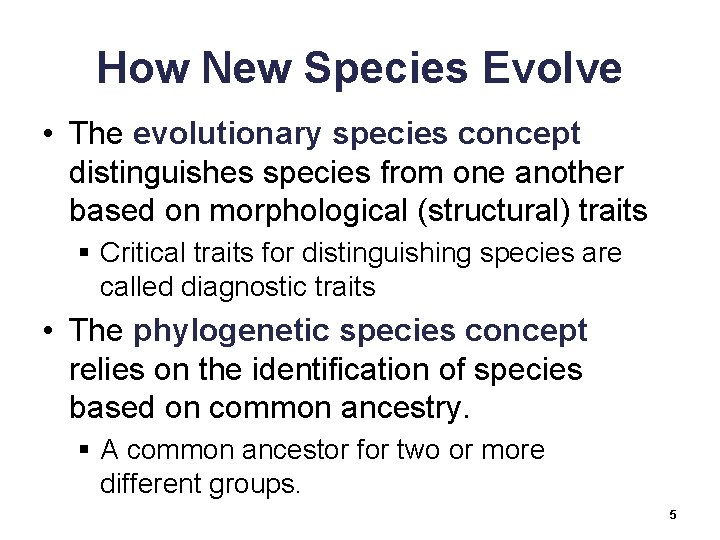
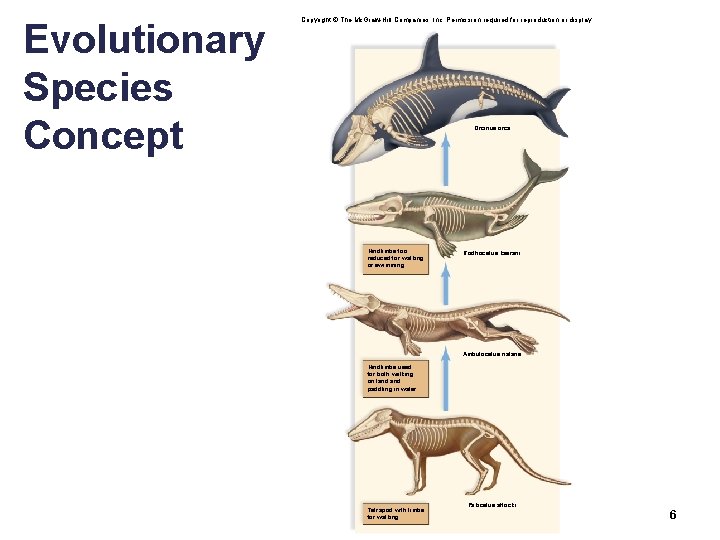
How New Species Evolve • The evolutionary species concept distinguishes species from one another based on morphological (structural) traits § Critical traits for distinguishing species are called diagnostic traits • The phylogenetic species concept relies on the identification of species based on common ancestry. § A common ancestor for two or more different groups. 5
Evolutionary Species Concept Copyright © The Mc. Graw-Hill Companies, Inc. Permission required for reproduction or display. Orcinus orca Hindlimbs too reduced for walking or swimming Rodhocetus kasrani Ambulocetus natans Hindlimbs used for both walking on land paddling in water Tetrapod with limbs for walking Pakicetus attocki 6
How New Species Evolve • Biological Species Concept • Populations of the same species breed only among themselves • Experience reproductive isolation from other such populations • Very few species are actually tested for reproductive isolation 7
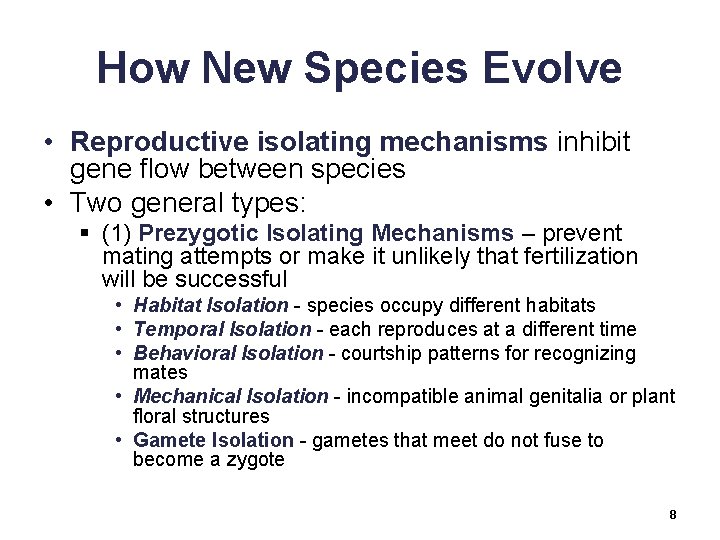
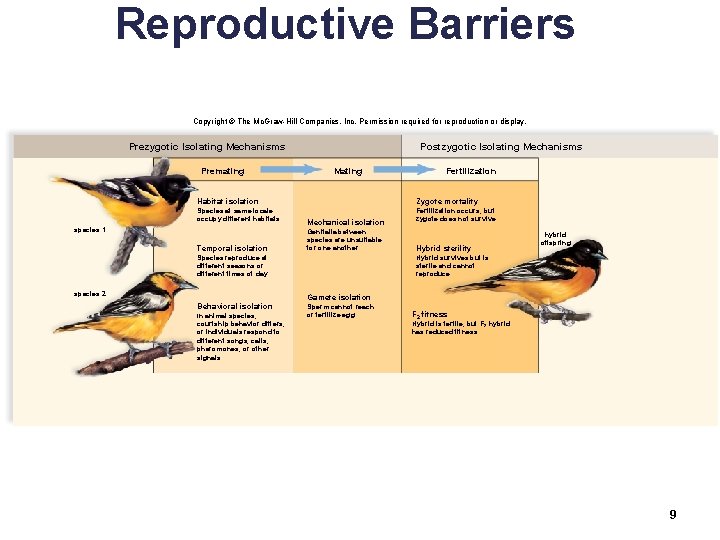
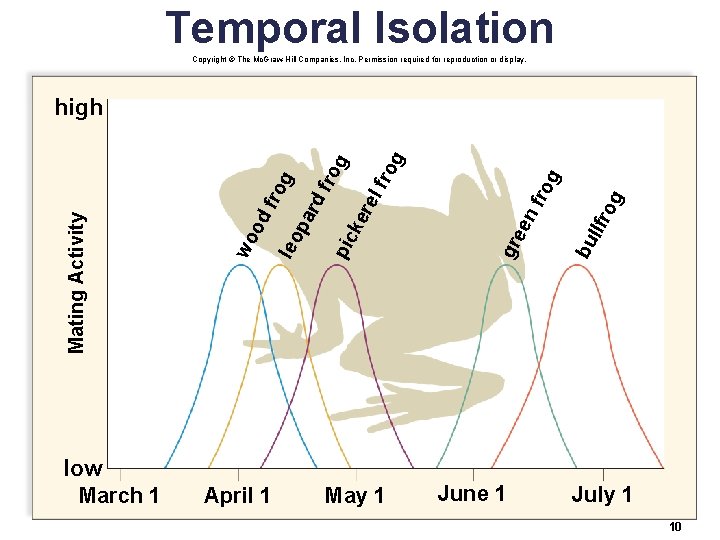
How New Species Evolve • Reproductive isolating mechanisms inhibit gene flow between species • Two general types: § (1) Prezygotic Isolating Mechanisms – prevent mating attempts or make it unlikely that fertilization will be successful • Habitat Isolation - species occupy different habitats • Temporal Isolation - each reproduces at a different time • Behavioral Isolation - courtship patterns for recognizing mates • Mechanical Isolation - incompatible animal genitalia or plant floral structures • Gamete Isolation - gametes that meet do not fuse to become a zygote 8
Reproductive Barriers Copyright © The Mc. Graw-Hill Companies, Inc. Permission required for reproduction or display. Prezygotic Isolating Mechanisms Premating Postzygotic Isolating Mechanisms Mating Habitat isolation Species at same locale occupy different habitats. species 1 Temporal isolation Zygote mortality Mechanical isolation Genitalia between species are unsuitable for one another. Species reproduce at different seasons or different times of day. species 2 Fertilization occurs, but zygote does not survive. Hybrid sterility hybrid offspring Hybrid survives but is sterile and cannot reproduce. Gamete isolation Behavioral isolation In animal species, courtship behavior differs, or individuals respond to different songs, calls, pheromones, or other signals. Sperm cannot reach or fertilize egg. F 2 fitness Hybrid is fertile, but F 2 hybrid has reduced fitness. 9
Temporal Isolation Copyright © The Mc. Graw-Hill Companies, Inc. Permission required for reproduction or display. low March 1 April 1 May 1 g llfr o gre June 1 bu en fro g og l fr ke re pic rd pa leo od wo Mating Activity fro g high July 1 10
How New Species Evolve • Reproductive Isolating Mechanisms (cont. ) § Postzygotic Isolating Mechanisms - Prevent hybrid offspring from developing or breeding • Hybrid Inviability - hybrid zygote is not viable and dies • Hybrid Sterility - hybrid zygote develops into a sterile adult – Ex. Mule (Female Horse and Male Donkey), Ligers 11
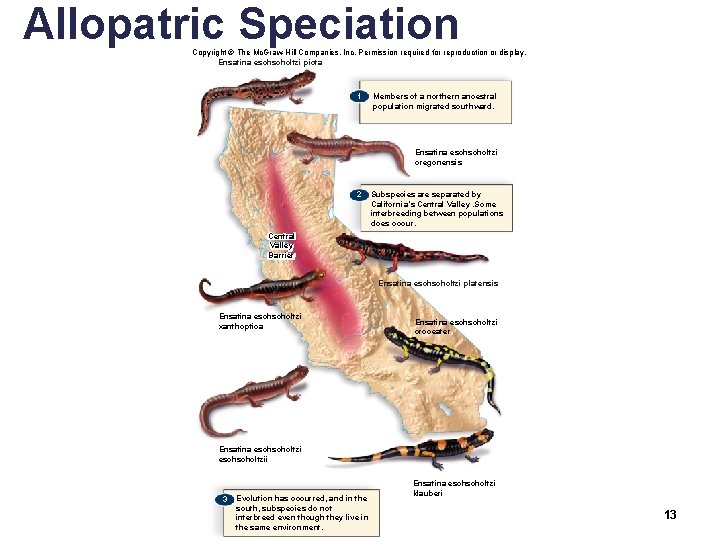
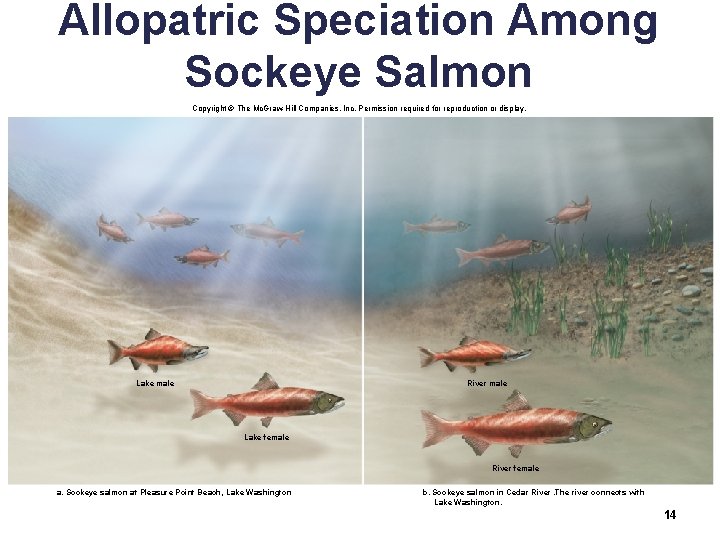
17. 2 Modes of Speciation • Speciation: § The splitting of one species into two, or § The transformation of one species into a new species over time • Two modes: § (1) Allopatric Speciation • Two geographically isolated populations of one species become different species over time • Can be due to differing selection pressures in differing environments • Stickleback Speciation 12
Allopatric Speciation Copyright © The Mc. Graw-Hill Companies, Inc. Permission required for reproduction or display. Ensatina eschscholtzi picta 1 Members of a northern ancestral population migrated southward. Ensatina eschscholtzi oregonensis 2 Subspecies are separated by California’s Central Valley. Some interbreeding between populations does occur. Central Valley Barrier Ensatina eschscholtzi platensis Ensatina eschscholtzi xanthoptica Ensatina eschscholtzi croceater Ensatina eschscholtzii 3 Evolution has occurred, and in the south, subspecies do not interbreed even though they live in the same environment. Ensatina eschscholtzi klauberi 13
Allopatric Speciation Among Sockeye Salmon Copyright © The Mc. Graw-Hill Companies, Inc. Permission required for reproduction or display. Lake male River male Lake female River female a. Sockeye salmon at Pleasure Point Beach, Lake Washington b. Sockeye salmon in Cedar River. The river connects with Lake Washington. 14
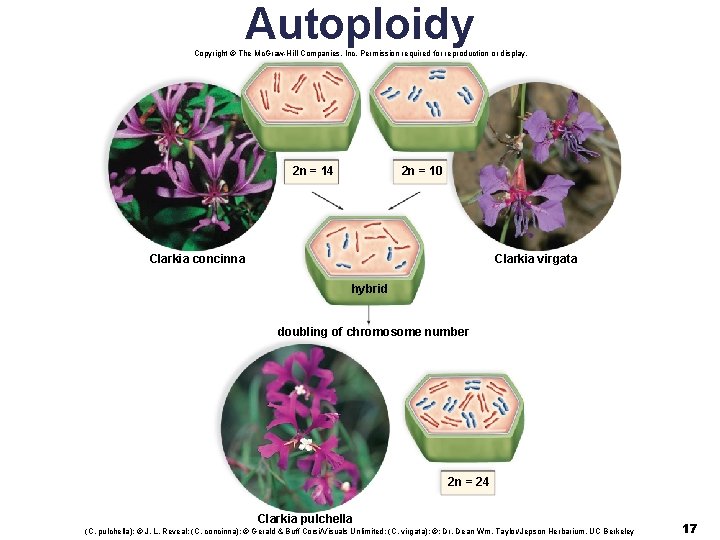
Modes of Speciation • Two modes (continued): § (2) Sympatric Speciation • One population develops into two or more reproductively isolated groups • No prior geographic isolation • In plants, sympatric speciation often involves polyploidy (a chromosome number beyond the diploid [2 n] number) – Tetraploid hybridization in plants » Results in self fertile species that are reproductively isolated from either parental species 15
Modes of Speciation § (2) Sympatric Speciation • A polyploid plant can reproduce with itself, but cannot reproduce with the 2 n population because not all the chromosomes would be able to pair during meiosis. • Two types of polyploidy are known: – Autoploidy - diploid plant produces diploid gametes due to nondisjunction during meiosis. » If diploid gamete fuses with a haploid gamete, a triploid plant results. » A triploid (3 n) plant is sterile and cannot produce offspring because the chromosomes cannot pair during meiosis. – Alloploidy - more complicated process than autoploidy » Requires two different but related species of plants » Hybridization is followed by doubling of the chromosomes. 16
Autoploidy Copyright © The Mc. Graw-Hill Companies, Inc. Permission required for reproduction or display. 2 n = 14 2 n = 10 Clarkia concinna Clarkia virgata hybrid doubling of chromosome number 2 n = 24 Clarkia pulchella (C. pulchella): © J. L. Reveal; (C. concinna): © Gerald & Buff Corsi/Visuals Unlimited; (C. virgata): ©: Dr. Dean Wm. Taylor/Jepson Herbarium, UC Berkeley 17
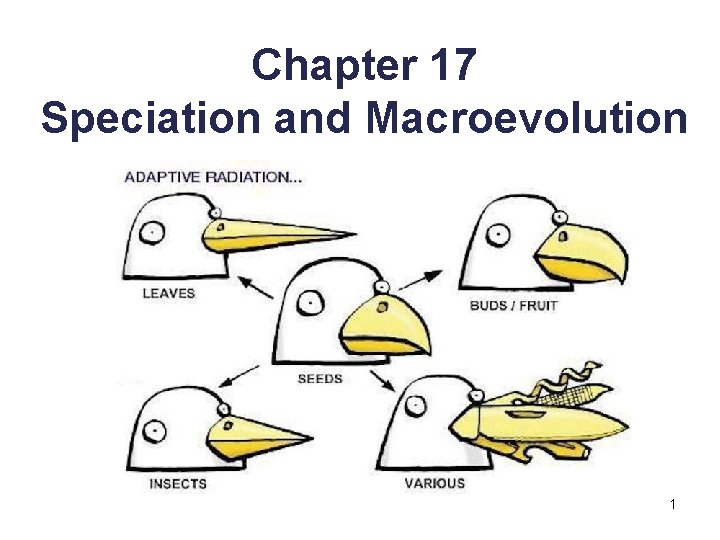
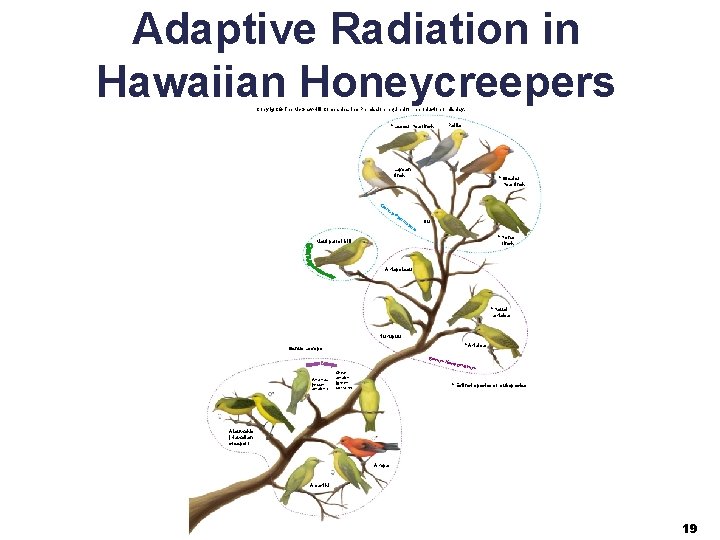
Modes of Speciation • Adaptive Radiation § Occurs when members of a species invade several new geographically separate environments § The populations become adapted to the different environments § Many new species evolve from the single ancestral species • Ex. Galapagos Finches, Hawaiian Honeycreepers 18
Adaptive Radiation in Hawaiian Honeycreepers Copyright © The Mc. Graw-Hill Companies, Inc. Permission required for reproduction or display. Palila * Lesser Koa finch Laysan finch * Greater Koa finch Ge nu s. P sit tir os tra Ou * Kona finch Maui parrot bill Akiapolaau * Kauai akialoa Nukupuu * Akialoa Genus Loxops Genu s Hem Anianiau (lesser amakihi) Great amakihi (green solitaire) ignath us * Extinct species or subspecies Alauwahio (Hawaiian creeper) Akepa Amakihi 19
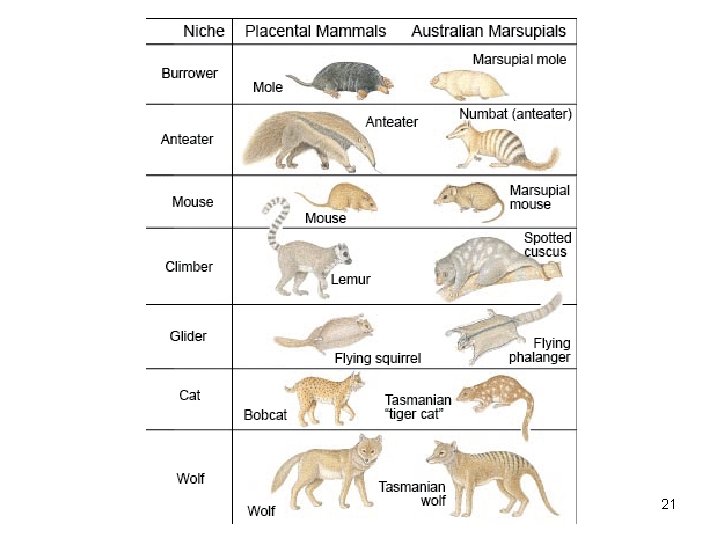
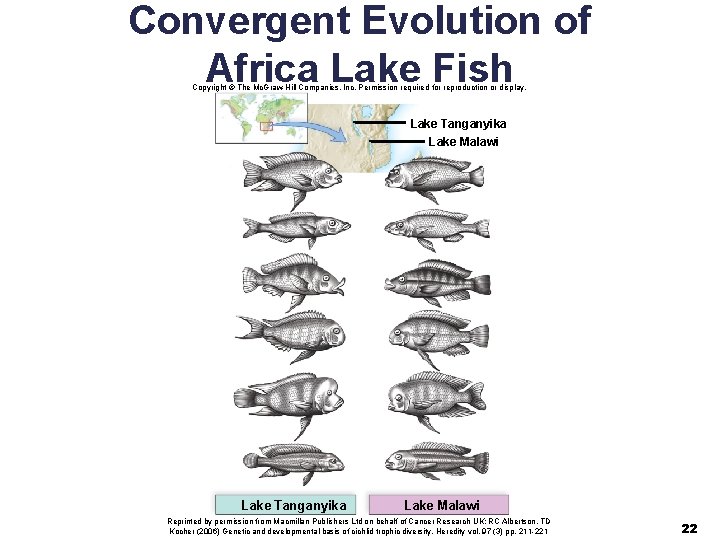
Modes of Speciation • Convergent Evolution § Occurs when a similar biological trait evolves in two unrelated species as a result of exposure to similar environments. • Traits evolving in this manner are termed analogous traits. – Similar function, but different origin – Ex: bird wing vs. bat wing 20
21
Convergent Evolution of Africa Lake Fish Copyright © The Mc. Graw-Hill Companies, Inc. Permission required for reproduction or display. Lake Tanganyika Lake Malawi Reprinted by permission from Macmillan Publishers Ltd on behalf of Cancer Research UK: RC Albertson, TD Kocher (2006) Genetic and developmental basis of cichlid trophic diversity. Heredity vol. 97 (3) pp. 211 -221 22
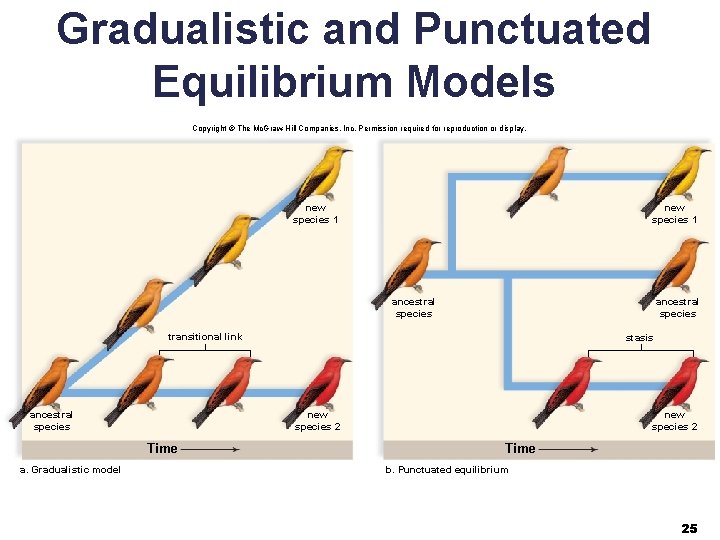
17. 3 Principles of Macroevolution • Macroevolution § Evolution at the species or higher level of classification § Some evolutionists support a gradualistic model • • Evolution at the species level occurs gradually Speciation occurs after populations become isolated Each group continues its own evolutionary pathway The gradualistic model suggests that it is difficult to indicate when speciation occurred 23
Principles of Macroevolution • Macroevolution § Some paleontologists support the punctuated equilibrium model • Species can appear quite suddenly – Species then remain essentially unchanged phenotypically during a period of stasis (sameness) until they undergo extinction. • This model states that periods of equilibrium are punctuated by speciation 24
Gradualistic and Punctuated Equilibrium Models Copyright © The Mc. Graw-Hill Companies, Inc. Permission required for reproduction or display. new species 1 ancestral species transitional link ancestral species new species 2 Time a. Gradualistic model stasis new species 2 Time b. Punctuated equilibrium 25
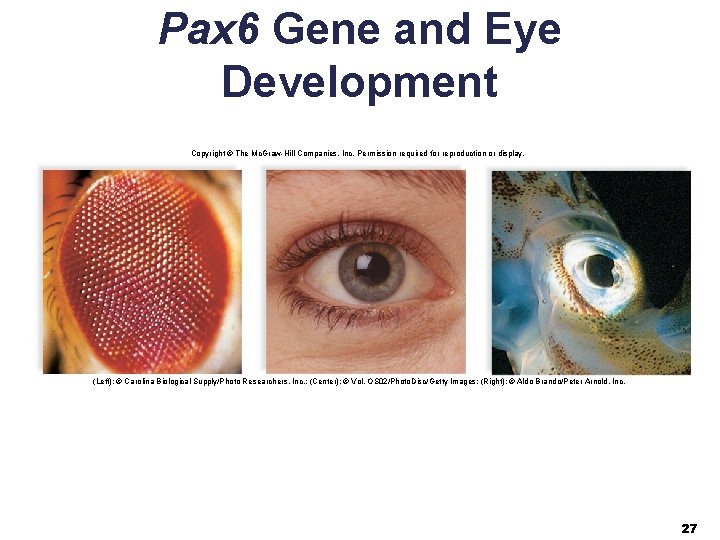
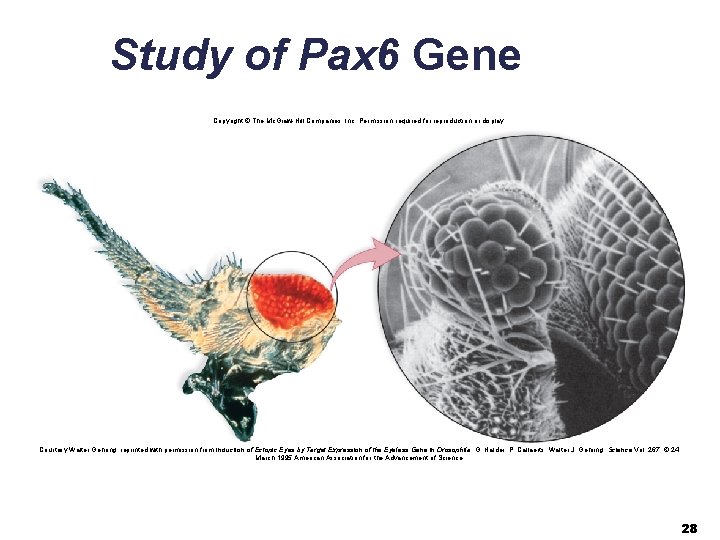
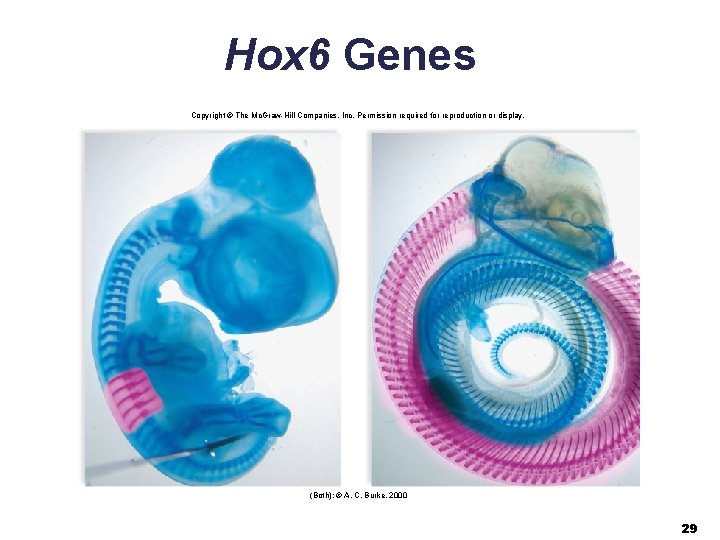
Principles of Macroevolution • Developmental Genes and Macroevolution § Genes can bring about radical changes in body shapes and organs. • Gene expression can influence development – A change in gene expression could stop a developmental process or continue it beyond its normal time. • Using modern technology, researchers discovered genes whose differential expression can bring about changes in body shapes and organs. – – Pax 6 in eye development Tbx 5 in limb development Hox genes in development of overall shape Hox genes Video 26
Pax 6 Gene and Eye Development Copyright © The Mc. Graw-Hill Companies, Inc. Permission required for reproduction or display. (Left): © Carolina Biological Supply/Photo Researchers, Inc. ; (Center): © Vol. OS 02/Photo. Disc/Getty Images; (Right): © Aldo Brando/Peter Arnold, Inc. 27
Study of Pax 6 Gene Copyright © The Mc. Graw-Hill Companies, Inc. Permission required for reproduction or display. Courtesy Walter Gehring, reprinted with permission from Induction of Ectopic Eyes by Target Expression of the Eyeless Gene in Drosophila, G. Halder, P. Callaerts, Walter J. Gehring, Science Vol. 267, © 24 March 1995 American Association for the Advancement of Science 28
Hox 6 Genes Copyright © The Mc. Graw-Hill Companies, Inc. Permission required for reproduction or display. (Both): © A. C. Burke, 2000 29