
Chapter 17 Section 1 The Cold War Superpowers
- Slides: 9
Chapter 17 Section 1 The Cold War Superpowers Face Off
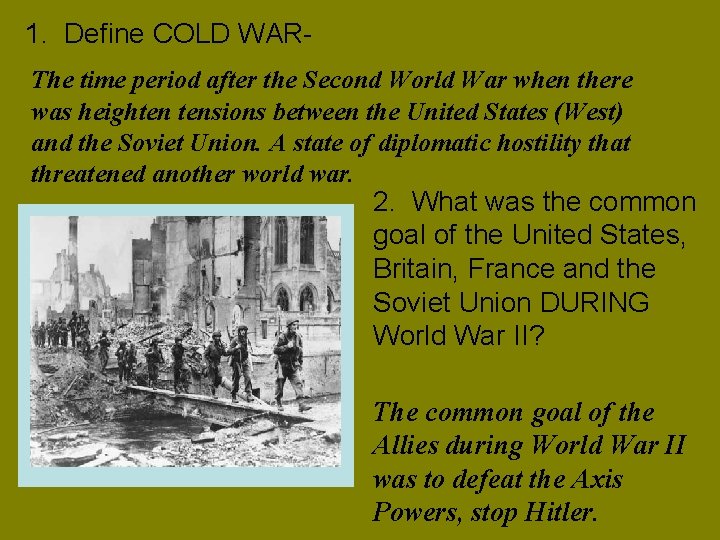
1. Define COLD WARThe time period after the Second World War when there was heighten tensions between the United States (West) and the Soviet Union. A state of diplomatic hostility that threatened another world war. 2. What was the common goal of the United States, Britain, France and the Soviet Union DURING World War II? The common goal of the Allies during World War II was to defeat the Axis Powers, stop Hitler.
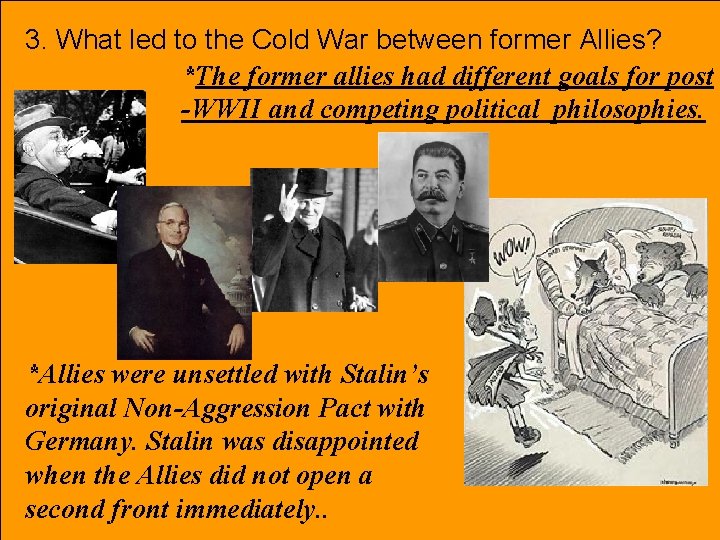
3. What led to the Cold War between former Allies? *The former allies had different goals for post -WWII and competing political philosophies. *Allies were unsettled with Stalin’s original Non-Aggression Pact with Germany. Stalin was disappointed when the Allies did not open a second front immediately. .
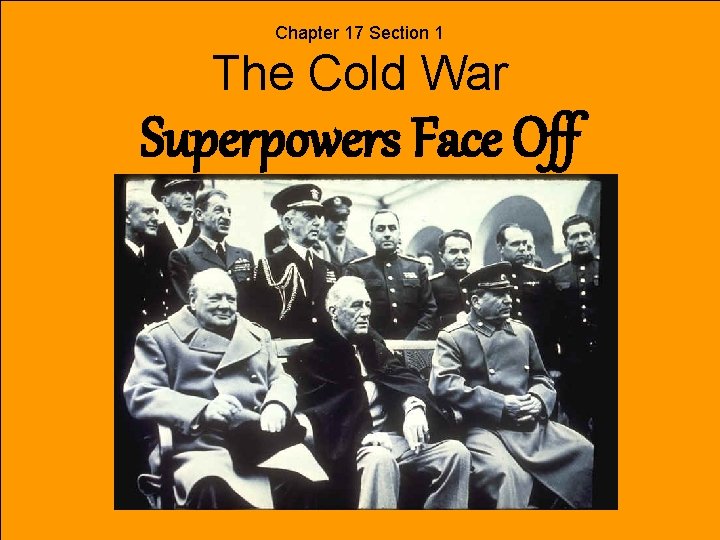
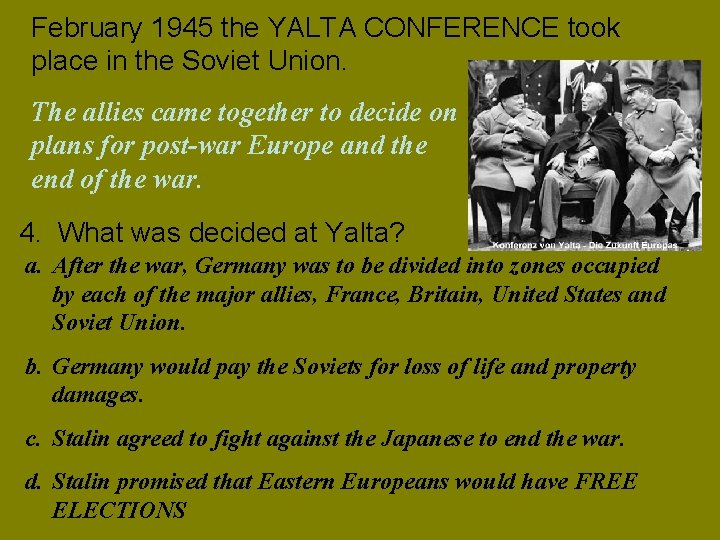
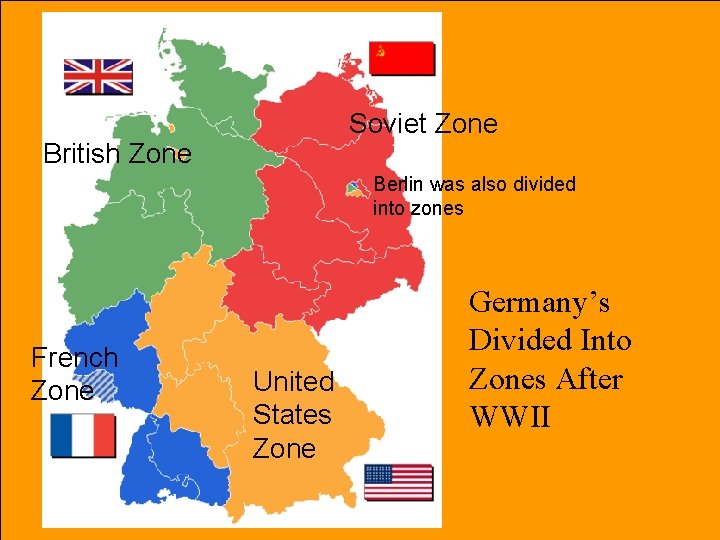
February 1945 the YALTA CONFERENCE took place in the Soviet Union. The allies came together to decide on plans for post-war Europe and the end of the war. 4. What was decided at Yalta? a. After the war, Germany was to be divided into zones occupied by each of the major allies, France, Britain, United States and Soviet Union. b. Germany would pay the Soviets for loss of life and property damages. c. Stalin agreed to fight against the Japanese to end the war. d. Stalin promised that Eastern Europeans would have FREE ELECTIONS
Soviet Zone British Zone Berlin was also divided into zones French Zone United States Zone Germany’s Divided Into Zones After WWII
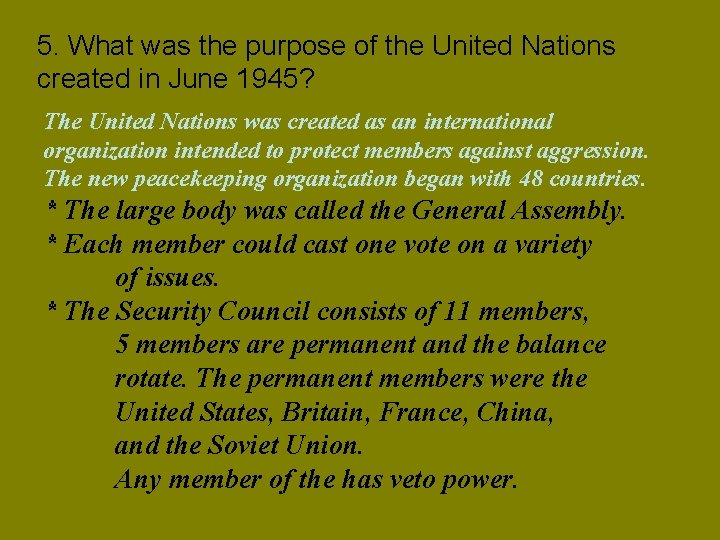
5. What was the purpose of the United Nations created in June 1945? The United Nations was created as an international organization intended to protect members against aggression. The new peacekeeping organization began with 48 countries. * The large body was called the General Assembly. * Each member could cast one vote on a variety of issues. * The Security Council consists of 11 members, 5 members are permanent and the balance rotate. The permanent members were the United States, Britain, France, China, and the Soviet Union. Any member of the has veto power.
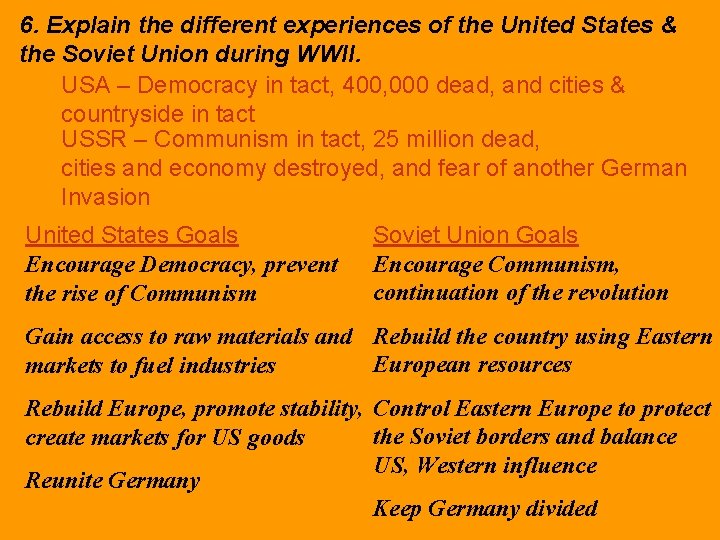
6. Explain the different experiences of the United States & the Soviet Union during WWII. USA – Democracy in tact, 400, 000 dead, and cities & countryside in tact USSR – Communism in tact, 25 million dead, cities and economy destroyed, and fear of another German Invasion United States Goals Encourage Democracy, prevent the rise of Communism Soviet Union Goals Encourage Communism, continuation of the revolution Gain access to raw materials and Rebuild the country using Eastern European resources markets to fuel industries Rebuild Europe, promote stability, Control Eastern Europe to protect the Soviet borders and balance create markets for US goods US, Western influence Reunite Germany Keep Germany divided
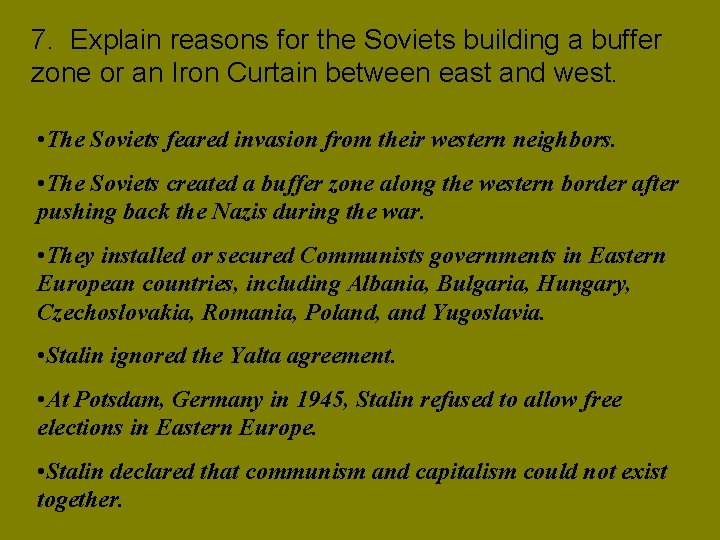
7. Explain reasons for the Soviets building a buffer zone or an Iron Curtain between east and west. • The Soviets feared invasion from their western neighbors. • The Soviets created a buffer zone along the western border after pushing back the Nazis during the war. • They installed or secured Communists governments in Eastern European countries, including Albania, Bulgaria, Hungary, Czechoslovakia, Romania, Poland, and Yugoslavia. • Stalin ignored the Yalta agreement. • At Potsdam, Germany in 1945, Stalin refused to allow free elections in Eastern Europe. • Stalin declared that communism and capitalism could not exist together.
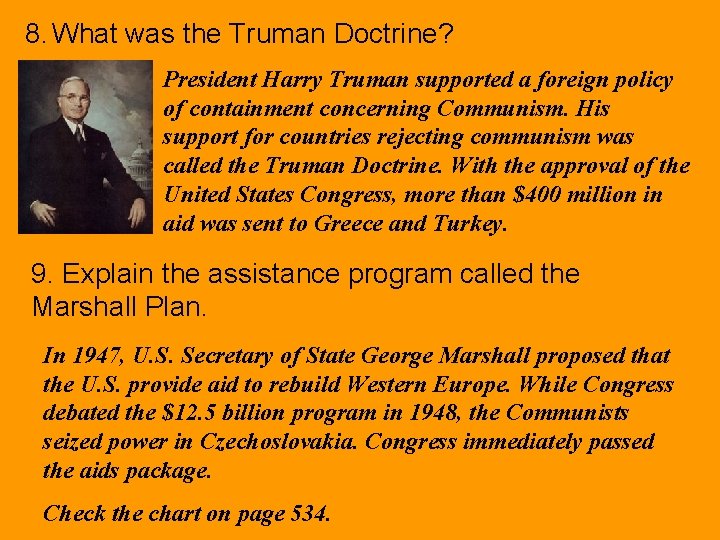
8. What was the Truman Doctrine? President Harry Truman supported a foreign policy of containment concerning Communism. His support for countries rejecting communism was called the Truman Doctrine. With the approval of the United States Congress, more than $400 million in aid was sent to Greece and Turkey. 9. Explain the assistance program called the Marshall Plan. In 1947, U. S. Secretary of State George Marshall proposed that the U. S. provide aid to rebuild Western Europe. While Congress debated the $12. 5 billion program in 1948, the Communists seized power in Czechoslovakia. Congress immediately passed the aids package. Check the chart on page 534.