
Chapter 17 Science the Environment and Society Lecture
- Slides: 28
Chapter 17 Science, the Environment, and Society Lecture Power. Point © W. W. Norton & Company, 2008
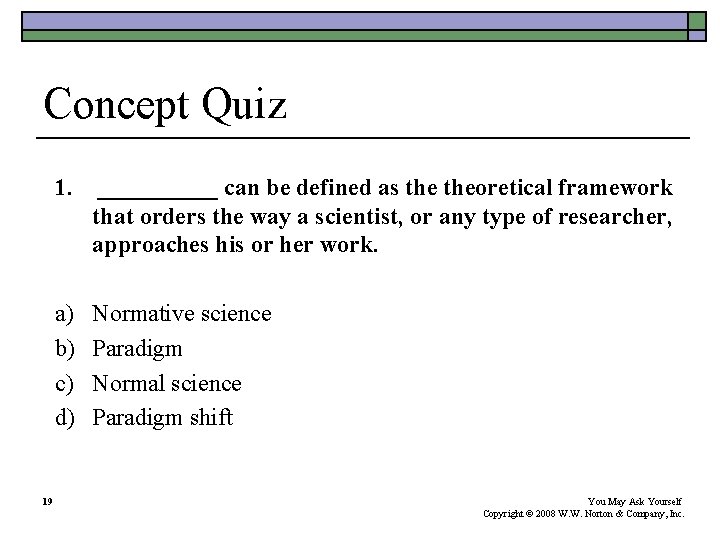
Science and Society o Sociologists of science look at the interactions between science and society. o A paradigm is the framework within which scientists operate. There are particular paradigms for particular branches of scientific research. 2 You May Ask Yourself Copyright © 2008 W. W. Norton & Company, Inc.
Science and Society o 3 Normative Science n Notion that science is unaffected by the personal beliefs or values of scientists but rather follows objective rules of evidence. n In practice, however, social factors such as funding availability, government policies (which in turn can be affected by interest groups), and international pressure or competition can affect choices about what scientific research is pursued. You May Ask Yourself Copyright © 2008 W. W. Norton & Company, Inc.
Science and Society o Thomas Kuhn theorizes that scientific revolutions, also called paradigm shifts, occur when enough anomalies accrue during the practice of normal science to challenge the existing paradigm. o Boundary work refers to research conducted on the border between legitimate and nonlegitimate science either within a specific scientific discipline or between disciplines. 4 You May Ask Yourself Copyright © 2008 W. W. Norton & Company, Inc.
Science and Society o 5 Anthropologists Bruno Latour and Steve Woolgar claim that scientific facts don’t just reveal themselves through experiments and research but are socially constructed as scientists debate findings, discuss results, and work through disagreements, all of which is influenced by unequal power relations between researchers. You May Ask Yourself Copyright © 2008 W. W. Norton & Company, Inc.
Science and Society o 6 The Matthew effect, a term coined by Robert Merton, refers to the notion that certain scientific results get more notice and have more influence based on the existing prestige of the researchers involved. You May Ask Yourself Copyright © 2008 W. W. Norton & Company, Inc.
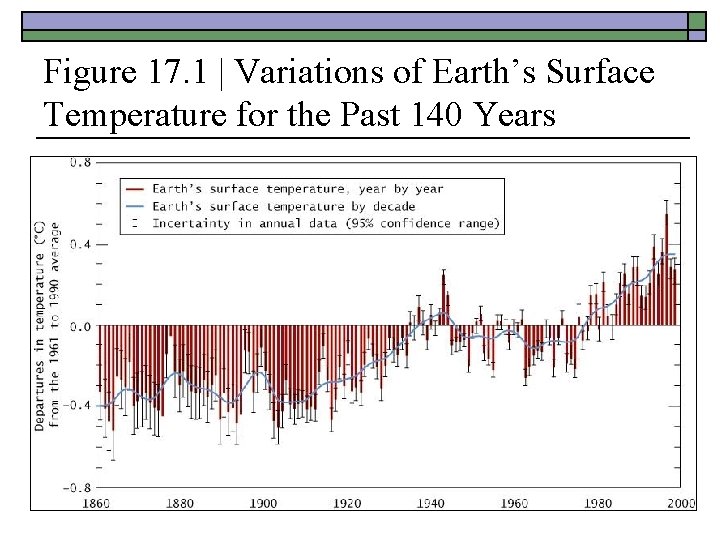
Agriculture and the Environment o o 7 The majority of scientists agree that the roots of global warming can be linked to human activity such as deforestation and the burning of coal, gas, and oil. At the same time, global warming is predicted to have a strong impact on human society, primarily through devastating natural disasters such as prolonged heat waves, more and bigger hurricanes, and debilitating droughts. You May Ask Yourself Copyright © 2008 W. W. Norton & Company, Inc.
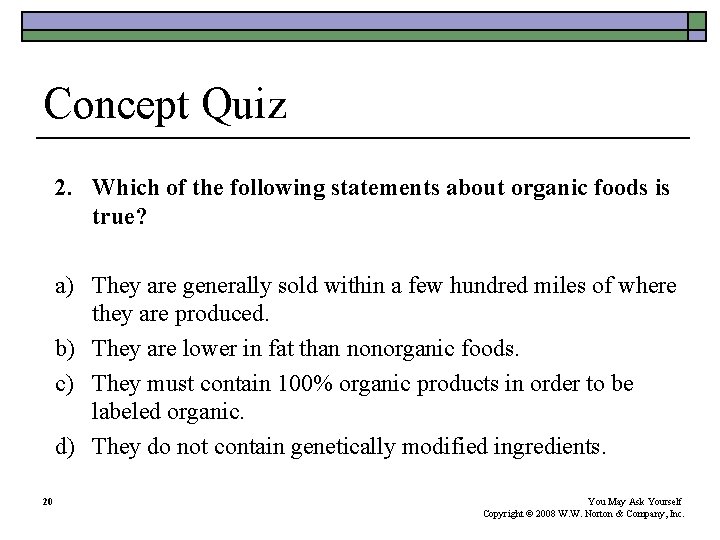
Agriculture and the Environment o 8 The term “organic” is often used as a catchall for foods that are seemingly healthy, “natural, ” or produced on a small scale. In the United States there are specific guidelines that have to be followed in order food products to be labeled “organic” or “made with organic ingredients. ” You May Ask Yourself Copyright © 2008 W. W. Norton & Company, Inc.
Agriculture and the Environment o 9 The organic food market creates stratification in two ways: n Because it is expensive to maintain an organic farm, many smaller farmers are essentially priced out of the organic farm market, which allows megafarms to dominate the market and use their influence to change policies and guidelines to their advantage. n Because organic products are more expensive, highincome individuals are much more likely to purchase them and reap their benefits than low-income people. You May Ask Yourself Copyright © 2008 W. W. Norton & Company, Inc.
Agriculture and the Environment o 10 Genetically modified foods, also referred to as genetically modified organisms or GMOs. n They are products whose genetic structures have been altered, usually to make them produce higher yields. n Proponents argue that GMOs help bring down food prices, reduce dependence on pesticides and herbicides, reduce waste, and can even provide vitamin and mineral content that may be missing from a population’s diet—all of which is particularly significant for developing countries. You May Ask Yourself Copyright © 2008 W. W. Norton & Company, Inc.
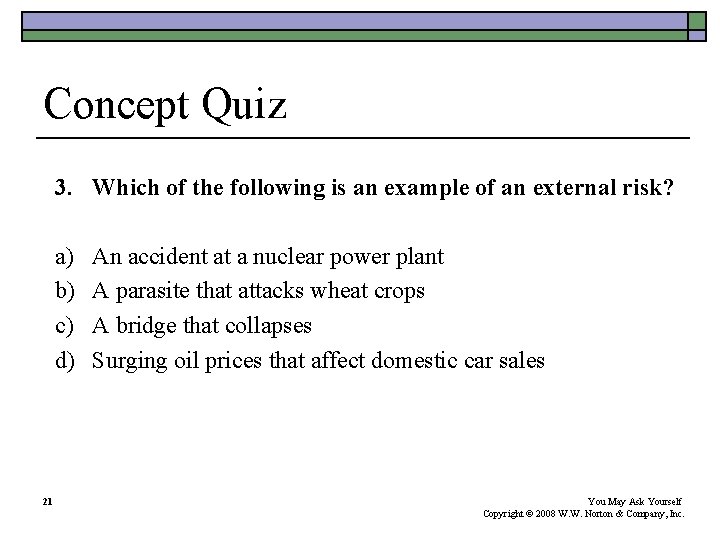
Agriculture and the Environment o Ulrich Beck developed the concept of the risk society and identified two main categories of risks: external risks and manufactured risks. o A risk society is a society that is concerned with mitigating risks, particularly manufactured risks that are unequally distributed by socioeconomic status and other dimensions of power. 11 You May Ask Yourself Copyright © 2008 W. W. Norton & Company, Inc.
Agriculture and the Environment o Critics of GMOs argue that they create risks to the environment and human health that have not been adequately evaluated. o Charles Perrow argues that disasters resulting from manufactured or natural risks are inevitable but that society can and should reduce the impact of such risks [through wise policy choices]. 12 You May Ask Yourself Copyright © 2008 W. W. Norton & Company, Inc.
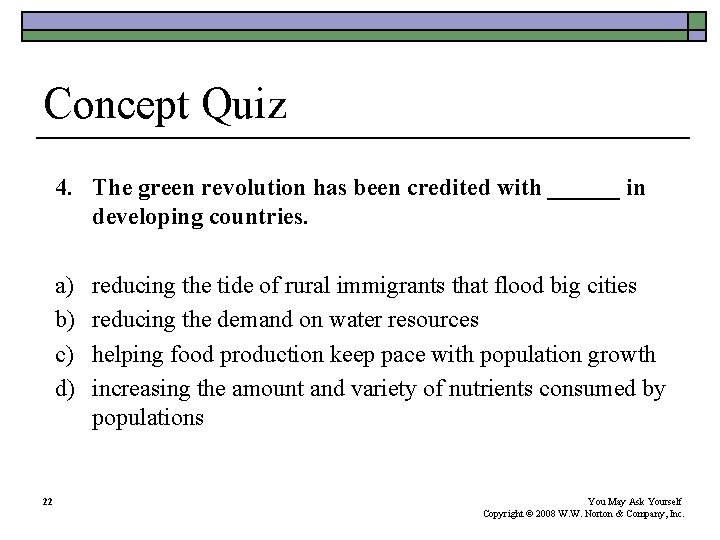
Agriculture and the Environment o 13 The green revolution refers broadly to two agricultural trends of the twentieth century: the introduction of high-yield crop varietals in developing countries and improvements in agricultural technologies such as irrigation systems, fertilizers, and pesticides. You May Ask Yourself Copyright © 2008 W. W. Norton & Company, Inc.
Agriculture and the Environment o 14 The green revolution is widely credited with increasing agricultural productivity throughout the developing world: n Increasing incomes n Increasing the value of formal schooling n Making farming more of a collective, community endeavor You May Ask Yourself Copyright © 2008 W. W. Norton & Company, Inc.
Agriculture and the Environment o 15 Critics of the green revolution argue that it makes farmers more dependent on a smaller number of crops. n This exposes them to risks if those crops fail, reduces the variety in their diet, and depletes the soil of nutrients. n It puts a great deal of pressure on water resources and has altered traditional water management techniques. You May Ask Yourself Copyright © 2008 W. W. Norton & Company, Inc.
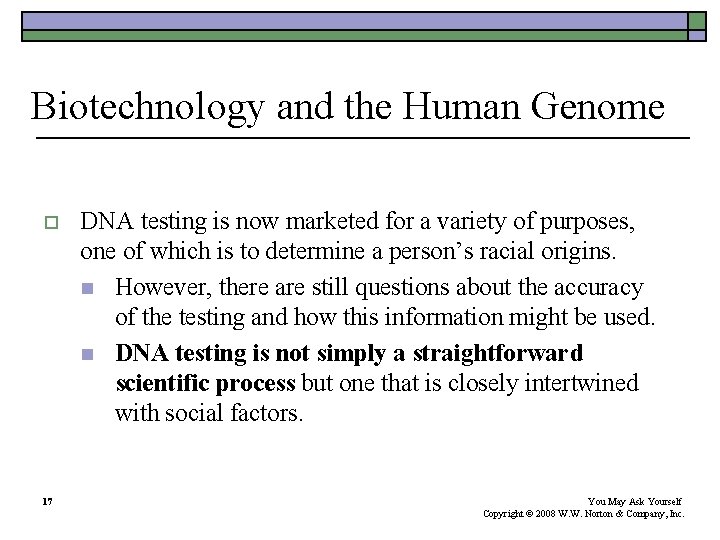
Biotechnology and the Human Genome o 16 The goal of the Human Genome Project was to identify and map all of the genes in human DNA. Researchers involved in the project recognized that it raised many social, ethical, and legal issues. Among the social issues raised are concerns about privacy, stratification, and stigmatization. You May Ask Yourself Copyright © 2008 W. W. Norton & Company, Inc.
Biotechnology and the Human Genome o 17 DNA testing is now marketed for a variety of purposes, one of which is to determine a person’s racial origins. n However, there are still questions about the accuracy of the testing and how this information might be used. n DNA testing is not simply a straightforward scientific process but one that is closely intertwined with social factors. You May Ask Yourself Copyright © 2008 W. W. Norton & Company, Inc.
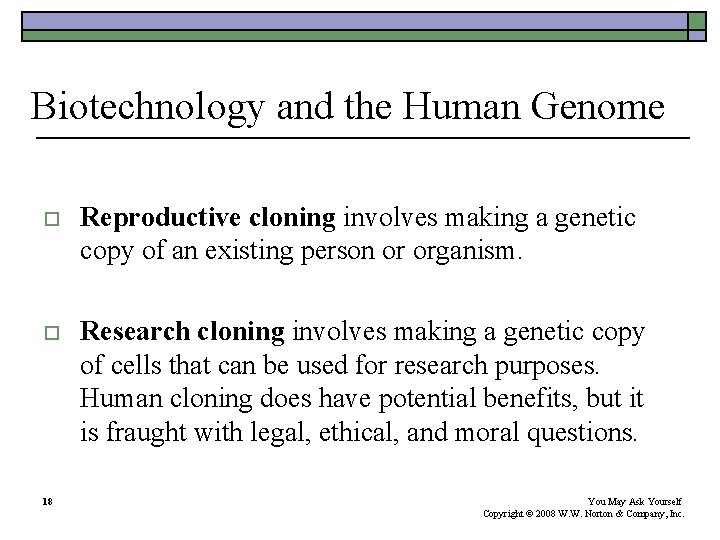
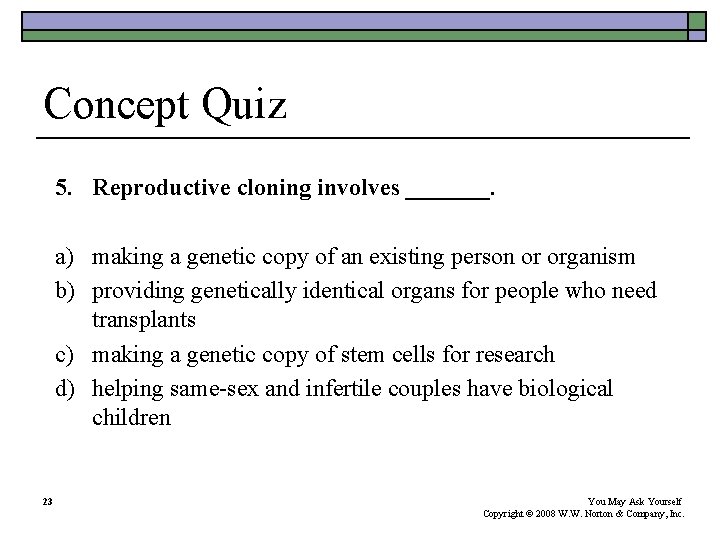
Biotechnology and the Human Genome o Reproductive cloning involves making a genetic copy of an existing person or organism. o Research cloning involves making a genetic copy of cells that can be used for research purposes. Human cloning does have potential benefits, but it is fraught with legal, ethical, and moral questions. 18 You May Ask Yourself Copyright © 2008 W. W. Norton & Company, Inc.
Concept Quiz 19 1. _____ can be defined as theoretical framework that orders the way a scientist, or any type of researcher, approaches his or her work. a) b) c) d) Normative science Paradigm Normal science Paradigm shift You May Ask Yourself Copyright © 2008 W. W. Norton & Company, Inc.
Concept Quiz 2. Which of the following statements about organic foods is true? a) They are generally sold within a few hundred miles of where they are produced. b) They are lower in fat than nonorganic foods. c) They must contain 100% organic products in order to be labeled organic. d) They do not contain genetically modified ingredients. 20 You May Ask Yourself Copyright © 2008 W. W. Norton & Company, Inc.
Concept Quiz 3. Which of the following is an example of an external risk? a) b) c) d) 21 An accident at a nuclear power plant A parasite that attacks wheat crops A bridge that collapses Surging oil prices that affect domestic car sales You May Ask Yourself Copyright © 2008 W. W. Norton & Company, Inc.
Concept Quiz 4. The green revolution has been credited with ______ in developing countries. a) b) c) d) 22 reducing the tide of rural immigrants that flood big cities reducing the demand on water resources helping food production keep pace with population growth increasing the amount and variety of nutrients consumed by populations You May Ask Yourself Copyright © 2008 W. W. Norton & Company, Inc.
Concept Quiz 5. Reproductive cloning involves _______. a) making a genetic copy of an existing person or organism b) providing genetically identical organs for people who need transplants c) making a genetic copy of stem cells for research d) helping same-sex and infertile couples have biological children 23 You May Ask Yourself Copyright © 2008 W. W. Norton & Company, Inc.
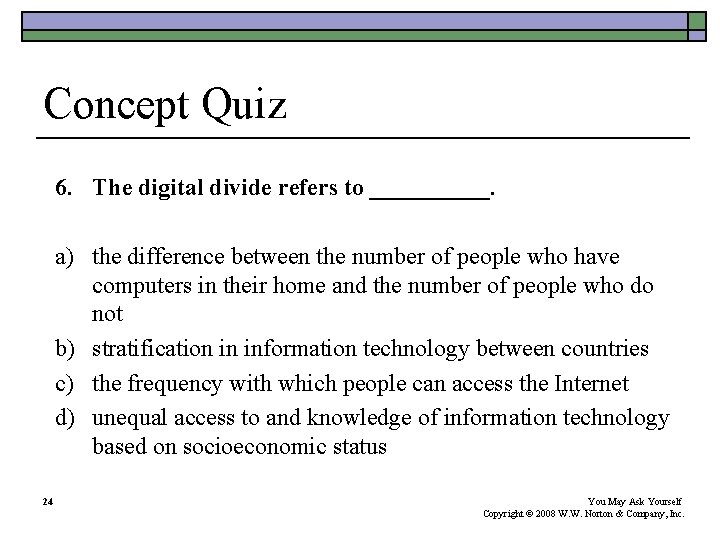
Concept Quiz 6. The digital divide refers to _____. a) the difference between the number of people who have computers in their home and the number of people who do not b) stratification in information technology between countries c) the frequency with which people can access the Internet d) unequal access to and knowledge of information technology based on socioeconomic status 24 You May Ask Yourself Copyright © 2008 W. W. Norton & Company, Inc.
Figure 17. 1 | Variations of Earth’s Surface Temperature for the Past 140 Years
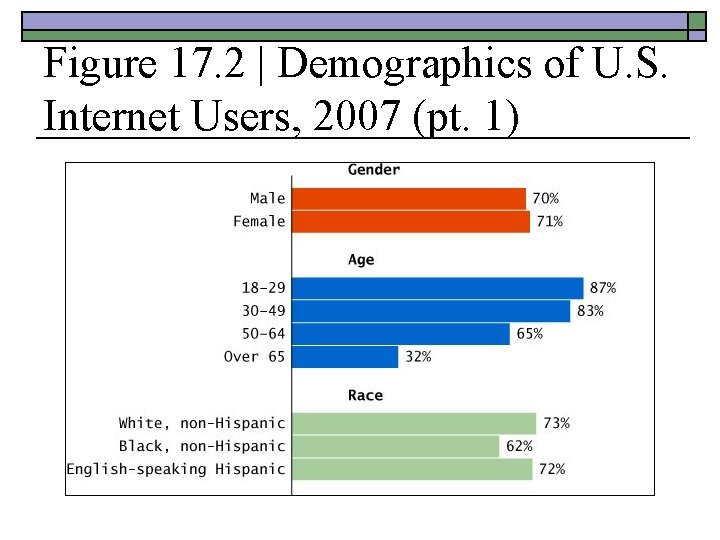
Figure 17. 2 | Demographics of U. S. Internet Users, 2007 (pt. 1)
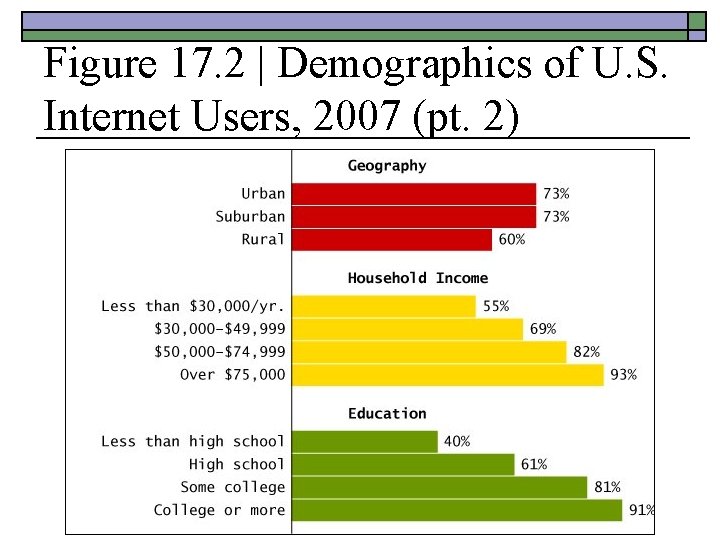
Figure 17. 2 | Demographics of U. S. Internet Users, 2007 (pt. 2)
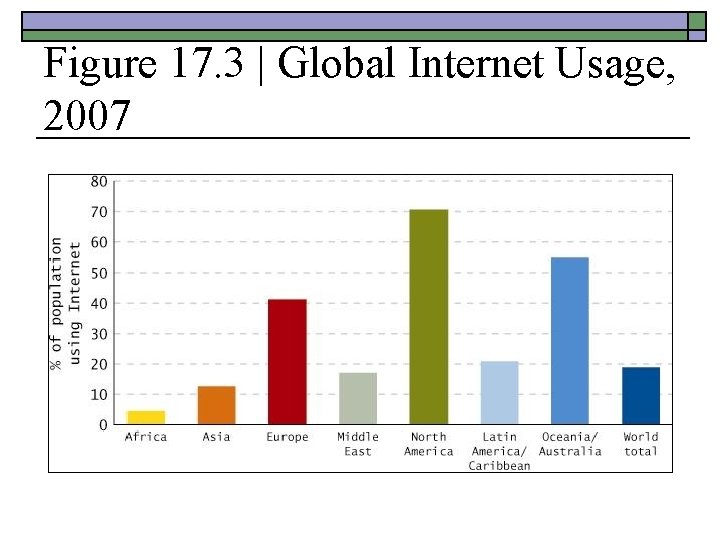
Figure 17. 3 | Global Internet Usage, 2007