
Chapter 17 Probability Models Copyright 2009 Pearson Education

Chapter 17 Probability Models Copyright © 2009 Pearson Education, Inc.
Objectives: n The student will be able to: n Tell if a situation involves Bernoulli trials. n Know the appropriate conditions for using a Binomial or Normal model. n Find and interpret in context the mean and standard deviation of a Binomial model. n Calculate binomial probabilities, perhaps with a Normal model. Copyright © 2009 Pearson Education, Inc. Slide 1 - 3
Bernoulli Trials n n n The basis for the probability models we will examine in this chapter is the Bernoulli trial. We have Bernoulli trials if: n there are two possible outcomes (success and failure). n the probability of success, p, is constant. n the trials are independent. Examples: n Flipping a coin (where heads is success), rolling a die (where getting a “ 6” is success), throwing free throws in a basketball game, drawing a card from a deck of cards with replacement (where drawing an Ace is success) Copyright © 2009 Pearson Education, Inc. Slide 1 - 4
Do we have Bernoulli Trials? n n n You are rolling 5 dice and need to get at least two 6’s to win the game We record the eye colors found in a group of 500 people A city council of 11 Republicans and 8 Democrats picks a committee of 4 at random. What is the probability that they choose all Democrats? A 2002 Rutgers University study found that 74% of high school students have cheated on a test at least once. Your local high school principle conducts a survey and gets responses that admit to cheating from 322 of 481 students. How likely is it that in a group of 120 the majority may have type A blood, given that Type A is found in 43% of the population? Copyright © 2009 Pearson Education, Inc. Slide 1 - 5
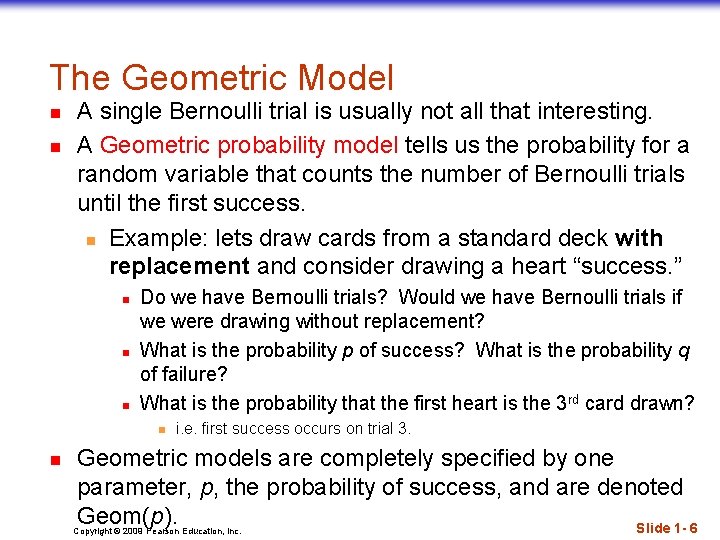
The Geometric Model n n A single Bernoulli trial is usually not all that interesting. A Geometric probability model tells us the probability for a random variable that counts the number of Bernoulli trials until the first success. n Example: lets draw cards from a standard deck with replacement and consider drawing a heart “success. ” n n n Do we have Bernoulli trials? Would we have Bernoulli trials if we were drawing without replacement? What is the probability p of success? What is the probability q of failure? What is the probability that the first heart is the 3 rd card drawn? n n i. e. first success occurs on trial 3. Geometric models are completely specified by one parameter, p, the probability of success, and are denoted Geom(p). Slide 1 - 6 Copyright © 2009 Pearson Education, Inc.
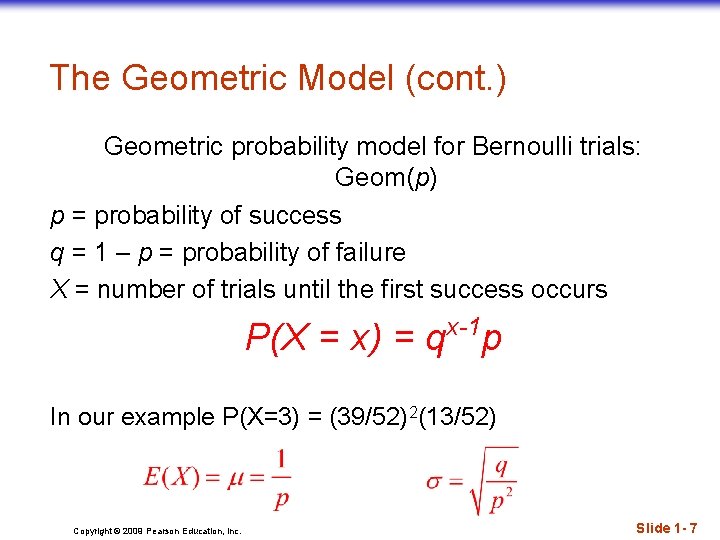
The Geometric Model (cont. ) Geometric probability model for Bernoulli trials: Geom(p) p = probability of success q = 1 – p = probability of failure X = number of trials until the first success occurs x-1 P(X = x) = q p In our example P(X=3) = (39/52)2(13/52) Copyright © 2009 Pearson Education, Inc. Slide 1 - 7
The Binomial Model n n A Binomial model tells us the probability for a random variable that counts the number of successes in a fixed number of Bernoulli trials. n Example: If success is drawing a heart (drawing with replacement), what is the probability that if we draw and replace 3 cards that we drew exactly one heart? Two parameters define the Binomial model: n, the number of trials; and, p, the probability of success. We denote this Binom(n, p). n Example: If we flip a coin 6 times what is the probability of getting heads exactly 3 times? Copyright © 2009 Pearson Education, Inc. Slide 1 - 9
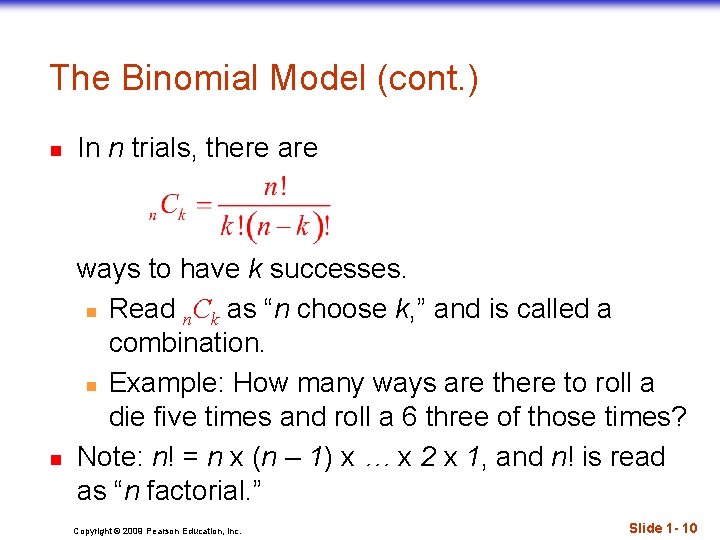
The Binomial Model (cont. ) n n In n trials, there are ways to have k successes. n Read n. Ck as “n choose k, ” and is called a combination. n Example: How many ways are there to roll a die five times and roll a 6 three of those times? Note: n! = n x (n – 1) x … x 2 x 1, and n! is read as “n factorial. ” Copyright © 2009 Pearson Education, Inc. Slide 1 - 10
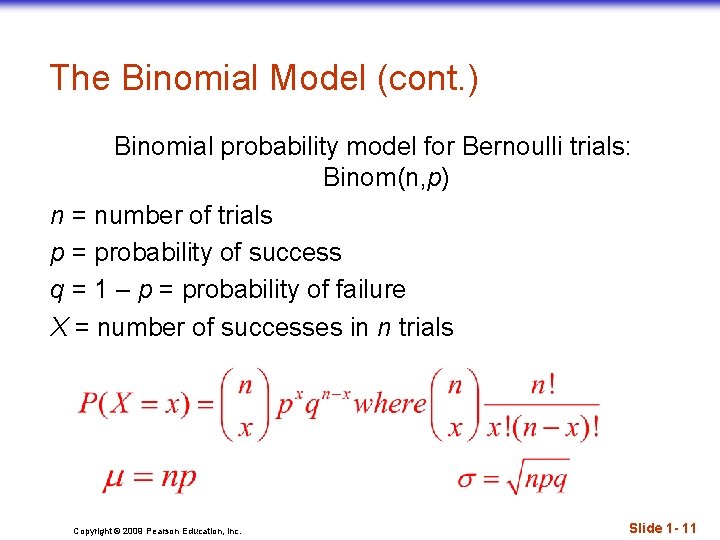
The Binomial Model (cont. ) Binomial probability model for Bernoulli trials: Binom(n, p) n = number of trials p = probability of success q = 1 – p = probability of failure X = number of successes in n trials Copyright © 2009 Pearson Education, Inc. Slide 1 - 11
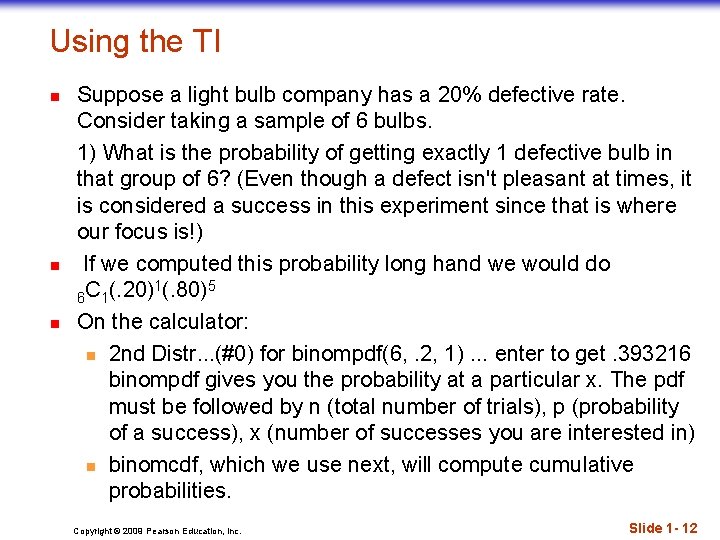
Using the TI n n n Suppose a light bulb company has a 20% defective rate. Consider taking a sample of 6 bulbs. 1) What is the probability of getting exactly 1 defective bulb in that group of 6? (Even though a defect isn't pleasant at times, it is considered a success in this experiment since that is where our focus is!) If we computed this probability long hand we would do 1 5 6 C 1(. 20) (. 80) On the calculator: n 2 nd Distr. . . (#0) for binompdf(6, . 2, 1). . . enter to get. 393216 binompdf gives you the probability at a particular x. The pdf must be followed by n (total number of trials), p (probability of a success), x (number of successes you are interested in) n binomcdf, which we use next, will compute cumulative probabilities. Copyright © 2009 Pearson Education, Inc. Slide 1 - 12
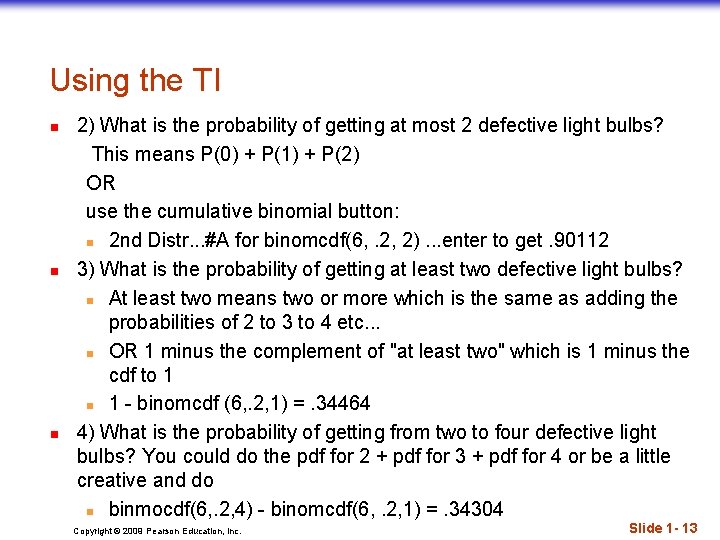
Using the TI n n n 2) What is the probability of getting at most 2 defective light bulbs? This means P(0) + P(1) + P(2) OR use the cumulative binomial button: n 2 nd Distr. . . #A for binomcdf(6, . 2, 2). . . enter to get. 90112 3) What is the probability of getting at least two defective light bulbs? n At least two means two or more which is the same as adding the probabilities of 2 to 3 to 4 etc. . . n OR 1 minus the complement of "at least two" which is 1 minus the cdf to 1 n 1 - binomcdf (6, . 2, 1) =. 34464 4) What is the probability of getting from two to four defective light bulbs? You could do the pdf for 2 + pdf for 3 + pdf for 4 or be a little creative and do n binmocdf(6, . 2, 4) - binomcdf(6, . 2, 1) =. 34304 Copyright © 2009 Pearson Education, Inc. Slide 1 - 13
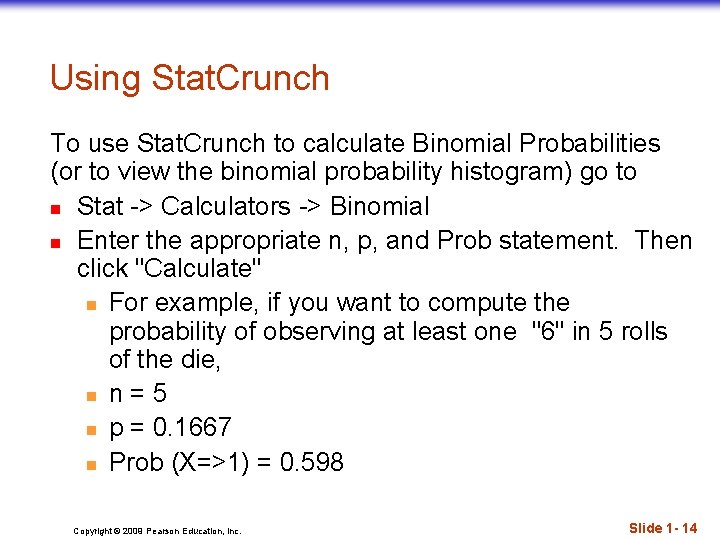
Using Stat. Crunch To use Stat. Crunch to calculate Binomial Probabilities (or to view the binomial probability histogram) go to n Stat -> Calculators -> Binomial n Enter the appropriate n, p, and Prob statement. Then click "Calculate" n For example, if you want to compute the probability of observing at least one "6" in 5 rolls of the die, n n = 5 n p = 0. 1667 n Prob (X=>1) = 0. 598 Copyright © 2009 Pearson Education, Inc. Slide 1 - 14
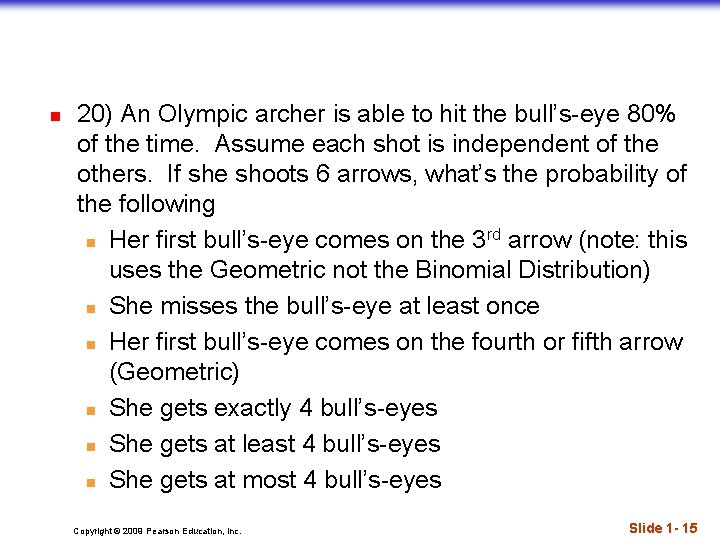
n 20) An Olympic archer is able to hit the bull’s-eye 80% of the time. Assume each shot is independent of the others. If she shoots 6 arrows, what’s the probability of the following rd arrow (note: this n Her first bull’s-eye comes on the 3 uses the Geometric not the Binomial Distribution) n She misses the bull’s-eye at least once n Her first bull’s-eye comes on the fourth or fifth arrow (Geometric) n She gets exactly 4 bull’s-eyes n She gets at least 4 bull’s-eyes n She gets at most 4 bull’s-eyes Copyright © 2009 Pearson Education, Inc. Slide 1 - 15
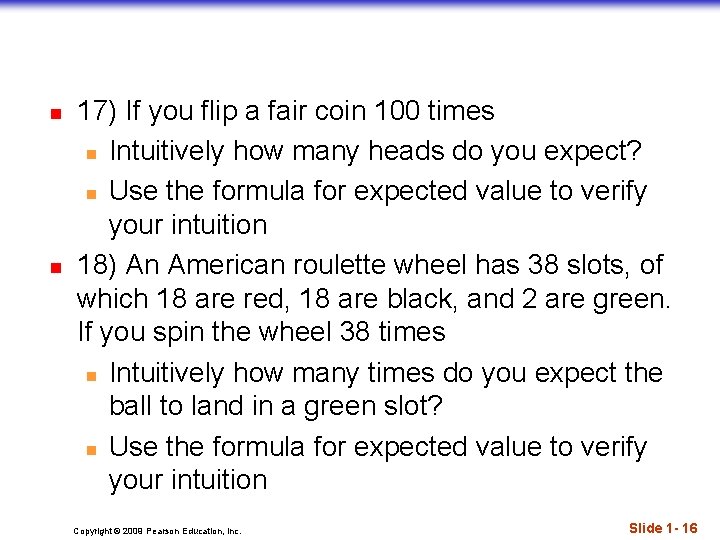
n n 17) If you flip a fair coin 100 times n Intuitively how many heads do you expect? n Use the formula for expected value to verify your intuition 18) An American roulette wheel has 38 slots, of which 18 are red, 18 are black, and 2 are green. If you spin the wheel 38 times n Intuitively how many times do you expect the ball to land in a green slot? n Use the formula for expected value to verify your intuition Copyright © 2009 Pearson Education, Inc. Slide 1 - 16
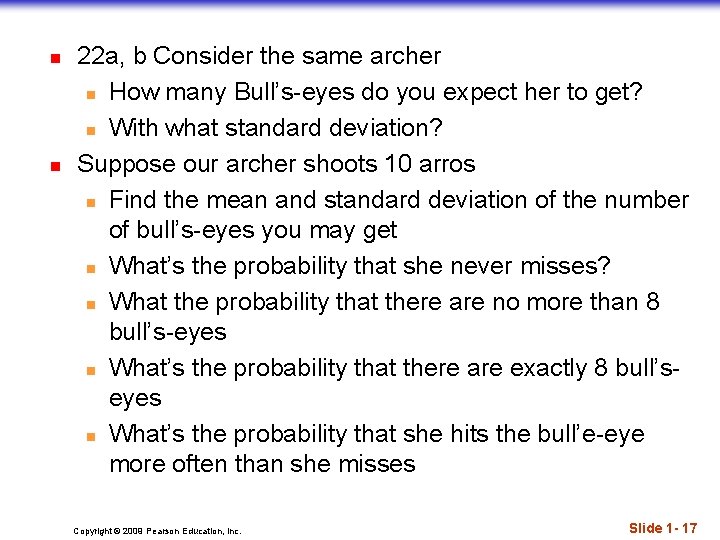
n n 22 a, b Consider the same archer n How many Bull’s-eyes do you expect her to get? n With what standard deviation? Suppose our archer shoots 10 arros n Find the mean and standard deviation of the number of bull’s-eyes you may get n What’s the probability that she never misses? n What the probability that there are no more than 8 bull’s-eyes n What’s the probability that there are exactly 8 bull’seyes n What’s the probability that she hits the bull’e-eye more often than she misses Copyright © 2009 Pearson Education, Inc. Slide 1 - 17
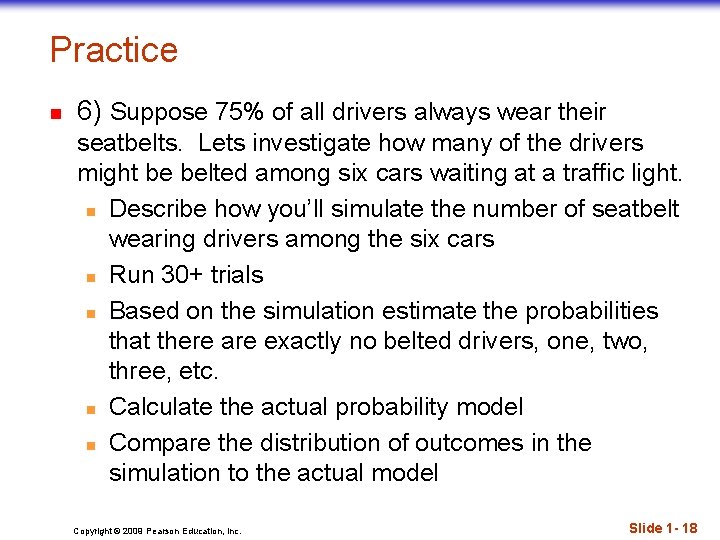
Practice n 6) Suppose 75% of all drivers always wear their seatbelts. Lets investigate how many of the drivers might be belted among six cars waiting at a traffic light. n Describe how you’ll simulate the number of seatbelt wearing drivers among the six cars n Run 30+ trials n Based on the simulation estimate the probabilities that there are exactly no belted drivers, one, two, three, etc. n Calculate the actual probability model n Compare the distribution of outcomes in the simulation to the actual model Copyright © 2009 Pearson Education, Inc. Slide 1 - 18
Recall our election example from chapter 11 n If your candidate is favored by approximately 53% of the population, but only 100 people vote, what is the probability that your candidate wins? n In other words, your candidate needs at least 51 votes of 100 votes. Assume each voter is independent. n Do we have Bernoulli trials? n What is the probability of “success” for a trial? n What the probability that at least 51 of 100 voters vote for your candidate? Copyright © 2009 Pearson Education, Inc. Slide 1 - 19
The Normal Model to the Rescue! n n When dealing with a large number of trials in a Binomial situation, making direct calculations of the probabilities becomes tedious (or outright impossible). Fortunately, the Normal model comes to the rescue… Copyright © 2009 Pearson Education, Inc. Slide 1 - 20
The Normal Model to the Rescue (cont. ) n As long as the Success/Failure Condition holds, we can use the Normal model to approximate Binomial probabilities. n Success/failure condition: A Binomial model is approximately Normal if we expect at least 10 successes and 10 failures: np ≥ 10 and nq ≥ 10. Copyright © 2009 Pearson Education, Inc. Slide 1 - 21
Continuous Random Variables n n n When we use the Normal model to approximate the Binomial model, we are using a continuous random variable to approximate a discrete random variable. So, when we use the Normal model, we no longer calculate the probability that the random variable equals a particular value, but only that it lies between two values. Ex. For our election example: n μ = np = 100*. 53 =53 n σ = √(npq) = √(100*. 53*. 47) =4. 99 n P(at least 51 votes) ~ Normalcdf(51, 100, 53, 4. 99) Copyright © 2009 Pearson Education, Inc. Slide 1 - 22
What Can Go Wrong? n n n Be sure you have Bernoulli trials. n You need two outcomes per trial, a constant probability of success, and independence. n Remember that the 10% Condition provides a reasonable substitute for independence. Don’t confuse Geometric and Binomial models. Don’t use the Normal approximation with small n. n You need at least 10 successes and 10 failures to use the Normal approximation. Copyright © 2009 Pearson Education, Inc. Slide 1 - 23
What have we learned? (cont. ) n Geometric model n n Binomial model n n When we’re interested in the number of successes in a certain number of Bernoulli trials. Normal model n n When we’re interested in the number of Bernoulli trials until the next success. To approximate a Binomial model when we expect at least 10 successes and 10 failures. Poisson model n To approximate a Binomial model when the probability of success, p, is very small and the number of trials, n, is very large. Copyright © 2009 Pearson Education, Inc. Slide 1 - 25
- Slides: 23