
Chapter 17 Principle of Diffusion and Mass Transfer


- Slides: 29
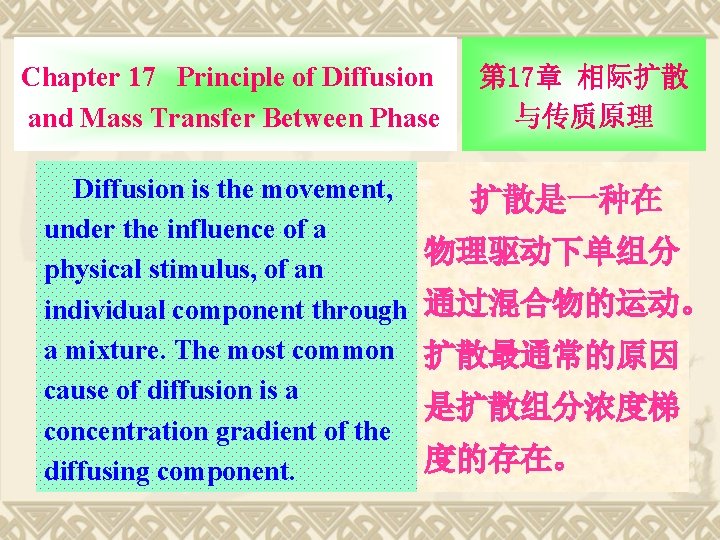
Chapter 17 Principle of Diffusion and Mass Transfer Between Phase Diffusion is the movement, under the influence of a physical stimulus, of an individual component through a mixture. The most common cause of diffusion is a concentration gradient of the diffusing component. 第 17章 相际扩散 与传质原理 扩散是一种在 物理驱动下单组分 通过混合物的运动。 扩散最通常的原因 是扩散组分浓度梯 度的存在。
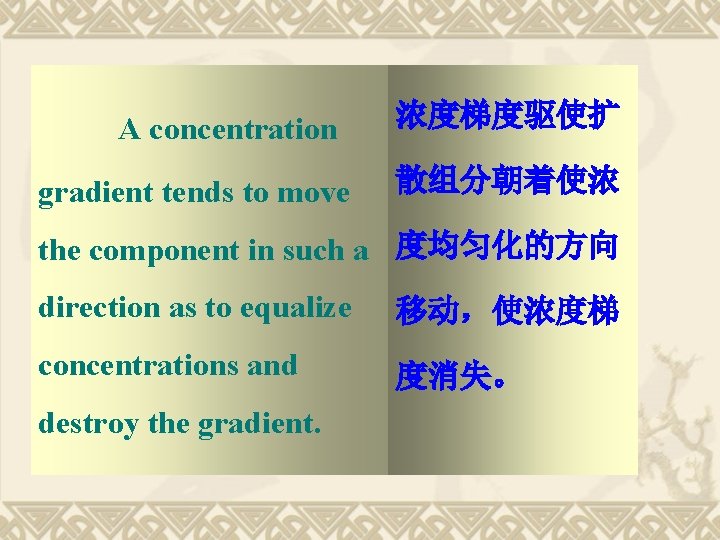
A concentration gradient tends to move 浓度梯度驱使扩 散组分朝着使浓 the component in such a 度均匀化的方向 direction as to equalize 移动,使浓度梯 concentrations and 度消失。 destroy the gradient.
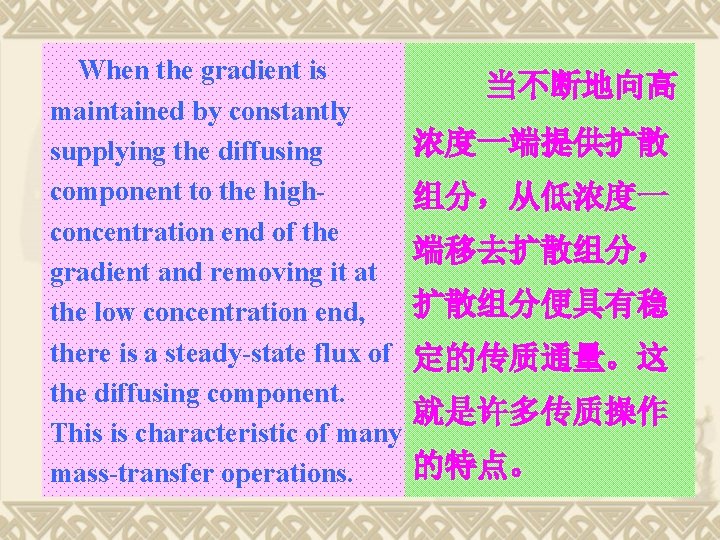
When the gradient is maintained by constantly supplying the diffusing component to the highconcentration end of the gradient and removing it at the low concentration end, there is a steady-state flux of the diffusing component. This is characteristic of many mass-transfer operations. 当不断地向高 浓度一端提供扩散 组分,从低浓度一 端移去扩散组分, 扩散组分便具有稳 定的传质通量。这 就是许多传质操作 的特点。
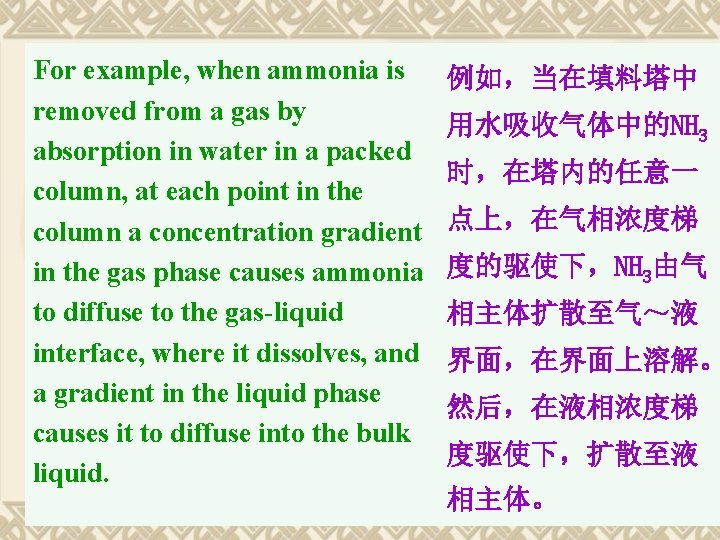
For example, when ammonia is removed from a gas by absorption in water in a packed column, at each point in the column a concentration gradient in the gas phase causes ammonia to diffuse to the gas-liquid interface, where it dissolves, and a gradient in the liquid phase causes it to diffuse into the bulk liquid. 例如,当在填料塔中 用水吸收气体中的NH 3 时,在塔内的任意一 点上,在气相浓度梯 度的驱使下,NH 3由气 相主体扩散至气~液 界面,在界面上溶解。 然后,在液相浓度梯 度驱使下,扩散至液 相主体。
In stripping a solute from a liquid the gradients are reversed; here diffusion brings solute from the bulk liquid to the interface and from there into the gas phase. 当从吸收液中 解吸溶质时, 浓度梯度与吸 收过程相反。 此时,扩散作 用使溶质从液 相主体移至界 面,再从界面 移至气相。
In some other masstransfer operations such as leaching and adsorption, unsteady- 在其它一些诸如浸 取和吸咐操作中发 生的是不稳定扩散, state diffusion takes 随着过程趋于平衡, place, and the gradients 扩散组分的浓度梯 and fluxes decrease with 度和通量随时间而 time as equilibrium is approached. 降低。
Although the usual cause of diffusion is a concentration gradient, diffusion can also be caused by an activity gradient, as in reverse osmosis, by a pressure gradient, by a temperature gradient, or by the application of an external force field, as in a centrifuge. 虽然扩散的一般 原因是浓度梯度,但 能动梯度也能引起扩 散如反渗透过程,压 力梯度、温度梯度和 外场力都可引起扩散, 如离心分离。
Molecular diffusion induced by 由温度引起的分子 temperature is thermal 扩散称为热扩散, diffusion, and that from an 由外场力引起的扩 external field is forced diffusion. Both are uncommon in chemical engineering. Only diffusion 散称为强制扩散。 这两种扩散方式在 化学 程中并不常 见。本章仅讨论由 under a concentration gradient 浓度梯度引起的质 is considered in this chapter. 量扩散。
Diffusion is not restricted 扩散并不局 to molecular transfer 限于分子通过固 through stagnant layers 体或液体停滞膜 of solid or fluid. It also 的传递。当不同 takes place when fluids of 组成的流体相混 different compositions 合时也会发生扩散。 are mixed.
The first step in mixing is often mass transfer caused by the eddy motion characteristic of turbulent flow. This is called eddy 混合过程首先 是因湍流的涡流特 性引起的质量传递。 这一过程被称为涡 diffusion. The second step 流扩散。其次是在 is molecular diffusion 微小的漩涡间及其 between and inside the 内部的分子扩散。 very small eddies.
Sometimes the diffusion process is 有时扩散过程 accompanied by bulk 还伴随着与扩散 flow of the mixture in 方向相平行的混 a direction parallel to 合物主体流动。 the direction of diffusion.
Role of diffusion in mass transfer In all the mass-transfer operations, diffusion occurs in at least one phase and often in both phases. In distillation, the low boiler diffuses through the liquid phase to the interface and away from the interface into the vapor. 扩散在质量传递中的角色 在所有的质量传 递操作中,扩散 至少在一相中发 生,更多则是在 两相中发生。蒸 馏时,低沸物由 液相扩散至界面, 离开界面进入汽 相。
The high boiler diffuses in the reverse direction and passes through the vapor into the liquid. In leaching, diffusion of solute through the solid phase is followed by diffusion into the liquid. 高沸物逆向扩 散从汽相进入液 相。浸取时,溶 质扩散穿过固相, 然后再扩散进入 液相。
In liquid extraction, the solute diffuses through the raffinate phase to the interface and then into the extract phase. In crystallization, solute diffuses through the mother liquor to the crystals and deposits on the solid surfaces. 液~液萃取 时,溶质从萃余 相扩散至液~液 界面,然后进入 萃取相。结晶时, 溶质由母液扩散 到晶体,然后沉 积于晶体表面。
In humidification or dehumidification there is no diffusion through the liquid phase because the liquid phase is pure and no concentration gradient through it can exist; but the vapor diffuses to or from the liquid-gas interface into or out of the gas phase. 增湿和减湿时, 因液相是纯液体, 无浓度梯度存在。 故液相无扩散。但 增湿时,蒸汽离开 汽液界面,扩散进 入汽相;而减湿时, 则为蒸汽朝向汽液 界面,扩散离开汽 相。
In membrane 膜分离时, separations diffusion 所有相中即膜 occurs in all there 两侧的流体中 phases: in the fluids on 和膜自身内均 either side of the 会发生扩散现象。 membrane and in the membrane itself.
Chap. 8 Gas absorption § 8 -1 Introduction This chapter deals with the mass-transfer operations known as gas absorption and stripping or desorption. ⒈气体吸收: 利用气体混合物各组份在吸收剂中的溶解 度不同,而使气体混合物得以分离的单元操作。 In gas absorption a soluble gas is absorbed from its mixture with an inert gas by means of liquid in which the solute gas is more or less soluble.
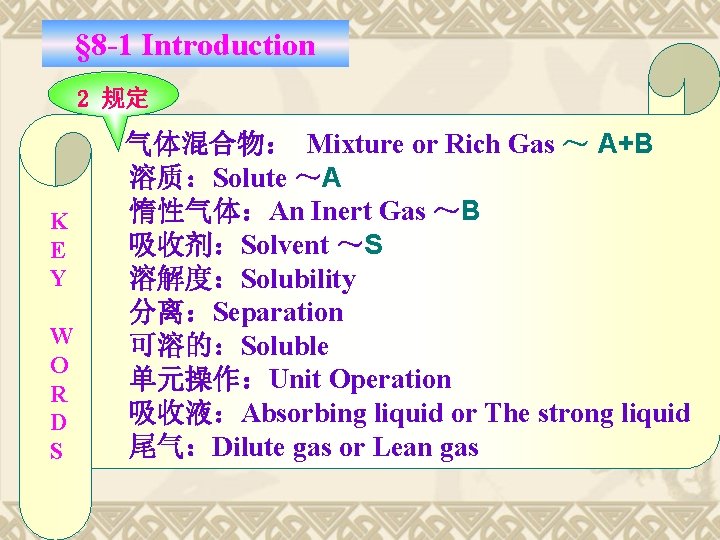
§ 8 -1 Introduction 2 规定 K E Y W O R D S 气体混合物: Mixture or Rich Gas ~ A+B 溶质:Solute ~A 惰性气体:An Inert Gas ~B 吸收剂:Solvent ~S 溶解度:Solubility 分离:Separation 可溶的:Soluble 单元操作:Unit Operation 吸收液:Absorbing liquid or The strong liquid 尾气:Dilute gas or Lean gas
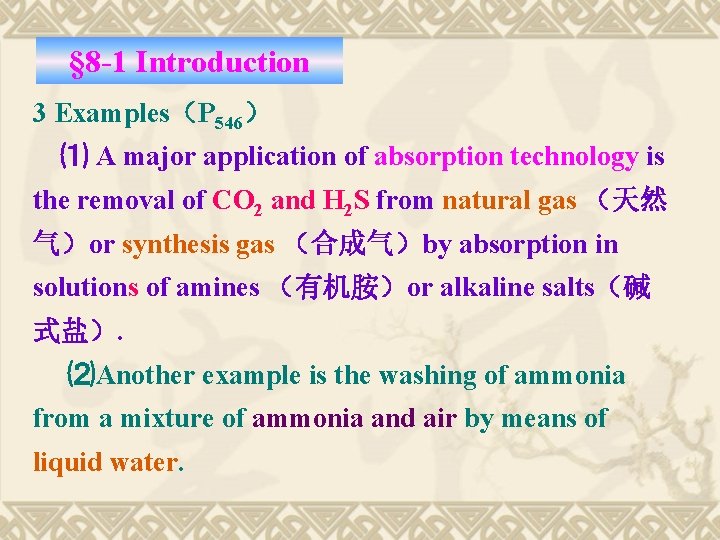
§ 8 -1 Introduction 3 Examples(P 546) ⑴ A major application of absorption technology is the removal of CO 2 and H 2 S from natural gas (天然 气)or synthesis gas (合成气)by absorption in solutions of amines (有机胺)or alkaline salts(碱 式盐). ⑵Another example is the washing of ammonia from a mixture of ammonia and air by means of liquid water.
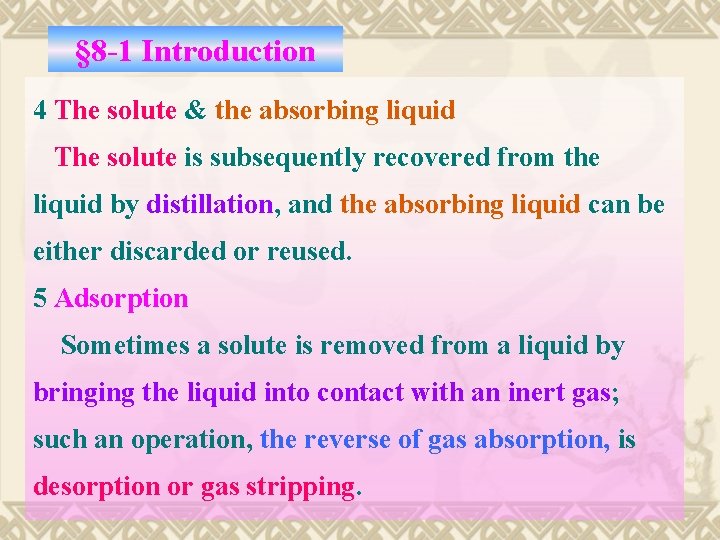
§ 8 -1 Introduction 4 The solute & the absorbing liquid The solute is subsequently recovered from the liquid by distillation, and the absorbing liquid can be either discarded or reused. 5 Adsorption Sometimes a solute is removed from a liquid by bringing the liquid into contact with an inert gas; such an operation, the reverse of gas absorption, is desorption or gas stripping.
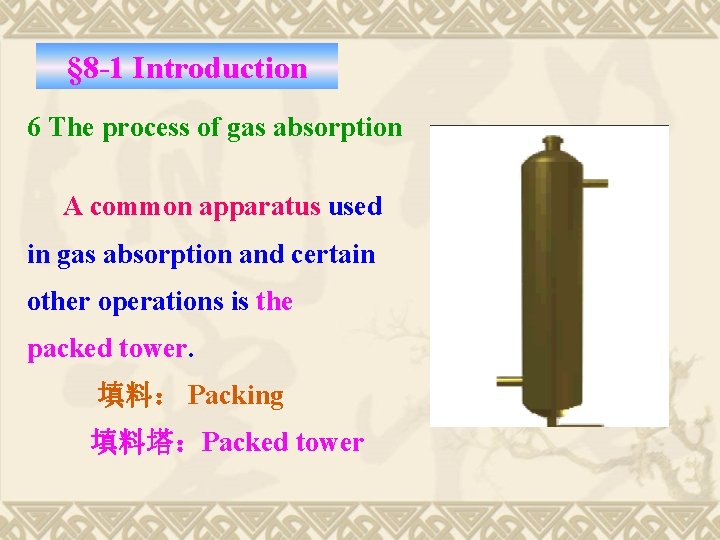
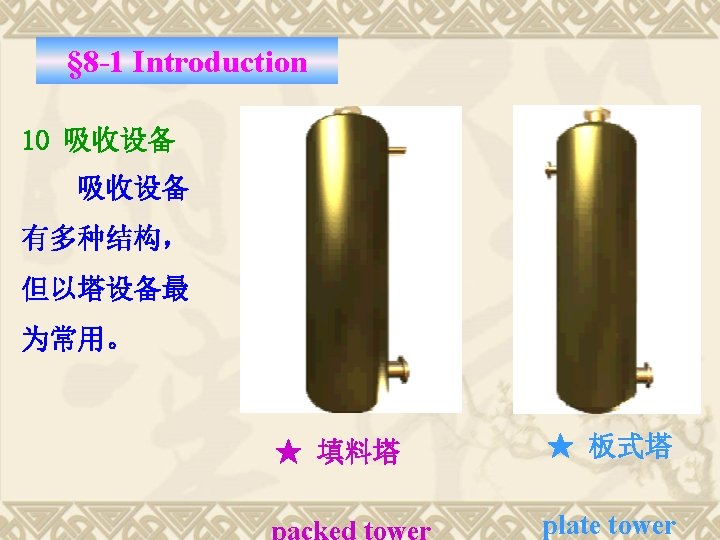
§ 8 -1 Introduction 6 The process of gas absorption A common apparatus used in gas absorption and certain other operations is the packed tower. 填料: Packing 填料塔:Packed tower
§ 8 -1 Introduction The rich gas enters the distributing space below the packing and flows upward through the interstices (空隙 )in the packing countercurrent to the flow of the liquid.
§ 8 -1 Introduction ⑴ The packing provides a large area of contact between the liquid and gas and encourages intimate contact between the phases. ⑵The solute in the rich gas is absorbed by the fresh liquid entering the tower , and dilute, or lean, gas leaves the top. ⑶The liquid is enriched in solute as it flows down the tower, and concentrated liquid, called the strong liquid , leaves the bottom of the tower through the liquid outlet.
§ 8 -1 Introduction 7 Major applications for gas absorption in commercial industry ⑴ Purification of the material gases 原料气净化 CO 2 and H 2 S are removed from natural gas or synthesis gas by absorption in solutions of amines salts. 在合成NH 3 艺中,来自变换 段的变换气约含 28%CO 2。因C 02可使catalyst中毒。所以,变换气进合 成塔前,必须经过水洗和铜洗两个 段,将CO 2的含 量减小到 0. 01%以下。
§ 8 -1 Introduction 7 Major applications for gas absorption in commercial industry ⑵Recovering of using materials ⑶Preparation of some solution 化学吸 收 For examples: NO 2 is absorbed by liquid water. →HNO 3 HCl is absorbed by liquid water. →HCl ⑷Purification of waste gas 物理吸 收
§ 8 -1 Introduction 8 Classification ⑶Single and multiple component absorption Single component : 混合气中只有一个组份进入液相。 Multicomponent : 混合气中有两或更多组份进入液相。 This chapter deals with the isothermal single absorption.
§ 8 -1 Introduction 9 This chapter will discuss some questions : ⑴ 吸收过程进行的限度和影响因素 ~ Phase-equilibrium ~相平衡 ⑵ 吸收剂用量的计算(操作型问题) ~ Calculation of amount of the liquid ⑶ 吸收塔高度的计算(设计型问题) ~Calculation of tower height ⑷ 提高吸收塔生产能力的措施 ~ Methods to enhance the ability of absorption tower