
Chapter 17 Organizational Behavior 15 th Ed Robbins
Chapter 17 Organizational Behavior 15 th Ed Robbins and Judge Human Resources and Policies Copyright © 2013 Pearson Education, Inc. publishing as Prentice Hall 17 -1
Chapter 17 Learning Objectives After studying this chapter you should be able to: 1. Define initial selection, and identify the most useful methods. 2. Define substantive selection, and identify the most useful methods. 3. Define contingent selection, and contrast the arguments for and against drug testing. 4. Compare the four main types of training. 5. Contrast formal and informal training methods. 6. Contrast on-the-job and off-the-job training. 7. Describe the purposes of performance evaluation and list the methods by which it can be done. 8. Show managers can improve performance evaluations. 9. Describe how organizations can manage work-family conflicts. Copyright © 2013 Pearson Education, Inc. publishing as Prentice Hall 17 -2

LO 1 Define initial selection, and identify the most useful methods Copyright © 2013 Pearson Education, Inc. publishing as Prentice Hall 17 -3

LO 1 Define initial selection, and identify the most useful methods Copyright © 2013 Pearson Education, Inc. publishing as Prentice Hall 17 -4
LO 2 Define substantive selection, and identify the most useful methods Substantive Selection Written tests Performance simulations Assessment centers Situational judgment tests Interviews Copyright © 2013 Pearson Education, Inc. publishing as Prentice Hall 17 -5
LO 4 Compare the four main types of training Types of Training There are four general skill categories for training: Basic literacy skills Technical skills Interpersonal skills Problem solving skills Copyright © 2013 Pearson Education, Inc. publishing as Prentice Hall 17 -6
LO 5 Contrast formal and informal training methods Training Methods Historically, training meant formal training. It is planned in advance and has a structured format. Organizations are increasingly relying on informal training. Unstructured, unplanned, and easily adapted to situations and individuals. Copyright © 2013 Pearson Education, Inc. publishing as Prentice Hall 17 -7
LO 6 Contrast on-the-job and off-the-job training Training Methods Effectiveness The effectiveness of a training program can refer to the level of student satisfaction, the amount students learn, the extent to which they transfer the material from training to their jobs, or the financial return on investments in training. An effective training program requires not just teaching the skills but also changing the work environment to support the trainees. Copyright © 2013 Pearson Education, Inc. publishing as Prentice Hall 17 -8
Describe the purposes of performance evaluation and list the methods LO 7 by which it can be done Purposes of Performance Evaluation Human resource decisions. Evaluations identify training and development needs. Pinpoint employee skills and competencies needing development. Criterion for selection and development. Provide feedback to employees. Copyright © 2013 Pearson Education, Inc. publishing as Prentice Hall 17 -9
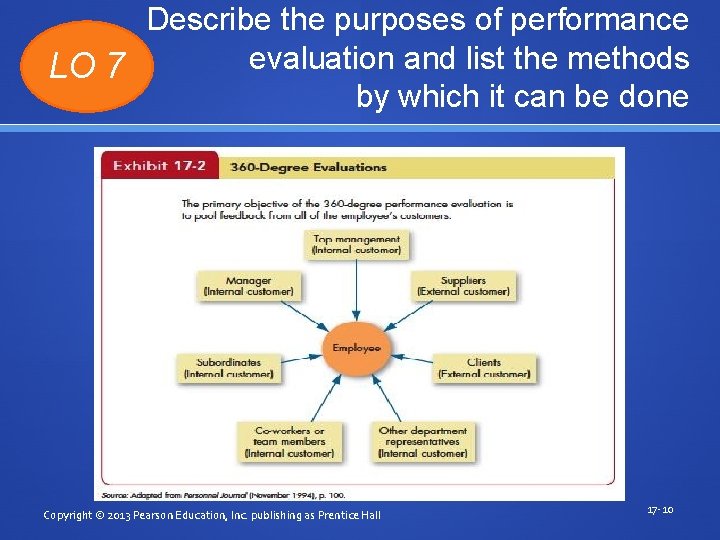
Describe the purposes of performance evaluation and list the methods LO 7 by which it can be done Copyright © 2013 Pearson Education, Inc. publishing as Prentice Hall 17 -10
LO 8 Show managers can improve performance evaluations Use Multiple Evaluators Evaluate Selectively Train Evaluators Provide Employees with Due Process Copyright © 2013 Pearson Education, Inc. publishing as Prentice Hall 17 -11
LO 8 Show managers can improve performance evaluations Providing Performance Feedback Managers are often uncomfortable discussing weaknesses with employees. In fact, unless pressured by organizational policies and controls, managers are likely to ignore this responsibility. The solution to the problem is not to ignore it but to train managers to conduct constructive feedback sessions. Copyright © 2013 Pearson Education, Inc. publishing as Prentice Hall 17 -12
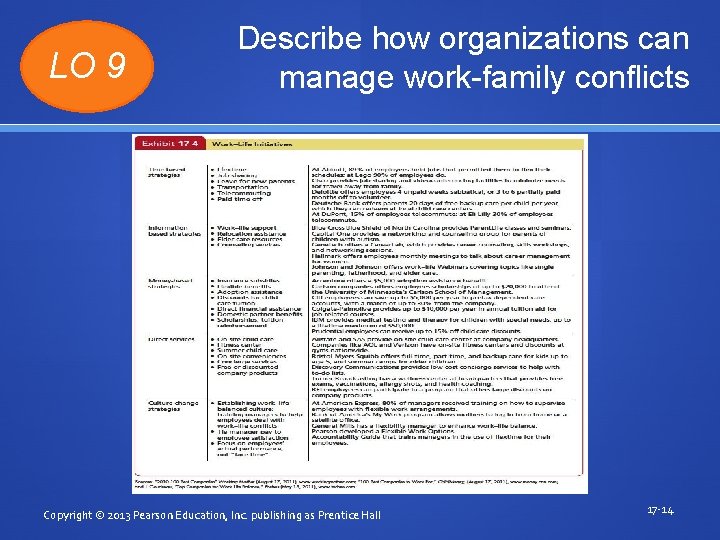
LO 9 Describe how organizations can manage work-family conflicts Managing Work-Life in Organizations Work-life conflicts grabbed management’s attention in the 1980 s, largely as a result of the growing number of women, with dependent children, entering the workforce. Organizations quickly realized work-life conflicts were not limited to female employees with children. Copyright © 2013 Pearson Education, Inc. publishing as Prentice Hall 17 -13
LO 9 Describe how organizations can manage work-family conflicts Copyright © 2013 Pearson Education, Inc. publishing as Prentice Hall 17 -14
Summary and Implications for Managers An organization’s human resource policies and practices create important forces that shape employee behavior and attitudes. In this chapter, we specifically discussed the influence of selection practices, training and development programs, and performance evaluation systems. Copyright © 2013 Pearson Education, Inc. publishing as Prentice Hall 17 -15

All rights reserved. No part of this publication may be reproduced, stored in a retrieval system, or transmitted, in any form or by any means, electronic, mechanical, photocopying, recording, or otherwise, without the prior written permission of the publisher. Printed in the United States of America. Copyright © 2013 Pearson Education, Inc. publishing as Prentice Hall 17 -16
- Slides: 16