
Chapter 17 Oligopoly Question 1 An oligopoly is

- Slides: 47
Chapter 17 Oligopoly
Question 1 • An oligopoly is a market in which: • Answer: there are only a few sellers, each offering a product similar or identical to the products offered by other firms in the market. 2
Oligopoly • Oligopoly – Only a few sellers – Offer similar or identical products – Interdependent • Game theory – How people behave in strategic situations • Choose among alternative courses of action • Must consider how others might respond to the action he takes 3
Markets with Only a Few Sellers • A small group of sellers – Tension between cooperation and selfinterest – Is best off cooperating • Acting like a monopolist – Produce a small quantity of output – Charge P >MC – Each - cares only about its own profit • Powerful incentives not to cooperate 4
Markets with Only a Few Sellers • A duopoly example • Duopoly – Oligopoly with only two members – Decide quantity to sell – Price – determined on the market • By demand 5
Question 2 • One key difference between an oligopoly market and a perfectly competitive market is that oligopolistic firms: • Answer: can affect the profit of others firms in the market by choices they make whereas firms in perfectly competitive markets do not affect each other by choice they make. 6
Markets with Only a Few Sellers • Competition, monopolies, and cartels • Perfectly competitive firm – Price = marginal cost – Quantity = efficient • Monopoly – Price > marginal cost – Quantity < efficient quantity 7
Markets with Only a Few Sellers • Competition, monopolies, and cartels • Duopoly – Collude and form a cartel • Act as a monopoly – Total level of production – Quantity produced by each member – Don’t collude – self-interest • Difficult to agree; Antitrust laws • Higher quantity; lower price; lower profit – Not competitive allocation • Nash equilibrium 8
Markets with Only a Few Sellers • Collusion – Agreement among firms in a market • Quantities to produce or • Prices to charge • Cartel – Group of firms acting in unison 9
Question 3 • If, in a particular market, firms sell identical products, then the market is – A. perfectly competitive. – B. monopolistically competitive. – C. an oligopoly. • Answer: C. Only 10
Question 4 • A market structure in which there are many firms selling products that are similar but not identical is known as: • Answer: oligopoly. 11
Question 5 • The equilibrium quantity in markets characterized by oligopoly is: • Answer: higher than in monopoly markets and lower than in perfectly competitive markets. 12
Markets with Only a Few Sellers • The equilibrium for an oligopoly • Nash equilibrium – Economic actors interacting with one another – Each choose their best strategy • Given the strategies that all the other actors have chosen 13
Question 6 • Consider a market that is initially perfectly competitive with many firms selling an identical product. Over time, however, suppose the merging of firms results in the market being served by only three or four firms selling this same product. As a result, we would expect: • Answer: a decrease in market output and an increase in the price of the product. 14
Markets with Only a Few Sellers • How the size of an oligopoly affects the market outcome • More sellers – Form a cartel - Maximize profit • Produce monopoly quantity • Charge monopoly price • Difficult to reach & enforce an agreement 15
Markets with Only a Few Sellers • How the size of an oligopoly affects the market outcome • More sellers – Do not form a cartel – Each firm: • The output effect – P > MC – Sell one more unit: Increase profit • The price effect – Increase production: increase total amount sold – Decrease in price: Lower profit 16
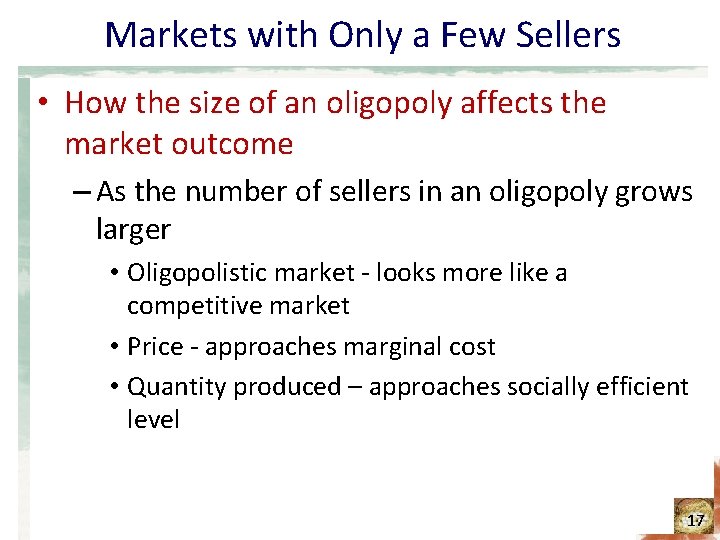
Markets with Only a Few Sellers • How the size of an oligopoly affects the market outcome – As the number of sellers in an oligopoly grows larger • Oligopolistic market - looks more like a competitive market • Price - approaches marginal cost • Quantity produced – approaches socially efficient level 17
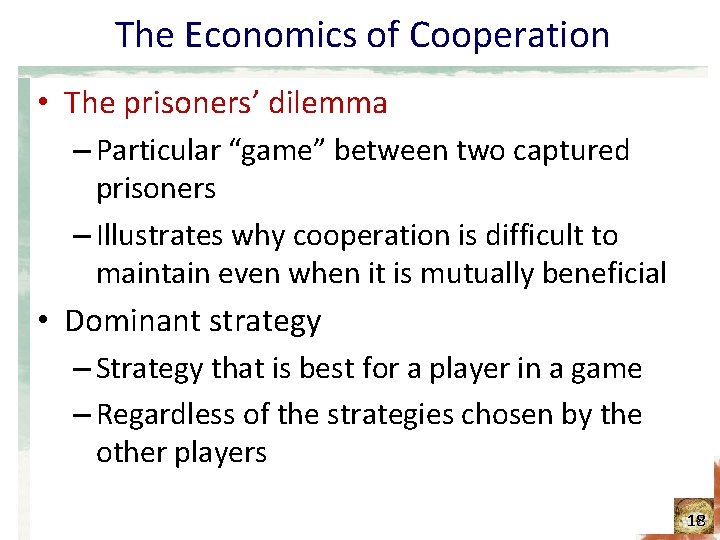
The Economics of Cooperation • The prisoners’ dilemma – Particular “game” between two captured prisoners – Illustrates why cooperation is difficult to maintain even when it is mutually beneficial • Dominant strategy – Strategy that is best for a player in a game – Regardless of the strategies chosen by the other players 18
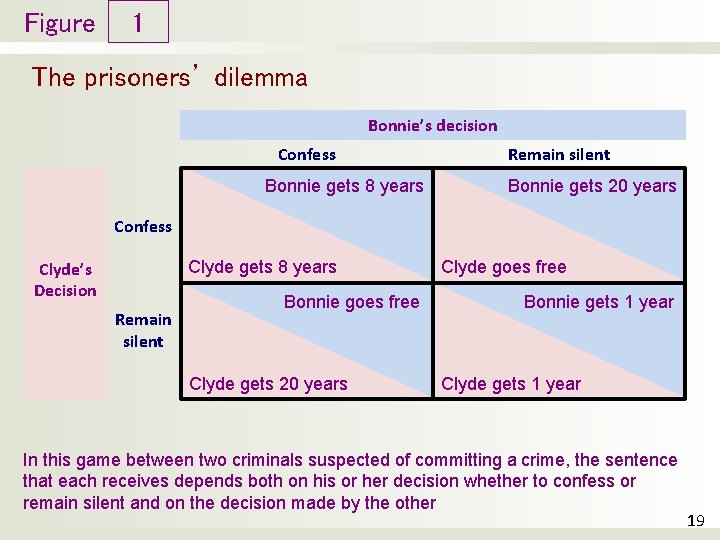
Figure 1 The prisoners’ dilemma Bonnie’s decision Confess Bonnie gets 8 years Remain silent Bonnie gets 20 years Confess Clyde gets 8 years Clyde’s Decision Remain silent Bonnie goes free Clyde gets 20 years Clyde goes free Bonnie gets 1 year Clyde gets 1 year In this game between two criminals suspected of committing a crime, the sentence that each receives depends both on his or her decision whether to confess or remain silent and on the decision made by the other 19
Question 7 • The prisoners’ dilemma is an important game to study because • Answer: it identifies the fundamental difficulty in maintaining cooperative agreements. 20
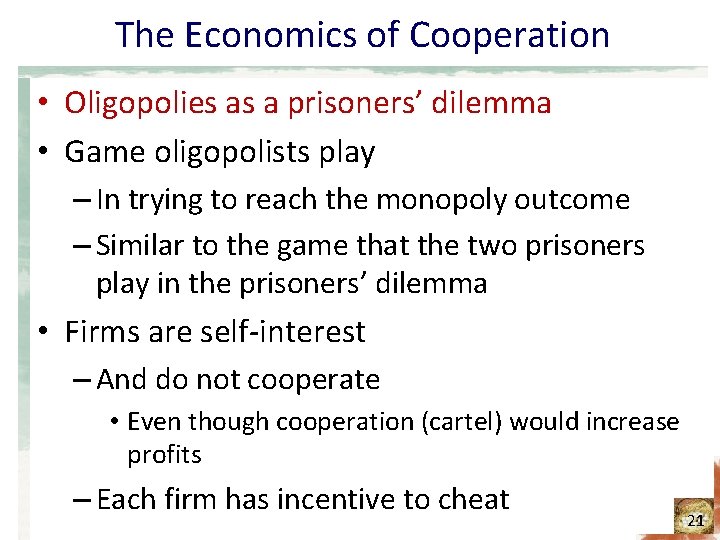
The Economics of Cooperation • Oligopolies as a prisoners’ dilemma • Game oligopolists play – In trying to reach the monopoly outcome – Similar to the game that the two prisoners play in the prisoners’ dilemma • Firms are self-interest – And do not cooperate • Even though cooperation (cartel) would increase profits – Each firm has incentive to cheat 21
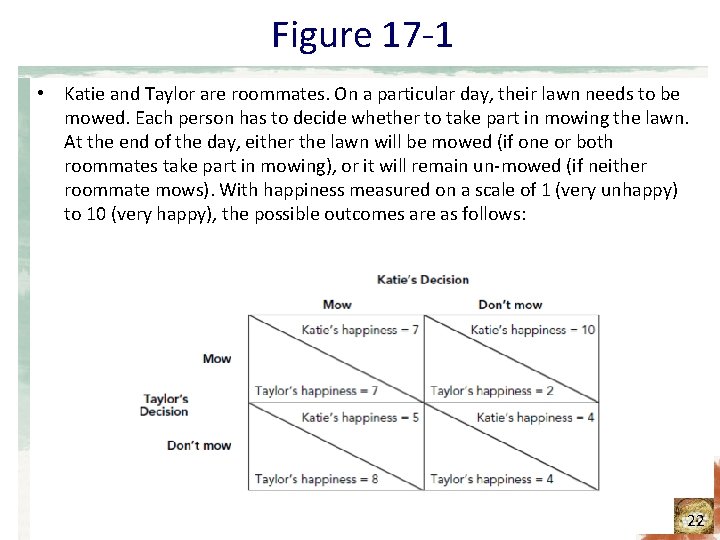
Figure 17 -1 • Katie and Taylor are roommates. On a particular day, their lawn needs to be mowed. Each person has to decide whether to take part in mowing the lawn. At the end of the day, either the lawn will be mowed (if one or both roommates take part in mowing), or it will remain un-mowed (if neither roommate mows). With happiness measured on a scale of 1 (very unhappy) to 10 (very happy), the possible outcomes are as follows: 22
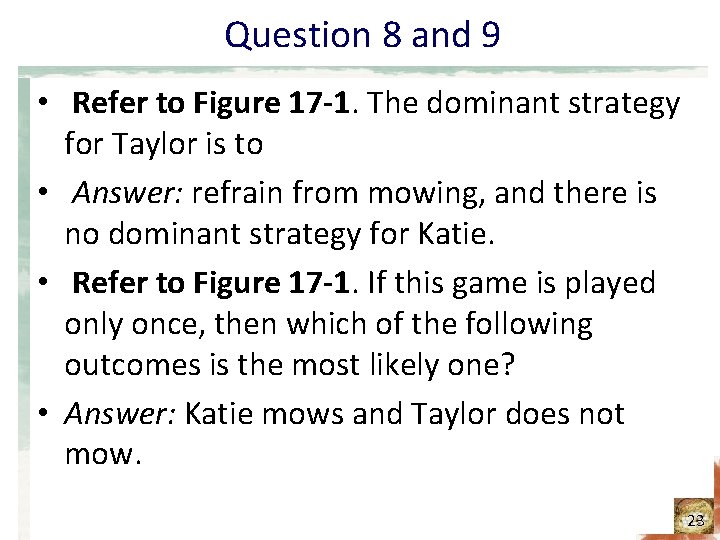
Question 8 and 9 • Refer to Figure 17 -1. The dominant strategy for Taylor is to • Answer: refrain from mowing, and there is no dominant strategy for Katie. • Refer to Figure 17 -1. If this game is played only once, then which of the following outcomes is the most likely one? • Answer: Katie mows and Taylor does not mow. 23
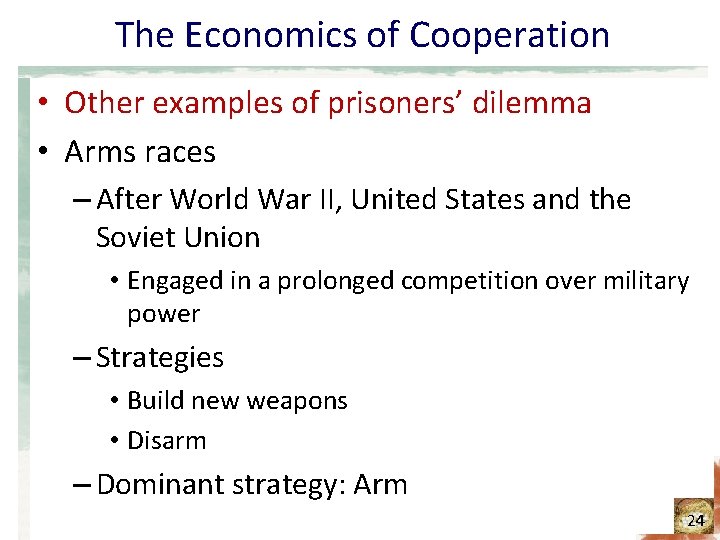
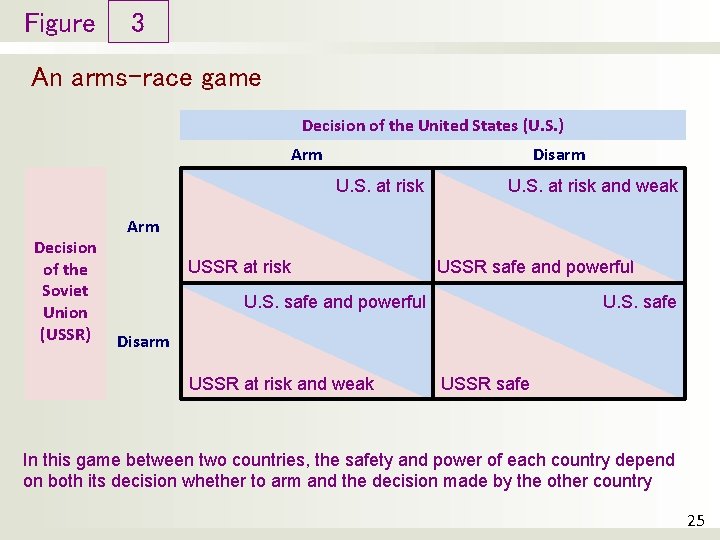
The Economics of Cooperation • Other examples of prisoners’ dilemma • Arms races – After World War II, United States and the Soviet Union • Engaged in a prolonged competition over military power – Strategies • Build new weapons • Disarm – Dominant strategy: Arm 24
Figure 3 An arms-race game Decision of the United States (U. S. ) Arm Disarm U. S. at risk Decision of the Soviet Union (USSR) U. S. at risk and weak Arm USSR at risk USSR safe and powerful U. S. safe Disarm USSR at risk and weak USSR safe In this game between two countries, the safety and power of each country depend on both its decision whether to arm and the decision made by the other country 25
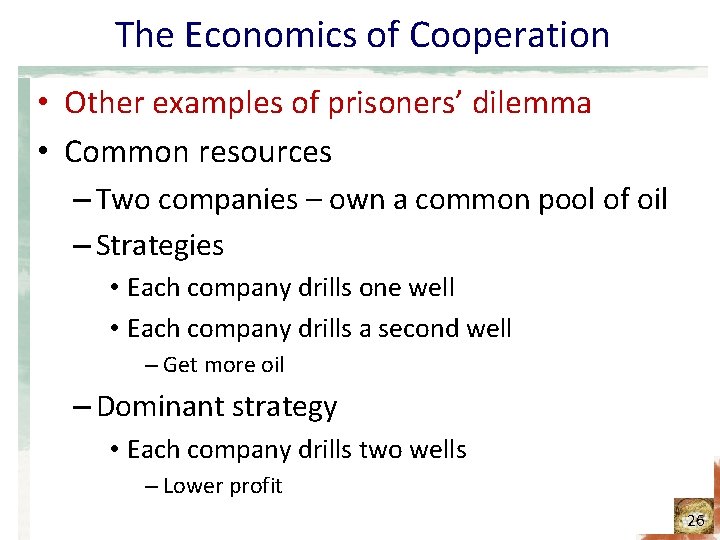
The Economics of Cooperation • Other examples of prisoners’ dilemma • Common resources – Two companies – own a common pool of oil – Strategies • Each company drills one well • Each company drills a second well – Get more oil – Dominant strategy • Each company drills two wells – Lower profit 26
Question 10 • In a game, a dominant strategy is: • Answer: the best strategy for a player to follow, regardless of the strategies followed by other players. 27
The Economics of Cooperation • The prisoners’ dilemma and the welfare of society • Dominant strategy – Noncooperative equilibrium • May be bad for society and the players – Arms race game – Common resource game • May be good for society – Quantity and price – closer to optimal level 28
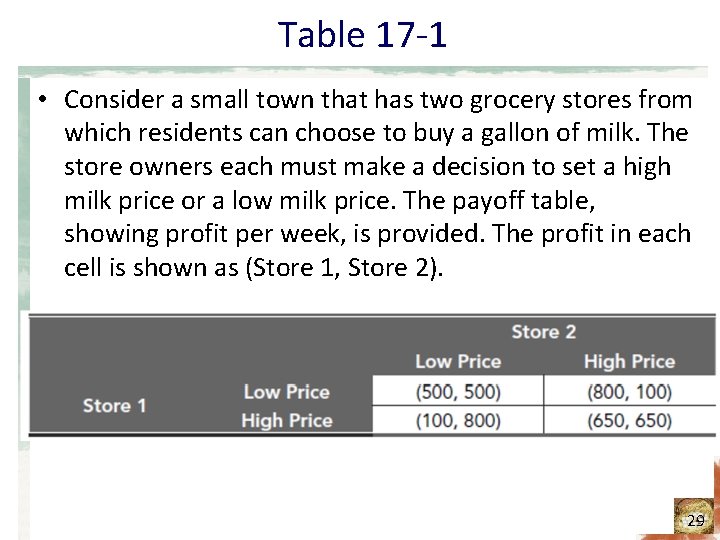
Table 17 -1 • Consider a small town that has two grocery stores from which residents can choose to buy a gallon of milk. The store owners each must make a decision to set a high milk price or a low milk price. The payoff table, showing profit per week, is provided. The profit in each cell is shown as (Store 1, Store 2). 29
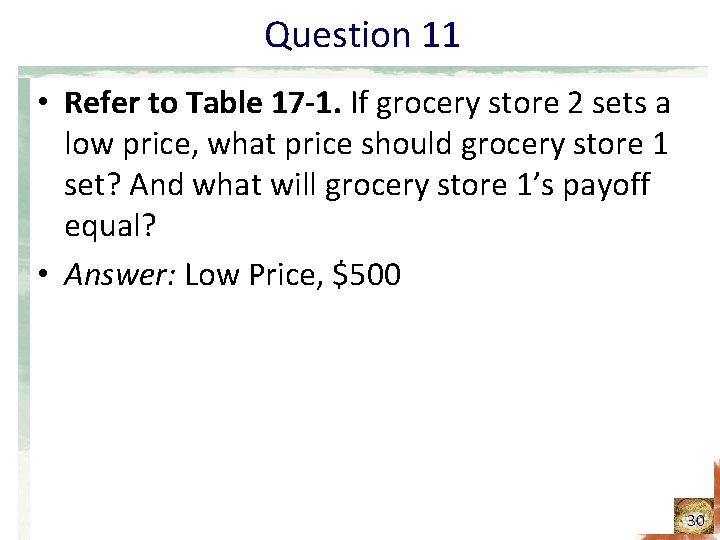
Question 11 • Refer to Table 17 -1. If grocery store 2 sets a low price, what price should grocery store 1 set? And what will grocery store 1’s payoff equal? • Answer: Low Price, $500 30
The Economics of Cooperation • Why people sometimes cooperate • Game of repeated prisoners’ dilemma – Repeat the game – Agree on penalties if one cheats – Both have incentive to cooperate 31
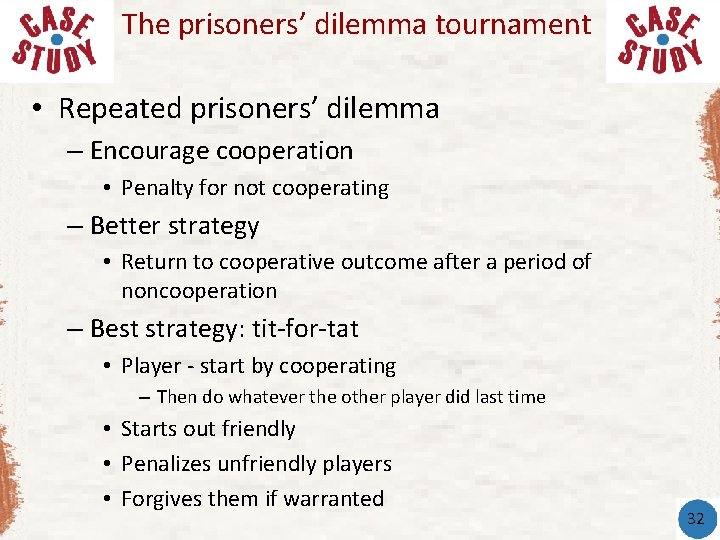
The prisoners’ dilemma tournament • Repeated prisoners’ dilemma – Encourage cooperation • Penalty for not cooperating – Better strategy • Return to cooperative outcome after a period of noncooperation – Best strategy: tit-for-tat • Player - start by cooperating – Then do whatever the other player did last time • Starts out friendly • Penalizes unfriendly players • Forgives them if warranted 32
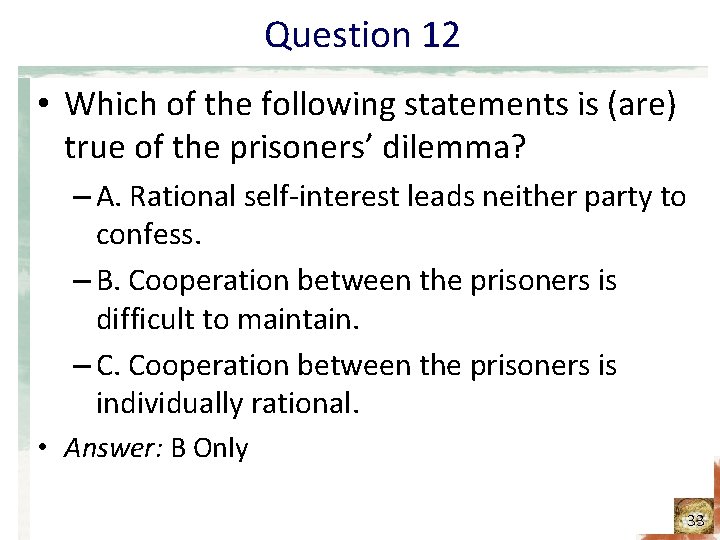
Question 12 • Which of the following statements is (are) true of the prisoners’ dilemma? – A. Rational self-interest leads neither party to confess. – B. Cooperation between the prisoners is difficult to maintain. – C. Cooperation between the prisoners is individually rational. • Answer: B Only 33
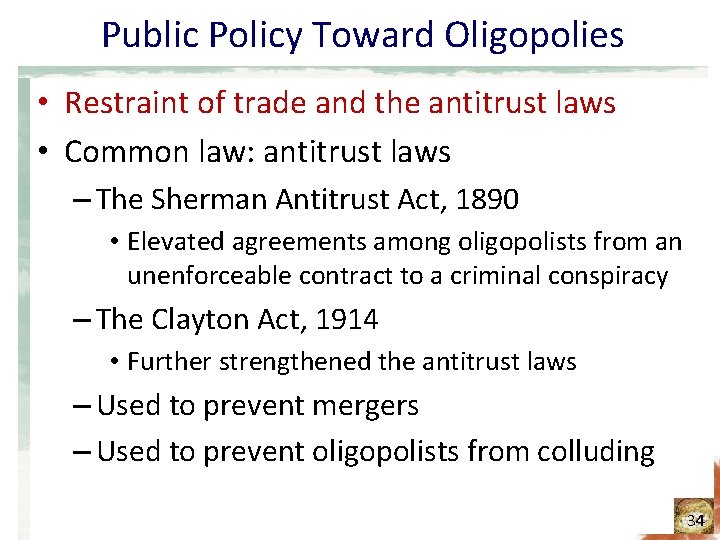
Public Policy Toward Oligopolies • Restraint of trade and the antitrust laws • Common law: antitrust laws – The Sherman Antitrust Act, 1890 • Elevated agreements among oligopolists from an unenforceable contract to a criminal conspiracy – The Clayton Act, 1914 • Further strengthened the antitrust laws – Used to prevent mergers – Used to prevent oligopolists from colluding 34
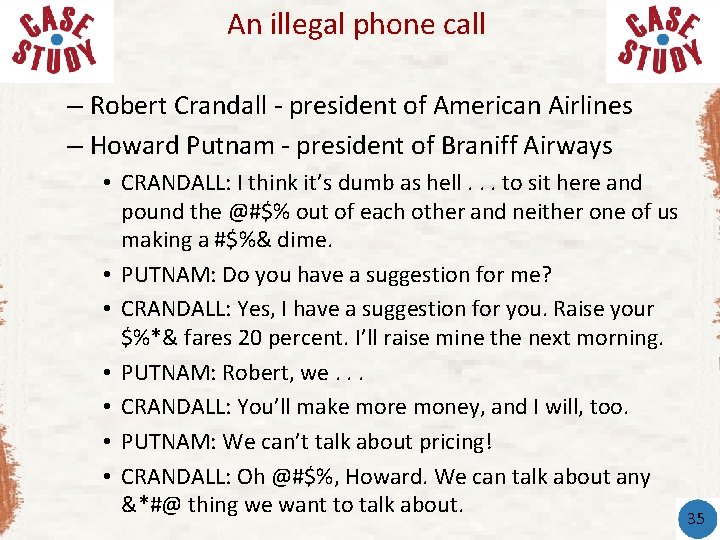
An illegal phone call – Robert Crandall - president of American Airlines – Howard Putnam - president of Braniff Airways • CRANDALL: I think it’s dumb as hell. . . to sit here and pound the @#$% out of each other and neither one of us making a #$%& dime. • PUTNAM: Do you have a suggestion for me? • CRANDALL: Yes, I have a suggestion for you. Raise your $%*& fares 20 percent. I’ll raise mine the next morning. • PUTNAM: Robert, we. . . • CRANDALL: You’ll make more money, and I will, too. • PUTNAM: We can’t talk about pricing! • CRANDALL: Oh @#$%, Howard. We can talk about any &*#@ thing we want to talk about. 35
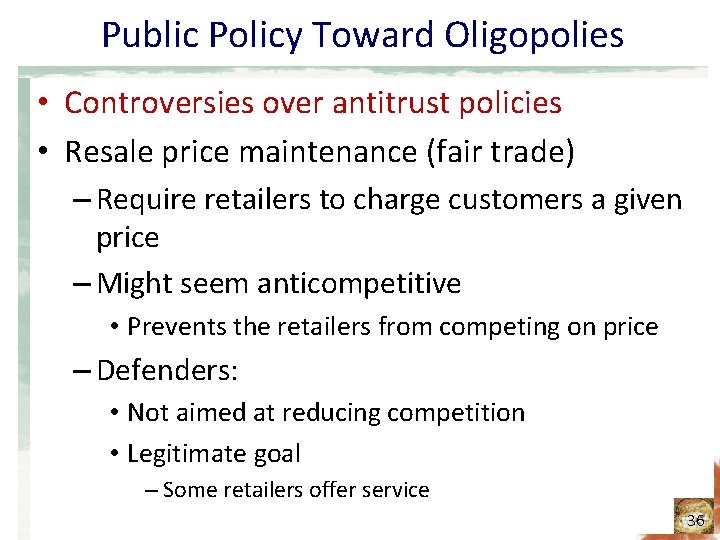
Public Policy Toward Oligopolies • Controversies over antitrust policies • Resale price maintenance (fair trade) – Require retailers to charge customers a given price – Might seem anticompetitive • Prevents the retailers from competing on price – Defenders: • Not aimed at reducing competition • Legitimate goal – Some retailers offer service 36
Public Policy Toward Oligopolies • Controversies over antitrust policies • Predatory pricing – Charge prices that are too low • Anticompetitive – Price cuts may be intended to drive other firms out of the market – Skeptics • Predatory pricing – not a profitable strategy • Price war - to drive out a rival – Prices - driven below cost 37
Public Policy Toward Oligopolies • Controversies over antitrust policies • Tying – Offer two goods together at a single price • Expand market power – Skeptics • Cannot increase market power by binding two goods together – Form of price discrimination • Tying may increase profit 38
FRQ 1 • Describe the source of tension between cooperation and self-interest in a market characterized by oligopoly. Use an example of an actual cartel arrangement to demonstrate why this tension creates instability in cartels. 39
FRQ 1 Answer • The source of the tension exists because total profits are maximized when oligopolists cooperate on price and quantity by operating as a monopolist. However, individual profits can be gained by individuals cheating on their cooperative agreement. This is why cooperative agreements among members of a cartel are inherently unstable. This is evident in the problem OPEC experiences in enforcing the cooperative agreement on production and price of crude oil. 40
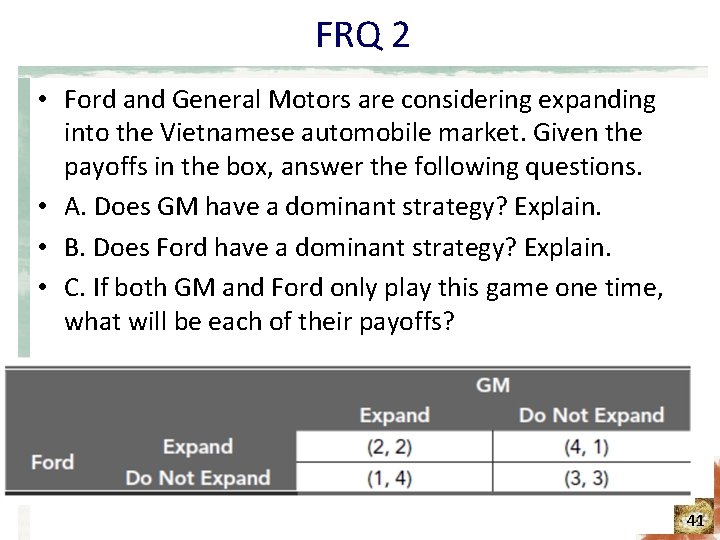
FRQ 2 • Ford and General Motors are considering expanding into the Vietnamese automobile market. Given the payoffs in the box, answer the following questions. • A. Does GM have a dominant strategy? Explain. • B. Does Ford have a dominant strategy? Explain. • C. If both GM and Ford only play this game one time, what will be each of their payoffs? 41
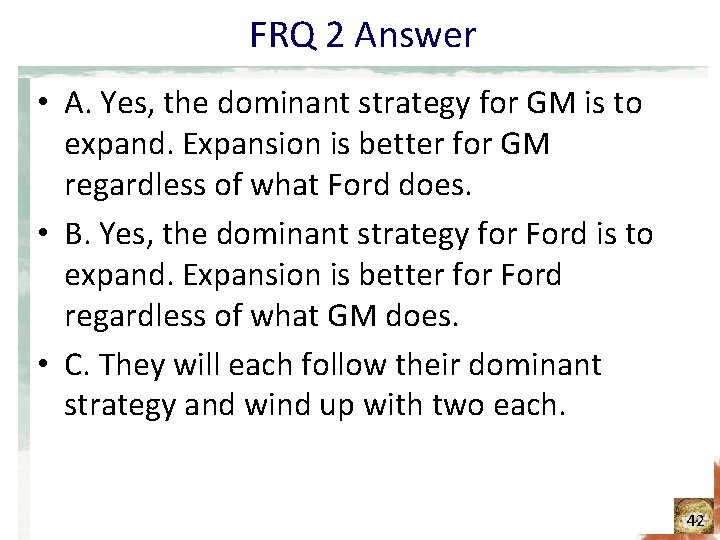
FRQ 2 Answer • A. Yes, the dominant strategy for GM is to expand. Expansion is better for GM regardless of what Ford does. • B. Yes, the dominant strategy for Ford is to expand. Expansion is better for Ford regardless of what GM does. • C. They will each follow their dominant strategy and wind up with two each. 42
The Microsoft case • U. S. government’s suit against the Microsoft Corporation, 1998 – Central issue: tying • Should Microsoft be allowed to integrate its Internet browser into its Windows operating system • The government’s claim: – Microsoft was bundling - to expand market power into the market of Internet browsers – Would deter other software companies from entering the market and offering new products 43
The Microsoft case • Microsoft responded – New features into old products - natural part of technological progress • Cars - include CD players, air conditioners • Cameras - built-in flashes • Operating systems - added many features to Windows – Previously stand-alone products – Computers - more reliable and easier to use – Integration of Internet technology, • The next natural next step 44
The Microsoft case • Disagreement – Extent of Microsoft’s market power • The government – More than 80% of new personal computers • Use a Microsoft operating system • Substantial monopoly power • Microsoft – Software market is always changing – Competitors: Apple Mac & Linux operating systems – Low price – limited market power 45
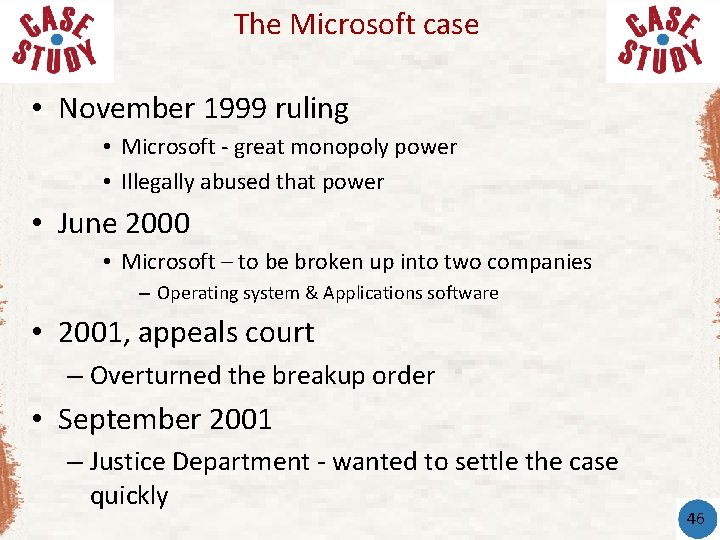
The Microsoft case • November 1999 ruling • Microsoft - great monopoly power • Illegally abused that power • June 2000 • Microsoft – to be broken up into two companies – Operating system & Applications software • 2001, appeals court – Overturned the breakup order • September 2001 – Justice Department - wanted to settle the case quickly 46
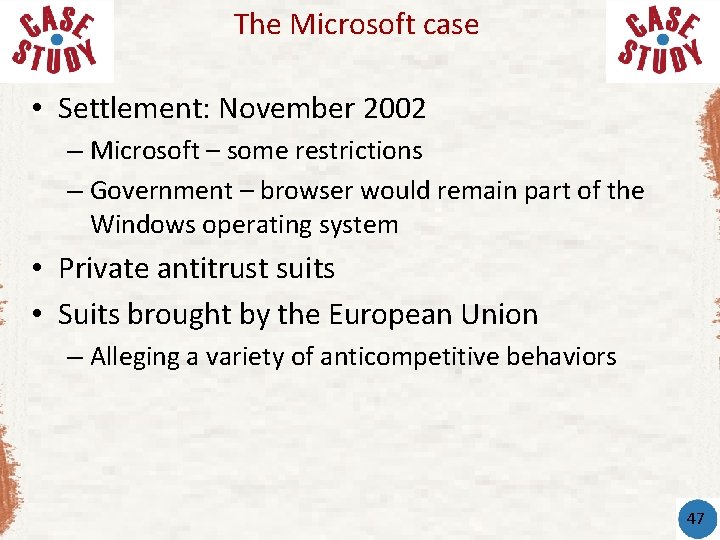
The Microsoft case • Settlement: November 2002 – Microsoft – some restrictions – Government – browser would remain part of the Windows operating system • Private antitrust suits • Suits brought by the European Union – Alleging a variety of anticompetitive behaviors 47