
CHAPTER 17 Oligopoly Economics N Gregory Mankiw PRINCIPLES
- Slides: 41
CHAPTER 17 Oligopoly 과점 Economics N. Gregory Mankiw PRINCIPLES OF N. Gregory Mankiw Premium Power. Point Slides by Ron Cronovich © 2009 South-Western, a part of Cengage Learning, all rights reserved
In this chapter, look for the answers to these questions: § What outcomes are possible under oligopoly? § § § 과점시장에서는 어떤 결과가 도출될까? Why is it difficult for oligopoly firms to cooperate? 과점시장의 기업들은 왜 협력하기 어려울까? How are antitrust laws used to foster competition? 독점금지법(반독점법)은 어떻게 경쟁을 촉진시킬까? 1
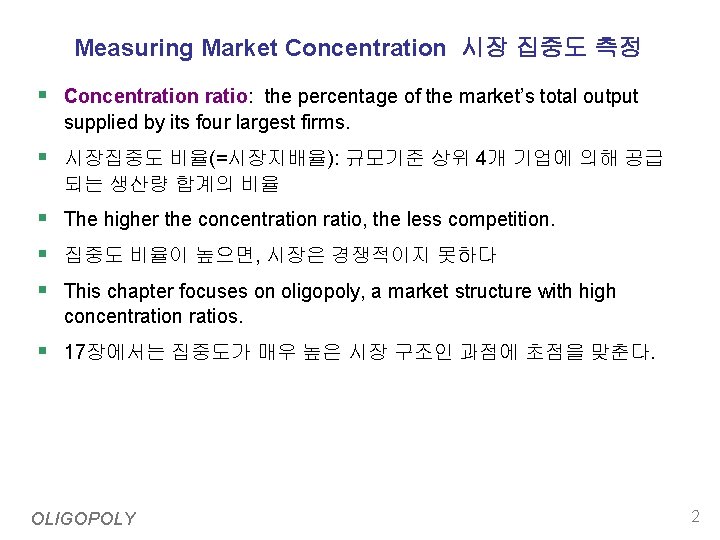
Measuring Market Concentration 시장 집중도 측정 § Concentration ratio: the percentage of the market’s total output supplied by its four largest firms. § 시장집중도 비율(=시장지배율): 규모기준 상위 4개 기업에 의해 공급 되는 생산량 합계의 비율 § The higher the concentration ratio, the less competition. § 집중도 비율이 높으면, 시장은 경쟁적이지 못하다 § This chapter focuses on oligopoly, a market structure with high concentration ratios. § 17장에서는 집중도가 매우 높은 시장 구조인 과점에 초점을 맞춘다. OLIGOPOLY 2
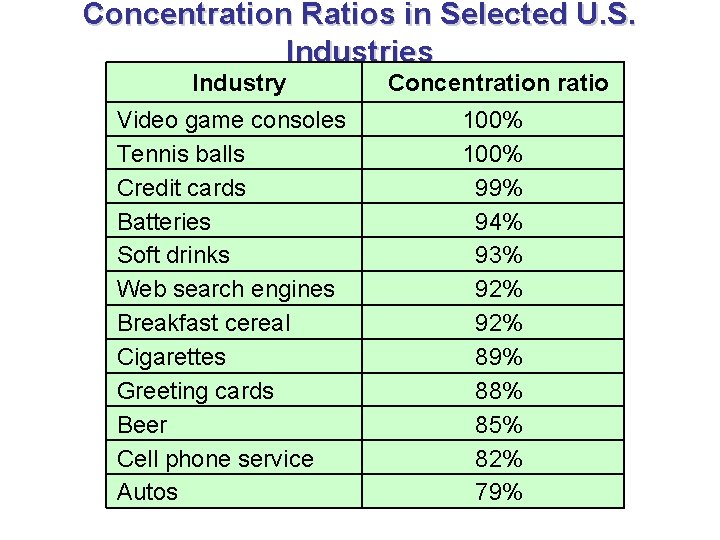
Concentration Ratios in Selected U. S. Industries Industry Video game consoles Tennis balls Credit cards Batteries Soft drinks Web search engines Breakfast cereal Cigarettes Greeting cards Beer Cell phone service Autos Concentration ratio 100% 99% 94% 93% 92% 89% 88% 85% 82% 79%
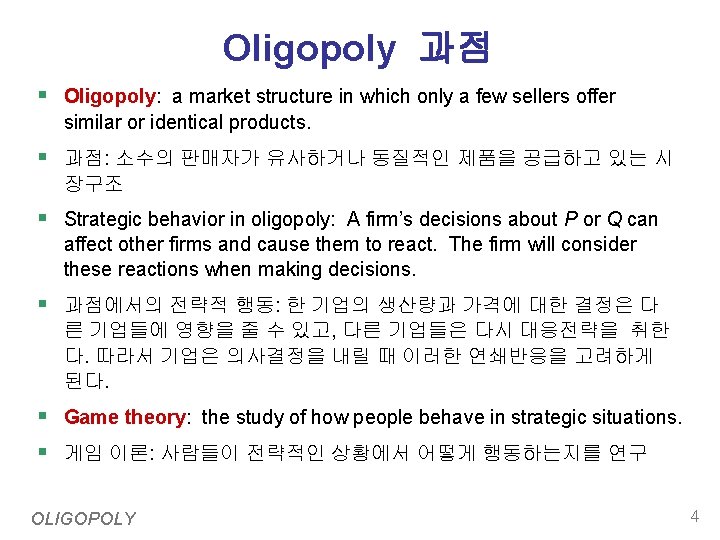
Oligopoly 과점 § Oligopoly: a market structure in which only a few sellers offer similar or identical products. § 과점: 소수의 판매자가 유사하거나 동질적인 제품을 공급하고 있는 시 장구조 § Strategic behavior in oligopoly: A firm’s decisions about P or Q can affect other firms and cause them to react. The firm will consider these reactions when making decisions. § 과점에서의 전략적 행동: 한 기업의 생산량과 가격에 대한 결정은 다 른 기업들에 영향을 줄 수 있고, 다른 기업들은 다시 대응전략을 취한 다. 따라서 기업은 의사결정을 내릴 때 이러한 연쇄반응을 고려하게 된다. § Game theory: the study of how people behave in strategic situations. § 게임 이론: 사람들이 전략적인 상황에서 어떻게 행동하는지를 연구 OLIGOPOLY 4
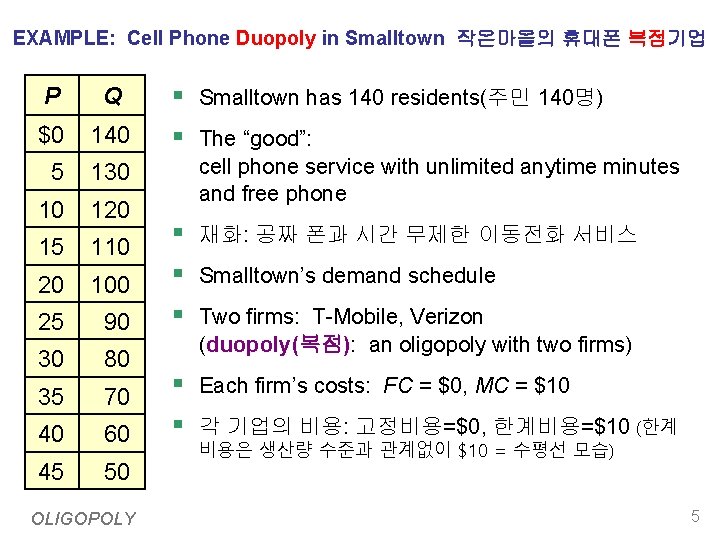
EXAMPLE: Cell Phone Duopoly in Smalltown 작은마을의 휴대폰 복점기업 § Smalltown has 140 residents(주민 140명) P Q $0 140 5 130 10 120 15 110 20 100 § Smalltown’s demand schedule 25 90 § Two firms: T-Mobile, Verizon 30 80 35 70 40 60 45 50 OLIGOPOLY § The “good”: cell phone service with unlimited anytime minutes and free phone § 재화: 공짜 폰과 시간 무제한 이동전화 서비스 (duopoly(복점): an oligopoly with two firms) § Each firm’s costs: FC = $0, MC = $10 § 각 기업의 비용: 고정비용=$0, 한계비용=$10 (한계 비용은 생산량 수준과 관계없이 $10 = 수평선 모습) 5
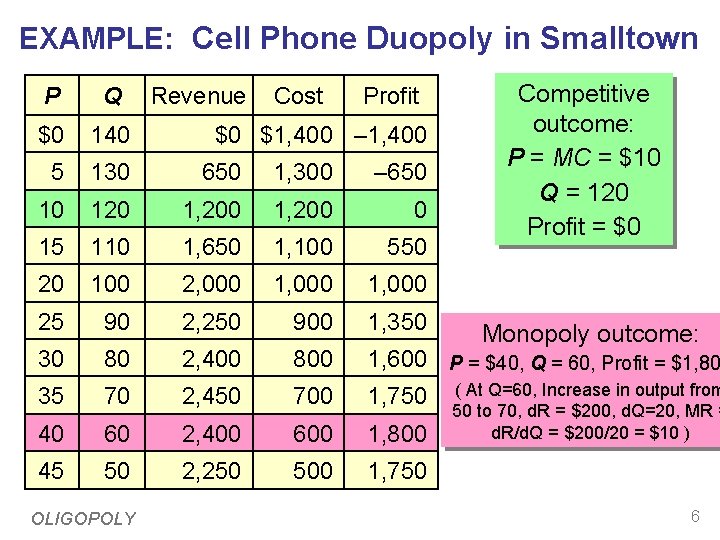
EXAMPLE: Cell Phone Duopoly in Smalltown Q $0 140 5 130 650 1, 300 – 650 10 120 1, 200 0 15 110 1, 650 1, 100 550 20 100 2, 000 1, 000 25 90 2, 250 900 1, 350 30 80 2, 400 800 35 70 2, 450 700 1, 600 P = $40, Q = 60, Profit = $1, 80 1, 750 ( At Q=60, Increase in output from 40 60 2, 400 600 1, 800 45 50 2, 250 500 1, 750 OLIGOPOLY Revenue Cost Profit Competitive outcome: P = MC = $10 Q = 120 Profit = $0 P $0 $1, 400 – 1, 400 Monopoly outcome: 50 to 70, d. R = $200, d. Q=20, MR = d. R/d. Q = $200/20 = $10 ) 6
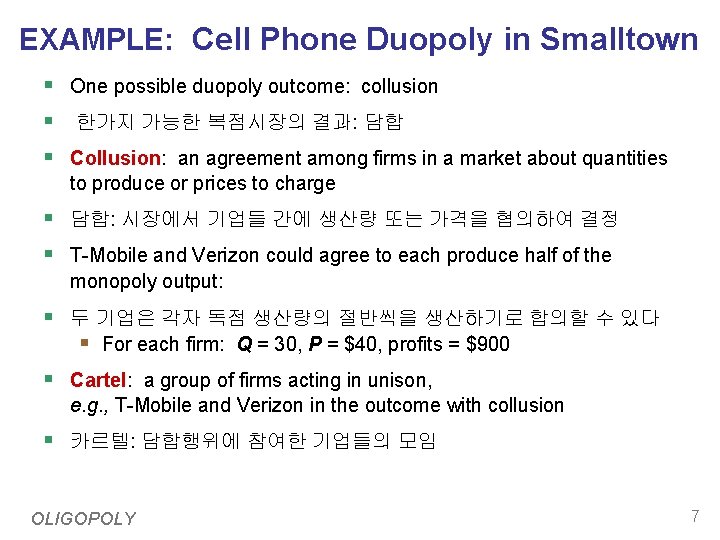
EXAMPLE: Cell Phone Duopoly in Smalltown § One possible duopoly outcome: collusion § 한가지 가능한 복점시장의 결과: 담합 § Collusion: an agreement among firms in a market about quantities to produce or prices to charge § 담합: 시장에서 기업들 간에 생산량 또는 가격을 협의하여 결정 § T-Mobile and Verizon could agree to each produce half of the monopoly output: § 두 기업은 각자 독점 생산량의 절반씩을 생산하기로 합의할 수 있다 § For each firm: Q = 30, P = $40, profits = $900 § Cartel: a group of firms acting in unison, e. g. , T-Mobile and Verizon in the outcome with collusion § 카르텔: 담합행위에 참여한 기업들의 모임 OLIGOPOLY 7
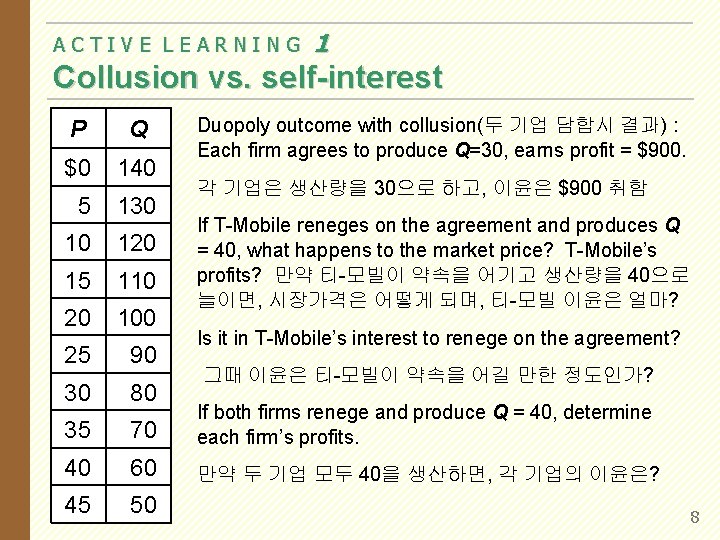
ACTIVE LEARNING 1 Collusion vs. self-interest Duopoly outcome with collusion(두 기업 담합시 결과) : Each firm agrees to produce Q=30, earns profit = $900. P Q $0 140 5 130 10 120 15 110 20 100 25 90 30 80 35 70 If both firms renege and produce Q = 40, determine each firm’s profits. 40 60 만약 두 기업 모두 40을 생산하면, 각 기업의 이윤은? 45 50 각 기업은 생산량을 30으로 하고, 이윤은 $900 취함 If T-Mobile reneges on the agreement and produces Q = 40, what happens to the market price? T-Mobile’s profits? 만약 티-모빌이 약속을 어기고 생산량을 40으로 늘이면, 시장가격은 어떻게 되며, 티-모빌 이윤은 얼마? Is it in T-Mobile’s interest to renege on the agreement? 그때 이윤은 티-모빌이 약속을 어길 만한 정도인가? 8
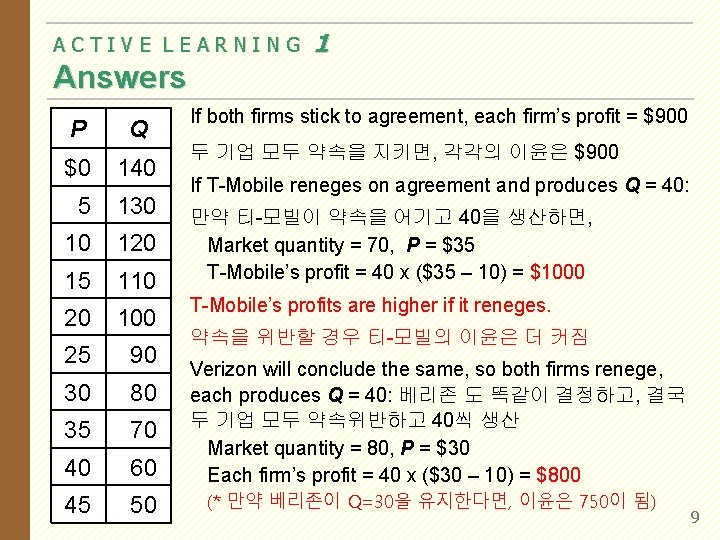
ACTIVE LEARNING 1 Answers P Q $0 140 5 130 10 120 15 110 20 100 25 90 30 80 35 70 40 60 45 50 If both firms stick to agreement, each firm’s profit = $900 두 기업 모두 약속을 지키면, 각각의 이윤은 $900 If T-Mobile reneges on agreement and produces Q = 40: 만약 티-모빌이 약속을 어기고 40을 생산하면, Market quantity = 70, P = $35 T-Mobile’s profit = 40 x ($35 – 10) = $1000 T-Mobile’s profits are higher if it reneges. 약속을 위반할 경우 티-모빌의 이윤은 더 커짐 Verizon will conclude the same, so both firms renege, each produces Q = 40: 베리존 도 똑같이 결정하고, 결국 두 기업 모두 약속위반하고 40씩 생산 Market quantity = 80, P = $30 Each firm’s profit = 40 x ($30 – 10) = $800 (* 만약 베리존이 Q=30을 유지한다면, 이윤은 750이 됨) 9
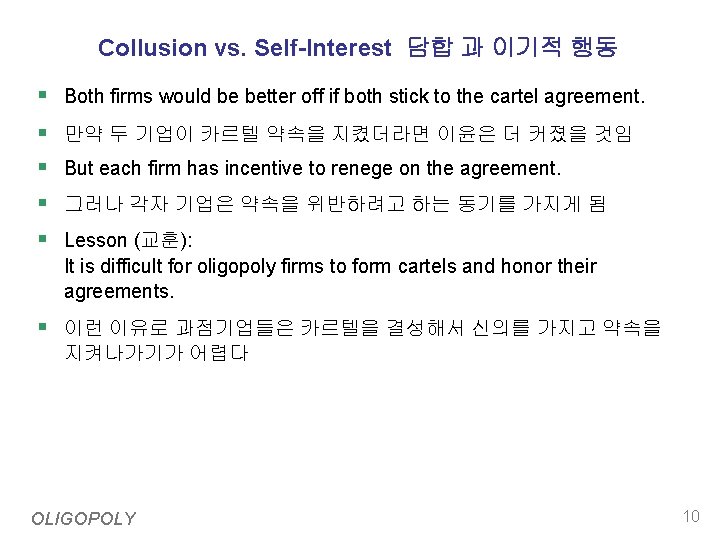
Collusion vs. Self-Interest 담합 과 이기적 행동 § Both firms would be better off if both stick to the cartel agreement. § § 만약 두 기업이 카르텔 약속을 지켰더라면 이윤은 더 커졌을 것임 But each firm has incentive to renege on the agreement. 그러나 각자 기업은 약속을 위반하려고 하는 동기를 가지게 됨 Lesson (교훈): It is difficult for oligopoly firms to form cartels and honor their agreements. § 이런 이유로 과점기업들은 카르텔을 결성해서 신의를 가지고 약속을 지켜나가기가 어렵다 OLIGOPOLY 10
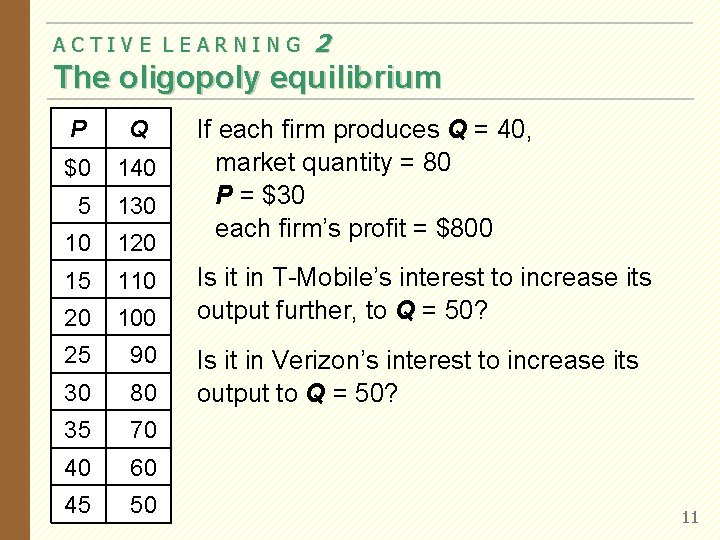
ACTIVE LEARNING 2 The oligopoly equilibrium P Q $0 140 5 130 10 120 15 110 20 100 25 90 30 80 35 70 40 60 45 50 If each firm produces Q = 40, market quantity = 80 P = $30 each firm’s profit = $800 Is it in T-Mobile’s interest to increase its output further, to Q = 50? Is it in Verizon’s interest to increase its output to Q = 50? 11
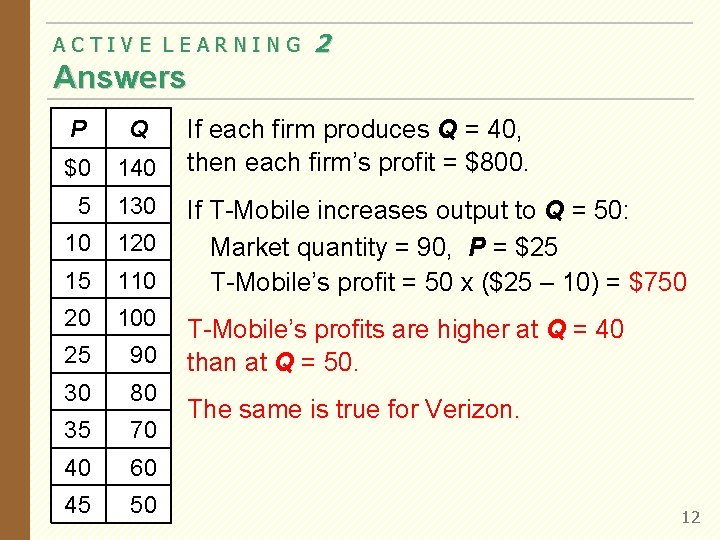
ACTIVE LEARNING 2 Answers P Q $0 140 5 130 10 120 15 110 20 100 25 90 30 80 35 70 40 60 45 50 If each firm produces Q = 40, then each firm’s profit = $800. If T-Mobile increases output to Q = 50: Market quantity = 90, P = $25 T-Mobile’s profit = 50 x ($25 – 10) = $750 T-Mobile’s profits are higher at Q = 40 than at Q = 50. The same is true for Verizon. 12
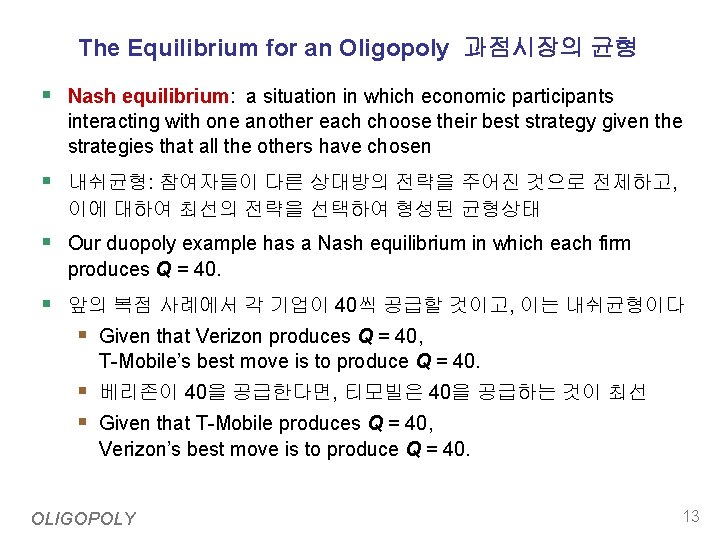
The Equilibrium for an Oligopoly 과점시장의 균형 § Nash equilibrium: a situation in which economic participants interacting with one another each choose their best strategy given the strategies that all the others have chosen § 내쉬균형: 참여자들이 다른 상대방의 전략을 주어진 것으로 전제하고, 이에 대하여 최선의 전략을 선택하여 형성된 균형상태 § Our duopoly example has a Nash equilibrium in which each firm produces Q = 40. § 앞의 복점 사례에서 각 기업이 40씩 공급할 것이고, 이는 내쉬균형이다 § Given that Verizon produces Q = 40, T-Mobile’s best move is to produce Q = 40. § 베리존이 40을 공급한다면, 티모빌은 40을 공급하는 것이 최선 § Given that T-Mobile produces Q = 40, Verizon’s best move is to produce Q = 40. OLIGOPOLY 13
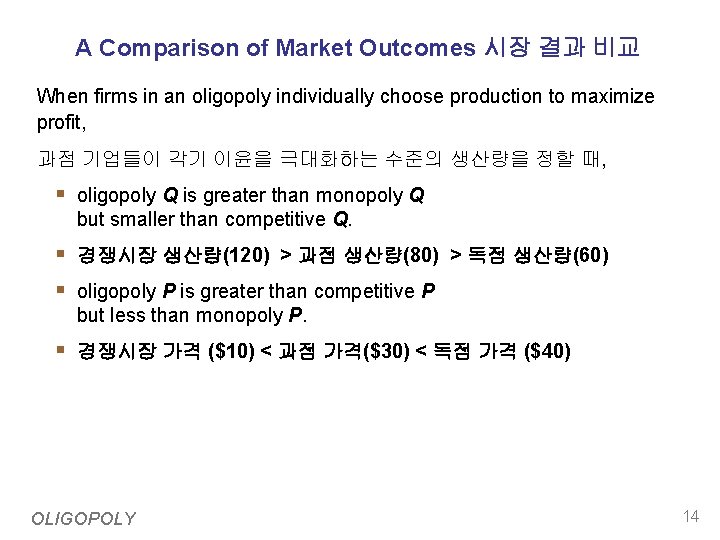
A Comparison of Market Outcomes 시장 결과 비교 When firms in an oligopoly individually choose production to maximize profit, 과점 기업들이 각기 이윤을 극대화하는 수준의 생산량을 정할 때, § oligopoly Q is greater than monopoly Q but smaller than competitive Q. § 경쟁시장 생산량(120) > 과점 생산량(80) > 독점 생산량(60) § oligopoly P is greater than competitive P but less than monopoly P. § 경쟁시장 가격 ($10) < 과점 가격($30) < 독점 가격 ($40) OLIGOPOLY 14
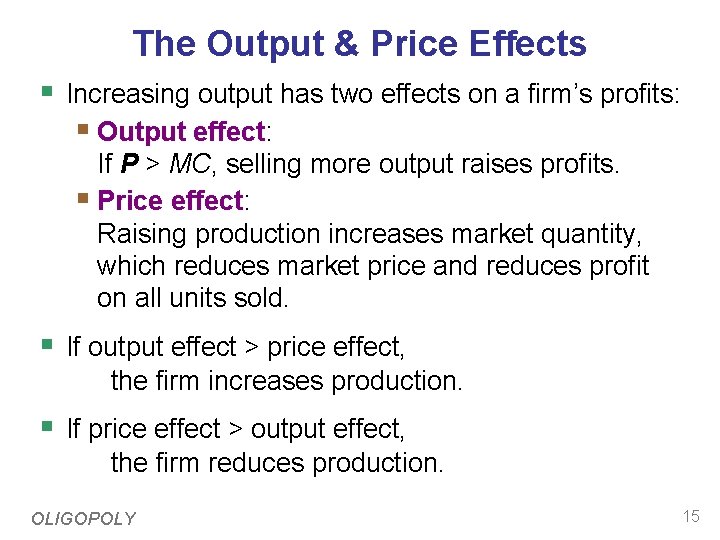
The Output & Price Effects § Increasing output has two effects on a firm’s profits: § Output effect: If P > MC, selling more output raises profits. § Price effect: Raising production increases market quantity, which reduces market price and reduces profit on all units sold. § If output effect > price effect, the firm increases production. § If price effect > output effect, the firm reduces production. OLIGOPOLY 15
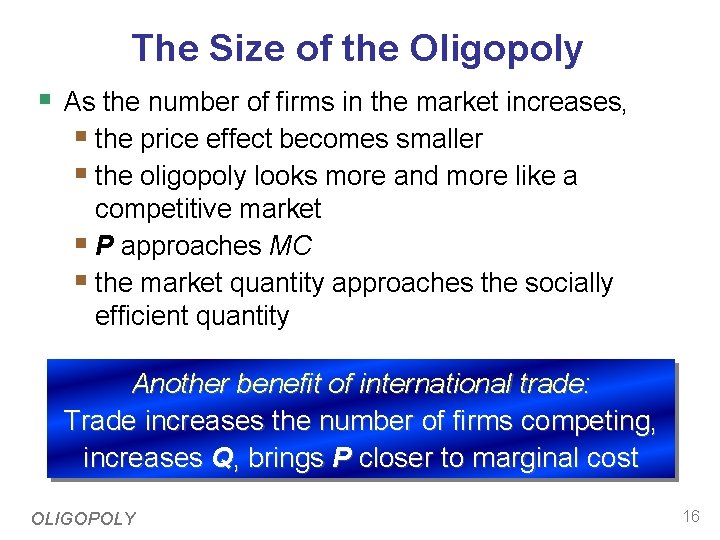
The Size of the Oligopoly § As the number of firms in the market increases, § the price effect becomes smaller § the oligopoly looks more and more like a competitive market § P approaches MC § the market quantity approaches the socially efficient quantity Another benefit of international trade: Trade increases the number of firms competing, increases Q, brings P closer to marginal cost OLIGOPOLY 16
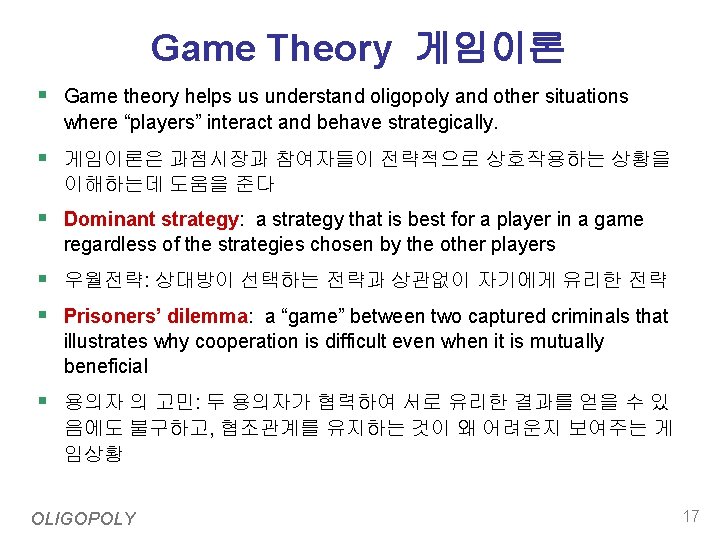
Game Theory 게임이론 § Game theory helps us understand oligopoly and other situations where “players” interact and behave strategically. § 게임이론은 과점시장과 참여자들이 전략적으로 상호작용하는 상황을 이해하는데 도움을 준다 § Dominant strategy: a strategy that is best for a player in a game regardless of the strategies chosen by the other players § 우월전략: 상대방이 선택하는 전략과 상관없이 자기에게 유리한 전략 § Prisoners’ dilemma: a “game” between two captured criminals that illustrates why cooperation is difficult even when it is mutually beneficial § 용의자 의 고민: 두 용의자가 협력하여 서로 유리한 결과를 얻을 수 있 음에도 불구하고, 협조관계를 유지하는 것이 왜 어려운지 보여주는 게 임상황 OLIGOPOLY 17
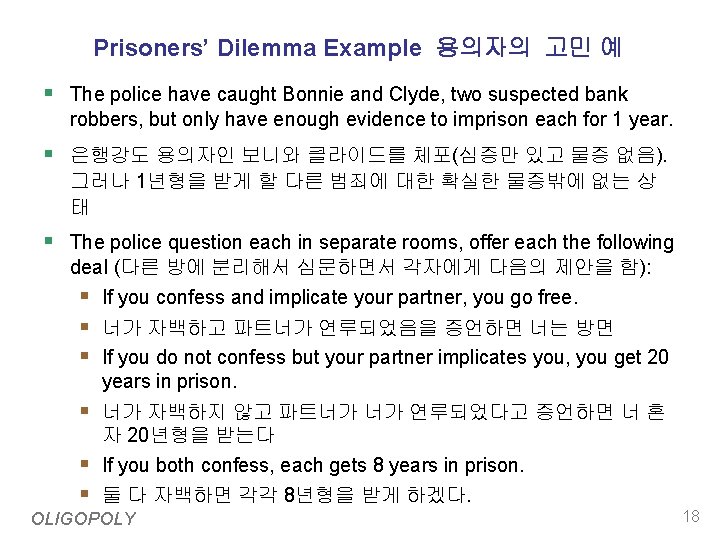
Prisoners’ Dilemma Example 용의자의 고민 예 § The police have caught Bonnie and Clyde, two suspected bank robbers, but only have enough evidence to imprison each for 1 year. § 은행강도 용의자인 보니와 클라이드를 체포(심증만 있고 물증 없음). 그러나 1년형을 받게 할 다른 범죄에 대한 확실한 물증밖에 없는 상 태 § The police question each in separate rooms, offer each the following deal (다른 방에 분리해서 심문하면서 각자에게 다음의 제안을 함): § If you confess and implicate your partner, you go free. § 너가 자백하고 파트너가 연루되었음을 증언하면 너는 방면 § If you do not confess but your partner implicates you, you get 20 years in prison. § 너가 자백하지 않고 파트너가 너가 연루되었다고 증언하면 너 혼 § § 자 20년형을 받는다 If you both confess, each gets 8 years in prison. 둘 다 자백하면 각각 8년형을 받게 하겠다. OLIGOPOLY 18
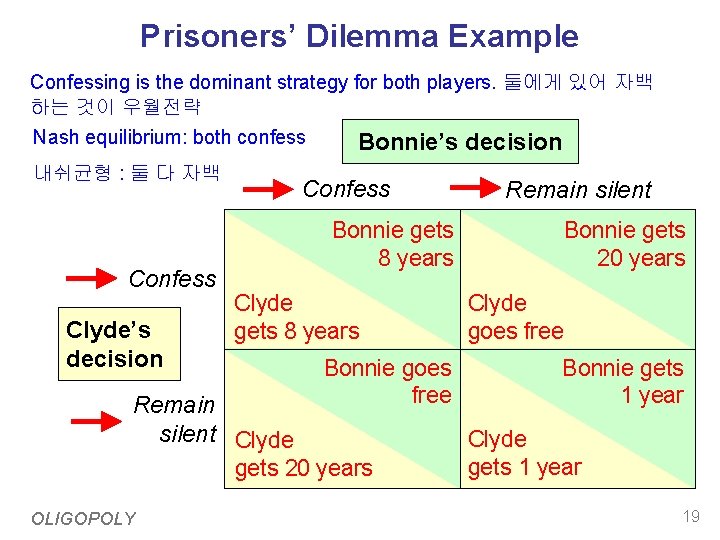
Prisoners’ Dilemma Example Confessing is the dominant strategy for both players. 둘에게 있어 자백 하는 것이 우월전략 Nash equilibrium: both confess 내쉬균형 : 둘 다 자백 Confess Clyde’s decision Bonnie’s decision Confess Bonnie gets 8 years Clyde gets 8 years Bonnie goes free Remain silent Clyde gets 20 years OLIGOPOLY Remain silent Bonnie gets 20 years Clyde goes free Bonnie gets 1 year Clyde gets 1 year 19
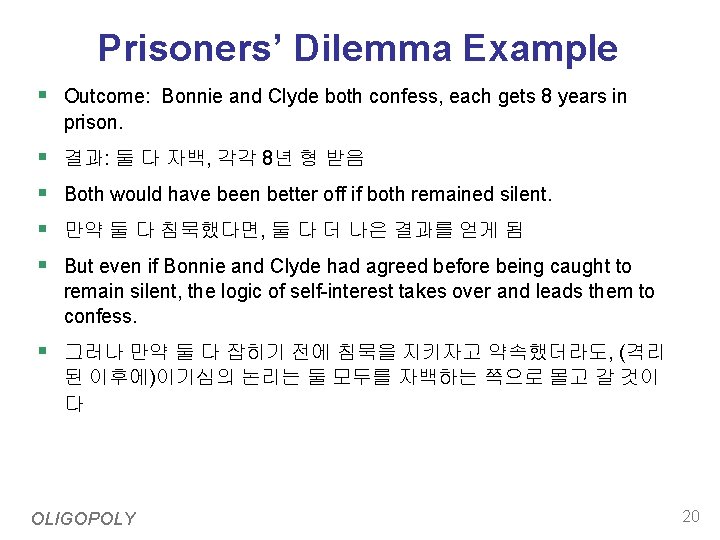
Prisoners’ Dilemma Example § Outcome: Bonnie and Clyde both confess, each gets 8 years in prison. § § 결과: 둘 다 자백, 각각 8년 형 받음 Both would have been better off if both remained silent. 만약 둘 다 침묵했다면, 둘 다 더 나은 결과를 얻게 됨 But even if Bonnie and Clyde had agreed before being caught to remain silent, the logic of self-interest takes over and leads them to confess. § 그러나 만약 둘 다 잡히기 전에 침묵을 지키자고 약속했더라도, (격리 된 이후에)이기심의 논리는 둘 모두를 자백하는 쪽으로 몰고 갈 것이 다 OLIGOPOLY 20
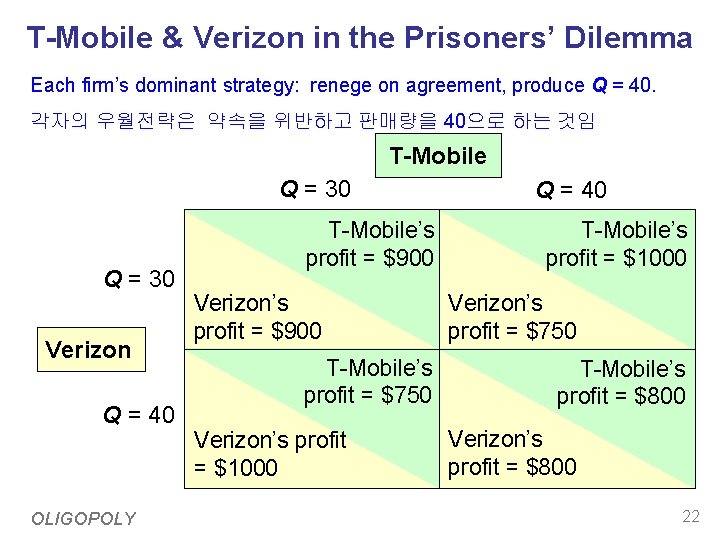
Oligopolies as a Prisoners’ Dilemma 용의자 고민과 과점 § When oligopolies form a cartel in hopes of reaching the monopoly outcome, they become players in a prisoners’ dilemma. § 과점기업들이 독점의 이윤을 얻고자 카르텔을 구성할 경우 그들은 용 의자 고민 게임의 플레이어가 된다 § Our earlier example: § T-Mobile and Verizon are duopolists in Smalltown. § The cartel outcome maximizes profits: Each firm agrees to serve Q = 30 customers. § Here is the “payoff matrix(결과 표)” for this example… OLIGOPOLY 21
T-Mobile & Verizon in the Prisoners’ Dilemma Each firm’s dominant strategy: renege on agreement, produce Q = 40. 각자의 우월전략은 약속을 위반하고 판매량을 40으로 하는 것임 T-Mobile Q = 30 Verizon Q = 40 OLIGOPOLY T-Mobile’s profit = $900 Verizon’s profit = $900 T-Mobile’s profit = $750 Verizon’s profit = $1000 Q = 40 T-Mobile’s profit = $1000 Verizon’s profit = $750 T-Mobile’s profit = $800 Verizon’s profit = $800 22
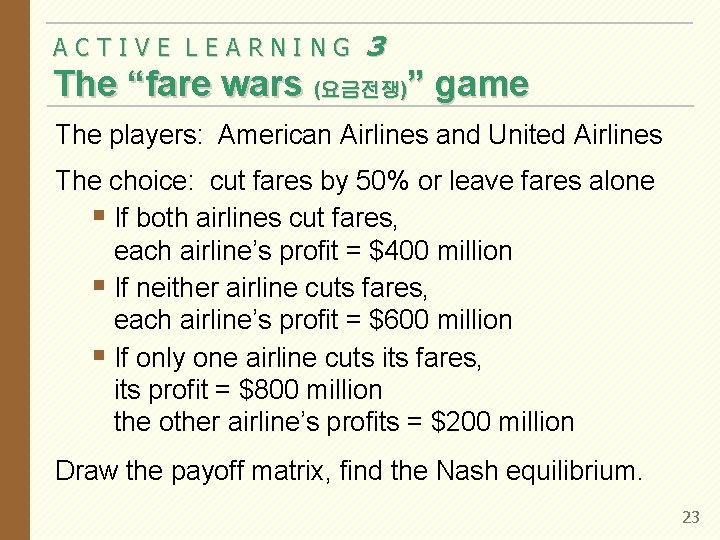
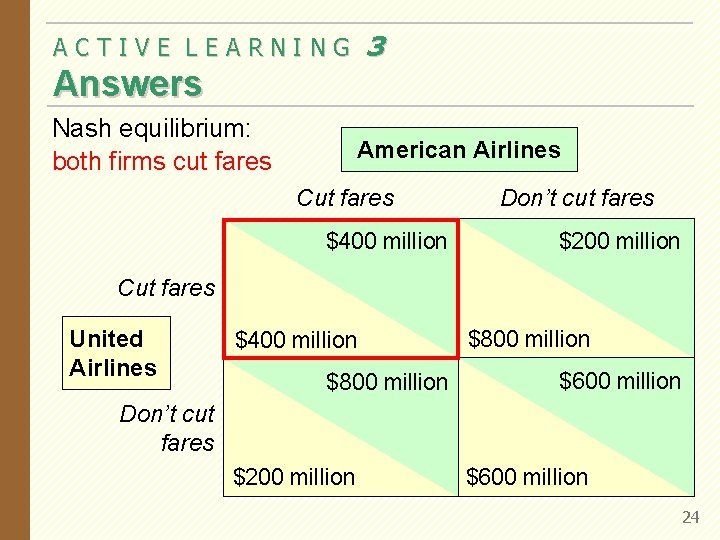
ACTIVE LEARNING 3 The “fare wars (요금전쟁)” game The players: American Airlines and United Airlines The choice: cut fares by 50% or leave fares alone § If both airlines cut fares, each airline’s profit = $400 million § If neither airline cuts fares, each airline’s profit = $600 million § If only one airline cuts its fares, its profit = $800 million the other airline’s profits = $200 million Draw the payoff matrix, find the Nash equilibrium. 23
3 ACTIVE LEARNING Answers Nash equilibrium: both firms cut fares American Airlines Cut fares $400 million Don’t cut fares $200 million Cut fares United Airlines $400 million $800 million $600 million Don’t cut fares $200 million $600 million 24
Other Examples of the Prisoners’ Dilemma Ad Wars Two firms spend millions on TV ads to steal business from each other. Each firm’s ad cancels out the effects of the other, and both firms’ profits fall by the cost of the ads. Organization of Petroleum Exporting Countries Member countries try to act like a cartel, agree to limit oil production to boost prices & profits. But agreements sometimes break down when individual countries renege. OPEC(석유 수출국들의 모임) 회원국들은 카르텔처럼 행동한다. 가격을 높이 받고 이윤을 크게 하려고 원유생산량을 제한하는데 협약했다. 그 러나 회원국들이 약속을 지키지 않으면서(원유생산량을 늘임) 협약은 종종 지켜지지 않을 때가 많다 OLIGOPOLY 25
Other Examples of the Prisoners’ Dilemma Arms race between military superpowers (군사대국간의 군비경쟁) Each country would be better off if both disarm, but each has a dominant strategy of arming. (참고 armed robbery: 무장강 도) Common resources All would be better off if everyone conserved common resources, but each person’s dominant strategy is overusing the resources. OLIGOPOLY 26
Prisoners’ Dilemma and Society’s Welfare § The noncooperative oligopoly equilibrium § Bad for oligopoly firms: prevents them from achieving monopoly profits § Good for society: Q is closer to the socially efficient output P is closer to MC § In other prisoners’ dilemmas, the inability to cooperate may reduce social welfare. § e. g. , arms race, overuse of common resources OLIGOPOLY 27
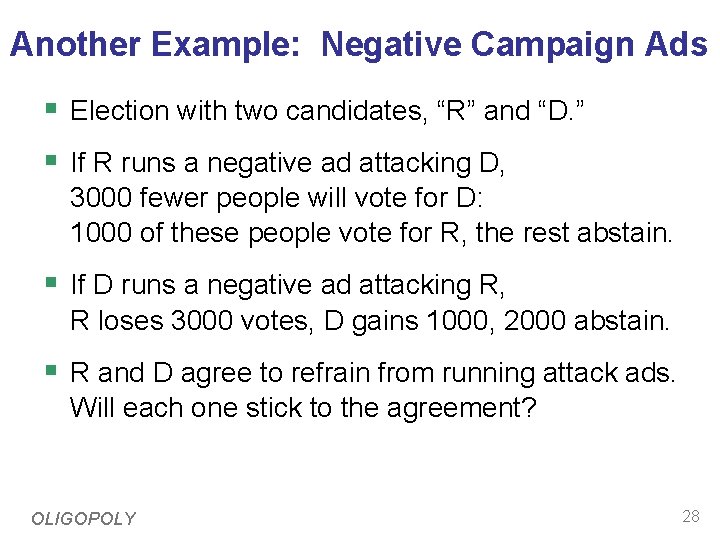
Another Example: Negative Campaign Ads § Election with two candidates, “R” and “D. ” § If R runs a negative ad attacking D, 3000 fewer people will vote for D: 1000 of these people vote for R, the rest abstain. § If D runs a negative ad attacking R, R loses 3000 votes, D gains 1000, 2000 abstain. § R and D agree to refrain from running attack ads. Will each one stick to the agreement? OLIGOPOLY 28
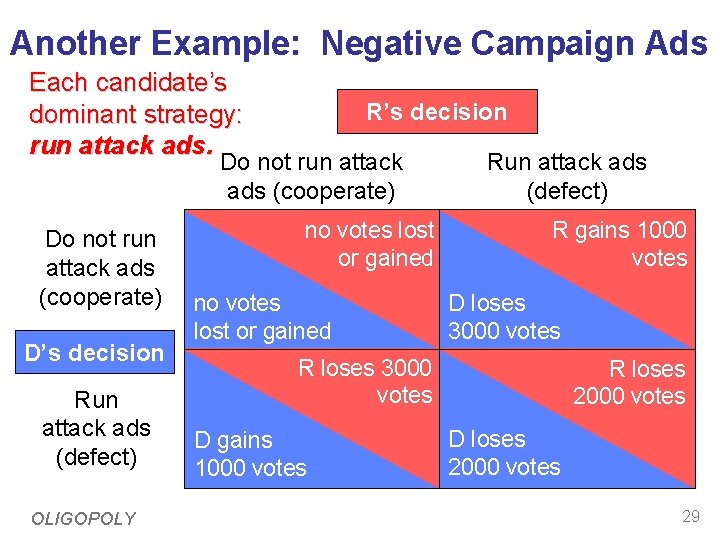
Another Example: Negative Campaign Ads Each candidate’s dominant strategy: run attack ads. R’s decision Do not run attack ads (cooperate) D’s decision Run attack ads (defect) OLIGOPOLY no votes lost or gained Run attack ads (defect) R gains 1000 votes D loses 3000 votes R loses 3000 votes D gains 1000 votes R loses 2000 votes D loses 2000 votes 29
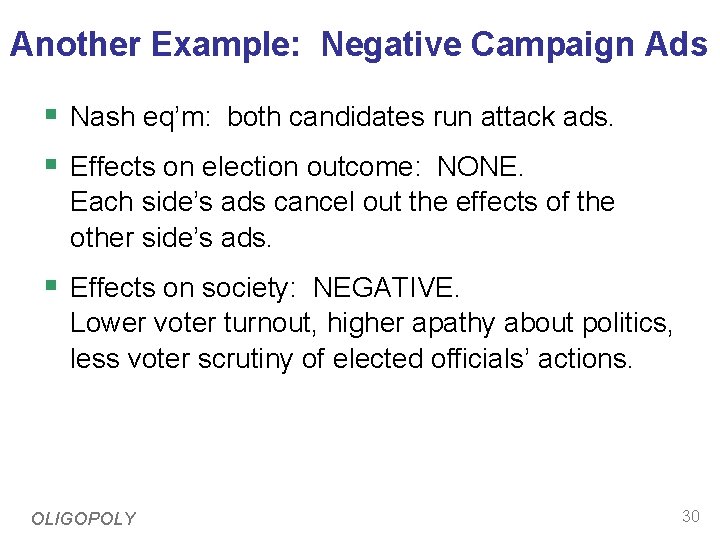
Another Example: Negative Campaign Ads § Nash eq’m: both candidates run attack ads. § Effects on election outcome: NONE. Each side’s ads cancel out the effects of the other side’s ads. § Effects on society: NEGATIVE. Lower voter turnout, higher apathy about politics, less voter scrutiny of elected officials’ actions. OLIGOPOLY 30
Why People Sometimes Cooperate 그러면 때때로 왜 협력할까 § When the game is repeated many times, cooperation may be possible. § 게임이 여러 차례 반복된다면, 협력도 가능하다 § These strategies may lead to cooperation: § If your rival reneges in one round, you renege in all subsequent § rounds. “Tit-for-tat” Whatever your rival does in one round (whether renege or cooperate), you do in the following round. OLIGOPOLY 31
Public Policy Toward Oligopolies 과점에 대한 공공정책 § Recall one of the Ten Principles from Chap. 1: Governments can sometimes improve market outcomes. § 정부는 때때로 시장의 결과를 개선시킬 수 있다 § In oligopolies, production is too low and prices are too high, relative to the social optimum. § 사회적 최적수준에 비하여 과점시장에서 생산량은 너무 낮고 가격은 너무 높다 § Role for policymakers (정책입안자의 역할): Promote competition, prevent cooperation to move the oligopoly outcome closer to the efficient outcome. § 경쟁을 촉진시켜 과점기업들이 협력하는 것을 막아 효율적인 결과에 가깝게 되도록 한다 OLIGOPOLY 32
Restraint of Trade and Antitrust Laws 거래제한과 독점금지법 § Sherman Antitrust Act (1890): Forbids collusion between competitors( 경쟁기업간 담합금지) § Clayton Antitrust Act (1914): Strengthened rights of individuals damaged by anticompetitive arrangements between firms § 기업들간 반경쟁적인 행위로 피해를 본 개인들의 권리 (손해배 상 청구권)를 더욱 강화 -> 피해액의 3배 보상 OLIGOPOLY 33
Controversies Over Antitrust Policy 독점금지법에 대한 논 쟁 § Most people agree that price-fixing agreements among competitors should be illegal. § 대다수가 동의하는 부분; 경쟁기업들 간 담합하여 가격을 고정시키는 것은 불법이다 § Some economists are concerned that policymakers go too far when using antitrust laws to stifle business practices that are not necessarily harmful, and may have legitimate objectives. § 정부가 독점금지법을 통해 합법적인 목적의 그다지 해롭지 않은 기 업의 행동까지 심하게 규제한다는 지적을 받는다 § We consider three such practices… OLIGOPOLY 34
1. Resale Price Maintenance (“Fair Trade”) 재판매 가격유지(공정거래) § Occurs when a manufacturer imposes lower limits on the prices retailers can charge. § 이는 생산자가 소매점이 받을 수 있는 가격의 하한선을 부과하는 경우 § Is often opposed because it appears to reduce competition at the retail level. § 이는 종종 금지되는데, 소매점 간의 경쟁을 제한하는 것으로 보기 때문 § (소비자권장가? ) § Yet, any market power the manufacturer has is at the wholesale level; manufacturers do not gain from restricting competition at the retail level. § 하지만 생산자가 가지고 있는 시장지배력은 도매가격을 통해서 나타 난다; 생산자는 소매점의 경쟁을 제한함으로써 얻는 이익이 없다 OLIGOPOLY 35
2. Predatory Pricing 약탈가격 설정 § Occurs when a firm cuts prices to prevent entry or drive a competitor out of the market, so that it can charge monopoly prices later. § 이는 기업이 신규진입을 마고 경쟁자를 시장에서 내몰기 위해 가격을 너무 낮게 내리는 경우이다 ( 그리고 나중에는 독점가격을 메길 수 있 다) § Illegal under antitrust laws, but hard for the courts to determine when a price cut is predatory and when it is competitive & beneficial to consumers. § 독점금지법에 의해 불법이다. 그러나 법원으로서는 어떤 경우가 약탈 가격 설정이고, 어떤 경우가 소비자에게 유익한 경쟁가격 인하인지 판단하기가 어렵다 OLIGOPOLY 36
3. Tying 끼워 팔기 § Occurs when a manufacturer bundles two products together and sells them for one price (예, MS including a browser with its operating system) § 이는 생산자가 두 제품을 묶어서 하나의 가격에 판매하는 경우(예, MS사 가 윈도우OS를 팔면서 익스플로러를 끼워넣는 경우) § Critics argue that tying gives firms more market power by connecting weak products to strong ones. § 비판자들은 끼워팔기 행위는 취약한 제품을 경쟁력이 높는 제품에 연결 시킴으로써 기업의 시장지배력을 높인다고 주장 § Others counter that tying cannot change market power: Buyers are not willing to pay more for two goods together than for the goods separately. § 끼워팔기가 시장지배력을 변화시키지 못한다는 주장; 구매자는 두 제품 을 따로 구입할 때 지불하는 가격보다 더 지불하지 않을 것이기 때문 § Firms may use tying for price discrimination, which is not illegal § 기업은 가격차별의 행위로써 끼워팔기를 활용. 이는 불법 아님 OLIGOPOLY 37
CONCLUSION § Oligopolies can end up looking like monopolies or like competitive markets, depending on the number of firms and how cooperative they are. § 과점시장은 몇 개의 기업이 있는지에 따라서 그리고 그들 관계가 얼마 나 협조적인지에 따라 독점시장처럼 혹은 경쟁시장처럼 될 수 있음 § The prisoners’ dilemma shows how difficult it is for firms to maintain cooperation, even when doing so is in their best interest. § 용의자 고민 게임은 기업들이 협조관계를 유지하기가 얼마나 어려운지 를 보여줌. 그렇게 하는 것이 매우 유익함에도 불구하고. § Policymakers use the antitrust laws to regulate oligopolists’ behavior. The proper scope of these laws is the subject of ongoing controversy. § 정부는 과점기업들의 행동을 규제하기 위해 독점금지법을 활용. 하지만 이 법이 적용되는 적절한 범위에 대해서는 논란이 많다 OLIGOPOLY 38
CHAPTER SUMMARY § Oligopolists can maximize profits if they form a cartel and act like a monopolist. § 과점기업들은 카르텔을 구성하여 독점기업처럼 행동할때 이윤을 극대 화시킬 수 있음 § Yet, self-interest leads each oligopolist to a higher quantity and lower price than under the monopoly outcome. § 그럼에도, 이기심으로 인해 독점시장보다 더 낮은 가격과 더 많은 생 산량이 나오는 결과가 도출된다 § The larger the number of firms, the closer will be the quantity and price to the levels that would prevail under competition. § 과점시장에 기업수가 많을수록 산출랴와 가격은 완전경쟁시장 수준에 가까워진다 39
CHAPTER SUMMARY § The prisoners’ dilemma shows that self-interest can prevent people from cooperating, even when cooperation is in their mutual interest. The logic of the prisoners’ dilemma applies in many situations. § 용의자 고민 모형은 두 용의자가 협조하는 것이 더 좋은 결과를 가져 옴에도 불구하고, 이기심으로 인해 협조가 어려짐을 보여준다. 이 모 형은 여러 상황에 응용적용될 수 있다 § Policymakers use the antitrust laws to prevent oligopolies from engaging in anticompetitive behavior such as price-fixing. But the application of these laws is sometimes controversial. § 정부는 과점기업들의 가격담합 등 경쟁제한 행위를 방지하기 위해 독 점금지법을 사용한다. 그러나 때로는 이법의 적용이 논란이 되고 있 다 40