
Chapter 17 Multinational Capital Structure and Cost of








![Weighted average cost of capital (WACC) NPV = St [ E[CFt] / (1+i. WACC)t](https://slidetodoc.com/presentation_image_h2/7090fa3f22091455e9b3e667b0b2073d/image-12.jpg "Weighted average cost of capital (WACC) NPV = St [ E[CFt] / (1+i. WACC)t")






- Slides: 22
Chapter 17 Multinational Capital Structure and Cost of Capital 17. 1 17. 2 17. 3 Capital Structure and the Cost of Capital Project Valuation and the Cost of Capital Sources of Funds for Multinational Operations 17. 4 The International Evidence on Capital Structure 17. 5 The Cost of Capital on Multinational Operations 17. 6 Summary Kirt C. Butler, Multinational Finance, South-Western College Publishing, 2 e 17 -1
Capital structure F Capital structure refers to the proportion of longterm debt and equity and the particular forms of capital chosen to finance the assets of the firm. F Management must choose – – – – the proportions of debt and equity the currency of denomination fixed or floating rate interest payments indenture provisions conversion features callability seniority maturity Kirt C. Butler, Multinational Finance, South-Western College Publishing, 2 e 17 -2
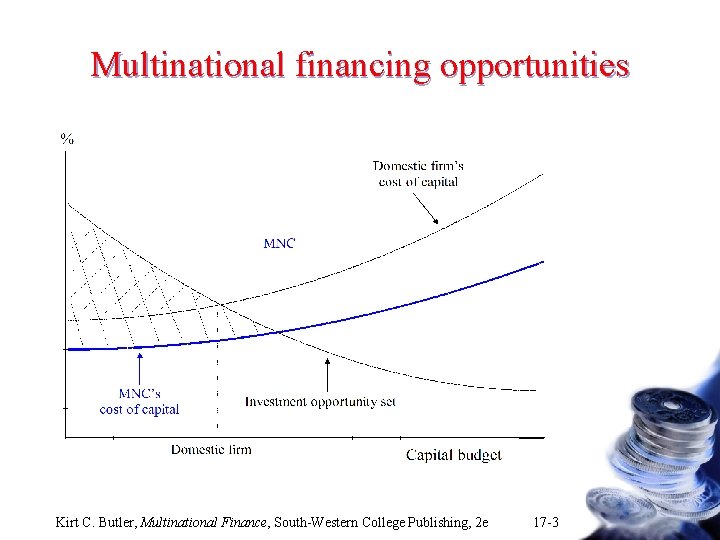
Multinational financing opportunities Kirt C. Butler, Multinational Finance, South-Western College Publishing, 2 e 17 -3
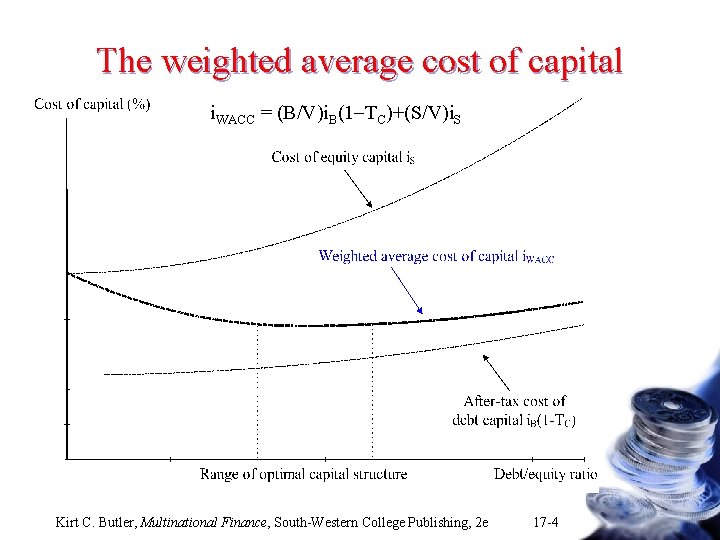
The weighted average cost of capital i. WACC = (B/V)i. B(1 -TC)+(S/V)i. S Kirt C. Butler, Multinational Finance, South-Western College Publishing, 2 e 17 -4
The multinational’s cost of capital (given a particular set of investments) Kirt C. Butler, Multinational Finance, South-Western College Publishing, 2 e 17 -5
Optimal capital structure Far better an approximate answer to the right question, which is often vague, than an exact answer to a wrong question, which can always be made precise. John W. Tukey Kirt C. Butler, Multinational Finance, South-Western College Publishing, 2 e 17 -6
The perfect market assumptions F Perfect markets: » Frictionless markets » Equal access to market prices » Rational investors » Equal access to costless information Kirt C. Butler, Multinational Finance, South-Western College Publishing, 2 e 17 -7
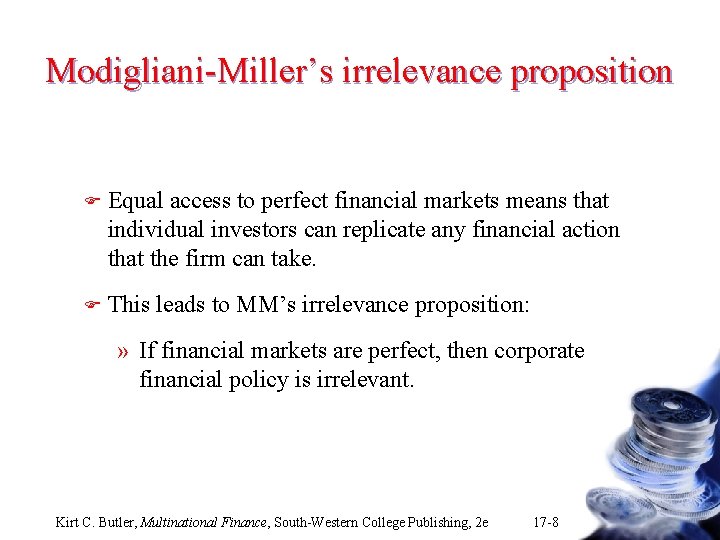
Modigliani-Miller’s irrelevance proposition F Equal access to perfect financial markets means that individual investors can replicate any financial action that the firm can take. F This leads to MM’s irrelevance proposition: » If financial markets are perfect, then corporate financial policy is irrelevant. Kirt C. Butler, Multinational Finance, South-Western College Publishing, 2 e 17 -8
The converse of MM’s irrelevance proposition F If financial policy is to increase value, then it must either » increase the firm’s expected future cash flows or » decrease the discount rate in a way that cannot be replicated by individual investors. Kirt C. Butler, Multinational Finance, South-Western College Publishing, 2 e 17 -9
Financial market integration vs. segmentation F In integrated financial markets, real after-tax rates of return on equivalent assets are equal. F Factors contributing to segmentation include: » » » prohibitive transactions costs different legal and political systems regulatory interference (e. g. , barriers to financial flows) differential taxes informational barriers home asset bias (a tendency to buy financial assets in the domestic market) » differential investor expectations Kirt C. Butler, Multinational Finance, South-Western College Publishing, 2 e 17 -10
Project valuation and the cost of capital F Alternative approaches to project valuation » WACC: Weighted average cost of capital » APV: Adjusted present value F Use an asset-specific discount rate that reflects the opportunity cost of capital. » Cash flows denominated in the domestic (foreign) currency should be discounted at a domestic (foreign) discount rate. » Nominal (real) cash flows should be discounted at nominal (real) discount rate. Kirt C. Butler, Multinational Finance, South-Western College Publishing, 2 e 17 -11
Weighted average cost of capital (WACC) NPV = St [ E[CFt] / (1+i. WACC)t ] where i. WACC = [(B/VL) i. B (1 -TC)] + [(S/VL)i. S] and B = the market value of corporate bonds S = the market value of corporate stock VL = B + S = the market value of the firm i. B = the required return on corporate bonds i. S = the required return on corporate stock TC = the marginal corporate income tax rate Kirt C. Butler, Multinational Finance, South-Western College Publishing, 2 e 17 -12
Adjusted present value (APV) APV = VU + PV(financing side effects) - initial investment where VU = the value of the unlevered or all-equity project PV(financing side effects) = value of tax shields from the use of debt net of costs of financial distress Kirt C. Butler, Multinational Finance, South-Western College Publishing, 2 e 17 -13
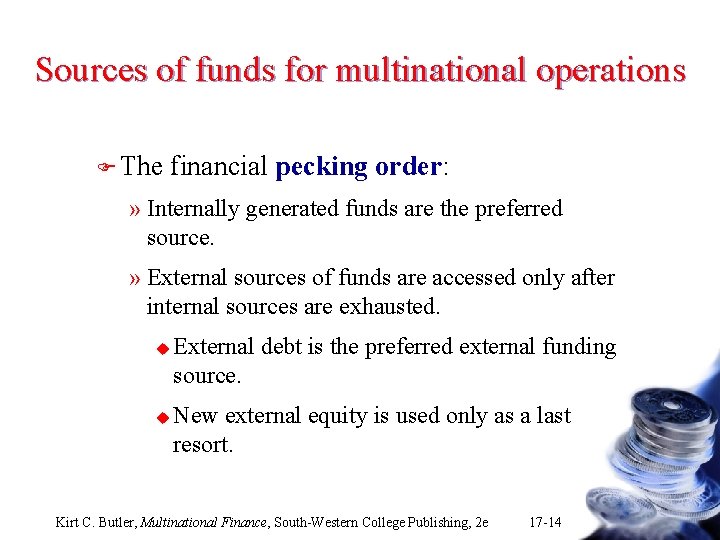
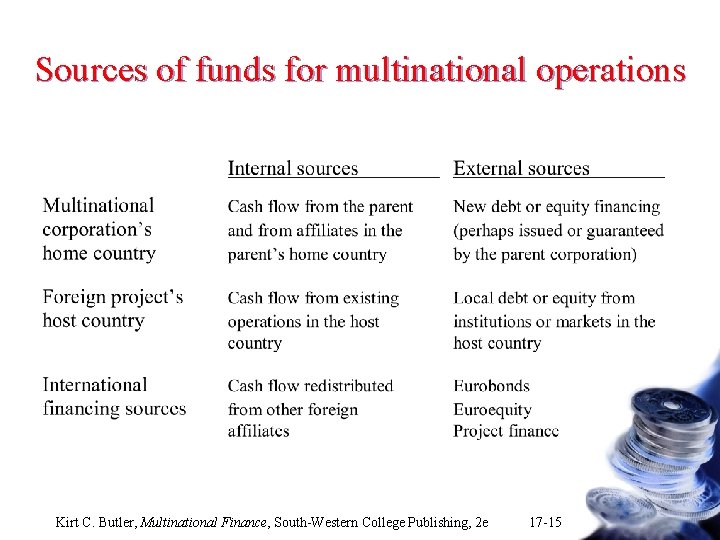
Sources of funds for multinational operations F The financial pecking order: » Internally generated funds are the preferred source. » External sources of funds are accessed only after internal sources are exhausted. u External debt is the preferred external funding source. u New external equity is used only as a last resort. Kirt C. Butler, Multinational Finance, South-Western College Publishing, 2 e 17 -14
Sources of funds for multinational operations Kirt C. Butler, Multinational Finance, South-Western College Publishing, 2 e 17 -15
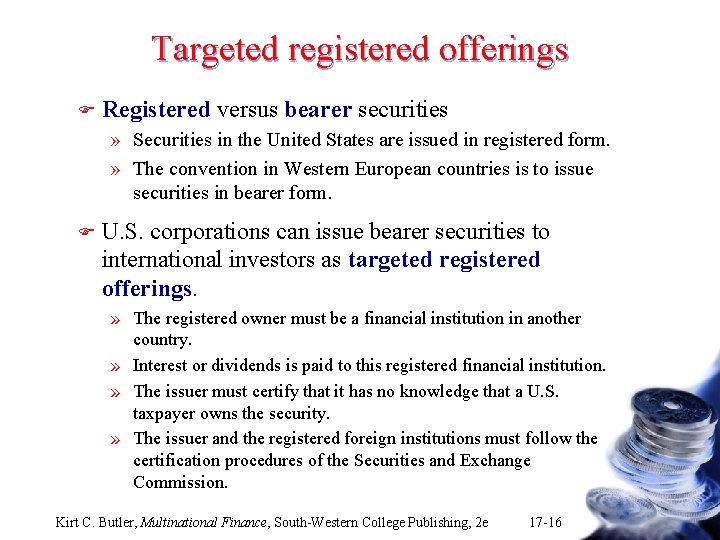
Targeted registered offerings F Registered versus bearer securities » Securities in the United States are issued in registered form. » The convention in Western European countries is to issue securities in bearer form. F U. S. corporations can issue bearer securities to international investors as targeted registered offerings. » The registered owner must be a financial institution in another country. » Interest or dividends is paid to this registered financial institution. » The issuer must certify that it has no knowledge that a U. S. taxpayer owns the security. » The issuer and the registered foreign institutions must follow the certification procedures of the Securities and Exchange Commission. Kirt C. Butler, Multinational Finance, South-Western College Publishing, 2 e 17 -16
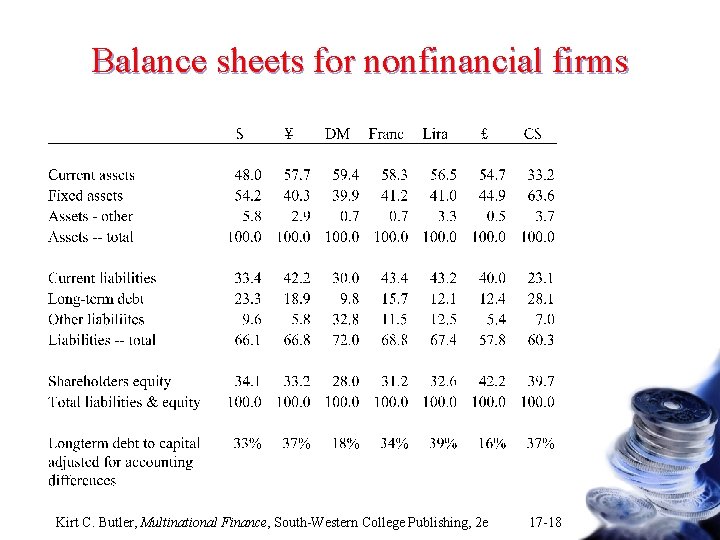
The U. S. evidence on capital structure F Leverage increases with » Fixed assets » Firm size » Nondebt tax shields F Leverage » » » decreases with Growth opportunities Profitability Uniqueness of the firm’s product(s) Earnings volatility Advertising and R&D expenditures Probability of bankruptcy or default Kirt C. Butler, Multinational Finance, South-Western College Publishing, 2 e 17 -17
Balance sheets for nonfinancial firms Kirt C. Butler, Multinational Finance, South-Western College Publishing, 2 e 17 -18
The international evidence on capital structure F Leverage increases with » The proportion of fixed to total assets » Firm size F Leverage decreases with » Asset market-to-book ratios (~ growth opportunities) » Profitability Kirt C. Butler, Multinational Finance, South-Western College Publishing, 2 e 17 -19
Diversifiable versus nondiversifiable risks and the multinational’s cost of capital F If operating risks are diversifiable, then they are not priced by investors and should not be reflected in capital costs. F If operating risks are nondiversifiable (systematic), then they should be reflected in capital costs. » The multinational corporation’s capital costs are increased if these risks are positively related to the market portfolio » The multinational corporation’s capital costs are decreased if these risks are negatively related to the market portfolio Kirt C. Butler, Multinational Finance, South-Western College Publishing, 2 e 17 -20
The multinational corporation’s cost of capital F Mixed empirical evidence » MNCs have lower betas despite higher financial leverage Michel and Shaked, “Multinational Corporations vs. Domestic Corporations: Financial Performance and Characteristics, ” Journal of International Business Studies, Fall 1986. » MNCs have higher betas after controlling for leverage, size and growth Reeb, Kwok and Baek, “Systematic Risk of the Multinational Corporation, ” Journal of International Business Studies, No. 2, 1998. Kirt C. Butler, Multinational Finance, South-Western College Publishing, 2 e 17 -21
The effect of financial market liberalizations on the cost of capital F Bekaert and Harvey (1998) find that financial market liberalizations tend to: » Increase the correlation of emerging market returns with world market returns. » Have little impact on emerging market volatility. » Decrease local firms’ capital costs by up to 1 percent. Source: Geert Bekaert and Campbell Harvey, “Foreign Speculators and Emerging Equity Markets, ” Fuqua School of Business Working Paper, June 1998. Kirt C. Butler, Multinational Finance, South-Western College Publishing, 2 e 17 -22