
Chapter 17 MOOCS and Virtual Learning Spaces A
- Slides: 26
Chapter 17: MOOCS and Virtual Learning Spaces: A Withering of the Traditional Classroom Copyright © 2016 Wolters Kluwer Health | Lippincott Williams & Wilkins
Higher Education—State of Evolution and Alternative Learning Environments • Traditional face-to-face learning spaces and pedagogy is being challenged by – Massive open, online courses (MOOCS) – Notion of open courseware – Creation of virtual environments Copyright © 2017 Wolters Kluwer • All Rights Reserved
MOOCS • Online courses on a wide range of topics open to anyone in the world who has Internet access and computer and language proficiencies • Registration is open to everyone. • No limits on the number of student participants • No need for prerequisites Copyright © 2017 Wolters Kluwer • All Rights Reserved
Question How are traditional learning environment being challenged? Copyright © 2017 Wolters Kluwer • All Rights Reserved
Answer Massive Open Online Courses, MOOCs, have shaped the online learning scene, fostered “disruptive” innovations in higher education and lifelong learning, and quickly gained immense popularity over such a short period of time Copyright © 2017 Wolters Kluwer • All Rights Reserved
Two different types of MOOCS • CMOOCS • XMOOCS Copyright © 2017 Wolters Kluwer • All Rights Reserved
Benefits of MOOCS • Thousands of students enroll from around the world. • Access is free or involves minimal fee for certificate of completion. • Education taught by university experts • Serves as an alternative (and supplement for many) to the traditional, university classroom • Allows learners to acquire new skills at their own pace • May also enhance employability Copyright © 2017 Wolters Kluwer • All Rights Reserved
Challenges and Concerns of MOOCs • Completion rate • Majority of MOOCs are conducted in English. • Not accessible to underprivileged communities • Majority of learners were already educated. Copyright © 2017 Wolters Kluwer • All Rights Reserved
Open Source Materials • Use of open source websites/concerns • Wikipedia • Up. To. Date • Google • Medscape Copyright © 2017 Wolters Kluwer • All Rights Reserved
Virtual Learning Spaces/Online Courses • According to the landmark report 2013—Grade Change: Tracking Online Education in the United States, 7. 1 million higher education students were taking at least one online course in the United States. • Majority of academic leaders are predicting online courses to continue to impact an increasing number of students. Copyright © 2017 Wolters Kluwer • All Rights Reserved
Online Pedagogy • Considered as “those in which at least 80% of the course content is delivered online” • In the past were offered in an asynchronous format • Today’s format includes the following: – Web-conferencing tools such as Adobe Connect, Blackboard’s Collaborate, Cisco’s Webex, and Citrix’s Go. To. Meeting have enabled nurse faculty to push beyond the asynchronous world to foster synchronous communication in real time. Copyright © 2017 Wolters Kluwer • All Rights Reserved
Question What is the difference between an asynchronous format and a synchronous format? Copyright © 2017 Wolters Kluwer • All Rights Reserved
Answer An asynchronous format consists of organized modules, vast amounts of reading, and typed discussion boards, and they involved working independently at a time of one’s convenience. Web-conferencing tools such as Adobe Connect, Blackboard’s Collaborate, Cisco’s Webex, and Citrix’s Go. To. Meeting have enabled nurse faculty to push beyond the asynchronous world to foster synchronous communication in real time. Copyright © 2017 Wolters Kluwer • All Rights Reserved
More Online Tools • Blackboard • Angel • Moodle • Canvas • Voice. Thread Copyright © 2017 Wolters Kluwer • All Rights Reserved
Communication and Online Courses • Teachers must provide frequent communication with students and encourage them to communicate as well – It is imperative to success. – Faculty members must demonstrate presence. – Make it explicit to the student that he or she is available by email or phone call Copyright © 2017 Wolters Kluwer • All Rights Reserved
Standards for Distance Education • Regulatory issues: assure quality and that online standards were comparable to face-to-face method by utilizing the five pillars to measure quality in online courses • Learning effectiveness • Scale • Access • Faculty satisfaction • Student satisfaction Copyright © 2017 Wolters Kluwer • All Rights Reserved
Faculty and Learner Expectations: Challenges and Impact of Traditional versus Online Classes • Decreased financial resources • Increased accountability to stakeholders • Demands for curriculum reform that meets the changing needs of the nursing workforce • Shrinking faculty shortage • Accommodating the millennial student Copyright © 2017 Wolters Kluwer • All Rights Reserved
Traditional versus Online Nursing Education • Inaccessibility to a wireless network in the traditional learning environment poses challenges to learner expectations • As a demographic that frequently uses the Internet, it is important for students to access the appropriate discipline-specific databases such as CINAHL and Medline instead of using Internet search engines • Use of an interactive response system in class • Instant messaging or a group chat room and blogging Copyright © 2017 Wolters Kluwer • All Rights Reserved
Question What are the reasons that students are seeking online classes more than ever? Copyright © 2017 Wolters Kluwer • All Rights Reserved
Answer Demands for curriculum reform that meets the changing needs of the nursing workforce and accommodating the millennial student. Copyright © 2017 Wolters Kluwer • All Rights Reserved
Environmental Barriers: Time, Setting, and Physical Space • Traditional nursing education requires a considerable time commitment from both the instructor and student. • Clinical and research faculty must balance primary responsibilities with teaching commitments and faculty development. • Increasing clinical demands can be challenges to effective teaching. • Students that attend a traditional classroom have to balance their own competing employment and familial and financial priorities. Copyright © 2017 Wolters Kluwer • All Rights Reserved
Environmental Barriers: Time, Setting, and Physical Space (cont. ) – Inappropriately designed physical space – Lack of flexibility – Geographic restrictions – Appointed times – Limited number of students Copyright © 2017 Wolters Kluwer • All Rights Reserved
Faculty Development and MOOC Teaching Faculty Expectations • Paying more attention to their teaching styles and pedagogy when thousands of participants/learners are embarking on their open digital platform • Faculty wanting to ensure their teaching is high quality • Platforms allow different levels of interaction with students to actually understand the students’ strengths, weaknesses, and collaborative spirit. Copyright © 2017 Wolters Kluwer • All Rights Reserved
Faculty Learning New Styles of Teaching in MOOCS • Faculty learning to develop his or her distinct online voice and presence • Findings ways to improve quality of online presentations and communication to thousands of participants to provide clarity and articulation of specific messages, directions, and overall summaries • Flipping their traditional courses Copyright © 2017 Wolters Kluwer • All Rights Reserved
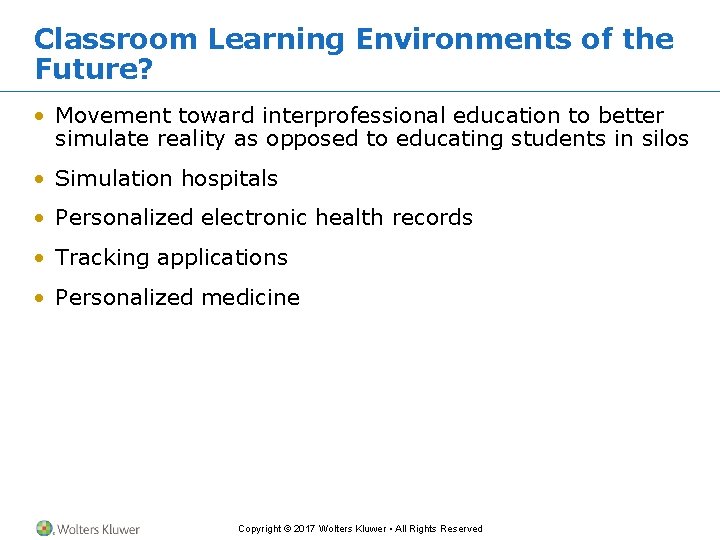
Classroom Learning Environments of the Future? • Movement toward interprofessional education to better simulate reality as opposed to educating students in silos • Simulation hospitals • Personalized electronic health records • Tracking applications • Personalized medicine Copyright © 2017 Wolters Kluwer • All Rights Reserved
End of Presentation Copyright © 2017 Wolters Kluwer • All Rights Reserved