
Chapter 17 ManyElectron Atoms and Chemical Bonding 17
Chapter 17 Many-Electron Atoms and Chemical Bonding 17. 1 Many-Electron Atoms and the Periodic Table 17. 2 Experimental Measures of Orbital Energies 17. 3 Sizes of Atoms and Ions 17. 4 Properties of the Chemical Bond 17. 5 Ionic and Covalent Bonds 17. 6 Oxidation States 1
17. 1 Many-Electron Atoms Many electron atoms and the periodic table Building up electron configurations Building up from H to Ar: Pauli and Aufbau principles Hund’s rule: paramagnetism and diamagnetism. Building from K to Kr: Transition elements and d orbitals Electron shells, effective nuclear charge Correlations of periodic properties of familes of elements and electron configurations 2

Multielectron atoms: Every electron in a multielectron atom is assigned four quantum numbers (n, l, ml and ms) that uniquely define its chemical and physical properties. From the use of quantum numbers, we can envision every electron of a multielectron atom in terms of a characteristic energy (En), size (r), shape (l), orientation (ml) and spin (ms). The highest energy (valence) electrons are of greatest chemical interest 3
Building up the table from electron configurations: First four periods (H-Kr) 1 a 8 a 2 a 3 a 3 a 4 a 5 a 6 a 7 a 8 8 8 4 a 5 a 6 a 7 a 1 b 2 b 4
Electronic structure of atoms of the elements: Atoms of the various elements differ from each other in their values of Z (atomic number) and electrons. Electrons in atoms are arranged in orbitals, shells and subshells. Orbitals having the same value of n are said to be in the same shell. Orbitals having the same values of n and l are said to be in the same subshell. Orbitals of all elements are hydrogen like and are characterized by the quantum numbers n, l and ml. Energies of orbitals depend on (n + l), not just n. 5
For atoms with more than one electron, approximations are required in order to make quantitative quantum mechanical approximations. The orbital approximation: The electron density of an isolated many-electron atom is approximately the sum of the electron densities of each of the individual electrons taken separately. The approximation amounts to treat each electron as if it were moving in a field o charge that is the net result of the nuclear attraction and the average repulsions of all the other electrons. 6
Building up the ground state electron configurations of atoms An electron configuration is a list of the occupied orbitals and the number of electrons in each. The electron configuration of lowest energy is termed the ground state electronic configuration. The ground state electron configuration is built by filling the lowest energy orbitals first (Aufbau principle) and obeying the Pauli principle and Hund’s rule 7
Shells, subshells and orbitals: definitions Shell: a collection of orbitals with the same value of n Example: the three orbitals 3 s, 3 p, 3 d comprise a shell with n = 3 Subshell: a collection of orbitals with the same value of n and l. The orbital of a subshell have the same energy for the same value of l. Example: for the n = 3 shell there are three subshells, the 3 s subshell (l = 0), the 3 p subshell (l = 1), and the 3 d subshell (l = 2), Orbitals: the individual components of a shell or subshell Example: the px, py and pz orbitals are the components of any p (l = 1) subshell and each orbital has the same energy 8
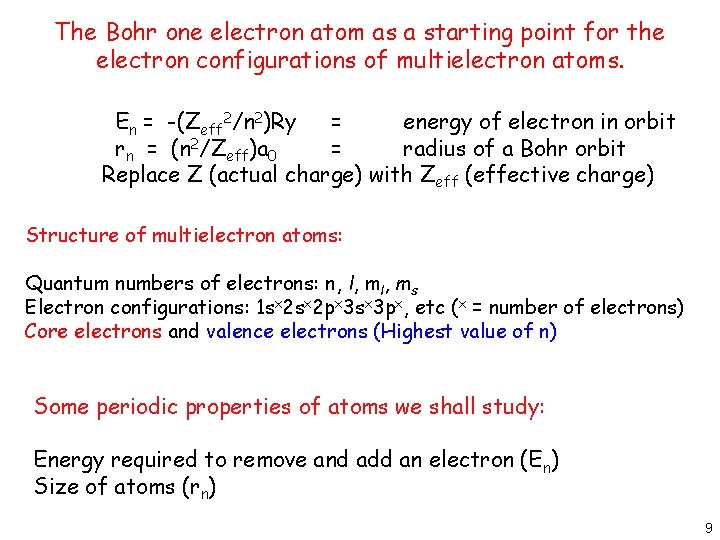
The Bohr one electron atom as a starting point for the electron configurations of multielectron atoms. En = -(Zeff 2/n 2)Ry = energy of electron in orbit rn = (n 2/Zeff)a 0 = radius of a Bohr orbit Replace Z (actual charge) with Zeff (effective charge) Structure of multielectron atoms: Quantum numbers of electrons: n, l, ms Electron configurations: 1 sx 2 px 3 sx 3 px, etc (x = number of electrons) Core electrons and valence electrons (Highest value of n) Some periodic properties of atoms we shall study: Energy required to remove and add an electron (En) Size of atoms (rn) 9
The energy of an orbital of a hydrogen atom or any one electron atom only depends on the value of n shell = all orbitals with the same value of n subshell = all orbitals with the same value of n and l an orbital is fully defined by three quantum numbers, n, l, and ml 10
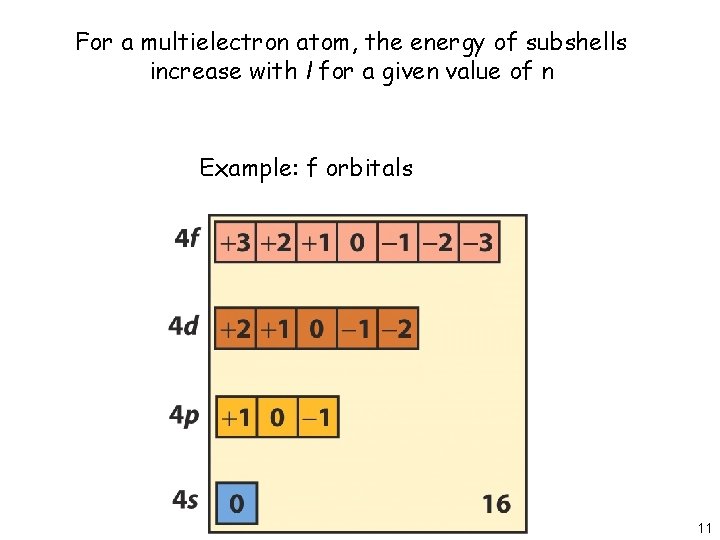
For a multielectron atom, the energy of subshells increase with l for a given value of n Example: f orbitals 11
Determining the ground state electronic configuration of neutral atoms (1) Use the (n + l) rule to determine the relative energies of the atomic orbitals from 1 s to nl (2) Imagine a bare nucleus of charge +Z surrounded by empty atomic orbitals. (3) Add Z electrons to the empty orbitals starting with the lowest energy orbital first, obeying the Pauli principle as required. (4) Electrons are placed in orbitals of lowest energy according to the Aufbau principle to obtain the ground state electron configuration. Apply other rules as required. 12
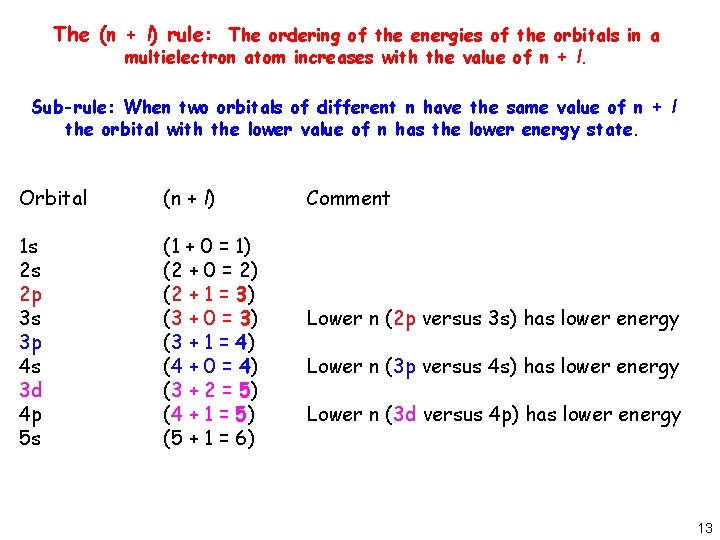
The (n + l) rule: The ordering of the energies of the orbitals in a multielectron atom increases with the value of n + l. Sub-rule: When two orbitals of different n have the same value of n + l the orbital with the lower value of n has the lower energy state. Orbital (n + l) 1 s 2 s 2 p 3 s 3 p 4 s 3 d 4 p 5 s (1 + 0 = 1) (2 + 0 = 2) (2 + 1 = 3) (3 + 0 = 3) (3 + 1 = 4) (4 + 0 = 4) (3 + 2 = 5) (4 + 1 = 5) (5 + 1 = 6) Comment Lower n (2 p versus 3 s) has lower energy Lower n (3 p versus 4 s) has lower energy Lower n (3 d versus 4 p) has lower energy 13
Relative orbital energies for the multielectron atom. The energy of an orbital of a multielectron atom depends on n and l (but not ml) 2 s < 2 p < 3 s 3 s < 3 p < 3 d ~ 4 s (may switch with Z) Note energy levels are getting closer together for n = 3 as expected from the Bohr atom. This means that factors ignored may have to be considered 14
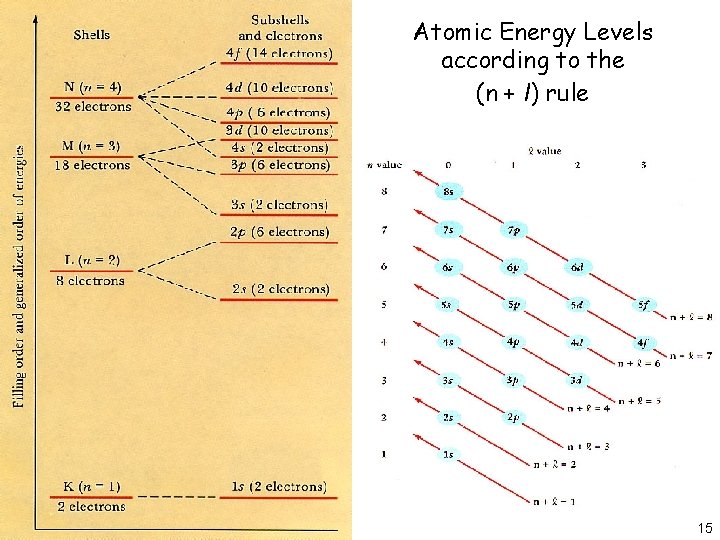
Atomic Energy Levels according to the (n + l) rule 15
Ground state electron configuration of a many electron atom: Governs reactivity of atoms under normal condition (1) Imagine a bare nucleus of charge +Z Imagine empty orbitals surrounding the nucleus (2) Fill the orbitals with Z electrons for the neutral atom following two principles: (3) Aufbau principle: fill lowest energy orbitals first (4) Pauli exclusion principle: each electron must have four different quantum numbers (maximum of 2 electrons in an orbital). 16
The Aufbau principle. Systems in nature tend to minimize their energy. The ground state of an atom is the one with the lowest energy. All other allowed states are excited states of the atom. The Aufbau principle for atoms: The systematic adding electrons to orbitals of an atom (ZA) with atomic number Z, beginning with the orbital of lowest energy and continuing to add electrons, in accordance with the Pauli principle, until Z electrons are added to the atom. 17
Constructing the periodic table by filling orbitals with electrons (electron configurations) in accordance with the Pauli and Aufbau principles. Construction of the first row of the periodic table. Electron configurations: 1 H and 2 He. Aufbau: Fill 1 s orbital first Pauli: no more than two electrons in the 1 s orbital The basis of the duet rule: filling a shell 1 s subshell filled with 2 He = stable electron core given symbol [He]. 18
Filling the orbitals of 3 Li, 4 Be and 5 B Aufbau: Fill 1 s orbital first, then 2 s, then 2 p. Pauli: no more than two electrons in the 1 s orbital. 2 s subshell filled with 4 Be. 19
Filling the orbitals of 6 C and 7 N. The need for a third rule (Hund’s rule): For nitrogen, how do the three 2 p electrons distribute themselves in the three 2 p orbitals? For carbon, how do the two 2 p electrons distribute themselves in the three 2 p orbitals? 20
Hund’s rule: Applies when filling the orbitals of a subshell with electrons (np or nd or nf subshells). Or more generally when filling orbitals of identical energy When adding electrons to a subshell, the ground state electronic configuration is formed by maximizing the number of electrons with parallel spins ( )( ) before pairing two electrons in one orbital ( )(). Example: 6 C = [He]2 s 22 px( )2 py( )2 pz() = ground state Example: 6 C = [He]2 s 22 px( )2 py()2 pz() = excited state 21
Filling the orbitals of 6 C and 7 N. The need for a third rule (Hund’s rule): Hund’s Rule: When electrons occupy orbitals of the same energy, the lowest energy state corresponds to the configuration with the greatest number of orbitally and spin unpaired electrons. When the configuration is written as 1 s 22 p 2 it is understood that two different p orbitals (px, py) are occupied. 22
Paramagnetic and diamagnetic substances The presence of two orbitally and spin unpaired electrons in the ground state of carbon makes the atom paramagnetic. A paramagnetic substance is attracted to a magnetic field. A diamagnetic substance is repelled from a magnetic field. All substances which possess one or more orbitally unpaired electrons are paramagnetic. All substances which possess only spin paired electrons are diamagnetic. 23
Examples of diamagnetic and paramagnetic atoms Which of the following atoms are paramagnetic? 1 H, 2 He, 3 Li, 4 Be, 5 B, 6 C, 7 N, 8 O, 9 F, 10 Ne 1 H, 3 L, 5 B, 7 N, 9 F must be paramagnetic since they possess an odd number of electrons. 2 He and 4 Be, 6 C 4 Be: 6 C: 8 O: 10 Ne are diamagnetic (filled shells). and 8 O paramagnetic or diamagnetic? 1 s 22 s 2 p 2 1 s 22 s 2 p 4 Two filled shells: diamagnetic Hund’s rule: px( )py( ) Let’s see 24
The Pauli exclusions principle does not forbid the existence of any of the Pauli allowed configurations. If there are more than electron configurations one allowed Pauli configuration, the lowest energy one (ground state) will be predicted by Hund’s rule and the others will be excited states. Are the following two configurations allowed for 7 N by the Pauli principle? 1 s 22 px 12 py 12 pz 1 or 1 s 22 px 22 py 12 pz 0 Ans: Yes. Which is more stable? 1 s 22 px( )2 py( )2 pz( ) is more stable than 1 s 22 px( )2 py( )2 pz() by Hund’s rule 25
Filling the orbitals of 8 O, 9 F and 10 Ne Filling the 2 p subshell produces another stable configuration of electrons which serves as the core shell of the third row: symbol [Ne] 26
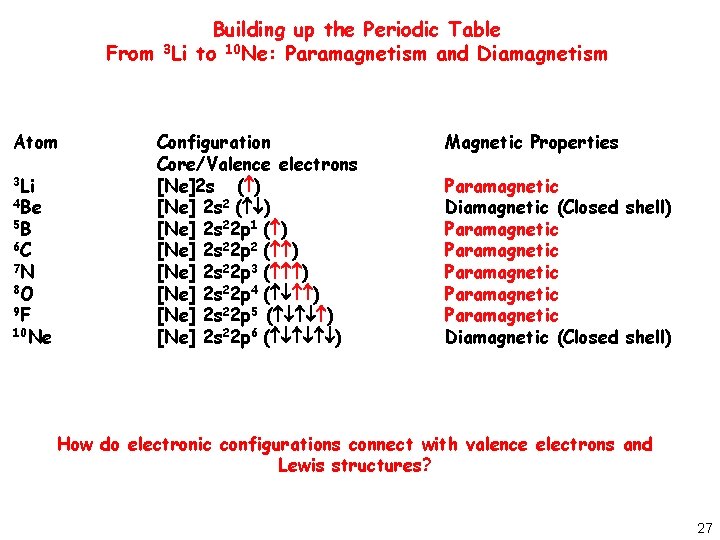
Building up the Periodic Table From 3 Li to 10 Ne: Paramagnetism and Diamagnetism Atom 3 Li 4 Be 5 B 6 C 7 N 8 O 9 F 10 Ne Configuration Core/Valence electrons [Ne]2 s ( ) [Ne] 2 s 22 p 1 ( ) [Ne] 2 s 22 p 2 ( ) [Ne] 2 s 22 p 3 ( ) [Ne] 2 s 22 p 4 ( ) [Ne] 2 s 22 p 5 ( ) [Ne] 2 s 22 p 6 ( ) Magnetic Properties Paramagnetic Diamagnetic (Closed shell) Paramagnetic Paramagnetic Diamagnetic (Closed shell) How do electronic configurations connect with valence electrons and Lewis structures? 27
Correlation of valence electron and Lewis structures: 2 p indicates an unpaired electron in a 2 p orbital 28
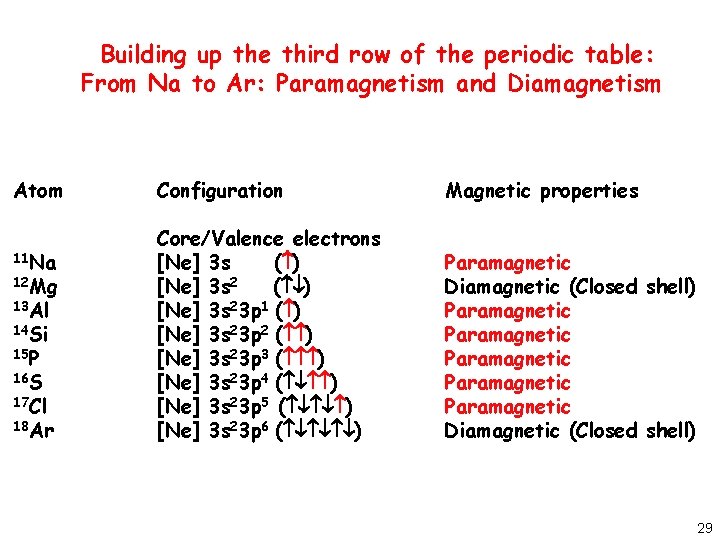
Building up the third row of the periodic table: From Na to Ar: Paramagnetism and Diamagnetism Atom 11 Na 12 Mg 13 Al 14 Si 15 P 16 S 17 Cl 18 Ar Configuration Magnetic properties Core/Valence electrons [Ne] 3 s ( ) [Ne] 3 s 23 p 1 ( ) [Ne] 3 s 23 p 2 ( ) [Ne] 3 s 23 p 3 ( ) [Ne] 3 s 23 p 4 ( ) [Ne] 3 s 23 p 5 ( ) [Ne] 3 s 23 p 6 ( ) Paramagnetic Diamagnetic (Closed shell) Paramagnetic Paramagnetic Diamagnetic (Closed shell) 29
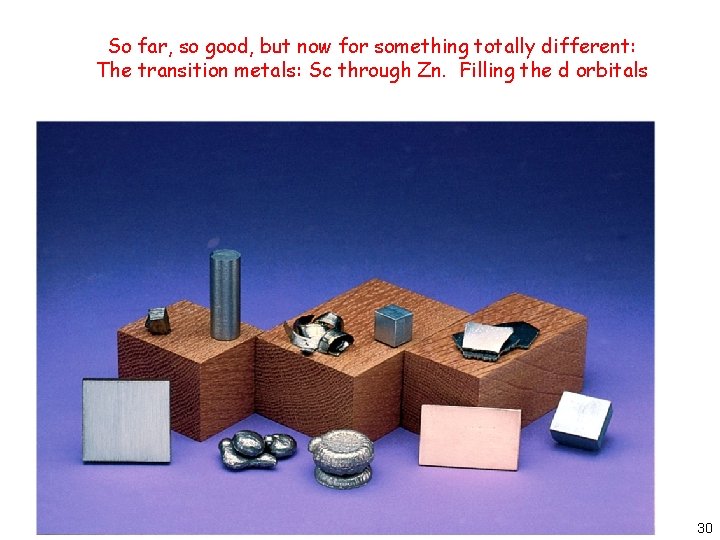
So far, so good, but now for something totally different: The transition metals: Sc through Zn. Filling the d orbitals 30
Electron configuration of the transition elements: 21 Sc through 30 Zn d orbitals raise their ugly lobes! The d block elements: 21 Sc, 22 Ti, 23 V, 24 Cr, 25 Mn, 26 Fe, 27 Co, 28 Ni, 29 Cu, 30 Zn 31
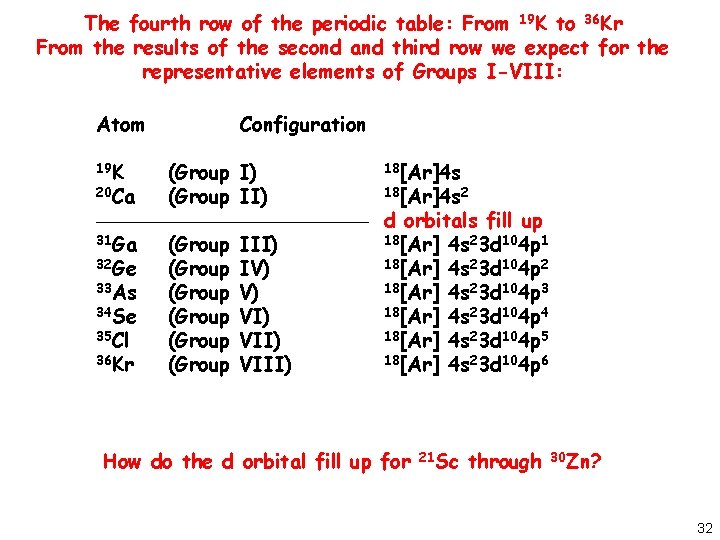
The fourth row of the periodic table: From 19 K to 36 Kr From the results of the second and third row we expect for the representative elements of Groups I-VIII: Atom 19 K 20 Ca Configuration (Group I) (Group II) _________________ 31 Ga 32 Ge 33 As 34 Se 35 Cl 36 Kr (Group (Group III) IV) V) VII) VIII) 18[Ar]4 s 2 d orbitals fill up 18[Ar] 4 s 23 d 104 p 1 18[Ar] 4 s 23 d 104 p 2 18[Ar] 4 s 23 d 104 p 3 18[Ar] 4 s 23 d 104 p 4 18[Ar] 4 s 23 d 104 p 5 18[Ar] 4 s 23 d 104 p 6 How do the d orbital fill up for 21 Sc through 30 Zn? 32
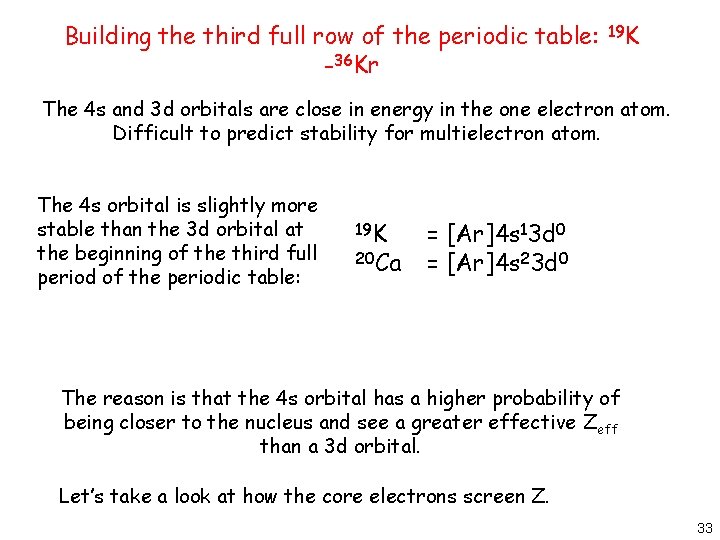
Building the third full row of the periodic table: -36 Kr 19 K The 4 s and 3 d orbitals are close in energy in the one electron atom. Difficult to predict stability for multielectron atom. The 4 s orbital is slightly more stable than the 3 d orbital at the beginning of the third full period of the periodic table: 19 K 20 Ca = [Ar]4 s 13 d 0 = [Ar]4 s 23 d 0 The reason is that the 4 s orbital has a higher probability of being closer to the nucleus and see a greater effective Zeff than a 3 d orbital. Let’s take a look at how the core electrons screen Z. 33
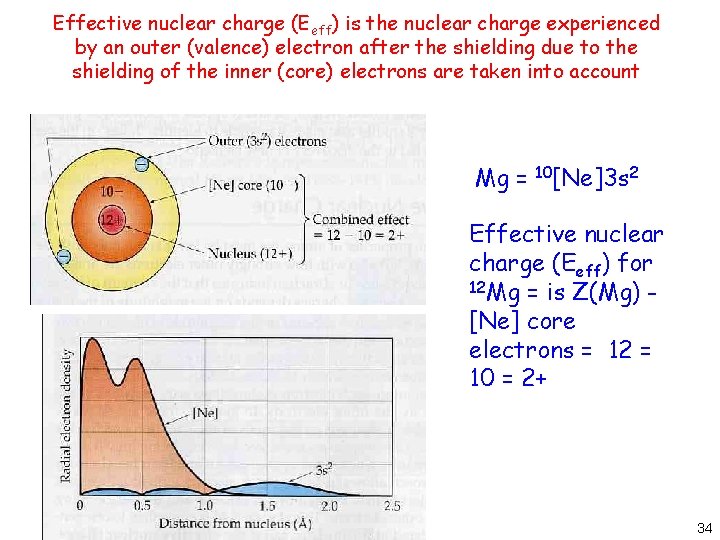
Effective nuclear charge (Eeff) is the nuclear charge experienced by an outer (valence) electron after the shielding due to the shielding of the inner (core) electrons are taken into account Mg = 10[Ne]3 s 2 Effective nuclear charge (Eeff) for 12 Mg = is Z(Mg) [Ne] core electrons = 12 = 10 = 2+ 34
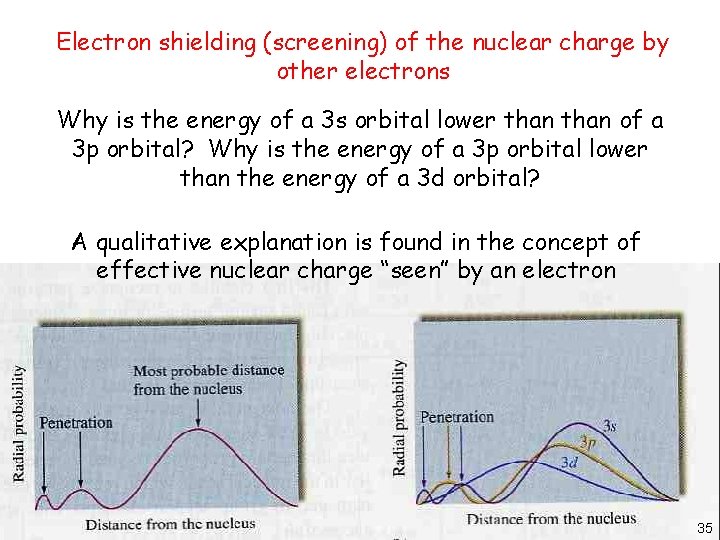
Electron shielding (screening) of the nuclear charge by other electrons Why is the energy of a 3 s orbital lower than of a 3 p orbital? Why is the energy of a 3 p orbital lower than the energy of a 3 d orbital? A qualitative explanation is found in the concept of effective nuclear charge “seen” by an electron 35
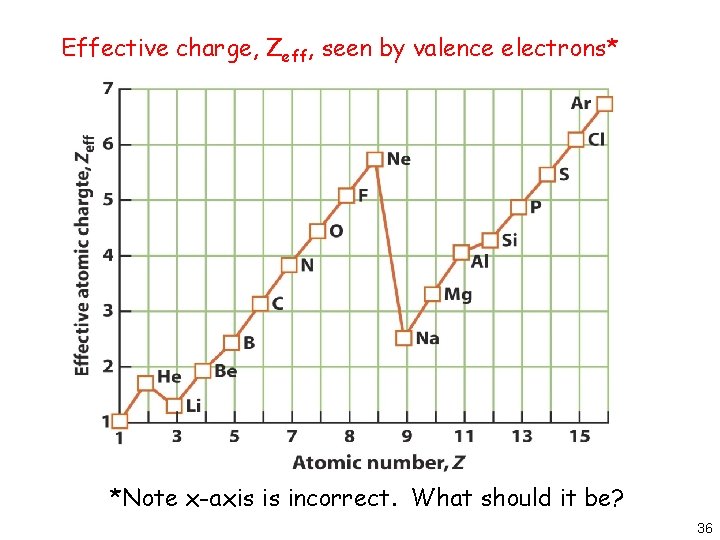
Effective charge, Zeff, seen by valence electrons* *Note x-axis is incorrect. What should it be? 36
Two new features for the transition elements: the energy “switch” of the 4 s and 3 d orbitals and the Cr and Cu anomalies. The 4 s and 3 d orbitals are very close in energy in the one electron atom. Depending on the screening (Eeff) 4 s < 3 d or 3 d < 4 s. From detailed computation and from experiment: 4 s < 3 d in the neutral atoms at the beginning of the 4 th period 20 Ca 18[Ar]4 s 2 21 Sc not [Ne]3 s 23 p 63 d 2 = 18[Ar]4 s 23 d 1: Note in the cations of transition metals, 3 d is lower than 4 s: 21 Sc+2 = 18[Ar]3 d 1 not 18[Ar]4 s 1. Thus, 4 s electrons are loss first! 37
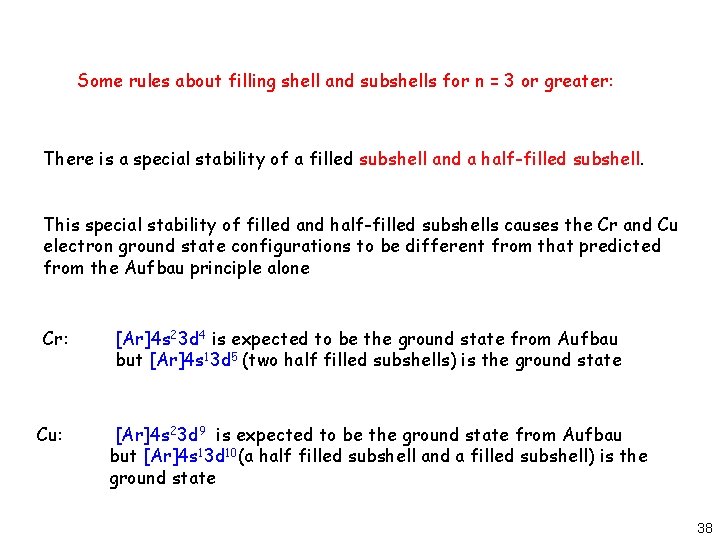
Some rules about filling shell and subshells for n = 3 or greater: There is a special stability of a filled subshell and a half-filled subshell. This special stability of filled and half-filled subshells causes the Cr and Cu electron ground state configurations to be different from that predicted from the Aufbau principle alone Cr: Cu: [Ar]4 s 23 d 4 is expected to be the ground state from Aufbau but [Ar]4 s 13 d 5 (two half filled subshells) is the ground state [Ar]4 s 23 d 9 is expected to be the ground state from Aufbau but [Ar]4 s 13 d 10(a half filled subshell and a filled subshell) is the ground state 38
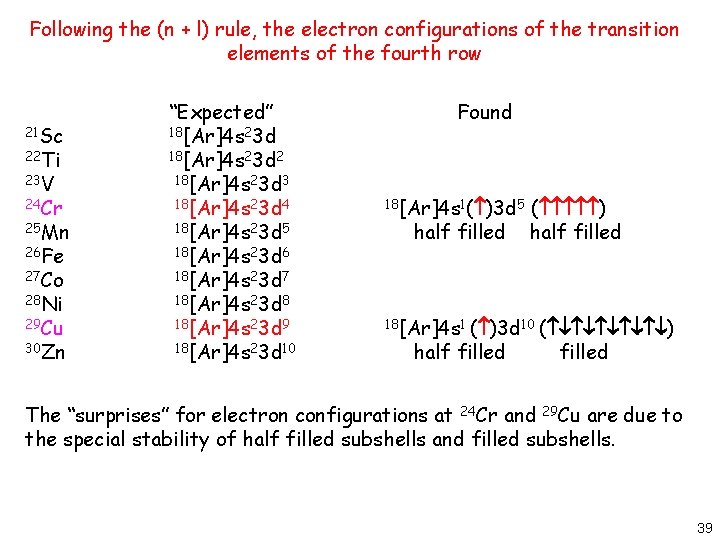
Following the (n + l) rule, the electron configurations of the transition elements of the fourth row 21 Sc 22 Ti 23 V 24 Cr 25 Mn 26 Fe 27 Co 28 Ni 29 Cu 30 Zn “Expected” 18[Ar]4 s 23 d 2 18[Ar]4 s 23 d 3 18[Ar]4 s 23 d 4 18[Ar]4 s 23 d 5 18[Ar]4 s 23 d 6 18[Ar]4 s 23 d 7 18[Ar]4 s 23 d 8 18[Ar]4 s 23 d 9 18[Ar]4 s 23 d 10 Found 18[Ar]4 s 1( )3 d 5 half filled ( ) half filled 18[Ar]4 s 1 ( )3 d 10 ( ) half filled The “surprises” for electron configurations at 24 Cr and 29 Cu are due to the special stability of half filled subshells and filled subshells. 39
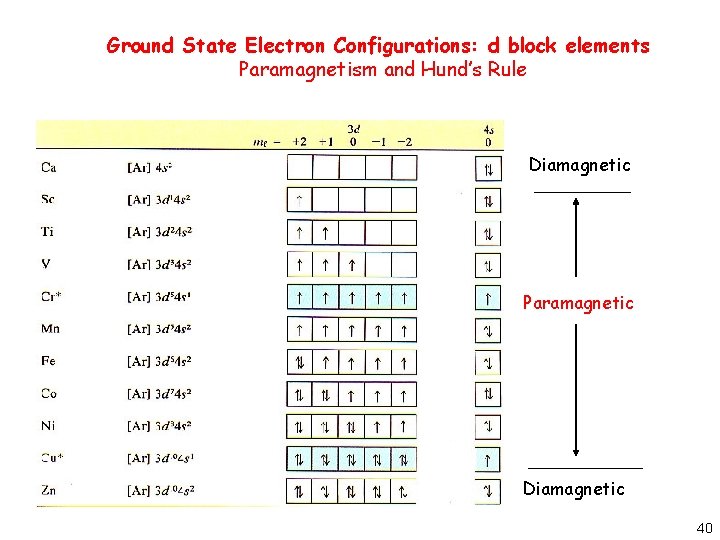
Ground State Electron Configurations: d block elements Paramagnetism and Hund’s Rule Diamagnetic Paramagnetic Diamagnetic 40
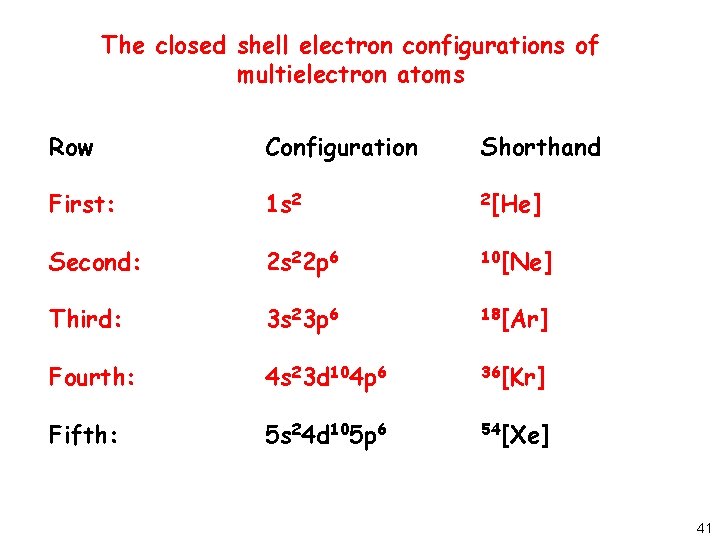
The closed shell electron configurations of multielectron atoms Row Configuration Shorthand First: 1 s 2 2[He] Second: 2 s 22 p 6 10[Ne] Third: 3 s 23 p 6 18[Ar] Fourth: 4 s 23 d 104 p 6 36[Kr] Fifth: 5 s 24 d 105 p 6 54[Xe] 41

The electron configurations of the valence shell of the main group elements Group I: ns 1 np 0 The alkali metals: (H) Li, Na, K, Rb, Cs Group II: ns 2 np 0 The alkali earth metals: Be, Mg, Ca, Sr, Ba Group III: ns 2 np 1 The boron family: B, Al, Ga, In, Tl Group IV: ns 2 np 2 The carbon family: C, Si, Ge, Sn, Pb Group V: ns 2 np 3 The nitrogen family: N, P, As, Sb, Bi Group VI: ns 2 np 4 The chalcogens: O, S, Se, Te, Po Group VII: ns 2 np 5 The halogens: F, Cl, Br, I Group VIII: ns 2 np 6 The noble gases: (He) Ne, Ar, Kr, Xe, 42
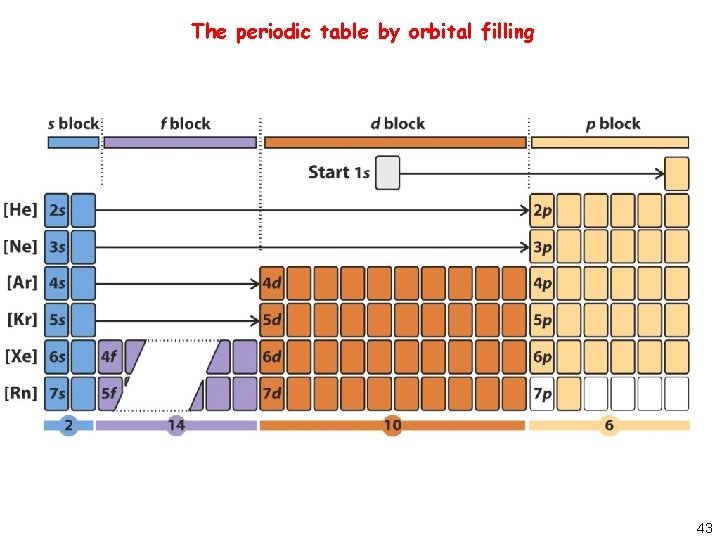
The periodic table by orbital filling 43
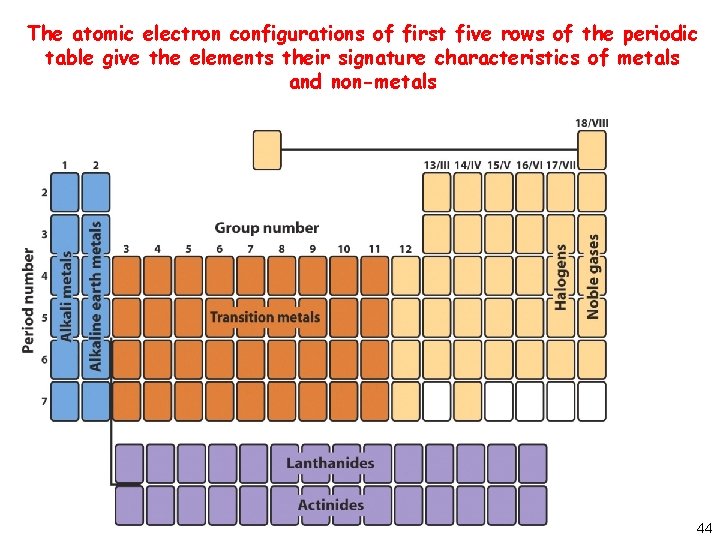
The atomic electron configurations of first five rows of the periodic table give the elements their signature characteristics of metals and non-metals 44
Electronic structure and the periodic table Electrons in the outermost shell of an atom are the most important in determining chemical properties. Chemical reactions involve only the outer (valence) electrons. The inner (core) electrons are not involved in chemical reactions. Elements in a given vertical column (families) of the periodic table have similar outer-shell electron configurations and similar properties. They are isoelectronic with respect to the number of valence electrons. Elements in a row show regular trends in their properties due to the continuing increase in the number of valence electrons until a shell is filled. 45
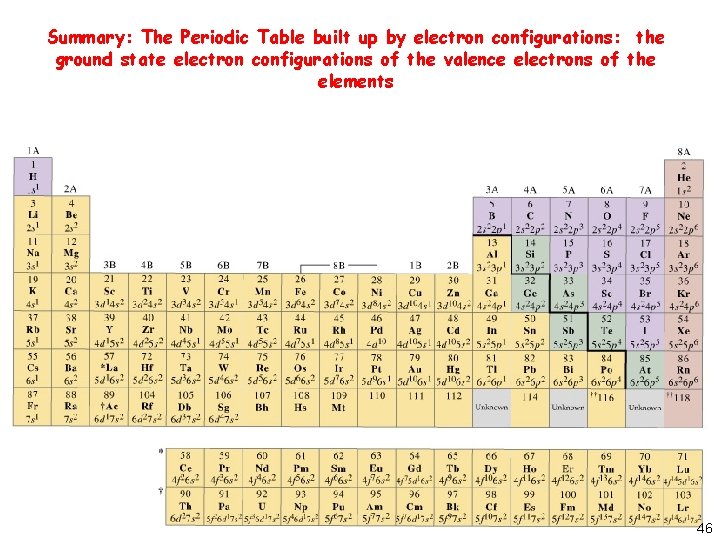
Summary: The Periodic Table built up by electron configurations: the ground state electron configurations of the valence electrons of the elements 46

47
Effective nuclear charge (Zeff) on the outer electrons Maintain hydrogen atom like orbitals as an approximation, but subshell energies are not equal: Ens < Enp < End < Enf A s electron penetrates to the nucleus more than a p electron: a p electron penetrates to the nucleus more than a d electron: more penetration, more stable, lower energy. Subshell energies: E 3 s < E 3 p < E 3 d 48
Classification of orbitals of a many electron atom according to their energies. Orbitals with same value of n and different value of l comprise a shell. Example: 2 s and 2 p comprise a shell. A group of orbitals with exactly equal energies comprise a subshell. Example: 2 px, 2 py and 2 pz The orbital approximation ignores electron-electron repulsion, but takes into account Hund’s rule: electrons with parallel spins ( ) tend to stay apart compared to electrons with antiparallel spins ( ). 49
More about orbitals, shells and subshells Each shell of principal quantum number n contains n subshells n = 1, only one subshell (s) n = 2, two subshells (s, p) n = 3, three subshells (s, p, d) Each subshell of quantum number l contains (2 l + 1) orbitals l = 0, (2 x 0 + 1) = 1 orbital (s) l = 1, (2 x 1 + 1) = 3 orbitals (px, py, p. Z) l = 2, (2 x 2 + 1) = 5 orbitals (dxy, dyz, dx 2 - y 2, dz 2) The number of orbitals for a given n is n 2 (solutions to wave equation) For n = 1, one orbital; for n = 2, four orbitals, for n = 3, nine orbitals The number of electrons that can fill a given shell = 2 n 2 For each orbital, there can be a maximum of 2 occupying electrons 50
The Pauli principle imposes structure on the many electron atom. Without it, all the electrons might be expected to crowd into the low energy orbitals. With it the electrons are organized, filled orbitals with no more than two electrons. The ground state of an atom possesses the lowest energy organization of electrons around the nucleus. All electron organizations are described by electron configurations. The ground state of an atom corresponds to the lowest energy electron configuration. 51
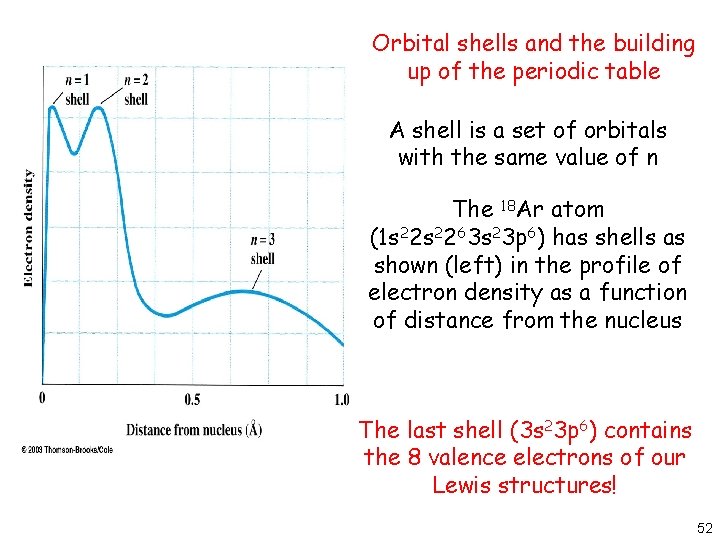
Orbital shells and the building up of the periodic table A shell is a set of orbitals with the same value of n The 18 Ar atom (1 s 2263 s 23 p 6) has shells as shown (left) in the profile of electron density as a function of distance from the nucleus The last shell (3 s 23 p 6) contains the 8 valence electrons of our Lewis structures! 52
Building up electronic configurations of atoms: In Place: the ordering of the energy levels (n +l) rule. Two principles now needed to be applied: The Pauli exclusion principle and the Aufbau principle The Pauli exclusion principle (A principle not derived from quantum mechanics, but required to explain observations). Two equivalent statements of the Pauli exclusion principle: (1) No two electrons may have the same set of four quantum numbers; (2) No more than two electrons may occupy the same orbital. Because of the Pauli exclusion principle, outer electrons do not “fall” into the inner shell. Thus, the atom is stable. Furthermore, the principle together with the Aufbau principle leads to “magic” number of electrons in shells 53
- Slides: 53