
Chapter 17 Introduction to Assurance Overview Why assurance
- Slides: 28
Chapter 17: Introduction to Assurance • • • Overview Why assurance? Trust and assurance Life cycle and assurance Building security in vs. adding security later November 1, 2004 Introduction to Computer Security © 2004 Matt Bishop 1
Overview • • Trust Problems from lack of assurance Types of assurance Life cycle and assurance Waterfall life cycle model Other life cycle models Adding security afterwards November 1, 2004 Introduction to Computer Security © 2004 Matt Bishop 2
Trust • Trustworthy entity has sufficient credible evidence leading one to believe that the system will meet a set of requirements • Trust is a measure of trustworthiness relying on the evidence • Assurance is confidence that an entity meets its security requirements based on evidence provided by applying assurance techniques November 1, 2004 Introduction to Computer Security © 2004 Matt Bishop 3
Relationships November 1, 2004 Introduction to Computer Security © 2004 Matt Bishop 4
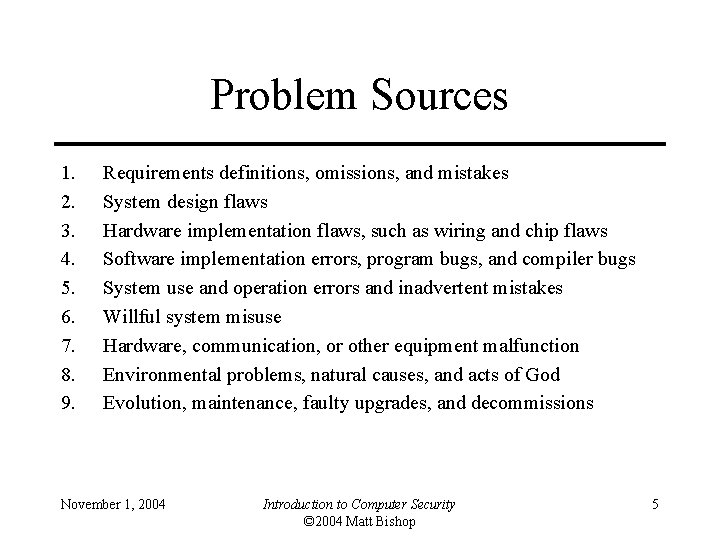
Problem Sources 1. 2. 3. 4. 5. 6. 7. 8. 9. Requirements definitions, omissions, and mistakes System design flaws Hardware implementation flaws, such as wiring and chip flaws Software implementation errors, program bugs, and compiler bugs System use and operation errors and inadvertent mistakes Willful system misuse Hardware, communication, or other equipment malfunction Environmental problems, natural causes, and acts of God Evolution, maintenance, faulty upgrades, and decommissions November 1, 2004 Introduction to Computer Security © 2004 Matt Bishop 5
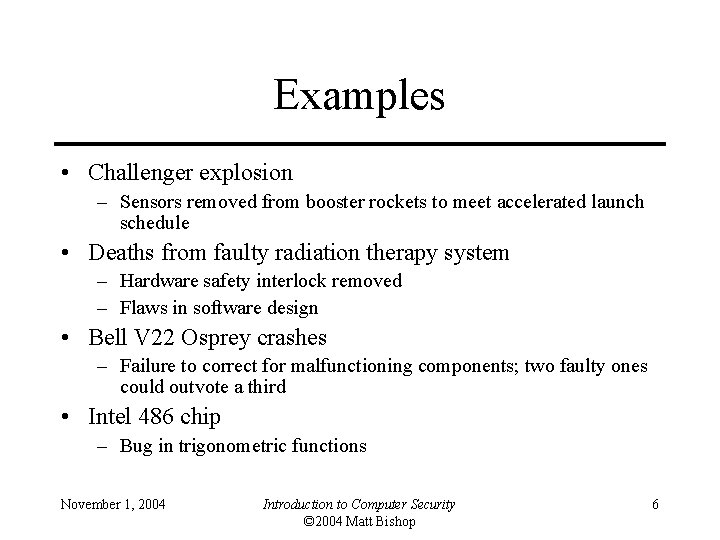
Examples • Challenger explosion – Sensors removed from booster rockets to meet accelerated launch schedule • Deaths from faulty radiation therapy system – Hardware safety interlock removed – Flaws in software design • Bell V 22 Osprey crashes – Failure to correct for malfunctioning components; two faulty ones could outvote a third • Intel 486 chip – Bug in trigonometric functions November 1, 2004 Introduction to Computer Security © 2004 Matt Bishop 6
Role of Requirements • Requirements are statements of goals that must be met – Vary from high-level, generic issues to lowlevel, concrete issues • Security objectives are high-level security issues • Security requirements are specific, concrete issues November 1, 2004 Introduction to Computer Security © 2004 Matt Bishop 7
Types of Assurance • Policy assurance is evidence establishing security requirements in policy is complete, consistent, technically sound • Design assurance is evidence establishing design sufficient to meet requirements of security policy • Implementation assurance is evidence establishing implementation consistent with security requirements of security policy November 1, 2004 Introduction to Computer Security © 2004 Matt Bishop 8
Types of Assurance • Operational assurance is evidence establishing system sustains the security policy requirements during installation, configuration, and day-to-day operation – Also called administrative assurance November 1, 2004 Introduction to Computer Security © 2004 Matt Bishop 9
Life Cycle November 1, 2004 Introduction to Computer Security © 2004 Matt Bishop 10
Life Cycle • • Conception Manufacture Deployment Fielded Product Life November 1, 2004 Introduction to Computer Security © 2004 Matt Bishop 11
Conception • Idea – Decisions to pursue it • Proof of concept – See if idea has merit • High-level requirements analysis – What does “secure” mean for this concept? – Is it possible for this concept to meet this meaning of security? – Is the organization willing to support the additional resources required to make this concept meet this meaning of security? November 1, 2004 Introduction to Computer Security © 2004 Matt Bishop 12
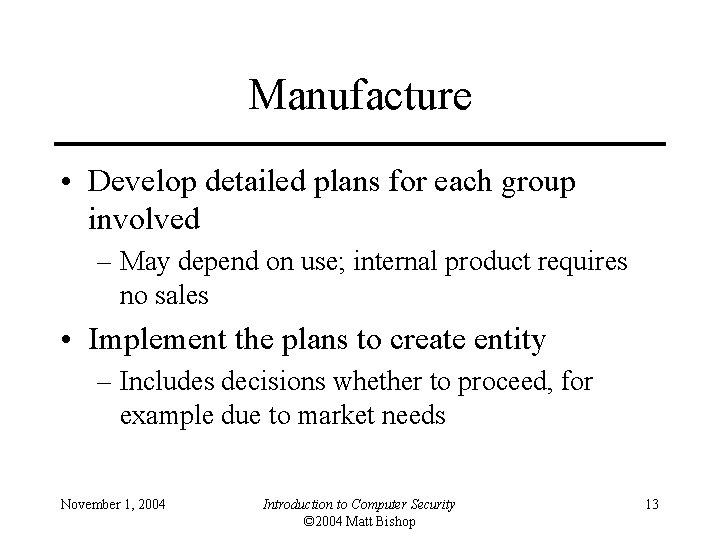
Manufacture • Develop detailed plans for each group involved – May depend on use; internal product requires no sales • Implement the plans to create entity – Includes decisions whether to proceed, for example due to market needs November 1, 2004 Introduction to Computer Security © 2004 Matt Bishop 13
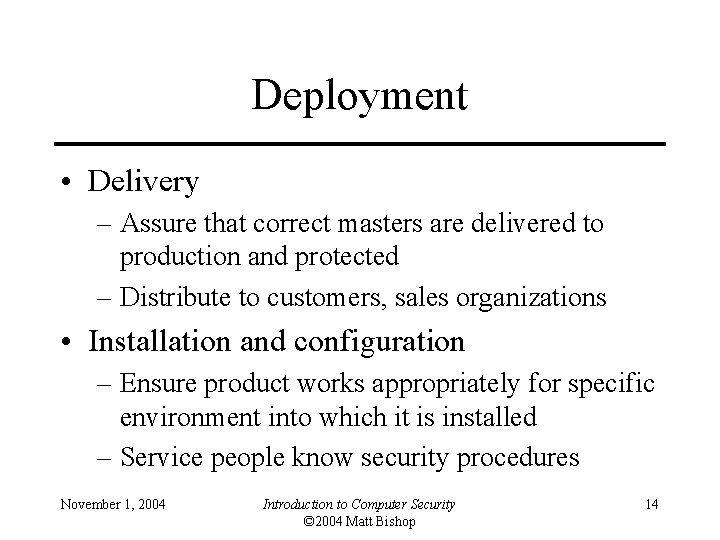
Deployment • Delivery – Assure that correct masters are delivered to production and protected – Distribute to customers, sales organizations • Installation and configuration – Ensure product works appropriately for specific environment into which it is installed – Service people know security procedures November 1, 2004 Introduction to Computer Security © 2004 Matt Bishop 14
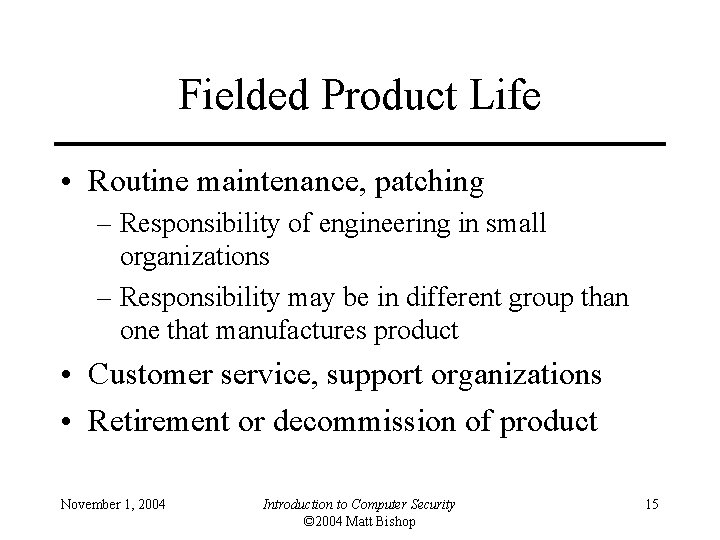
Fielded Product Life • Routine maintenance, patching – Responsibility of engineering in small organizations – Responsibility may be in different group than one that manufactures product • Customer service, support organizations • Retirement or decommission of product November 1, 2004 Introduction to Computer Security © 2004 Matt Bishop 15
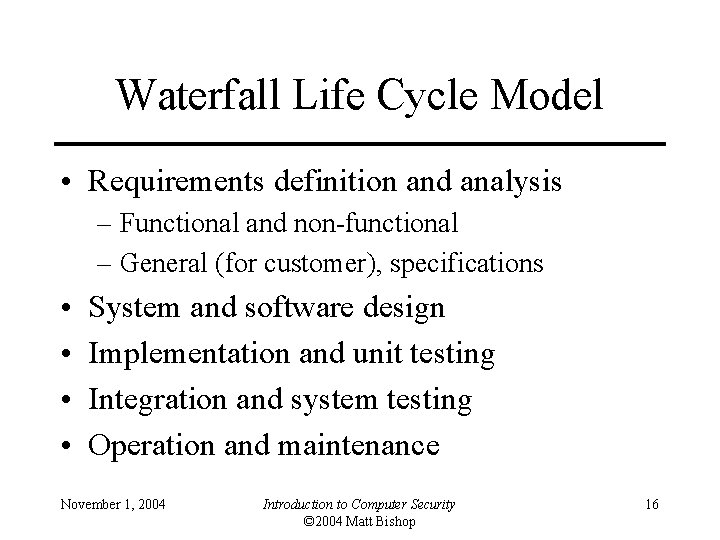
Waterfall Life Cycle Model • Requirements definition and analysis – Functional and non-functional – General (for customer), specifications • • System and software design Implementation and unit testing Integration and system testing Operation and maintenance November 1, 2004 Introduction to Computer Security © 2004 Matt Bishop 16
Relationship of Stages November 1, 2004 Introduction to Computer Security © 2004 Matt Bishop 17
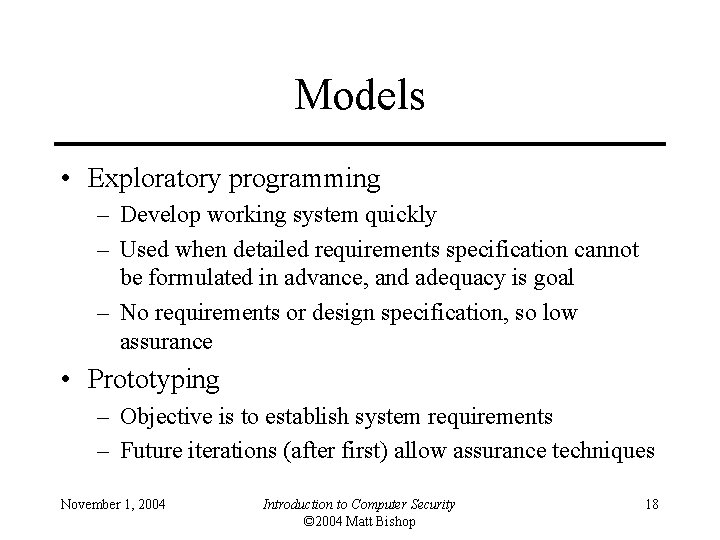
Models • Exploratory programming – Develop working system quickly – Used when detailed requirements specification cannot be formulated in advance, and adequacy is goal – No requirements or design specification, so low assurance • Prototyping – Objective is to establish system requirements – Future iterations (after first) allow assurance techniques November 1, 2004 Introduction to Computer Security © 2004 Matt Bishop 18
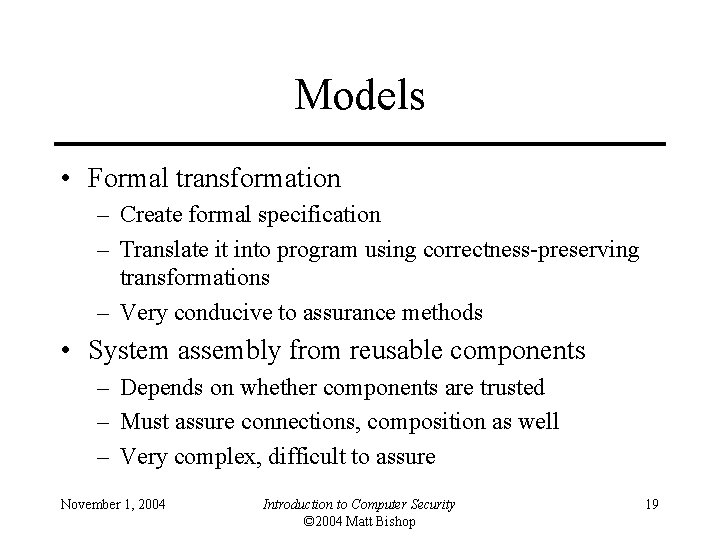
Models • Formal transformation – Create formal specification – Translate it into program using correctness-preserving transformations – Very conducive to assurance methods • System assembly from reusable components – Depends on whether components are trusted – Must assure connections, composition as well – Very complex, difficult to assure November 1, 2004 Introduction to Computer Security © 2004 Matt Bishop 19
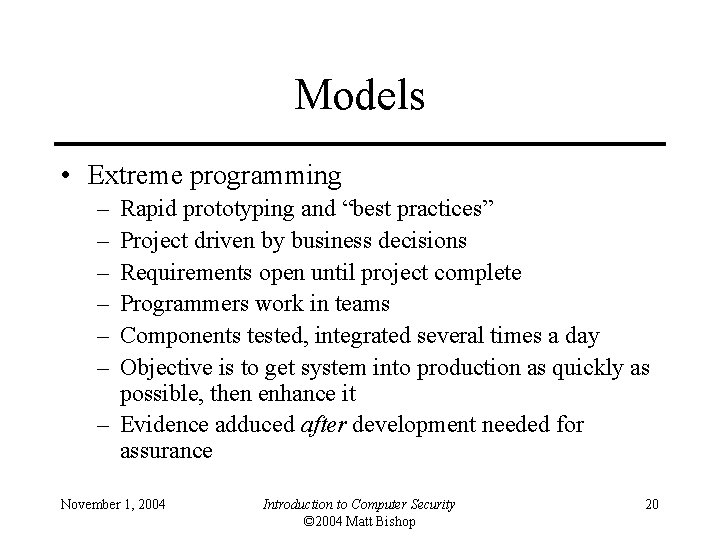
Models • Extreme programming – – – Rapid prototyping and “best practices” Project driven by business decisions Requirements open until project complete Programmers work in teams Components tested, integrated several times a day Objective is to get system into production as quickly as possible, then enhance it – Evidence adduced after development needed for assurance November 1, 2004 Introduction to Computer Security © 2004 Matt Bishop 20
Security: Built In or Add On? • Think of security as you do performance – You don’t build a system, then add in performance later • Can “tweak” system to improve performance a little • Much more effective to change fundamental algorithms, design • You need to design it in – Otherwise, system lacks fundamental and structural concepts for high assurance November 1, 2004 Introduction to Computer Security © 2004 Matt Bishop 21
Reference Validation Mechanism • Reference monitor is access control concept of an abstract machine that mediates all accesses to objects by subjects • Reference validation mechanism (RVM) is an implementation of the reference monitor concept. – Tamperproof – Complete (always invoked and can never be bypassed) – Simple (small enough to be subject to analysis and testing, the completeness of which can be assured) • Last engenders trust by providing assurance of correctness November 1, 2004 Introduction to Computer Security © 2004 Matt Bishop 22
Examples • Security kernel combines hardware and software to implement reference monitor • Trusted computing base (TCB) is all protection mechanisms within a system responsible for enforcing security policy – Includes hardware and software – Generalizes notion of security kernel November 1, 2004 Introduction to Computer Security © 2004 Matt Bishop 23
Adding On Security • Key to problem: analysis and testing • Designing in mechanisms allow assurance at all levels – Too many features adds complexity, complicates analysis • Adding in mechanisms makes assurance hard – Gap in abstraction from requirements to design may prevent complete requirements testing – May be spread throughout system (analysis hard) – Assurance may be limited to test results November 1, 2004 Introduction to Computer Security © 2004 Matt Bishop 24
Example • 2 AT&T products – Add mandatory controls to UNIX system – SV/MLS • Add MAC to UNIX System V Release 3. 2 – SVR 4. 1 ES • Re-architect UNIX system to support MAC November 1, 2004 Introduction to Computer Security © 2004 Matt Bishop 25
Comparison • Architecting of System – SV/MLS: used existing kernel modular structure; no implementation of least privilege – SVR 4. 1 ES: restructured kernel to make it highly modular and incorporated least privilege November 1, 2004 Introduction to Computer Security © 2004 Matt Bishop 26
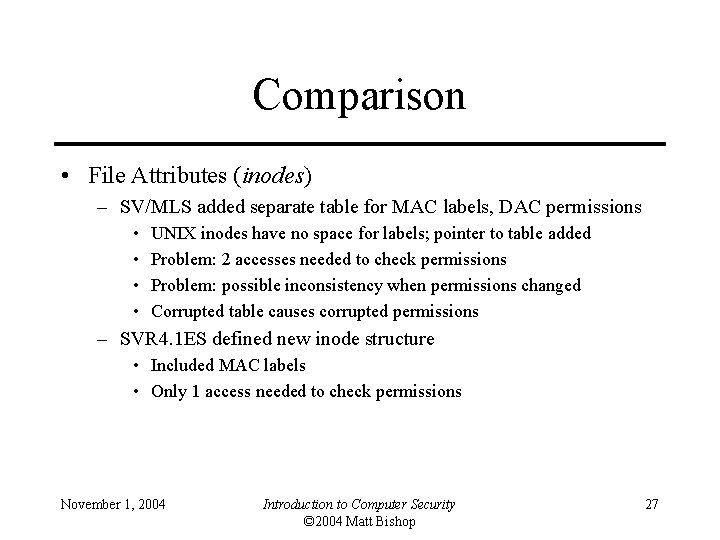
Comparison • File Attributes (inodes) – SV/MLS added separate table for MAC labels, DAC permissions • • UNIX inodes have no space for labels; pointer to table added Problem: 2 accesses needed to check permissions Problem: possible inconsistency when permissions changed Corrupted table causes corrupted permissions – SVR 4. 1 ES defined new inode structure • Included MAC labels • Only 1 access needed to check permissions November 1, 2004 Introduction to Computer Security © 2004 Matt Bishop 27
Key Points • Assurance critical for determining trustworthiness of systems • Different levels of assurance, from informal evidence to rigorous mathematical evidence • Assurance needed at all stages of system life cycle • Building security in is more effective than adding it later November 1, 2004 Introduction to Computer Security © 2004 Matt Bishop 28