
Chapter 17 International Dimensions of Talent Management Learning


- Slides: 31
Chapter 17 International Dimensions of Talent Management
Learning Goals (1 of 3) • 17 -1: Explain the concept of culture and its implications for talent management. • 17 -2: Identify various dimensions that help to distinguish cultures. • 17 -3: Discuss recent theoretical and methodological developments in the study of culture. Cascio & Aguinis, Applied Psychology in Talent Management, 8 e. © SAGE Publishing, 2019. 3
Learning Goals (2 of 3) • 17 -4: Distinguish translation, conceptual, and metric equivalence when psychological measures are transported across cultures. • 17 -5: Describe how selection for international assignments differs from that for domestic assignments. Cascio & Aguinis, Applied Psychology in Talent Management, 8 e. © SAGE Publishing, 2019. 4
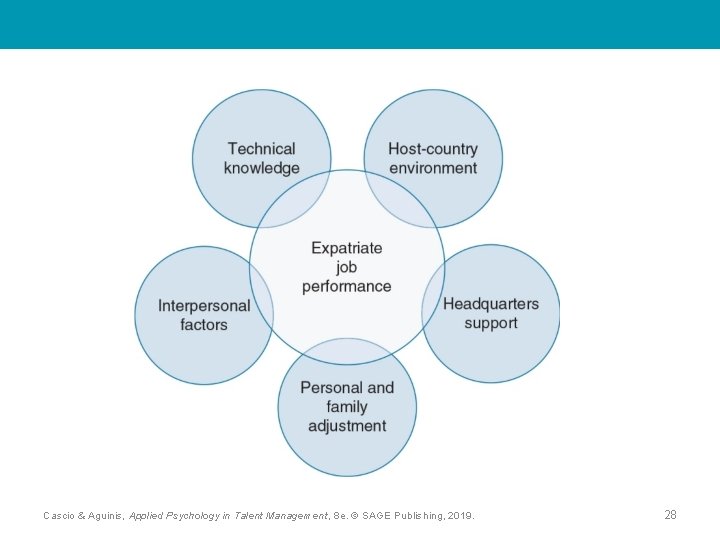
Learning Goals (3 of 3) • 17 -6: Specify key areas in which to focus expatriate training. • 17 -7: Identify key components of an effective performance management system for expatriates. • 17 -8: Suggest evidence-based actions that organizations can take to reduce turnover among repatriates. Cascio & Aguinis, Applied Psychology in Talent Management, 8 e. © SAGE Publishing, 2019. 5
Twenty-First-Century Capitalism (1 of 14) • Globalization and culture – Vertical cultures accept hierarchy as a given – Horizontal cultures accept equality as a given – Individualistic cultures in societies complex and loose – Collectivism in societies simple and tight Cascio & Aguinis, Applied Psychology in Talent Management, 8 e. © SAGE Publishing, 2019. 6
Twenty-First-Century Capitalism (2 of 14) • Globalization and culture – Definition of the self • Autonomous and independent from groups versus interdependent with others – Structure of goals • Priority given to personal goals versus priority given to in-group goals Cascio & Aguinis, Applied Psychology in Talent Management, 8 e. © SAGE Publishing, 2019. 7
Twenty-First-Century Capitalism (3 of 14) • Globalization and culture – Norms versus attitudes • Attitudes, personal needs, perceived rights, and contracts as determinants of social behavior versus norms, duties, and obligations as determinants of social behavior Cascio & Aguinis, Applied Psychology in Talent Management, 8 e. © SAGE Publishing, 2019. 8
Twenty-First-Century Capitalism (4 of 14) • Globalization and culture – Relatedness versus rationality • Collectivists emphasize relatedness whereas individualists emphasize rationality Cascio & Aguinis, Applied Psychology in Talent Management, 8 e. © SAGE Publishing, 2019. 9
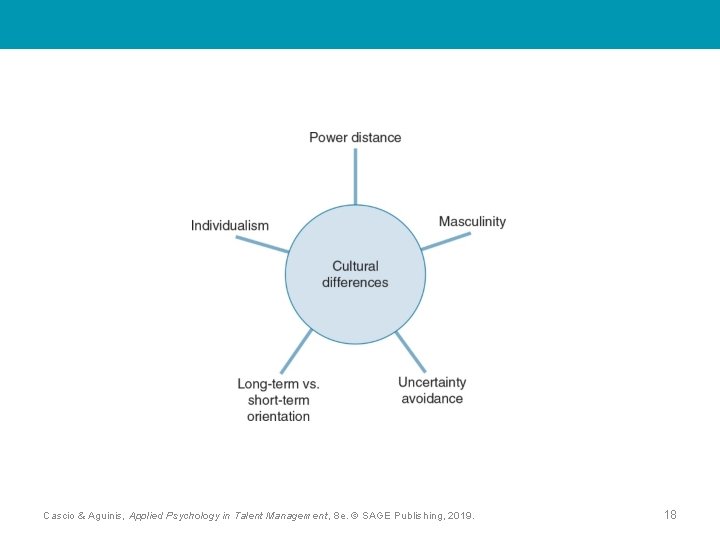
Twenty-First-Century Capitalism (5 of 14) • Country-level cultural differences – Power distance • Extent members of an organization accept inequality and whether they perceive much distance between those with power Cascio & Aguinis, Applied Psychology in Talent Management, 8 e. © SAGE Publishing, 2019. 10
Twenty-First-Century Capitalism (6 of 14) • Country-level cultural differences – Uncertainty avoidance • Extent to which a culture programs its members to feel either comfortable or uncomfortable in unstructured situations Cascio & Aguinis, Applied Psychology in Talent Management, 8 e. © SAGE Publishing, 2019. 11
Twenty-First-Century Capitalism (7 of 14) • Country-level cultural differences – Individualism • Extent to which people emphasize personal or group goals – Masculinity • Societies that differentiate very strongly by gender Cascio & Aguinis, Applied Psychology in Talent Management, 8 e. © SAGE Publishing, 2019. 12
Twenty-First-Century Capitalism (8 of 14) • Country-level cultural differences – Long-term versus short-term orientation • Extent to which a culture programs its members to accept delayed gratification of their material, social, and emotional needs. Cascio & Aguinis, Applied Psychology in Talent Management, 8 e. © SAGE Publishing, 2019. 13
Twenty-First-Century Capitalism (9 of 14) • Country-level cultural differences – Culture • Global, national, regional, state, community, industry, organizational, and team levels clearly affects behavior in organizations Cascio & Aguinis, Applied Psychology in Talent Management, 8 e. © SAGE Publishing, 2019. 14
Twenty-First-Century Capitalism (10 of 14) • Country-level cultural differences – Cross-cultural research • Helps us understand leverage similarities and differences in globalized and interdependent world Cascio & Aguinis, Applied Psychology in Talent Management, 8 e. © SAGE Publishing, 2019. 15
Twenty-First-Century Capitalism (11 of 14) • Psychological measurement – Translation equivalence • Wording of a measure that has been translated into a different language – Conceptual equivalence • Attribute being measured has similar meaning across cultures Cascio & Aguinis, Applied Psychology in Talent Management, 8 e. © SAGE Publishing, 2019. 16
Twenty-First-Century Capitalism (12 of 14) • Psychological measurement – Metric equivalence • Statistical associations among dependent and independent variables remain relatively stable, regardless of whether a measure is used domestically or internationally Cascio & Aguinis, Applied Psychology in Talent Management, 8 e. © SAGE Publishing, 2019. 17
Cascio & Aguinis, Applied Psychology in Talent Management, 8 e. © SAGE Publishing, 2019. 18
Twenty-First-Century Capitalism (13 of 14) • Terminology – Expatriate or foreign-service employee • Anyone working outside her or his home country with a planned return to that or a third country – Home country • Expatriate’s country of residence Cascio & Aguinis, Applied Psychology in Talent Management, 8 e. © SAGE Publishing, 2019. 19
Twenty-First-Century Capitalism (14 of 14) • Terminology – Host country • Country in which expatriate is working – Third-country national • Expatriate who has transferred to additional country while working abroad Cascio & Aguinis, Applied Psychology in Talent Management, 8 e. © SAGE Publishing, 2019. 20
International Management and Cultural Competence (1 of 2) • Future international executives – Gets organizational attention and investment – Takes or makes more opportunities to learn – Is receptive to learning opportunities – Changes as a result of experience Cascio & Aguinis, Applied Psychology in Talent Management, 8 e. © SAGE Publishing, 2019. 21
International Management and Cultural Competence (2 of 2) • Cultural intelligence (CQ) – Individuals’ belief in their ability to be effective in culturally diverse environments and their interests in other cultures – Captures affective, cognitive, behavioral, and motivational facets Cascio & Aguinis, Applied Psychology in Talent Management, 8 e. © SAGE Publishing, 2019. 22
Selection for International Assignments (1 of 2) • General mental ability – Wonderlic Personnel Test – Ravens Progressive Matrices – General Aptitude Test Battery – Differential Aptitude Test Cascio & Aguinis, Applied Psychology in Talent Management, 8 e. © SAGE Publishing, 2019. 23
Selection for International Assignments (2 of 2) • Personality characteristics – Extroversion – Agreeableness – Emotional stability – Conscientiousness – Openness – Global mind-set – Cultural agility – Cultural intelligence Cascio & Aguinis, Applied Psychology in Talent Management, 8 e. © SAGE Publishing, 2019. 24
Cross-Cultural Training (CCT) • Formal programs to prepare persons of one culture to interact in another culture or to interact with persons from different cultures – Culture – Language – Practical day-to-day matters Cascio & Aguinis, Applied Psychology in Talent Management, 8 e. © SAGE Publishing, 2019. 25
Performance Management (1 of 2) • Performance management – Evaluation and continuous improvement of individual or team performance – Job descriptions congruent with organizational goals – Adequate training to raters and ratees Cascio & Aguinis, Applied Psychology in Talent Management, 8 e. © SAGE Publishing, 2019. 26
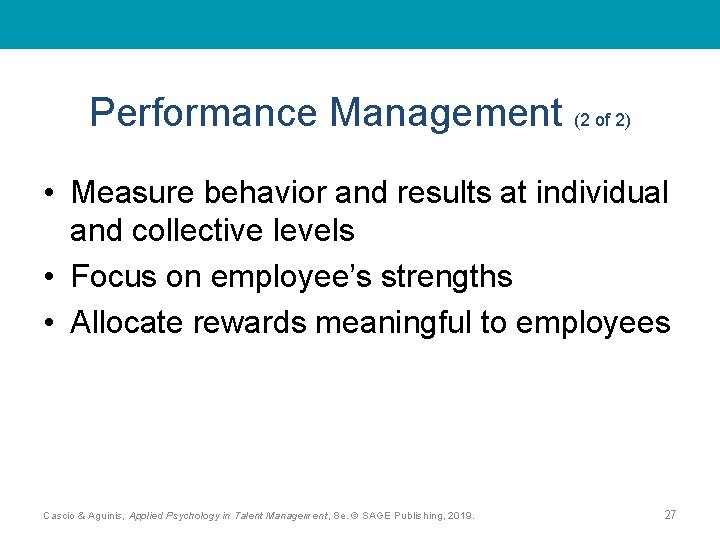
Performance Management (2 of 2) • Measure behavior and results at individual and collective levels • Focus on employee’s strengths • Allocate rewards meaningful to employees Cascio & Aguinis, Applied Psychology in Talent Management, 8 e. © SAGE Publishing, 2019. 27
Cascio & Aguinis, Applied Psychology in Talent Management, 8 e. © SAGE Publishing, 2019. 28
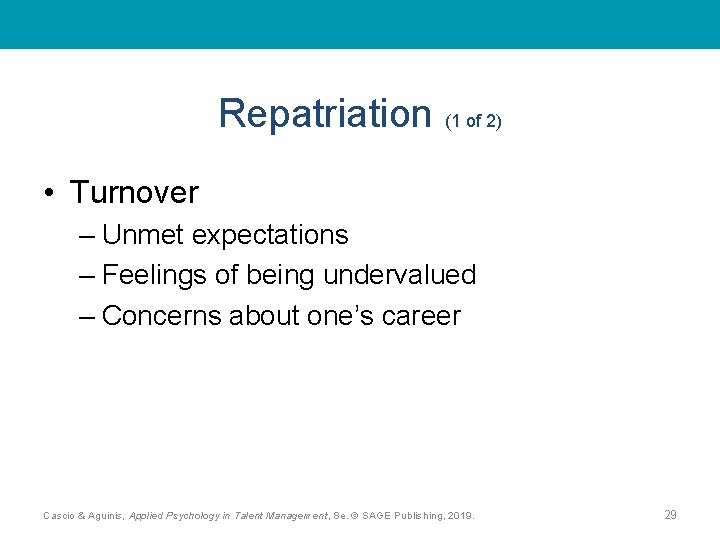
Repatriation (1 of 2) • Turnover – Unmet expectations – Feelings of being undervalued – Concerns about one’s career Cascio & Aguinis, Applied Psychology in Talent Management, 8 e. © SAGE Publishing, 2019. 29
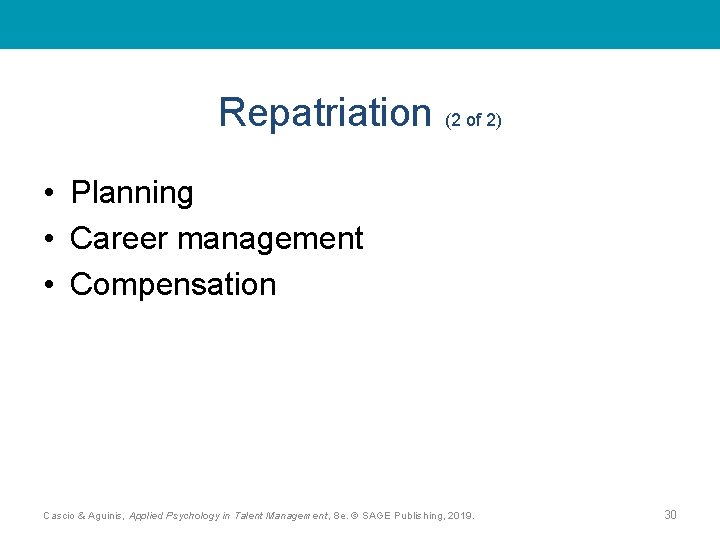
Repatriation (2 of 2) • Planning • Career management • Compensation Cascio & Aguinis, Applied Psychology in Talent Management, 8 e. © SAGE Publishing, 2019. 30
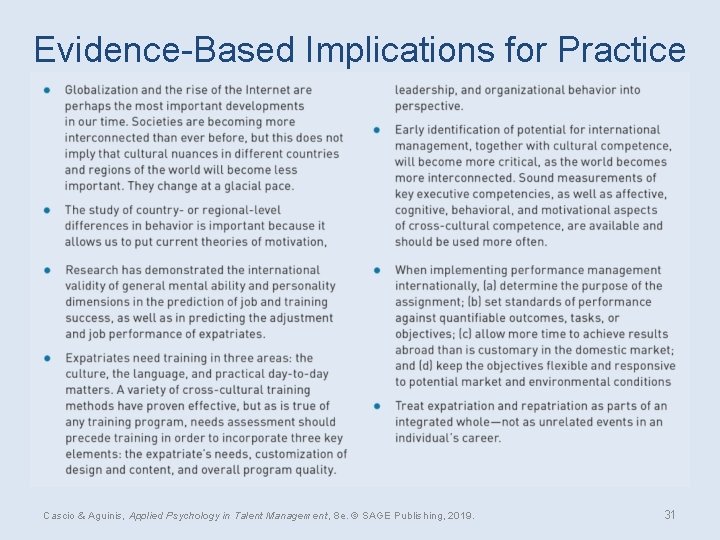
Evidence-Based Implications for Practice Cascio & Aguinis, Applied Psychology in Talent Management, 8 e. © SAGE Publishing, 2019. 31