
Chapter 17 Geologic Time Concepts and Principles Chapter



- Slides: 64
Chapter 17 Geologic Time: Concepts and Principles
Chapter Outline I. III. IV. V. VIII. IX. X. XIII. Introduction How Is Geologic Time Measured? Early Concepts of Geologic Time and the Age of Earth James Mutton and the Recognition of Geologic Time Relative Dating Methods Correlating Rock Units Geo-Insight: Uluru and Kata. Tjuta Absolute Dating Methods Development of the Geologic Time Scale Stratigraphy and Stratigraphic Terminology Geologic Time and Climate Change Geo-Focus: Denver's Weather— 280 Million Years Ago! Geo-Recap
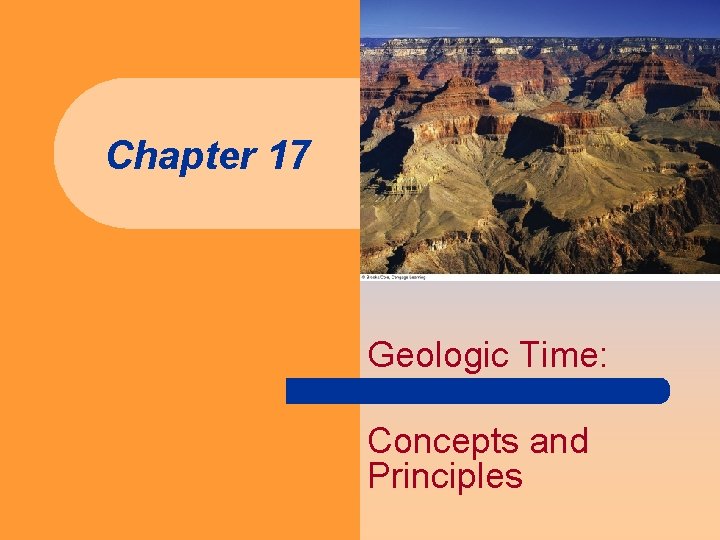
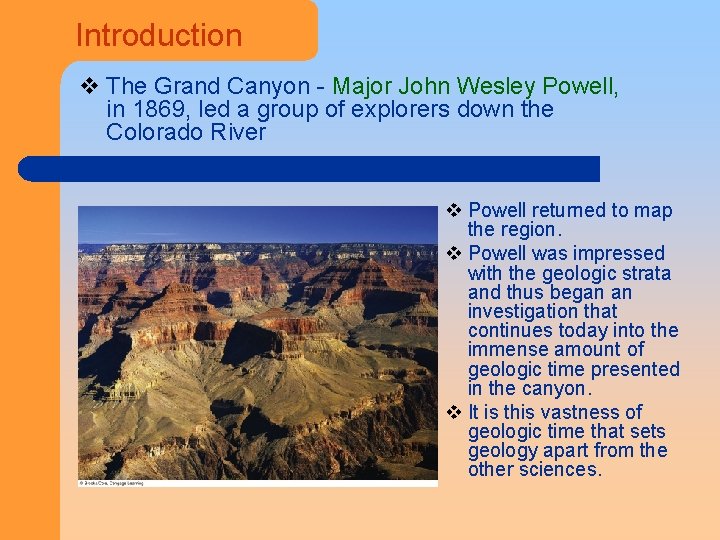
Introduction v The Grand Canyon - Major John Wesley Powell, in 1869, led a group of explorers down the Colorado River v Powell returned to map the region. v Powell was impressed with the geologic strata and thus began an investigation that continues today into the immense amount of geologic time presented in the canyon. v It is this vastness of geologic time that sets geology apart from the other sciences.
Introduction v Geologic time provides an immense contribution to other sciences v The logic used in applying the principles of relative dating “involves basic reasoning skills” that are useful in almost any profession or discipline. v The geologic time scale is fundamental to understanding the physical and biological history of our planet v An accurate and precise geologic calendar is critical in determining the onset, duration, and possible causes of such past events as global climate change and their potential effects on humans.
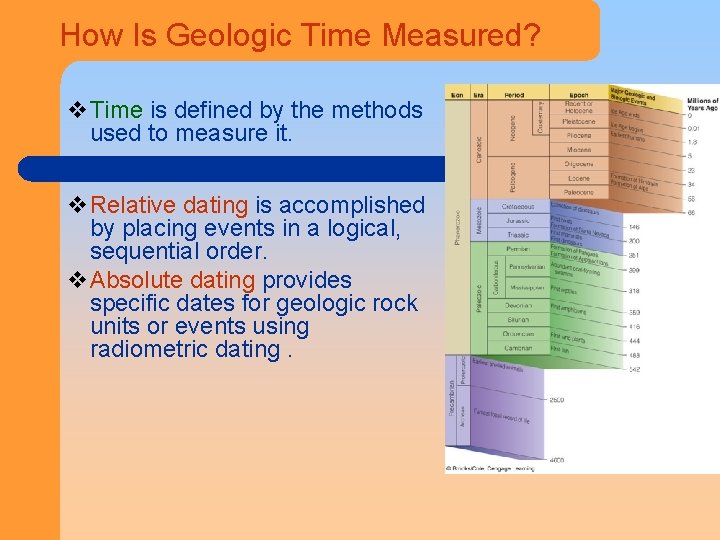
How Is Geologic Time Measured? v. Time is defined by the methods used to measure it. v. Relative dating is accomplished by placing events in a logical, sequential order. v. Absolute dating provides specific dates for geologic rock units or events using radiometric dating.
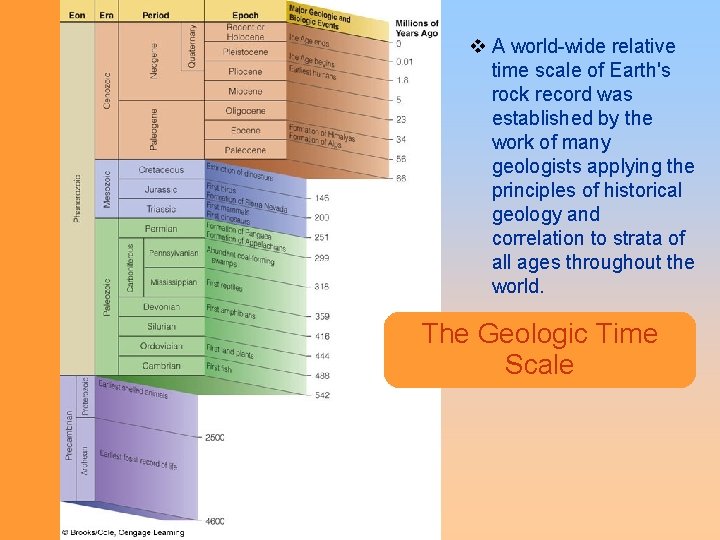
v A world-wide relative time scale of Earth's rock record was established by the work of many geologists applying the principles of historical geology and correlation to strata of all ages throughout the world. The Geologic Time Scale
Early Concepts of Geologic Time and the Age of Earth v James Ussher, in the early 1600’s asserted that God created Earth on Sunday, October 23, 4004 B. C. v Many early Christians analyzed historical records and genealogies found in the scripture to try and determine the age of the Earth. v During the 18 th and 19 th centuries, attempts were made to determine Earth’s age based on scientific evidence rather than revelation. v Although some attempts were ingenious, they yielded a variety of ages that now are known to be much too young.
James Hutton and the Recognition of Geologic Time v Scientific attempts to estimate Earth's age were first made by naturalists during the 18 th and 19 th centuries. v They formulated some of the basic principles used for deciphering the age of the earth. v James Hutton, the father of modern geology, first suggested that present day processes operating over long periods of time could explain all geologic features. v. His observations were instrumental in establishing the principle of uniformitarianism and the fact that Earth was much older than earlier scientists thought.
James Hutton and the Recognition of Geologic Time v Charles Lyell argued convincingly for Hutton's conclusions. v He established the principle of uniformitarianism as the guiding principle of geology. v. This principle holds that the laws of nature have been constant through time and v. That the same processes operating today have operated in the past, although not necessarily at the same rates.
Relative Dating Methods v Before the development of radiometric dating, there was no reliable method for absolute dating, therefore relative dating methods were used. v. Relative dating places events in sequential order but does not tell us how long ago an event took place. v. The principles of relative dating provided geologists with a means to interpret geologic history and develop a relative geologic time scale.
Relative Dating Methods v Fundamental Principles of Relative Dating Besides uniformitarianism, several principles were developed for relative dating: v 1. Superposition v 2. Original horizontality v 3. Cross-cutting relationships v 4. Lateral continuity v 5. Inclusions v 6. Fossil succession. v. These principles are used to determine the relative geologic ages and for interpreting Earth history.
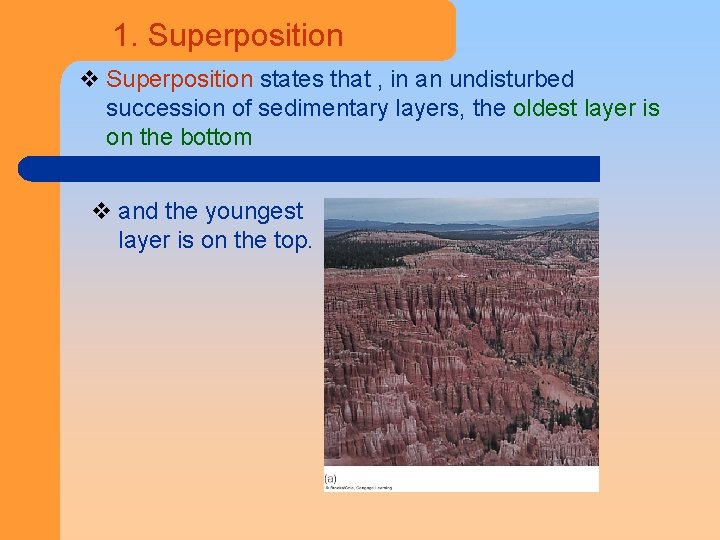
1. Superposition v Superposition states that , in an undisturbed succession of sedimentary layers, the oldest layer is on the bottom v and the youngest layer is on the top.
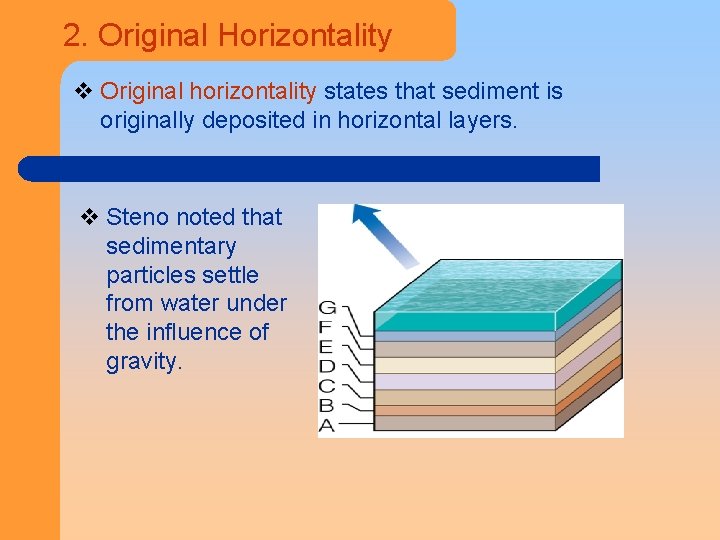
2. Original Horizontality v Original horizontality states that sediment is originally deposited in horizontal layers. v Steno noted that sedimentary particles settle from water under the influence of gravity.
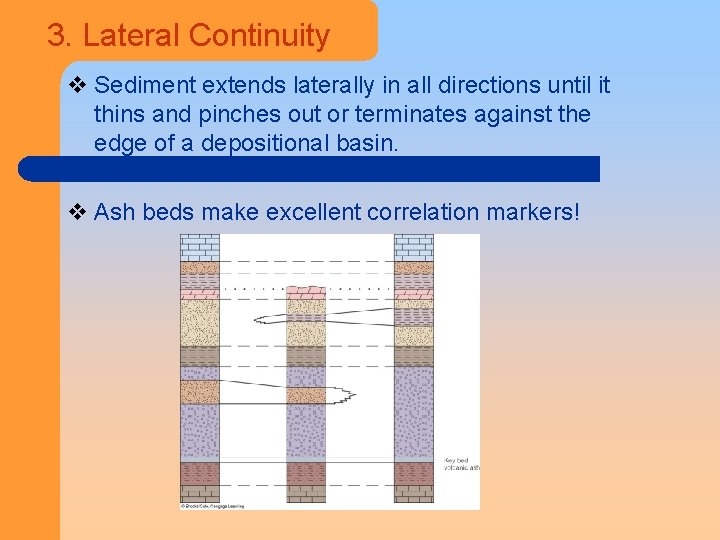
3. Lateral Continuity v Sediment extends laterally in all directions until it thins and pinches out or terminates against the edge of a depositional basin. v Ash beds make excellent correlation markers!
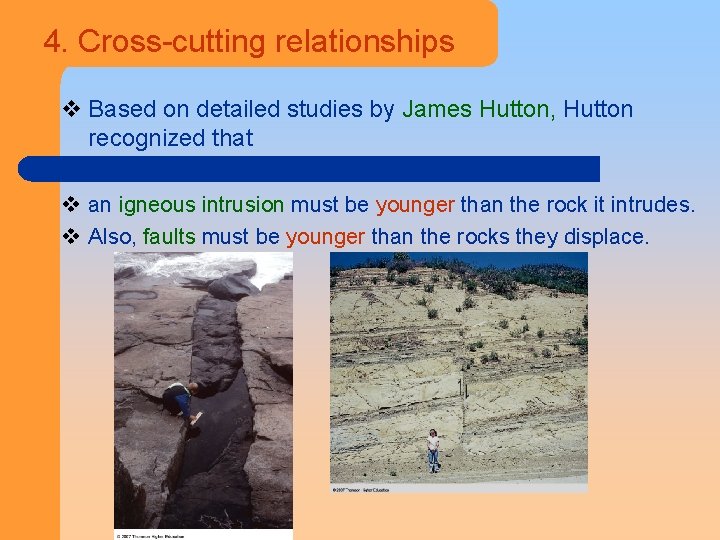
4. Cross-cutting relationships v Based on detailed studies by James Hutton, Hutton recognized that v an igneous intrusion must be younger than the rock it intrudes. v Also, faults must be younger than the rocks they displace.
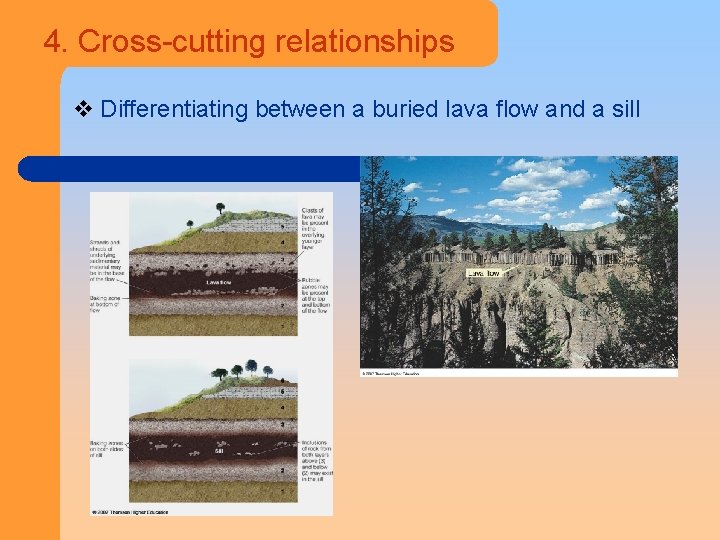
4. Cross-cutting relationships v Differentiating between a buried lava flow and a sill
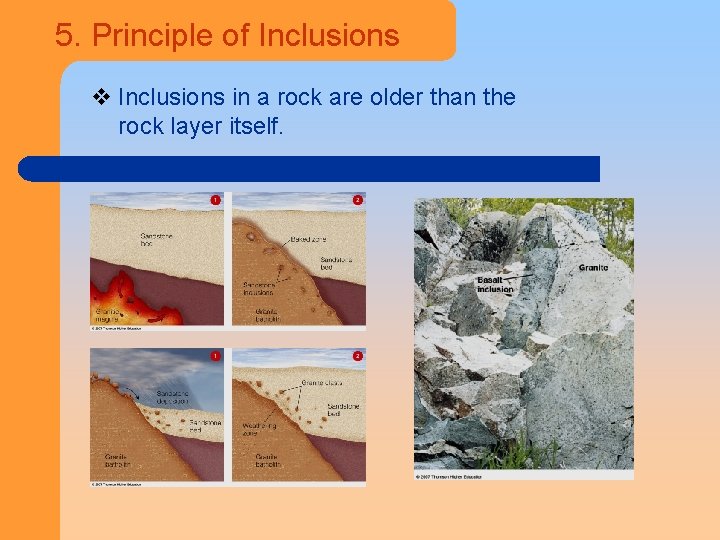
5. Principle of Inclusions v Inclusions in a rock are older than the rock layer itself.
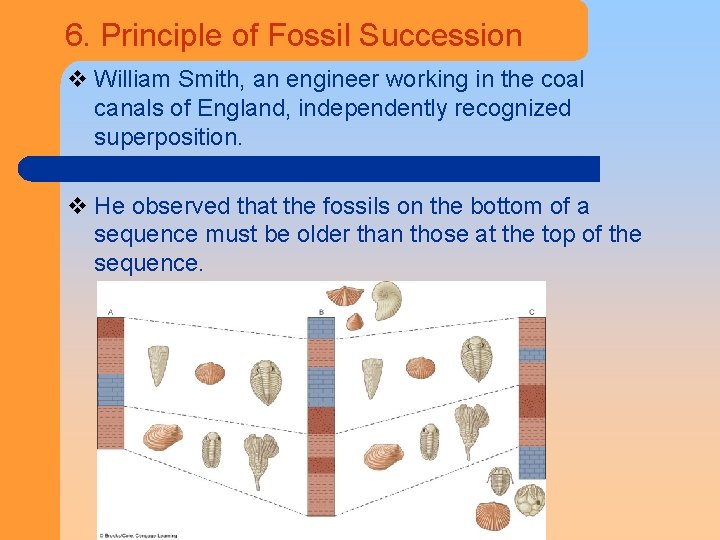
6. Principle of Fossil Succession v William Smith, an engineer working in the coal canals of England, independently recognized superposition. v He observed that the fossils on the bottom of a sequence must be older than those at the top of the sequence.
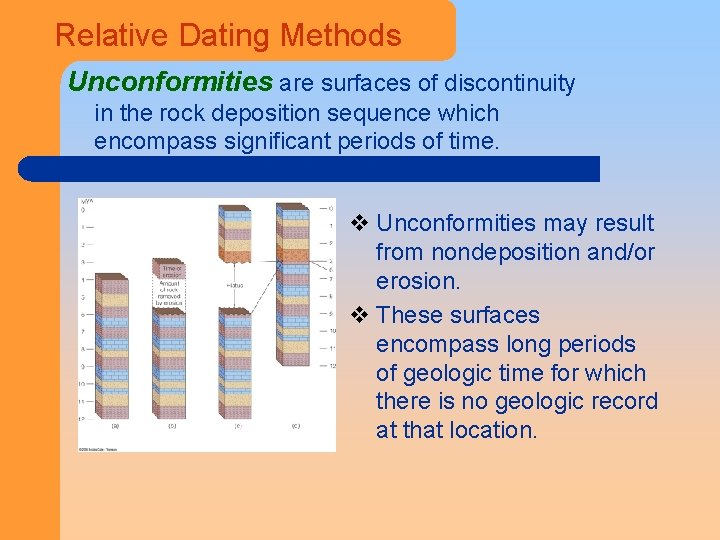
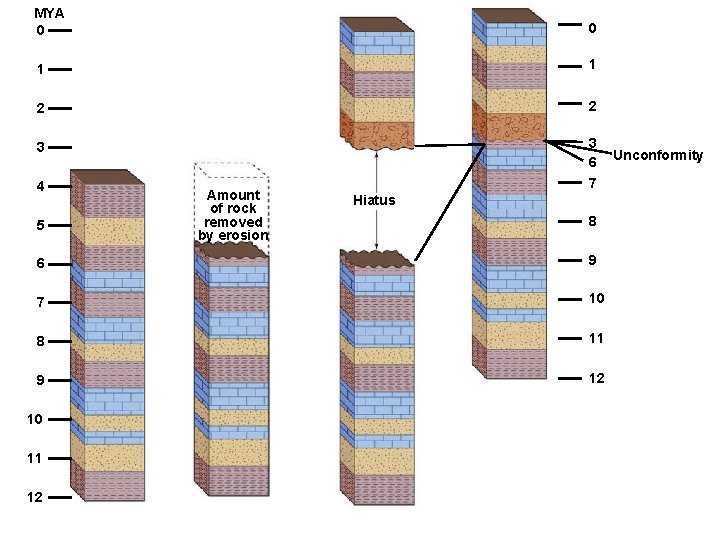
Relative Dating Methods Unconformities are surfaces of discontinuity in the rock deposition sequence which encompass significant periods of time. v Unconformities may result from nondeposition and/or erosion. v These surfaces encompass long periods of geologic time for which there is no geologic record at that location.
MYA 0 0 1 1 2 2 3 3 6 7 4 5 Amount of rock removed by erosion Hiatus 8 6 9 7 10 8 11 9 12 10 11 12 Unconformity
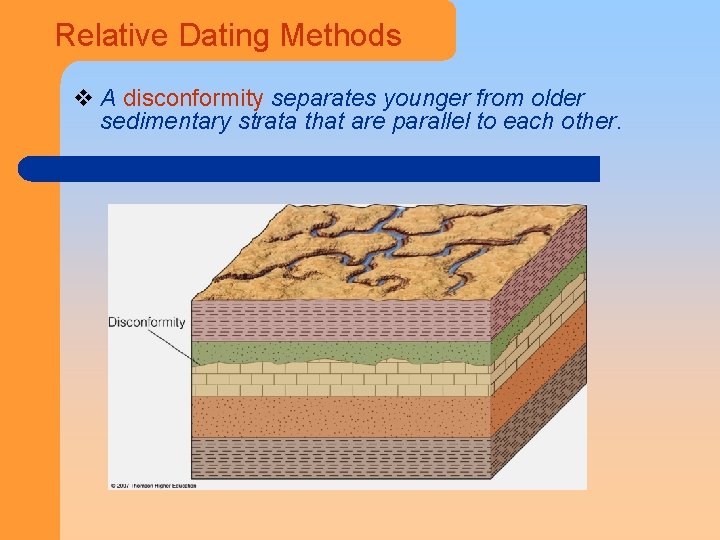
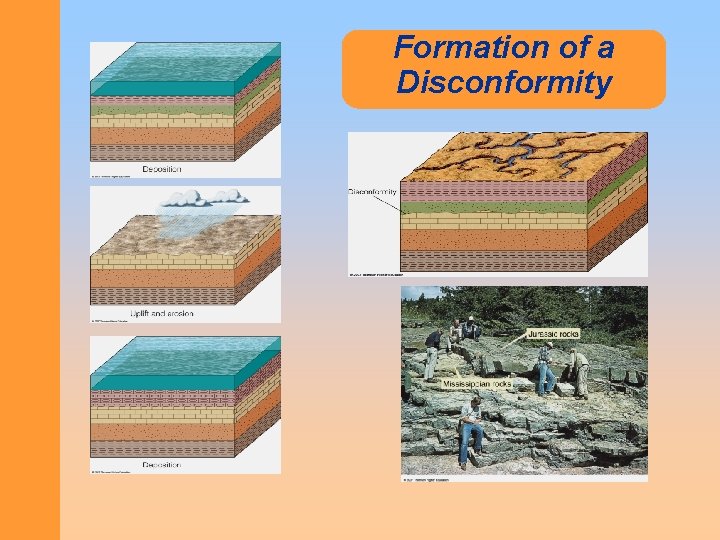
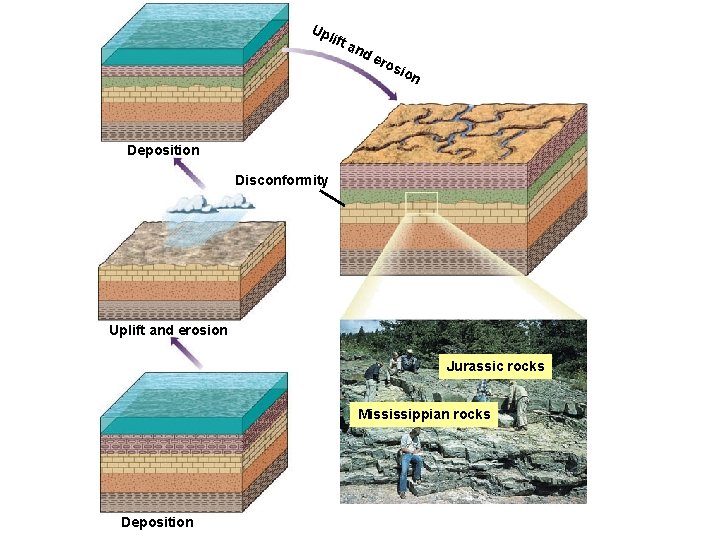
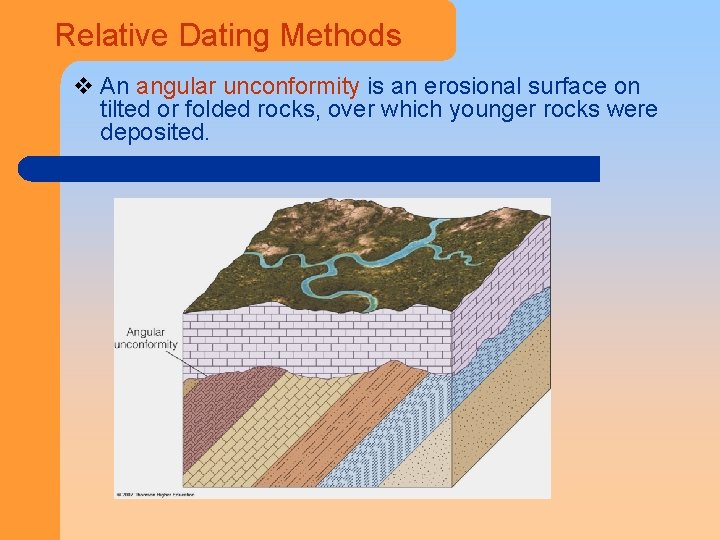
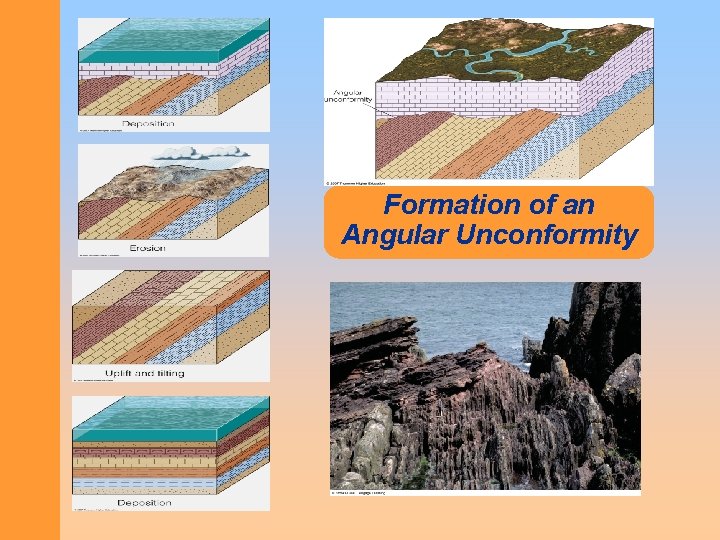
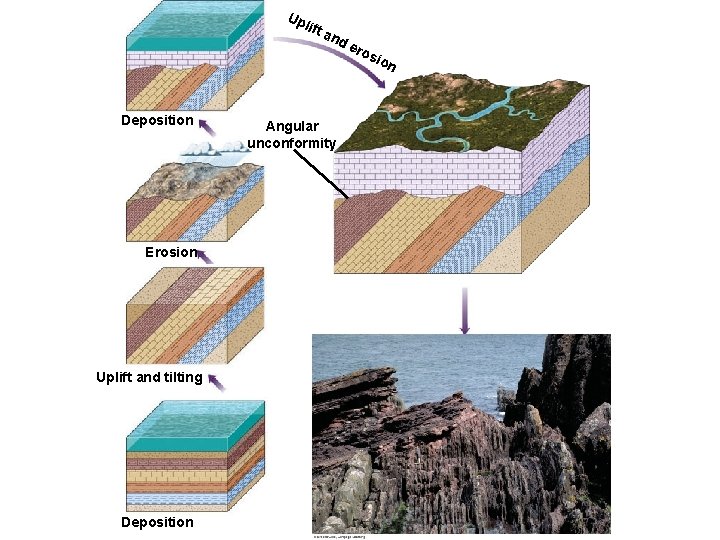
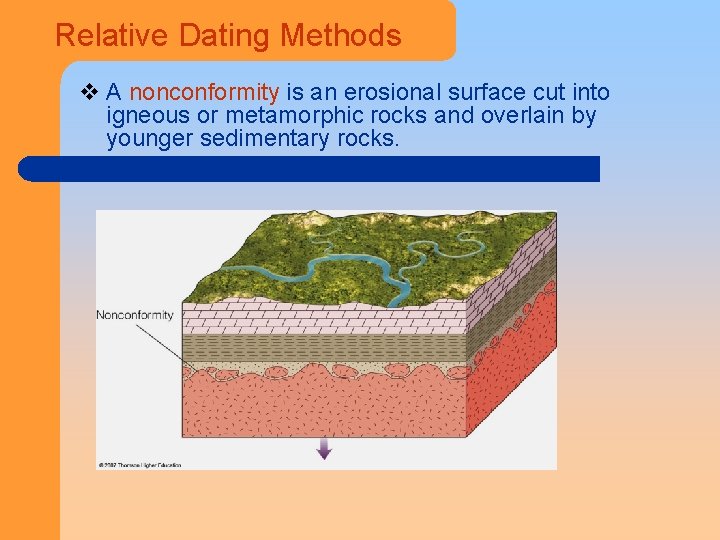
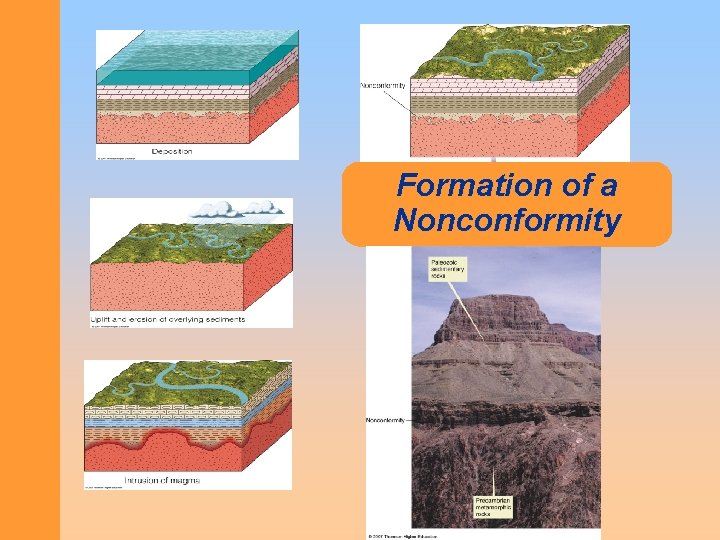
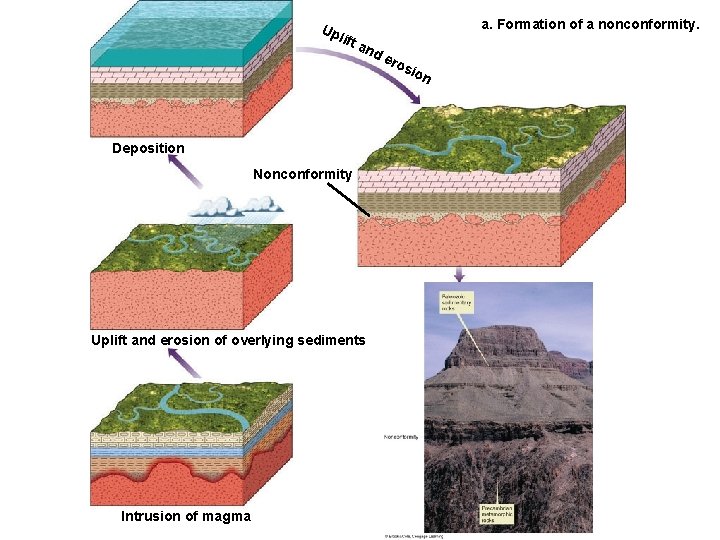
Relative Dating Methods v Unconformities v. Three types of unconformities are recognized. v A disconformity separates younger from older sedimentary strata that are parallel to each other. v. An angular unconformity is an erosional surface on tilted or folded rocks, over which younger sedimentary rocks were deposited. v. A nonconformity is an erosional surface cut into igneous or metamorphic rocks and overlain by younger sedimentary rocks.
Relative Dating Methods v A disconformity separates younger from older sedimentary strata that are parallel to each other.
Formation of a Disconformity
Up li ft a nd ero s ion Deposition Disconformity Uplift and erosion Jurassic rocks Mississippian rocks Deposition
Relative Dating Methods v An angular unconformity is an erosional surface on tilted or folded rocks, over which younger rocks were deposited.
Formation of an Angular Unconformity 4
Up li ft a nd ero s ion Deposition Erosion Uplift and tilting Deposition Angular unconformity
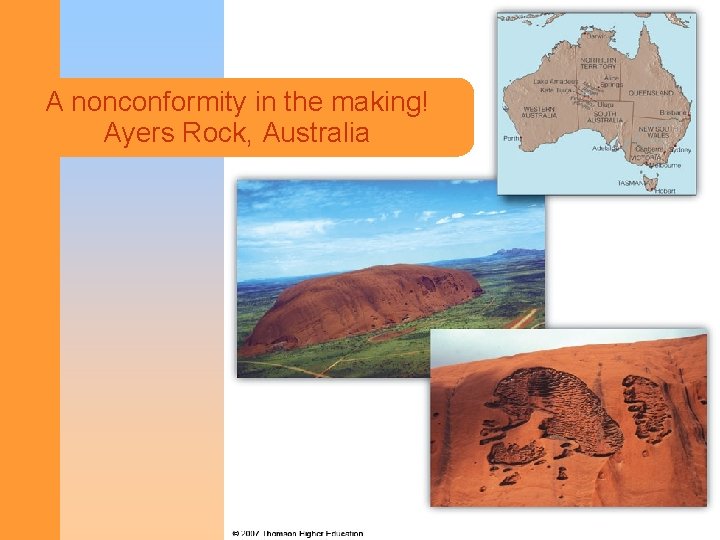
Relative Dating Methods v A nonconformity is an erosional surface cut into igneous or metamorphic rocks and overlain by younger sedimentary rocks.
Formation of a Nonconformity
Up li a. Formation of a nonconformity. ft a nd ero s ion Deposition Nonconformity Uplift and erosion of overlying sediments Intrusion of magma
A nonconformity in the making! Ayers Rock, Australia
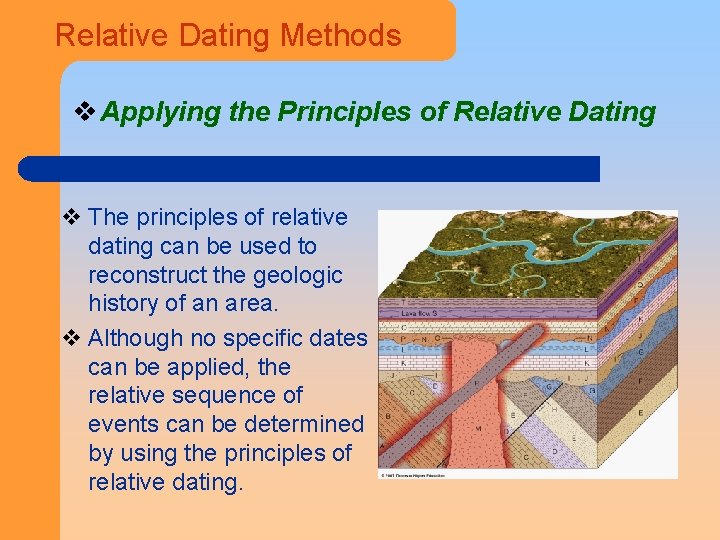
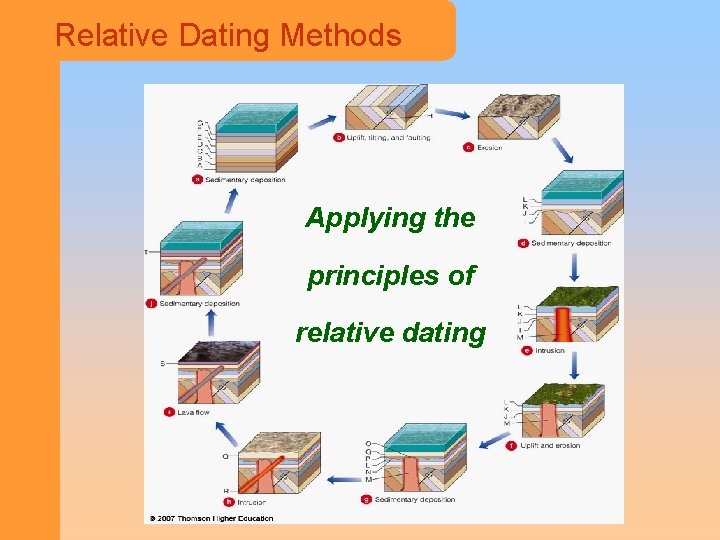
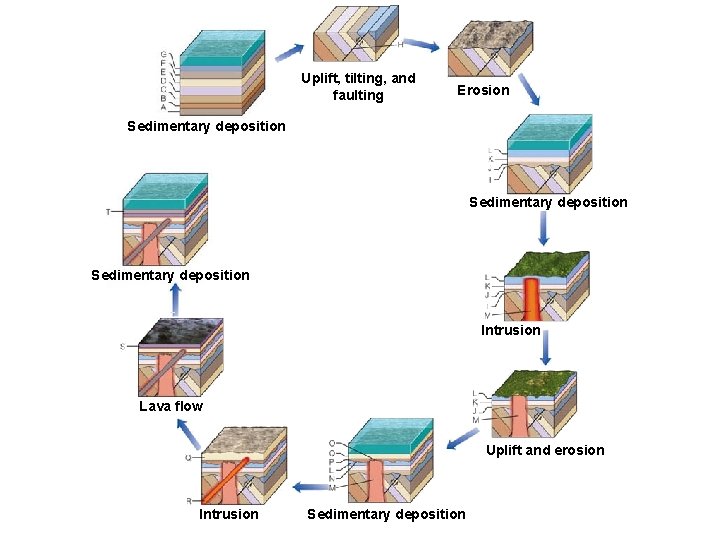
Relative Dating Methods v Applying the Principles of Relative Dating v The principles of relative dating can be used to reconstruct the geologic history of an area. v Although no specific dates can be applied, the relative sequence of events can be determined by using the principles of relative dating.
Relative Dating Methods Applying the principles of relative dating
Uplift, tilting, and faulting Erosion Sedimentary deposition Intrusion Lava flow Uplift and erosion Intrusion Sedimentary deposition
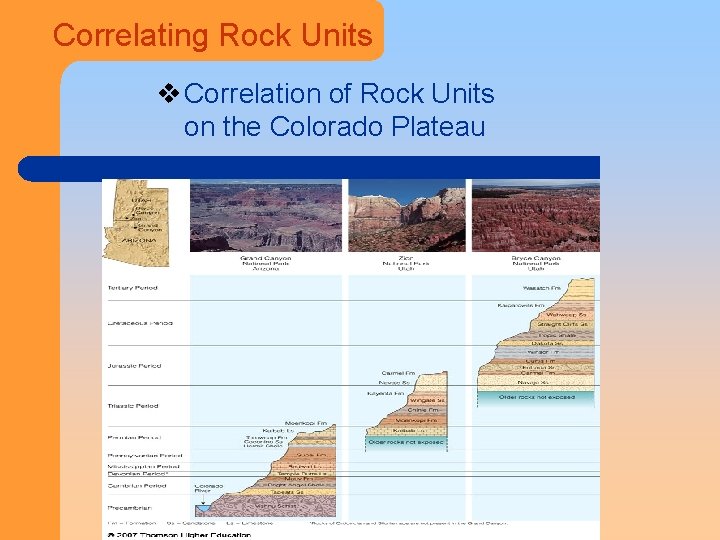
Correlating Rock Units v. Correlation is the demonstration of equivalency of rock units from one area to another. v. Time equivalence is usually demonstrated by the occurrence of similar fossils in strata.
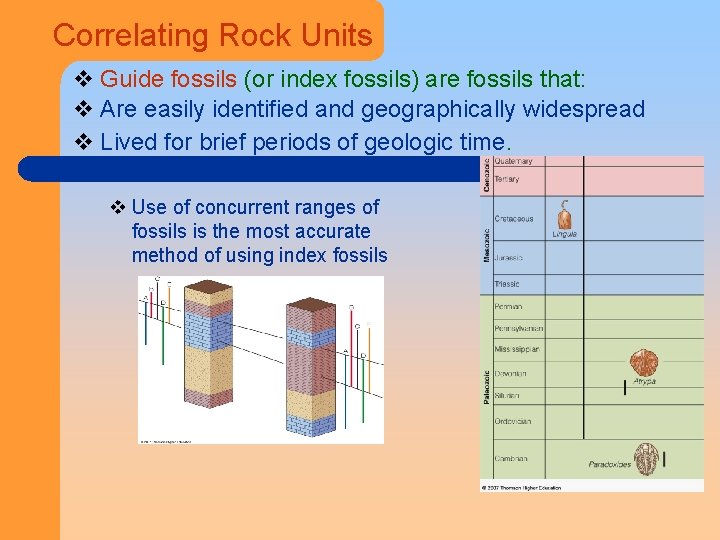
Correlating Rock Units v Guide fossils (or index fossils) are fossils that: v Are easily identified and geographically widespread v Lived for brief periods of geologic time. v Use of concurrent ranges of fossils is the most accurate method of using index fossils
Correlating Rock Units v Correlation of Rock Units on the Colorado Plateau
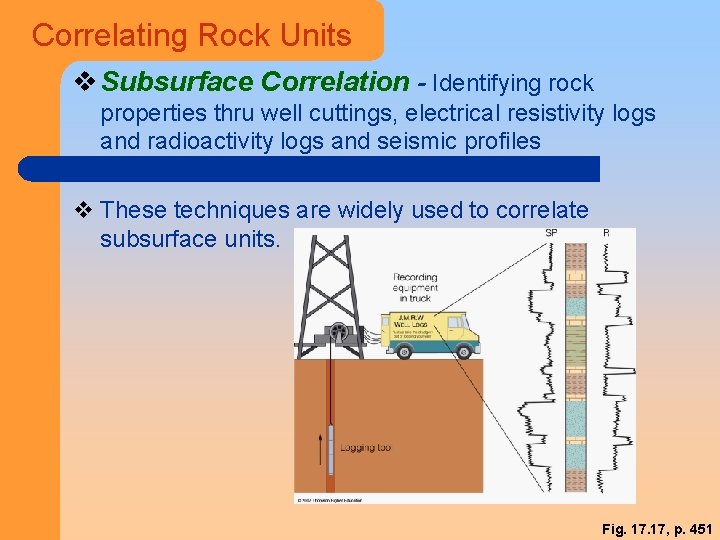
Correlating Rock Units v Subsurface Correlation - Identifying rock properties thru well cuttings, electrical resistivity logs and radioactivity logs and seismic profiles v These techniques are widely used to correlate subsurface units. Fig. 17, p. 451
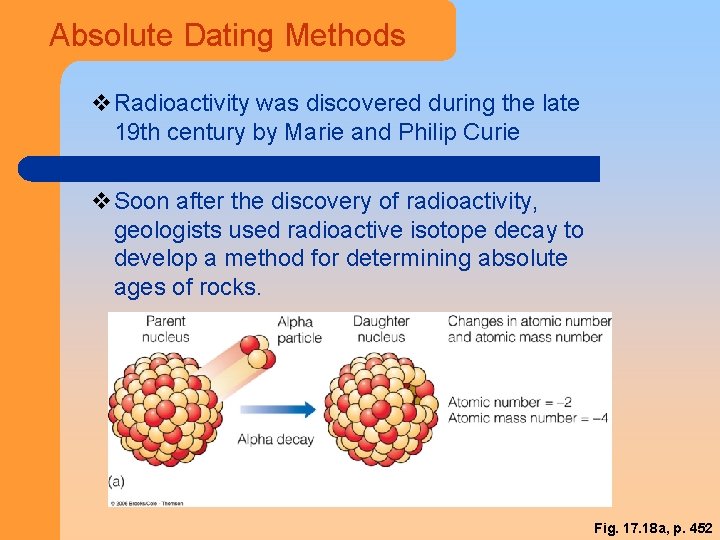
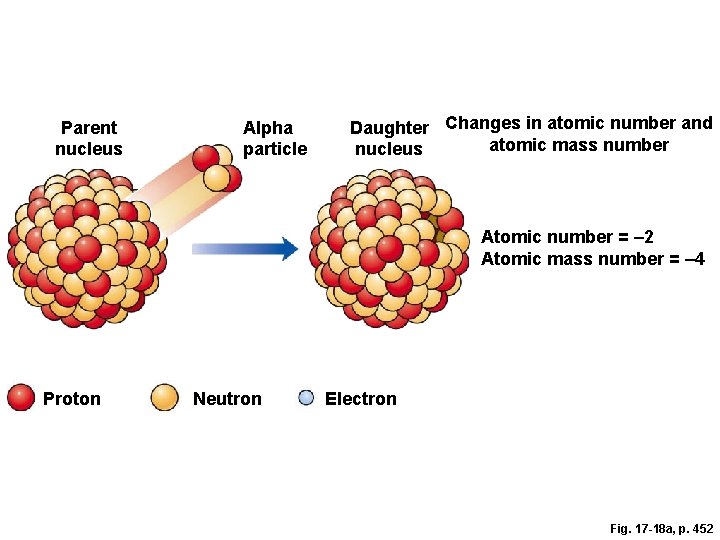
Absolute Dating Methods v. Radioactivity was discovered during the late 19 th century by Marie and Philip Curie v. Soon after the discovery of radioactivity, geologists used radioactive isotope decay to develop a method for determining absolute ages of rocks. Fig. 17. 18 a, p. 452
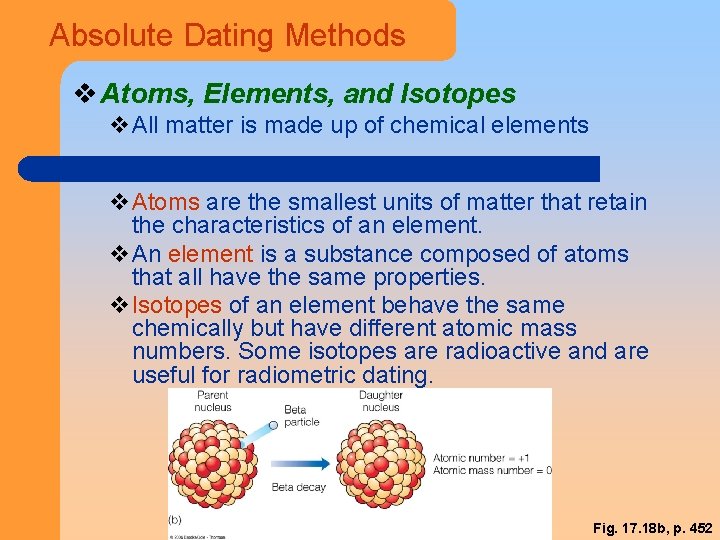
Absolute Dating Methods v Atoms, Elements, and Isotopes v. All matter is made up of chemical elements v. Atoms are the smallest units of matter that retain the characteristics of an element. v. An element is a substance composed of atoms that all have the same properties. v. Isotopes of an element behave the same chemically but have different atomic mass numbers. Some isotopes are radioactive and are useful for radiometric dating. Fig. 17. 18 b, p. 452
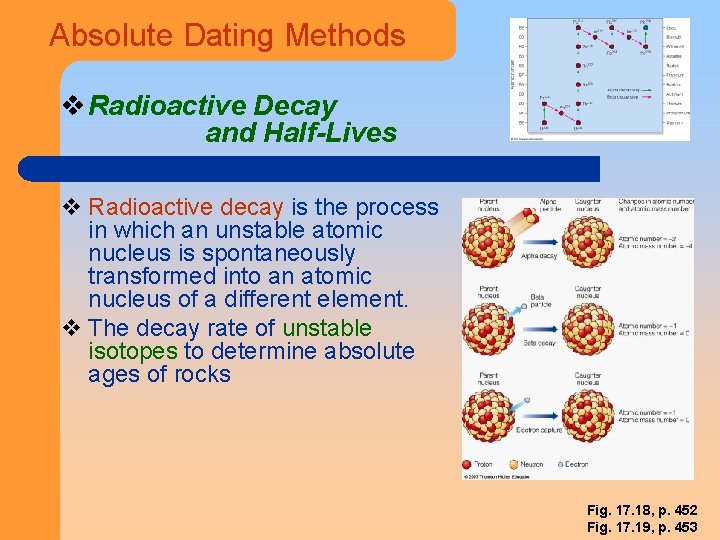
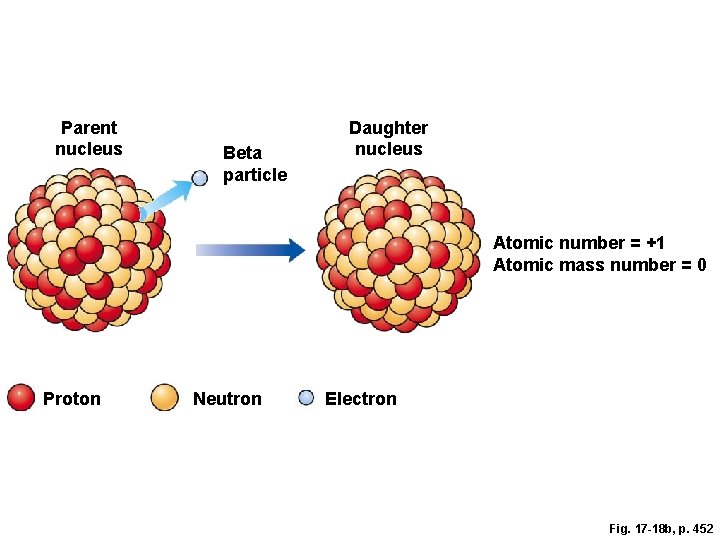
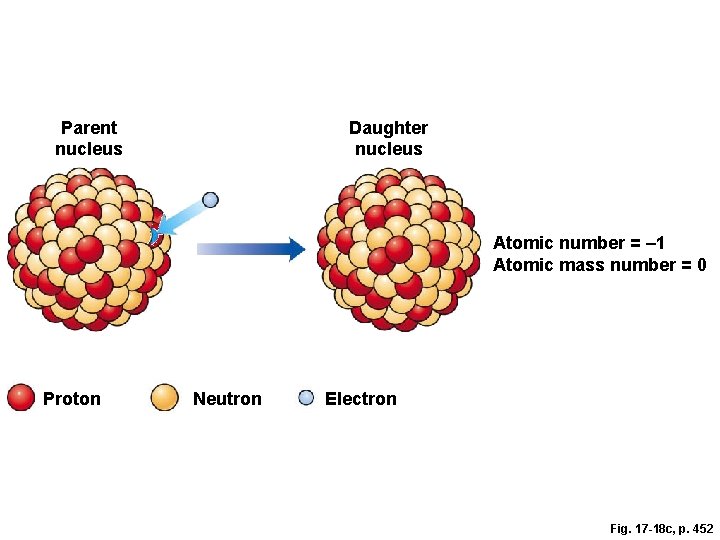
Absolute Dating Methods v Radioactive Decay and Half-Lives v Radioactive decay is the process in which an unstable atomic nucleus is spontaneously transformed into an atomic nucleus of a different element. v The decay rate of unstable isotopes to determine absolute ages of rocks Fig. 17. 18, p. 452 Fig. 17. 19, p. 453
Parent nucleus Alpha particle Daughter Changes in atomic number and atomic mass number nucleus Atomic number = – 2 Atomic mass number = – 4 Proton Neutron Electron Fig. 17 -18 a, p. 452
Parent nucleus Beta particle Daughter nucleus Atomic number = +1 Atomic mass number = 0 Proton Neutron Electron Fig. 17 -18 b, p. 452
Parent nucleus Daughter nucleus Atomic number = – 1 Atomic mass number = 0 Proton Neutron Electron Fig. 17 -18 c, p. 452
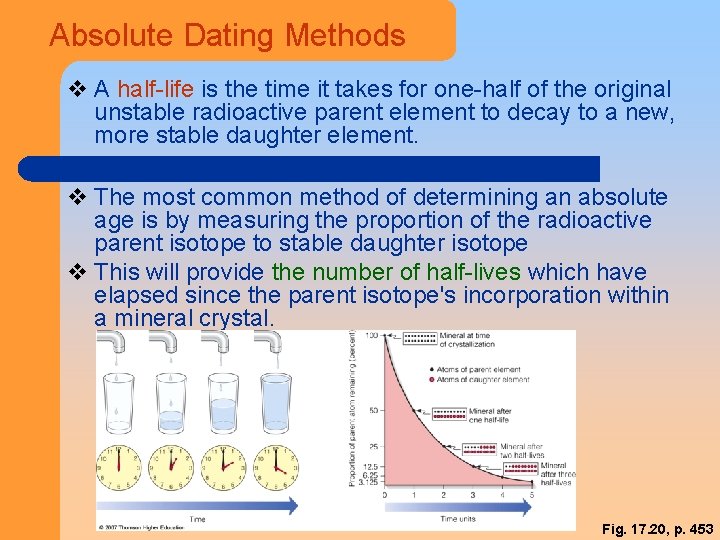
Absolute Dating Methods v A half-life is the time it takes for one-half of the original unstable radioactive parent element to decay to a new, more stable daughter element. v The most common method of determining an absolute age is by measuring the proportion of the radioactive parent isotope to stable daughter isotope v This will provide the number of half-lives which have elapsed since the parent isotope's incorporation within a mineral crystal. Fig. 17. 20, p. 453
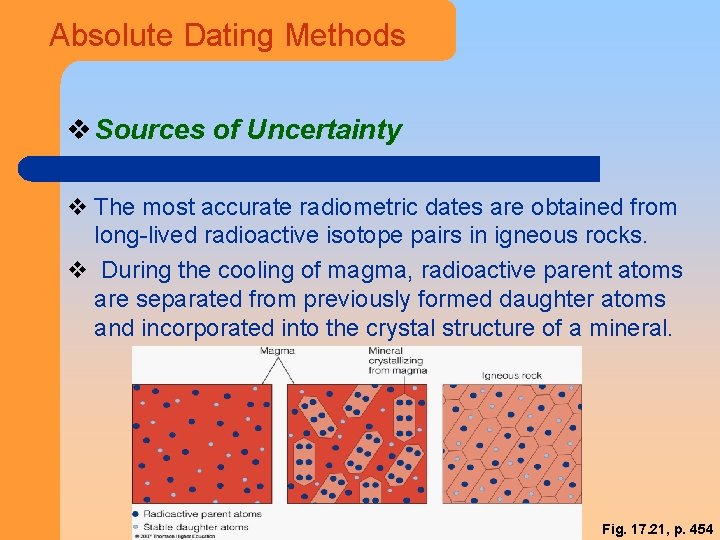
Absolute Dating Methods v Sources of Uncertainty v The most accurate radiometric dates are obtained from long-lived radioactive isotope pairs in igneous rocks. v During the cooling of magma, radioactive parent atoms are separated from previously formed daughter atoms and incorporated into the crystal structure of a mineral. Fig. 17. 21, p. 454
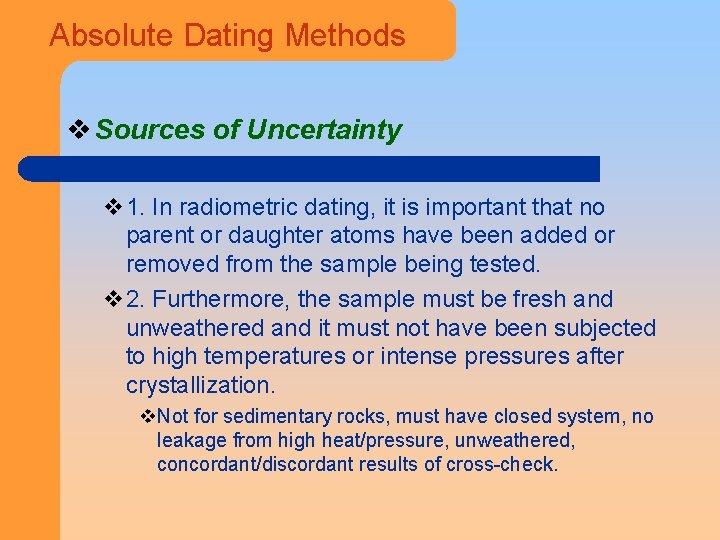
Absolute Dating Methods v Sources of Uncertainty v 1. In radiometric dating, it is important that no parent or daughter atoms have been added or removed from the sample being tested. v 2. Furthermore, the sample must be fresh and unweathered and it must not have been subjected to high temperatures or intense pressures after crystallization. v. Not for sedimentary rocks, must have closed system, no leakage from high heat/pressure, unweathered, concordant/discordant results of cross-check.
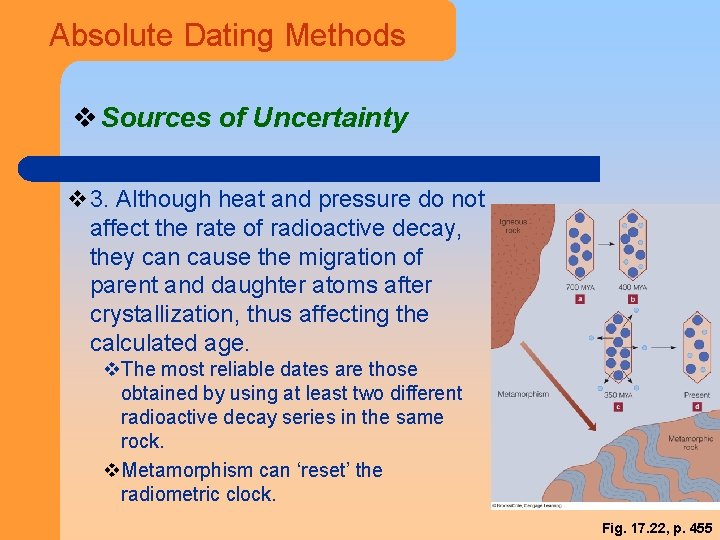
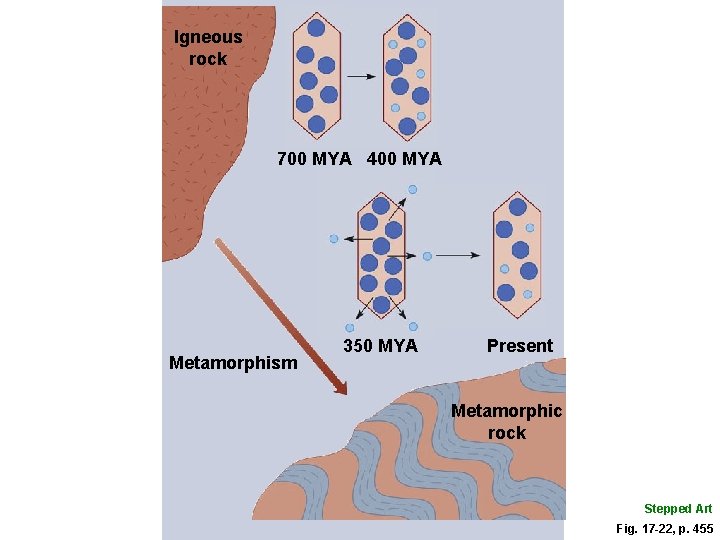
Absolute Dating Methods v Sources of Uncertainty v 3. Although heat and pressure do not affect the rate of radioactive decay, they can cause the migration of parent and daughter atoms after crystallization, thus affecting the calculated age. v. The most reliable dates are those obtained by using at least two different radioactive decay series in the same rock. v. Metamorphism can ‘reset’ the radiometric clock. Fig. 17. 22, p. 455
Igneous rock 700 MYA 400 MYA Metamorphism 350 MYA Present Metamorphic rock Stepped Art Fig. 17 -22, p. 455
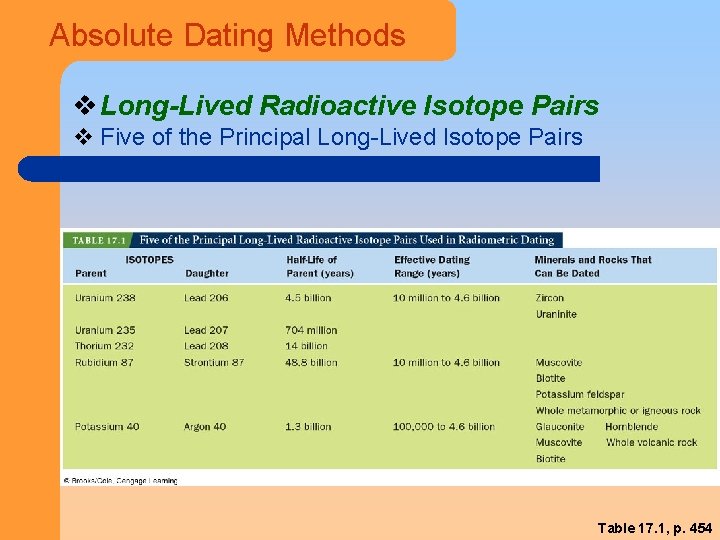
Absolute Dating Methods v Long-Lived Radioactive Isotope Pairs v Five of the Principal Long-Lived Isotope Pairs Table 17. 1, p. 454
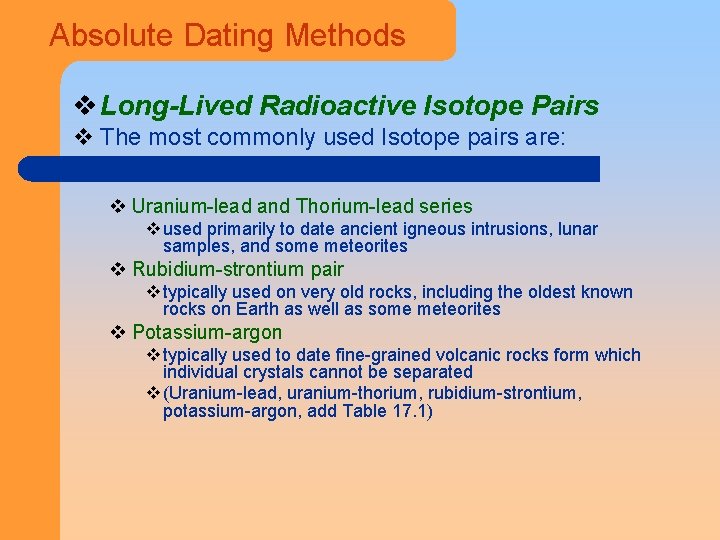
Absolute Dating Methods v Long-Lived Radioactive Isotope Pairs v The most commonly used Isotope pairs are: v Uranium-lead and Thorium-lead series v used primarily to date ancient igneous intrusions, lunar samples, and some meteorites v Rubidium-strontium pair v typically used on very old rocks, including the oldest known rocks on Earth as well as some meteorites v Potassium-argon v typically used to date fine-grained volcanic rocks form which individual crystals cannot be separated v (Uranium-lead, uranium-thorium, rubidium-strontium, potassium-argon, add Table 17. 1)
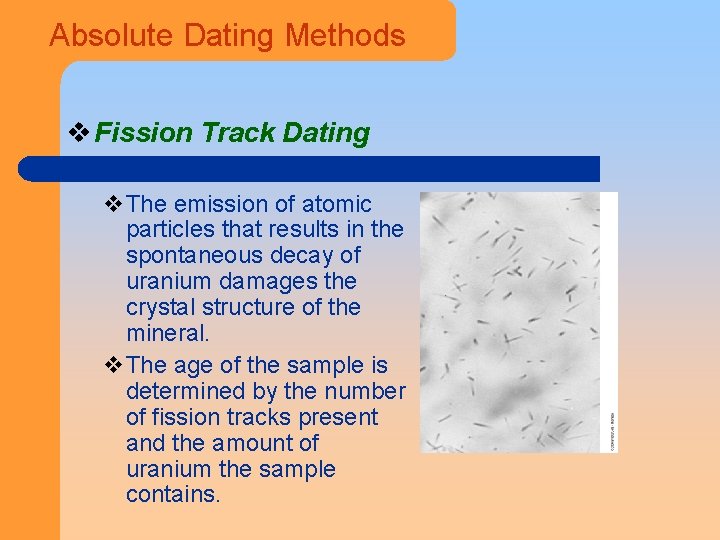
Absolute Dating Methods v Fission Track Dating v. The emission of atomic particles that results in the spontaneous decay of uranium damages the crystal structure of the mineral. v. The age of the sample is determined by the number of fission tracks present and the amount of uranium the sample contains.
Absolute Dating Methods v Radiocarbon and Tree-Ring Dating Methods v. Carbon-14 dating v Carbon 14 has a half-life of 5730 years, limiting its use to relatively young geologic materials. v Carbon-14 dating can be used only for organic matter such as wood, bones, and shells and is effective back to approximately 70, 000 years ago. v Unlike the long-lived isotopic pairs, the carbon-14 dating technique determines age by the ratio of radioactive carbon 14 to stable carbon-12.
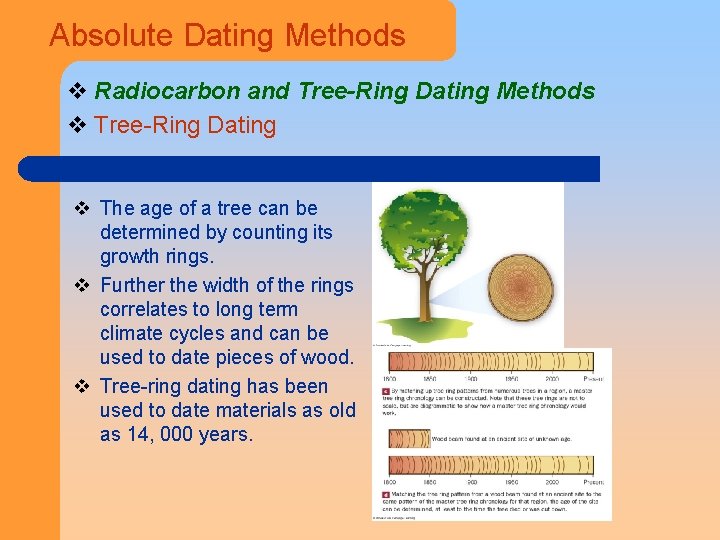
Absolute Dating Methods v Radiocarbon and Tree-Ring Dating Methods v Tree-Ring Dating v The age of a tree can be determined by counting its growth rings. v Further the width of the rings correlates to long term climate cycles and can be used to date pieces of wood. v Tree-ring dating has been used to date materials as old as 14, 000 years.
Development of the Geologic Time Scale v. The geologic time scale was developed primarily during the 19 th century through the efforts of many people. v. It was originally a relative geologic time scale. v. With the discovery of radioactivity and the development of radiometric dating methods, absolute age dates were added at the beginning of the 20 th century. v. The time scale is still being refined as new radiometric dates and more accurate methodologies develop.
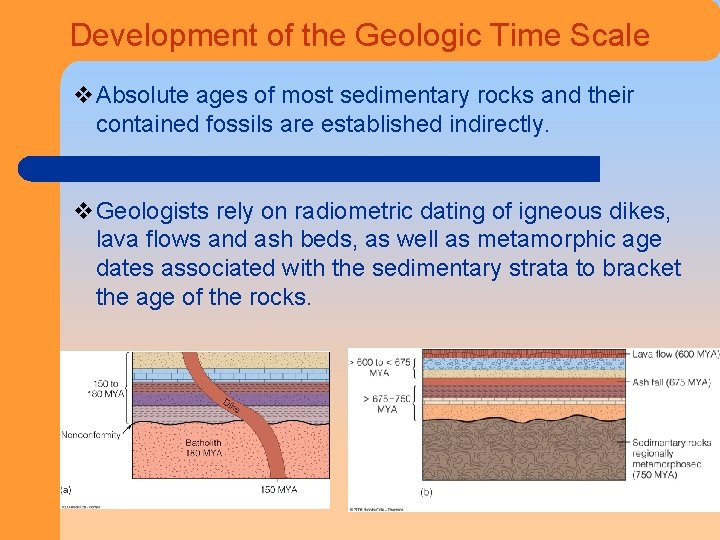
Development of the Geologic Time Scale v. Absolute ages of most sedimentary rocks and their contained fossils are established indirectly. v. Geologists rely on radiometric dating of igneous dikes, lava flows and ash beds, as well as metamorphic age dates associated with the sedimentary strata to bracket the age of the rocks.
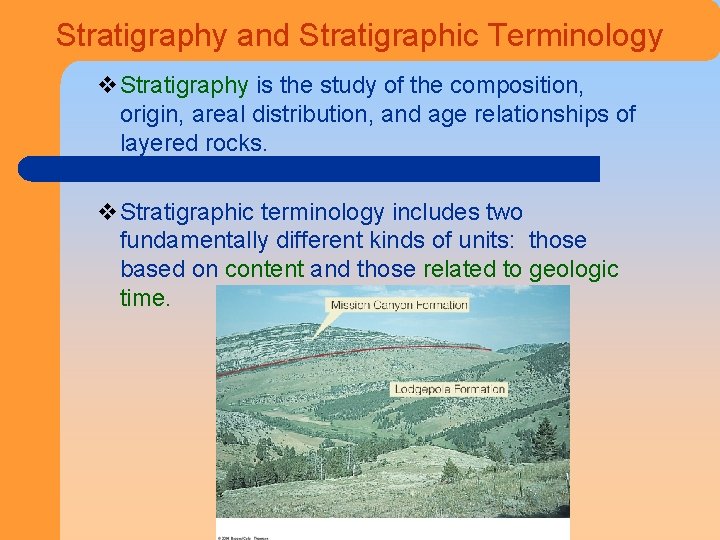
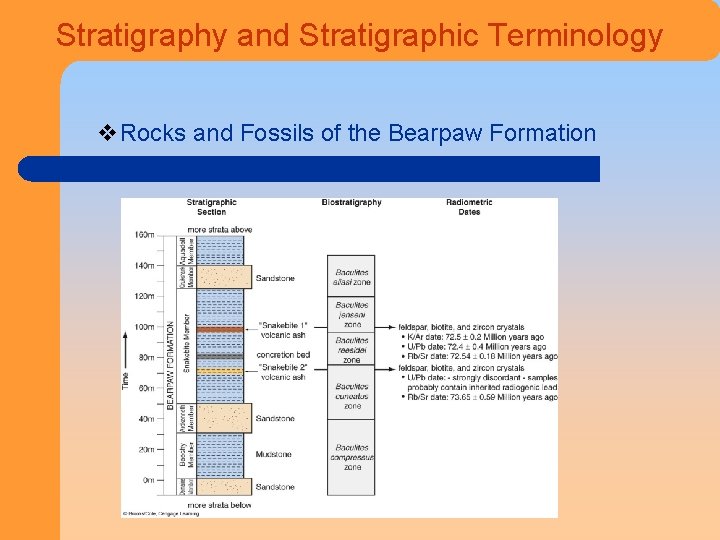
Stratigraphy and Stratigraphic Terminology v. Stratigraphy is the study of the composition, origin, areal distribution, and age relationships of layered rocks. v. Stratigraphic terminology includes two fundamentally different kinds of units: those based on content and those related to geologic time.
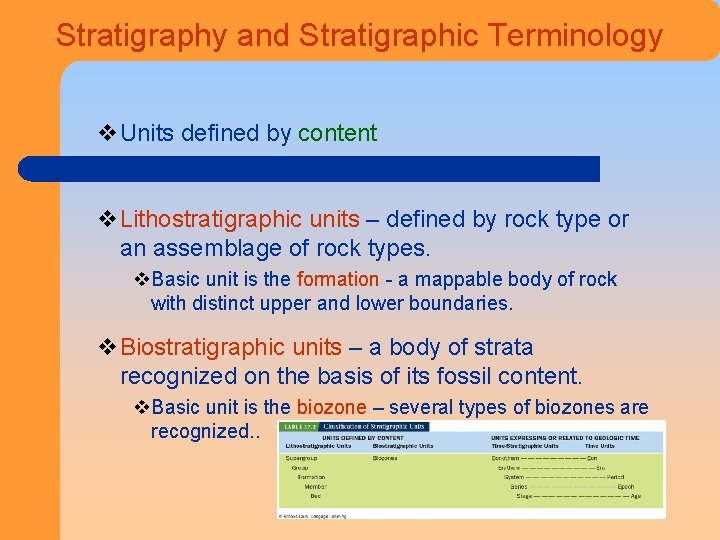
Stratigraphy and Stratigraphic Terminology v. Units defined by content v. Lithostratigraphic units – defined by rock type or an assemblage of rock types. v. Basic unit is the formation - a mappable body of rock with distinct upper and lower boundaries. v. Biostratigraphic units – a body of strata recognized on the basis of its fossil content. v. Basic unit is the biozone – several types of biozones are recognized. .
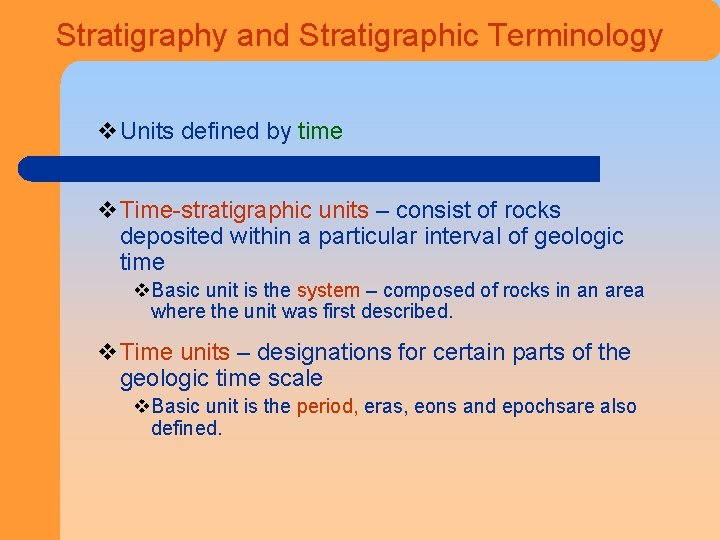
Stratigraphy and Stratigraphic Terminology v. Units defined by time v. Time-stratigraphic units – consist of rocks deposited within a particular interval of geologic time v. Basic unit is the system – composed of rocks in an area where the unit was first described. v. Time units – designations for certain parts of the geologic time scale v. Basic unit is the period, eras, eons and epochsare also defined.
Stratigraphy and Stratigraphic Terminology v. Rocks and Fossils of the Bearpaw Formation
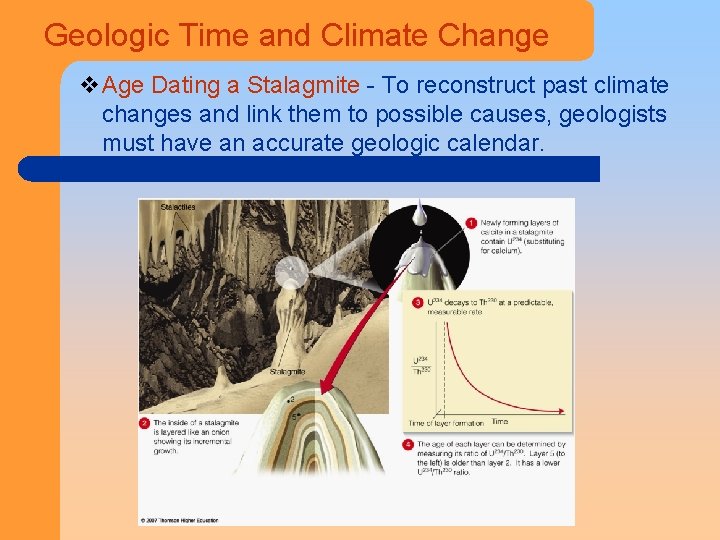
Geologic Time and Climate Change v. Age Dating a Stalagmite - To reconstruct past climate changes and link them to possible causes, geologists must have an accurate geologic calendar.
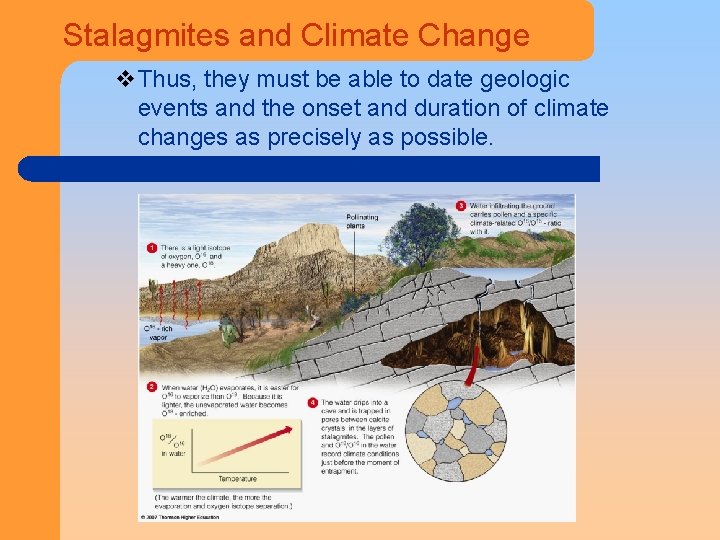
Stalagmites and Climate Change v. Thus, they must be able to date geologic events and the onset and duration of climate changes as precisely as possible.
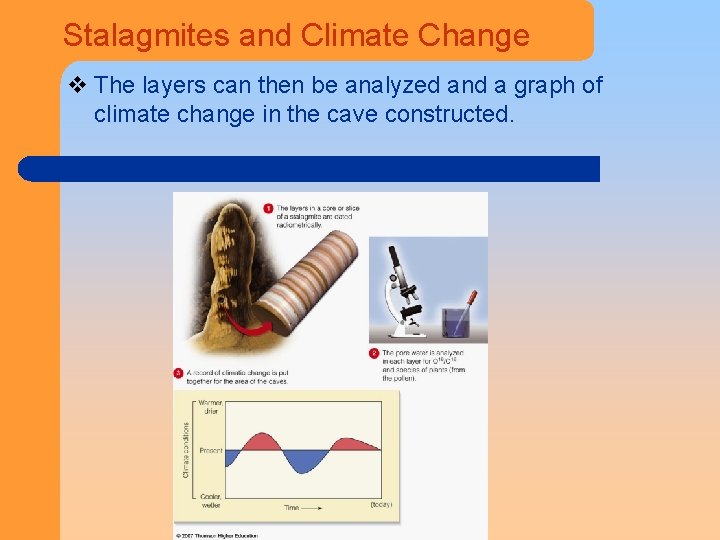
Stalagmites and Climate Change v The layers can then be analyzed and a graph of climate change in the cave constructed.
Learning Objectives Upon completion of this material, the student should understand the following. • The concept of geologic time and its measurements have changed throughout human history. • The principle of uniformitarianism is fundamental to geology. • Relative dating—placing geologic events in a sequential order—provides a means to interpret geologic history. • The three types of unconformities—disconformities, angular unconformities, and nonconformities—are erosional surfaces separating younger from older rocks and represent significant intervals of geologic time for which we have no record at a particular location. • Time equivalency of rock units can be demonstrated by various correlation techniques. • Absolute dating methods are used to date geologic events in terms of years before present.