
Chapter 17 Gastrointestinal Tract Structure Function Gastrointestinal GI








- Slides: 38
Chapter 17 Gastrointestinal Tract
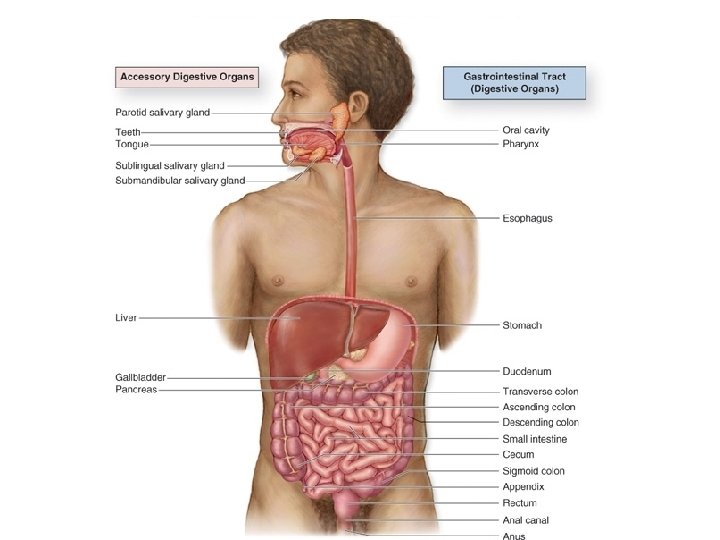
Structure & Function • Gastrointestinal (GI) tract is concerned with: – Made up of the:
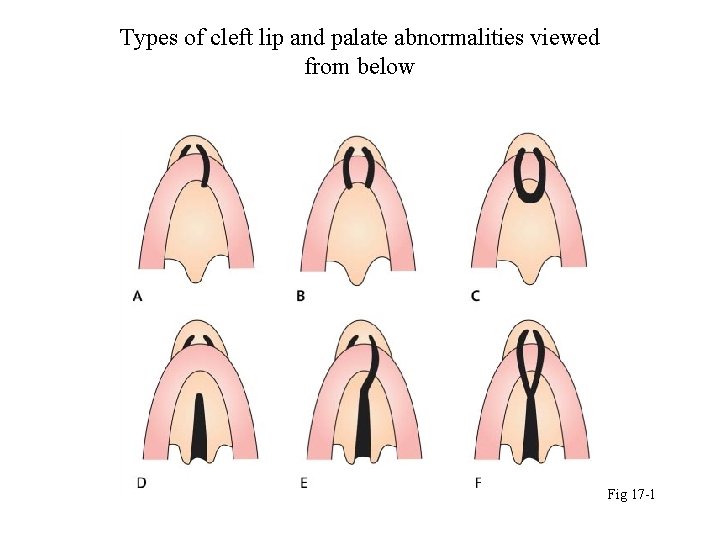
Cleft Lip & Cleft Palate • Embryologically, the face and palate form when proliferating cell masses merge to form: • Multifactorial inheritance leads to developmental defects • Cleft lip is a defect in the: • Cleft palate is a defect in the:
Types of cleft lip and palate abnormalities viewed from below Fig 17 -1
Cleft Lip and Palate
Tooth Development • Each tooth consists of: – Dentine which is: – Enamel which covers: – Pulp cavity in center of the tooth which contain: – Root is embedded in the: • Covered by a small layer of bone-like material called: • Tooth is anchored in the jaw by connective tissue
Dental caries • Infectious disease of teeth due to bacteria on tooth surface – Plaque is made up of: • Predispose to: – Caused by bacteria feeding on food materials such as sugars & starches • Acids are released that: • Bacteria invade forming: • If left untreated, bacteria invade the pulp resulting in: • Spread of the infection to the bone surrounding the dental root results in:
Dental caries: Prevention & Treatment • Incidence of tooth decay can be reduced by: • Dental caries are treated by:
Periodontal disease • Bacteria and debris collect around the base of the teeth – Inflammation only affecting the gums surrounding the root is called: – Inflammation and infection between the gums and teeth is called: • Infection may spread into the tooth socket causing:
Diseases of the Esophagus • The esophagus is a muscular tube extending from the: – Upper sphincter relaxes to allow: – Lower esophageal sphincter (cardiac sphincter) relaxes to allow:
Diseases of the Esophagus • Incompetent Cardiac Sphincter – Allows for: • Lining of esophagus becomes: – Called: • Long-term reflux can lead to bleeding, ulceration, and scarring of esophagus • In some individuals the lining becomes metaplastic which increases the risk of developing adenocarcinoma – Called: – Treatment consists of:
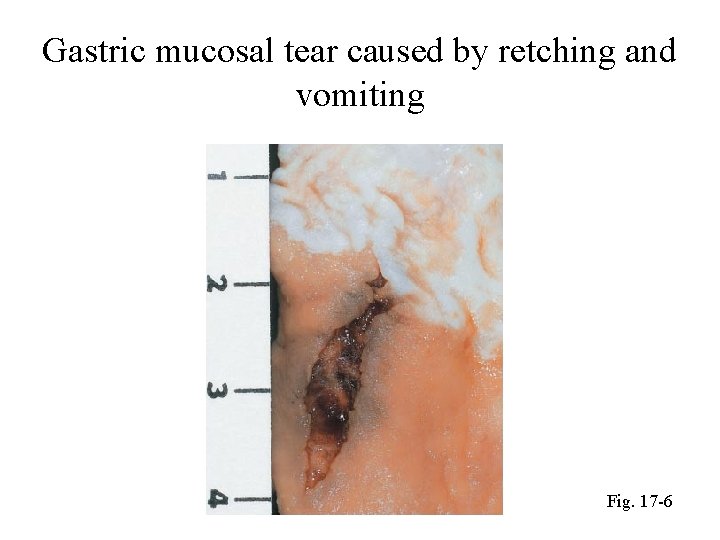
Diseases of the Esophagus • Gastric Mucosal Tears – Occur in the gastroesophageal junction due to: • Can bleed extensively – Most often follows:
Gastric mucosal tear caused by retching and vomiting Fig. 17 -6
Gastritis • Is inflammation of the: – Acute gastritis is a: • May be complicated by: ulceration & bleeding • Most caused by: – Chronic gastritis: • Produces compounds that break down: • Spreads via person-to-person through: • Increased risk of:
Peptic ulcer • Is a chronic ulcer that usually involves the: – Results from: • H. pylori infection predisposes a person to ulceration – Produce pain which is usually relieved by: – Complications: – Usually treated with: • Antacids: • Antibiotic therapy:
Inflammatory Diseases of the Intestines • Enteritis: • Colitis: • Gastroenteritis:
Inflammatory Diseases of the Intestines • Acute enteritis is usually caused by: – Are generally of: – Symptoms include: • Chronic enteritis is characterized by periodic flare-ups manifested by: – Patients may also have inflammation of other tissue – Two main diseases appear to be autoimmune: • Crohn Disease • Ulcerative colitis
Inflammatory Diseases of the Intestines • Crohn disease is: – Distal ilium is frequently involved but may involve any part of small intestine & possibly the colon – Thickening & scarring of intestinal wall can narrow lumen which impedes: – Treatment: drugs and possible surgical resection of affected part of bowel
Inflammatory Diseases of the Intestines • Ulcerative colitis: – Usually begins in the: – Mucosa may bleed excessively: – Treatment: symptomatic and supportive measures, antibiotics, corticosteroids to control flare-ups, immunosuppressive drugs, surgical resection
Inflammatory Diseases of the Intestines • Appendicitis occurs when the opening to the appendix becomes blocked by: – Normal secretions become blocked and create: • This leads to compression of: • Bacteria invade the wall of the appendix causing: • Symptoms include: • Treatment:
Eating Disorders • Anorexia Nervosa is a condition in which a person has a: – Lose weight by: • May also: – Most often occurs in: • Many bodily processes such as menstrual cycle are disrupted and may lead to death if not treated – Treatment requires:
Eating Disorders • Bulemia nervosa is characterized by: – Weight is usually maintained leaving family and friends: – Risk of gastric mucosa tears from retching and vomiting – Dental problems and metabolic alkalosis from vomitinginduced loss of gastric acid – Treatment similar to treatment of anorexia nervosa
Diseases of the Colon • Diverticulosis is a condition of diverticula which are: – Usually occurs in: – Small hard stools require increase intraluminal pressure to: • High pressure predisposes someone to the condition • Diverticulitis occurs when:
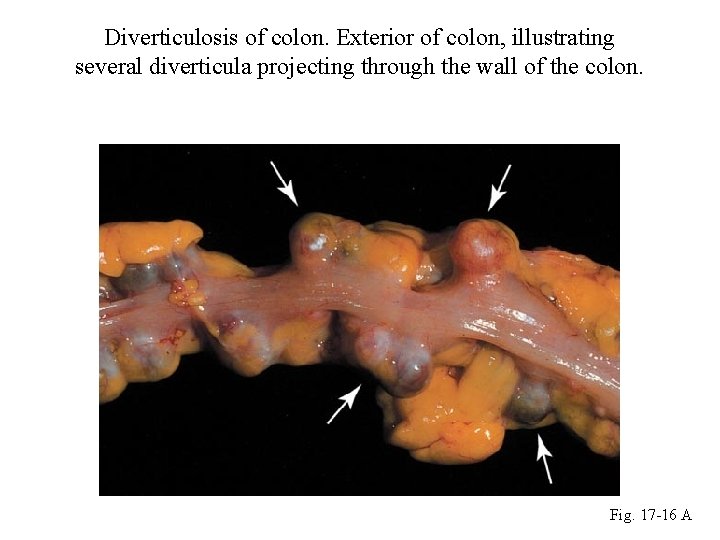
Diverticulosis of colon. Exterior of colon, illustrating several diverticula projecting through the wall of the colon. Fig. 17 -16 A
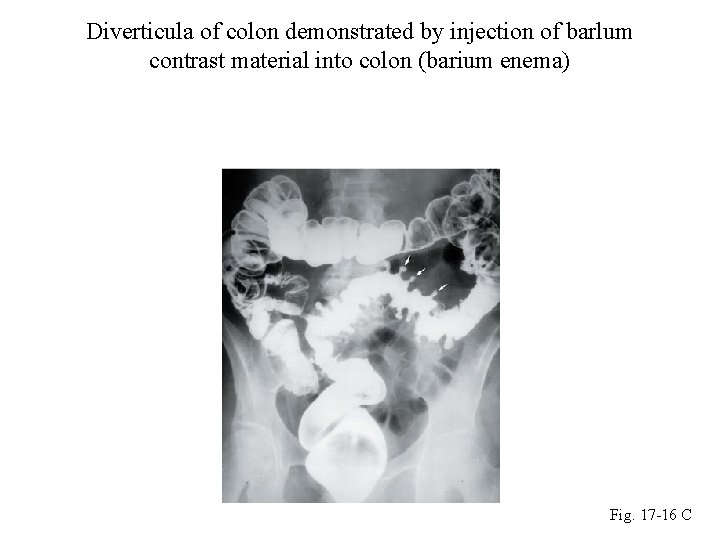
Diverticula of colon demonstrated by injection of barlum contrast material into colon (barium enema) Fig. 17 -16 C
Intestinal Obstruction • A person is said to have an intestinal obstruction if: – Always considered as: – Severity of symptoms depends on: – High intestinal obstruction occurs in: • Symptoms include: – Low intestinal obstruction occurs in: • Symptoms include:
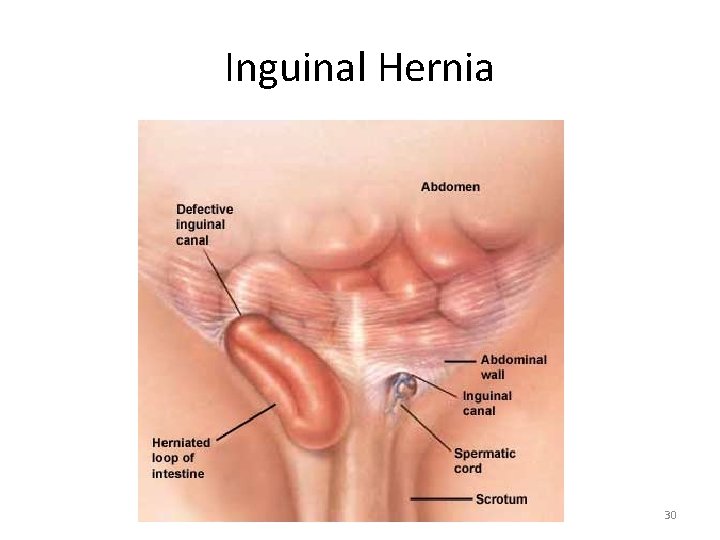
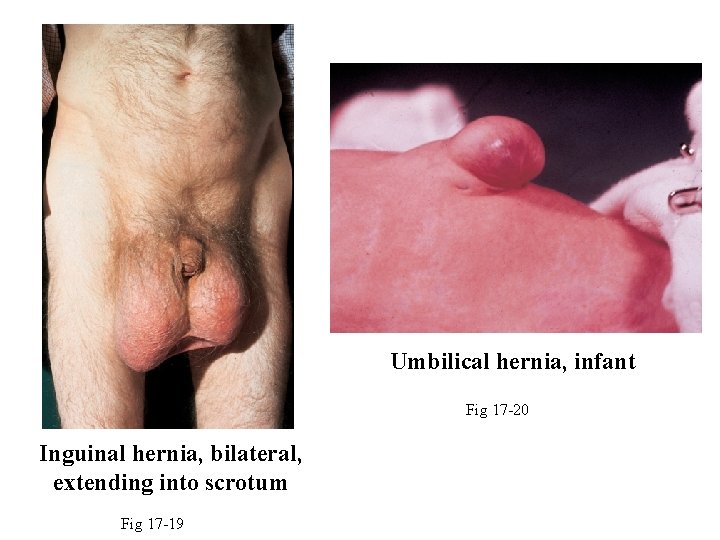
Intestinal Obstruction • Hernia is: – Inguinal hernia is common in: • loop of small bowel protrudes through a weak area in inguinal ring and may descend into: – Umbilical hernia occurs when:
Intestinal Obstruction • Hernia – Reducible hernia: – Incarcerated hernia: – Strangulated hernia:
Inguinal Hernia 30
Umbilical hernia, infant Fig 17 -20 Inguinal hernia, bilateral, extending into scrotum Fig 17 -19
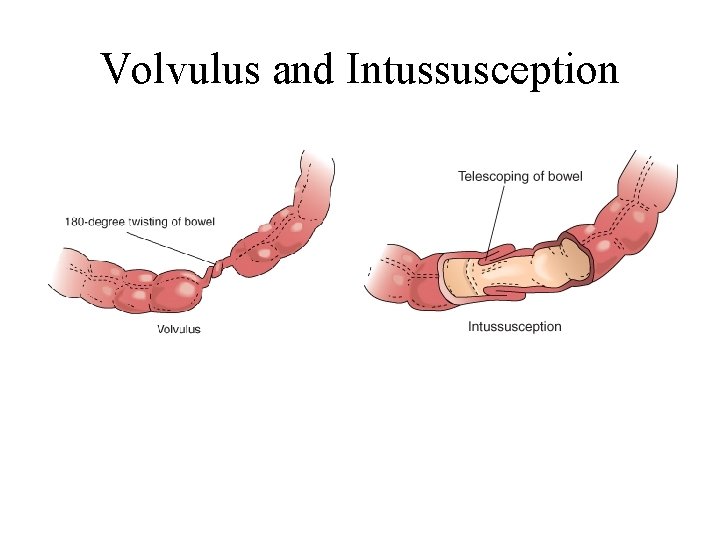
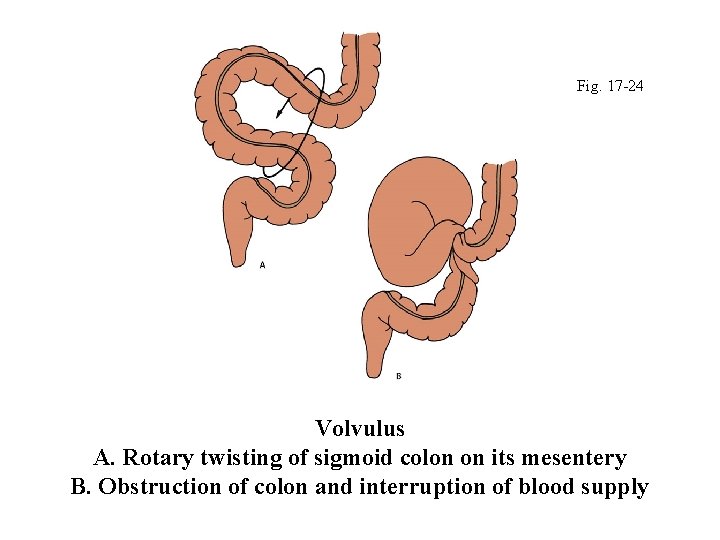
Intestinal Obstruction • Volvulus is: – Most often occurs in: • Intussusception is: a telescoping of a segment of bowel into adjacent segment – Most often occurs in:
Volvulus and Intussusception
Intussusception resulting from a colon tumor Fig. 17 -24
Fig. 17 -24 Volvulus A. Rotary twisting of sigmoid colon on its mesentery B. Obstruction of colon and interruption of blood supply
Hemorrhoids • Are varicose veins of: – Development is predisposed by: – Symptoms are relieved by: • Internal hemorrhoids occur in: – May erode and bleed, become thrombosed, or prolapse • External hemorrhoids occur in: – May become thrombosed, causing discomfort
Hemorrhoids
? ? QUESTIONS? ?