
CHAPTER 17 FROM GENE TO PROTEIN What does
- Slides: 39
CHAPTER 17 FROM GENE TO PROTEIN What does DNA do with all the bases?
Introduction • The information content of DNA is in the form of specific sequences of nucleotides along the DNA strands. • The DNA inherited by an organism leads to specific traits by dictating the synthesis of proteins. • Proteins are the links between genotype and phenotype.
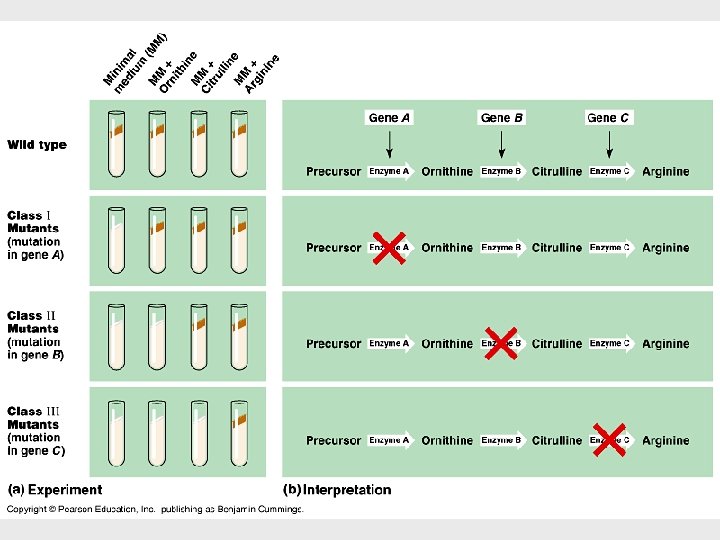
The Connection Between Genes and Proteins • The study of metabolic defects provided evidence that genes specify proteins • In 1909, Archibald Gerrod was the first to suggest that genes dictate phenotype through enzymes • The symptoms of an inherited disease reflect a person’s inability to synthesize a particular enzyme. • Gerrod speculated that alkaptonuria, a hereditary disease, was caused by the absence of an enzyme that breaks down a specific substrate, alkapton.
• In the 1930 s, George Beadle and Boris Ephrussi speculated that each mutation affecting eye color in Drosophila blocks pigment synthesis by preventing production of an enzyme • Beadle and Edward Tatum were finally able to establish the link between genes and enzymes in their exploration of the metabolism of a bread mold, Neurospora crassa. • They mutated Neurospora with X-rays and screened the survivors for mutants that differed in their nutritional needs.
Results • Their results provided strong evidence for the one gene - one enzyme hypothesis. • First, it became clear that not all proteins are enzymes and yet their synthesis depends on specific genes. • This tweaked the hypothesis to one gene one protein. • Therefore, Beadle and Tatum’s idea has been restated as the one gene - one polypeptide hypothesis.
Transcription and translation are the two main processes linking gene to protein: an overview • Genes provide the instructions for making specific proteins. • The bridge between DNA and protein synthesis is RNA. • RNA is chemically similar to DNA, except that it contains ribose as its sugar and substitutes the nitrogenous base uracil for thymine. • An RNA molecule almost always consists of a single strand.
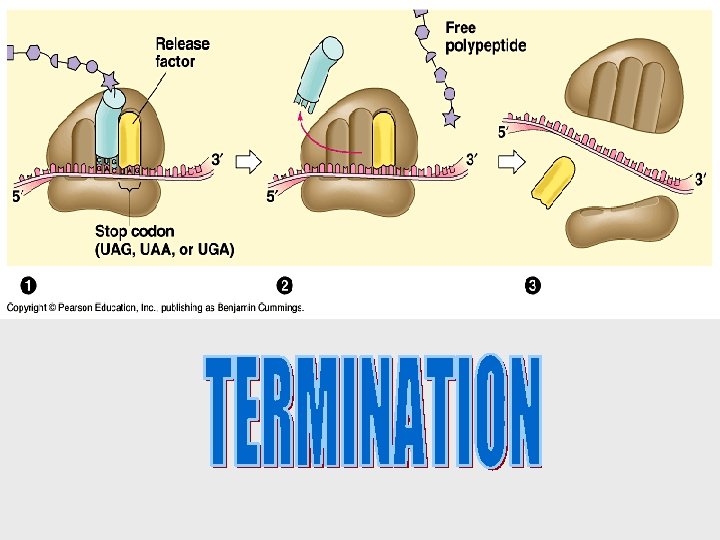
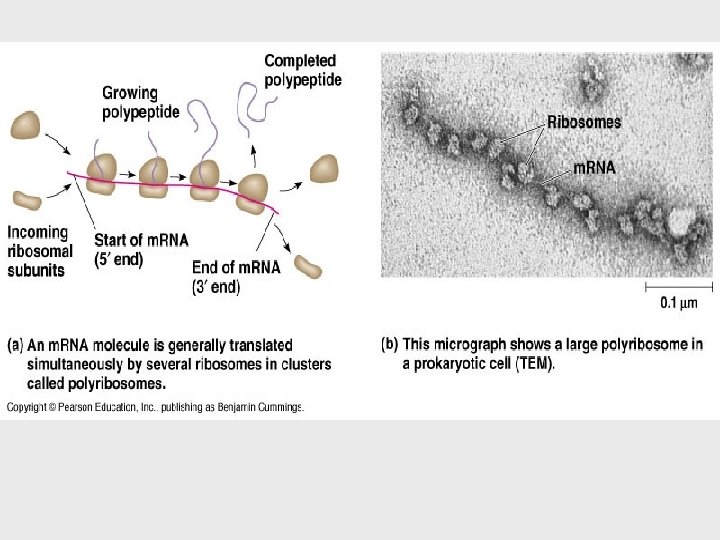
• To get from DNA, written in one chemical language, to protein, written in another, requires two major stages, transcription and translation. • During transcription, a DNA strand provides a template for the synthesis of a complementary RNA strand. • Transcription of a gene produces a messenger RNA (m. RNA) molecule. • During translation, the information contained in the order of nucleotides in m. RNA is used to determine the amino acid sequence of a polypeptide. (occurs at ribosomes)
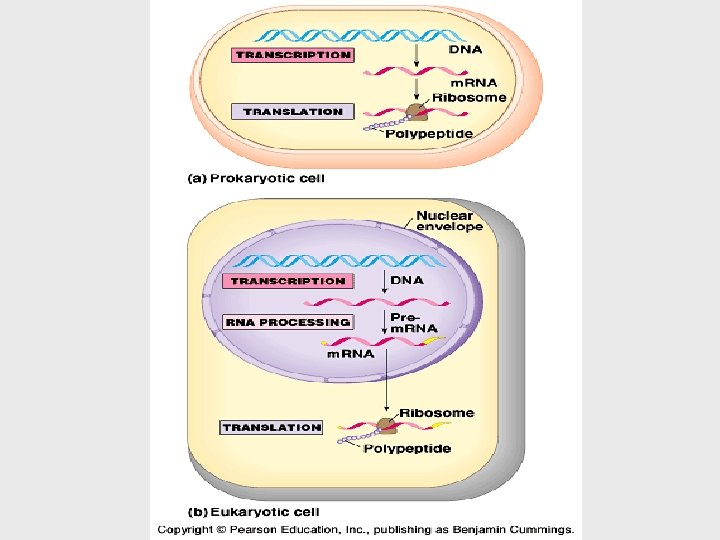
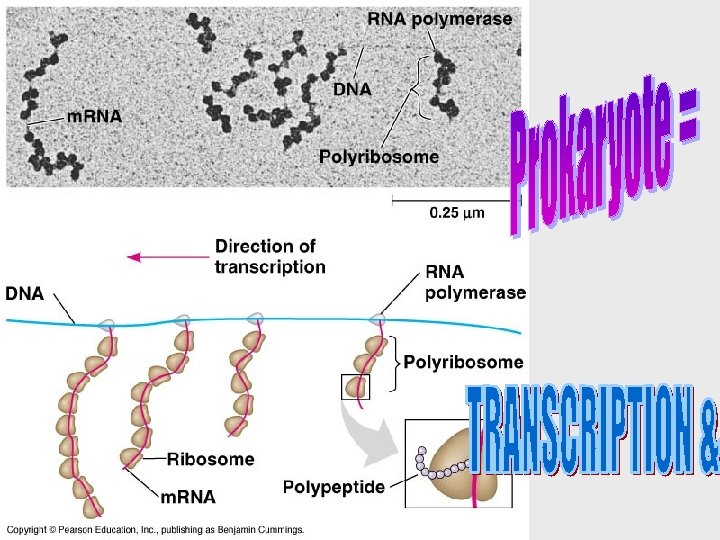
• Because bacteria lack nuclei, transcription and translation are coupled. • Ribosomes attach to the leading end of a m. RNA molecule while transcription is still in progress. • In a eukaryotic cell, almost all transcription occurs in the nucleus and translation occurs mainly at ribosomes in the cytoplasm. • Before the primary transcript can leave the nucleus it is modified in various ways during RNA processing before the finished m. RNA is exported to the cytoplasm (eukaryotes). • DNA -> RNA -> protein. THE SECRET OF LIFE
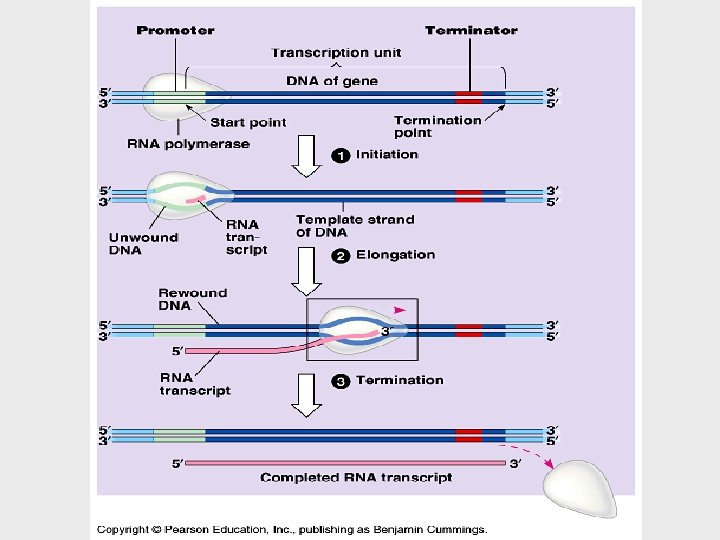
Transcription is the DNAdirected synthesis of RNA • Messenger RNA is transcribed from the template strand of a gene. • RNA polymerase separates the DNA strands at the appropriate point and bonds the RNA nucleotides as they base-pair along the DNA template. • Genes are read 3’->5’, creating a 5’->3’ RNA molecule.
• RNA polymerase attaches and initiates transcription at the promotor, “upstream” of the information contained in the gene, the transcription unit. • The terminator signals the end of transcription. • Bacteria have a single type of RNA polymerase • Eukaryotes have three RNA polymerases (I, II, and III) • RNA polymerase II is used for m. RNA synthesis.
Transcription can be separated into three stages: initiation, elongation, and termination. • The presence of a promotor sequence determines which strand of the DNA helix is the template. • The promotor also includes a binding site for RNA polymerase • In prokaryotes, RNA polymerase can recognize and bind directly to the promotor region.
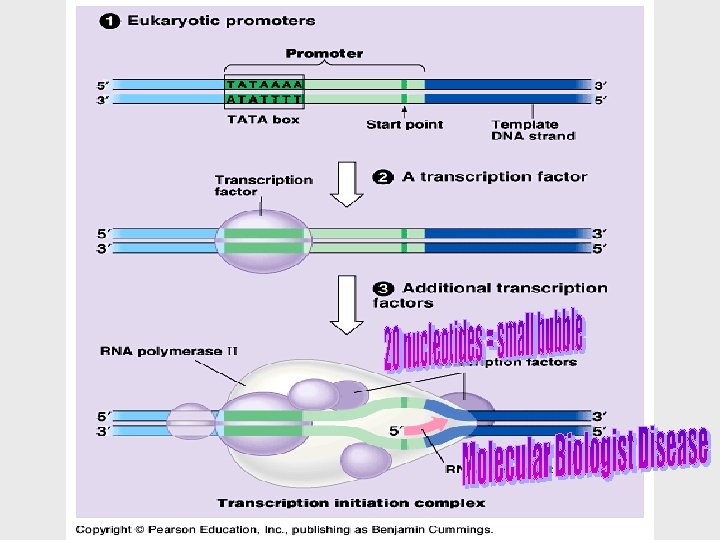
• In eukaryotes, proteins called transcription factors recognize the promotor region, especially a TATA box, and bind to the promotor. • After they have bound to the promotor, RNA polymerase binds to transcription factors to create a transcription initiation complex.
• A single gene can be transcribed simultaneously by several RNA polymerases at a time. = speed and large amount. • A growing strand of RNA trails off from each polymerase. • Energy for Polymerization? Triphosphate nucleosides • Transcription proceeds until after the RNA polymerase transcribes a terminator sequence in the DNA.
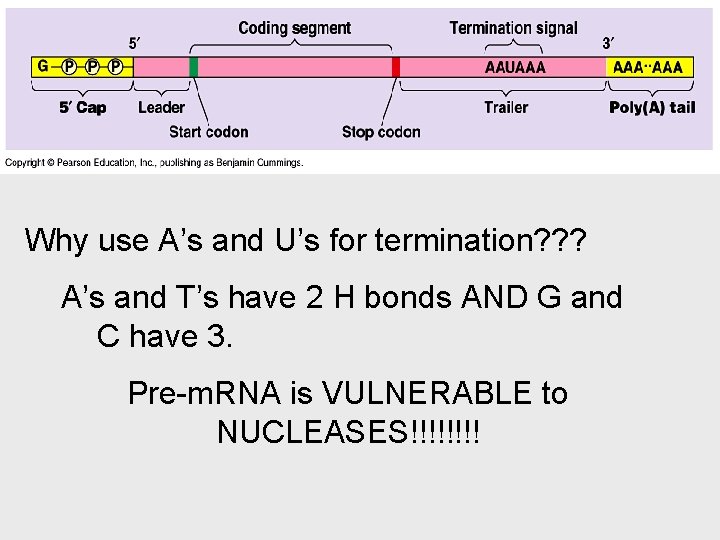
• In prokaryotes, RNA polymerase stops transcription right at the end of the terminator. • Both the RNA and DNA are then released. • In eukaryotes, the polymerase continues for hundreds of nucleotides past the terminator sequence, AAUAAA. • At a point about 10 to 35 nucleotides past this sequence, the pre-m. RNA is cut from the enzyme.
Why use A’s and U’s for termination? ? ? A’s and T’s have 2 H bonds AND G and C have 3. Pre-m. RNA is VULNERABLE to NUCLEASES!!!!
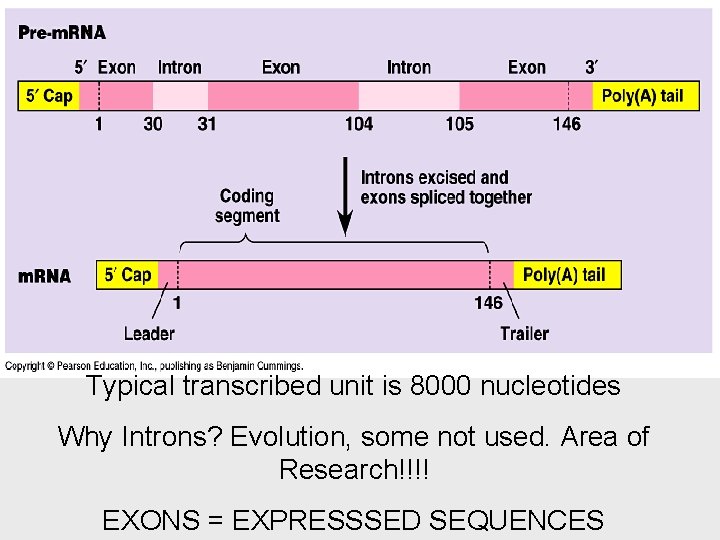
Typical transcribed unit is 8000 nucleotides Why Introns? Evolution, some not used. Area of Research!!!! EXONS = EXPRESSSED SEQUENCES
Eukaryotic cells modify RNA after transcription • This helps protect m. RNA from hydrolytic enzymes. • It also functions as an “attach here” signal for ribosomes. • the poly(A) tail also seems to facilitate the export of m. RNA from the nucleus. • The most remarkable stage of RNA processing occurs during the removal of a large portion of the RNA molecule during RNA splicing.
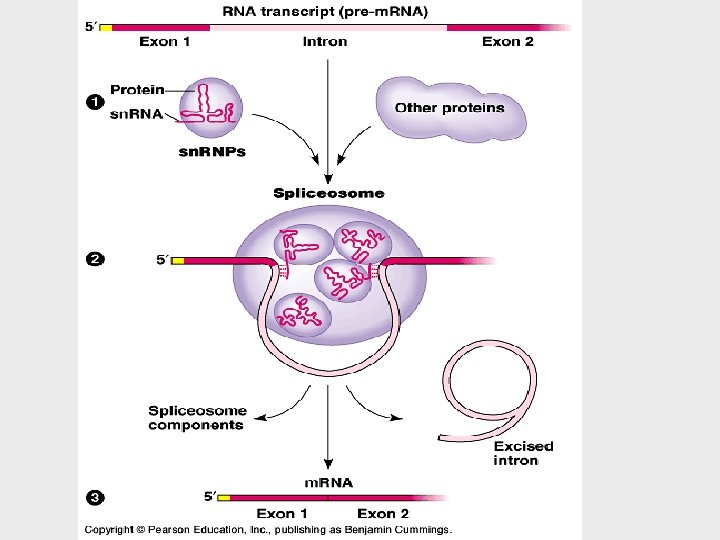
• Most eukaryotic genes and their RNA transcripts have long noncoding stretches of nucleotides. • coding regions, exons, which are translated into amino acid sequences • Noncoding segments, introns = cut out • RNA splicing removes introns and joins exons • This splicing is accomplished by a spliceosome.
RNA splicing appears to have several functions. • First, at least some introns contain sequences that control gene activity in some way. • Splicing itself may regulate the passage of m. RNA from the nucleus to the cytoplasm. • One clear benefit of split genes is to enable a one gene to encode for more than one polypeptide.
• Alternative RNA splicing gives rise to two or more different polypeptides • Split genes may also facilitate the evolution of new proteins • introns increases the probability of potentially beneficial crossing over between genes. • exon shuffling could lead to new proteins through novel combinations of functions.
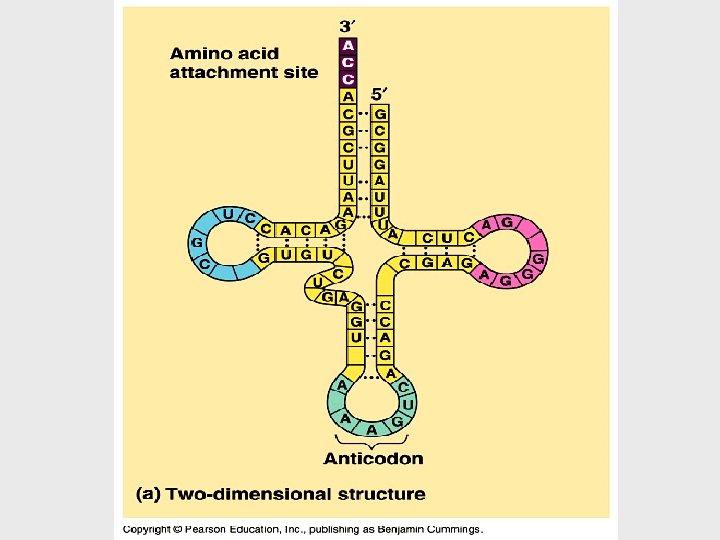
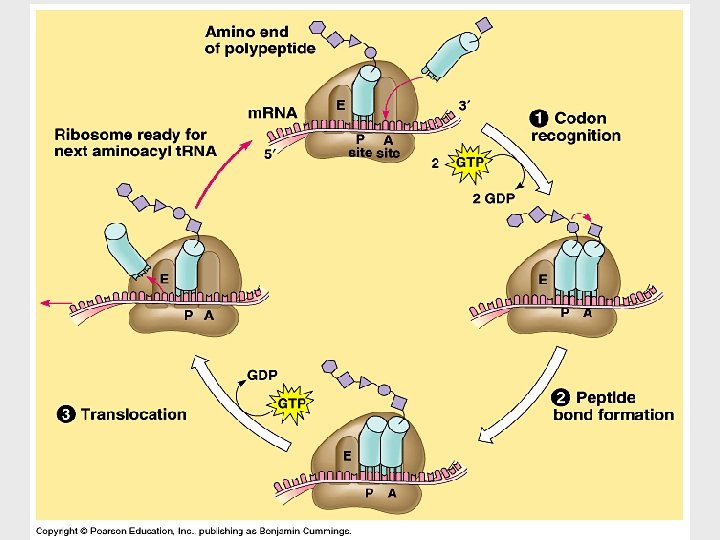
Translation is the RNA-directed synthesis of a polypeptide • In the process of translation, a cell interprets a series of codons along a m. RNA molecule. • Transfer RNA (t. RNA) transfers amino acids from the cytoplasm’s pool to a ribosome. • A t. RNA molecule consists of a strand of about 80 nucleotides that folds back on itself to form a three-dimensional structure.
• Each amino acid is joined to the correct t. RNA by aminoacyl-t. RNA synthetase. • The synthetase catalyzes a covalent bond between them, forming aminoacyl-t. RNA or activated amino acid.
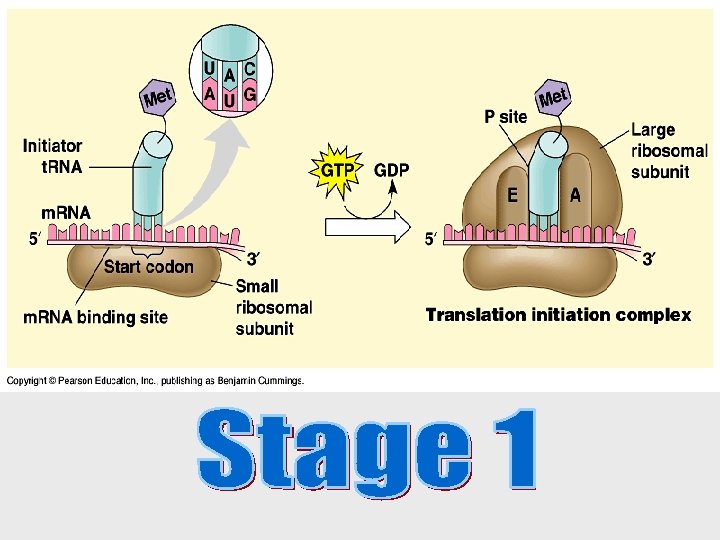
Ribosomes facilitate the specific coupling of the t. RNA anticodons with m. RNA codons. • Each ribosome has a large and a small subunit. 60% RNA 40% Protein • These are composed of proteins and ribosomal RNA (r. RNA), the most abundant RNA in the cell. • After r. RNA genes are transcribed to r. RNA in the nucleus, the r. RNA and proteins form the subunits in the nucleolus.
• prokaryotic and eukaryotic ribosomes have enough differences that certain antibiotic drugs (like tetracycline) can paralyze prokaryotic ribosomes without inhibiting eukaryotic ribosomes.
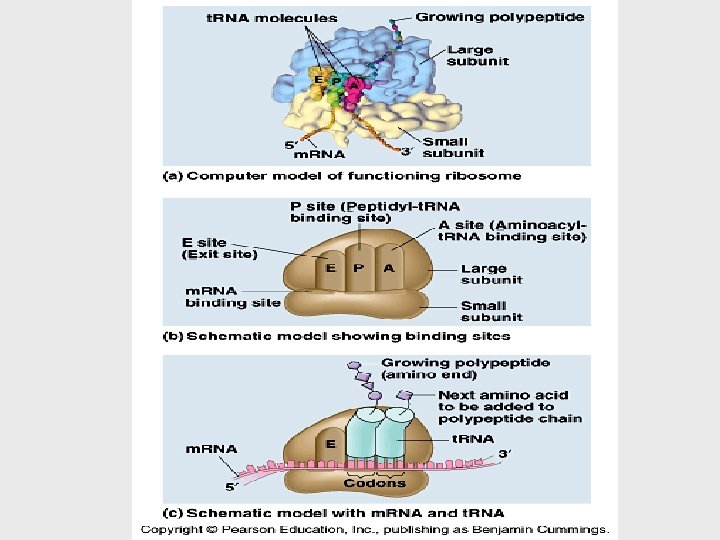
• Each ribosome has a binding site for m. RNA and three binding sites for t. RNA molecules. • The P site holds the t. RNA carrying the growing polypeptide chain. • The A site carries the t. RNA with the next amino acid. • Discharged t. RNAs leave the ribosome at the E site.
Genetics explains why you look like your father ……. . and if you don't why you should