
Chapter 17 From Gene to Protein The Bridge
Chapter 17 From Gene to Protein
The Bridge Between DNA and Protein n DNA contains the genes that make us who we are. n The characteristics we have are the result of the proteins our cells produce during the process of transcription and translation. 2
Main Questions: n Somehow the information content in DNA-- -the specific sequence of nucleotides along the DNA--strands needs to be turned into protein. n How does this information determine the organism’s appearance? n How is the information in the DNA sequence translated by a cell into a specific trait?
The Bridge Between DNA and Protein n RNA is the single stranded compound that carries the message from the DNA to the ribosome for translation into protein. n Recall, n The DNA = A, T, C, G; RNA= A, U, C, G order of these bases carries the code for the protein which is constructed from any or all of the 20 amino acids.
RNA n RNA is used because it is a way to protect the DNA from possible damage. n Many copies of RNA can be made from one gene, thus, it allows many copies of a protein to be made simultaneously.

m. RNA and RNA Polymerase n m. RNA is the “messenger” or vehicle that carries the genetic information from the DNA to the protein synthesizing machinery. n RNA polymerase pries apart the DNA and joins RNA nucleotides together in the 5’-->3’ direction (adding, again, to the free 3’ end). n RNA polymerase is just like DNA polymerase, but it doesn’t need a primer.
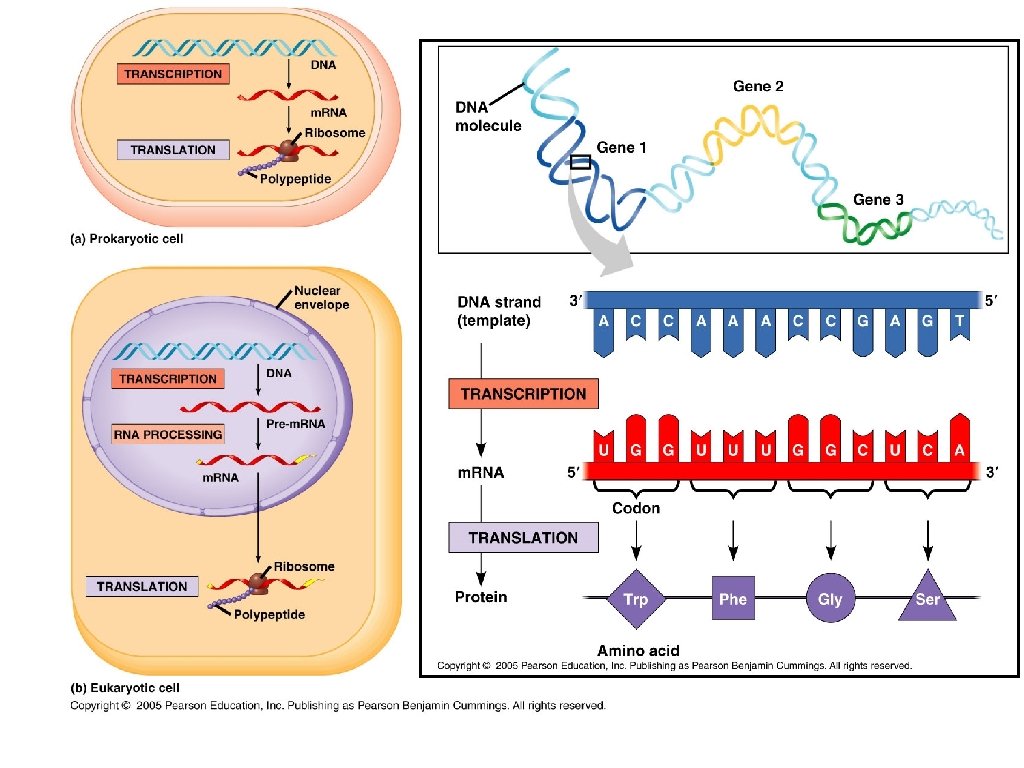
Transcription and Translation n The process of going from gene to m. RNA is called transcription. n Translation is the process that occurs when the m. RNA reaches the ribosome and protein synthesis occurs.
Transcription and Translation n The m. RNA produced during transcription is read by the ribosome and results in the production of a polypeptide. n The polypeptide is comprised of amino acids. n The specific sequence of amino acids is determined by the genetic code on the DNA.
Transcription n The gene determines the sequence of bases along the length of the m. RNA molecule. n One of the two regions of the DNA serves as the template. n The DNA is read 3’-->5’ so the m. RNA can be synthesized 5’-->3’ n Not all regions of DNA codes for protein.
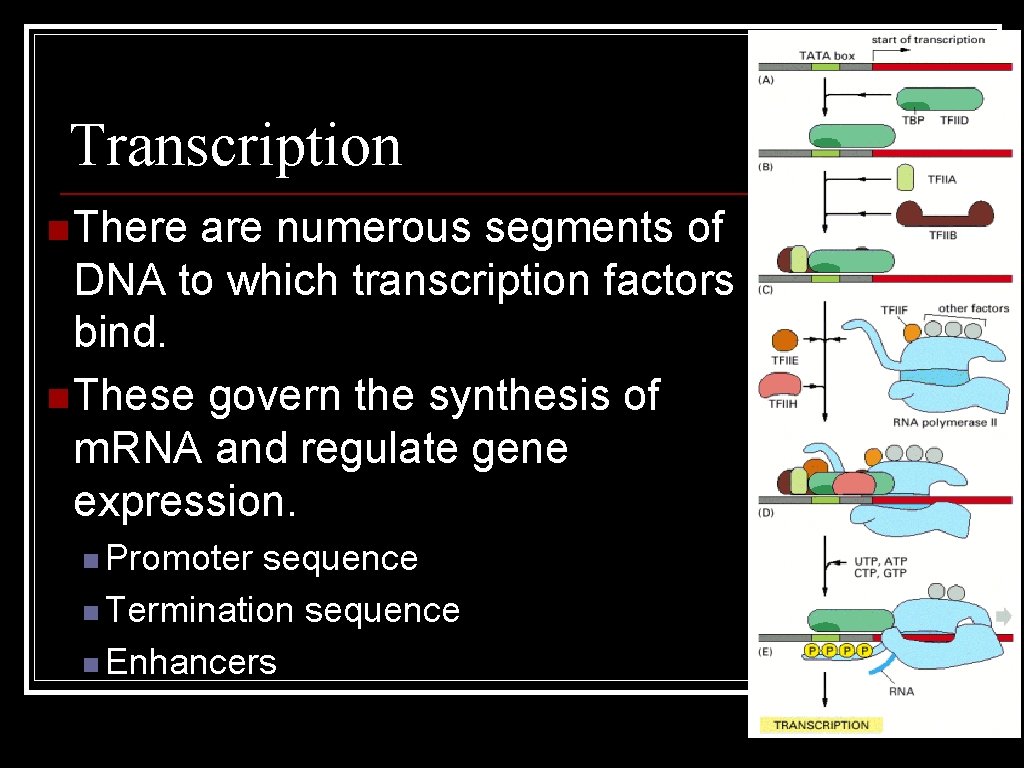
Transcription n There are numerous segments of DNA to which transcription factors bind. n These govern the synthesis of m. RNA and regulate gene expression. n Promoter sequence n Termination sequence n Enhancers
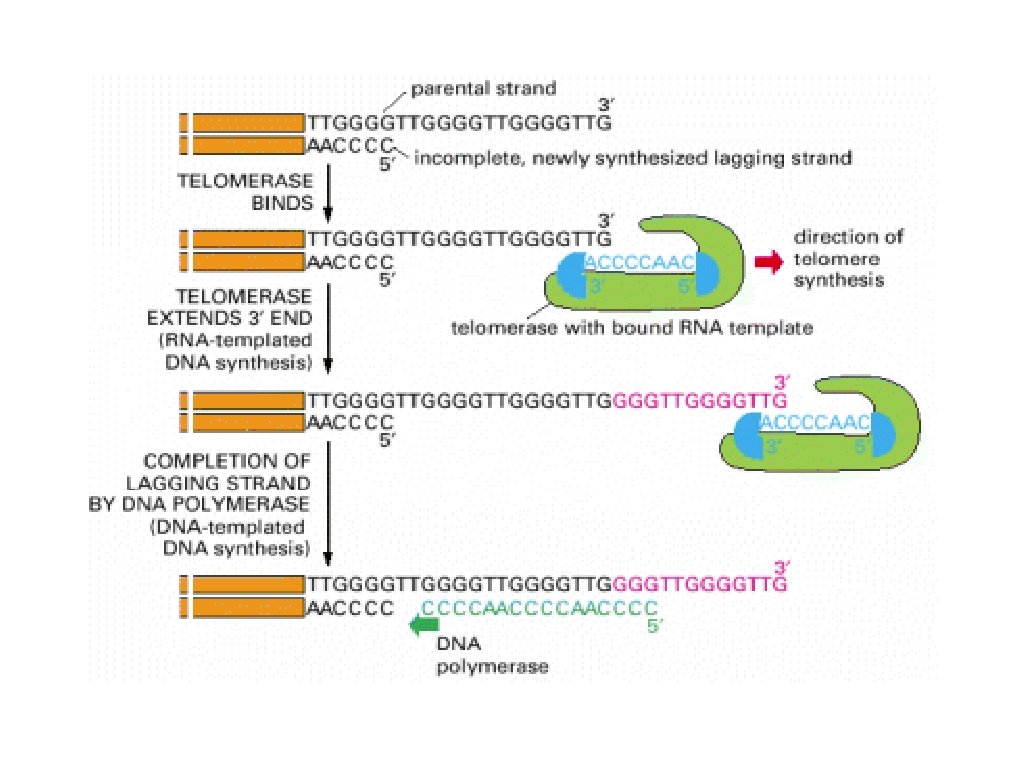
Other Functions of Non-Coding DNA n Other regions of non-coding DNA are involved in regulating gene expression, coding for t. RNA molecules, and ensuring that the DNA maintains its length (telomeres). 11
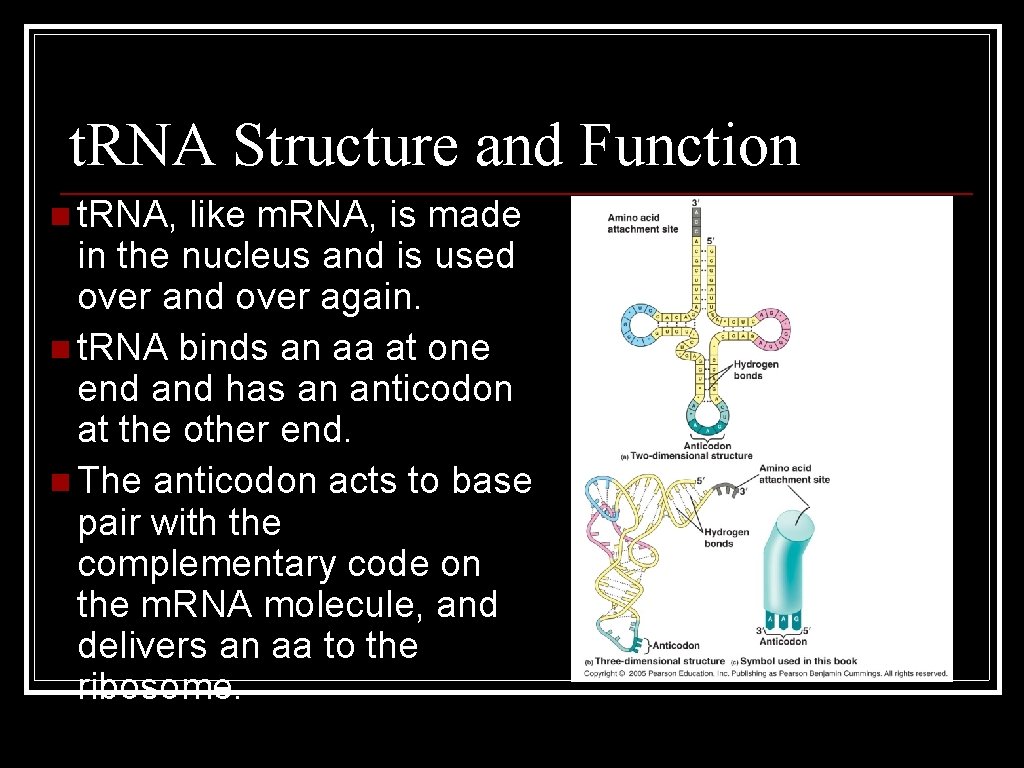
t. RNA Structure and Function n t. RNA, like m. RNA, is made in the nucleus and is used over and over again. n t. RNA binds an aa at one end and has an anticodon at the other end. n The anticodon acts to base pair with the complementary code on the m. RNA molecule, and delivers an aa to the ribosome.
Transcription and Translation n Additionally, in eukaryotes, once genes get transcribed, the RNA that is produced is often modified before getting translated. 14
Post Transcriptional Modification n In eukaryotes, once the primary transcript is made, it is spliced and modified before getting translated into protein. 15
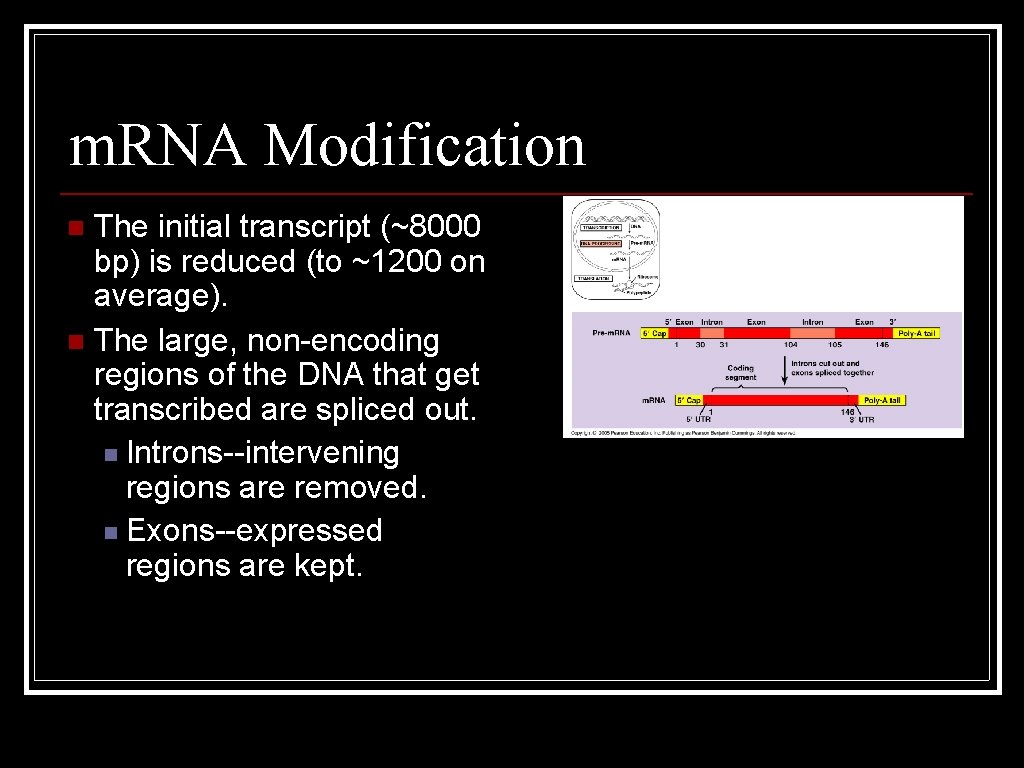
m. RNA Modification The initial transcript (~8000 bp) is reduced (to ~1200 on average). n The large, non-encoding regions of the DNA that get transcribed are spliced out. n Introns--intervening regions are removed. n Exons--expressed regions are kept. n
m. RNA Modification n Some untranslated regions of the exons are saved because they have important functions such as ribosome binding.
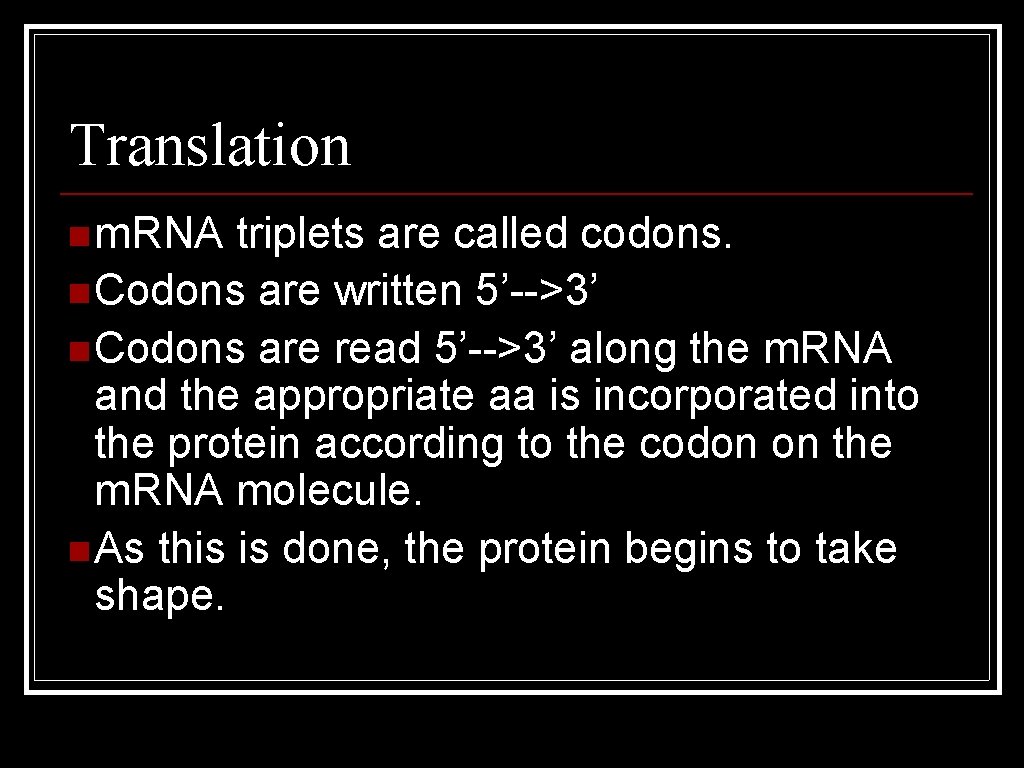
Translation n m. RNA triplets are called codons. n Codons are written 5’-->3’ n Codons are read 5’-->3’ along the m. RNA and the appropriate aa is incorporated into the protein according to the codon on the m. RNA molecule. n As this is done, the protein begins to take shape.
Protein Synthesis n Many copies of protein can be made simultaneously within a cell using a single m. RNA molecule. n This is an efficient way for the cell to make large amounts of protein in times of need. 22
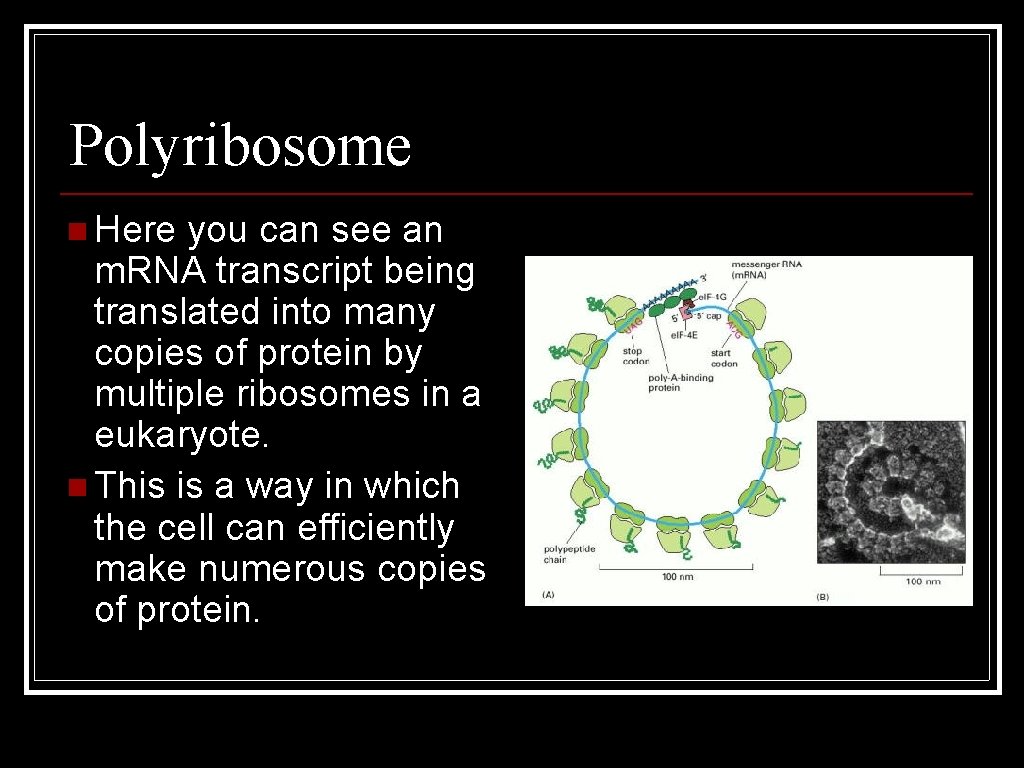
Polyribosome n Here you can see an m. RNA transcript being translated into many copies of protein by multiple ribosomes in a eukaryote. n This is a way in which the cell can efficiently make numerous copies of protein.
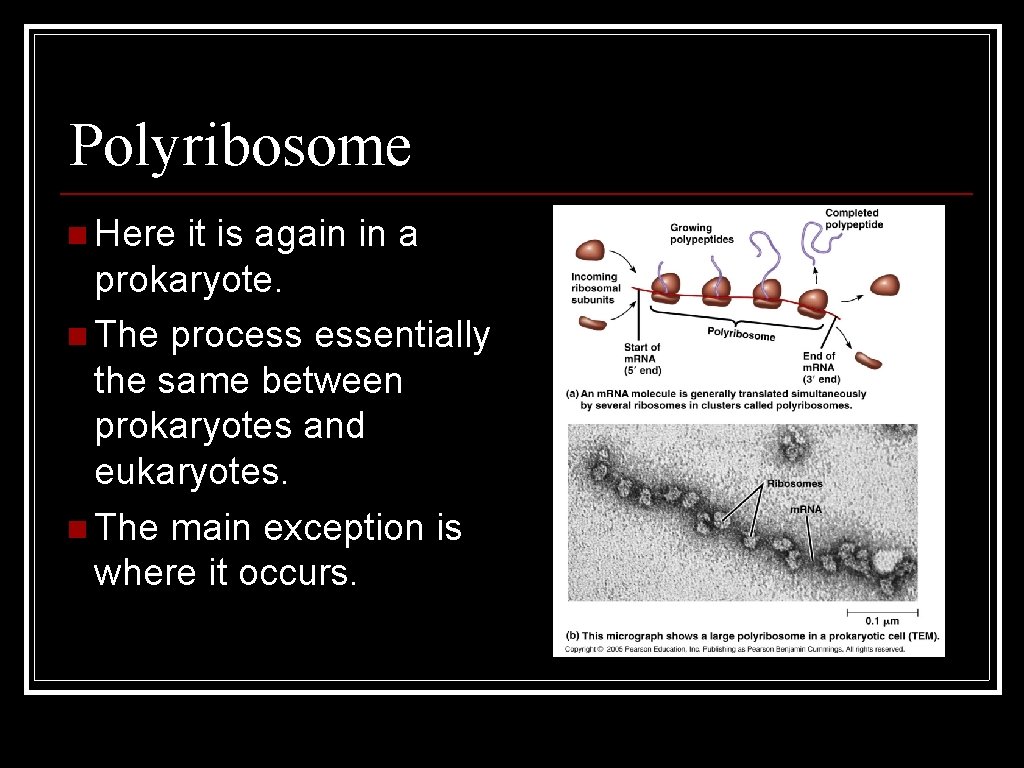
Polyribosome n Here it is again in a prokaryote. n The process essentially the same between prokaryotes and eukaryotes. n The main exception is where it occurs.
One Main Difference n Between prokaryotes and eukaryotes, there is one main difference between transcription and translation. The two processes can occur simultaneously in prokaryotes because they lack a nucleus. n In eukaryotes, the two processes occur at different times. Transcription occurs in the nucleus, translation occurs in the cytoplasm.
Translation n So how, exactly, does the cell translate genetic code into protein? 27
The Genetic Code n Scientists began wondering how the genetic information contained within DNA instructed the formation of proteins. n How could 4 different base pairs code for 20 different amino acids? n 1: 1 obviously didn’t work; a 2 letter code didn’t work either; but a 3 letter code would give you more than enough needed.

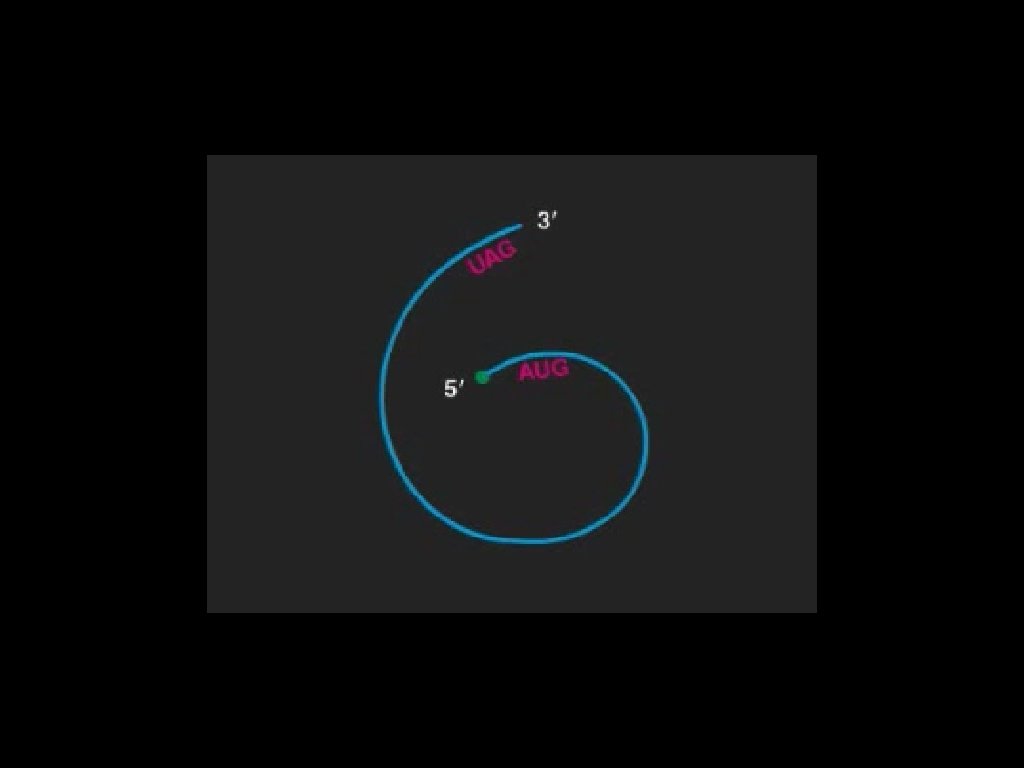
The Genetic Code n Codons are composed of triplets of bases. n 61 of the 64 codons code for amino acids. n 3 of the codons code for stop codons and signal an end to translation. n AUG--start codon
Genetic Code n The genetic code is said to be redundant. n More than one triplet codes for the same amino acid. n One triplet only codes for one amino acid. n The reading frame is important because any error in the reading frame codes for gibberish.
Ribosomes n r. RNA genes are found on chromosomal DNA and are transcribed and processed in the nucleolus. n They are assembled and transferred to the cytoplasm as individual subunits. n The large and small subunits form one large subunit when they are attached to the m. RNA.
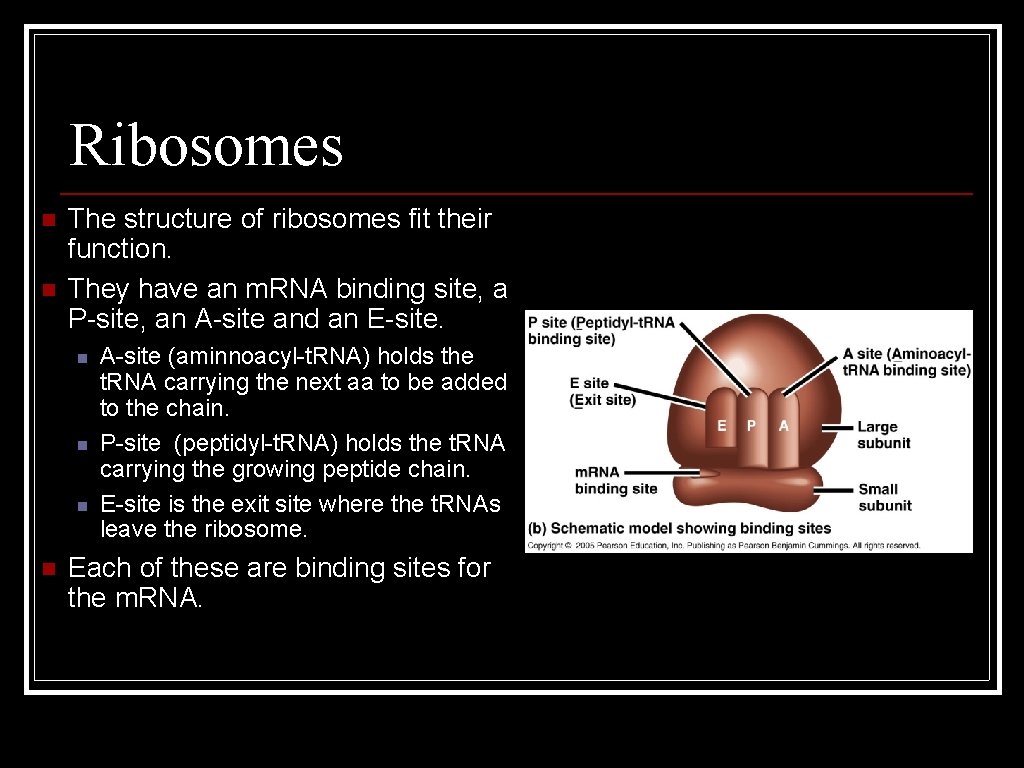
Ribosomes n n The structure of ribosomes fit their function. They have an m. RNA binding site, a P-site, an A-site and an E-site. n n A-site (aminnoacyl-t. RNA) holds the t. RNA carrying the next aa to be added to the chain. P-site (peptidyl-t. RNA) holds the t. RNA carrying the growing peptide chain. E-site is the exit site where the t. RNAs leave the ribosome. Each of these are binding sites for the m. RNA.
The 3 Stages of Protein Building n 1. Initiation n 2. Elongation n 3. Termination n All three stages require factors to help them “go” and GTP to power them.
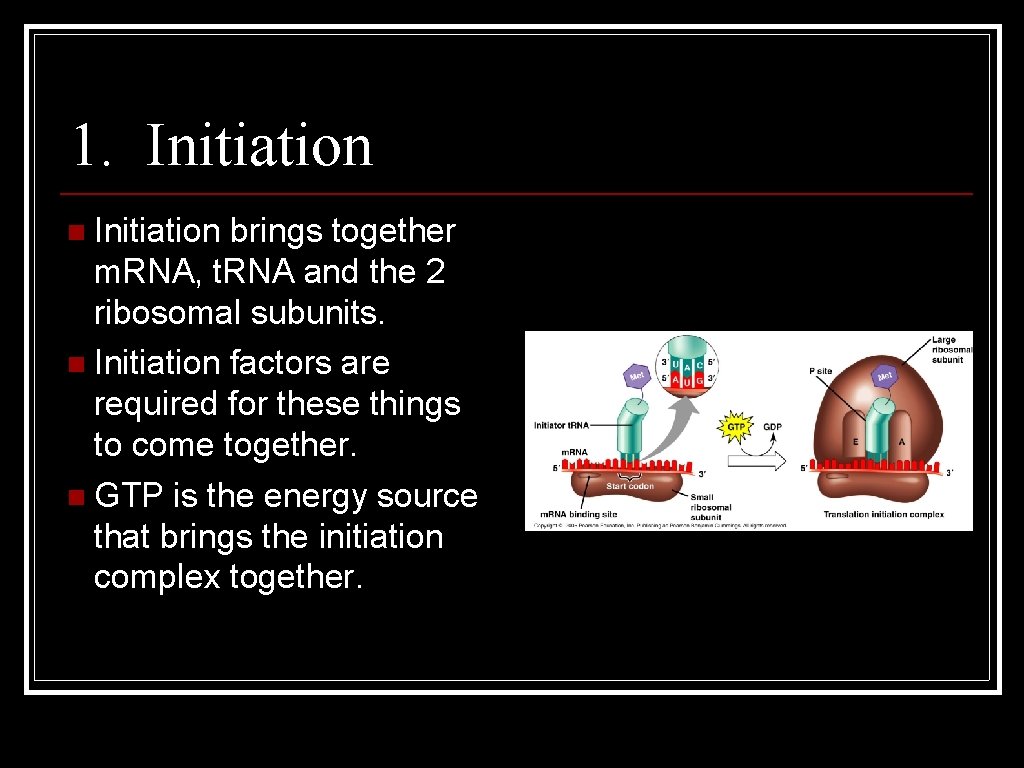
1. Initiation n Initiation brings together m. RNA, t. RNA and the 2 ribosomal subunits. n Initiation factors are required for these things to come together. n GTP is the energy source that brings the initiation complex together.
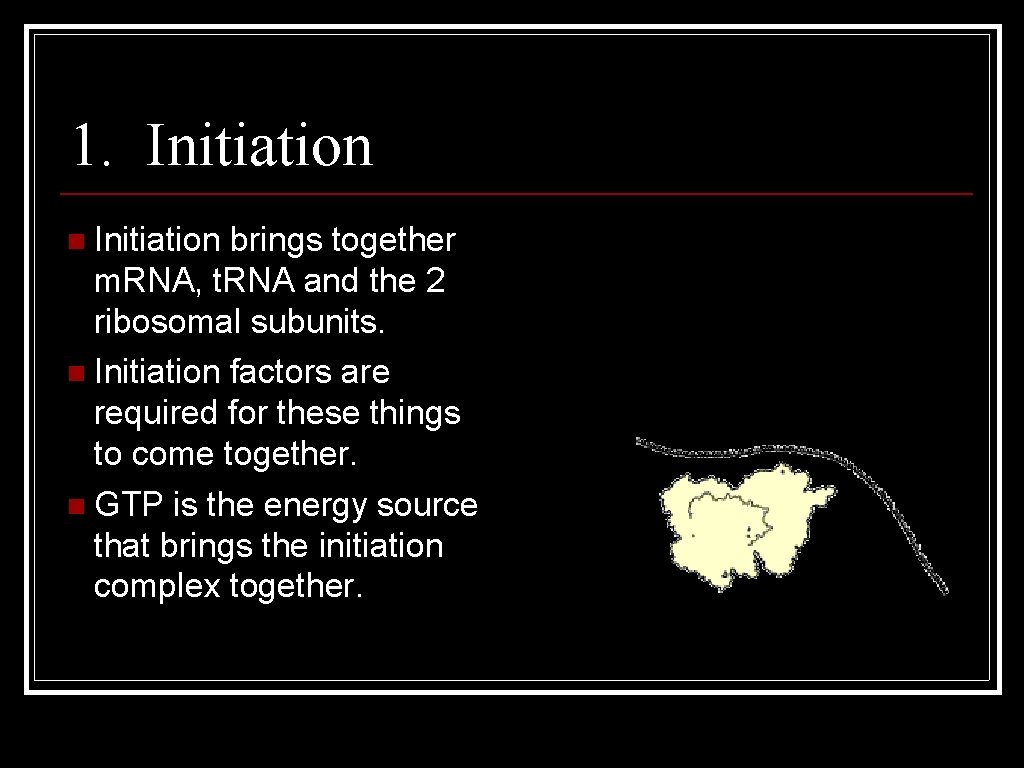
1. Initiation n Initiation brings together m. RNA, t. RNA and the 2 ribosomal subunits. n Initiation factors are required for these things to come together. n GTP is the energy source that brings the initiation complex together.

2. Elongation n The elongation stage is where aa’s are added one by one to the growing polypeptide chain. n Elongation factors are involved in the addition of the aa’s. n GTP energy is also spent in this stage.

3. Termination occurs when a stop codon on the m. RNA reaches the “A-site” within the ribosome. n Release factor then binds to the stop codon in the “A-site” causing the addition of water to the peptide instead of an aa. n This signals the end of translation. n
Polypeptide Synthesis n As the polypeptide is being synthesized, it usually folds and takes on its 3 D structure. n Post-translational modifications are often required to make the protein function. n Adding fats, sugars, phosphate groups, etc. n Removal of certain proteins to make the protein functional. n Separately synthesized polypeptides may need to come together to form a functional protein.
- Slides: 40