
Chapter 17 Externalities and Public Goods 17 1
Chapter 17 Externalities and Public Goods 17. 1 Introduction 17. 2 Externalities 17. 3 Public Goods 1
17. 1 Introduction First Fundamental Theorem of Welfare Economics: IF 1) All consumers and producers act as perfect competitors (no one has market power) and 2) A market exists for each and every commodity Then Resource allocation is Pareto Efficient 2
17. 1 Introduction An EXTERNALITY occurs when: 1) The activity of one agent directly affects the welfare of another agent And 2) This affect is not transmitted by market prices Therefore no perfect competition Therefore the First Fundamental Theorem of Welfare Economics doesn’t hold 3
17. 1 Introduction A PURE PUBLIC GOOD has two features: 1) Nonrival – once provided, another person can consume it at no additional cost 2) Nonexcludable – once provided, it is impossible or highly expensive to prevent anyone from consuming it Perfectly competitive markets can’t exist for these goods Therefore the First Fundamental Theorem of Welfare Economics doesn’t hold 4
17. 2 Externalities IF Externalities Exist, THEN Social marginal cost ≠ private marginal cost, AND 1 st Fundamental Theorem of Welfare Economics Fails THEREFORE Government could intervene 5
17. 2 Externalities Ø What is an Externality? Ø Graphical Analysis of Externalities Ø Private Responses to Externalities Ø Public Responses to Externalities Ø Implications for Income Distribution Ø Positive Externalities
Theory - What is an Externality? An EXTERNALITY occurs when: 1) The activity of one agent directly affects the welfare of another agent And 2) This affect is not transmitted by market prices 7
Externality Examples Externalities: -A firm pollutes the air through production -A dorm student uses up all the bandwidth downloading So You Think You Can Dance -neighborhood dogs make your house safer Not Externalities: -A store with noisy country music must reduce price to keep customers -Subway has a sale, forcing Mr. Sub to have a sale also 8
Theory - Externality Features Externalities carry a variety of rarely considered features: 1) EXTERNALITIES CAN BE PRODUCED BY CONSUMERS AS WELL AS FIRMS 2) EXTERNALITIES ARE RECIPROCAL IN NATURE 3) EXTERNALITIES CAN BE POSITIVE OR NEGATIVE 4) PUBLIC GOODS AND EXERNALITIES CAN BE SIMILAR 9
1) EXTERNALITIES CAN BE PRODUCED BY CONSUMERS AS WELL AS FIRMS Examples: -a student using bandwidth -a smoker -a neighborhood watch patrol -a cell phone “loud-talker” 10

2) EXTERNALITIES ARE RECIPROCAL IN NATURE -all parties using a good affected by externalities affect each other: -the roommate downloading movies and the roommate downloading papers -person using a cell phone beside 2 people talking -which is “worse” is a biased value judgment 11
3) EXTERNALITIES CAN BE POSITIVE OR NEGATIVE -As previously stated, externalities can also be positive -negative externalities tend to be overproduced, and positive externalities tend to be underproduced -ie: shoveling your snow makes winter easier on your neighbors, owning a guard dog protects your neighbors, washing your hands prevents other from getting sick 12
4) PUBLIC GOODS AND EXERNALITIES CAN BE SIMILAR -Externalities are unintended costs or benefits to the community, whereas public goods have intended benefits to the community (Mishan 1971) -ie: If you hire security, it has externalities. If your block hires security, it is a public good -It is still useful to examine them independently in practice 13
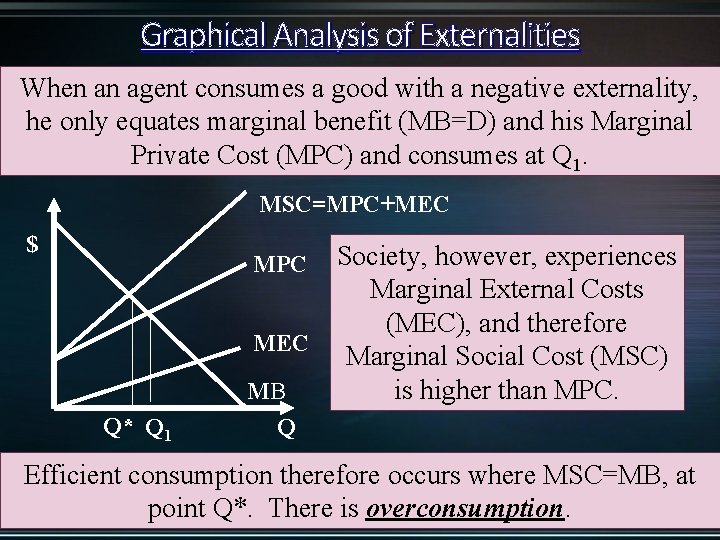
Graphical Analysis of Externalities When an agent consumes a good with a negative externality, he only equates marginal benefit (MB=D) and his Marginal Private Cost (MPC) and consumes at Q 1. MSC=MPC+MEC $ Society, however, experiences Marginal External Costs (MEC), and therefore MEC Marginal Social Cost (MSC) MB is higher than MPC Q* Q 1 Q Efficient consumption therefore occurs where MSC=MB, at 14 point Q*. There is overconsumption.
Graphical Notes -The marginal benefit curve slopes down: 1) due to diminishing marginal benefit or 2) As a reflection of the demand curve and market price decreasing with quantity -Costs tend to increase with output, therefore MPC is upward sloping 15
Graphical Notes -Typically as output increases, the negative externality also increases, causing the MEC curve to be upward sloping -(2 barking dogs is more annoying than one) -The distance between the MSC and the MPC is always the MEC. 16
Graphical Implications -Private markets will overproduce when negative externalities exist -without a market for externalities, this is a RATIONAL action -Note that optimal amount of the externality IS NOT ZERO (ie: pollution is a cost, but some level is acceptable for the benefit) -Overproduction causes a deadweight loss to society: 17

Producer and Consumer Surplus: $ MSC MPC P* P Producer Surplus MEC Consumer Surplus MB=D Q* Q Q 18
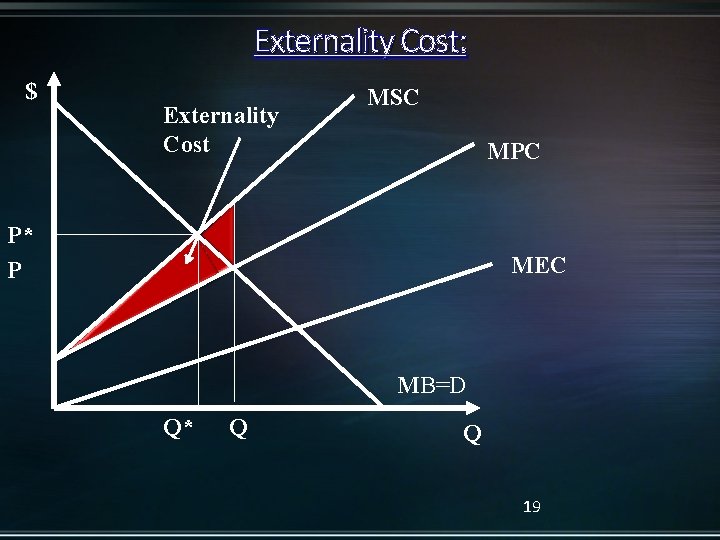
Externality Cost: $ Externality Cost MSC MPC P* P MEC MB=D Q* Q Q 19
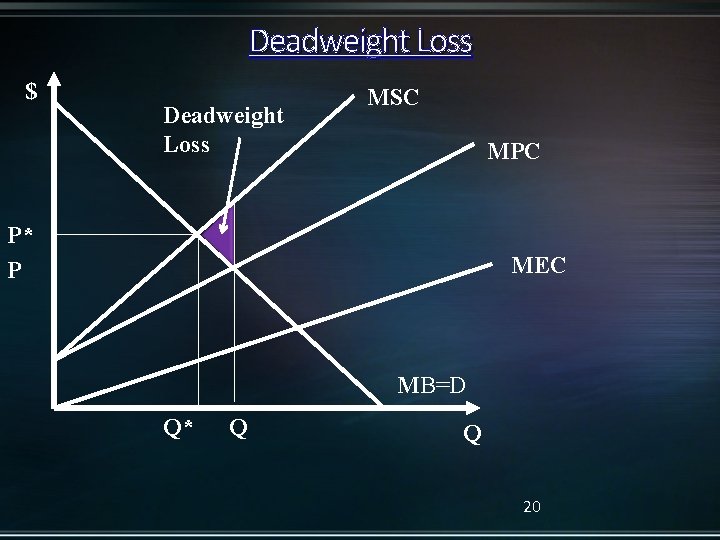
Deadweight Loss $ Deadweight Loss MSC MPC P* P MEC MB=D Q* Q Q 20
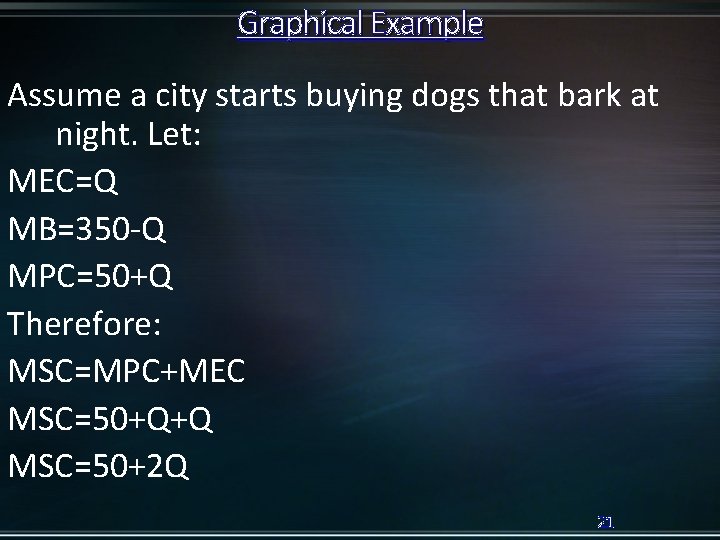
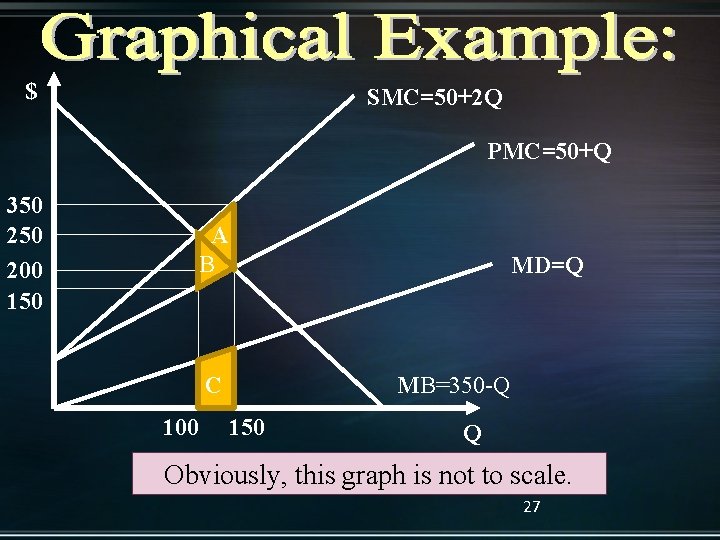
Graphical Example Assume a city starts buying dogs that bark at night. Let: MEC=Q MB=350 -Q MPC=50+Q Therefore: MSC=MPC+MEC MSC=50+Q+Q MSC=50+2 Q 21
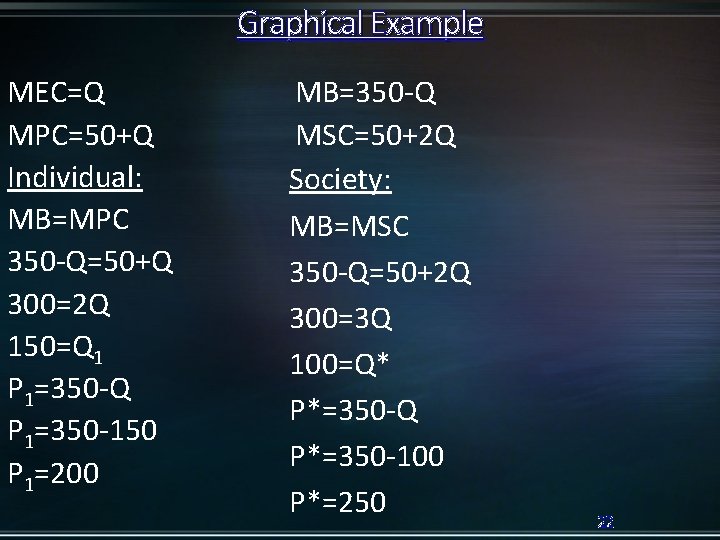
Graphical Example MEC=Q MPC=50+Q Individual: MB=MPC 350 -Q=50+Q 300=2 Q 150=Q 1 P 1=350 -Q P 1=350 -150 P 1=200 MB=350 -Q MSC=50+2 Q Society: MB=MSC 350 -Q=50+2 Q 300=3 Q 100=Q* P*=350 -Q P*=350 -100 P*=250 22
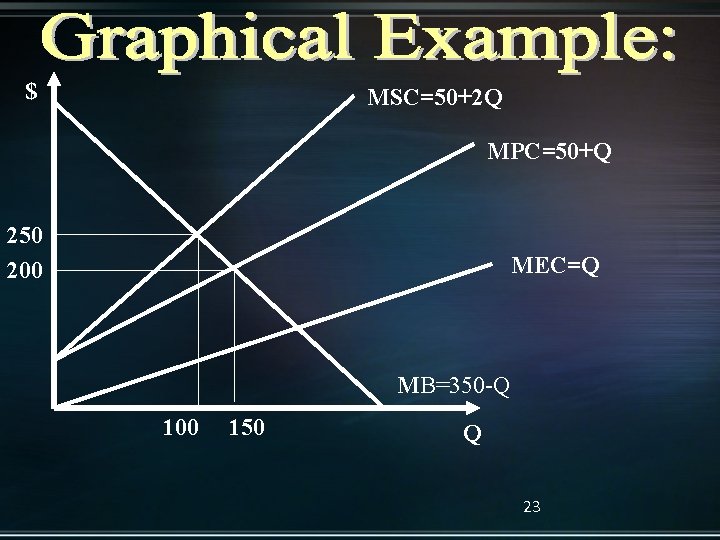
$ MSC=50+2 Q MPC=50+Q 250 200 MEC=Q MB=350 -Q 100 150 Q 23
Deadweight loss To calculate deadweight loss, we need 2 more points in the graph: MSC=50+2 Q 1 MSC=50+2(150) MSC=350 MPC=50+Q* MPC=50+100 MPC=150 24
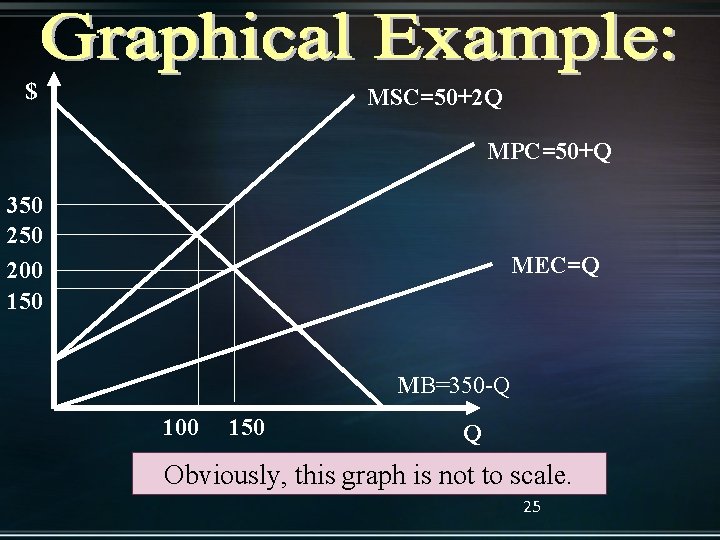
$ MSC=50+2 Q MPC=50+Q 350 200 150 MEC=Q MB=350 -Q 100 150 Q Obviously, this graph is not to scale. 25
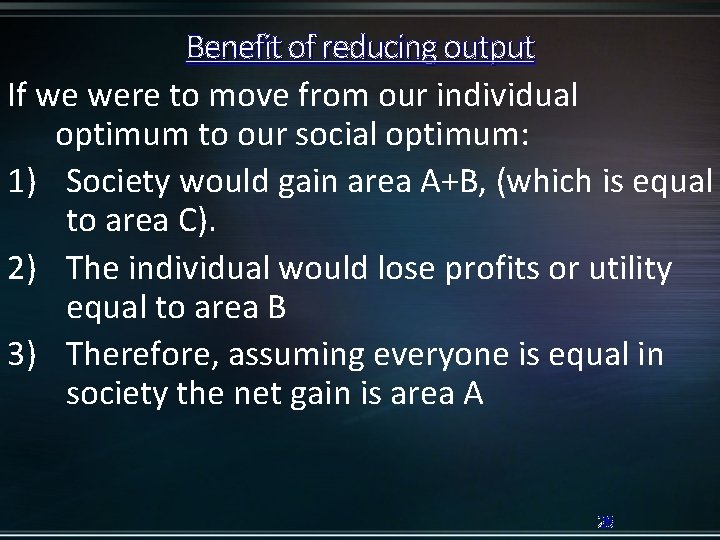
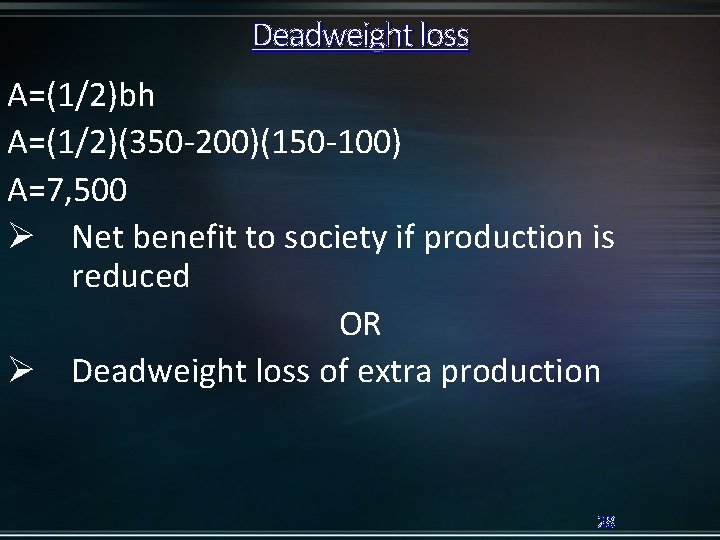
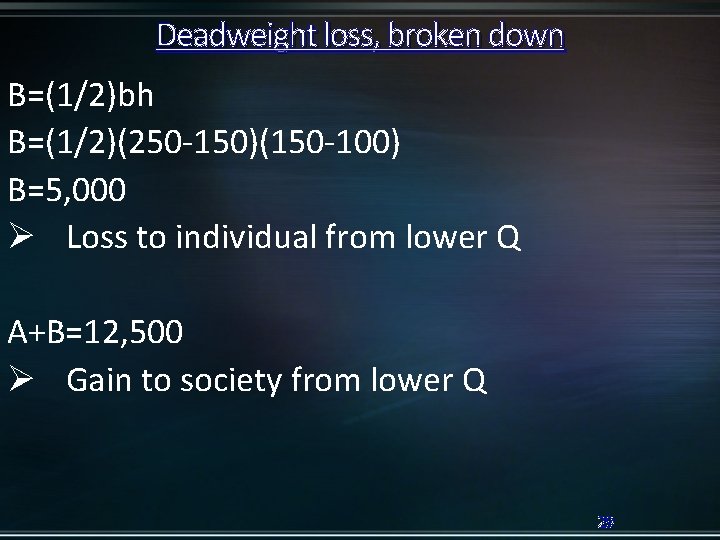
Benefit of reducing output If we were to move from our individual optimum to our social optimum: 1) Society would gain area A+B, (which is equal to area C). 2) The individual would lose profits or utility equal to area B 3) Therefore, assuming everyone is equal in society the net gain is area A 26
$ SMC=50+2 Q PMC=50+Q 350 200 150 A B MD=Q C 100 MB=350 -Q 150 Q Obviously, this graph is not to scale. 27
Deadweight loss A=(1/2)bh A=(1/2)(350 -200)(150 -100) A=7, 500 Ø Net benefit to society if production is reduced OR Ø Deadweight loss of extra production 28
Deadweight loss, broken down B=(1/2)bh B=(1/2)(250 -150)(150 -100) B=5, 000 Ø Loss to individual from lower Q A+B=12, 500 Ø Gain to society from lower Q 29
Theory - Real World Calculation Difficulties 1) Utility and demand are hard to measure, making MB hard to define 2) The Marginal External Cost (MEC) can be hard to identify, quantify, and value: a) What activities produce pollutants? b) Which pollutants do harm? c) What is the value of the damage done? 30
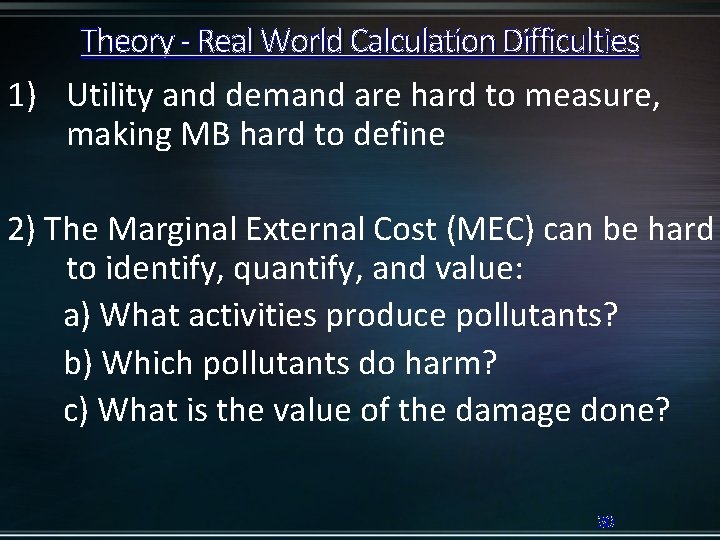
2 a) WHAT ACTIVITIES PRODUCE POLLUTANTS? Smog has been linked to many health concerns, and depends on factors such as production causing particulates and gases, temperature, and wind. -But these particulates and gases can travel large distances before causing smog -This makes smog production hard to pin down -Greenhouse gases have a greater transborder effect 31
2 b) WHICH POLLUTANTS DO HARM? -Scientists can’t do randomized studies on pollution (take 50 people and expose them to pollution and compare them to 50 kept away from pollution) -CORRELATION can be found, but CAUSATION is more difficult to prove -It is also possible that an outside variable is increasing both pollution and health problems -ie: Low income may lead to lower healthcare and lower removal of pollution 32
2 c) WHAT IS THE VALUE OF THE DAMAGE DONE? -Assume we have perfect scientific information, and the amount of damage can be accurately assessed -What is the value of that damage? -One could compare house prices in polluted and nonpolluted areas to estimate value -But what if people underestimate (or overestimate) the health impact? -Some effects may also be long-term 33
MEC Difficulty Conclusion: -Although the model is simple, the application is difficult -It requires biologists, engineers, ecologists, and doctors to work with economists -Long-term and transborder effects make this even more difficult -The economist’s tool of marginal analysis is essential in any policy, since zero pollution is never a possibility. 34
MEC Examples: 1) Assume a new student moves into dorms and plays loud, bad music (country rap), long into the night. The average GPA of the floor goes from a 3. 1 in Fall to a 2. 8 in Winter. What are the marginal external costs? 2) A new Styrofoam recycling plant opens up in Podunk (Population 200, 000). Cancer rates rise from 10% in 2000 to 15% in 2010. What are the marginal external costs? 35
Theory - Private Responses to Externalities Government regulation isn’t the only method to deal with externalities. Externalities can be dealt with through private individuals through: 1) The Coase Theorem (assigning property rights) 2) Mergers 3) Social Conventions 36
1) Assigning Property Rights One way to privately deal with externalities is for one party to be given OWNERSHIP or PROPERTY RIGHTS of the market the externality exists in. Let’s examine the case of internet bandwidth. We have 2 people sharing the internet, one for downloading movies (Mark), another for everyday use (Evan). As we see on the following graph, Mark’s downloading causes Marginal Damage to Evan: 37
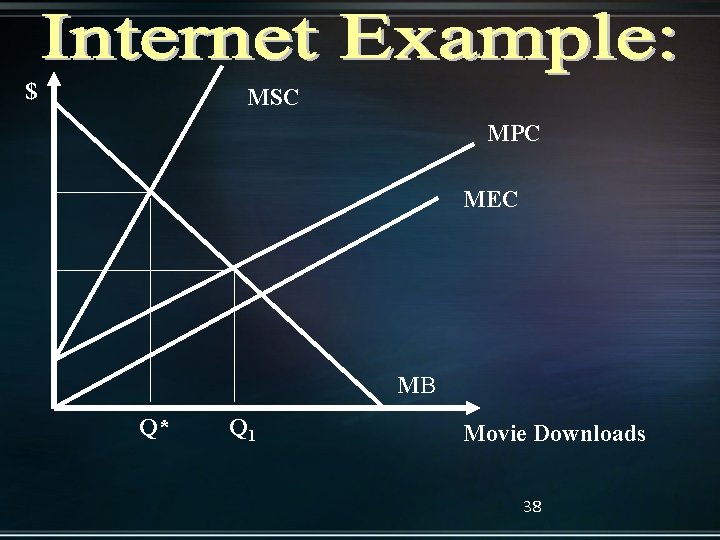
$ MSC MPC MEC MB Q* Q 1 Movie Downloads 38
OPTION 1: “Pollutor Given Rights” Assume that Mark is given property rights over bandwidth. -Mark consumes up to Q 1 because his MB>MPC up to that point -He’d be willing to give up marginal consumption if Payment>(MB-MPC) -Evan is willing to pay up to his MEC -Since between Q 1 and Q*, MEC>MB-MPC, room for negotiating exists: 39
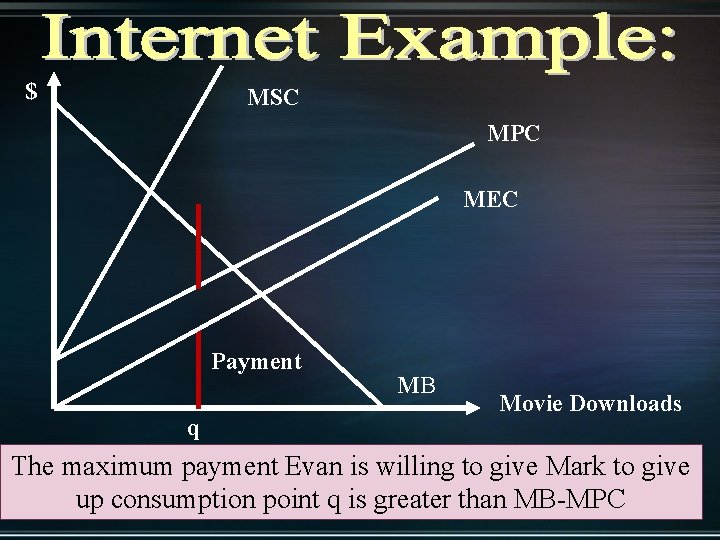
$ MSC MPC MEC Payment q MB Movie Downloads The maximum payment Evan is willing to give Mark to give up consumption point q is greater than MB-MPC 40
Option 2 – “Non-Polluter” Given Rights Assume that Evan is given property rights over bandwidth: -Consumption starts at zero -Evan is willing to allow downloading if the payment he receives is greater than MEC (which starts at zero) -Mark is willing to pay to download if the payment is less than his MB-MPC -To the left of Q 1, this is the case: 41
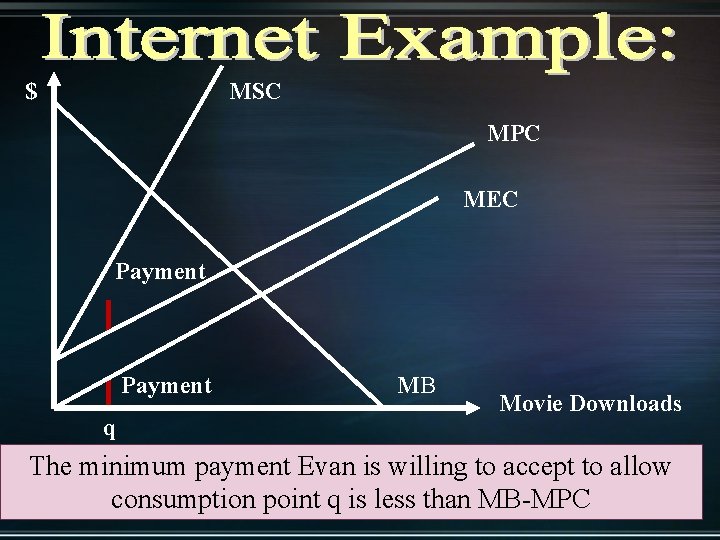
$ MSC MPC MEC Payment q MB Movie Downloads The minimum payment Evan is willing to accept to allow consumption point q is less than MB-MPC 42
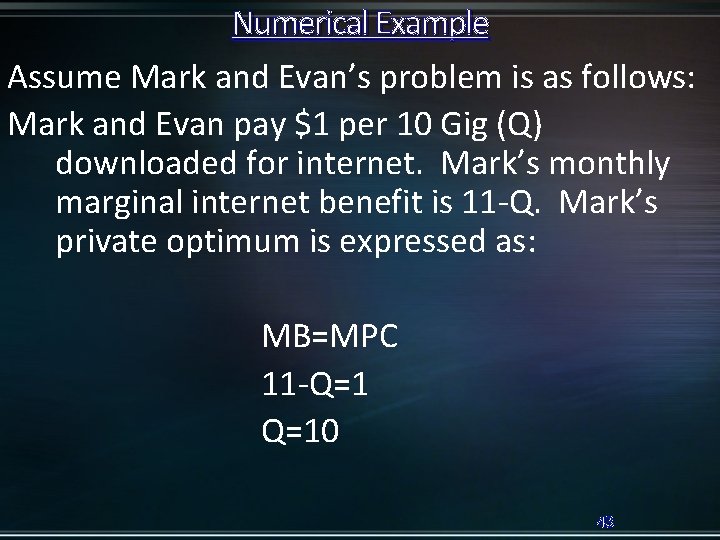
Numerical Example Assume Mark and Evan’s problem is as follows: Mark and Evan pay $1 per 10 Gig (Q) downloaded for internet. Mark’s monthly marginal internet benefit is 11 -Q. Mark’s private optimum is expressed as: MB=MPC 11 -Q=1 Q=10 43
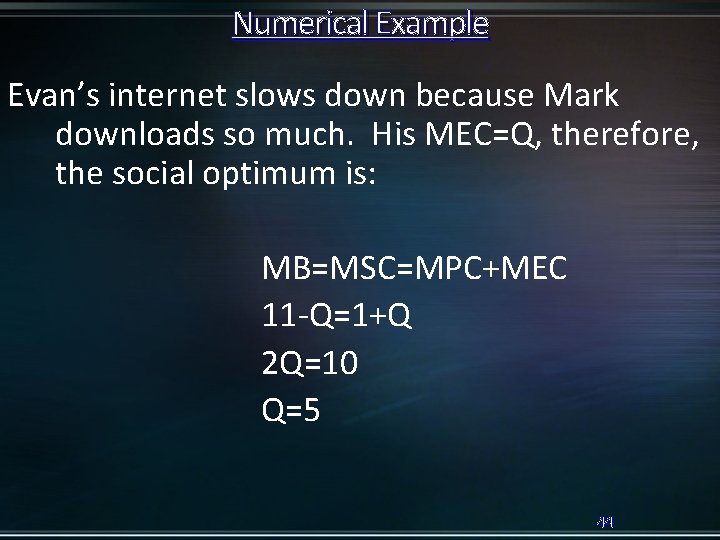
Numerical Example Evan’s internet slows down because Mark downloads so much. His MEC=Q, therefore, the social optimum is: MB=MSC=MPC+MEC 11 -Q=1+Q 2 Q=10 Q=5 44
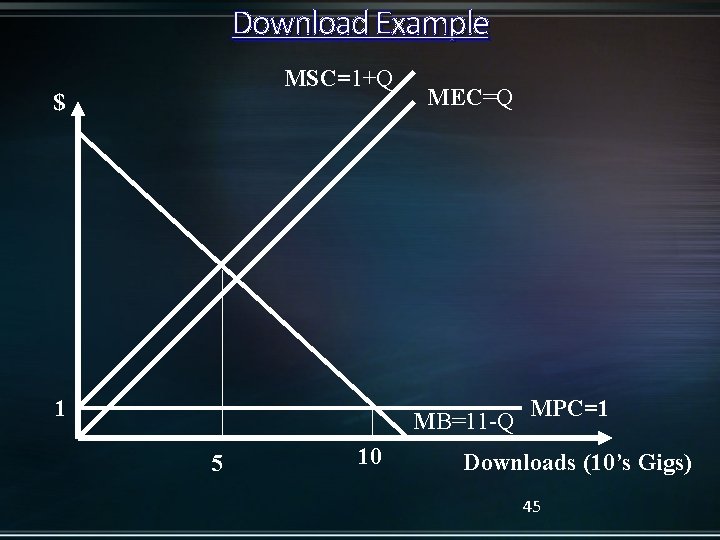
Download Example MSC=1+Q $ 1 MEC=Q MB=11 -Q 5 10 MPC=1 Downloads (10’s Gigs) 45
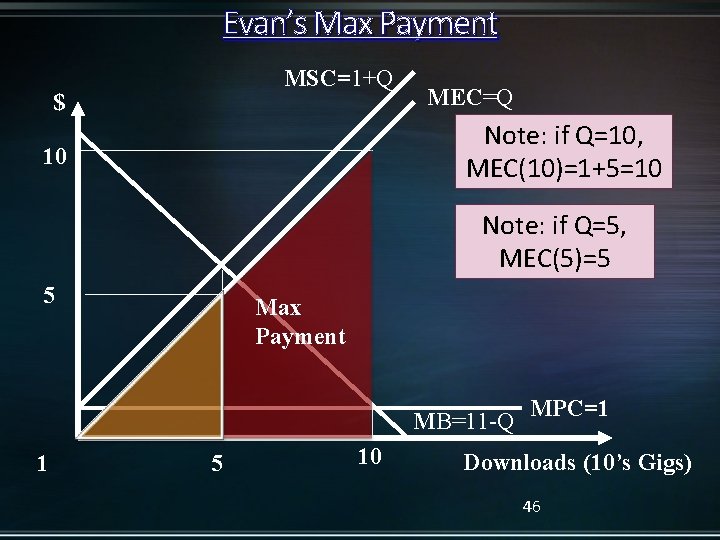
Evan’s Max Payment MSC=1+Q $ MEC=Q Note: if Q=10, MEC(10)=1+5=10 10 Note: if Q=5, MEC(5)=5 5 Max Payment MB=11 -Q 1 5 10 MPC=1 Downloads (10’s Gigs) 46
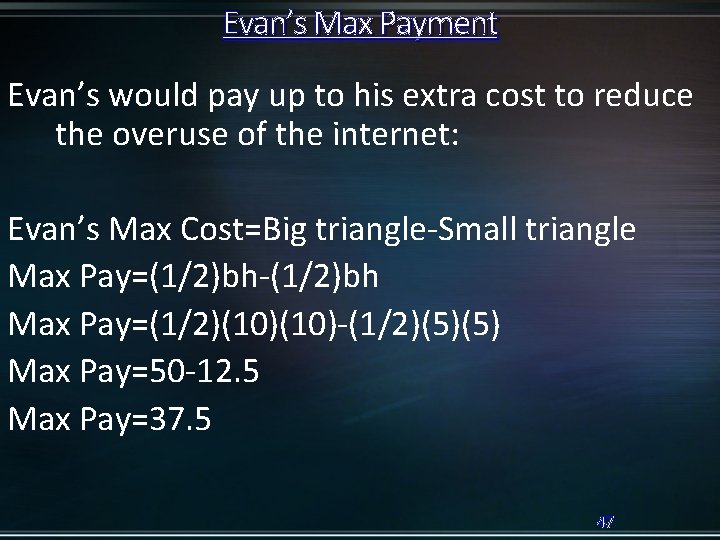
Evan’s Max Payment Evan’s would pay up to his extra cost to reduce the overuse of the internet: Evan’s Max Cost=Big triangle-Small triangle Max Pay=(1/2)bh-(1/2)bh Max Pay=(1/2)(10)-(1/2)(5)(5) Max Pay=50 -12. 5 Max Pay=37. 5 47
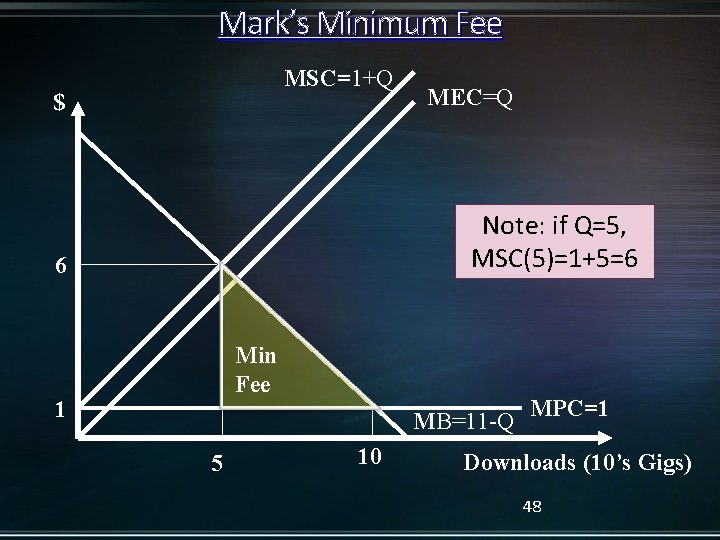
Mark’s Minimum Fee MSC=1+Q $ MEC=Q Note: if Q=5, MSC(5)=1+5=6 6 Min Fee 1 MB=11 -Q 5 10 MPC=1 Downloads (10’s Gigs) 48
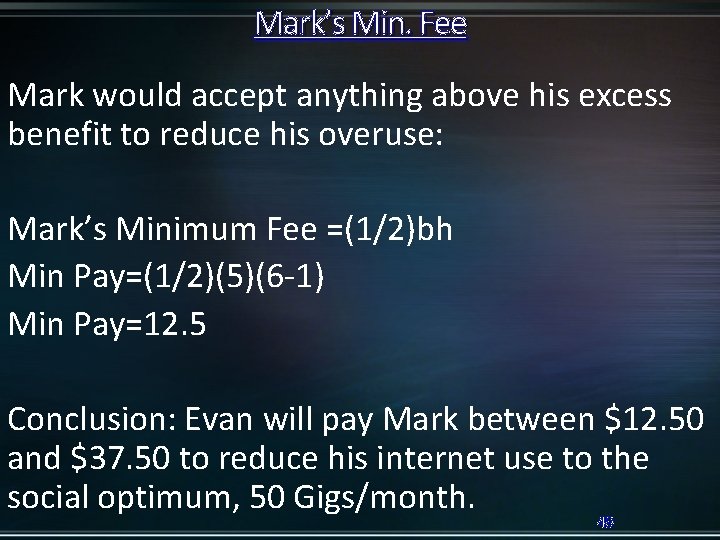
Mark’s Min. Fee Mark would accept anything above his excess benefit to reduce his overuse: Mark’s Minimum Fee =(1/2)bh Min Pay=(1/2)(5)(6 -1) Min Pay=12. 5 Conclusion: Evan will pay Mark between $12. 50 and $37. 50 to reduce his internet use to the social optimum, 50 Gigs/month. 49
Private Responses to Externalities For the above analysis to work: 1) Bargaining costs must be low 2) Resource owners must be able to identify damages to their property and legally prevent them (ie: Evan cutting off Mark’s internet) Note that since for most production points the willingness to pay > willingness to accept, the actual payments are a function of bargaining ability. 50
Theory - The Coase Theorem WHO receives property rights affects income distribution, but not outcome – production moves to Q*, where MB=MSC THE COASE THEOREM implies that once property rights are established, no government intervention is required to deal with externalities. (Coase 1960) 51
Of Coase There’s Problems The Coase Theorem works best in cases where few parties are involved and the sources of externalities are well-defined. -Often many people are involved (ie: air polution) -Often the externalities are poorly defined (ie: air pollution, noise pollution, etc) -Coasian assignment of property rights has been successful both in waterways of England Scotland elephant herds of Zimbabwe 52
2) Private Response: Merger One way to “internalize” an externality is to combine involved parties. For example, if one firm’s actions caused an externality to another, the two firms could merge (through buyout or a 3 rd party) -IE: Bookstore buys out the Discotheque next door (externality = noise) -The new, superfirm would then take their externality into account and move to Q* -Since everything happens within one firm, one could argue it is no longer an externality 53
3) Private Response: Social Conventions Social conventions and moral precepts encourage people to take Marginal External Cost into account: -you should recycle, if you don’t you’re a horrible person -you should respect others, and not litter or be noisy -you shouldn’t bud in line, as it is rude and affects everyone else behind you 54
3) Private Response: Social Conventions The Golden Rule: “Do unto others as you would have them do unto you” can be turned into economic terms as: “Always consider the external marginal benefits and marginal costs of an action” -social conventions and moral precepts work to move MPC closer to MSC 55
- Slides: 55