
Chapter 17 Electrochemistry o o Redox review 4



- Slides: 29
Chapter 17 Electrochemistry o o Redox review (4. 9) 17. 1 -17. 2 17. 4 -17. 5 17. 6 -17. 7
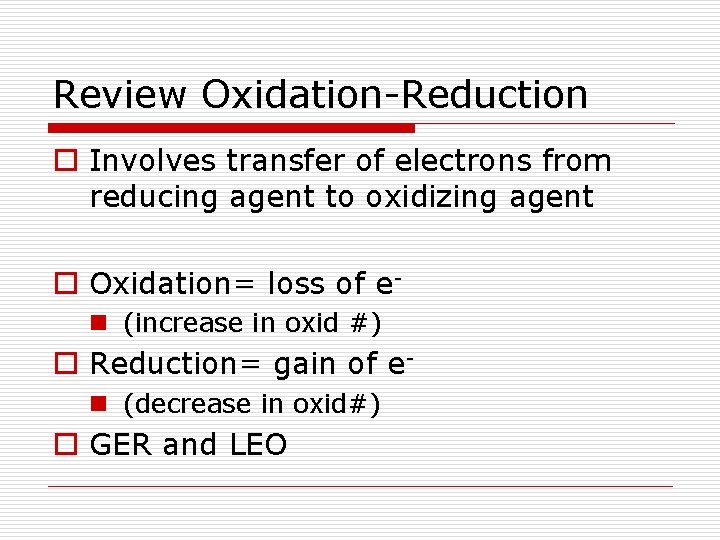
Review Oxidation-Reduction o Involves transfer of electrons from reducing agent to oxidizing agent o Oxidation= loss of en (increase in oxid #) o Reduction= gain of en (decrease in oxid#) o GER and LEO
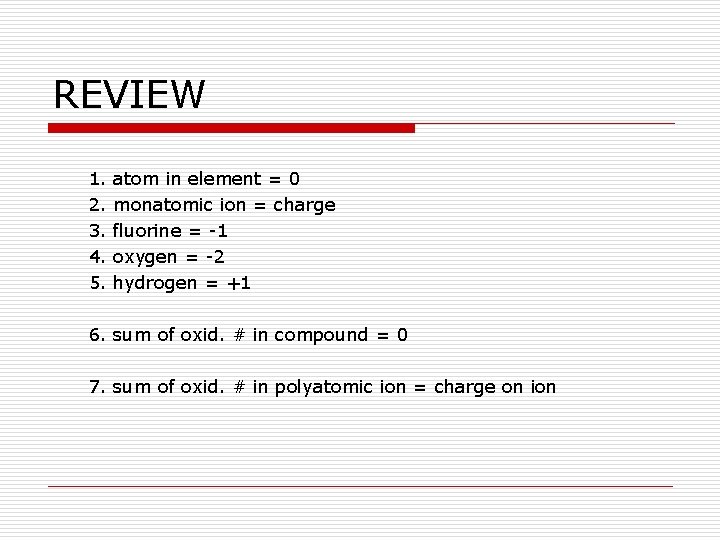
REVIEW 1. 2. 3. 4. 5. atom in element = 0 monatomic ion = charge fluorine = -1 oxygen = -2 hydrogen = +1 6. sum of oxid. # in compound = 0 7. sum of oxid. # in polyatomic ion = charge on ion
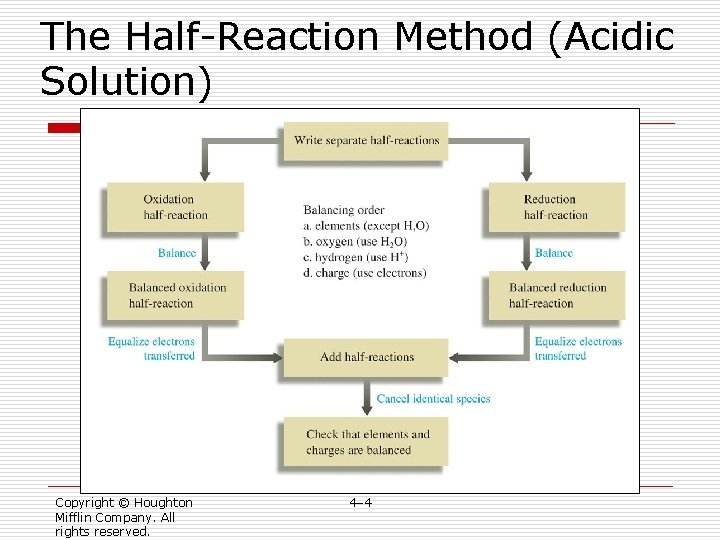
The Half-Reaction Method (Acidic Solution) Copyright © Houghton Mifflin Company. All rights reserved. 4– 4
Review- Balancing Oxidation. Reduction Reactions 1. Separate in ½ reactions 2. Intermediate steps a. balance all elements other than H and O b. balance O with H 2 O c. balance H with H+ d. balance charge with (e-) 3. Multiply ½ rxn. so that the number of electrons is same 4. Add ½ rxns.
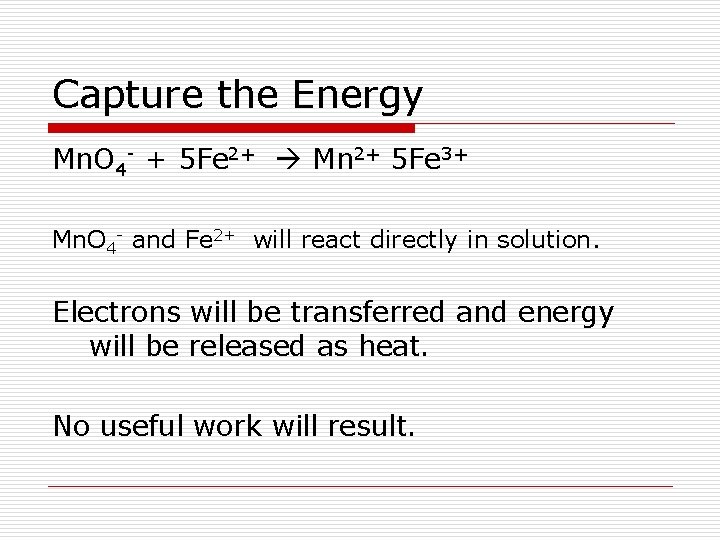
Capture the Energy Mn. O 4 - + 5 Fe 2+ Mn 2+ 5 Fe 3+ Mn. O 4 - and Fe 2+ will react directly in solution. Electrons will be transferred and energy will be released as heat. No useful work will result.
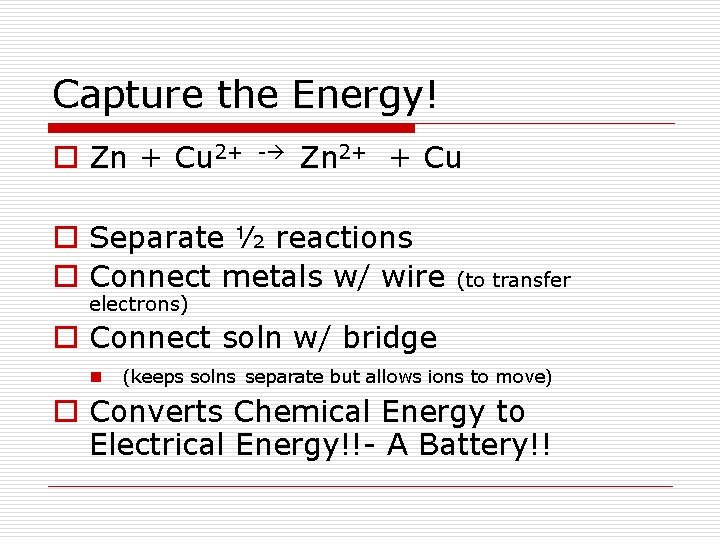
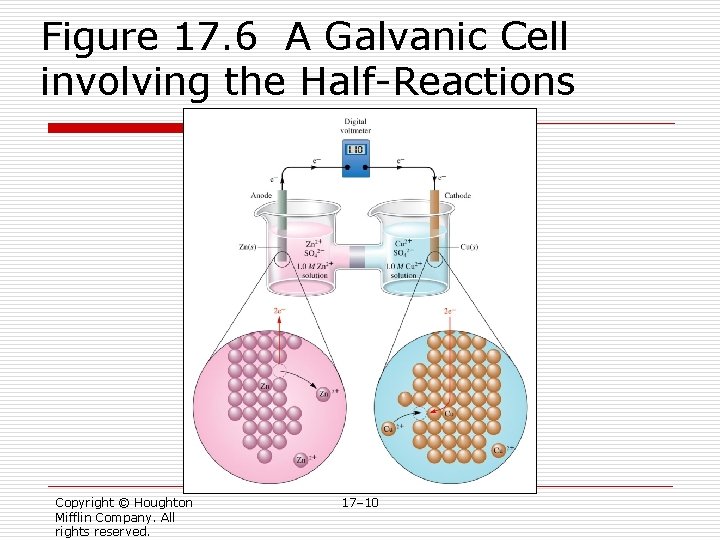
Capture the Energy! o Zn + Cu 2+ - Zn 2+ + Cu o Separate ½ reactions o Connect metals w/ wire electrons) (to transfer o Connect soln w/ bridge n (keeps solns separate but allows ions to move) o Converts Chemical Energy to Electrical Energy!!- A Battery!!
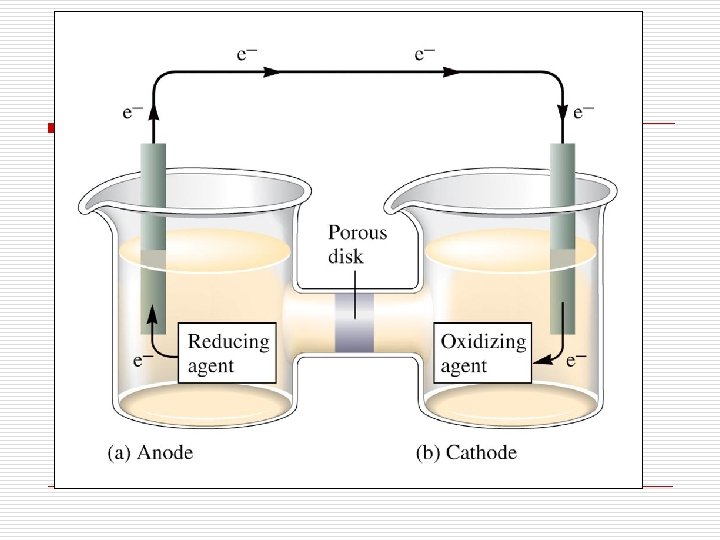
Galvanic Cell
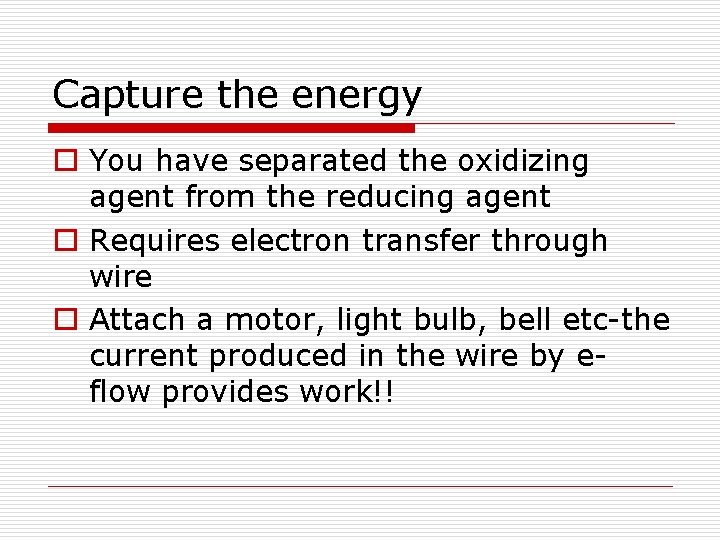
Capture the energy o You have separated the oxidizing agent from the reducing agent o Requires electron transfer through wire o Attach a motor, light bulb, bell etc-the current produced in the wire by eflow provides work!!
Figure 17. 6 A Galvanic Cell involving the Half-Reactions Copyright © Houghton Mifflin Company. All rights reserved. 17– 10
Cell potential is…. . o The pressure of a Galvanic cell to “push” the e- “driving force” o Electromotive Force, emf o Symbol E o Units: Joule/coulomb (=1 Volt, V) o Coulomb = unit of charge n Specifies # of e-
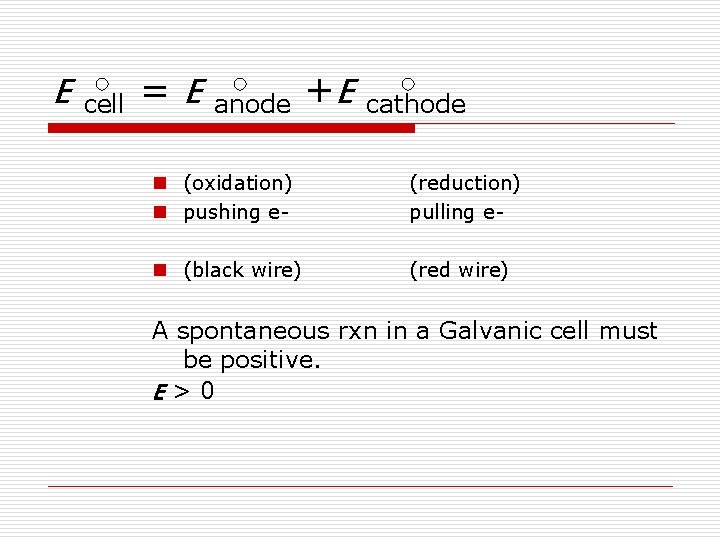
E cell =E anode +E cathode n (oxidation) n pushing e- (reduction) pulling e- n (black wire) (red wire) A spontaneous rxn in a Galvanic cell must be positive. E>0
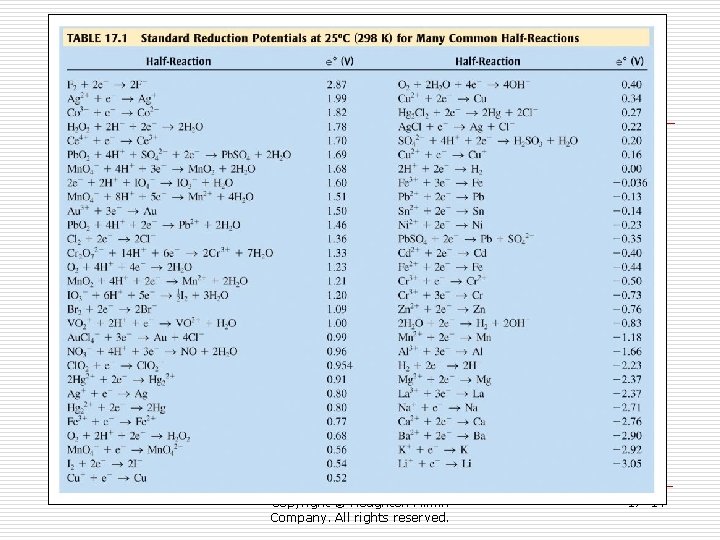
E 1/2 reactions o P. 796 table o Standard Reduction potentials o 1 M solutions o 1 atm gases o 25 C o Hydrogen ½ rxn = 0. 00 V
Table 17. 1 Standard Reduction Potentials at 25°C (298 K) for Many Common Half-Reactions Copyright © Houghton Mifflin Company. All rights reserved. 17– 14
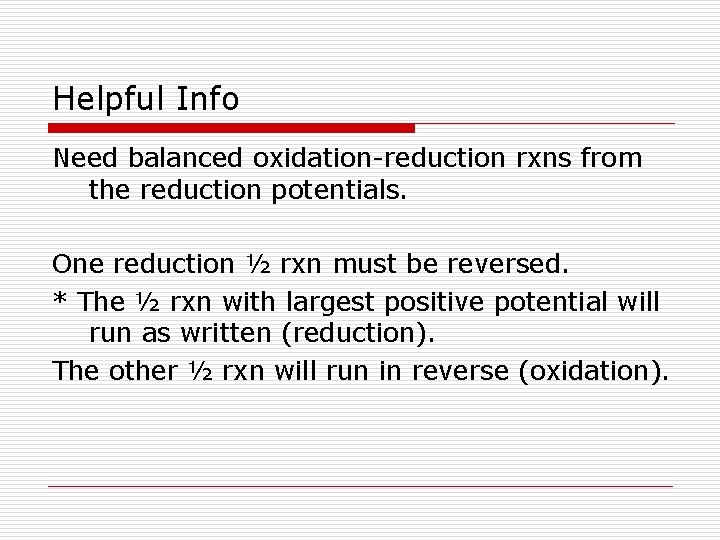
Helpful Info Need balanced oxidation-reduction rxns from the reduction potentials. One reduction ½ rxn must be reversed. * The ½ rxn with largest positive potential will run as written (reduction). The other ½ rxn will run in reverse (oxidation).
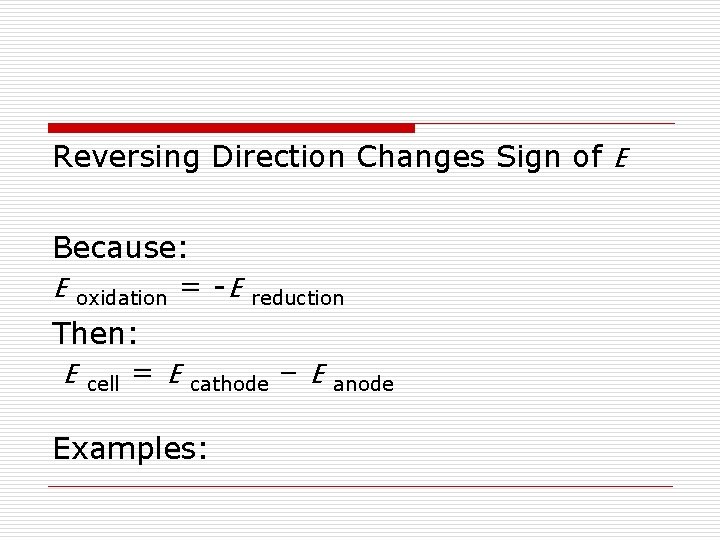
Reversing Direction Changes Sign of E Because: E oxidation = -E Then: E cell = E reduction cathode Examples: –E anode
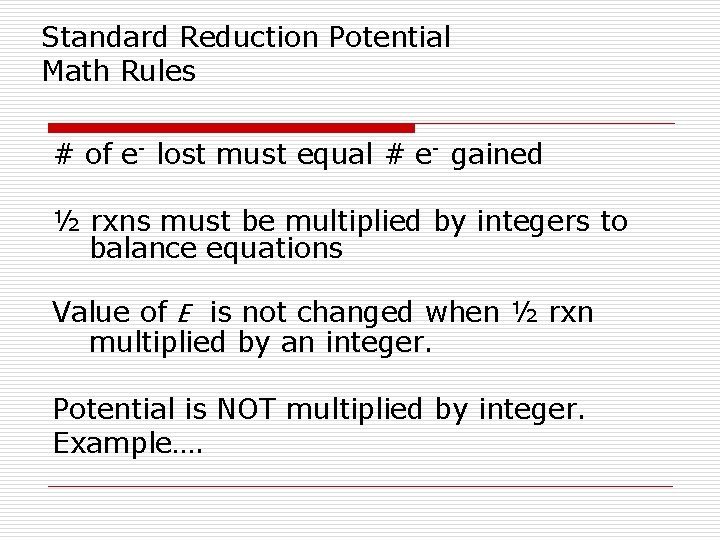
Standard Reduction Potential Math Rules # of e- lost must equal # e- gained ½ rxns must be multiplied by integers to balance equations Value of E is not changed when ½ rxn multiplied by an integer. Potential is NOT multiplied by integer. Example….
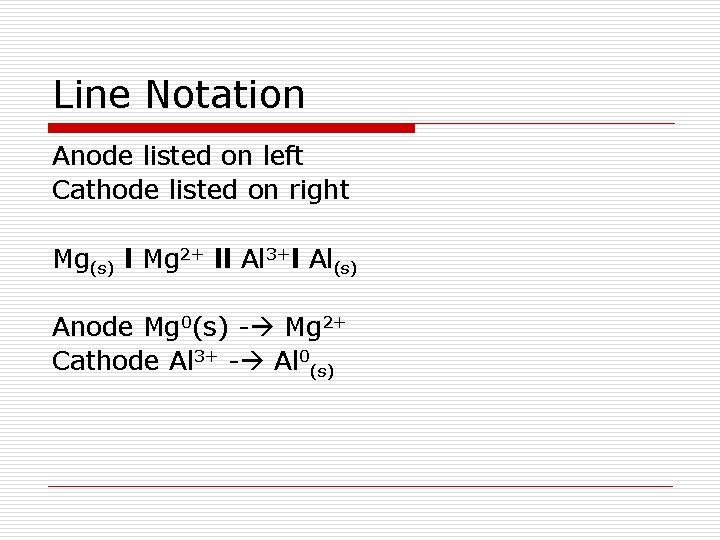
Line Notation Anode listed on left Cathode listed on right Mg(s) l Mg 2+ ll Al 3+l Al(s) Anode Mg 0(s) - Mg 2+ Cathode Al 3+ - Al 0(s)
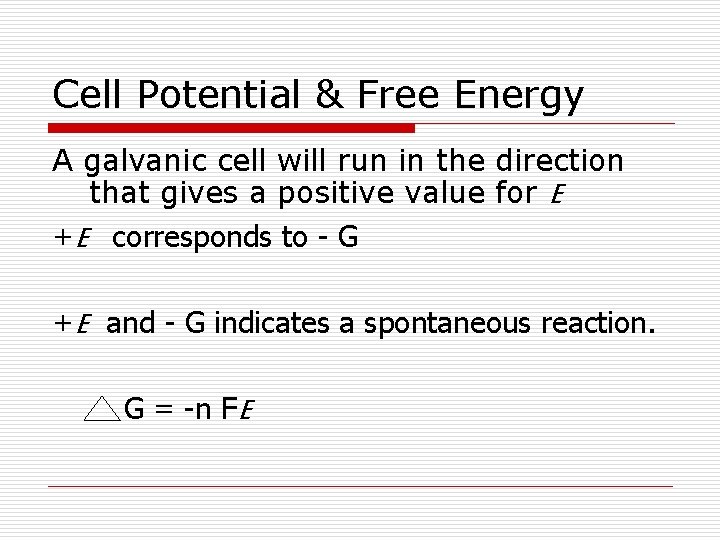
Cell Potential & Free Energy A galvanic cell will run in the direction that gives a positive value for E +E corresponds to - G +E and - G indicates a spontaneous reaction. G = -n FE
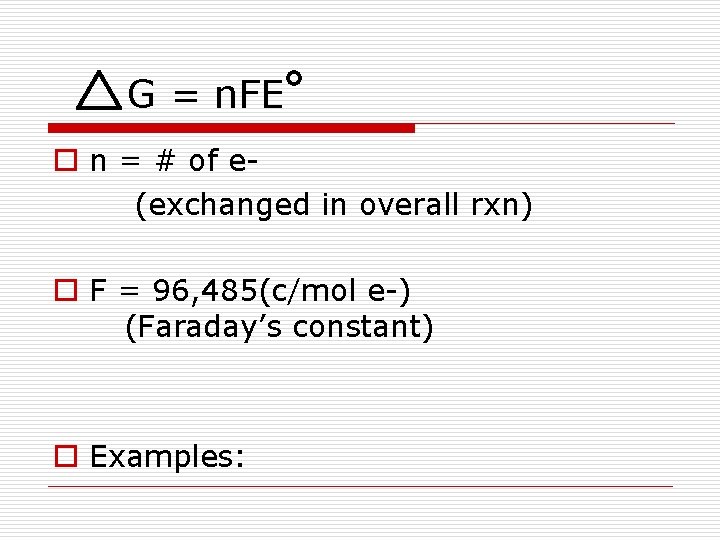
G = n. FE o n = # of e(exchanged in overall rxn) o F = 96, 485(c/mol e-) (Faraday’s constant) o Examples:
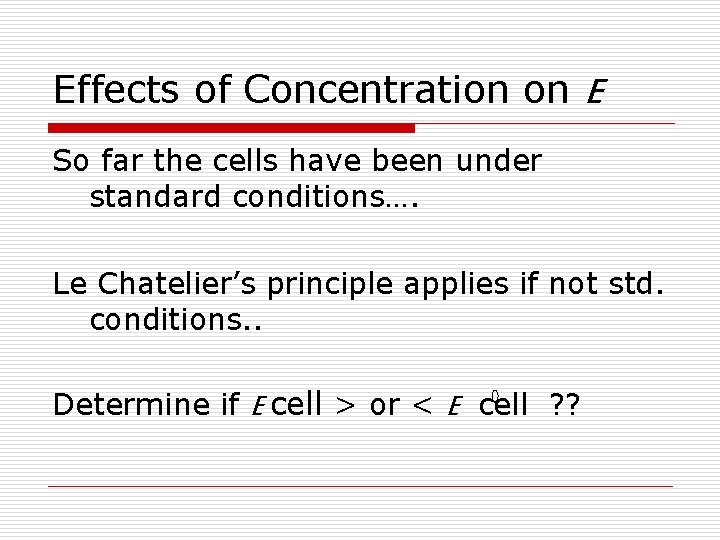
Effects of Concentration on E So far the cells have been under standard conditions…. Le Chatelier’s principle applies if not std. conditions. . Determine if E cell > or < E cell ? ?
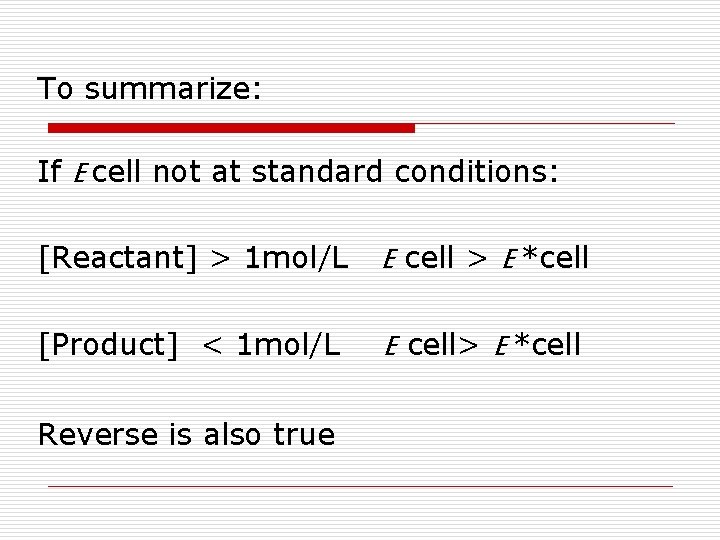
To summarize: If E cell not at standard conditions: [Reactant] > 1 mol/L E cell > E *cell [Product] < 1 mol/L E cell> E *cell Reverse is also true
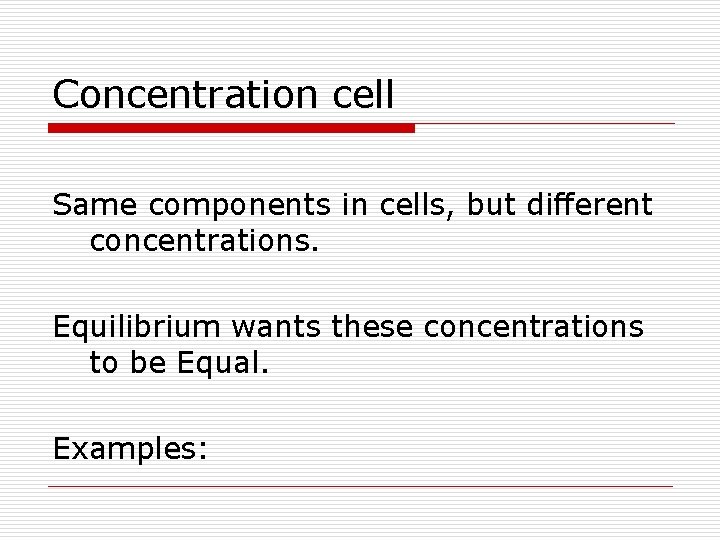
Concentration cell Same components in cells, but different concentrations. Equilibrium wants these concentrations to be Equal. Examples:
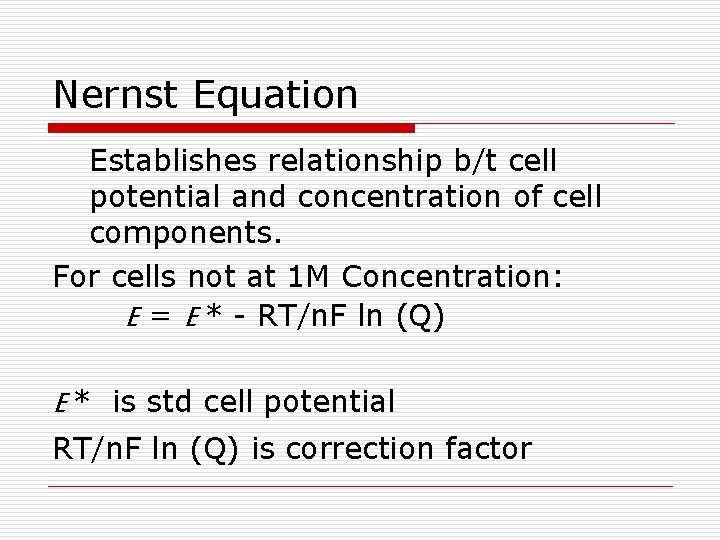
Nernst Equation Establishes relationship b/t cell potential and concentration of cell components. For cells not at 1 M Concentration: E = E * - RT/n. F ln (Q) E * is std cell potential RT/n. F ln (Q) is correction factor
Common form: o E = E * - RT/n. F ln (Q) Commonly written : o E = E * - 0. 0591/n log (Q) o Examples:
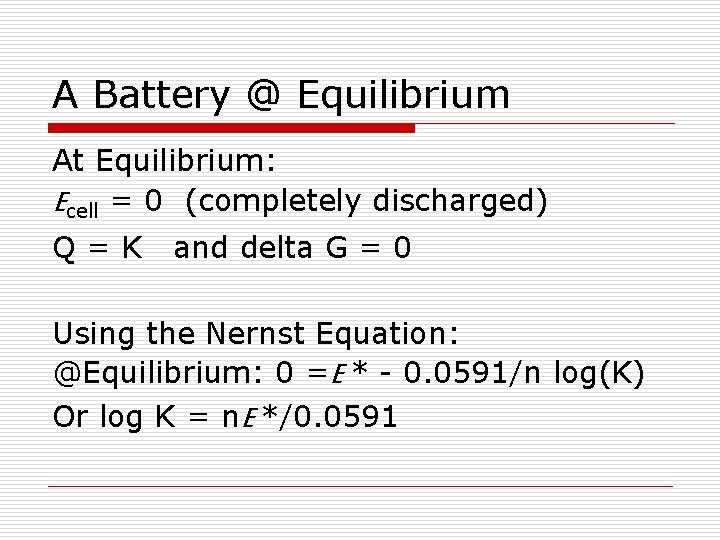
A Battery @ Equilibrium At Equilibrium: Ecell = 0 (completely discharged) Q=K and delta G = 0 Using the Nernst Equation: @Equilibrium: 0 =E * - 0. 0591/n log(K) Or log K = n. E */0. 0591
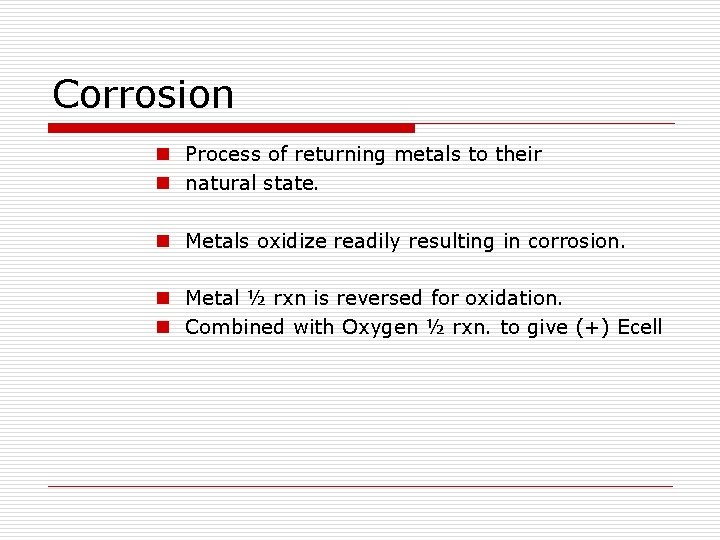
Corrosion n Process of returning metals to their n natural state. n Metals oxidize readily resulting in corrosion. n Metal ½ rxn is reversed for oxidation. n Combined with Oxygen ½ rxn. to give (+) Ecell
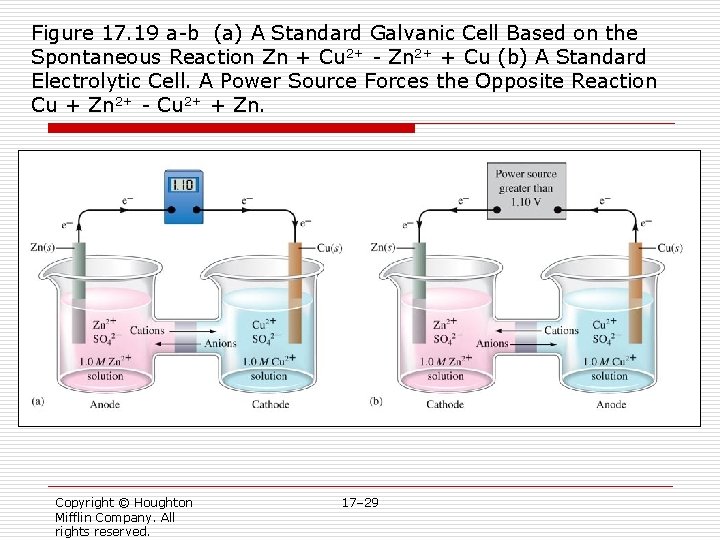
Electrolysis o Involves forcing current through a cell to produce a chemical change resulting in (-) cell potential. o Example:
Figure 17. 19 a-b (a) A Standard Galvanic Cell Based on the Spontaneous Reaction Zn + Cu 2+ - Zn 2+ + Cu (b) A Standard Electrolytic Cell. A Power Source Forces the Opposite Reaction Cu + Zn 2+ - Cu 2+ + Zn. Copyright © Houghton Mifflin Company. All rights reserved. 17– 29