
Chapter 17 Domain Name System Kyung Hee University
- Slides: 42
Chapter 17 Domain Name System Kyung Hee University 1
Introduction q Mapping a name to an address or address to a name q When the Internet was small, information for mapping is stored in host file The host file would be too large to store in every host One solution is to store the entire host file in a single computer Another solution is to divide the information into smaller parts and storing each part on a different computer Kyung Hee University l The host that needs mapping can contact the closest computer l This method is used by the Domain Name System 2
17. 1 Name Space q The names should be unique because the addresses are unique. q Name space that maps each address to a unique name can be organized in two ways : Flat Name Space l l l Name is assigned to an address A name in space is a sequence of characters without structure The names may or may not have a common section Hierarchical Name Space l l l Kyung Hee University The first part : the nature of the organization The second part : the name of organization The third part : departments of the organization 3
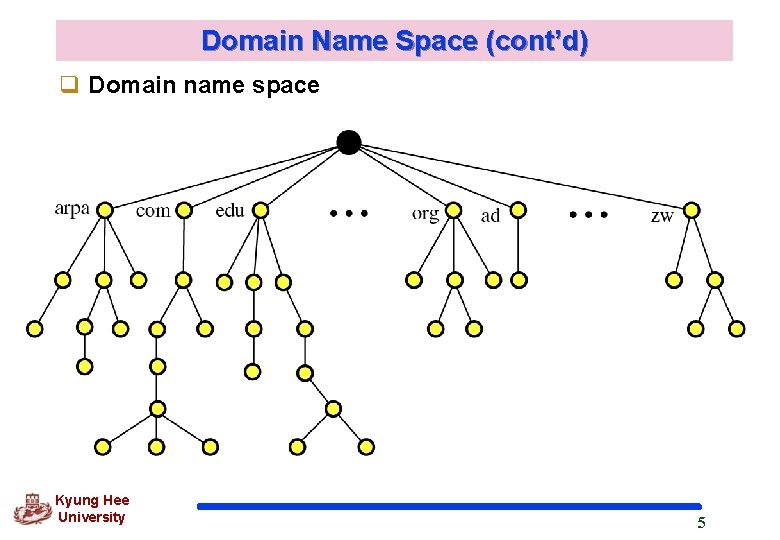
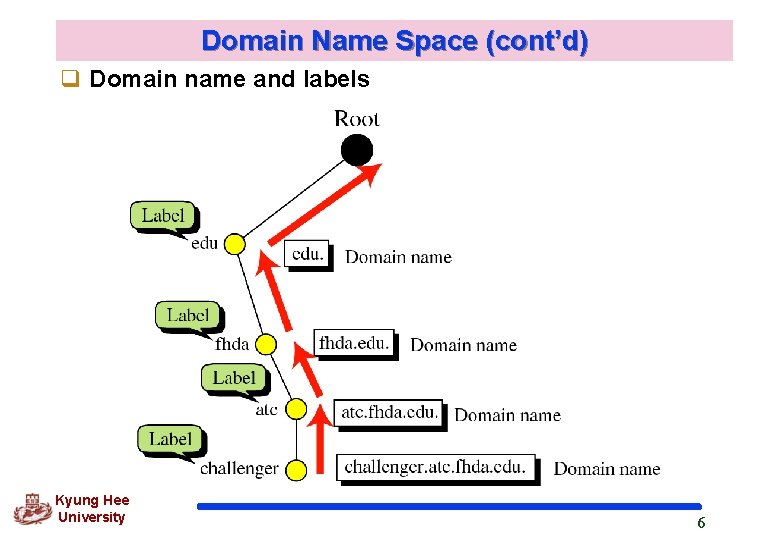
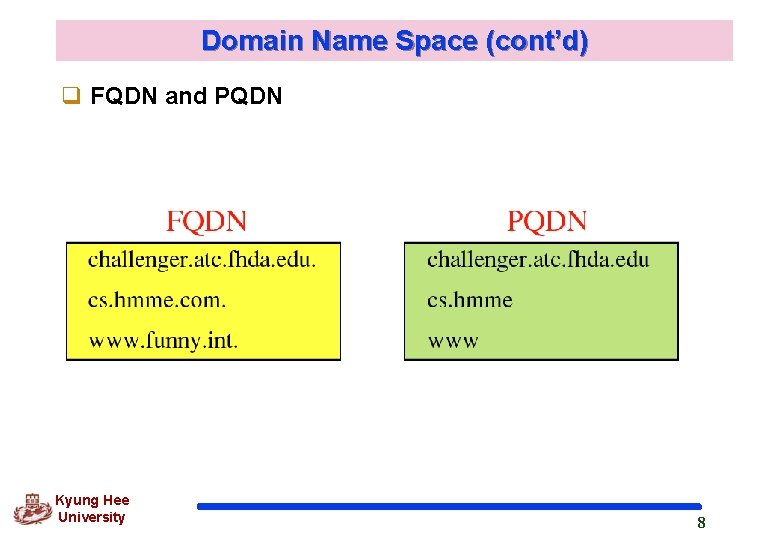
17. 2 Domain Name Space q The tree can have only 128 levels: level 0 (root) to level 127 q. Label Each node in the tree has a label, which is a string with a maximum of 63 characters. q Domain name A full domain name is a sequence of labels separated by dots (. ) q Fully Qualified Domain Name (FQDN) A label that is terminated by a null string l Kyung Hee University challenger. stc. fhda. edu. 4
Domain Name Space (cont’d) q Domain name space Kyung Hee University 5
Domain Name Space (cont’d) q Domain name and labels Kyung Hee University 6
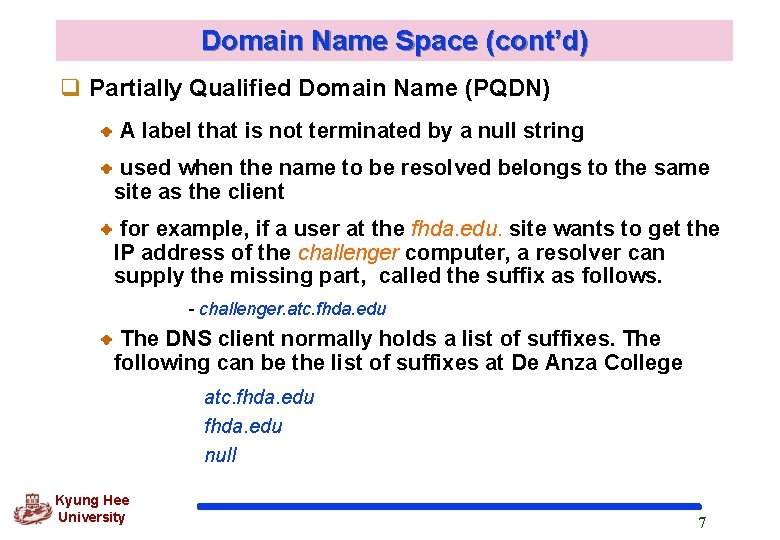
Domain Name Space (cont’d) q Partially Qualified Domain Name (PQDN) A label that is not terminated by a null string used when the name to be resolved belongs to the same site as the client for example, if a user at the fhda. edu. site wants to get the IP address of the challenger computer, a resolver can supply the missing part, called the suffix as follows. - challenger. atc. fhda. edu The DNS client normally holds a list of suffixes. The following can be the list of suffixes at De Anza College atc. fhda. edu null Kyung Hee University 7
Domain Name Space (cont’d) q FQDN and PQDN Kyung Hee University 8
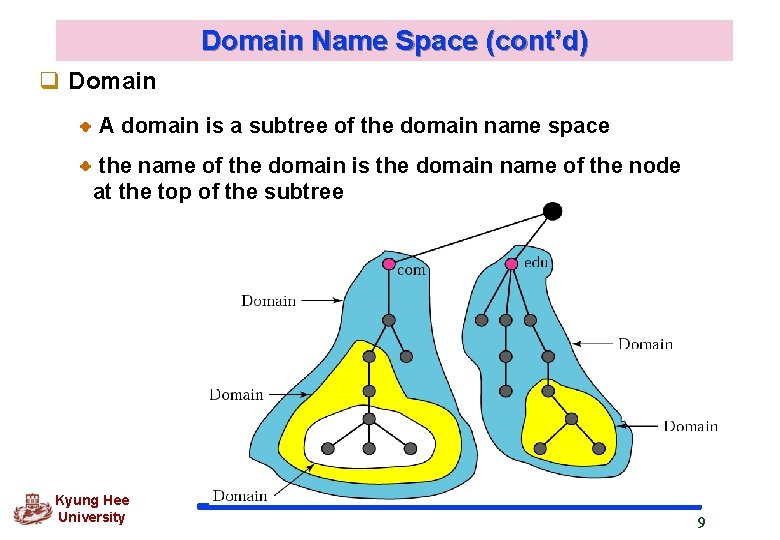
Domain Name Space (cont’d) q Domain A domain is a subtree of the domain name space the name of the domain is the domain name of the node at the top of the subtree Kyung Hee University 9
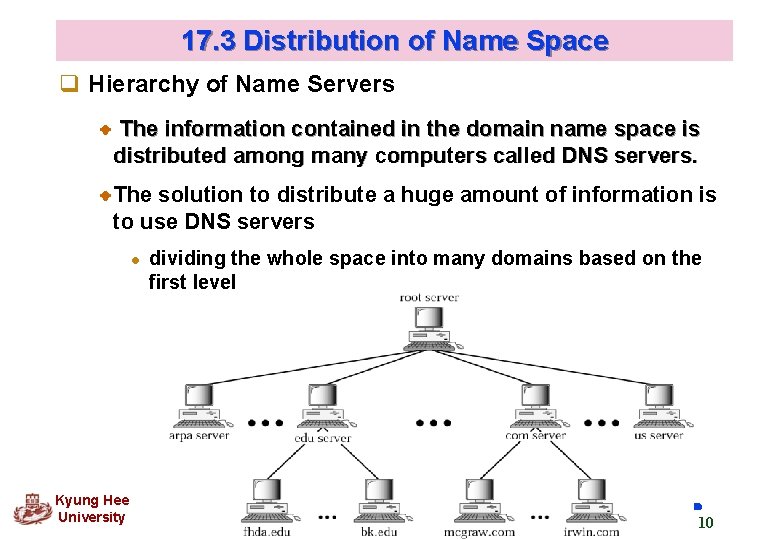
17. 3 Distribution of Name Space q Hierarchy of Name Servers The information contained in the domain name space is distributed among many computers called DNS servers. The solution to distribute a huge amount of information is to use DNS servers l Kyung Hee University dividing the whole space into many domains based on the first level 10
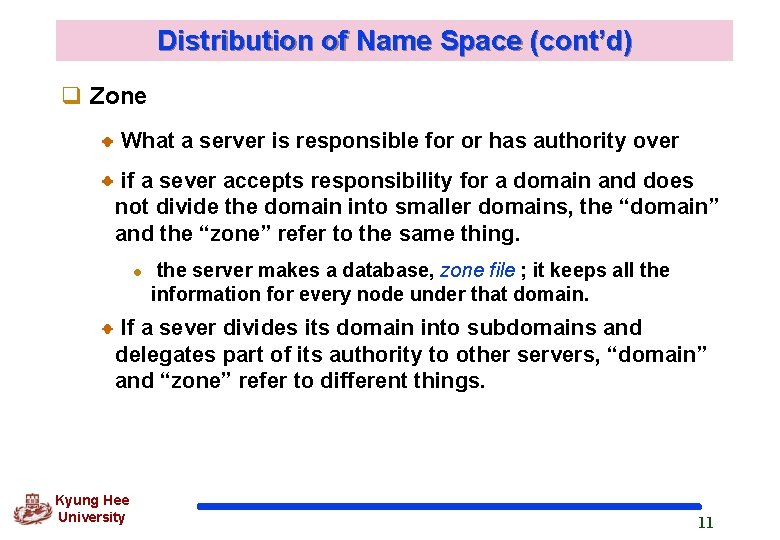
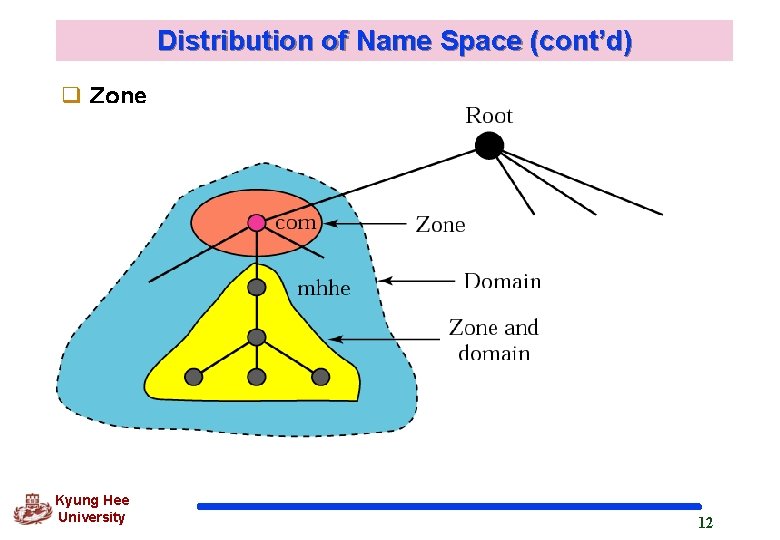
Distribution of Name Space (cont’d) q Zone What a server is responsible for or has authority over if a sever accepts responsibility for a domain and does not divide the domain into smaller domains, the “domain” and the “zone” refer to the same thing. l the server makes a database, zone file ; it keeps all the information for every node under that domain. If a sever divides its domain into subdomains and delegates part of its authority to other servers, “domain” and “zone” refer to different things. Kyung Hee University 11
Distribution of Name Space (cont’d) q Zone Kyung Hee University 12
Distribution of Name Space (cont’d) q. A primary server loads all information from the disk file; the secondary server loads all information from the primary server. When the secondary downloads information from the primary, it is called zone transfer. Kyung Hee University 13
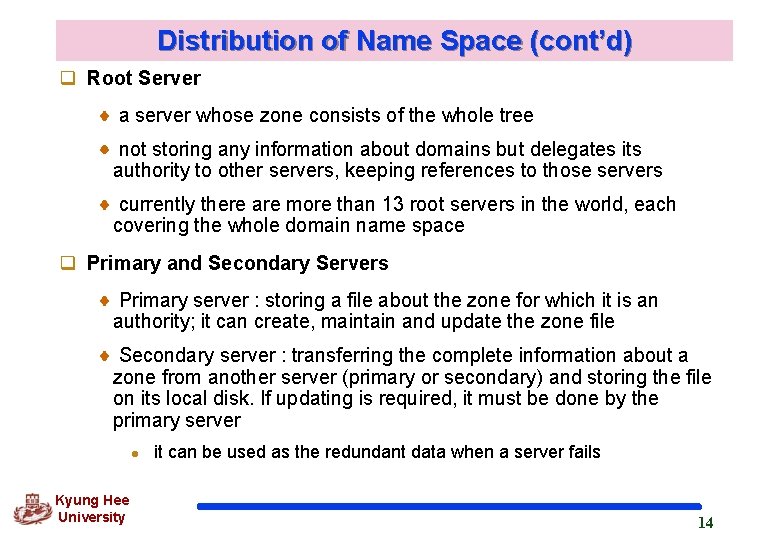
Distribution of Name Space (cont’d) q Root Server a server whose zone consists of the whole tree not storing any information about domains but delegates its authority to other servers, keeping references to those servers currently there are more than 13 root servers in the world, each covering the whole domain name space q Primary and Secondary Servers Primary server : storing a file about the zone for which it is an authority; it can create, maintain and update the zone file Secondary server : transferring the complete information about a zone from another server (primary or secondary) and storing the file on its local disk. If updating is required, it must be done by the primary server l Kyung Hee University it can be used as the redundant data when a server fails 14
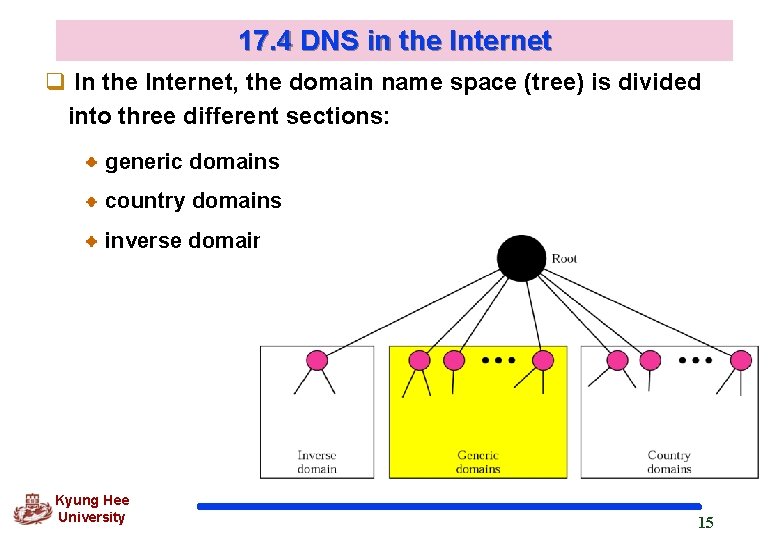
17. 4 DNS in the Internet q In the Internet, the domain name space (tree) is divided into three different sections: generic domains country domains inverse domain Kyung Hee University 15
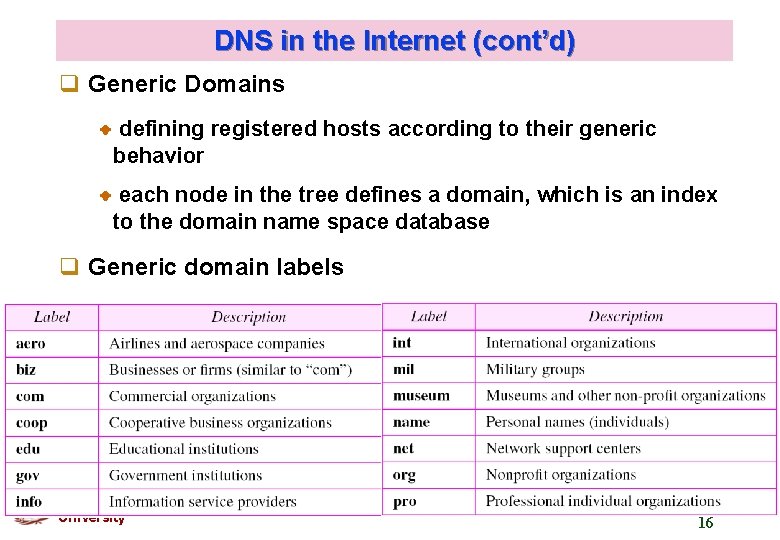
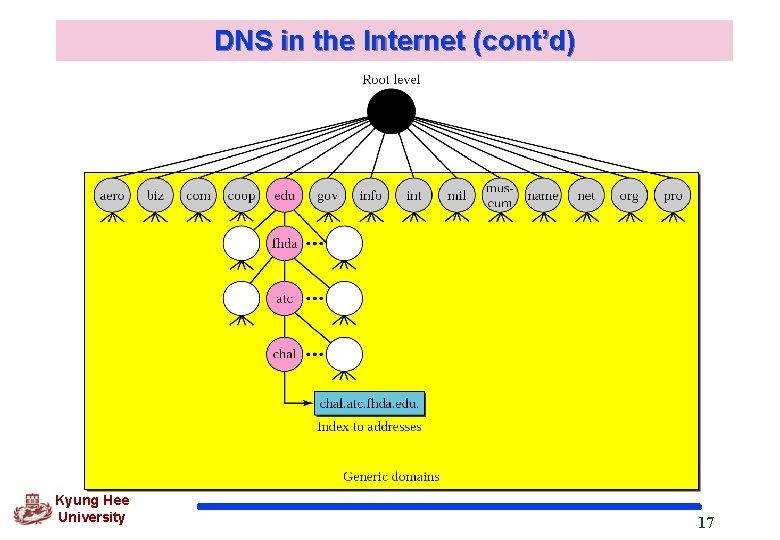
DNS in the Internet (cont’d) q Generic Domains defining registered hosts according to their generic behavior each node in the tree defines a domain, which is an index to the domain name space database q Generic domain labels Kyung Hee University 16
DNS in the Internet (cont’d) Kyung Hee University 17
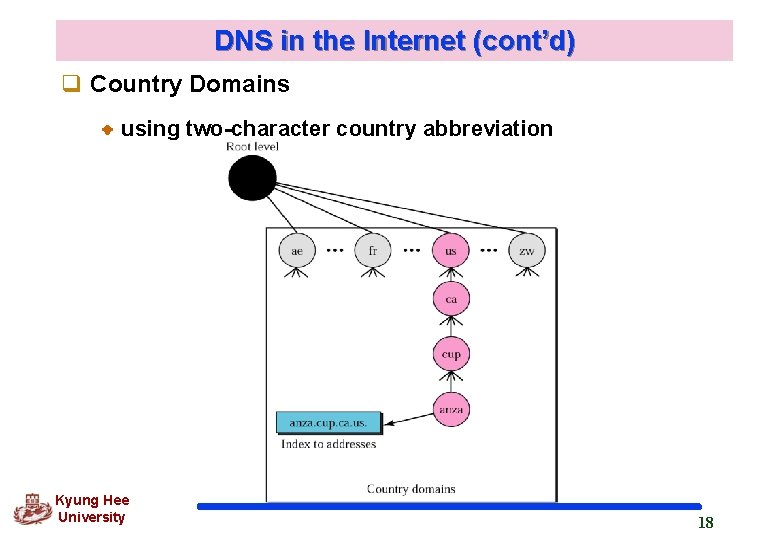
DNS in the Internet (cont’d) q Country Domains using two-character country abbreviation Kyung Hee University 18
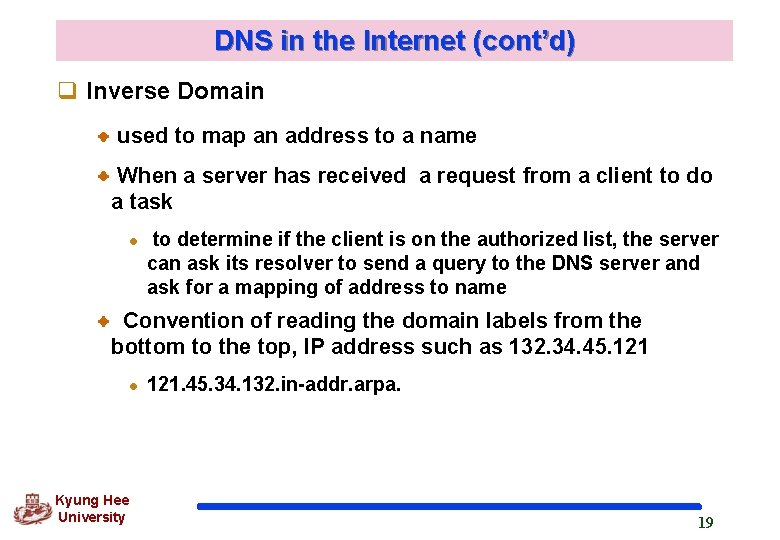
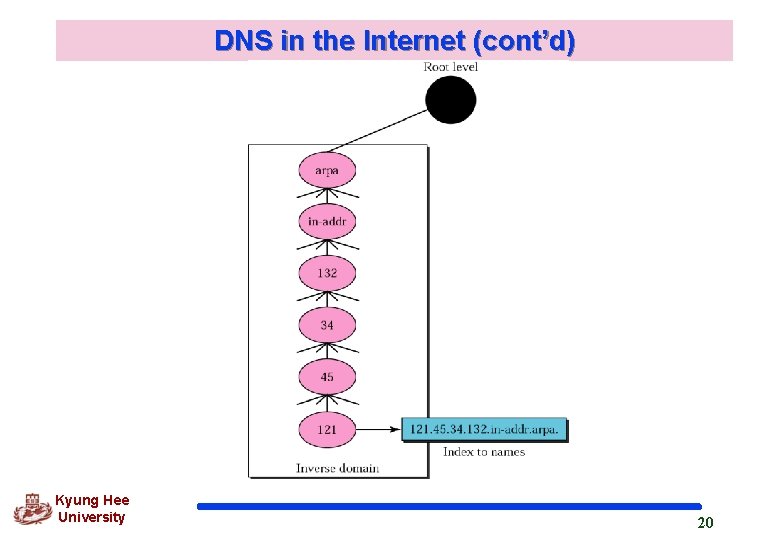
DNS in the Internet (cont’d) q Inverse Domain used to map an address to a name When a server has received a request from a client to do a task l to determine if the client is on the authorized list, the server can ask its resolver to send a query to the DNS server and ask for a mapping of address to name Convention of reading the domain labels from the bottom to the top, IP address such as 132. 34. 45. 121 l Kyung Hee University 121. 45. 34. 132. in-addr. arpa. 19
DNS in the Internet (cont’d) Kyung Hee University 20
17. 5 Resolution q name-address resolution : mapping a name to an address or an address to a name q Resolver A host that needs to map an addresses to a name or a name to an address calls a DNS client called a resolver. l The resolver accesses the closest DNS server with a mapping request q Mapping names to Addresses 1) resolver gives a domain name to the server and asks for the corresponding address 2) the sever checks the generic domains or the country domains to find the mapping Kyung Hee University 21
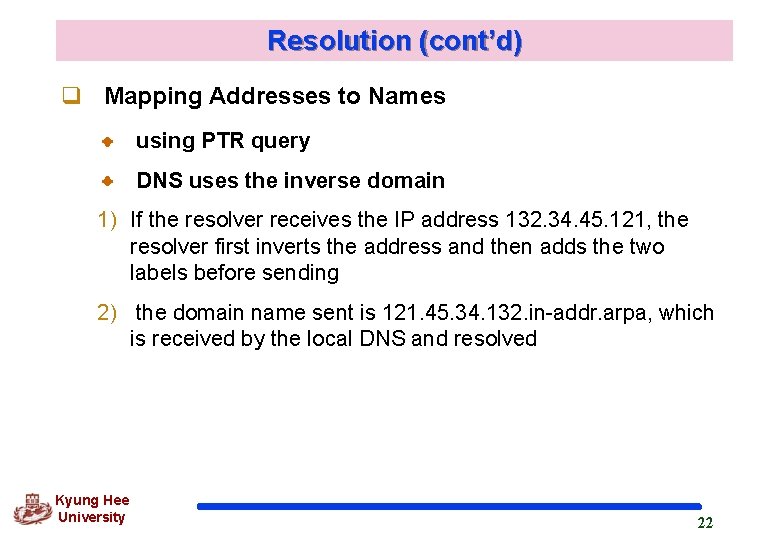
Resolution (cont’d) q Mapping Addresses to Names using PTR query DNS uses the inverse domain 1) If the resolver receives the IP address 132. 34. 45. 121, the resolver first inverts the address and then adds the two labels before sending 2) the domain name sent is 121. 45. 34. 132. in-addr. arpa, which is received by the local DNS and resolved Kyung Hee University 22
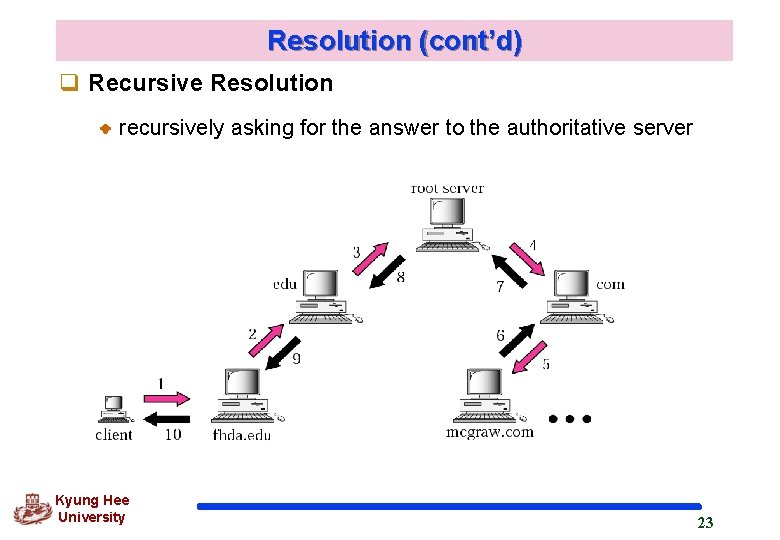
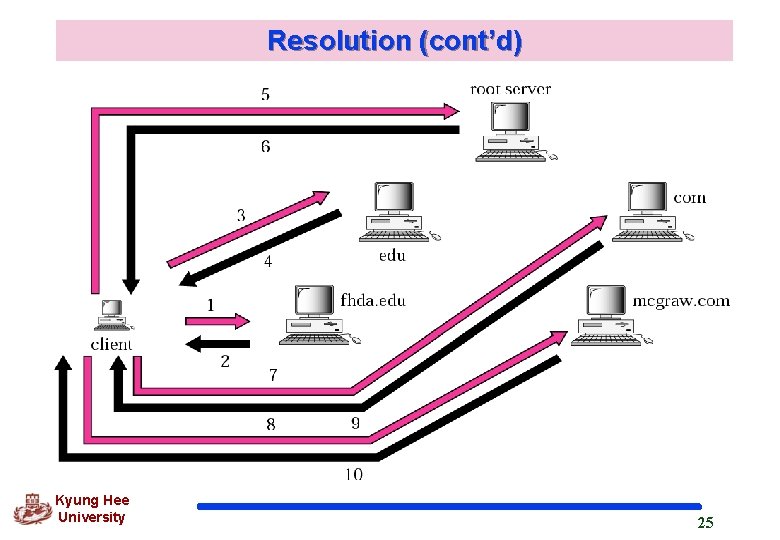
Resolution (cont’d) q Recursive Resolution recursively asking for the answer to the authoritative server Kyung Hee University 23
Resolution (cont’d) q Iterative Resolution if the server is an authority for the name, it sends the answer. If it is not, it returns (to the client) the IP address of the server that it thinks can resolve the query the client is responsible for repeating the query to this second server if the newly addressed server can resolve the problem, it answers the query with the IP address; otherwise, it returns the IP address of a new server to the client Kyung Hee University 24
Resolution (cont’d) Kyung Hee University 25
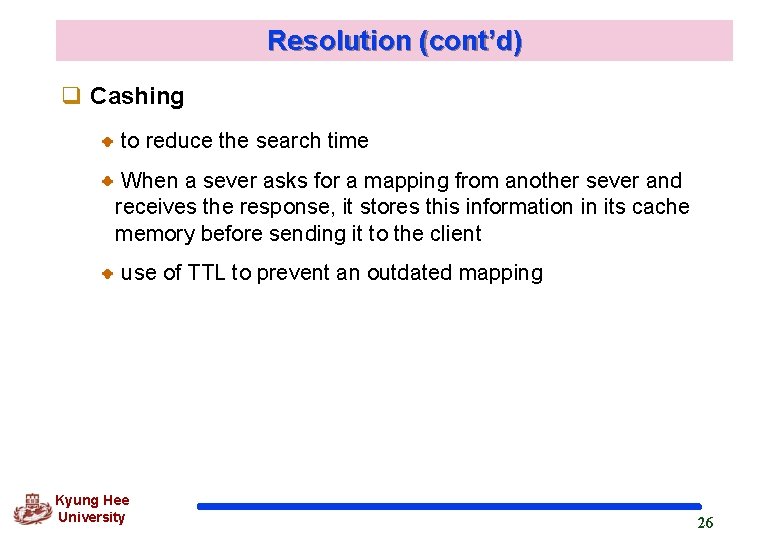
Resolution (cont’d) q Cashing to reduce the search time When a sever asks for a mapping from another sever and receives the response, it stores this information in its cache memory before sending it to the client use of TTL to prevent an outdated mapping Kyung Hee University 26
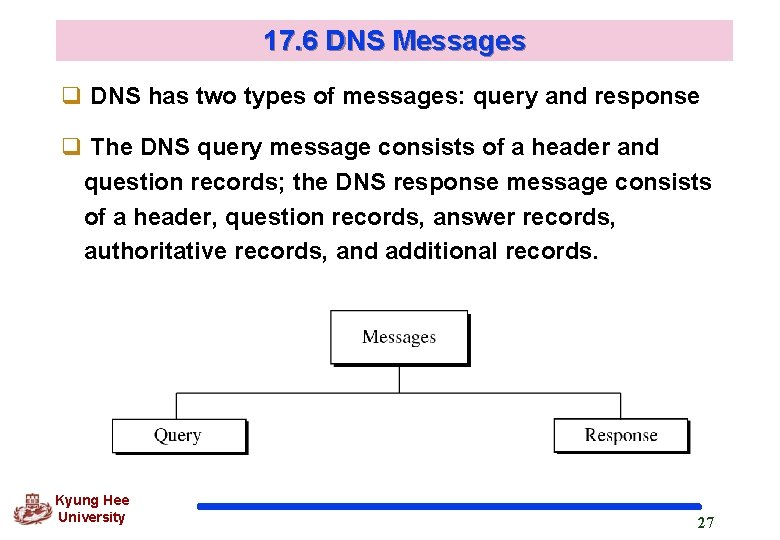
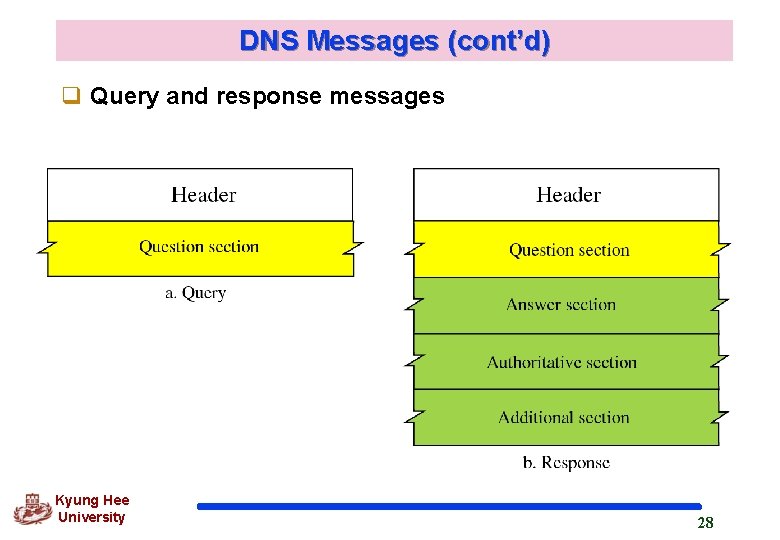
17. 6 DNS Messages q DNS has two types of messages: query and response q The DNS query message consists of a header and question records; the DNS response message consists of a header, question records, answer records, authoritative records, and additional records. Kyung Hee University 27
DNS Messages (cont’d) q Query and response messages Kyung Hee University 28
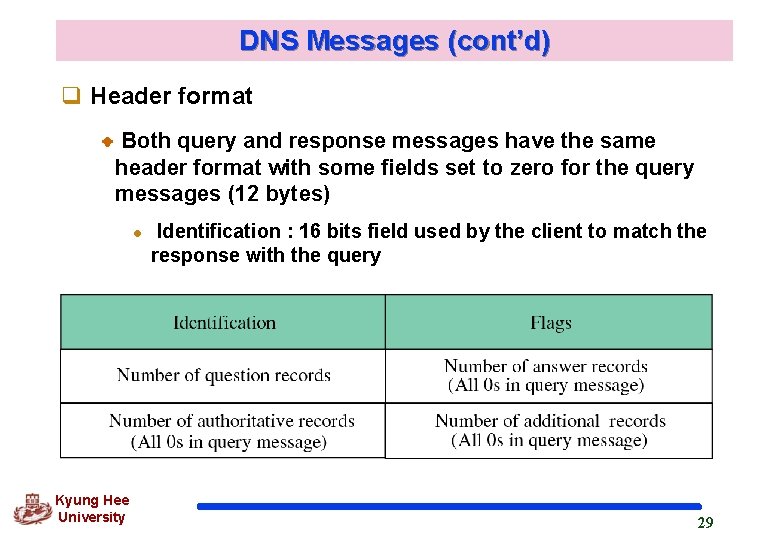
DNS Messages (cont’d) q Header format Both query and response messages have the same header format with some fields set to zero for the query messages (12 bytes) l Kyung Hee University Identification : 16 bits field used by the client to match the response with the query 29
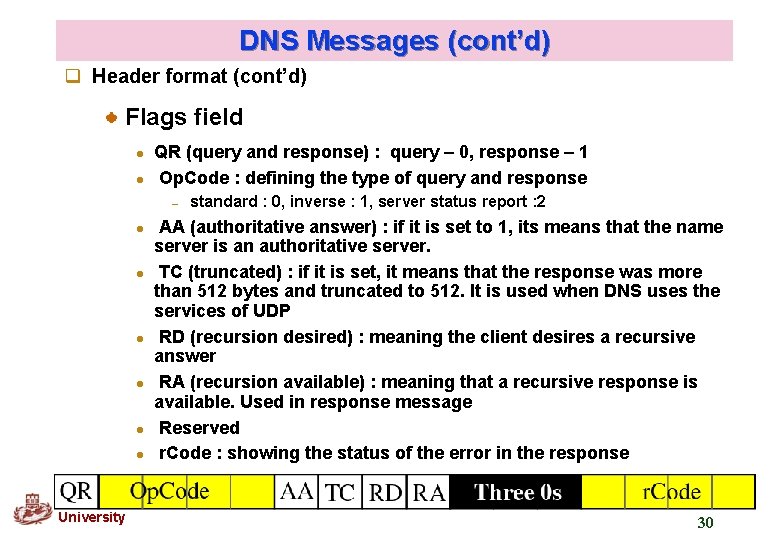
DNS Messages (cont’d) q Header format (cont’d) Flags field l l QR (query and response) : query – 0, response – 1 Op. Code : defining the type of query and response – l l l Kyung Hee University standard : 0, inverse : 1, server status report : 2 AA (authoritative answer) : if it is set to 1, its means that the name server is an authoritative server. TC (truncated) : if it is set, it means that the response was more than 512 bytes and truncated to 512. It is used when DNS uses the services of UDP RD (recursion desired) : meaning the client desires a recursive answer RA (recursion available) : meaning that a recursive response is available. Used in response message Reserved r. Code : showing the status of the error in the response 30
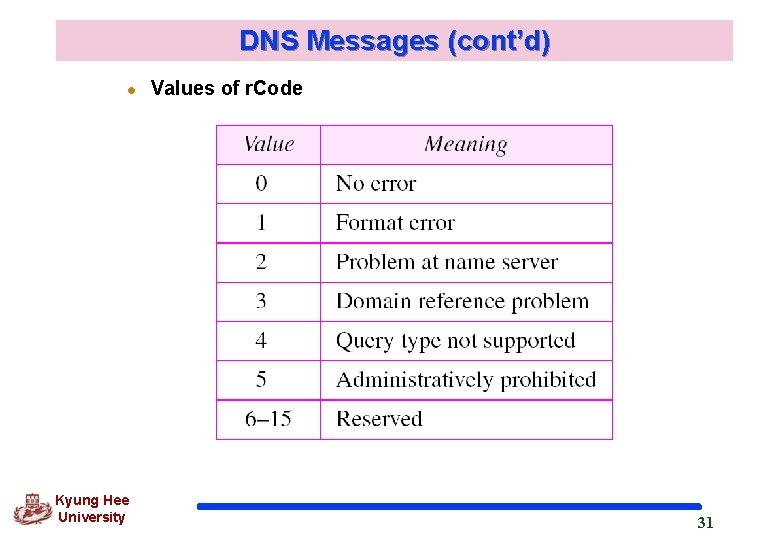
DNS Messages (cont’d) l Kyung Hee University Values of r. Code 31
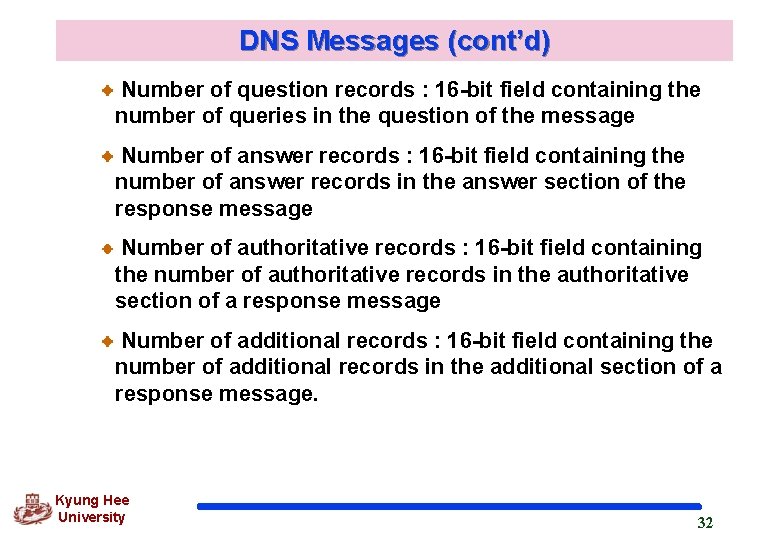
DNS Messages (cont’d) Number of question records : 16 -bit field containing the number of queries in the question of the message Number of answer records : 16 -bit field containing the number of answer records in the answer section of the response message Number of authoritative records : 16 -bit field containing the number of authoritative records in the authoritative section of a response message Number of additional records : 16 -bit field containing the number of additional records in the additional section of a response message. Kyung Hee University 32
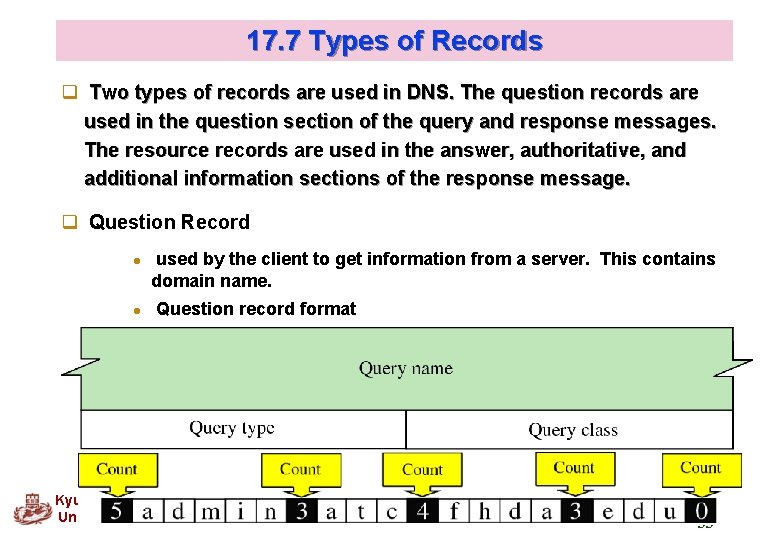
17. 7 Types of Records q Two types of records are used in DNS. The question records are used in the question section of the query and response messages. The resource records are used in the answer, authoritative, and additional information sections of the response message. q Question Record l l l Kyung Hee University used by the client to get information from a server. This contains domain name. Question record format Query name format 33
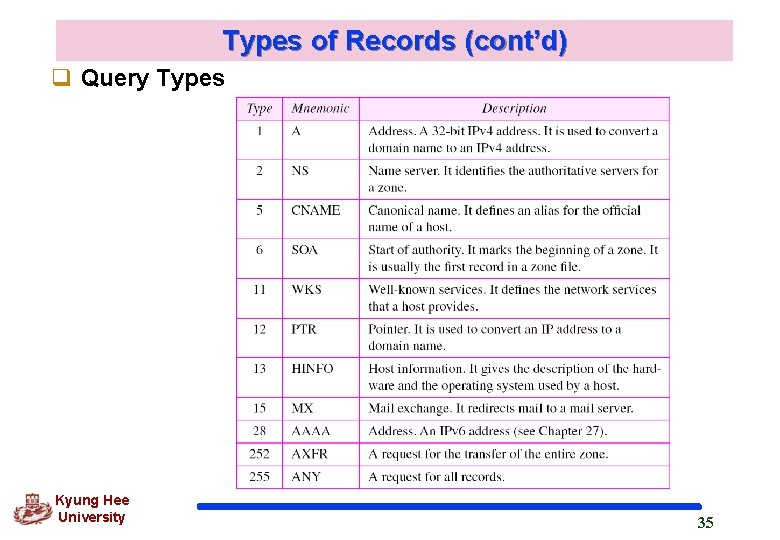
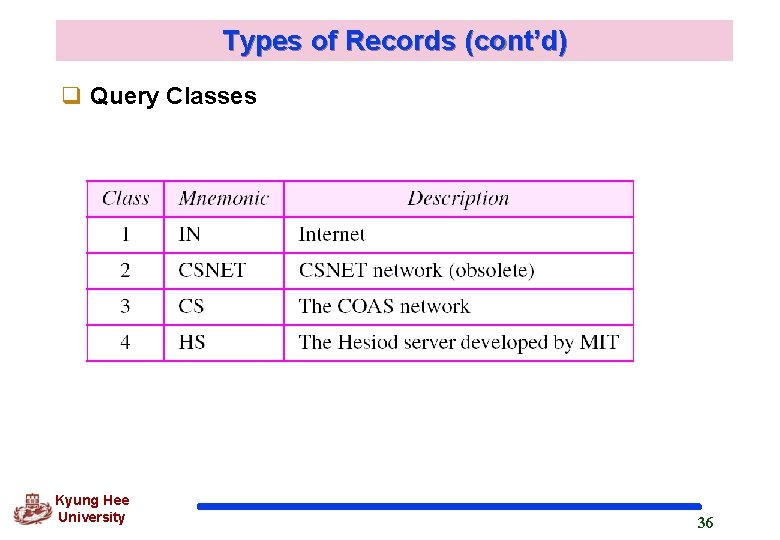
Types of Records (cont’d) q Query type (table 17. 4) q Query class : defining the specific protocol using DNS (Table 17. 5) Kyung Hee University 34
Types of Records (cont’d) q Query Types Kyung Hee University 35
Types of Records (cont’d) q Query Classes Kyung Hee University 36
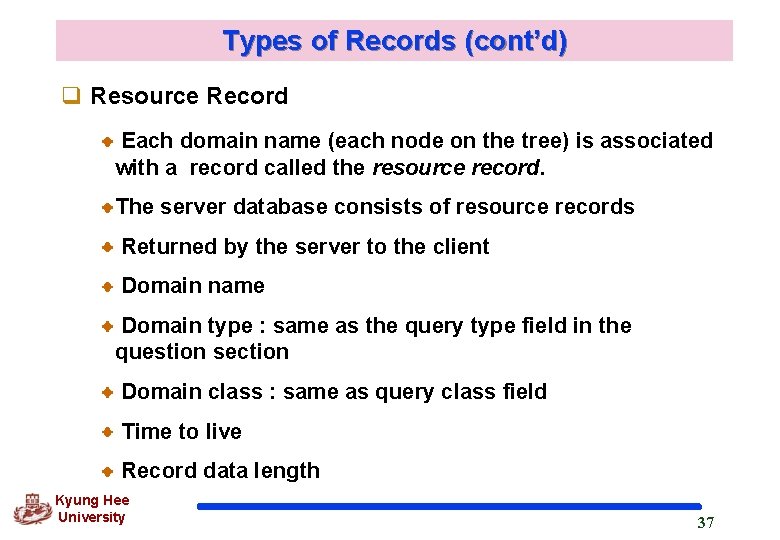
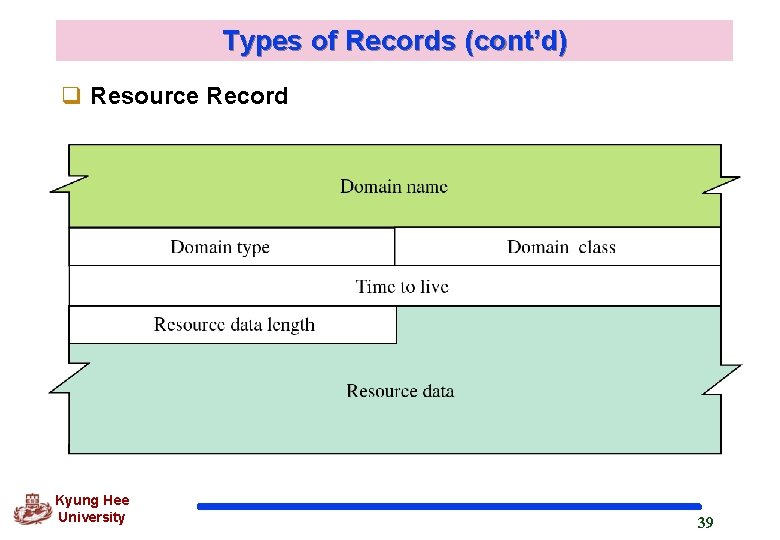
Types of Records (cont’d) q Resource Record Each domain name (each node on the tree) is associated with a record called the resource record. The server database consists of resource records Returned by the server to the client Domain name Domain type : same as the query type field in the question section Domain class : same as query class field Time to live Record data length Kyung Hee University 37
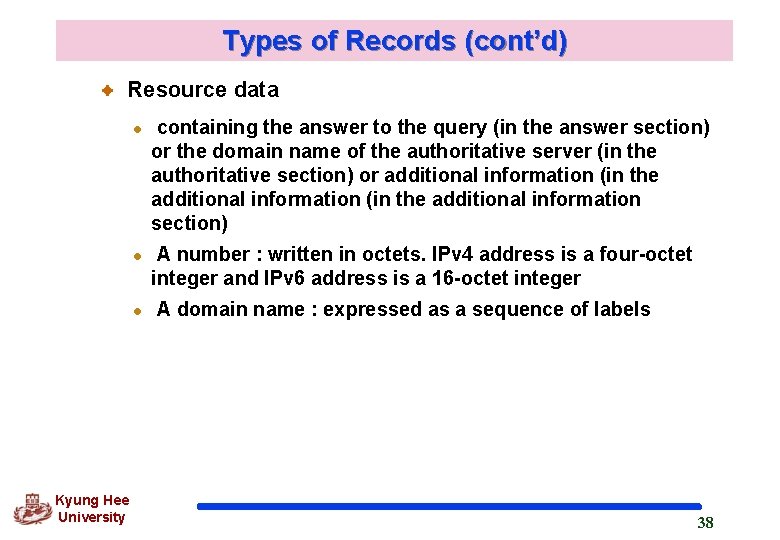
Types of Records (cont’d) Resource data l l l Kyung Hee University containing the answer to the query (in the answer section) or the domain name of the authoritative server (in the authoritative section) or additional information (in the additional information section) A number : written in octets. IPv 4 address is a four-octet integer and IPv 6 address is a 16 -octet integer A domain name : expressed as a sequence of labels 38
Types of Records (cont’d) q Resource Record Kyung Hee University 39
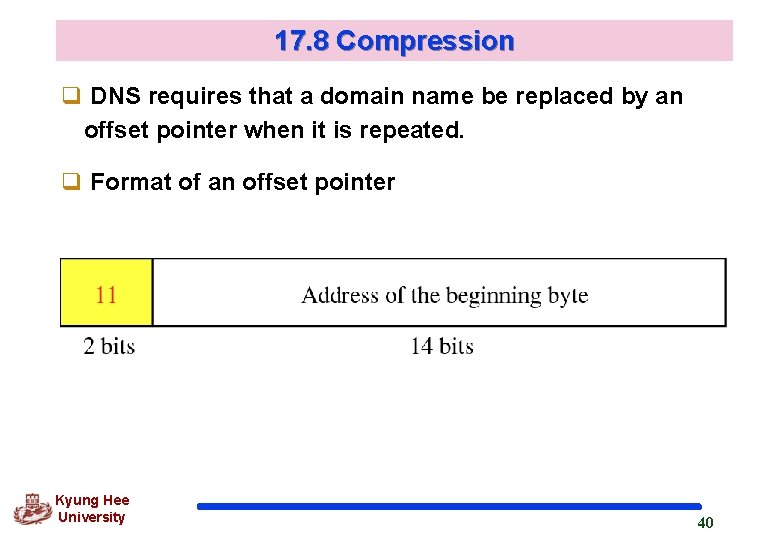
17. 8 Compression q DNS requires that a domain name be replaced by an offset pointer when it is repeated. q Format of an offset pointer Kyung Hee University 40
17. 9 DDNS q The DNS master file must be updated dynamically the change such as adding a new host, removing host, or changing an IP address. q In DDNS, when a binding between a name and address is determined, information is sent, usually by DHCP to a primary DNS server. Kyung Hee University 41
17. 10 Encapsulation q using either UDP or TCP UDP : used when the size of the response message is less than 512 bytes q well-known port used by the server is port 53 Kyung Hee University 42