
Chapter 17 Database System Architectures Database System Concepts
Chapter 17: Database System Architectures Database System Concepts, 6 th Ed. ©Silberschatz, Korth and Sudarshan See www. db-book. com for conditions on re-use
Chapter 17: Database System Architectures n Centralized and Client-Server Systems n Server System Architectures n Parallel Systems n Distributed Systems n Network Types Database System Concepts - 6 th Edition 17. 2 ©Silberschatz, Korth and Sudarshan
Centralized Systems n Run on a single computer system and do not interact with other computer systems. n General-purpose computer system: one to a few CPUs and a number of device controllers that are connected through a common bus that provides access to shared memory. n Single-user system (e. g. , personal computer or workstation): desk-top unit, single user, usually has only one CPU and one or two hard disks; the OS may support only one user. n Multi-user system: more disks, more memory, multiple CPUs, and a multi-user OS. Serve a large number of users who are connected to the system vie terminals. Often called server systems. Database System Concepts - 6 th Edition 17. 3 ©Silberschatz, Korth and Sudarshan
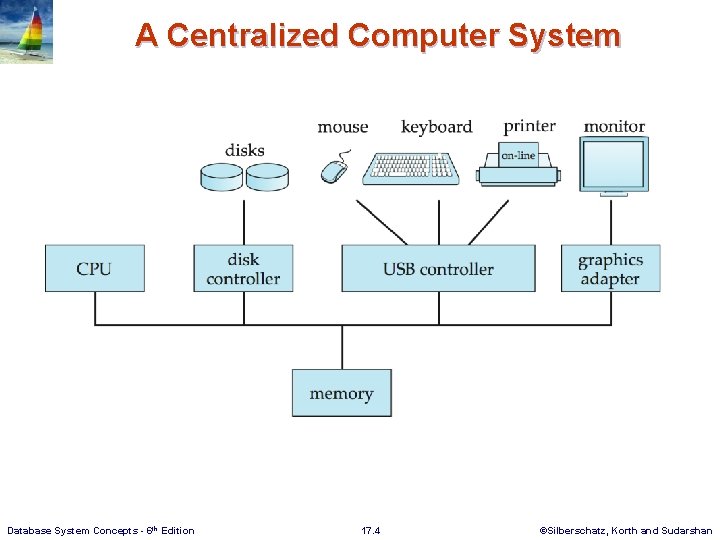
A Centralized Computer System Database System Concepts - 6 th Edition 17. 4 ©Silberschatz, Korth and Sudarshan
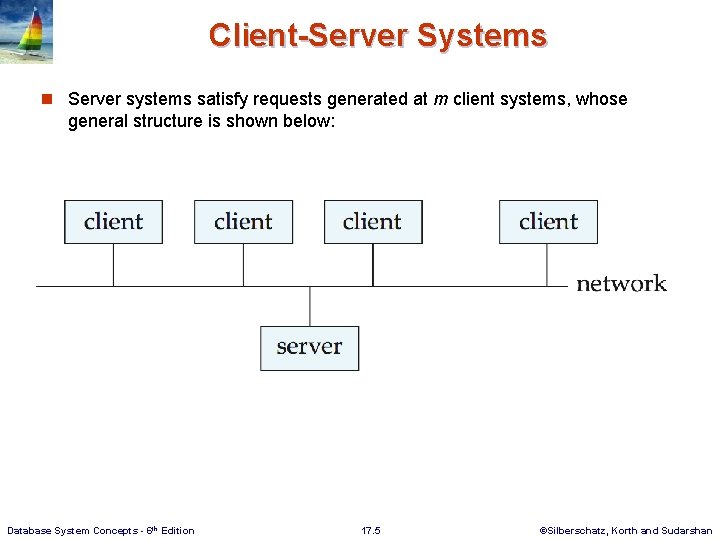
Client-Server Systems n Server systems satisfy requests generated at m client systems, whose general structure is shown below: Database System Concepts - 6 th Edition 17. 5 ©Silberschatz, Korth and Sudarshan
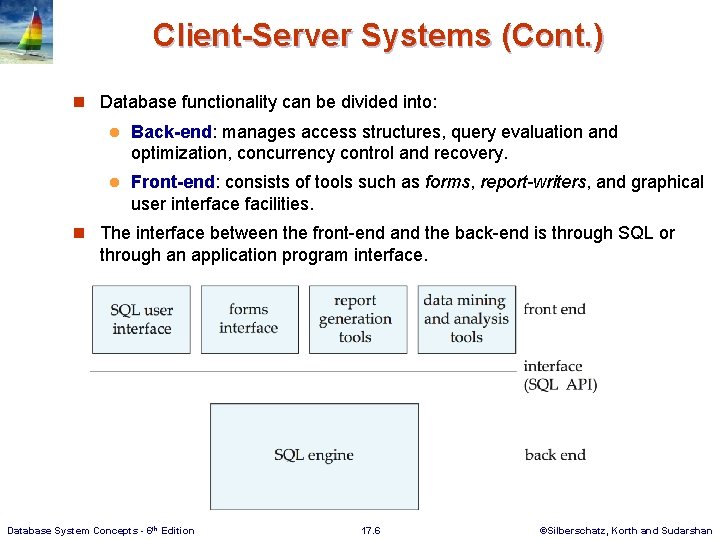
Client-Server Systems (Cont. ) n Database functionality can be divided into: l Back-end: manages access structures, query evaluation and optimization, concurrency control and recovery. l Front-end: consists of tools such as forms, report-writers, and graphical user interface facilities. n The interface between the front-end and the back-end is through SQL or through an application program interface. Database System Concepts - 6 th Edition 17. 6 ©Silberschatz, Korth and Sudarshan
Client-Server Systems (Cont. ) n Advantages of replacing mainframes with networks of workstations or personal computers connected to back-end server machines: l better functionality for the cost l flexibility in locating resources and expanding facilities l better user interfaces l easier maintenance Database System Concepts - 6 th Edition 17. 7 ©Silberschatz, Korth and Sudarshan
Server System Architecture n Server systems can be broadly categorized into two kinds: l transaction servers which are widely used in relational database systems, and l data servers, used in object-oriented database systems Database System Concepts - 6 th Edition 17. 8 ©Silberschatz, Korth and Sudarshan
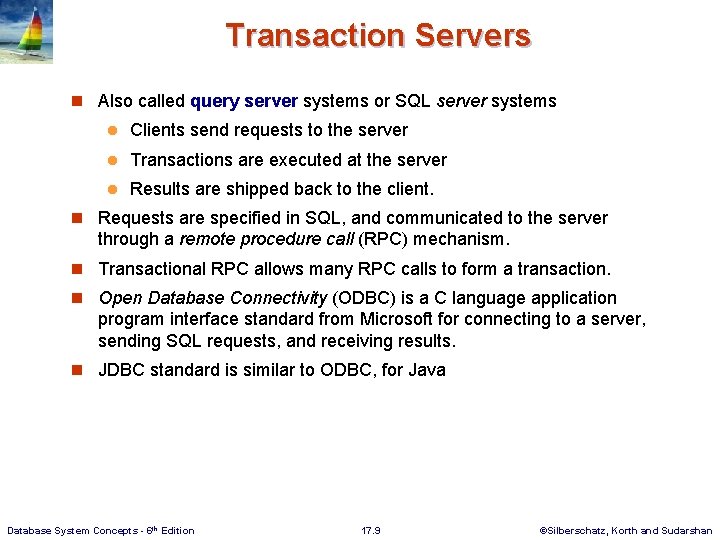
Transaction Servers n Also called query server systems or SQL server systems l Clients send requests to the server l Transactions are executed at the server l Results are shipped back to the client. n Requests are specified in SQL, and communicated to the server through a remote procedure call (RPC) mechanism. n Transactional RPC allows many RPC calls to form a transaction. n Open Database Connectivity (ODBC) is a C language application program interface standard from Microsoft for connecting to a server, sending SQL requests, and receiving results. n JDBC standard is similar to ODBC, for Java Database System Concepts - 6 th Edition 17. 9 ©Silberschatz, Korth and Sudarshan
Data Servers n Used in high-speed LANs, in cases where l The clients are comparable in processing power to the server l The tasks to be executed are compute intensive. n Used in many object-oriented database systems Database System Concepts - 6 th Edition 17. 10 ©Silberschatz, Korth and Sudarshan
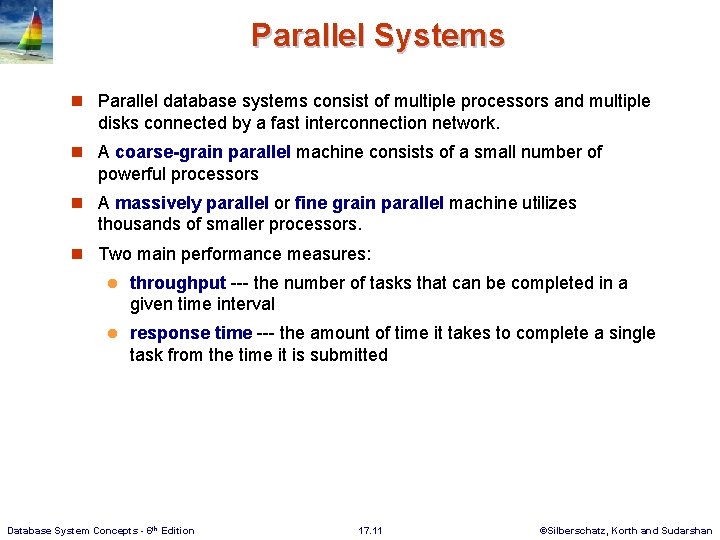
Parallel Systems n Parallel database systems consist of multiple processors and multiple disks connected by a fast interconnection network. n A coarse-grain parallel machine consists of a small number of powerful processors n A massively parallel or fine grain parallel machine utilizes thousands of smaller processors. n Two main performance measures: l throughput --- the number of tasks that can be completed in a given time interval l response time --- the amount of time it takes to complete a single task from the time it is submitted Database System Concepts - 6 th Edition 17. 11 ©Silberschatz, Korth and Sudarshan
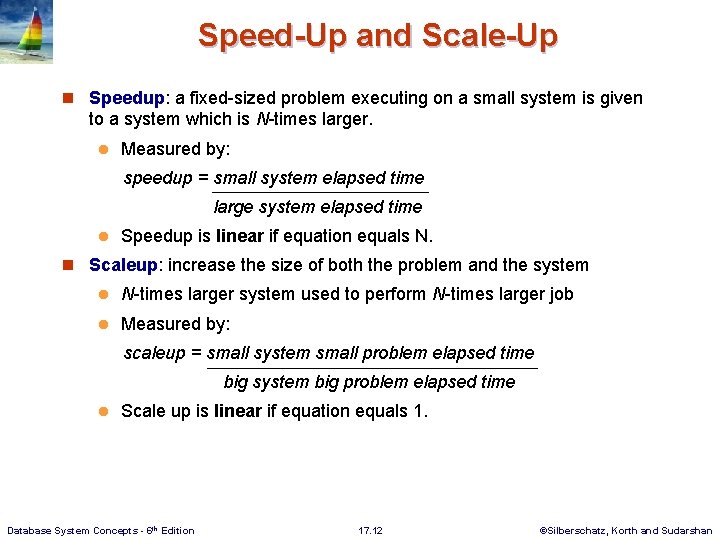
Speed-Up and Scale-Up n Speedup: a fixed-sized problem executing on a small system is given to a system which is N-times larger. l Measured by: speedup = small system elapsed time large system elapsed time l Speedup is linear if equation equals N. n Scaleup: increase the size of both the problem and the system l N-times larger system used to perform N-times larger job l Measured by: scaleup = small system small problem elapsed time big system big problem elapsed time l Scale up is linear if equation equals 1. Database System Concepts - 6 th Edition 17. 12 ©Silberschatz, Korth and Sudarshan
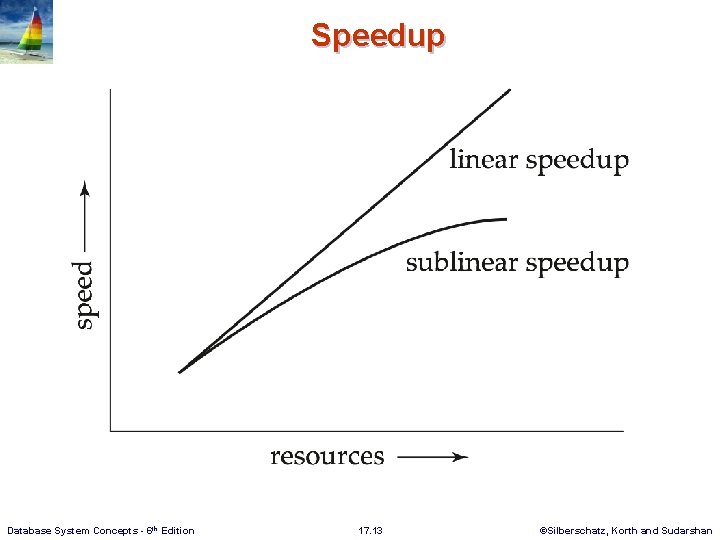
Speedup Database System Concepts - 6 th Edition 17. 13 ©Silberschatz, Korth and Sudarshan
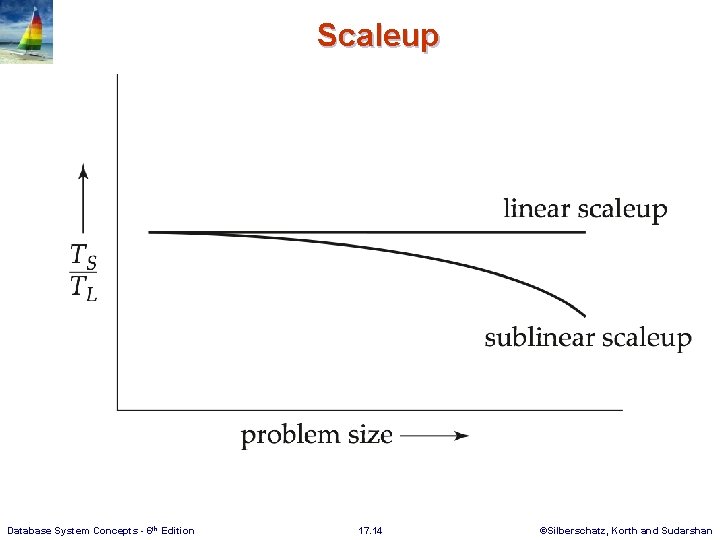
Scaleup Database System Concepts - 6 th Edition 17. 14 ©Silberschatz, Korth and Sudarshan
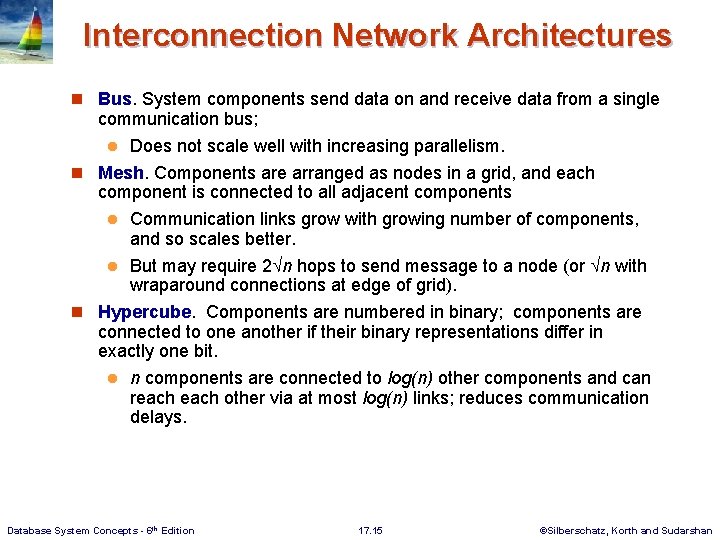
Interconnection Network Architectures n Bus. System components send data on and receive data from a single communication bus; l Does not scale well with increasing parallelism. n Mesh. Components are arranged as nodes in a grid, and each component is connected to all adjacent components l Communication links grow with growing number of components, and so scales better. l But may require 2 n hops to send message to a node (or n with wraparound connections at edge of grid). n Hypercube. Components are numbered in binary; components are connected to one another if their binary representations differ in exactly one bit. l n components are connected to log(n) other components and can reach other via at most log(n) links; reduces communication delays. Database System Concepts - 6 th Edition 17. 15 ©Silberschatz, Korth and Sudarshan
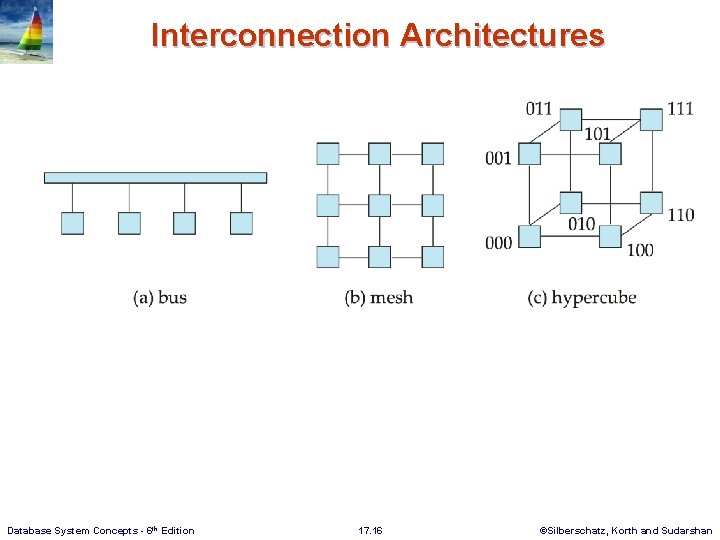
Interconnection Architectures Database System Concepts - 6 th Edition 17. 16 ©Silberschatz, Korth and Sudarshan
Parallel Database Architectures n Shared memory -- processors share a common memory n Shared disk -- processors share a common disk n Shared nothing -- processors share neither a common memory nor common disk n Hierarchical -- hybrid of the above architectures Database System Concepts - 6 th Edition 17. 17 ©Silberschatz, Korth and Sudarshan
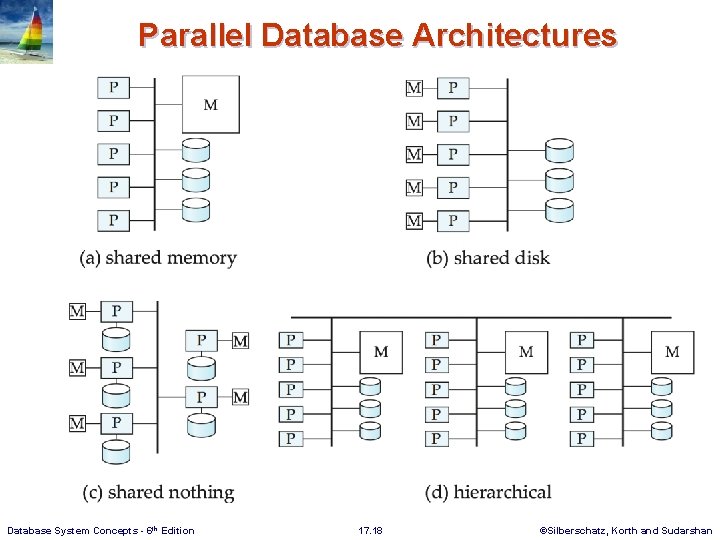
Parallel Database Architectures Database System Concepts - 6 th Edition 17. 18 ©Silberschatz, Korth and Sudarshan
Shared Memory n Processors and disks have access to a common memory, typically via a bus or through an interconnection network. n Extremely efficient communication between processors — data in shared memory can be accessed by any processor without having to move it using software. n Downside – architecture is not scalable beyond 32 or 64 processors since the bus or the interconnection network becomes a bottleneck n Widely used for lower degrees of parallelism (4 to 8). Database System Concepts - 6 th Edition 17. 19 ©Silberschatz, Korth and Sudarshan
Shared Disk n All processors can directly access all disks via an interconnection network, but the processors have private memories. l The memory bus is not a bottleneck l Architecture provides a degree of fault-tolerance — if a processor fails, the other processors can take over its tasks since the database is resident on disks that are accessible from all processors. n Examples: IBM Sysplex and DEC clusters (now part of Compaq) running Rdb (now Oracle Rdb) were early commercial users n Downside: bottleneck now occurs at interconnection to the disk subsystem. n Shared-disk systems can scale to a somewhat larger number of processors, but communication between processors is slower. Database System Concepts - 6 th Edition 17. 20 ©Silberschatz, Korth and Sudarshan
Shared Nothing n Node consists of a processor, memory, and one or more disks. Processors at one node communicate with another processor at another node using an interconnection network. A node functions as the server for the data on the disk or disks the node owns. n Examples: Teradata, Tandem, Oracle-n CUBE n Data accessed from local disks (and local memory accesses) do not pass through interconnection network, thereby minimizing the interference of resource sharing. n Shared-nothing multiprocessors can be scaled up to thousands of processors without interference. n Main drawback: cost of communication and non-local disk access; sending data involves software interaction at both ends. Database System Concepts - 6 th Edition 17. 21 ©Silberschatz, Korth and Sudarshan
Hierarchical n Combines characteristics of shared-memory, shared-disk, and shared- nothing architectures. n Top level is a shared-nothing architecture – nodes connected by an interconnection network, and do not share disks or memory with each other. n Each node of the system could be a shared-memory system with a few processors. n Alternatively, each node could be a shared-disk system, and each of the systems sharing a set of disks could be a shared-memory system. n Reduce the complexity of programming such systems by distributed virtual-memory architectures l Also called non-uniform memory architecture (NUMA) Database System Concepts - 6 th Edition 17. 22 ©Silberschatz, Korth and Sudarshan
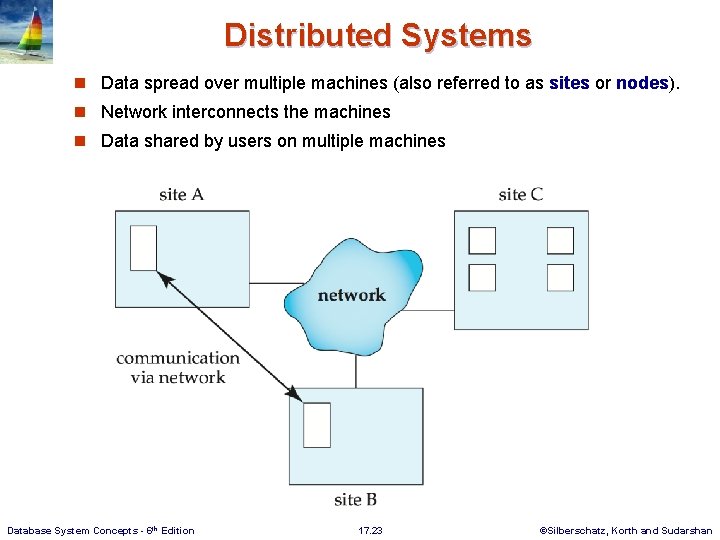
Distributed Systems n Data spread over multiple machines (also referred to as sites or nodes). n Network interconnects the machines n Data shared by users on multiple machines Database System Concepts - 6 th Edition 17. 23 ©Silberschatz, Korth and Sudarshan
Distributed Databases n Homogeneous distributed databases Same software/schema on all sites, data may be partitioned among sites l Goal: provide a view of a single database, hiding details of distribution n Heterogeneous distributed databases l Different software/schema on different sites l Goal: integrate existing databases to provide useful functionality n Differentiate between local and global transactions l A local transaction accesses data in the single site at which the transaction was initiated. l A global transaction either accesses data in a site different from the one at which the transaction was initiated or accesses data in several different sites. l Database System Concepts - 6 th Edition 17. 24 ©Silberschatz, Korth and Sudarshan
Trade-offs in Distributed Systems n Sharing data – users at one site able to access the data residing at some other sites. n Autonomy – each site is able to retain a degree of control over data stored locally. n Higher system availability through redundancy — data can be replicated at remote sites, and system can function even if a site fails. n Disadvantage: added complexity required to ensure proper coordination among sites. l Software development cost. l Greater potential for bugs. l Increased processing overhead. Database System Concepts - 6 th Edition 17. 25 ©Silberschatz, Korth and Sudarshan
Network Types n Local-area networks (LANs) – composed of processors that are distributed over small geographical areas, such as a single building or a few adjacent buildings. n Wide-area networks (WANs) – composed of processors distributed over a large geographical area. Database System Concepts - 6 th Edition 17. 26 ©Silberschatz, Korth and Sudarshan
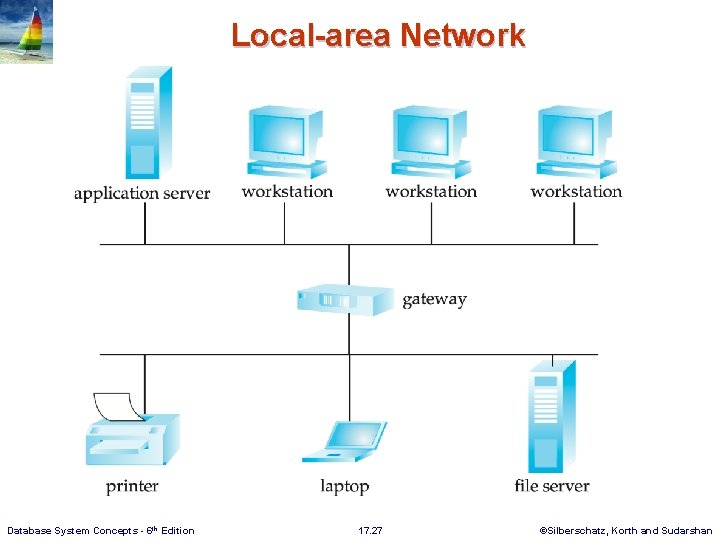
Local-area Network Database System Concepts - 6 th Edition 17. 27 ©Silberschatz, Korth and Sudarshan
Networks Types (Cont. ) n WANs with continuous connection (e. g. , the Internet) are needed for implementing distributed database systems Database System Concepts - 6 th Edition 17. 28 ©Silberschatz, Korth and Sudarshan
- Slides: 28