
Chapter 17 Blood Introduction Erythrocytes Leukocytes Hemostasis Blood
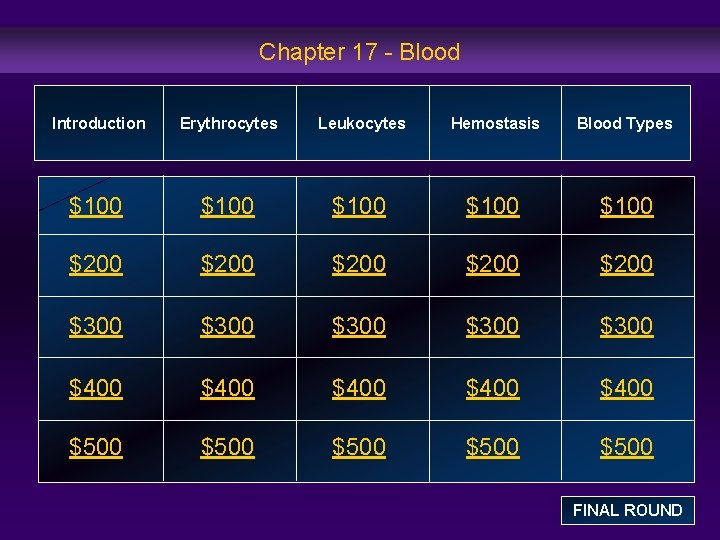
Chapter 17 - Blood Introduction Erythrocytes Leukocytes Hemostasis Blood Types $100 $100 $200 $200 $300 $300 $400 $400 $500 $500 FINAL ROUND
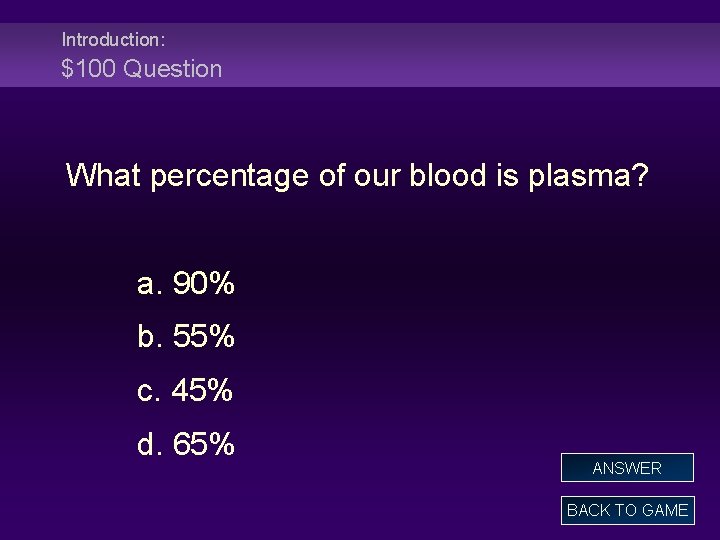
Introduction: $100 Question What percentage of our blood is plasma? a. 90% b. 55% c. 45% d. 65% ANSWER BACK TO GAME
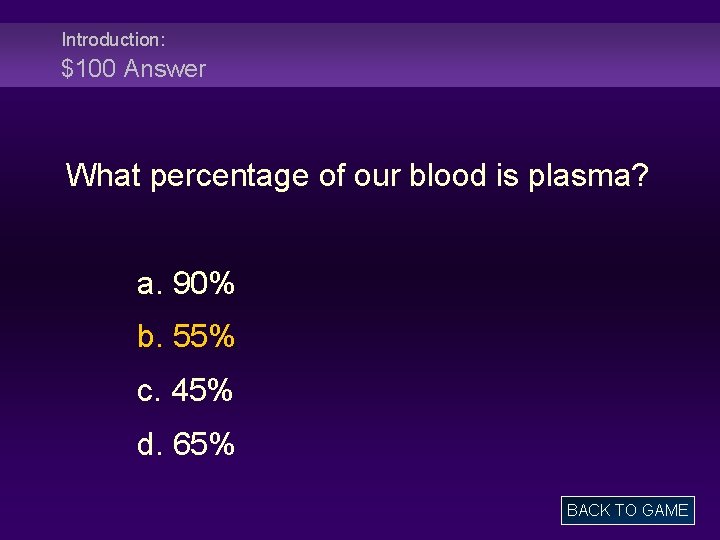
Introduction: $100 Answer What percentage of our blood is plasma? a. 90% b. 55% c. 45% d. 65% BACK TO GAME
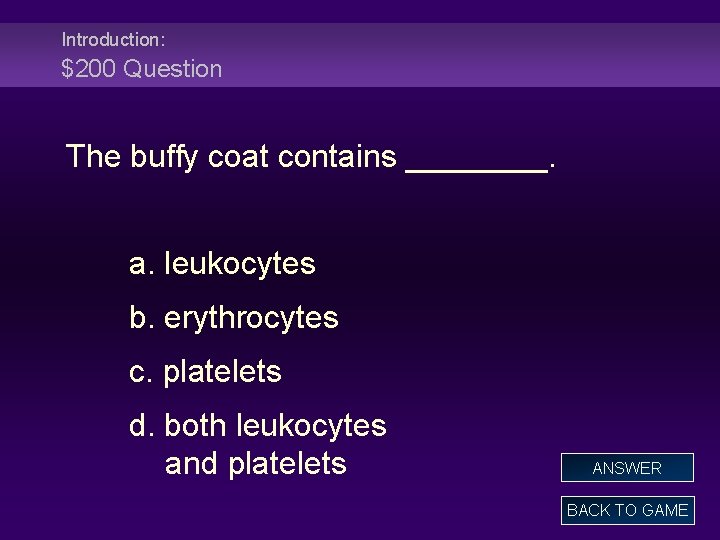
Introduction: $200 Question The buffy coat contains ____. a. leukocytes b. erythrocytes c. platelets d. both leukocytes and platelets ANSWER BACK TO GAME
Introduction: $200 Answer The buffy coat contains ____. a. leukocytes b. erythrocytes c. platelets d. both leukocytes and platelets BACK TO GAME
Introduction: $300 Question The most abundant plasma protein is ____. a. heparin b. globulins c. albumin d. fibrinogen ANSWER BACK TO GAME
Introduction: $300 Answer The most abundant plasma protein is ____. a. heparin b. globulins c. albumin d. fibrinogen BACK TO GAME
Introduction: $400 Question Which organ produces most of the plasma proteins? a. red bone marrow b. liver c. kidney d. thymus ANSWER BACK TO GAME
Introduction: $400 Answer Which organ produces most of the plasma proteins? a. red bone marrow b. liver c. kidney d. thymus BACK TO GAME
Introduction: $500 Question Which of the following blood components is a complete cell? a. erythrocyte b. leukocyte c. platelet d. all are complete cells ANSWER BACK TO GAME
Introduction: $500 Answer Which of the following blood components is a complete cell? a. erythrocyte b. leukocyte c. platelet d. all are complete cells BACK TO GAME
Erythrocytes: $100 Question The production of red blood cells is called _____. a. hematopoiesis b. erythropoiesis c. erythropoietin d. leukopoiesis ANSWER BACK TO GAME
Erythrocytes: $100 Answer The production of red blood cells is called _____. a. hematopoiesis b. erythropoiesis c. erythropoietin d. leukopoiesis BACK TO GAME
Erythrocytes: $200 Question Which of the following is present in a red blood cell? a. nucleus b. plasma membrane c. ribosome d. mitochondria ANSWER BACK TO GAME
Erythrocytes: $200 Answer Which of the following is present in a red blood cell? a. nucleus b. plasma membrane c. ribosome d. mitochondria BACK TO GAME
Erythrocytes: $300 Question Carbon dioxide bonds to what part of the hemoglobin molecule? a. heme b. globin c. both heme and globin d. carbon dioxide cannot bind to hemoglobin ANSWER BACK TO GAME
Erythrocytes: $300 Answer Carbon dioxide bonds to what part of the hemoglobin molecule? a. heme b. globin c. both heme and globin d. carbon dioxide cannot bind to hemoglobin BACK TO GAME
Erythrocytes: $400 Question The target organ of erythropoietin is the ______. a. kidneys b. liver c. thymus d. red bone marrow ANSWER BACK TO GAME
Erythrocytes: $400 Answer The target organ of erythropoietin is the ______. a. kidneys b. liver c. thymus d. red bone marrow BACK TO GAME
Erythrocytes: $500 Question Red blood cells enter the blood stream as _______. a. erythroblasts b. reticulocytes c. hemocytoblasts d. normoblasts ANSWER BACK TO GAME
Erythrocytes: $500 Answer Red blood cells enter the blood stream as _______. a. erythroblasts b. reticulocytes c. hemocytoblasts d. normoblasts BACK TO GAME
Leukocytes: $100 Question All of the following are granulocytes except: a. monocyte b. eosinophil c. neutrophil d. basophil ANSWER BACK TO GAME
Leukocytes: $100 Answer All of the following are granulocytes except: a. monocyte b. eosinophil c. neutrophil d. basophil BACK TO GAME
Leukocytes: $200 Question These cells contain histamine and are the least numerous of the circulating white blood cells: a. monocyte b. eosinophil c. neutrophil d. basophil ANSWER BACK TO GAME
Leukocytes: $200 Answer These cells contain histamine and are the least numerous of the circulating white blood cells: a. monocyte b. eosinophil c. neutrophil d. basophil BACK TO GAME
Leukocytes: $300 Question These cells are important in fighting parasitic infections. a. monocyte b. eosinophil c. neutrophil d. lymphocyte ANSWER BACK TO GAME
Leukocytes: $300 Answer These cells are important in fighting parasitic infections. a. monocyte b. eosinophil c. neutrophil d. lymphocyte BACK TO GAME
Leukocytes: $400 Question Some of these cells become plasma cells which can produce antibodies: a. monocyte b. eosinophil c. neutrophil d. lymphocyte ANSWER BACK TO GAME
Leukocytes: $400 Answer Some of these cells become plasma cells which can produce antibodies: a. monocyte b. eosinophil c. neutrophil d. lymphocyte BACK TO GAME
Leukocytes: $500 Question These cells can enter the tissues as macrophages and are important in chronic infections: a. monocyte b. eosinophil c. neutrophil d. basophil ANSWER BACK TO GAME
Leukocytes: $500 Answer These cells can enter the tissues as macrophages and are important in chronic infections: a. monocyte b. eosinophil c. neutrophil d. basophil BACK TO GAME
Hemostasis: $100 Question Platelets are fragments of which cells? a. megakaryocytes b. reticulocytes c. leukocytes d. thrombocytes ANSWER BACK TO GAME
Hemostasis: $100 Answer Platelets are fragments of which cells? a. megakaryocytes b. reticulocytes c. leukocytes d. thrombocytes BACK TO GAME
Hemostasis: $200 Question The immediate response to blood vessel damage is a ____. a. platelet plug b. blood clot c. vascular spasm d. fibrinolysis ANSWER BACK TO GAME
Hemostasis: $200 Answer The immediate response to blood vessel damage is a ____. a. platelet plug b. blood clot c. vascular spasm d. fibrinolysis BACK TO GAME
Hemostasis: $300 Question The protein backbone of a blood clot is ____. a. thrombin b. fibrin c. plasmin d. heparin ANSWER BACK TO GAME
Hemostasis: $300 Answer The protein backbone of a blood clot is ____. a. thrombin b. fibrin c. plasmin d. heparin BACK TO GAME
Hemostasis: $400 Question Platelets release this substance which contributes to vascular spasms: a. ADP b. prothrombin c. serotonin d. factor III ANSWER BACK TO GAME
Hemostasis: $400 Answer Platelets release this substance which contributes to vascular spasms: a. ADP b. prothrombin c. serotonin d. factor III BACK TO GAME
Hemostasis: $500 Question Which enzyme converts fibrinogen into fibrin? a. thrombin b. thromboplastin c. ADP d. plasmin ANSWER BACK TO GAME
Blood Types: $500 Answer Which enzyme converts fibrinogen into fibrin? a. thrombin b. thromboplastin c. ADP d. plasmin BACK TO GAME
Blood Types: $100 Question The most common blood type in the United States is _____. a. A b. B c. AB d. O ANSWER BACK TO GAME
Blood Types: $100 Answer The most common blood type in the United States is _____. a. A b. B c. AB d. O BACK TO GAME
Blood Types: $200 Question The universal recipient is _______. a. O+ b. O– c. B– d. AB+ ANSWER BACK TO GAME
Blood Types: $200 Answer The universal recipient is _______. a. O+ b. O– c. B– d. AB+ BACK TO GAME
Blood Types: $300 Question If John has O positive blood, he will have which of the following antibodies in his blood? a. anti-RH b. anti-A c. anti-B d. both anti-A and anti-B ANSWER BACK TO GAME
Blood Types: $300 Answer If John has O positive blood, he will have which of the following antibodies in his blood? a. anti-RH b. anti-A c. anti-B d. both anti-A and anti-B BACK TO GAME
Blood Types: $400 Question If Sarah has A positive blood, she may receive blood from all of the following except: a. O positive b. O negative c. A negative d. AB positive ANSWER BACK TO GAME
Blood Types: $400 Answer If Sarah has A positive blood, she may receive blood from all of the following except: a. O positive b. O negative c. A negative d. AB positive BACK TO GAME
Blood Types: $500 Question Karen has AB negative blood. Which blood types can receive Karen’s blood? a. O negative b. B negative c. AB positive d. both answers b and c are correct ANSWER BACK TO GAME
Blood Types: $500 Answer Karen has AB negative blood. Which blood types can receive Karen’s blood? a. O negative b. B negative c. AB positive d. both answers b and c are correct BACK TO GAME
FINAL ROUND Question This condition is caused by abnormal hemoglobin: a. pernicious anemia b. thalassemia c. polycythemia d. erythroblastosis fetalis ANSWER BACK TO GAME
FINAL ROUND Answer This condition is caused by abnormal hemoglobin: a. pernicious anemia b. thalassemia c. polycythemia d. erythroblastosis fetalis BACK TO GAME
- Slides: 53