
Chapter 17 Applications of DNA Typing Fundamentals of
- Slides: 26
Chapter 17 Applications of DNA Typing Fundamentals of Forensic DNA Typing Slides prepared by John M. Butler June 2009
Chapter 17 - Applications Chapter Summary DNA typing methods can be used for a variety of human identity testing applications including parentage testing, immigration testing, and missing persons and mass disaster victim identification. STR analysis has also been applied to mapping disease genes, characterizing cell lines, monitoring bone marrow transplants, detecting genetic chimeras, monitoring needle sharing among drug addicts, and examining human population diversity around the world.
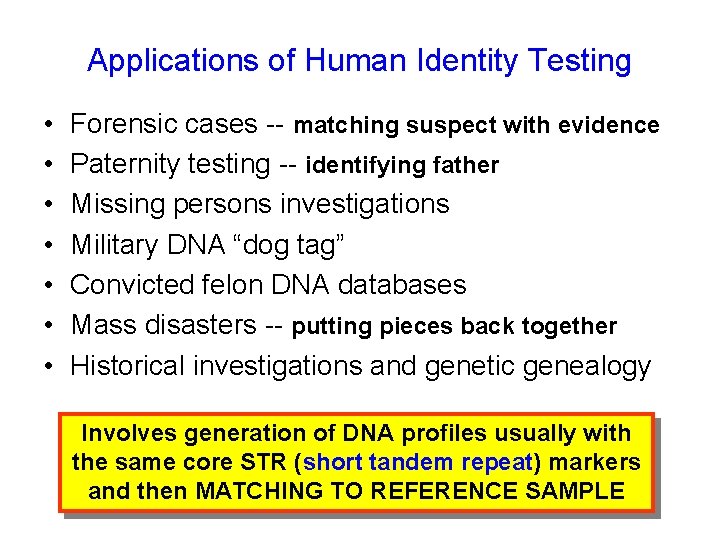
Applications of Human Identity Testing • • Forensic cases -- matching suspect with evidence Paternity testing -- identifying father Missing persons investigations Military DNA “dog tag” Convicted felon DNA databases Mass disasters -- putting pieces back together Historical investigations and genetic genealogy Involves generation of DNA profiles usually with the same core STR (short tandem repeat) markers and then MATCHING TO REFERENCE SAMPLE
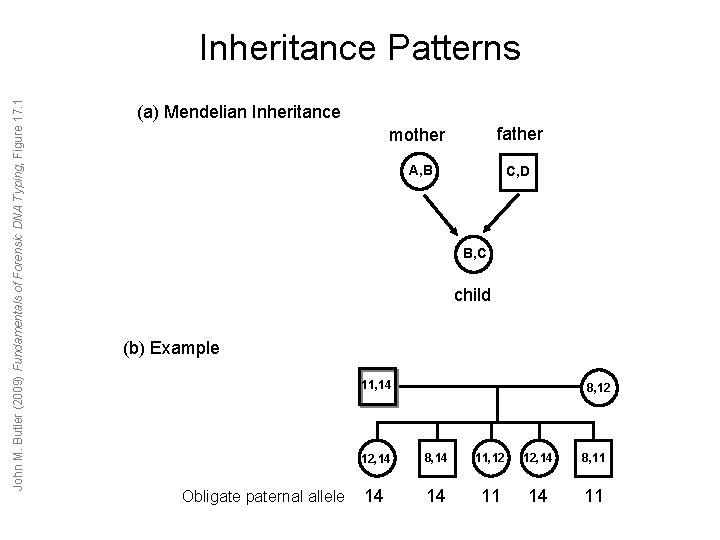
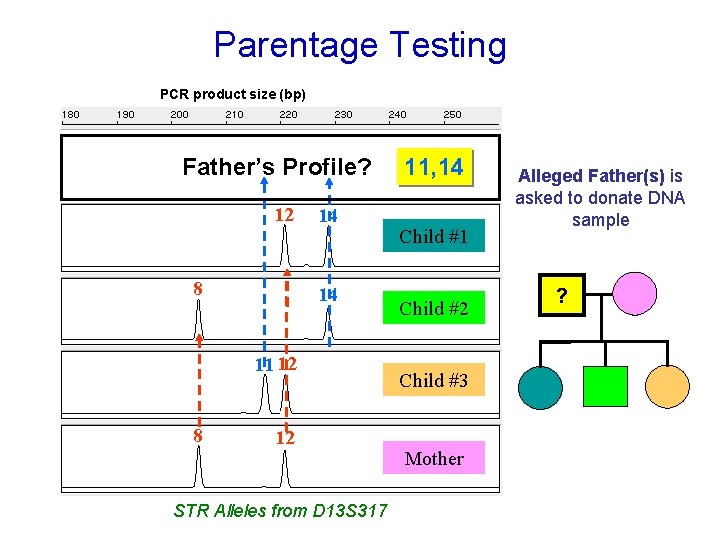
John M. Butler (2009) Fundamentals of Forensic DNA Typing, Figure 17. 1 Inheritance Patterns (a) Mendelian Inheritance mother father A, B C, D B, C child (b) Example 11, 14 Obligate paternal allele 8, 12 12, 14 8, 14 11, 12 12, 14 8, 11 14 14 11
Parentage Testing PCR product size (bp) 11 14 Father’s Profile? 12 8 14 14 11 12 8 12 STR Alleles from D 13 S 317 Father 11, 14 Child #1 Child #2 Child #3 Mother Alleged Father(s) is asked to donate DNA sample ?
Parentage Testing • >300, 000 paternity tests performed in the U. S. each year (~1 million samples) • Mutation can impact results
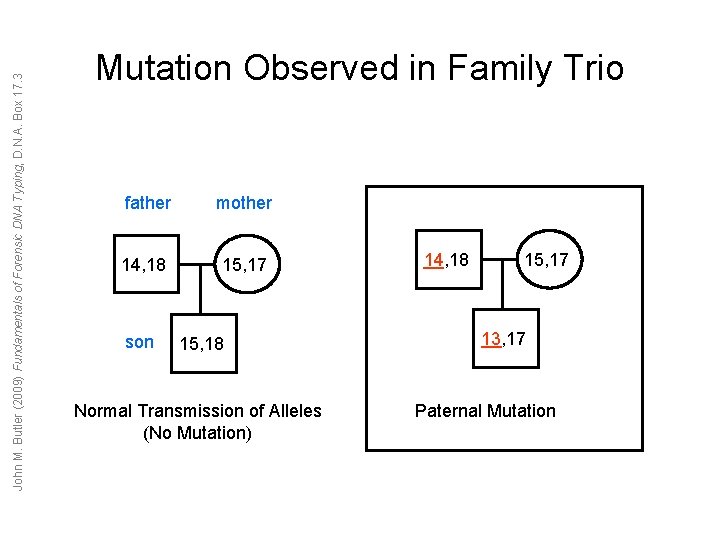
John M. Butler (2009) Fundamentals of Forensic DNA Typing, D. N. A. Box 17. 3 Mutation Observed in Family Trio father mother 14, 18 15, 17 son 15, 18 Normal Transmission of Alleles (No Mutation) 14, 18 15, 17 13, 17 Paternal Mutation
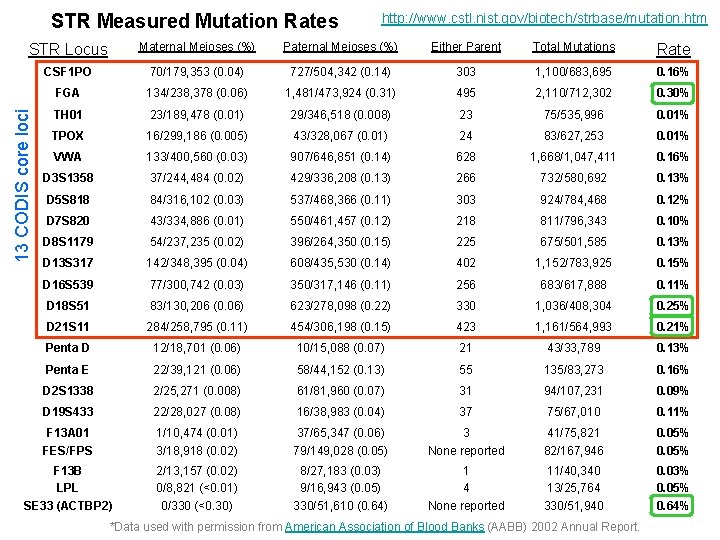
STR Measured Mutation Rates http: //www. cstl. nist. gov/biotech/strbase/mutation. htm Maternal Meioses (%) Paternal Meioses (%) Either Parent Total Mutations Rate CSF 1 PO 70/179, 353 (0. 04) 727/504, 342 (0. 14) 303 1, 100/683, 695 0. 16% FGA 134/238, 378 (0. 06) 1, 481/473, 924 (0. 31) 495 2, 110/712, 302 0. 30% TH 01 23/189, 478 (0. 01) 29/346, 518 (0. 008) 23 75/535, 996 0. 01% TPOX 16/299, 186 (0. 005) 43/328, 067 (0. 01) 24 83/627, 253 0. 01% VWA 133/400, 560 (0. 03) 907/646, 851 (0. 14) 628 1, 668/1, 047, 411 0. 16% D 3 S 1358 37/244, 484 (0. 02) 429/336, 208 (0. 13) 266 732/580, 692 0. 13% D 5 S 818 84/316, 102 (0. 03) 537/468, 366 (0. 11) 303 924/784, 468 0. 12% D 7 S 820 43/334, 886 (0. 01) 550/461, 457 (0. 12) 218 811/796, 343 0. 10% D 8 S 1179 54/237, 235 (0. 02) 396/264, 350 (0. 15) 225 675/501, 585 0. 13% D 13 S 317 142/348, 395 (0. 04) 608/435, 530 (0. 14) 402 1, 152/783, 925 0. 15% D 16 S 539 77/300, 742 (0. 03) 350/317, 146 (0. 11) 256 683/617, 888 0. 11% D 18 S 51 83/130, 206 (0. 06) 623/278, 098 (0. 22) 330 1, 036/408, 304 0. 25% D 21 S 11 284/258, 795 (0. 11) 454/306, 198 (0. 15) 423 1, 161/564, 993 0. 21% Penta D 12/18, 701 (0. 06) 10/15, 088 (0. 07) 21 43/33, 789 0. 13% Penta E 22/39, 121 (0. 06) 58/44, 152 (0. 13) 55 135/83, 273 0. 16% D 2 S 1338 2/25, 271 (0. 008) 61/81, 960 (0. 07) 31 94/107, 231 0. 09% D 19 S 433 22/28, 027 (0. 08) 16/38, 983 (0. 04) 37 75/67, 010 0. 11% F 13 A 01 FES/FPS 1/10, 474 (0. 01) 3/18, 918 (0. 02) 37/65, 347 (0. 06) 79/149, 028 (0. 05) 3 None reported 41/75, 821 82/167, 946 0. 05% F 13 B LPL SE 33 (ACTBP 2) 2/13, 157 (0. 02) 0/8, 821 (<0. 01) 0/330 (<0. 30) 8/27, 183 (0. 03) 9/16, 943 (0. 05) 330/51, 610 (0. 64) 1 4 None reported 11/40, 340 13/25, 764 330/51, 940 0. 03% 0. 05% 0. 64% 13 CODIS core loci STR Locus *Data used with permission from American Association of Blood Banks (AABB) 2002 Annual Report.
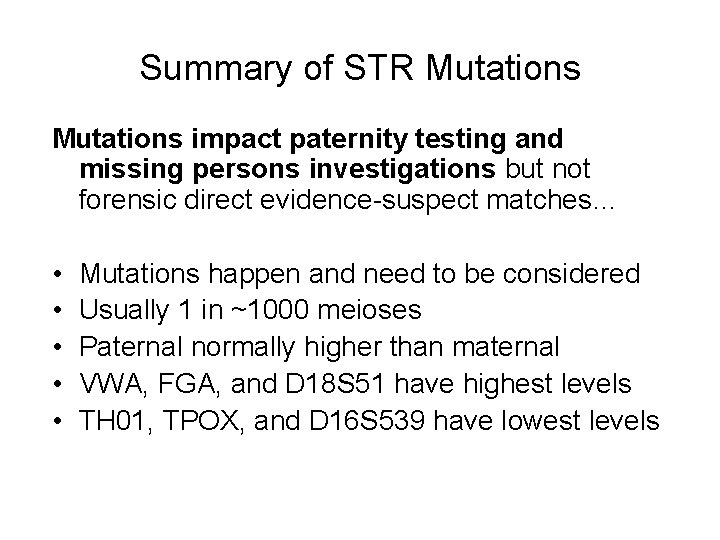
Summary of STR Mutations impact paternity testing and missing persons investigations but not forensic direct evidence-suspect matches… • • • Mutations happen and need to be considered Usually 1 in ~1000 meioses Paternal normally higher than maternal VWA, FGA, and D 18 S 51 have highest levels TH 01, TPOX, and D 16 S 539 have lowest levels
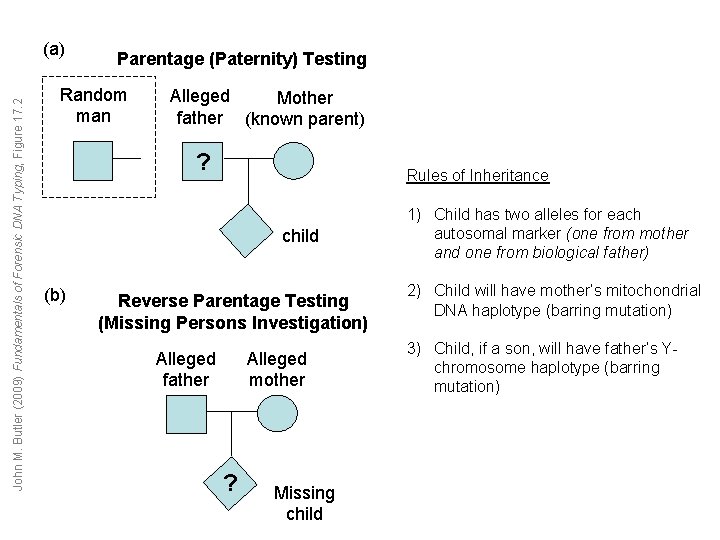
John M. Butler (2009) Fundamentals of Forensic DNA Typing, Figure 17. 2 (a) Parentage (Paternity) Testing Random man Alleged Mother father (known parent) ? Rules of Inheritance child (b) Reverse Parentage Testing (Missing Persons Investigation) Alleged mother Alleged father ? Missing child 1) Child has two alleles for each autosomal marker (one from mother and one from biological father) 2) Child will have mother’s mitochondrial DNA haplotype (barring mutation) 3) Child, if a son, will have father’s Ychromosome haplotype (barring mutation)
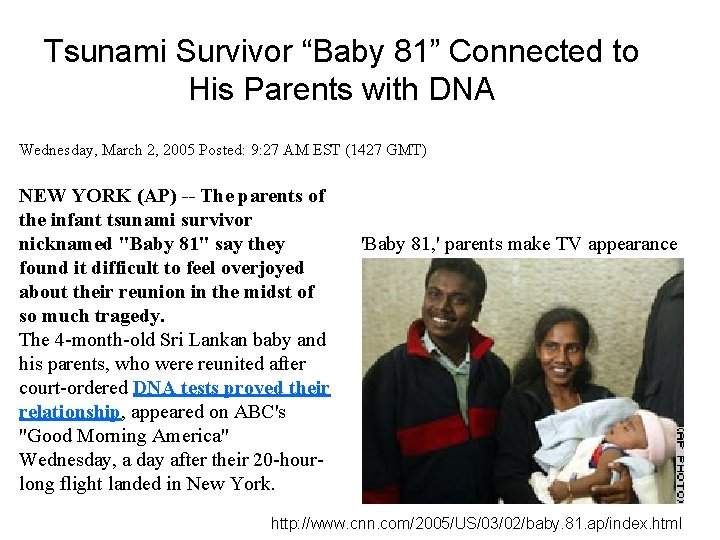
Tsunami Survivor “Baby 81” Connected to His Parents with DNA Wednesday, March 2, 2005 Posted: 9: 27 AM EST (1427 GMT) NEW YORK (AP) -- The parents of the infant tsunami survivor nicknamed "Baby 81" say they found it difficult to feel overjoyed about their reunion in the midst of so much tragedy. The 4 -month-old Sri Lankan baby and his parents, who were reunited after court-ordered DNA tests proved their relationship, appeared on ABC's "Good Morning America" Wednesday, a day after their 20 -hourlong flight landed in New York. 'Baby 81, ' parents make TV appearance http: //www. cnn. com/2005/US/03/02/baby. 81. ap/index. html
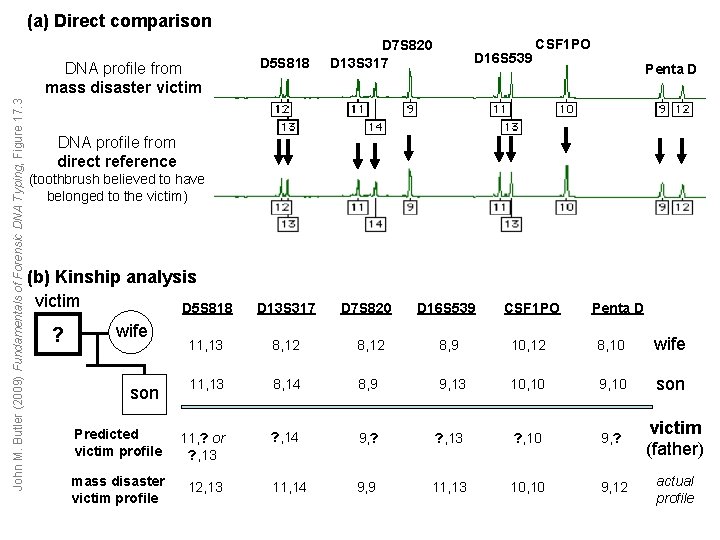
(a) Direct comparison John M. Butler (2009) Fundamentals of Forensic DNA Typing, Figure 17. 3 DNA profile from mass disaster victim D 5 S 818 D 7 S 820 D 13 S 317 D 16 S 539 CSF 1 PO Penta D DNA profile from direct reference (toothbrush believed to have belonged to the victim) (b) Kinship analysis victim D 5 S 818 ? wife D 13 S 317 D 7 S 820 D 16 S 539 CSF 1 PO Penta D 11, 13 8, 12 8, 9 10, 12 8, 10 wife son 11, 13 8, 14 8, 9 9, 13 10, 10 9, 10 son Predicted victim profile 11, ? or ? , 13 ? , 14 9, ? ? , 13 ? , 10 9, ? victim (father) mass disaster victim profile 12, 13 11, 14 9, 9 11, 13 10, 10 9, 12 actual profile
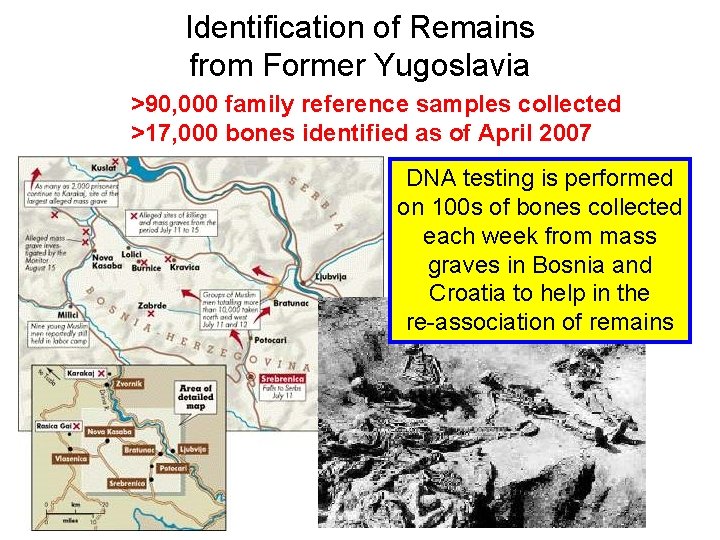
Identification of Remains from Former Yugoslavia >90, 000 family reference samples collected >17, 000 bones identified as of April 2007 DNA testing is performed on 100 s of bones collected each week from mass graves in Bosnia and Croatia to help in the re-association of remains
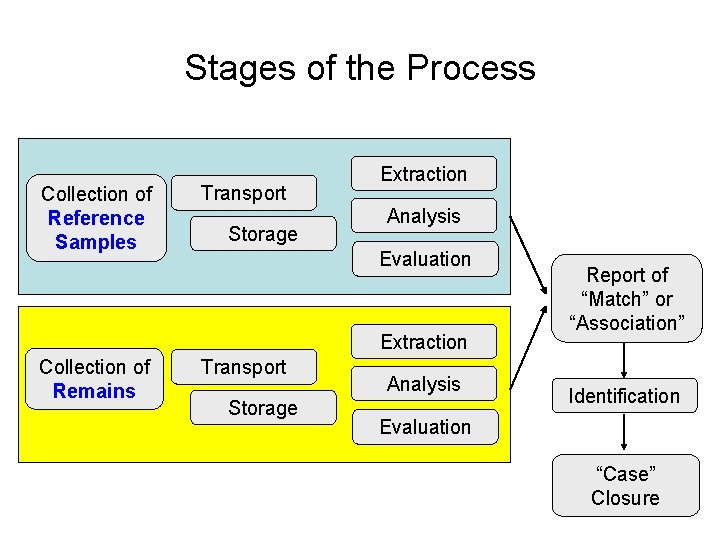
Stages of the Process Collection of Reference Samples Transport Storage Extraction Analysis Evaluation Extraction Collection of Remains Transport Storage Analysis Report of “Match” or “Association” Identification Evaluation “Case” Closure
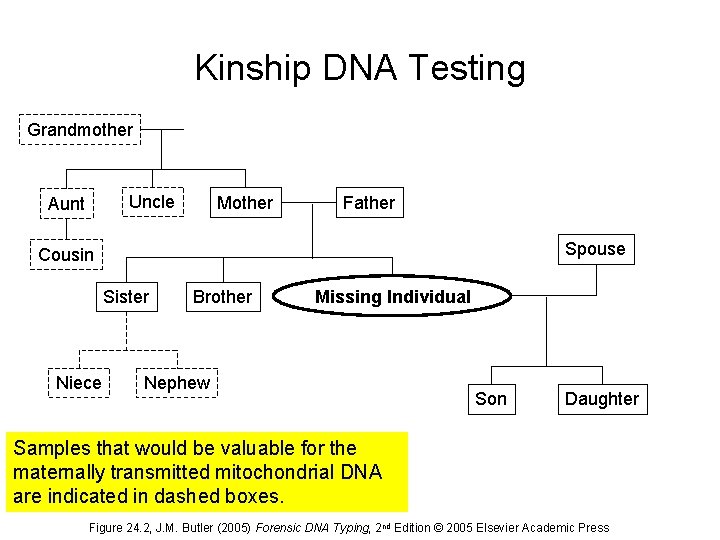
Kinship DNA Testing Grandmother Uncle Aunt Mother Father Spouse Cousin Sister Niece Brother Missing Individual Nephew Son Daughter Samples that would be valuable for the maternally transmitted mitochondrial DNA are indicated in dashed boxes. Figure 24. 2, J. M. Butler (2005) Forensic DNA Typing, 2 nd Edition © 2005 Elsevier Academic Press
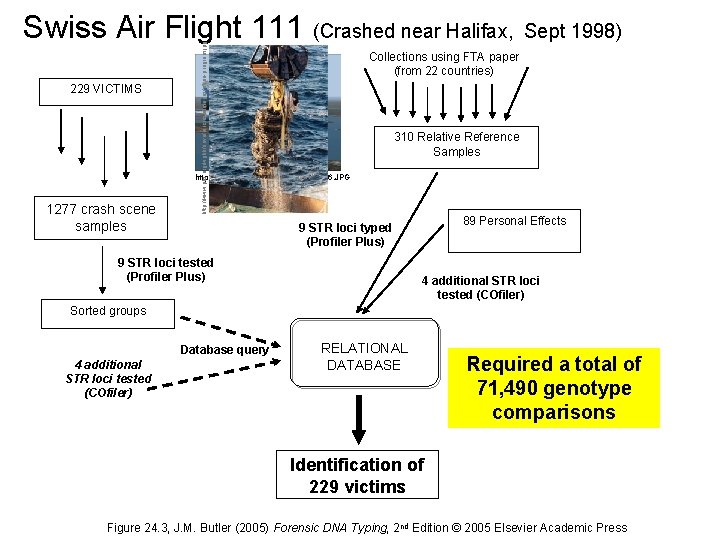
229 VICTIMS http: //www. pbs. org/wgbh/nova/aircrash/images/abou-program. jpg Swiss Air Flight 111 (Crashed near Halifax, Sept 1998) Collections using FTA paper (from 22 countries) 310 Relative Reference Samples http: //www. fs 2000. org/md-11/md 11_06. JPG 1277 crash scene samples 89 Personal Effects 9 STR loci typed (Profiler Plus) 9 STR loci tested (Profiler Plus) 4 additional STR loci tested (COfiler) Sorted groups Database query 4 additional STR loci tested (COfiler) RELATIONAL DATABASE Required a total of 71, 490 genotype comparisons Identification of 229 victims Figure 24. 3, J. M. Butler (2005) Forensic DNA Typing, 2 nd Edition © 2005 Elsevier Academic Press
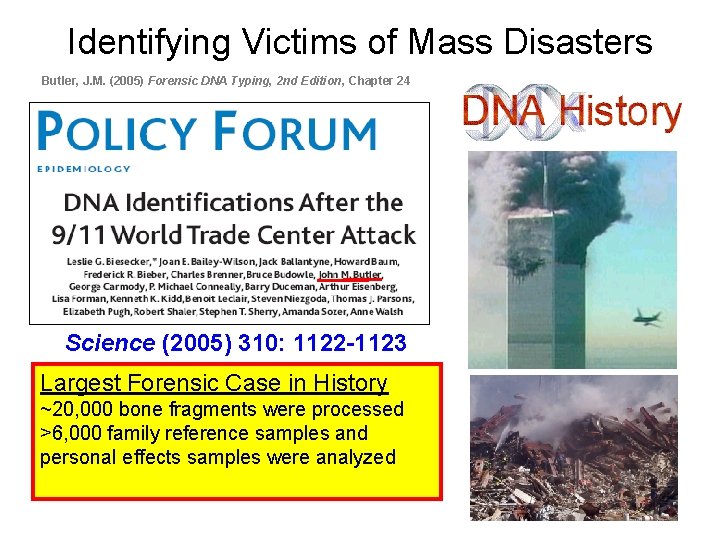
Identifying Victims of Mass Disasters Butler, J. M. (2005) Forensic DNA Typing, 2 nd Edition, Chapter 24 Science (2005) 310: 1122 -1123 Largest Forensic Case in History ~20, 000 bone fragments were processed >6, 000 family reference samples and personal effects samples were analyzed
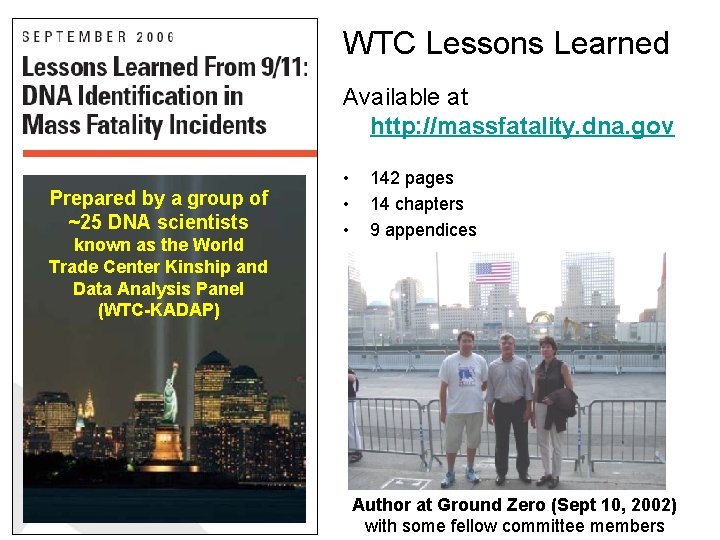
WTC Lessons Learned Available at http: //massfatality. dna. gov Prepared by a group of ~25 DNA scientists known as the World Trade Center Kinship and Data Analysis Panel (WTC-KADAP) • • • 142 pages 14 chapters 9 appendices Author at Ground Zero (Sept 10, 2002) with some fellow committee members
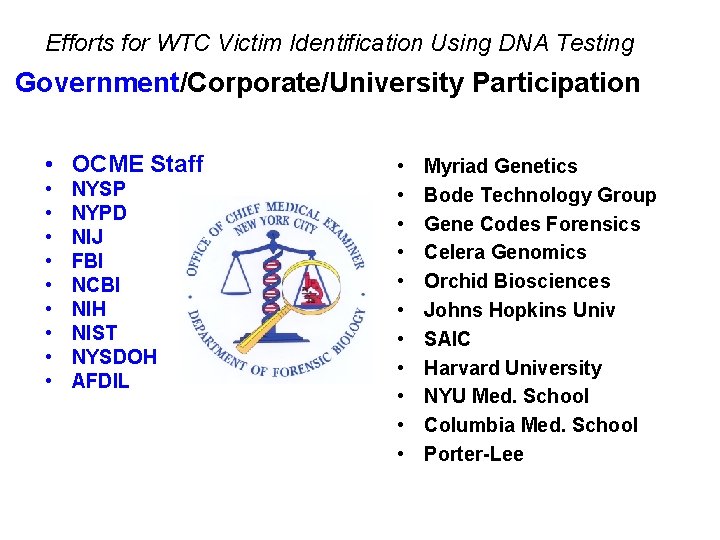
Efforts for WTC Victim Identification Using DNA Testing Government/Corporate/University Participation • OCME Staff • • • NYSP NYPD NIJ FBI NCBI NIH NIST NYSDOH AFDIL • • • Myriad Genetics Bode Technology Group Gene Codes Forensics Celera Genomics Orchid Biosciences Johns Hopkins Univ SAIC Harvard University NYU Med. School Columbia Med. School Porter-Lee
WTC DNA Identifications Free Press (2005)
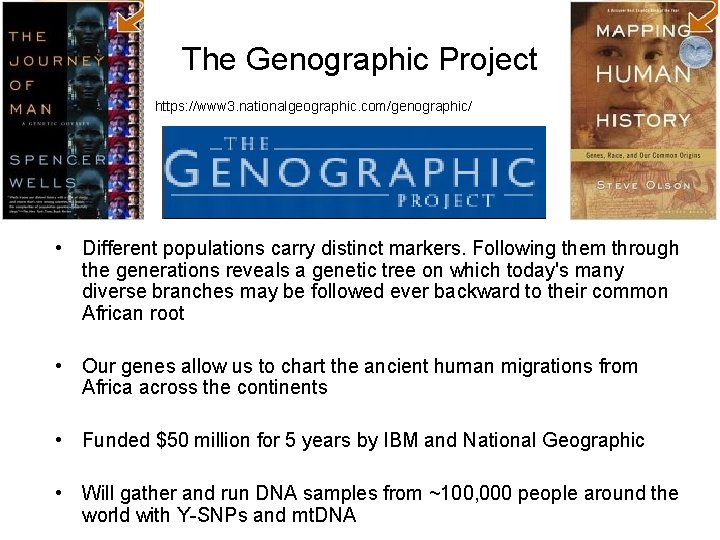
The Genographic Project https: //www 3. nationalgeographic. com/genographic/ • Different populations carry distinct markers. Following them through the generations reveals a genetic tree on which today's many diverse branches may be followed ever backward to their common African root • Our genes allow us to chart the ancient human migrations from Africa across the continents • Funded $50 million for 5 years by IBM and National Geographic • Will gather and run DNA samples from ~100, 000 people around the world with Y-SNPs and mt. DNA
Perhaps the Real Reason Some Genetic Genealogy Is Performed…
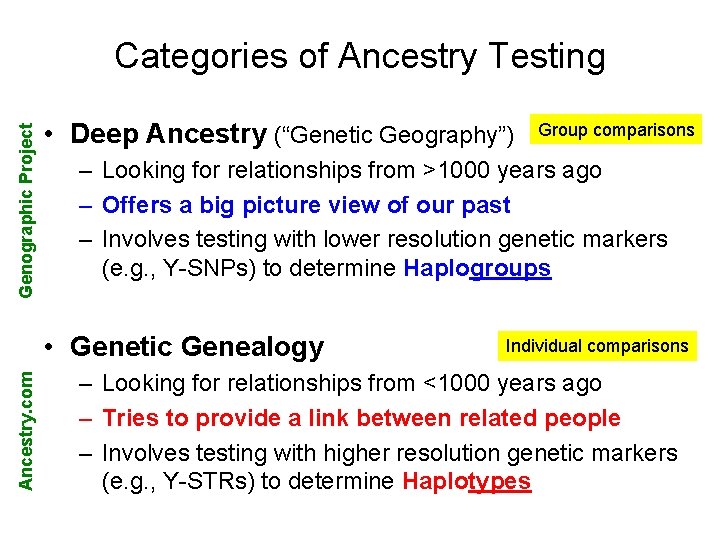
Genographic Project Categories of Ancestry Testing • Deep Ancestry (“Genetic Geography”) – Looking for relationships from >1000 years ago – Offers a big picture view of our past – Involves testing with lower resolution genetic markers (e. g. , Y-SNPs) to determine Haplogroups • Genetic Genealogy Ancestry. com Group comparisons Individual comparisons – Looking for relationships from <1000 years ago – Tries to provide a link between related people – Involves testing with higher resolution genetic markers (e. g. , Y-STRs) to determine Haplotypes
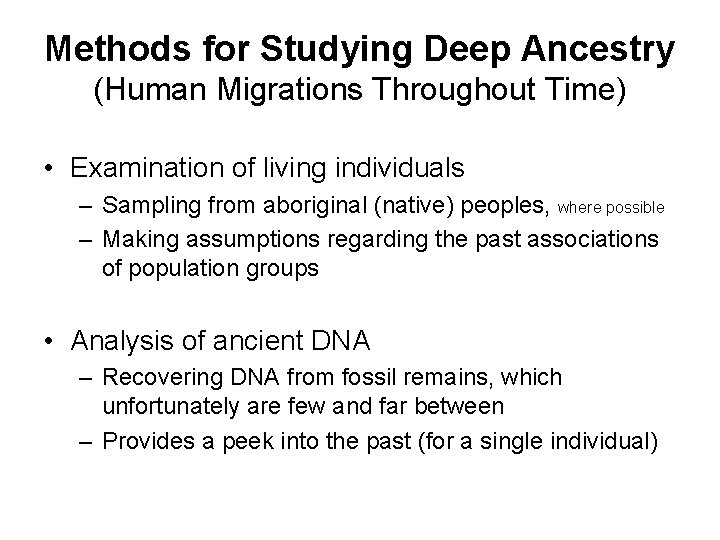
Methods for Studying Deep Ancestry (Human Migrations Throughout Time) • Examination of living individuals – Sampling from aboriginal (native) peoples, where possible – Making assumptions regarding the past associations of population groups • Analysis of ancient DNA – Recovering DNA from fossil remains, which unfortunately are few and far between – Provides a peek into the past (for a single individual)
• The Genographic Project, launched in April 2005, is a five-year genetic anthropology study that aims to map historical human migration patterns by collecting and analyzing DNA samples from hundreds of thousands of people from around the world. http: //en. wikipedia. org/wiki/The_Genographic_Project
Chapter 17 – Points for Discussion • What are some additional uses of STR typing besides forensic DNA analysis? • What advantages and disadvantages are there for the use of DNA in mass disaster victim identification?