
Chapter 17 2 Objectives After to finishing this
Chapter 17. 2
Objectives ► After to: finishing this section, you will be able § Define a bailment § Describe kinds of bailments § Discuss the obligations of common carriers toward passengers
► Special Bailments goods are given to a carrier to be transported ► goods are left with a hotel ►
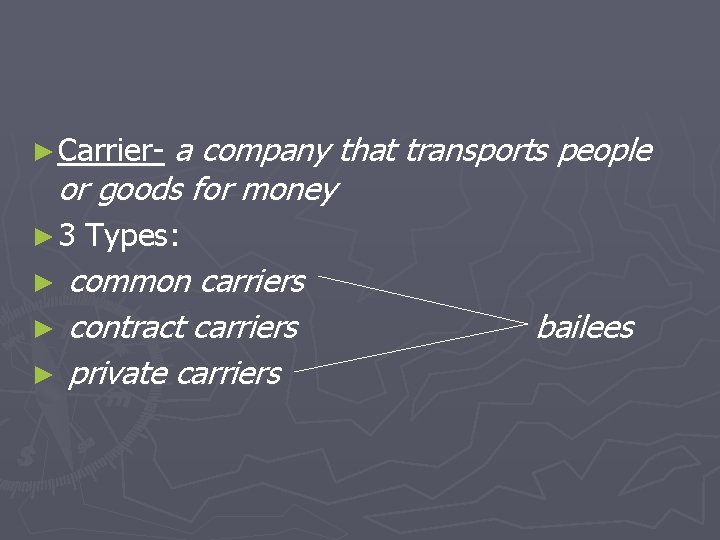
a company that transports people or goods for money ► Carrier► 3 Types: common carriers ► contract carriers ► private carriers ► bailees

► Common carriers- a company that transports people or goods for pay and offers its facilities to the general public ► Must serve everyone: not free to chose their customers and must treat everyone the same (universal service) ► insurers of the goods in their care ► government regulations ► Examples: railroads, airlines, trucking companies ►
► Contract carriers- transports people or goods but limits it to those with whom it desires to do business ► Does not serve public ► Ordinary bailer- reasonable care ► Example: trucking company for a grocery store

► Private carriers- operates its own trucks and other vehicles to transport its own goods ► Example 1: The Star Market Com owns its own fleet of trucks to transport groceries from its warehouse to its many different retail stores. The company’s primary business is selling groceries, not transportation. It is a private carrier.

► The government began to regulate interstate commerce: Railroads were the first to be regulated by the government in 1887 ► In 1978, common and contract carriers were strictly regulated ► § Deregulation of the transportation industry began in 1978.
reduction or removal of government control of business ► Airlines: set their own prices and routes ► Trucking industry: not deregulated ► Deregulation- ► ICC Interstate Commerce Commission- authority to review freight rates that carriers may charge for interstate shipments
► Common Carriers of Goods ► Common carriers may refuse: if they don’t have the equipment ► dangerousness ► improperly packaged ►
► Common Carriers: ► Insures of the goods- liable for loss even if they do nothing wrong
► Exceptions: ► Act of God- natural causes that humans could neither foresee nor avoid (still liable if they could avoid) ► Public enemy- seizure or destruction of goods by the military forces of an opposing government at war with the United States § Is liable for: ordinary robbers, mobs, rioters, or strikers ► Public authority- health officers
► Fault or carelessness of the shipper § § § ► Improper packaging Fraud in labeling Wrong addressing nature of the goods- foods may spoil, liquids may evaporate or ferment, or animals may be injured
► Common Carrier Rights: the payment of fees agreed upon for shipment ► the right of lien on all goods shipped for the amount of the shipping charges ► demurrage charge- a charge for storage beyond the time to load and unload the goods ►
► Common Carriers of People ► Passengers- people being transported by common carriers ► Examples: airplane, trains, bus, taxi, cruise ships
► Universal Service except for: no space available ► disorderly, intoxicated, insane, or infected people ► Airlines may refuse someone who refuses to be searched ►
► Removal of Passengers: Passengers may be removed for any reason that might have stopped them from being accepted in the first place ► Most common- not paying their fare ► ► Example 2: Howard, while in a railway coach, started a disturbance that was displeasing to all and possibly dangerous to some. As the coach passed through a small town, the train slowed to about 5 m. p. h. , and Howard was forcibly put off the train. He suffered an injury and collected damages from the railroad company. The court held that the train should have come to a full stop before Howard was removed.
► Not responsible: acts of God ► legal intervention ► public enemy ► own negligence ►
► Duty ends when they reach their destination and leave the premises ► Example 3: Mildred and Michael took a cruise ship to an island in the Caribbean. The members of the ship’s crew knew that there were areas on the island where tourists were sometimes robbed. They did not warn the passengers of this danger. The couple was robbed while visiting an unsafe area on the island. The cruise ship had violated its duty to warn the couple of possible danger and was susceptible to a lawsuit for their injuries.
► Carriers must have and follow a reasonable time schedule ► Must give ample time to get on and off the vehicle and may not leave early
publish the rules for overbooking ► Generally, if a passenger is bumped- they must be given alternate passage and their money back ► If they cannot be given alternate transportation, they must be given twice the price of their ticket ► Airlines- § Accepting the money relieves the airlines § If passenger declines the money, they may sue
if you leave with the carrier it becomes a bailment ► Lost baggage= $2500 ► Carry on- passenger is liable ► Baggage-
► Hotelkeepers and Their Guests individuals, partnership, or corporation that regularly offers rooms to transients for a price ► Transient- guest, a person whose stay is uncertain in length ► Temporary, not long term ► Begins at check-in or intent of check-in and ends at checkout ► Hotelkeeper-
► Rights and Duties of Hotelkeepers: ► Must accept everyone except: Can’t pay ► No rooms ► The person is dangerous to the health, welfare, or safety of other guests ►
► Civil Rights Act of 1964 - a criminal offence for a ► Example 6: Bob sought lodging at the Mainliner Motel but was refused. The clerk could give no reason for his refusal other than her personal dislike for Bob’s political affiliation. Bob was a member of a minority political group that was holding a convention in the town at the time. Bob could hold the motel liable for any damages that he might show had resulted form the motel’s failure to accept him as a guest. hotelkeeper to refuse a room to anyone on the grounds of race, creed, color, sex, or national origin
► Privacy► Example must be guaranteed 7: A few hours after occupying her room in the Mainliner Motel, Sue was embarrassed by the appearance of a porter and another guest, who entered her room with a passkey. Investigation revealed that the room clerk had negligently assigned Sue’s room to another guest, who arrived at a later hour. Such entry would be an invasion of privacy, for which Sue could seek damages from the Mainliner Motel.
► Property- property ► Example hotel is insurer of the guests’ 8: Edgar’s room at the Mainliner Motel was entered by a thief, who stole two suits of clothing and valuable samples used in Edgar’s business. The motel is responsible for the loss, although it was in no way negligent in its effort to protect Edgar’s property.
► An exception is made with accidental fire in which no negligence can be attributed to the hotelkeeper § Includes fires caused by fellow guests ► Fellow guests- other guests staying at the hotel at the ► Example 9: A fire broke out on the second floor of the Mainliner Motel. Although the fire was confined to that floor, several guests on the first floor reported losses to their property due to the fire and water. The motel was able to prove that the fire had started from a cigarette dropped on a bed by one of the guests. Such careless smoking violated both a city ordinance and a rule of the motel. The hotelkeeper was not responsible for the losses caused by the fire. same time
► Hotels must provide a safe place for storing valuables ► Example 10: Isabel took a room at the Evergreen Hotel. She had in her possession a valuable diamond necklace, which was lost during the night. The hotel proved that there was a good lock on the door and that all reasonable precautions had been made to protect the hotel against thefts. On the basis of these facts, the hotel escaped liability because Isabel should have put her necklace in the hotel safe for safekeeping.
► Guest’s Comfort and Safety- must provide a minimum standard of comfort, safety, and sanitation ► Example 11: A section of carpeting in the hall outside Sue’s room at the Mainliner Motel had torn loose, and the motel housekeeper had neglected to make the necessary repairs for several days. Sue tripped over the torn carpeting, suffering painful injuries. The motel had been negligent, and may be held responsible by Sue for damages resulting from the injury.
► Rights of Payment: ► may demand in advance ► right of lien on luggage if guests don’t pay ► Example 12: When Sue completed her business and was about to leave the city, she discovered that she did not have enough cash to pay her bill at the Mainliner Motel. The motel would not accept a check and took possession of her luggage as security until the bill was paid. After cash had been wired to Sue by her company, she paid the bill. This terminated the motel’s right of lien on her property.
► Guests’ Responsibilities- cannot give lodging to visitors overnight without the express consent of the management ► This stay is considered a petty theft because the visitor is not paying for the night’s stay ► Guests must check in and check out § Paying your bill is not the same as checking out ► Checking out- turning in your key and giving up further claim to a room
Assignment ► Page 379 #1 -6
- Slides: 33