
CHAPTER 17 1 CHAPTER 17 Banking and Financial
CHAPTER 17 1 CHAPTER 17 Banking and Financial Services 17 -1 Banks and Other Financial Institutions 17 -2 Financial Services and Electronic Banking 17 -3 Checks and Payment Methods © 2012 Cengage Learning. All Rights Reserved. Principles of Business, 8 e
17 -1 Banks and Other Financial Institutions Goal 1 Explain the purpose of the Federal Reserve System. Goal 2 List the types of financial institutions. Goal 3 Discuss factors for selecting a financial institution. © 2012 Cengage Learning. All Rights Reserved. SLIDE 2
CHAPTER 17 3 KEY TERMS ● Federal Reserve System (Fed) ● commercial bank ● credit union ● Federal Deposit Insurance Corporation (FDIC) © 2012 Cengage Learning. All Rights Reserved. Principles of Business, 8 e
CHAPTER 17 4 THE BANKING SYSTEM ● The Federal Reserve System (Fed) ● Federal Reserve activities ● Banking and the economy © 2012 Cengage Learning. All Rights Reserved. Principles of Business, 8 e
CHAPTER 17 5 Checkpoint ● What is the main purpose of the Federal Reserve System? ● The Federal Reserve System was created by the federal government to supervise and regulate member banks and to help banks serve the public efficiently by holding reserves and clearing checks. © 2012 Cengage Learning. All Rights Reserved. Principles of Business, 8 e
TYPES OF FINANCIAL INSTITUTIONS CHAPTER 17 6 ● Deposit institutions ● Non-deposit financial institutions © 2012 Cengage Learning. All Rights Reserved. Principles of Business, 8 e
CHAPTER DEPOSIT INSTITUTIONS 17 7 ● Commercial banks ● Savings and loan associations ● Mutual savings banks ● Credit unions © 2012 Cengage Learning. All Rights Reserved. Principles of Business, 8 e
NON-DEPOSIT FINANCIAL INSTITUTIONS CHAPTER 17 8 ● Life insurance companies ● Investment companies ● Consumer finance companies ● Mortgage companies ● Check-cashing outlets ● Pawnshops © 2012 Cengage Learning. All Rights Reserved. Principles of Business, 8 e
CHAPTER 17 9 Checkpoint ● What are some examples of non-deposit financial institutions? ● Examples of non-deposit financial institutions include life insurance companies, investment companies, consumer finance companies, mortgage companies, check-cashing outlets, and pawnshops. © 2012 Cengage Learning. All Rights Reserved. Principles of Business, 8 e
CHAPTER SELECTING A FINANCIAL INSTITUTION 17 10 ● Services offered ● ● ● ● Savings accounts Checking and payment accounts Loans and other credit plans Other services, such as safe-deposit boxes Safety Convenience Fees and charges Restrictions © 2012 Cengage Learning. All Rights Reserved. Principles of Business, 8 e
CHAPTER 17 11 Checkpoint ● What factors should be considered when selecting a financial institution? ● Factors to consider when shopping for a financial institution include the services offered, safety, convenience, fees and charges, and restrictions. © 2012 Cengage Learning. All Rights Reserved. Principles of Business, 8 e
17 -2 Financial Services and Electronic Banking Goal 1 Identify the financial services used by consumers. Goal 2 Explain types of checking accounts. Goal 3 Describe electronic banking activities. © 2012 Cengage Learning. All Rights Reserved. SLIDE 12
CHAPTER KEY TERMS 17 13 ● safe-deposit box ● service charge ● debit card © 2012 Cengage Learning. All Rights Reserved. Principles of Business, 8 e
TYPES OF FINANCIAL SERVICES ● ● ● ● CHAPTER 17 14 Savings services Payment services Lending services Electronic banking Storage of valuables Investment advice Management of trusts © 2012 Cengage Learning. All Rights Reserved. Principles of Business, 8 e
CHAPTER 17 15 Checkpoint ● What are the main financial services used by consumers? ● The main financial services used by consumers are savings services, payment services, lending services, electronic banking, storage of valuables, investment advice, and management of trusts. © 2012 Cengage Learning. All Rights Reserved. Principles of Business, 8 e
TYPES OF CHECKING ACCOUNTS CHAPTER 17 16 ● Regular checking accounts ● Interest-earning ● Checking accounts ● Special checking accounts © 2012 Cengage Learning. All Rights Reserved. Principles of Business, 8 e
COMPARING CHECKING ACCOUNTS CHAPTER 17 17 ● Minimum balance ● Interest rate earned, if any ● Monthly service charge ● Fees for other services, such as printing checks and stop payment orders ● Other restrictions © 2012 Cengage Learning. All Rights Reserved. Principles of Business, 8 e
CHAPTER 17 18 Checkpoint ● What are three main types of checking accounts? ● Regular checking accounts ● Interest-earning checking accounts ● Special checking accounts © 2012 Cengage Learning. All Rights Reserved. Principles of Business, 8 e
CHAPTER ELECTRONIC BANKING 17 19 ● E-banking services ● Automatic teller machines ● Payments at the point-of-sale ● Direct deposit ● Automatic bill payments © 2012 Cengage Learning. All Rights Reserved. Principles of Business, 8 e
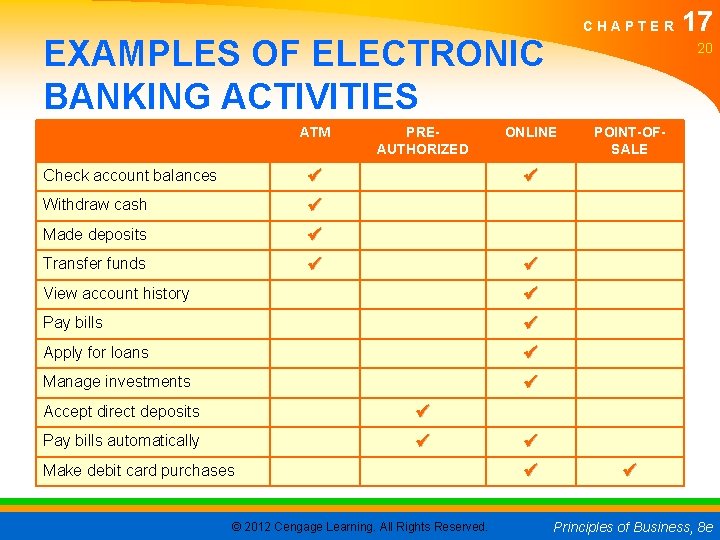
CHAPTER EXAMPLES OF ELECTRONIC BANKING ACTIVITIES ATM Check account balances Withdraw cash Made deposits Transfer funds PREAUTHORIZED 17 20 ONLINE POINT-OFSALE View account history Pay bills Apply for loans Manage investments Accept direct deposits Pay bills automatically Make debit card purchases © 2012 Cengage Learning. All Rights Reserved. Principles of Business, 8 e
ELECTRONIC PAYMENT OPTIONS CHAPTER 17 21 ● Debit card transactions ● Online payments ● Stored-value cards ● Smart cards © 2012 Cengage Learning. All Rights Reserved. Principles of Business, 8 e
CHAPTER 17 22 BANKING IN THE FUTURE ● Financial services combined with wireless technology ● Personalized systems for obtaining, transferring, and using funds © 2012 Cengage Learning. All Rights Reserved. Principles of Business, 8 e
CHAPTER 17 23 Checkpoint ● What are common electronic banking services? ● Common electronic banking services include automatic teller machines (ATMs), point-of-sale payments, direct deposit, and automatic bill payments. ● E-banking also includes electronic payment options such as debit card transactions, online payments, stored-value cards, and smart cards. © 2012 Cengage Learning. All Rights Reserved. Principles of Business, 8 e
17 -3 Checks and Payment Methods Goal 1 Describe three main types of endorsements. Goal 2 Describe proper check-writing procedures. Goal 3 Explain the bank reconciliation process. Goal 4 Identify other payment methods. © 2012 Cengage Learning. All Rights Reserved. SLIDE 24
CHAPTER KEY TERMS 17 25 ● endorsement ● check register ● stop payment order ● bank statement ● bank reconciliation ● outstanding checks © 2012 Cengage Learning. All Rights Reserved. Principles of Business, 8 e
OPENING A CHECKING ACCOUNT CHAPTER 17 26 ● Benefits of checking accounts ● Convenience and ease of making payments ● Safety to make payments with less risk than using cash ● Proof of payment ● A record of finances for managing your money © 2012 Cengage Learning. All Rights Reserved. Principles of Business, 8 e
CHAPTER THE FIRST DEPOSIT 17 27 ● Signature card ● Joint account ● Deposit slip © 2012 Cengage Learning. All Rights Reserved. Principles of Business, 8 e
CHAPTER TYPES OF ENDORSEMENTS 17 28 ● Blank endorsement ● Full endorsement ● Restrictive endorsement ● Special endorsement ● Two signatures required ● Restrictive endorsement © 2012 Cengage Learning. All Rights Reserved. Principles of Business, 8 e
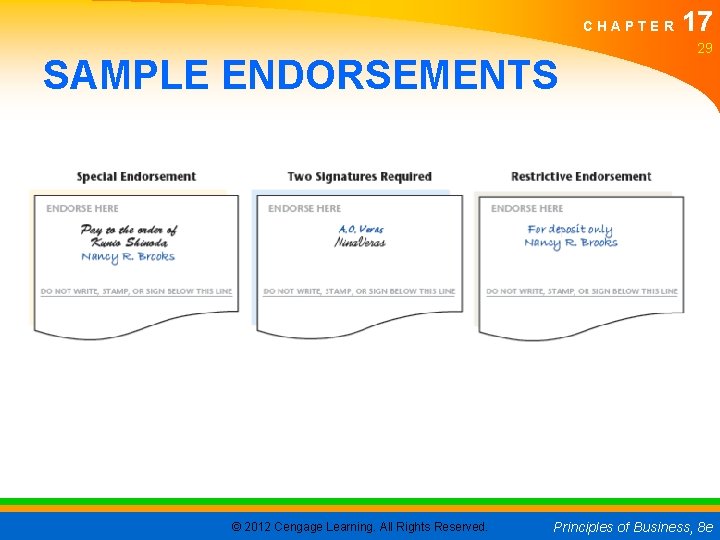
CHAPTER SAMPLE ENDORSEMENTS © 2012 Cengage Learning. All Rights Reserved. 17 29 Principles of Business, 8 e
CHAPTER Checkpoint 17 30 ● What are three types of endorsements? ● Blank endorsement ● Full endorsement ● Restrictive endorsement © 2012 Cengage Learning. All Rights Reserved. Principles of Business, 8 e
USING A CHECKING ACCOUNT CHAPTER 17 31 ● Check-writing procedures ● Elements of a check ● The check register ● Writing a check ● Proper check writing ● Stopping payment © 2012 Cengage Learning. All Rights Reserved. Principles of Business, 8 e
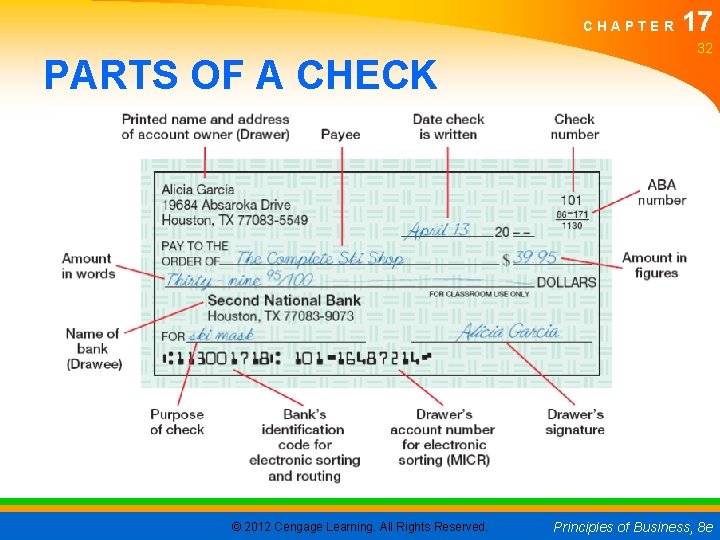
CHAPTER PARTS OF A CHECK © 2012 Cengage Learning. All Rights Reserved. 17 32 Principles of Business, 8 e
CHAPTER 17 33 Checkpoint ● What is the purpose of a check register? ● The purpose of a check register is to record all account activities so that the account holder will always know the account balance. ● The check register is also used for reconciling a checkbook with a bank’s monthly statement. © 2012 Cengage Learning. All Rights Reserved. Principles of Business, 8 e
THE RECONCILIATION PROCESS CHAPTER 17 34 ● Bank statement information ● Determine checks paid ● Find differences ● Calculate adjusted balance © 2012 Cengage Learning. All Rights Reserved. Principles of Business, 8 e
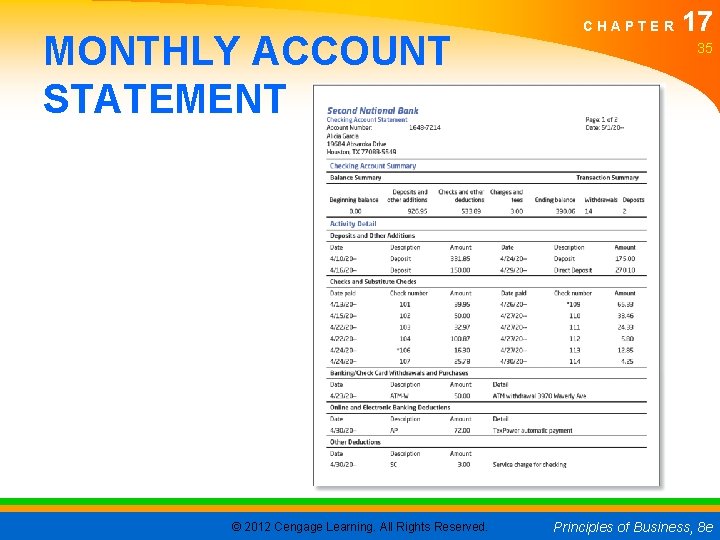
MONTHLY ACCOUNT STATEMENT © 2012 Cengage Learning. All Rights Reserved. CHAPTER 17 35 Principles of Business, 8 e
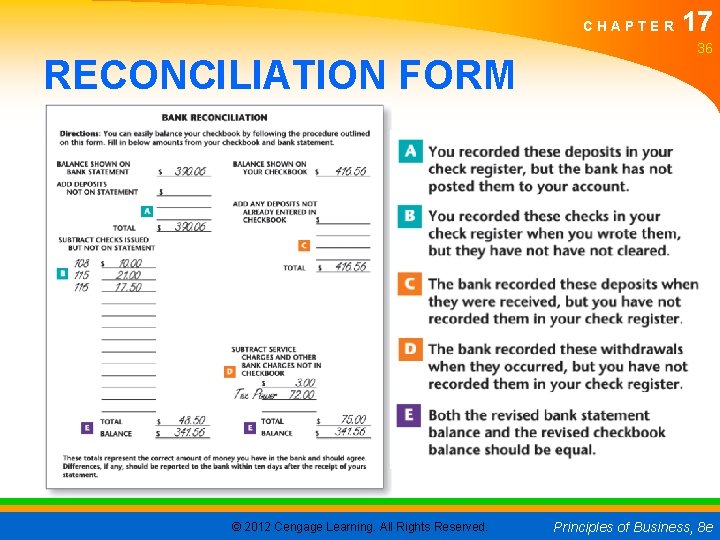
CHAPTER RECONCILIATION FORM © 2012 Cengage Learning. All Rights Reserved. 17 36 Principles of Business, 8 e
CHAPTER 17 37 Checkpoint ● What are causes of differences between the bank statement balance and a check register? ● Checks that have not cleared ● Deposits mailed to the bank that may not have arrived by the time the statement was issued ● Transactions that may not have been recorded in the check register ● Transactions that were not recorded correctly ● Service charges or interest earned © 2012 Cengage Learning. All Rights Reserved. Principles of Business, 8 e
OTHER TYPES OF PAYMENTS CHAPTER 17 38 ● Certified checks ● Cashier’s checks ● Traveler’s checks ● Money orders © 2012 Cengage Learning. All Rights Reserved. Principles of Business, 8 e
CHAPTER 17 39 CERTIFIED CHECKS ● Personal check for which a bank has guaranteed payment ● Certification stamped on face ● Signed or initialed by a bank officer © 2012 Cengage Learning. All Rights Reserved. Principles of Business, 8 e
CHAPTER 17 40 CASHIER’S CHECKS ● Check that a bank draws on its own funds ● Costs the amount of the check plus a service fee ● More acceptable than the personal checks © 2012 Cengage Learning. All Rights Reserved. Principles of Business, 8 e
CHAPTER 17 41 TRAVELER’S CHECKS ● Special forms designed for making payments when away from home ● Require your signature in two places ● Cash a check or pay for a purchase ● Commonly accepted throughout the world © 2012 Cengage Learning. All Rights Reserved. Principles of Business, 8 e
CHAPTER 17 42 MONEY ORDERS ● Form of payment that orders the issuing agency to pay the amount printed on the form to another party ● A bank money order ● A postal money order ● An express money order ● A telegraphic money order © 2012 Cengage Learning. All Rights Reserved. Principles of Business, 8 e
CHAPTER 17 43 Checkpoint ● How does a certified check differ from a cashier’s check? ● A certified check is a personal check for which a bank has guaranteed payment. ● A cashier’s check is a check that a bank draws on its own funds. © 2012 Cengage Learning. All Rights Reserved. Principles of Business, 8 e
- Slides: 43