
Chapter 16 Waves motion What is a wave

- Slides: 13
Chapter 16 Waves motion
What is a wave? A wave is defined as a Propagation of a disturbance through a medium Wave flees the place of its creation, while water [particle] does not. A wave is a means of transferring energy from one place to another. Waves are closely related to oscillations.
Can you think of some examples of waves?
Waves • Sound • Light • Water • Radio • Seismic
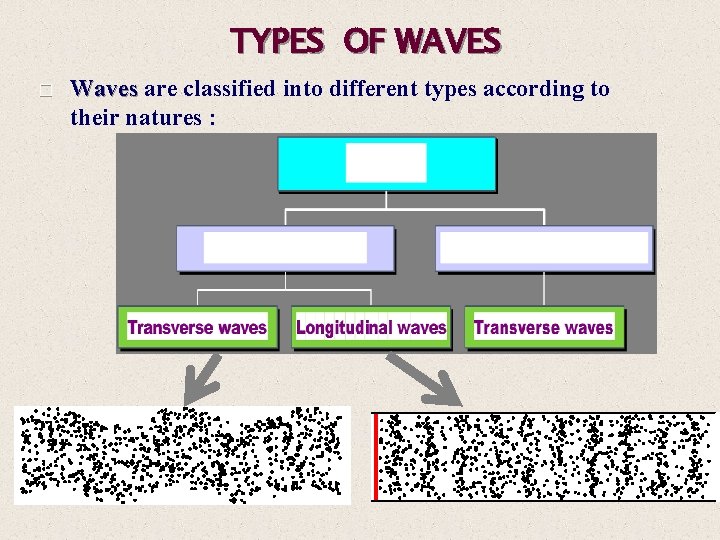
TYPES OF WAVES � Waves are classified into different types according to their natures :
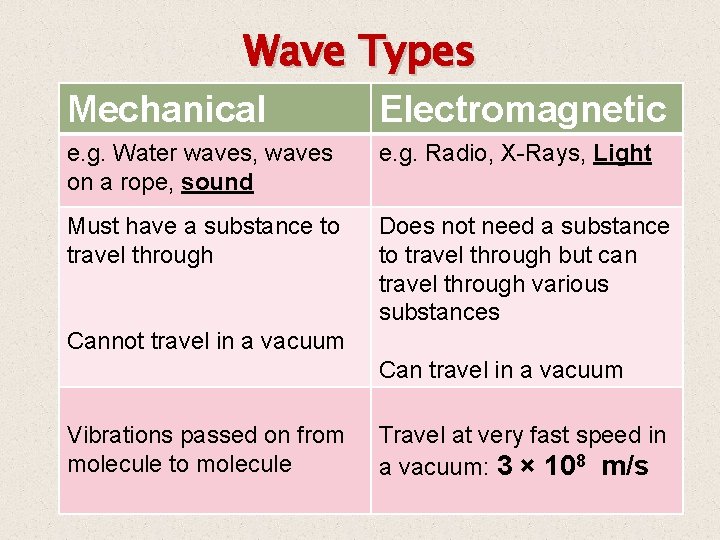
Wave Types Mechanical Electromagnetic e. g. Water waves, waves on a rope, sound e. g. Radio, X-Rays, Light Must have a substance to travel through Does not need a substance to travel through but can travel through various substances Cannot travel in a vacuum Can travel in a vacuum Vibrations passed on from molecule to molecule Travel at very fast speed in a vacuum: 3 × 10⁸ m/s
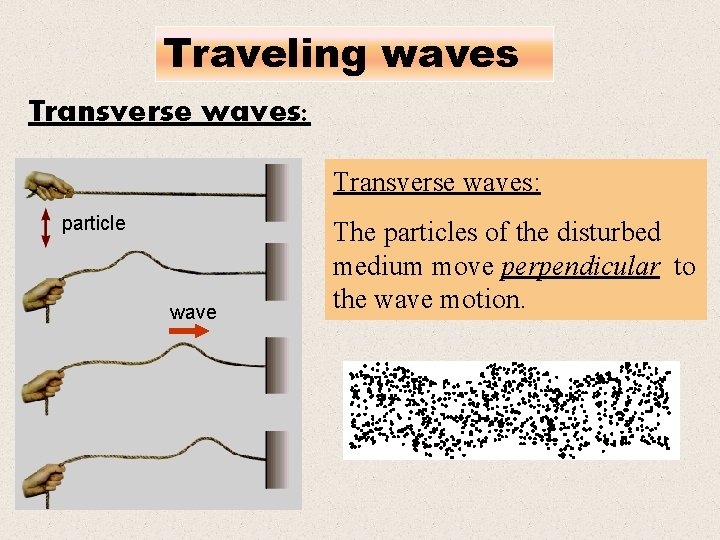
Traveling waves Transverse waves: particle wave The particles of the disturbed medium move perpendicular to the wave motion.
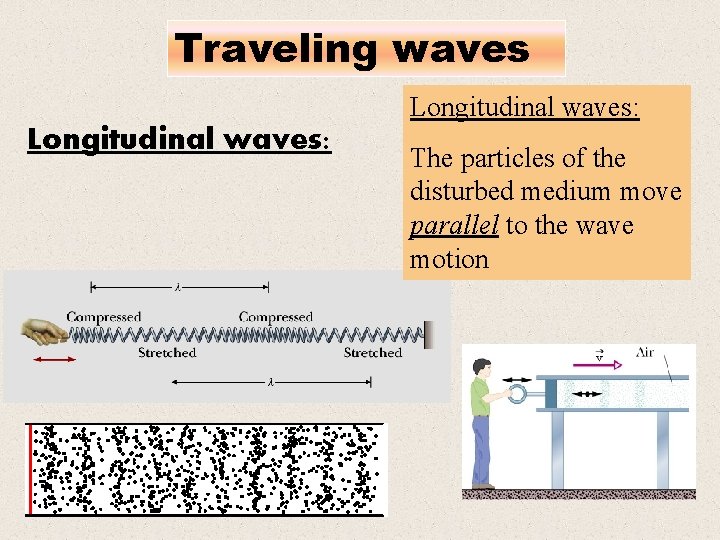
Traveling waves Longitudinal waves: The particles of the disturbed medium move parallel to the wave motion
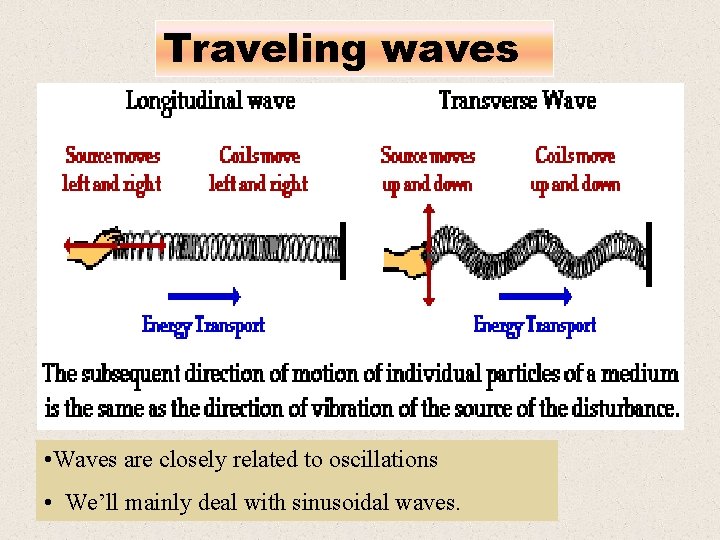
Traveling waves • Waves are closely related to oscillations • We’ll mainly deal with sinusoidal waves.
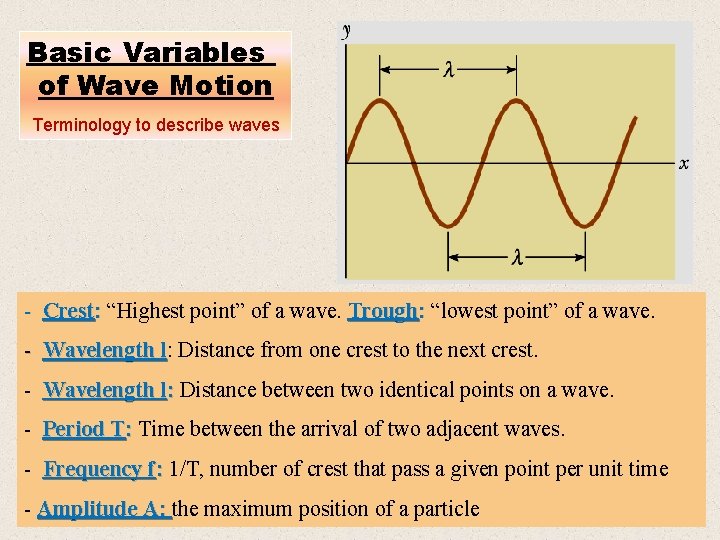
Basic Variables of Wave Motion Terminology to describe waves - Crest: “Highest point” of a wave. Trough: “lowest point” of a wave. - Wavelength l: l Distance from one crest to the next crest. - Wavelength l: Distance between two identical points on a wave. - Period T: Time between the arrival of two adjacent waves. - Frequency f: 1/T, number of crest that pass a given point per unit time - Amplitude A: the maximum position of a particle
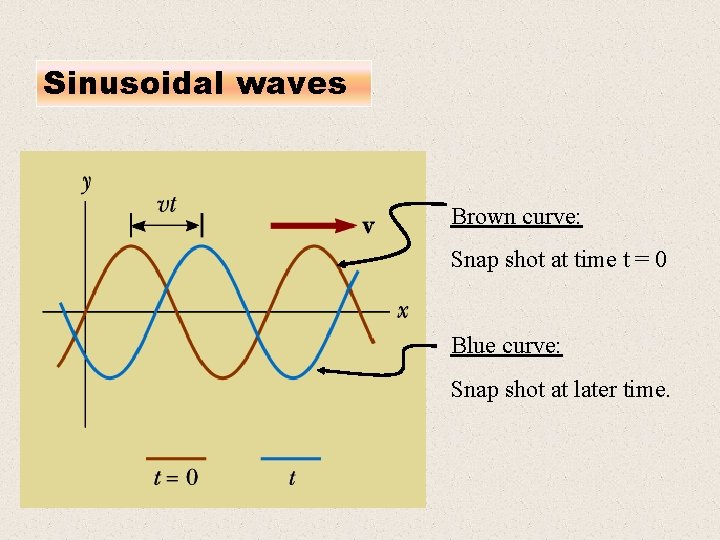
Sinusoidal waves Brown curve: Snap shot at time t = 0 Blue curve: Snap shot at later time.
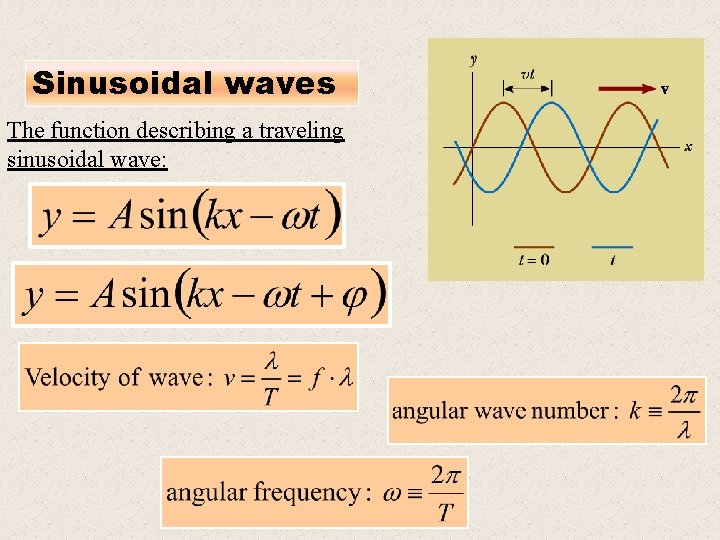
Sinusoidal waves The function describing a traveling sinusoidal wave:
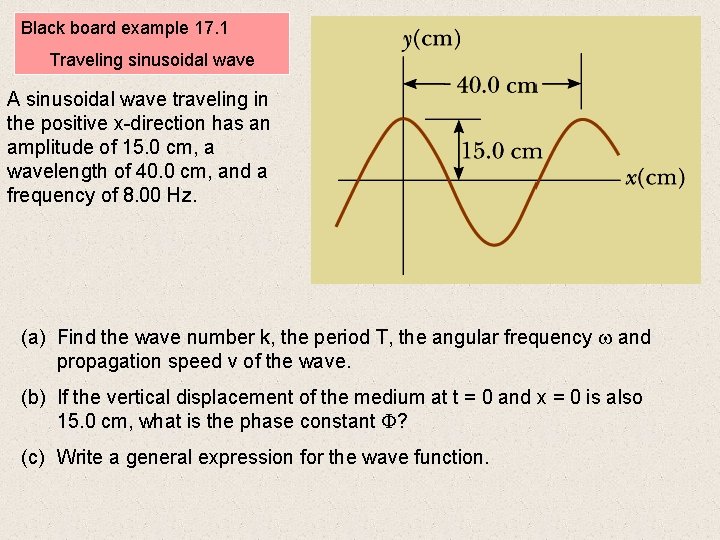
Black board example 17. 1 Traveling sinusoidal wave A sinusoidal wave traveling in the positive x-direction has an amplitude of 15. 0 cm, a wavelength of 40. 0 cm, and a frequency of 8. 00 Hz. (a) Find the wave number k, the period T, the angular frequency w and propagation speed v of the wave. (b) If the vertical displacement of the medium at t = 0 and x = 0 is also 15. 0 cm, what is the phase constant F? (c) Write a general expression for the wave function.