
Chapter 16 Wave Motion 1 Types of Waves
- Slides: 47
Chapter 16 Wave Motion 1
Types of Waves n There are two main types of waves n Mechanical waves n n n Some physical medium is being disturbed The wave is the propagation of a disturbance through a medium Electromagnetic waves n n No medium required Examples are light, radio waves, x-rays 2
General Features of Waves n n n In wave motion, energy is transferred over a distance Matter is not transferred over a distance All waves carry energy n The amount of energy and the mechanism responsible for the transport of the energy differ from case to case 3
Mechanical Wave Requirements n n n Some source of disturbance A medium that can be disturbed Some physical mechanism through which elements of the medium can influence each other 4
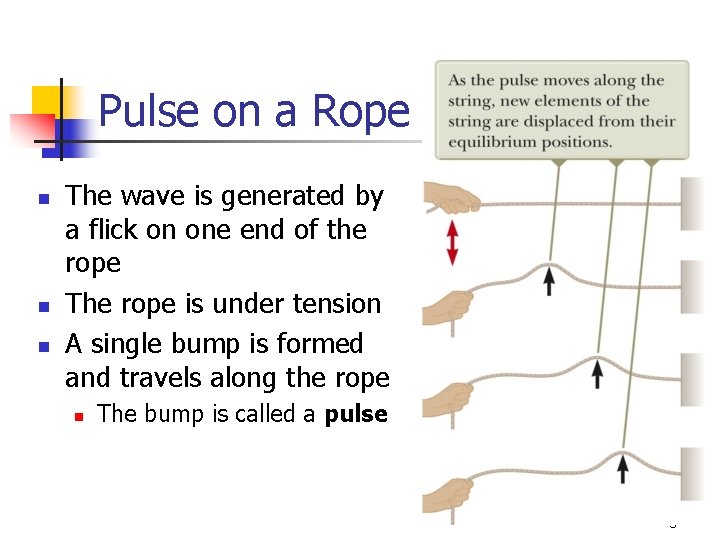
Pulse on a Rope n n n The wave is generated by a flick on one end of the rope The rope is under tension A single bump is formed and travels along the rope n The bump is called a pulse 5
Pulse on a Rope n n The rope is the medium through which the pulse travels The pulse has a definite height The pulse has a definite speed of propagation along the medium A continuous flicking of the rope would produce a periodic disturbance which would form a wave 6
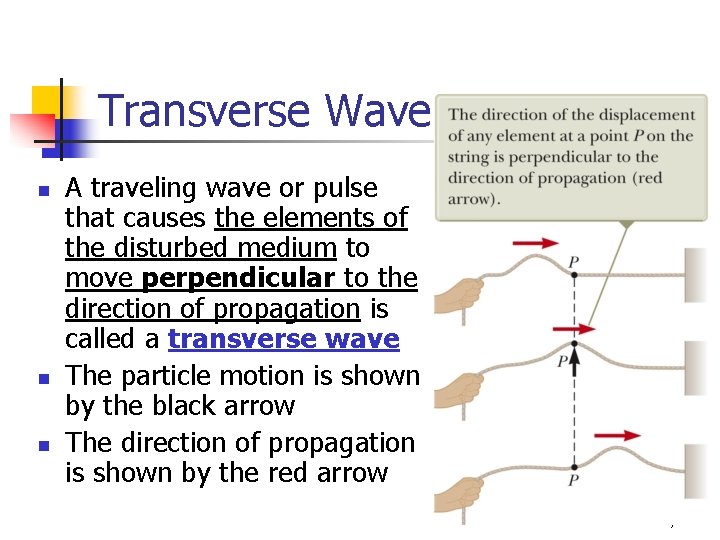
Transverse Wave n n n A traveling wave or pulse that causes the elements of the disturbed medium to move perpendicular to the direction of propagation is called a transverse wave The particle motion is shown by the black arrow The direction of propagation is shown by the red arrow 7
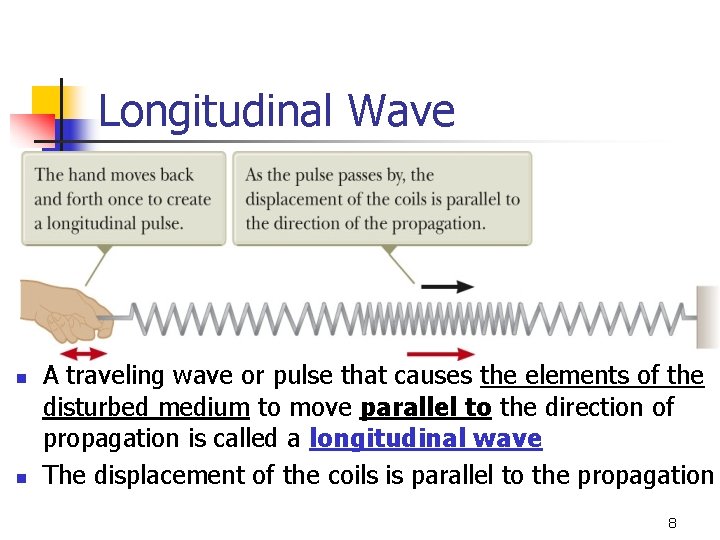
Longitudinal Wave n n A traveling wave or pulse that causes the elements of the disturbed medium to move parallel to the direction of propagation is called a longitudinal wave The displacement of the coils is parallel to the propagation 8
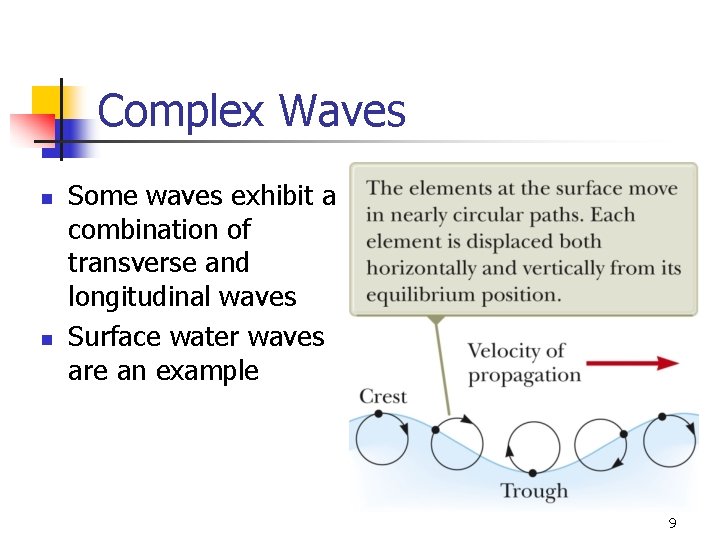
Complex Waves n n Some waves exhibit a combination of transverse and longitudinal waves Surface water waves are an example 9
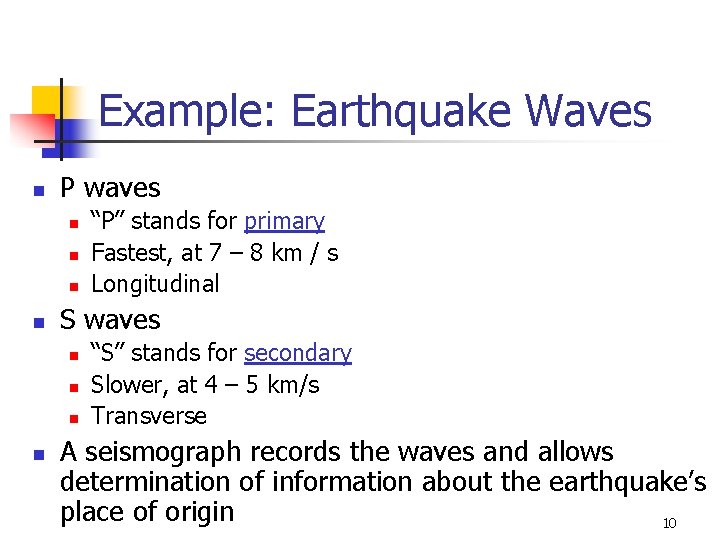
Example: Earthquake Waves n P waves n n S waves n n “P” stands for primary Fastest, at 7 – 8 km / s Longitudinal “S” stands for secondary Slower, at 4 – 5 km/s Transverse A seismograph records the waves and allows determination of information about the earthquake’s place of origin 10
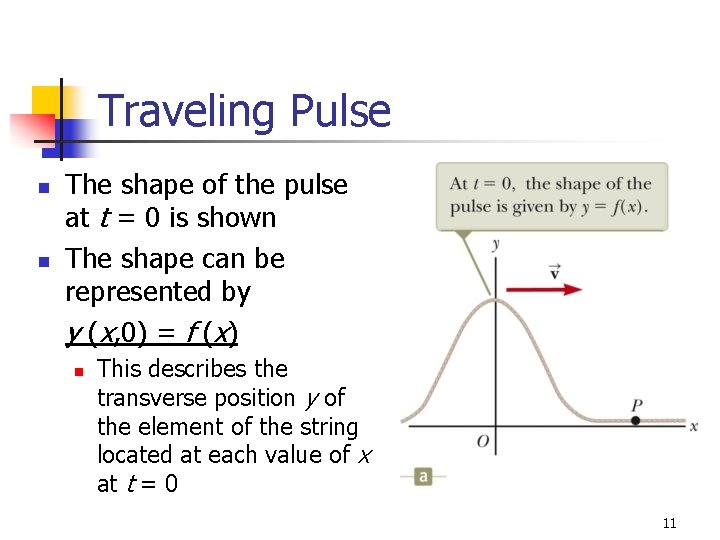
Traveling Pulse n n The shape of the pulse at t = 0 is shown The shape can be represented by y (x, 0) = f (x) n This describes the transverse position y of the element of the string located at each value of x at t = 0 11
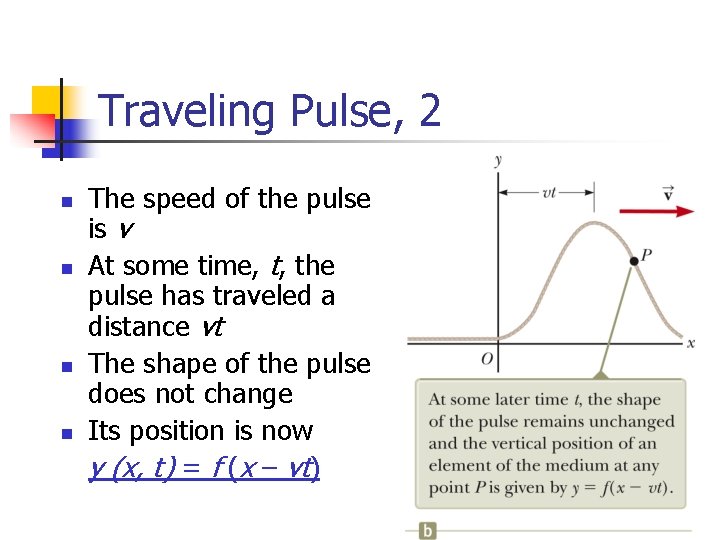
Traveling Pulse, 2 n n The speed of the pulse is v At some time, t, the pulse has traveled a distance vt The shape of the pulse does not change Its position is now y (x, t) = f (x – vt) 12
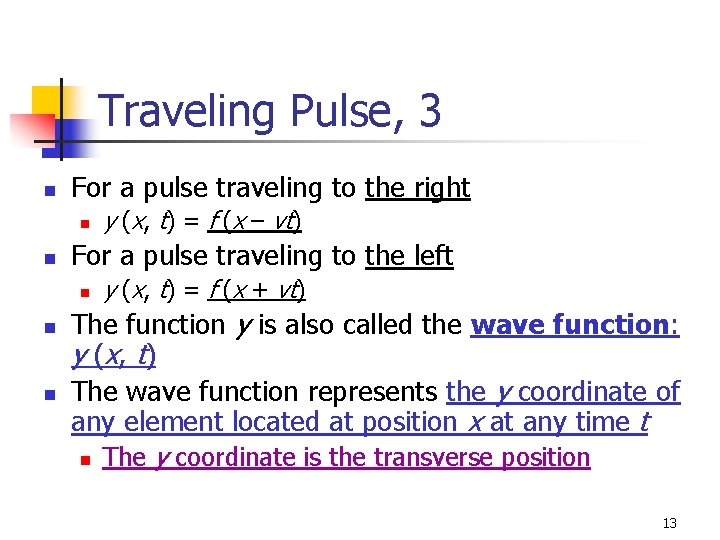
Traveling Pulse, 3 n For a pulse traveling to the right n n For a pulse traveling to the left n n n y (x, t) = f (x – vt) y (x, t) = f (x + vt) The function y is also called the wave function: y ( x, t ) The wave function represents the y coordinate of any element located at position x at any time t n The y coordinate is the transverse position 13
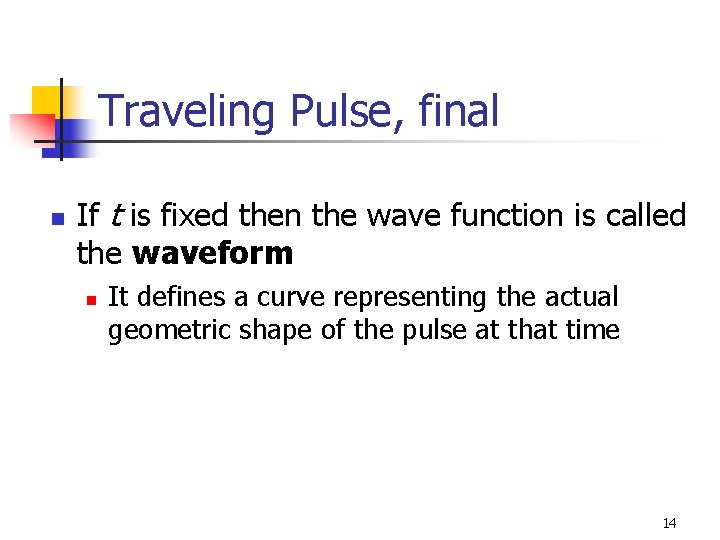
Traveling Pulse, final n If t is fixed then the wave function is called the waveform n It defines a curve representing the actual geometric shape of the pulse at that time 14
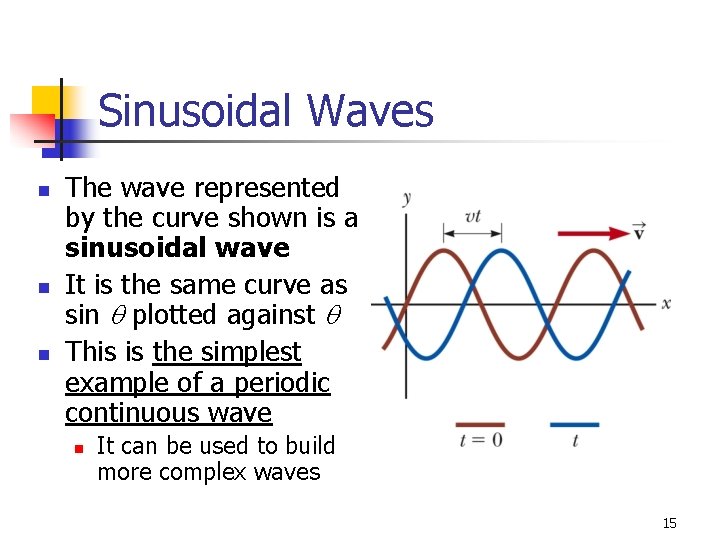
Sinusoidal Waves n n n The wave represented by the curve shown is a sinusoidal wave It is the same curve as sin q plotted against q This is the simplest example of a periodic continuous wave n It can be used to build more complex waves 15
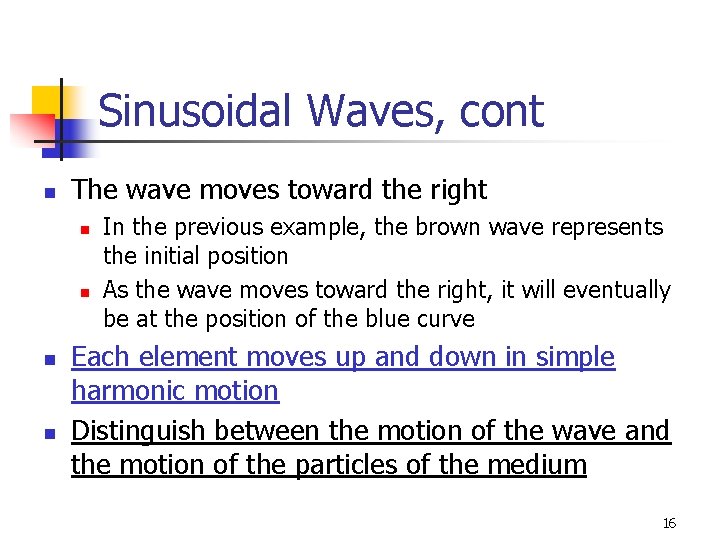
Sinusoidal Waves, cont n The wave moves toward the right n n In the previous example, the brown wave represents the initial position As the wave moves toward the right, it will eventually be at the position of the blue curve Each element moves up and down in simple harmonic motion Distinguish between the motion of the wave and the motion of the particles of the medium 16
Wave Model n The wave model is a new simplification model n n Allows to explore more analysis models for solving problems An ideal wave has a single frequency An ideal wave is infinitely long Ideal waves can be combined 17
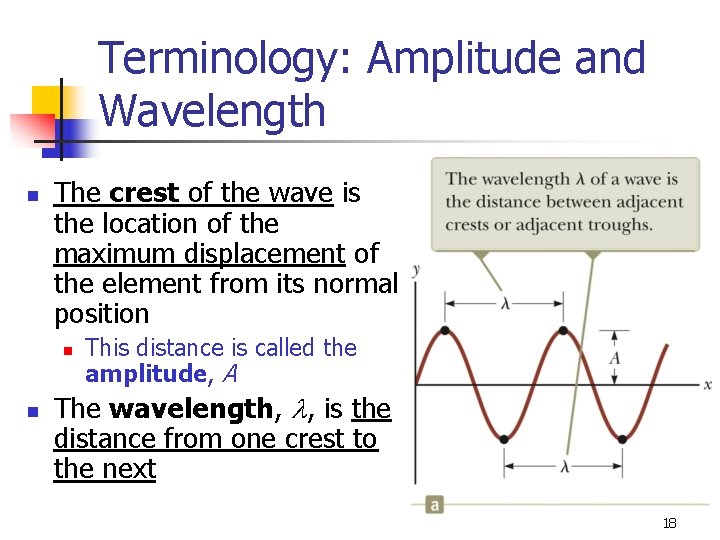
Terminology: Amplitude and Wavelength n The crest of the wave is the location of the maximum displacement of the element from its normal position n n This distance is called the amplitude, A The wavelength, l, is the distance from one crest to the next 18
Terminology: Wavelength and Period n n More generally, the wavelength is the minimum distance between any two identical points on adjacent waves The period, T , is the time interval required for two identical points of adjacent waves to pass by a point n The period of the wave is the same as the period of the simple harmonic oscillation of one element of the medium 19
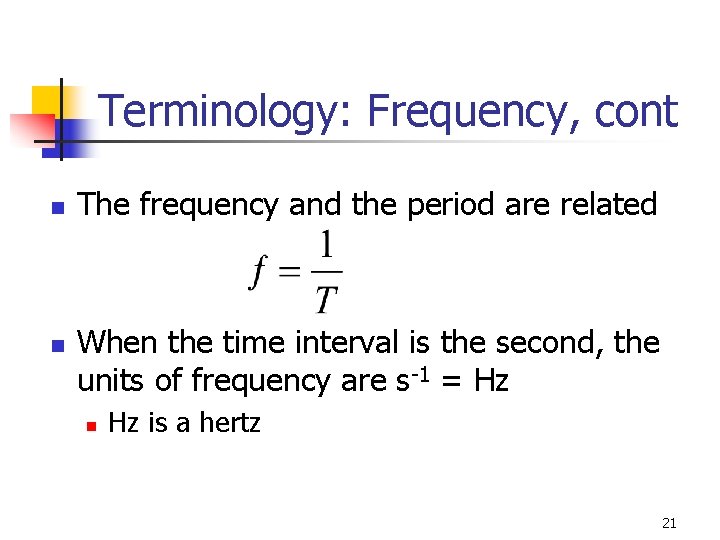
Terminology: Frequency n The frequency, ƒ, is the number of crests (or any point on the wave) that pass a given point in a unit time interval n n The time interval is most commonly the second The frequency of the wave is the same as the frequency of the simple harmonic motion of one element of the medium 20
Terminology: Frequency, cont n n The frequency and the period are related When the time interval is the second, the units of frequency are s-1 = Hz n Hz is a hertz 21
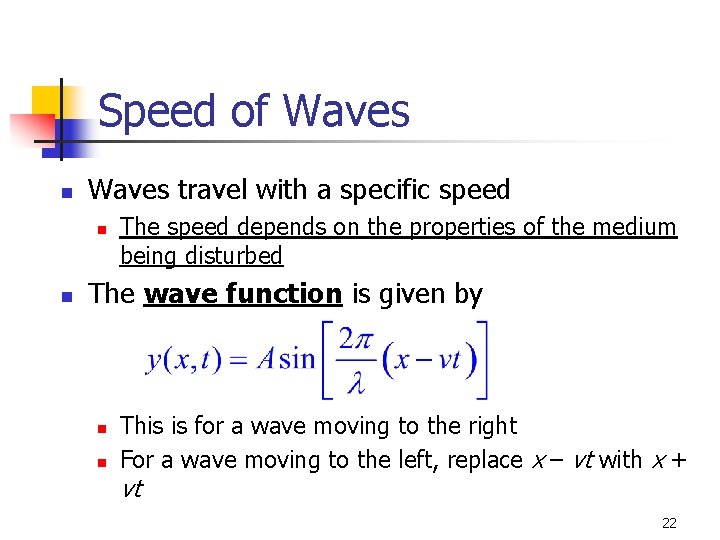
Speed of Waves n Waves travel with a specific speed n n The speed depends on the properties of the medium being disturbed The wave function is given by n n This is for a wave moving to the right For a wave moving to the left, replace x – vt with x + vt 22
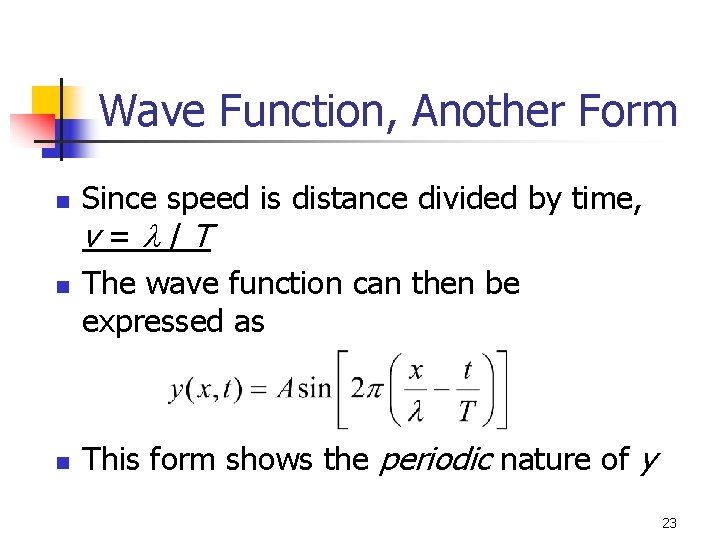
Wave Function, Another Form n n n Since speed is distance divided by time, v=l/T The wave function can then be expressed as This form shows the periodic nature of y 23
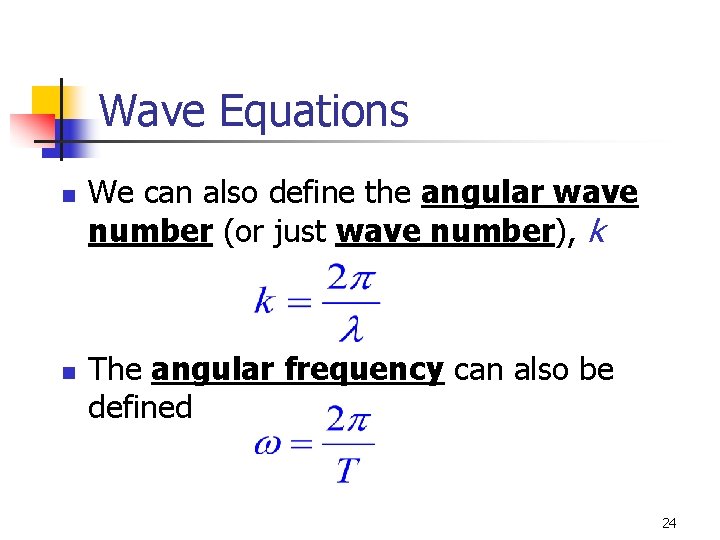
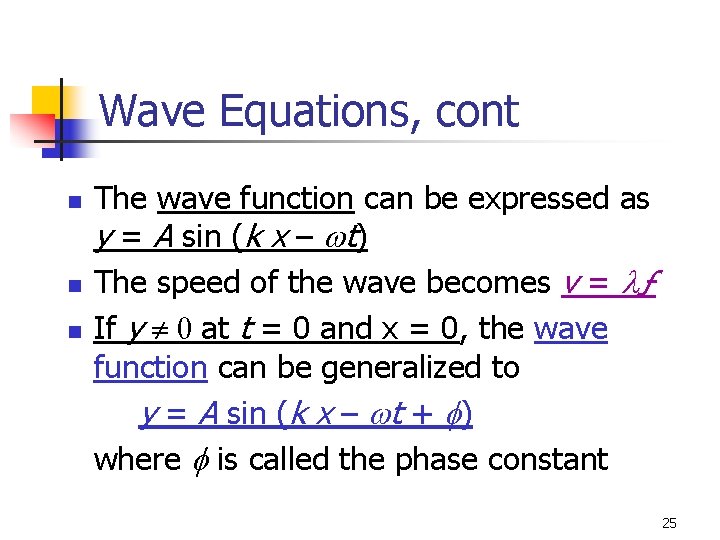
Wave Equations n n We can also define the angular wave number (or just wave number), k The angular frequency can also be defined 24
Wave Equations, cont n n n The wave function can be expressed as y = A sin (k x – t) The speed of the wave becomes v = lƒ If y ¹ 0 at t = 0 and x = 0, the wave function can be generalized to y = A sin (k x – t + f) where f is called the phase constant 25
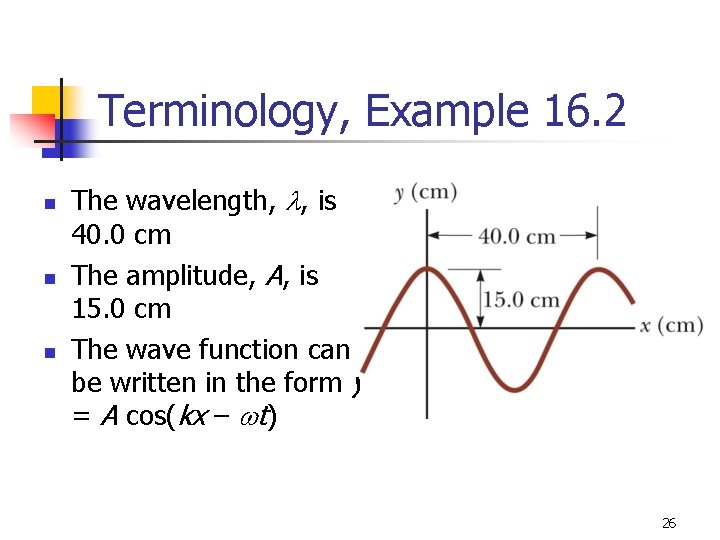
Terminology, Example 16. 2 n n n The wavelength, l, is 40. 0 cm The amplitude, A, is 15. 0 cm The wave function can be written in the form y = A cos(kx – t) 26
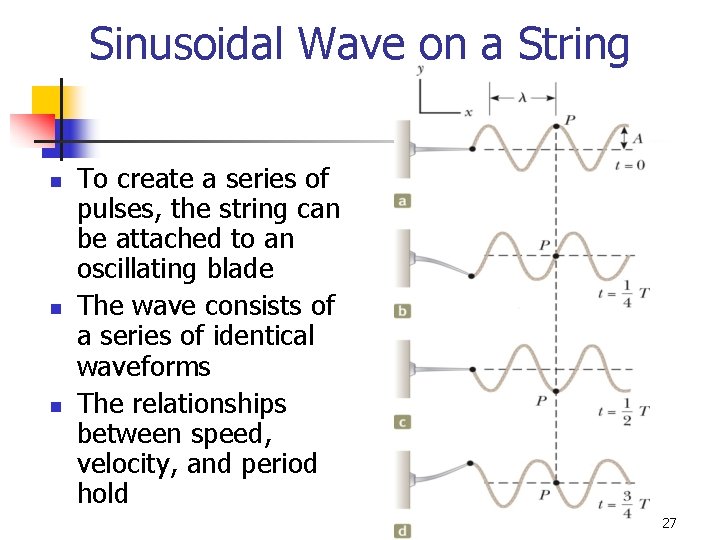
Sinusoidal Wave on a String n n n To create a series of pulses, the string can be attached to an oscillating blade The wave consists of a series of identical waveforms The relationships between speed, velocity, and period hold 27
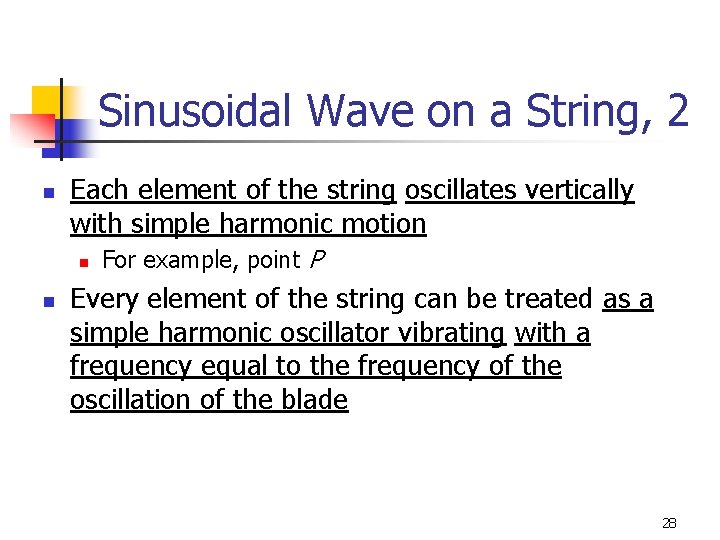
Sinusoidal Wave on a String, 2 n Each element of the string oscillates vertically with simple harmonic motion n n For example, point P Every element of the string can be treated as a simple harmonic oscillator vibrating with a frequency equal to the frequency of the oscillation of the blade 28
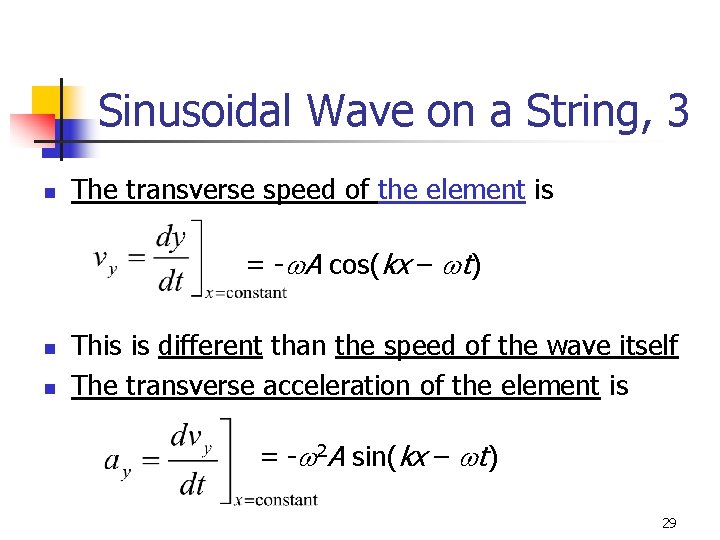
Sinusoidal Wave on a String, 3 n The transverse speed of the element is = - A cos(kx – t) n n This is different than the speed of the wave itself The transverse acceleration of the element is = - 2 A sin(kx – t) 29
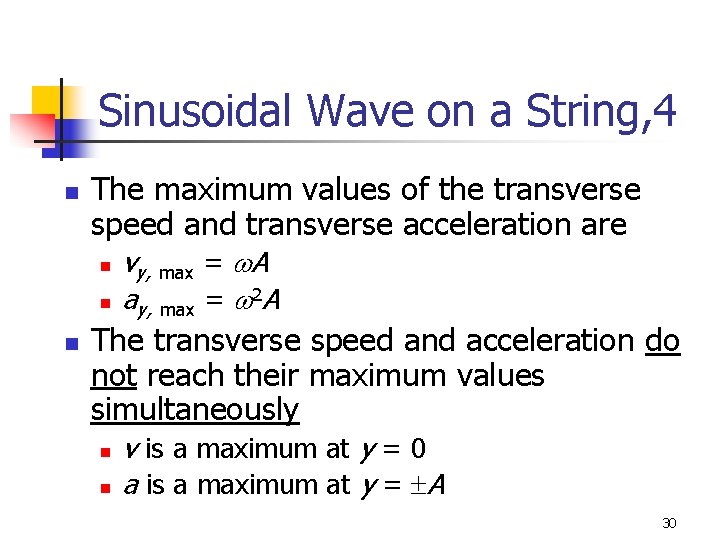
Sinusoidal Wave on a String, 4 n The maximum values of the transverse speed and transverse acceleration are n n n vy, max = A ay, max = 2 A The transverse speed and acceleration do not reach their maximum values simultaneously n n v is a maximum at y = 0 a is a maximum at y = ±A 30
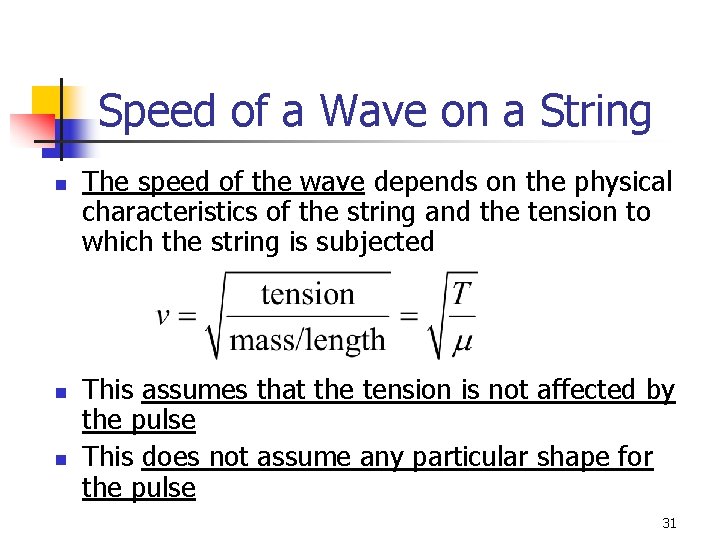
Speed of a Wave on a String n n n The speed of the wave depends on the physical characteristics of the string and the tension to which the string is subjected This assumes that the tension is not affected by the pulse This does not assume any particular shape for the pulse 31
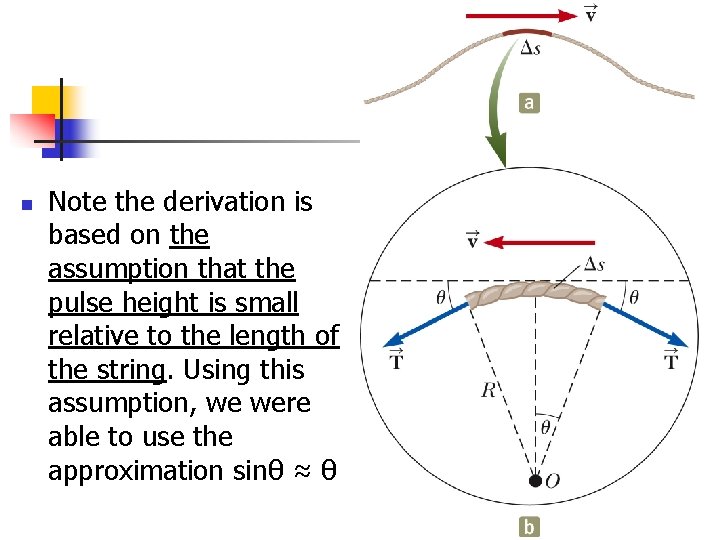
n Note the derivation is based on the assumption that the pulse height is small relative to the length of the string. Using this assumption, we were able to use the approximation sinθ ≈ θ 32
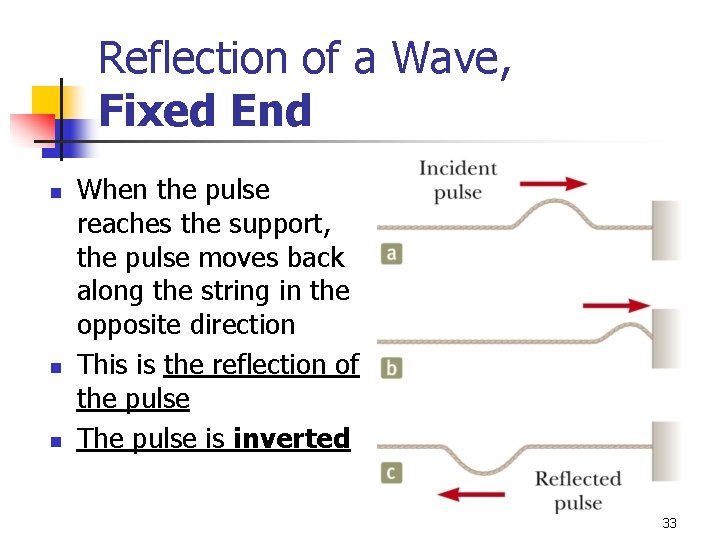
Reflection of a Wave, Fixed End n n n When the pulse reaches the support, the pulse moves back along the string in the opposite direction This is the reflection of the pulse The pulse is inverted 33
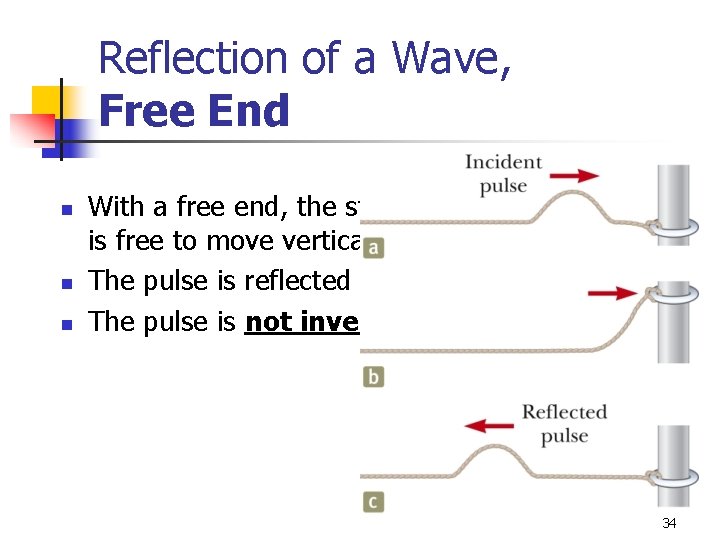
Reflection of a Wave, Free End n n n With a free end, the string is free to move vertically The pulse is reflected The pulse is not inverted 34
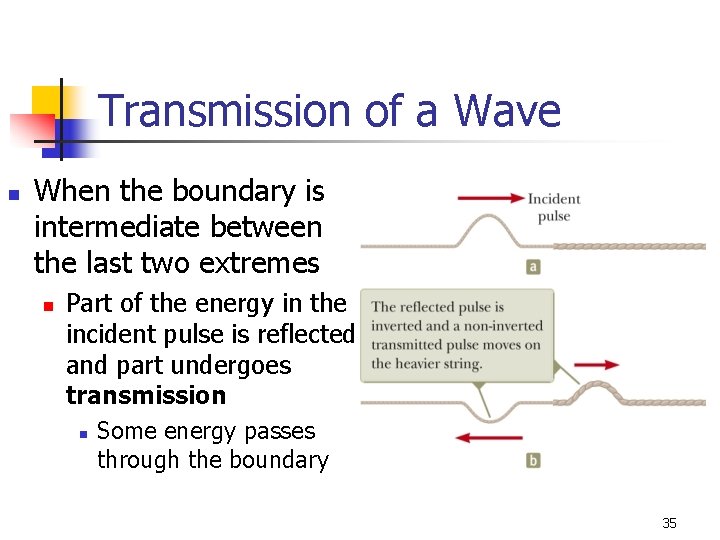
Transmission of a Wave n When the boundary is intermediate between the last two extremes n Part of the energy in the incident pulse is reflected and part undergoes transmission n Some energy passes through the boundary 35
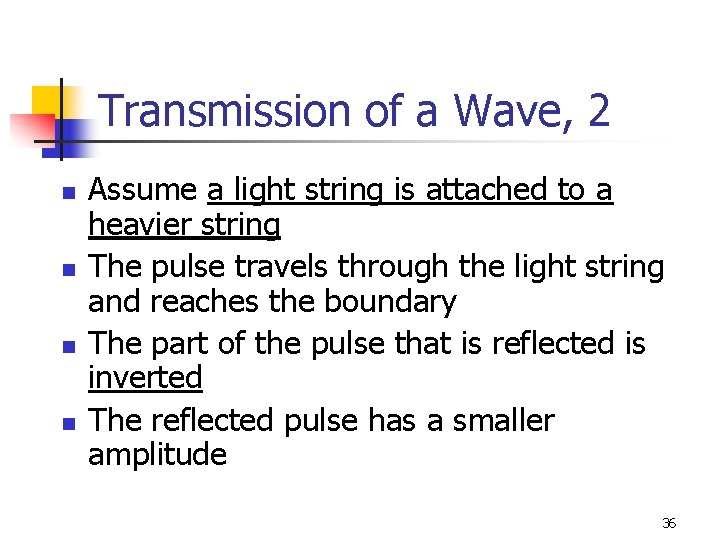
Transmission of a Wave, 2 n n Assume a light string is attached to a heavier string The pulse travels through the light string and reaches the boundary The part of the pulse that is reflected is inverted The reflected pulse has a smaller amplitude 36
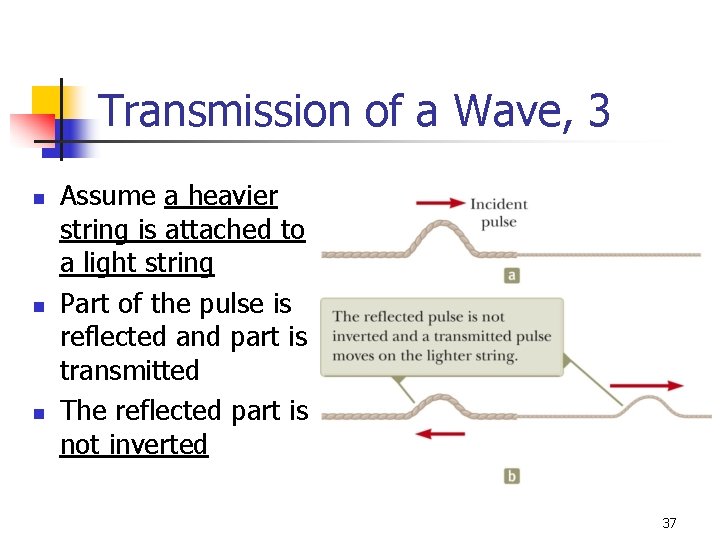
Transmission of a Wave, 3 n n n Assume a heavier string is attached to a light string Part of the pulse is reflected and part is transmitted The reflected part is not inverted 37
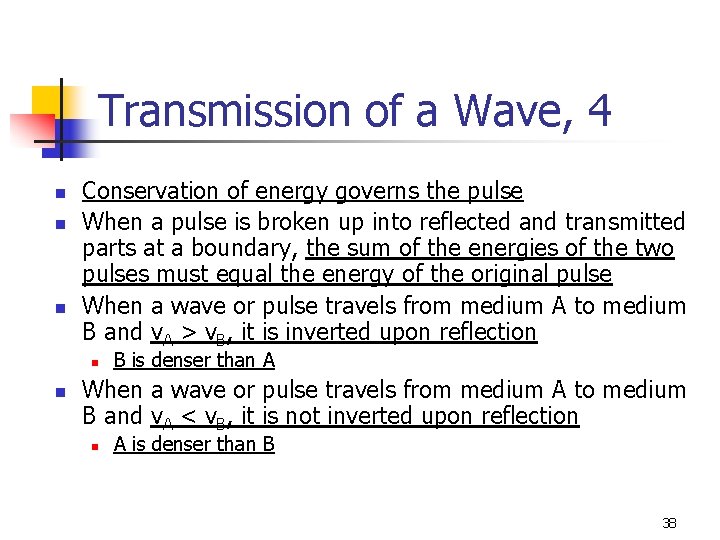
Transmission of a Wave, 4 n n n Conservation of energy governs the pulse When a pulse is broken up into reflected and transmitted parts at a boundary, the sum of the energies of the two pulses must equal the energy of the original pulse When a wave or pulse travels from medium A to medium B and v. A > v. B, it is inverted upon reflection n n B is denser than A When a wave or pulse travels from medium A to medium B and v. A < v. B, it is not inverted upon reflection n A is denser than B 38
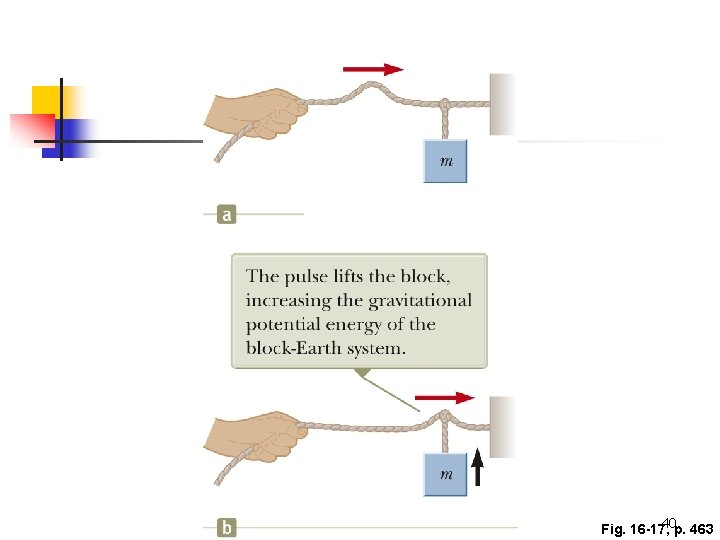
Energy in Waves in a String n n Waves transport energy when they propagate through a medium We can model each element of a string as a simple harmonic oscillator n n The oscillation will be in the y-direction Every element has the same total energy 39
40 p. 463 Fig. 16 -17,
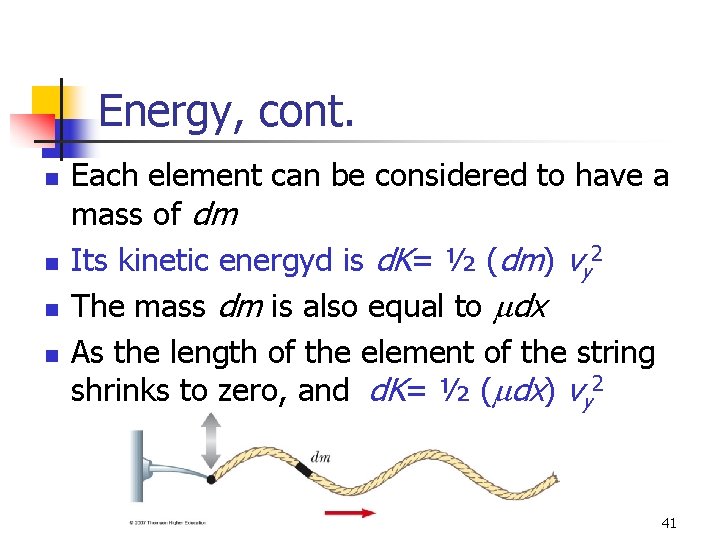
Energy, cont. n n Each element can be considered to have a mass of dm Its kinetic energyd is d. K= ½ (dm) vy 2 The mass dm is also equal to mdx As the length of the element of the string shrinks to zero, and d. K= ½ (mdx) vy 2 41
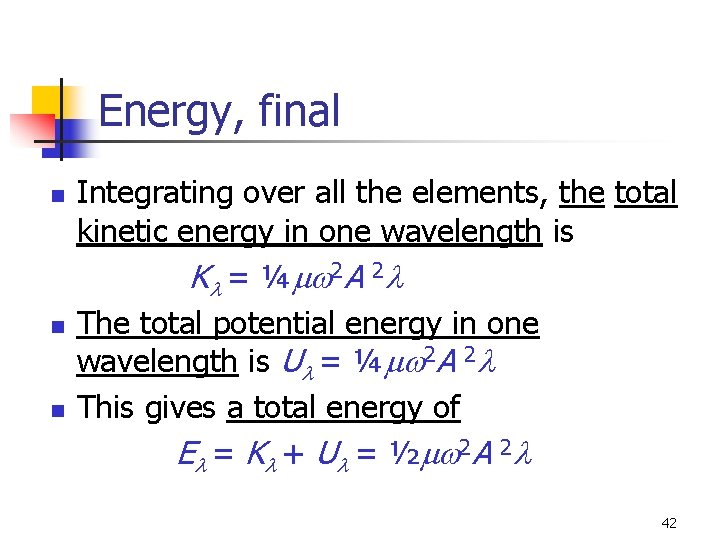
Energy, final n n n Integrating over all the elements, the total kinetic energy in one wavelength is Kl = ¼m 2 A 2 l The total potential energy in one wavelength is Ul = ¼m 2 A 2 l This gives a total energy of El = Kl + Ul = ½m 2 A 2 l 42
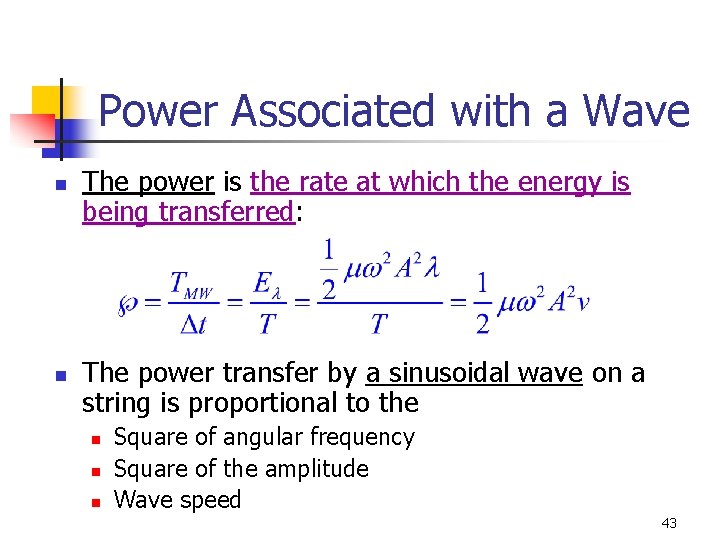
Power Associated with a Wave n n The power is the rate at which the energy is being transferred: The power transfer by a sinusoidal wave on a string is proportional to the n n n Square of angular frequency Square of the amplitude Wave speed 43
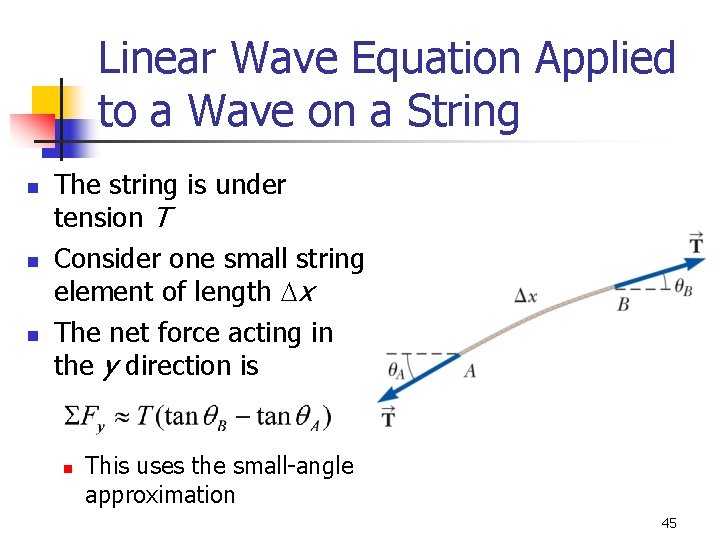
The Linear Wave Equation n n The wave functions y (x, t) represent solutions of an equation called the linear wave equation This equation gives a complete description of the wave motion From it you can determine the wave speed The linear wave equation is basic to many forms of wave motion 44
Linear Wave Equation Applied to a Wave on a String n n n The string is under tension T Consider one small string element of length Dx The net force acting in the y direction is n This uses the small-angle approximation 45
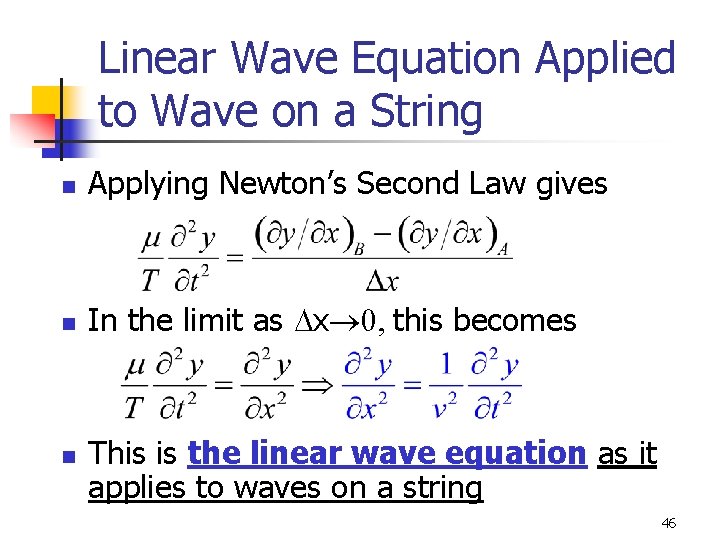
Linear Wave Equation Applied to Wave on a String n Applying Newton’s Second Law gives n In the limit as Dx® 0, this becomes n This is the linear wave equation as it applies to waves on a string 46
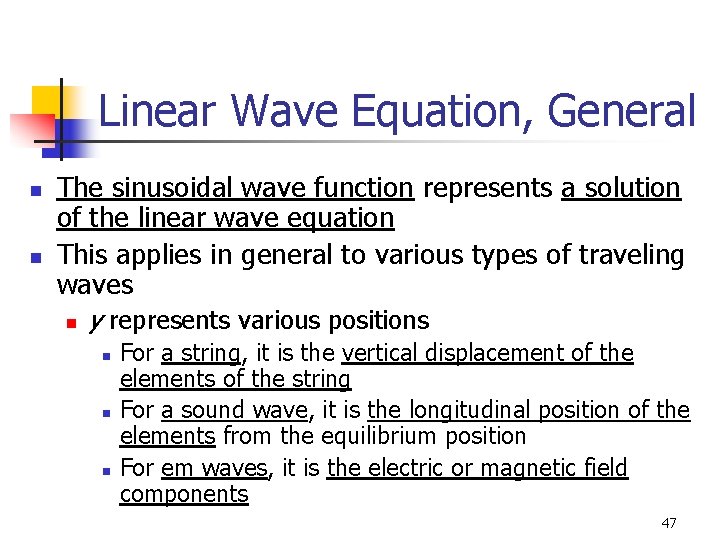
Linear Wave Equation, General n n The sinusoidal wave function represents a solution of the linear wave equation This applies in general to various types of traveling waves n y represents various positions n n n For a string, it is the vertical displacement of the elements of the string For a sound wave, it is the longitudinal position of the elements from the equilibrium position For em waves, it is the electric or magnetic field components 47