
Chapter 16 Using Language Jake Beverley Amna Millewa
Chapter 16 Using Language Jake Beverley & Amna Millewa Pgs 133 -140
Prepare Your Speeches for the Ear • Unlike the readers, listeners have only one chance to understand a spoken message. • Jargon- the specialized, “insider” language of a given profession. • “Good hard simple words with good hard clear meanings are good things to use when you speak. They are like pickets in a fence, slim and unimpressive on their own but sturdy and effective when strung together” -Simply Speaking, Peggy Noonan pgs 133 -134
• As a rule, try to use fewer words than more to express your thoughts and opinions. • Many great speeches use “key words” repeatedly to emphasize important ideas and keeps listeners following where you want to lead them. • Personal pronouns make the audience feel that they are actually part of the message and puts the speaker on the same playing field. pg 134
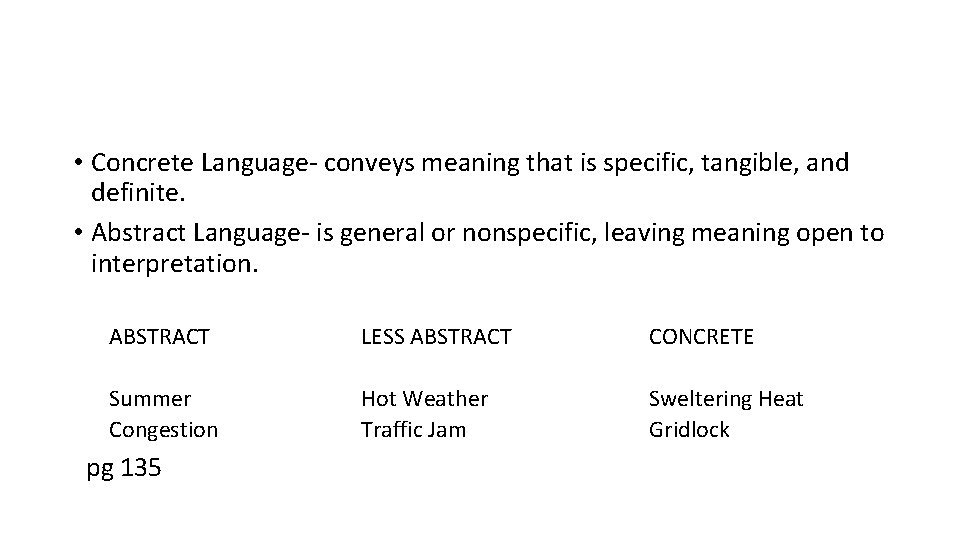
• Concrete Language- conveys meaning that is specific, tangible, and definite. • Abstract Language- is general or nonspecific, leaving meaning open to interpretation. ABSTRACT LESS ABSTRACT CONCRETE Summer Congestion Hot Weather Traffic Jam Sweltering Heat Gridlock pg 135
• Imagery- concrete language that brings into play the senses of smell, taste, sight, hearing, and touch to paint mental pictures. • Different figures of speech help audiences connect to what your talking about and make it easier to understand. - Simile: explicitly compares one thing to another. -Metaphor: compares two things but describes one thing as actually being the other. -Analogy: an extended metaphor or simile that compares an unfamiliar concept to another. Pg 135
• Choose words carefully to use in your speech. Using different dialects can either help or destroy your speech. • Avoid the “Shock Jock” Syndrome - an informal term for a radio host who uses suggestive language, etc. . • Voice- the feature of verbs that indicates the subjects relationship to the actions. -Passive: A test was announced by Ms. Carlos for Tuesday. -Active: Ms. Carlos announced a test for Tuesday. Pgs 136 -137
• Be culturally sensitive when using language. If not careful you can offend people in your audience. - Telling a joke in ebonix - Stereotyping • Repetition can create rhythm in speeches, (Anaphora) - “I have a Dream” Speech • Epiphora: a word or phrase that appears at the end of statements. - “Yes we can” Pres. Obamas speech • Alliterations and Parallelism are different arrangements that help tie ideas together. Pg 139
- Slides: 7