
Chapter 16 Transport cost structures and pricing principles
- Slides: 18
Chapter 16 Transport cost structures and pricing principles Chapter 11: Strategic Leadership
Outline This chapter covers the following topics: • Efficiency in transport • Economies of scale • Competition within modes of transport • Cost structures of the different transport modes • Cost trade-offs in transport • Profit planning and control • Tariff quoting Chapter 11: Strategic Leadership
Efficiency in transport • Transport is not demanded in its own right. • The demand for transport is a function of other activities. • Efficiency has a direct effect on the competitiveness of a business. • Objective: to operate at the scale or size where maximum economy is enjoyed. • Economy is the optimum use of resources so that the maximum benefit is gained from any given input of resources. Chapter 11: Strategic Leadership
Economies of scale • An expanded level or output results in reductions in the total unit cost of transport (per ton-kilometre). • Three transport management strategies contribute: • Increasing vehicle sizes and maximising utilisation of their capacity • Increasing fleet size and maximising utilisation of its capacity • Intensifing the use of indivisible facilities and infrastructure whenever these are owned Chapter 11: Strategic Leadership
Economies of scale (continued) Sub-groups of economies: – Economies of density – Economies of scope – Economies of distance Chapter 11: Strategic Leadership
Competition within modes of transport • General: – Related to cost structure, distance of haul and diversity and physical characteristics of the goods • Air: – Economic deregulation has led to a trend for oligopolistic market structure • Rail: – May enjoy a natural monopoly on a particular route Chapter 11: Strategic Leadership
Competition within modes of transport (continued) • Pipeline: – High capital costs • Sea: – Open competition (tramp shipping) to oligopolistic cartels (liner shipping conferences) Chapter 11: Strategic Leadership
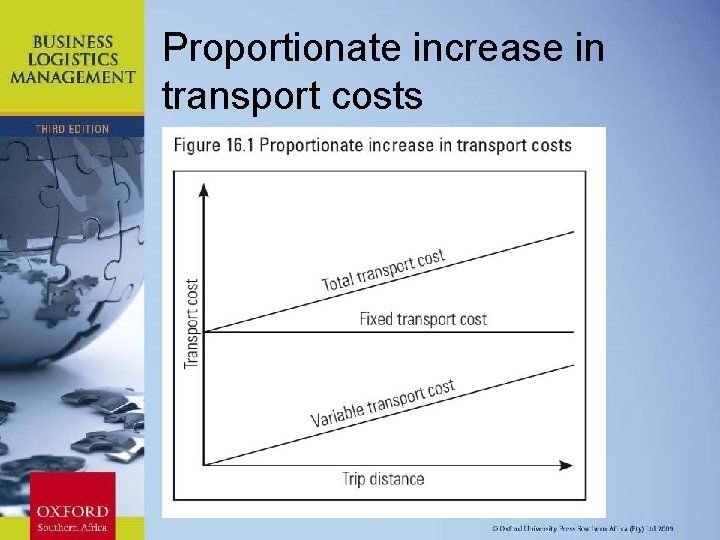
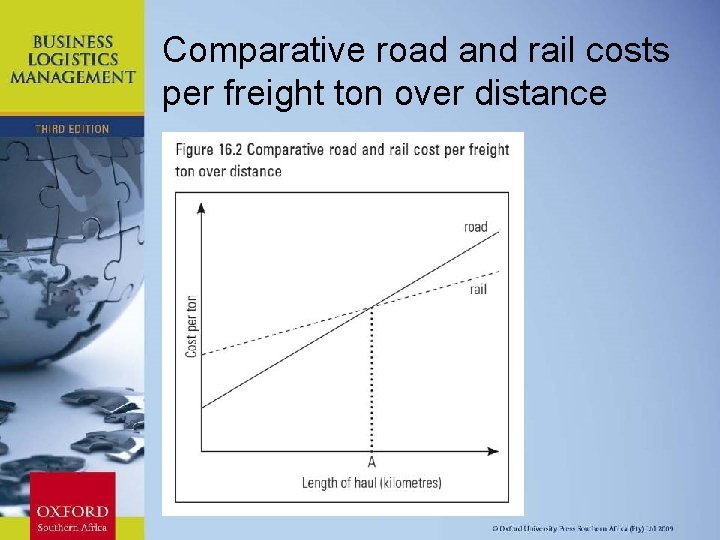
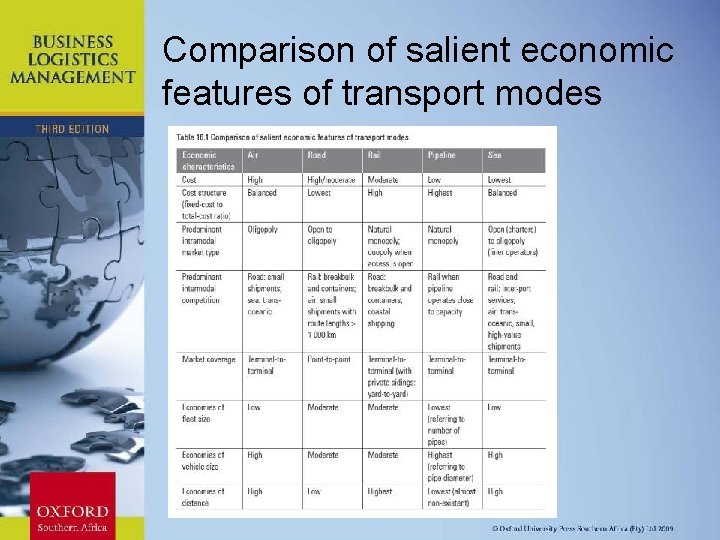
Cost structures of transport modes The relationship between the fixed and variable components of total cost (see Figure 16. 1). • Air: – High initial fixed cost; majority of other costs are variable or semi-variable • Road: – The ratio of fixed costs to total costs is very high (see Figure 16. 2). Chapter 11: Strategic Leadership
Cost structure of transport modes (continued) • Pipeline: – Fixed cost constitutes a high portion of the total cost – the highest of all modes • Sea: – High proportion of variable costs Chapter 11: Strategic Leadership
Proportionate increase in transport costs Chapter 11: Strategic Leadership
Comparative road and rail costs per freight ton over distance Chapter 11: Strategic Leadership
Comparison of salient economic features of transport modes Chapter 11: Strategic Leadership
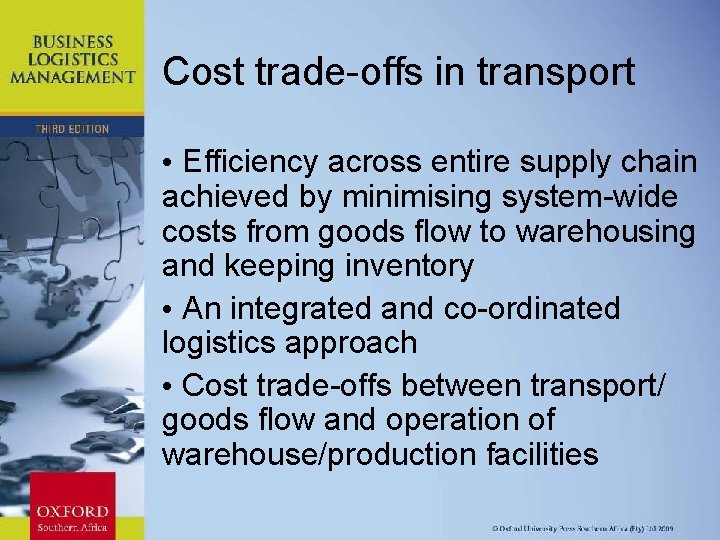
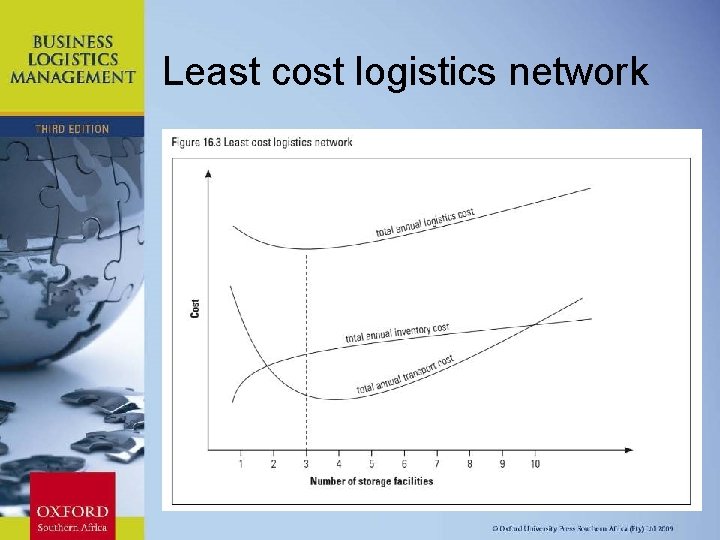
Cost trade-offs in transport • Efficiency across entire supply chain achieved by minimising system-wide costs from goods flow to warehousing and keeping inventory • An integrated and co-ordinated logistics approach • Cost trade-offs between transport/ goods flow and operation of warehouse/production facilities Chapter 11: Strategic Leadership
Least cost logistics network Chapter 11: Strategic Leadership
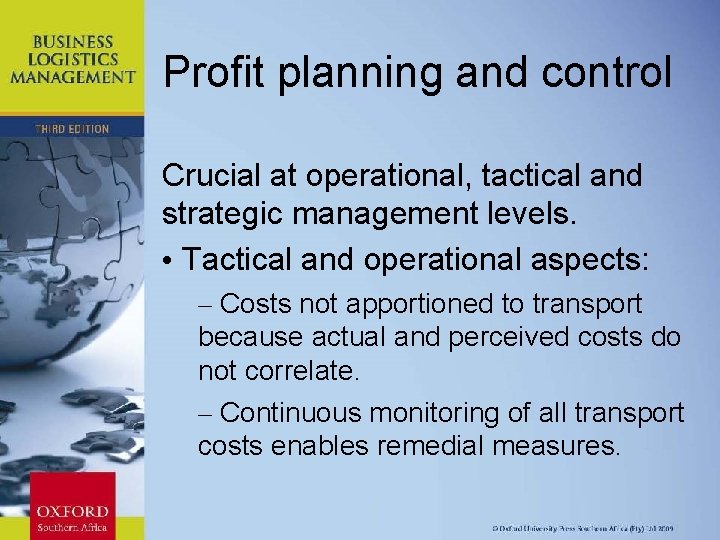
Profit planning and control Crucial at operational, tactical and strategic management levels. • Tactical and operational aspects: – Costs not apportioned to transport because actual and perceived costs do not correlate. – Continuous monitoring of all transport costs enables remedial measures. Chapter 11: Strategic Leadership
Profit planning and control (continued) • Strategic aspects: – A carrier must have a sound profit policy. – The rate of return required by a carrier can be expressed through two values: • Cost of capital for the business • Current return earned by the firm Chapter 11: Strategic Leadership
Tariff quoting • Total cost pricing • Marginal cost pricing • Value-of-service pricing Chapter 11: Strategic Leadership