
CHAPTER 16 TOOL MARKS INTRODUCTION Tool markany impression

- Slides: 15
CHAPTER 16 TOOL MARKS
INTRODUCTION • Tool mark—any impression, abrasion, or cut mark made when contact occurs between a tool and an object • • • An example of physical evidence Even mass-produced tools have minor differences The impressions can link the tool to a crime scene and potentially to the owner Forensic Science: Fundamentals & Investigations, Chapter 16 2
TOOLS AND CRIME SCENES • Tools: • increase our ability to handle manual tasks, but can also be used in crimes • How can a tool used in a crime lead investigators to the criminal? • Why is ownership of a tool used in a crime circumstantial evidence? Forensic Science: Fundamentals & Investigations, Chapter 16 3
TOOL MARK IMPRESSIONS Indentation Marks • Result when a tool is pressed against a softer surface • Tools usually leave distinctive marks • The hardness of a tool influences the resulting marks left in the softer object • May indicate the size of the tool used in a crime Forensic Science: Fundamentals & Investigations, Chapter 16 4
TOOL MARK IMPRESSIONS Abrasion Marks • An object’s surface can be ground or worn away by a tool • The harder object causes abrasions on the softer surface • Indentation and abrasion marks sometimes occur at the same time Forensic Science: Fundamentals & Investigations, Chapter 16 5
TOOL MARK IMPRESSIONS Cutting Marks • Edged instruments can penetrate a softer object and separate it into parts • Cut marks are produced along the edge as a surface is cut Forensic Science: Fundamentals & Investigations, Chapter 16 6
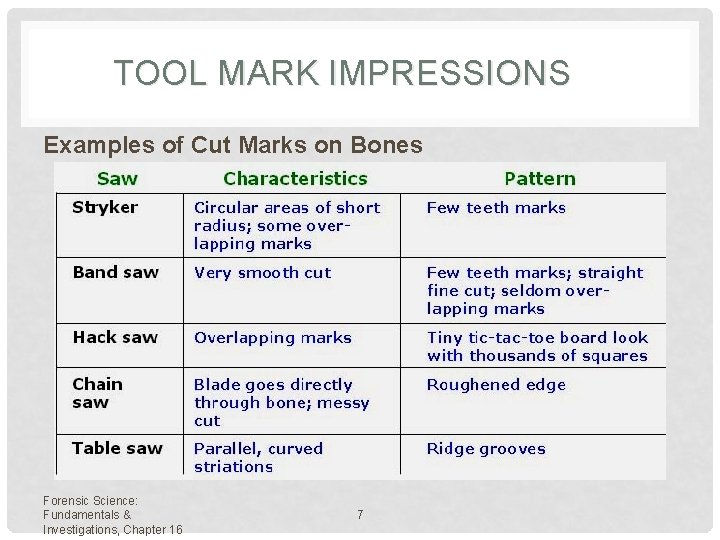
TOOL MARK IMPRESSIONS Examples of Cut Marks on Bones Forensic Science: Fundamentals & Investigations, Chapter 16 7
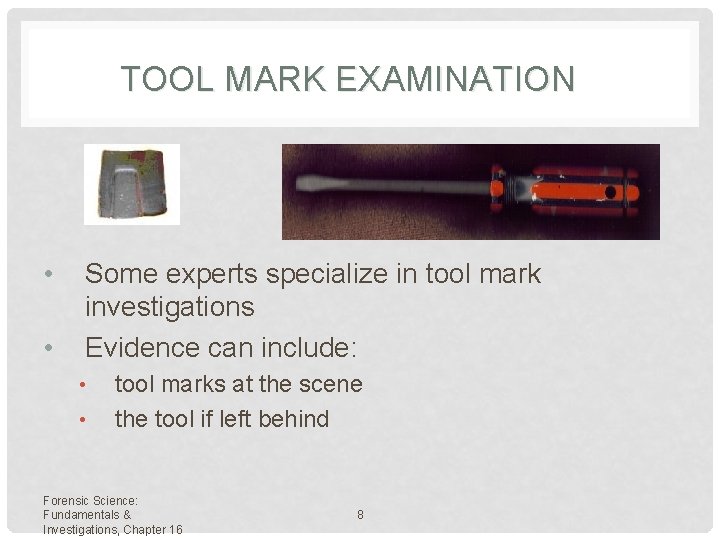
TOOL MARK EXAMINATION • • Some experts specialize in tool mark investigations Evidence can include: • • tool marks at the scene the tool if left behind Forensic Science: Fundamentals & Investigations, Chapter 16 8
DOCUMENTING THE EVIDENCE • Collect tool mark evidence when possible • Photograph the evidence with a measuring device to show scale • Measure the size of the impression Forensic Science: Fundamentals & Investigations, Chapter 16 9
DOCUMENTING THE EVIDENCE • Castings preserve tool mark impressions • silicone or rubber-based casting materials • Cast impressions retain the unique indentation marks made by a specific tool Forensic Science: Fundamentals & Investigations, Chapter 16 10
DOCUMENTING THE EVIDENCE • Take pictures and dust for fingerprints before applying casting material • Use magnetic dusting powder and silicone material • The size of the impression should be measured and recorded. Forensic Science: Fundamentals & Investigations, Chapter 16 11
COLLECTING AND PRESERVING A SAMPLE • • • Correctly label evidence Wrap small objects with clean paper and place them in small containers or plastic bags Pack large objects in cartons or boxes Record—who, where, when, and why Maintain the chain of custody Forensic Science: Fundamentals & Investigations, Chapter 16 12
ANALYZING TOOL MARK EVIDENCE • Laboratory tool mark analysis identifies: • • • major characteristics defining the type of tool used in a crime unique characteristics that might distinguish between the same kinds of tools Forensic comparison microscopes examine tool mark characteristics that match a suspect tool Forensic Science: Fundamentals & Investigations, Chapter 16 13
NEW TECHNOLOGY IN TOOL MARK IDENTIFICATION Courts now require more than visual pattern comparisons • Tool mark databases (with images acquired by forensic comparison microscopes) • Algorithms to statistically analyze tool mark patterns • Scanning tools measure the depth or height of tool marks and make a contour map. • Same techniques used for ballistics/firearms examinations Forensic Science: Fundamentals & Investigations, Chapter 16 14
TOOL MARK EVIDENCE IN THE COURTROOM • The tool mark witness prepares a written report to present to a jury. • When available, provide: • Original evidence • Castings • Magnified images of tool mark comparisons • Such evidence may link a series of crimes Forensic Science: Fundamentals & Investigations, Chapter 16 15