
Chapter 16 Theories Models and Frameworks From Leadership
- Slides: 63
Chapter 16 Theories, Models, and Frameworks From Leadership and Management Copyright © 2015 Wolters Kluwer Health | Lippincott Williams & Wilkins
Leadership Theories • Leaders empower others and lead others. • Leadership involves one individual trying to influence the behavior of others. • All nurses in management or advanced practice should know prevailing theories of leadership and management. Copyright © 2015 Wolters Kluwer Health | Lippincott Williams & Wilkins
Leadership Theories—(cont. ) • Trait approach • Style approach – Managerial grid • Transformational leadership Copyright © 2015 Wolters Kluwer Health | Lippincott Williams & Wilkins
Trait Approach • Objective is to identify personality characteristics that can be used to define a leader. Copyright © 2015 Wolters Kluwer Health | Lippincott Williams & Wilkins
Trait Theory • Related to the Great Man Theory • Leadership exists as an attribute of a personality; if certain traits are exhibited, the individual is a leader. • Successful leaders have certain inborn traits or qualities that help them stand out. • Traits of one leader may not be the same as other leaders. • Traits valued in one situation may not be valued in other situations. Copyright © 2015 Wolters Kluwer Health | Lippincott Williams & Wilkins
Trait Theory—Leadership Traits • Intelligence • Social sensitivity and participation • Honesty and integrity • Communication skills • Persuasive powers • Tireless energy • Uncanny foresight and intuition Copyright © 2015 Wolters Kluwer Health | Lippincott Williams & Wilkins
Trait Theory: Research-Identified Leadership Traits • Leaders need to be more intelligent than the group they lead. • Leaders must possess initiative (the ability to perceive and start courses of action not considered by others). • Creativity is an asset. • Communication skills are important. • Leaders have emotional maturity and integrity (a sense of purpose and direction, persistence, dependability, and objectivity). • Persuasion often is used by leaders to gain the consent of followers. Copyright © 2015 Wolters Kluwer Health | Lippincott Williams & Wilkins
Trait Theory: Researcher-Identified Leadership Traits—(cont. ) • Leaders participate in social activities. • Leaders need to be perceptive enough to distinguish their allies from their opponents and to place their subordinates in suitable positions. Copyright © 2015 Wolters Kluwer Health | Lippincott Williams & Wilkins
Trait Theory—Main Points • Focuses exclusively on the leader • Does not relate the leader to the situation or circumstances • Emphasizes having a leader with a certain set of traits is crucial having effective leadership • It is the leader and his/her personality that is central to the leadership process. • Organizations will work better if people in management have leadership traits. Copyright © 2015 Wolters Kluwer Health | Lippincott Williams & Wilkins
Trait Theory—Issues • Not clear which traits are essential to acquire and/or maintain leadership • Does not perceive personality as an integrated whole • Does not deal with followers • Omits environmental and situation factors Copyright © 2015 Wolters Kluwer Health | Lippincott Williams & Wilkins
Trait Theory—Application • Having a person with a specific set of traits is important for effective leadership. • Awareness of own traits can be useful in selfdevelopment. • Awareness of traits can be helpful when seeing a career or employment. Copyright © 2015 Wolters Kluwer Health | Lippincott Williams & Wilkins
Leadership Style Theories • Objective—to integrate the two major behavioral aspects of the leader—task and relationship—in order to influence subordinates to reach a predefined goal Copyright © 2015 Wolters Kluwer Health | Lippincott Williams & Wilkins
Leadership Style Theories—(cont. ) • Behavior pattern of an individual who attempts to influence others • Includes – Directive (task) behaviors – Supportive (relationship) behaviors • Give directions, establish goals, set timelines, define roles Copyright © 2015 Wolters Kluwer Health | Lippincott Williams & Wilkins
Leadership Style Theories—(cont. ) • Point is to motivate behavior to maximize the impact on the satisfaction and performance of followers. • Behavior-based theories assume that effective leaders acquire a pattern of learned behaviors. Copyright © 2015 Wolters Kluwer Health | Lippincott Williams & Wilkins
Leadership Styles • Three distinct leadership styles along a continuum – Authoritarian – Democratic – Laissez-faire Copyright © 2015 Wolters Kluwer Health | Lippincott Williams & Wilkins
Leadership Styles—Authoritarian Leader • Dictatorial • Leader makes all decisions and allows subordinates no influence in the decisionmaking process. • Emphasis on concern for the task Copyright © 2015 Wolters Kluwer Health | Lippincott Williams & Wilkins
Leadership Styles—Authoritarian Leader—(cont. ) • Motivated by external forces, power, authority, need for approval • Uses coercion, punishment to change followers behavior, and achieve results Copyright © 2015 Wolters Kluwer Health | Lippincott Williams & Wilkins
Leadership Styles—Democratic Leader • Relationship/person orientation • Participative • Consults with subordinates • Gives subordinates some influence in decision making Copyright © 2015 Wolters Kluwer Health | Lippincott Williams & Wilkins
Leadership Styles—Democratic Leader —(cont. ) • Majority rule • Treats subordinates with fairness and dignity Copyright © 2015 Wolters Kluwer Health | Lippincott Williams & Wilkins
Leadership Styles—Laissez-Faire Leader • Free reign • Allow group to have complete autonomy Copyright © 2015 Wolters Kluwer Health | Lippincott Williams & Wilkins
Leadership Styles—Laissez-Faire Leader—(cont. ) • Rarely supervise directly • No direction or facilitation • Group makes own decisions. Copyright © 2015 Wolters Kluwer Health | Lippincott Williams & Wilkins
Question The style of leadership that gives subordinates free reign with minimal supervision is: A. Authoritarian B. Democratic C. Dictatorial D. Laissez-faire Copyright © 2015 Wolters Kluwer Health | Lippincott Williams & Wilkins
Answer D. Laissez-faire • Rationale: Laissez-faire leaders provide little direction or facilitation and allow the group to make decisions. They are often ineffective. Copyright © 2015 Wolters Kluwer Health | Lippincott Williams & Wilkins
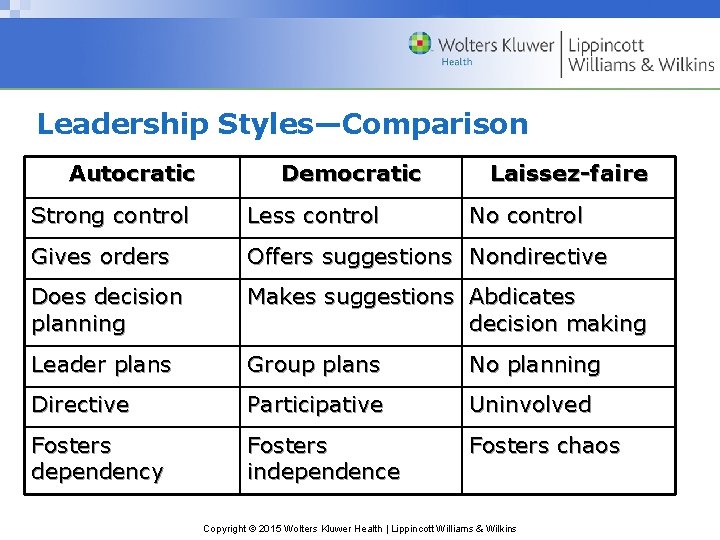
Leadership Styles—Comparison Autocratic Democratic Laissez-faire Strong control Less control No control Gives orders Offers suggestions Nondirective Does decision planning Makes suggestions Abdicates decision making Leader plans Group plans No planning Directive Participative Uninvolved Fosters dependency Fosters independence Fosters chaos Copyright © 2015 Wolters Kluwer Health | Lippincott Williams & Wilkins
Leadership Style Theories • Focus is on what leaders do in relational and contextual terms. • Leaders must pursue effective relationships with subordinate while considering factors in the environment that might influence outcomes. • Note: Employee satisfaction is not always the best measure of leadership. Copyright © 2015 Wolters Kluwer Health | Lippincott Williams & Wilkins
Leadership Style Theories—Application • Leaders should modify behavioral style to increase their effectiveness. • Employee-centered leaders tend to be most able to achieve effective work environments and productivity. Copyright © 2015 Wolters Kluwer Health | Lippincott Williams & Wilkins
Transformational Leadership • Objective—to show the leader can transform subordinates and motivate them to achieve their fullest potential and at the same time link their identities to the collective identity of the organization Copyright © 2015 Wolters Kluwer Health | Lippincott Williams & Wilkins
Transformational Leadership—(cont. ) • Involves assessing the motives of followers and satisfying their needs • Understands the motives of followers and helps them attain their fullest potential • Raises the level of motivation by being attentive to the needs and motives of followers Copyright © 2015 Wolters Kluwer Health | Lippincott Williams & Wilkins
Transformational Leadership—(cont. ) • Leadership concerned with values, ethical standards, and long-term goals • Process in which leaders and followers raise one another to higher levels of motivation Copyright © 2015 Wolters Kluwer Health | Lippincott Williams & Wilkins
Transformational Leadership—(cont. ) • Commits people to action, converts followers into leaders, converts leaders into agents of change • Focuses on merging motives, desires, values, and goals of leaders and followers Copyright © 2015 Wolters Kluwer Health | Lippincott Williams & Wilkins
Transformational Leadership—(cont. ) • Assumes three types of leaders – Transformational leaders – Transactional leaders – Laissez-faire leaders Copyright © 2015 Wolters Kluwer Health | Lippincott Williams & Wilkins
Transformational Leaders • Characteristics – Aware of importance of change and innovation – Seek to empower others – Serve as change agents and role models – Able to interpret and shape new meaning Copyright © 2015 Wolters Kluwer Health | Lippincott Williams & Wilkins
Transactional Leadership • Characteristics – Contingent reward—Efforts by subordinates are exchanged for specified rewards. – Management by exception—Corrective criticism, negative feedback, and negative reinforcement are applied as needed. Copyright © 2015 Wolters Kluwer Health | Lippincott Williams & Wilkins
Laissez-Faire Leadership • Characteristics – Hands-off approach – There is no exchange with followers or any attempt to help them achieve goals. – Considered to be “nonleaderhip” approach Copyright © 2015 Wolters Kluwer Health | Lippincott Williams & Wilkins
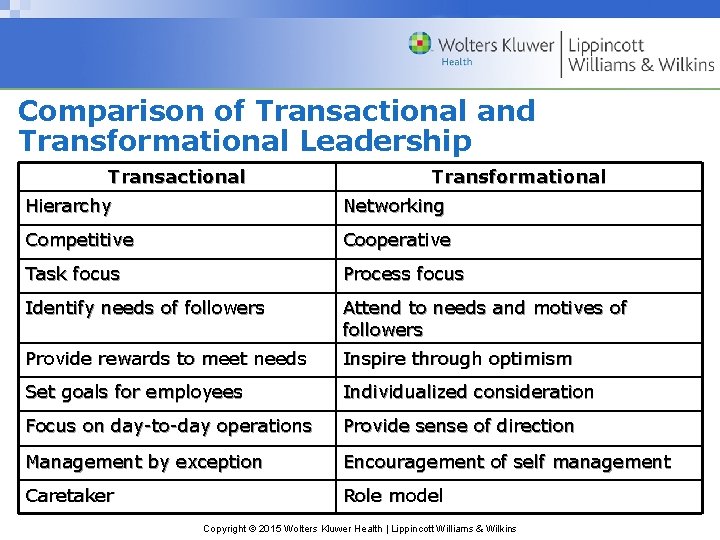
Comparison of Transactional and Transformational Leadership Transactional Transformational Hierarchy Networking Competitive Cooperative Task focus Process focus Identify needs of followers Attend to needs and motives of followers Provide rewards to meet needs Inspire through optimism Set goals for employees Individualized consideration Focus on day-to-day operations Provide sense of direction Management by exception Encouragement of self management Caretaker Role model Copyright © 2015 Wolters Kluwer Health | Lippincott Williams & Wilkins
Transformational Leadership—Characteristics: The 4 Is • Idealized influence—Followers want to emulate leaders as role models. • Inspirational motivation—Followers are motivated to achieve more than they would on their own. • Intellectual stimulation—Followers are intellectually encouraged to be creative and innovative. • Individualized consideration—Followers perform best when leaders work with them one-on-one. Copyright © 2015 Wolters Kluwer Health | Lippincott Williams & Wilkins
Transformational Leadership—(cont. ) • Leader is a role model. • Leader uses individualized consideration. • Leader provides a sense of direction. • Leader encourages self management. • Leader is consistent. Copyright © 2015 Wolters Kluwer Health | Lippincott Williams & Wilkins
Transformational Leadership—(cont. ) • Strategies – Attention through vision – Meaning through communication – Trust through positioning – Deployment of self through positive selfregard and optimism about a desired outcome Copyright © 2015 Wolters Kluwer Health | Lippincott Williams & Wilkins
Transformational Leadership—(cont. ) • Five types of knowledge – Knowing oneself – Knowing the job – Knowing the organization – Knowing the business – Knowing the world Copyright © 2015 Wolters Kluwer Health | Lippincott Williams & Wilkins
Transformational Leadership—(cont. ) • Six core functions of leaders – Valuing – Visioning – Coaching – Empowering – Team building – Promoting quality Copyright © 2015 Wolters Kluwer Health | Lippincott Williams & Wilkins
Transformational Theories • Application – Useful in all levels of an organization – Useful in team development – Helps to define and build a vision Copyright © 2015 Wolters Kluwer Health | Lippincott Williams & Wilkins
Management Theories • Taylor’s Principles of “Scientific” Management – Using scientific methods, work can be organized to produce maximum efficiency and productivity. – Workers with specific attributes and qualifications should be hired and trained to match the job that makes best use of their capabilities. Copyright © 2015 Wolters Kluwer Health | Lippincott Williams & Wilkins
Management Theories—(cont. ) • Taylor’s Principles of “Scientific” Management—(cont. ) – Workers should be rewarded monetarily if production exceeds goals. – Workers should know where and how they fit into the organization and should know the mission and how to accomplish it. – Managers and workers should work cooperatively (managers should plan and supervise; workers should implement). Copyright © 2015 Wolters Kluwer Health | Lippincott Williams & Wilkins
Management Theories—(cont. ) • Fayol’s Principles of Management – To ensure maximum efficiency and effectiveness, there should be specialization (both technical work and administrative work). – Managers must have the right and power to give orders—but with authority comes responsibility. – When sanctions are necessary, they should be fair and appropriate. – Employees should have only one supervisor. Copyright © 2015 Wolters Kluwer Health | Lippincott Williams & Wilkins
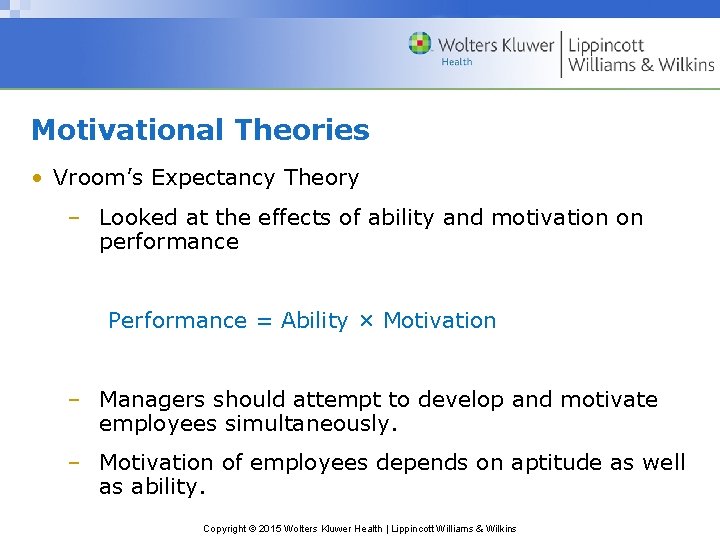
Motivational Theories • Vroom’s Expectancy Theory – Looked at the effects of ability and motivation on performance Performance = Ability × Motivation – Managers should attempt to develop and motivate employees simultaneously. – Motivation of employees depends on aptitude as well as ability. Copyright © 2015 Wolters Kluwer Health | Lippincott Williams & Wilkins
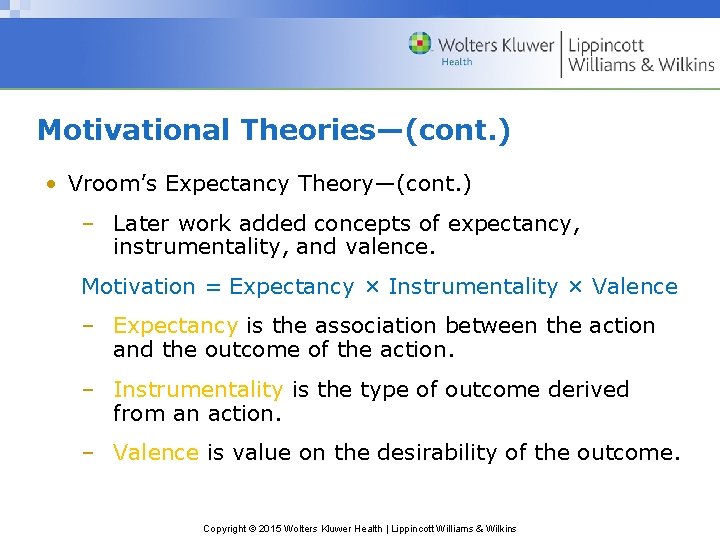
Motivational Theories—(cont. ) • Vroom’s Expectancy Theory—(cont. ) – Later work added concepts of expectancy, instrumentality, and valence. Motivation = Expectancy × Instrumentality × Valence – Expectancy is the association between the action and the outcome of the action. – Instrumentality is the type of outcome derived from an action. – Valence is value on the desirability of the outcome. Copyright © 2015 Wolters Kluwer Health | Lippincott Williams & Wilkins
Power and Authority • Power—influence wielded by an individual or group of individuals to change behaviors and attitudes and to sway decisions • Implies a dependence relationship – The more dependent one individual is on another, the more power is generated. • May be positive or negative Copyright © 2015 Wolters Kluwer Health | Lippincott Williams & Wilkins
Power and Authority—(cont. ) • Types of power – Reward – Coercive – Legitimate – Referent – Expert Copyright © 2015 Wolters Kluwer Health | Lippincott Williams & Wilkins
Power and Authority—(cont. ) • Authority—a formal right based on position in an organization – Authority is derived from power. Copyright © 2015 Wolters Kluwer Health | Lippincott Williams & Wilkins
Planned Change—Lewin • Planned change occurs by design. • Main concepts are “field” and “force. ” – Field—a system – Force—directed entity that has focus and strength • Change is a move from the status quo that results in a disruption in the balance of forces or disequilibrium between opposing forces. Copyright © 2015 Wolters Kluwer Health | Lippincott Williams & Wilkins
Planned Change—Lewin—(cont. ) • Two main forces involved in change – Driving forces – Restraining forces • Driving forces encourage or facilitate movement in a new direction. • Restraining forces block or impede progress. • Driving forces should exceed restraining forces during movement. Copyright © 2015 Wolters Kluwer Health | Lippincott Williams & Wilkins
Question Tell whether the following statement is true or false: For planned change to be successful, restraining forces should exceed driving forces during movement. Copyright © 2015 Wolters Kluwer Health | Lippincott Williams & Wilkins
Answer False Rationale: Driving forces should exceed restraining forces for “movement” or positive change to occur. Copyright © 2015 Wolters Kluwer Health | Lippincott Williams & Wilkins
Conflict Management • Conflict may be positive or negative. • Conflict may be functional or dysfunctional. • People tent to move away from situations in which there may be conflict. Copyright © 2015 Wolters Kluwer Health | Lippincott Williams & Wilkins
Conflict Management—(cont. ) • Conflict situations – At least two parties – Strong emotions and behavior directed at defeating or suppressing the opponent – Mutually exclusive needs or values exist (or are perceived to exist) – Opposing parties attempt to gain power over each other. Copyright © 2015 Wolters Kluwer Health | Lippincott Williams & Wilkins
Conflict Management—(cont. ) • When conflict occurs—strategies – Competing – Accommodating – Avoiding – Collaborating – Compromising Copyright © 2015 Wolters Kluwer Health | Lippincott Williams & Wilkins
Quality Improvement “In God we trust. All others bring data. ” —W. Edwards Deming • QI is the commitment and approach used to scrupulously examine and continuously improve every process in every part of an organization. • The intent of QI is meeting and exceeding customer expectations. Copyright © 2015 Wolters Kluwer Health | Lippincott Williams & Wilkins
Quality Improvement—(cont. ) • In health care, QI began with creation of Joint Commission on Accreditation of Hospitals (JCAH) (1951) – Published standards for hospital accreditation • Donebedian proposed framework for measuring quality – Structure, process, outcomes Copyright © 2015 Wolters Kluwer Health | Lippincott Williams & Wilkins
Quality Improvement—(cont. ) • Forces of Magnetism set by AACN (1983) • Institute of Medicine released report: To Err is Human: Building a Safer Health System (1999) • Institute of Medicine released report: Crossing the Quality Chasm: A New Health System for the 21 st Century (2001) Copyright © 2015 Wolters Kluwer Health | Lippincott Williams & Wilkins
Quality Improvement—Deming • Create constancy of purpose for improvement. • Adopt a the new philosophy. • Cease dependence on mass inspections. • End the practice of awarding business on the basis of price alone. • Institute on-the-job training and research. • Adopt and institute leadership. • Drive out fear among employees. Copyright © 2015 Wolters Kluwer Health | Lippincott Williams & Wilkins
Quality Improvement—Deming—(cont. ) • Improve constantly every process for planning, production, and service. • Dismantle barriers between departments. • Eliminate slogans, exhortations, and production targets. • Eliminate numerical quotas. Copyright © 2015 Wolters Kluwer Health | Lippincott Williams & Wilkins
Quality Improvement—Deming—(cont. ) • Remove barriers to pride of workmanship. • Institute a vigorous program of education and selfimprovement. • Put everyone in the organization to work to accomplish the transformation. Copyright © 2015 Wolters Kluwer Health | Lippincott Williams & Wilkins
Quality Improvement—Juran • Quality planning • Quality control • Quality improvement Copyright © 2015 Wolters Kluwer Health | Lippincott Williams & Wilkins