
Chapter 16 The Structure of Central Banks The
Chapter 16 The Structure of Central Banks: The U. S. Federal Reserve and the European Central Bank Mc. Graw-Hill/Irwin Copyright © 2006 by The Mc. Graw-Hill Companies, Inc. All rights reserved.
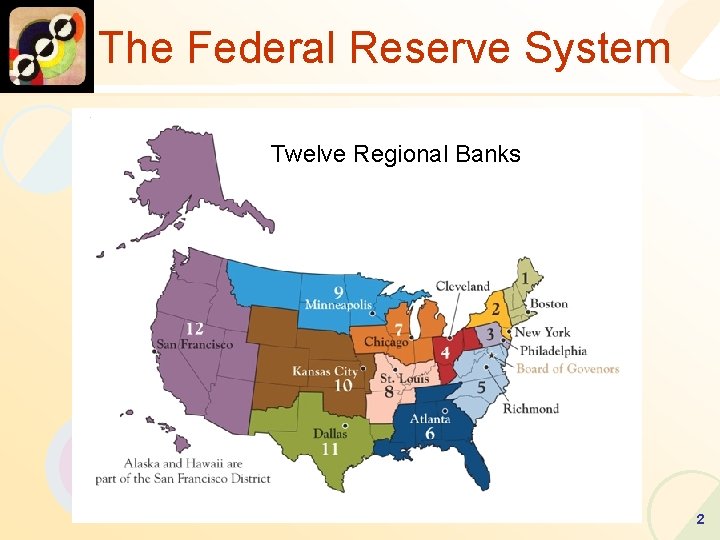
The Federal Reserve System Twelve Regional Banks 2
The Federal Reserve System • As the bank for the U. S. government, they • • • issue new currency (Federal Reserve Notes) and destroy old, worn currency; maintain the U. S. Treasury's bank account, paying checks, and processing electronic payments; and manage the U. S. Treasury’s borrowings. That means issuing, transferring, and redeeming U. S. Treasury bonds, notes, and bills. But like you and your bank, the Treasury decides what they want, and the Federal Reserve Banks just do it. 3
The Federal Reserve System As the Bankers’ Bank, they • • • hold deposits (on which they pay no interest) for the banks in their districts; operate and ensure the integrity of a payments network for clearing paper checks and transferring funds electronically; make funds available to commercial banks within the district through “discount loans, ” on which they charge interest at the discount rate; supervise and regulate financial institutions in the district to ensure their safety and soundness, as well as evaluate proposed bank mergers and new operations; and collect and make available data on business conditions. 4
The Federal Reserve System The Board of Governors • Seven Members appointed for 14 years by the President and confirmed by the Senate. • Chairman and Vice Chairman appointed by the President for four-year renewable terms. 5
The Federal Reserve System The Board of Governors • Analyzes financial and economic conditions, both domestic and international. • Administers consumer credit protection laws. • Supervises and regulates the regional Reserve Banks, including their budgets and their presidents’ salaries. • Sets the reserve requirement, which determines the level of reserves banks are required to hold. • Approves bank merger applications. 6
The Federal Reserve System The Board of Governors • Along with the Reserve Banks, regulates and supervises the banking system, examining individual banks for safety and soundness and for compliance with the law. • Collects and publishes detailed statistics about the system's activities and the economy at large. On the Board's Website, you can find information about the amount of money in the economy (M 1, M 2, and so on), interest rates, exchange rates, the banking system’s assets and liabilities, the level of production in U. S. industry, and the level of household wealth. 7

The Federal Reserve System Federal Open Market Committee (FOMC) • Twelve Voting Members • • • Seven Governors President of the Federal Reserve Bank of New York Four Reserve Bank President FOMC Web Site 8

The Federal Reserve System Assessing the Fed’s Structure. • Independence. • Controls its own Budget • Long-term appointments of Governor • Decision Making by Committee • FOMC is a committee 9
The Federal Reserve System Assessing the Fed’s Structure. • Accountability and Transparency • Monetary Policy Report to Congress • Policy Framework • "The Board of Governors of the Federal Reserve System and the Federal Open Market Committee shall maintain long run growth of the monetary and credit aggregates commensurate with the economy's long run potential to increase production, so as to promote effectively the goals of maximum employment, stable prices, and moderate long-term interest rates. " 10
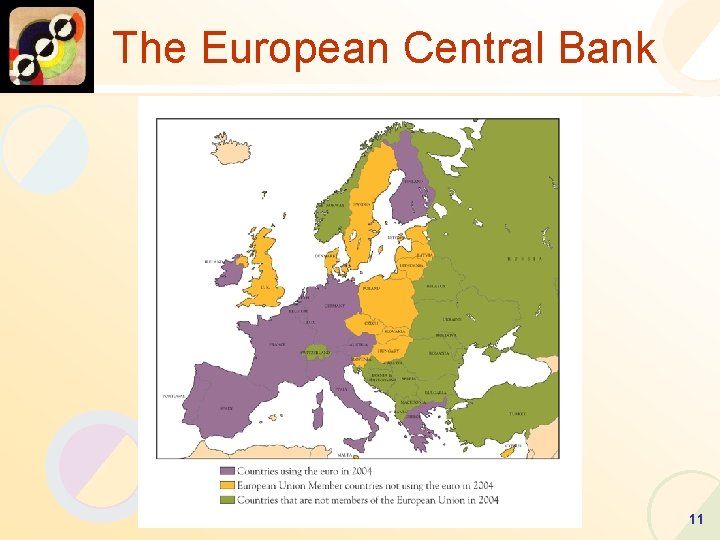
The European Central Bank 11
The European Central Bank Organizational Structure • Executive Board (Six Members) • President and Vice-President • National Central Banks (Web Links) • Governing Council 12
The European Central Bank Differences between ECB and The Fed • ECB does not regulate financial institutions • ECB’s monetary intervention is accomplished by all the National Central Banks. • ECB’s budget is controlled by the National Central Banks 13
The European Central Bank Policy Framework • "The primary objective of the European System of Central Banks shall be to maintain price stability. Without prejudice to the objective of price stability, the ECB shall support the general economic policies in the [European] Community, " including the objective of sustainable and noninflationary growth. 14
Chapter 16 End of Chapter Mc. Graw-Hill/Irwin Copyright © 2006 by The Mc. Graw-Hill Companies, Inc. All rights reserved.
- Slides: 15