
Chapter 16 The Interplay between Education and Occupation
Chapter 16 The Interplay between Education and Occupation
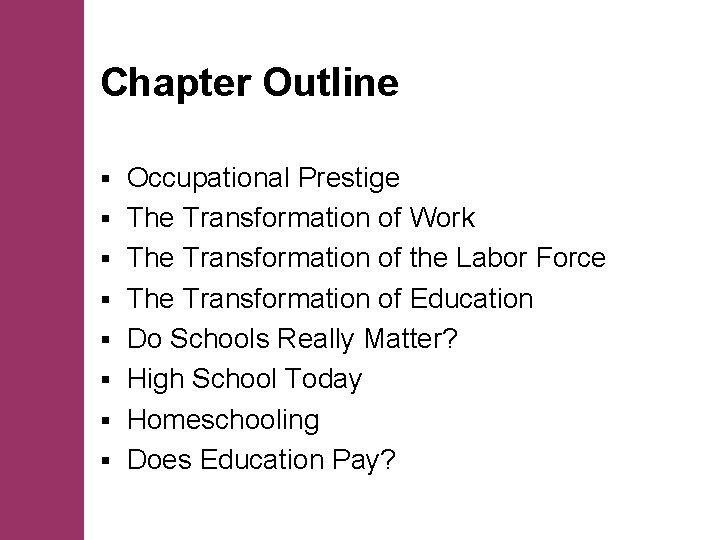
Chapter Outline § § § § Occupational Prestige The Transformation of Work The Transformation of the Labor Force The Transformation of Education Do Schools Really Matter? High School Today Homeschooling Does Education Pay?
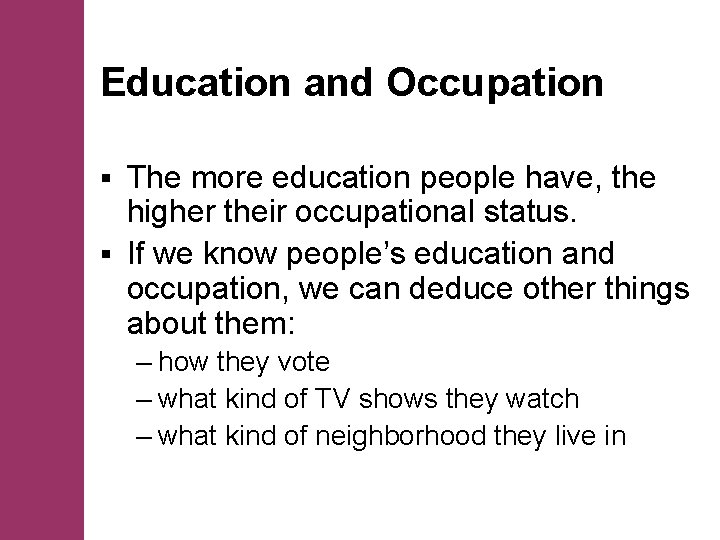
Education and Occupation The more education people have, the higher their occupational status. § If we know people’s education and occupation, we can deduce other things about them: § – how they vote – what kind of TV shows they watch – what kind of neighborhood they live in
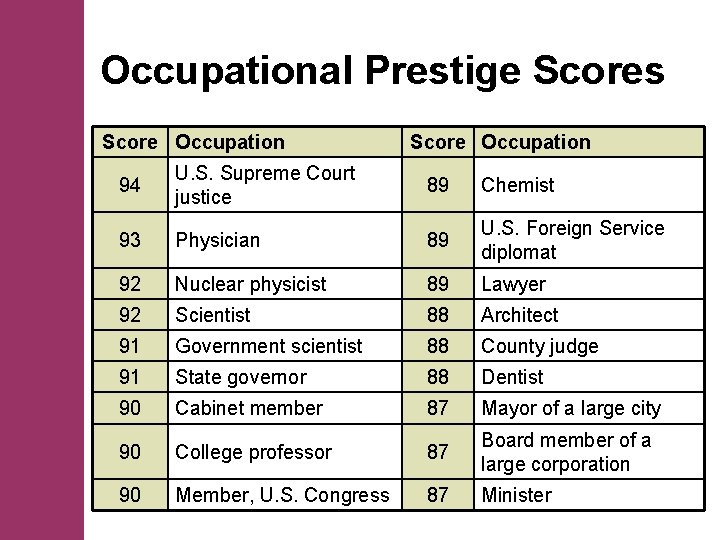
Occupational Prestige Scores Score Occupation 94 U. S. Supreme Court justice 89 Chemist 93 Physician 89 U. S. Foreign Service diplomat 92 Nuclear physicist 89 Lawyer 92 Scientist 88 Architect 91 Government scientist 88 County judge 91 State governor 88 Dentist 90 Cabinet member 87 Mayor of a large city 90 College professor 87 Board member of a large corporation 90 Member, U. S. Congress 87 Minister
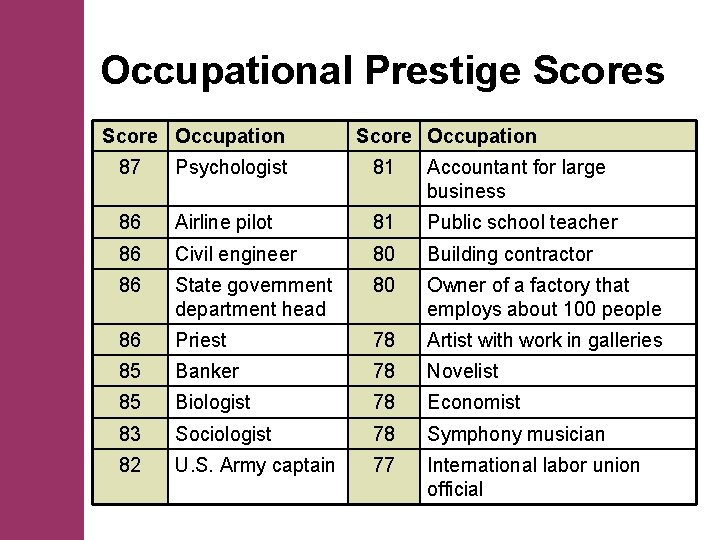
Occupational Prestige Scores Score Occupation 87 Psychologist 81 Accountant for large business 86 Airline pilot 81 Public school teacher 86 Civil engineer 80 Building contractor 86 State government department head 80 Owner of a factory that employs about 100 people 86 Priest 78 Artist with work in galleries 85 Banker 78 Novelist 85 Biologist 78 Economist 83 Sociologist 78 Symphony musician 82 U. S. Army captain 77 International labor union official
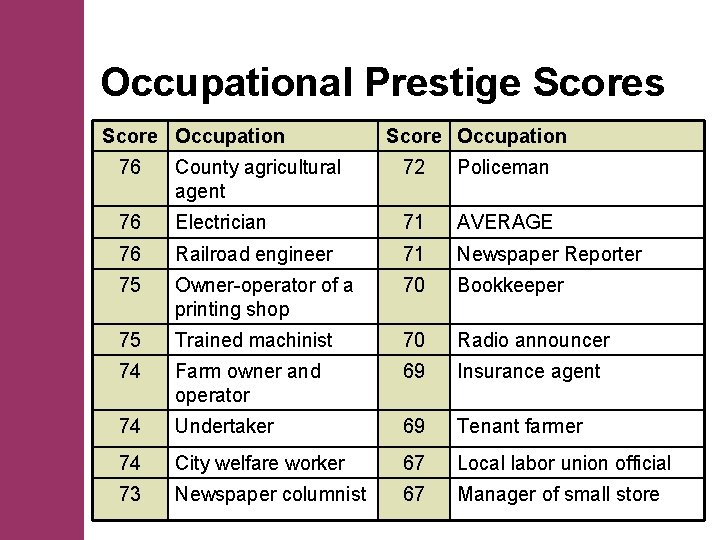
Occupational Prestige Scores Score Occupation 76 County agricultural agent 72 Policeman 76 Electrician 71 AVERAGE 76 Railroad engineer 71 Newspaper Reporter 75 Owner-operator of a printing shop 70 Bookkeeper 75 Trained machinist 70 Radio announcer 74 Farm owner and operator 69 Insurance agent 74 Undertaker 69 Tenant farmer 74 City welfare worker 67 Local labor union official 73 Newspaper columnist 67 Manager of small store
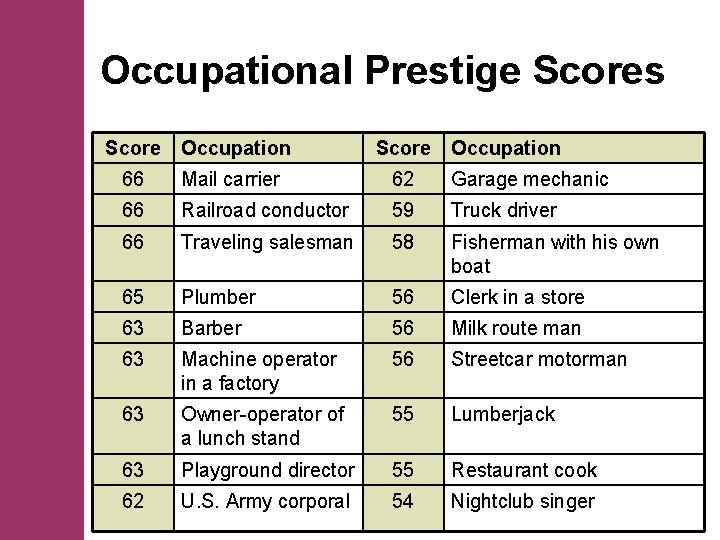
Occupational Prestige Scores Score Occupation 66 Mail carrier 62 Garage mechanic 66 Railroad conductor 59 Truck driver 66 Traveling salesman 58 Fisherman with his own boat 65 Plumber 56 Clerk in a store 63 Barber 56 Milk route man 63 Machine operator in a factory 56 Streetcar motorman 63 Owner-operator of a lunch stand 55 Lumberjack 63 Playground director 55 Restaurant cook 62 U. S. Army corporal 54 Nightclub singer
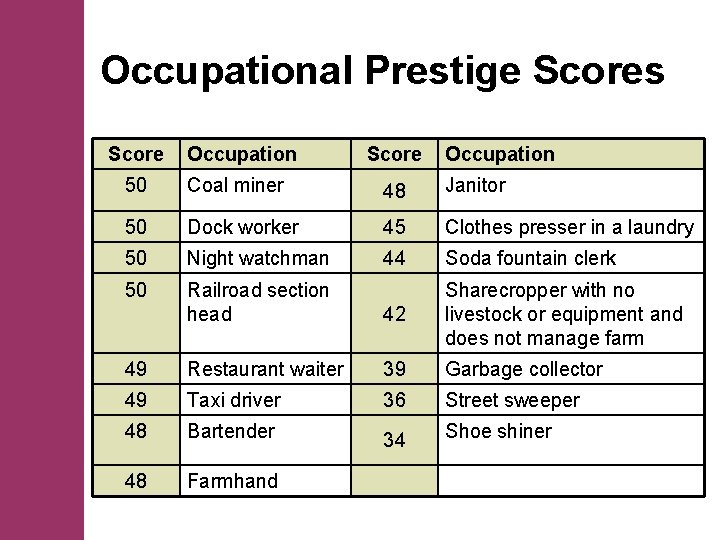
Occupational Prestige Scores Score Occupation 50 Coal miner 48 Janitor 50 Dock worker 45 Clothes presser in a laundry 50 Night watchman 44 Soda fountain clerk 50 Railroad section head 42 Sharecropper with no livestock or equipment and does not manage farm 49 Restaurant waiter 39 Garbage collector 49 Taxi driver 36 Street sweeper 48 Bartender 34 Shoe shiner 48 Farmhand
Why People Rate Occupations High or Low People rate a job by its importance. § The more training an occupation requires and the more pay it offers, the greater its public prestige. § They assume society will not pay high salaries to get people to do unimportant work. §
Occupational Opportunities Education is the primary factor determining our occupational opportunities. § Children receive socialization appropriate to certain occupations. § Children who don’t show academic aptitude tend to be placed in educational tracks that lead to manual occupations. § Academically talented children are groomed for technical and professional occupations. §
The Transformation of Work In 1900, fewer than 20% of North Americans had white-collar jobs. § Today, there are more white-collar than blue-collar workers. § Fewer jobs involving manual labor are available each year. §
The Transformation Of The Labor Force In 1870 about 40% of North Americans over age sixteen were in the labor force. § In 2000, nearly 2/3 were in the labor force. § Now most North Americans finish high school or college before entering the labor force, and most people must retire by age 70. § In 1870, few went to high school or college, and most started work young; people rarely retired as long as they could work. §
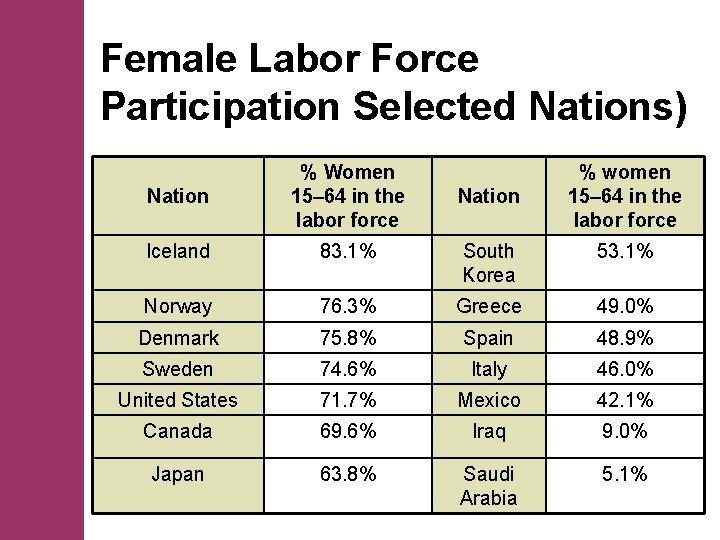
Female Labor Force Participation Selected Nations) Nation % Women 15– 64 in the labor force Iceland 83. 1% South Korea 53. 1% Norway 76. 3% Greece 49. 0% Denmark 75. 8% Spain 48. 9% Sweden 74. 6% Italy 46. 0% United States 71. 7% Mexico 42. 1% Canada 69. 6% Iraq 9. 0% Japan 63. 8% Saudi Arabia 5. 1% Nation % women 15– 64 in the labor force
Women in the Labor Force In 1900, few women in North America or anywhere else were employed outside the home. § Today, about 7 of 10 American and Canadian women are full-time members of the labor force. §
Reasons for Expansion of Women in the Labor Force 1. 2. 3. 4. 5. Unfavorable sex ratio forced many women to support themselves. Reduced fertility freed women from long years of pregnancy and child rearing. Increased freedom from housework. Change in the kinds of work available. Money.
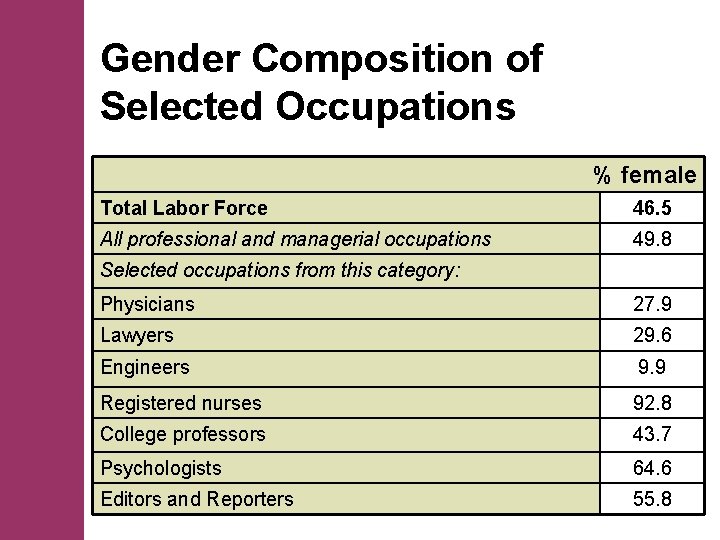
Gender Composition of Selected Occupations % female Total Labor Force 46. 5 All professional and managerial occupations 49. 8 Selected occupations from this category: Physicians 27. 9 Lawyers 29. 6 Engineers 9. 9 Registered nurses 92. 8 College professors 43. 7 Psychologists 64. 6 Editors and Reporters 55. 8
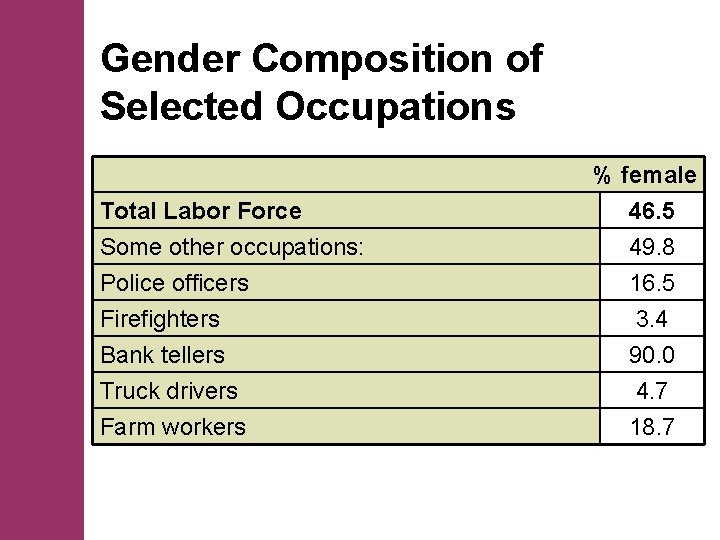
Gender Composition of Selected Occupations Total Labor Force Some other occupations: Police officers % female 46. 5 49. 8 16. 5 Firefighters Bank tellers Truck drivers 3. 4 90. 0 4. 7 Farm workers 18. 7
Chronic Unemployment Concentrated in certain areas, such as the Appalachia region of the United States or the Atlantic provinces of Canada. § More common in certain segments of the population, especially minority groups. § Unemployment afflicts a higher proportion of African Americans than whites. §
Education In 1647, the Puritans of the Massachusetts Colony enacted a law that all children should attend school. § In 1920, fewer than half of those of high school age were still in school. § The class of 1948 included 52. 9% of its age group. § The class of 1999 included more than 70% of its age group. §
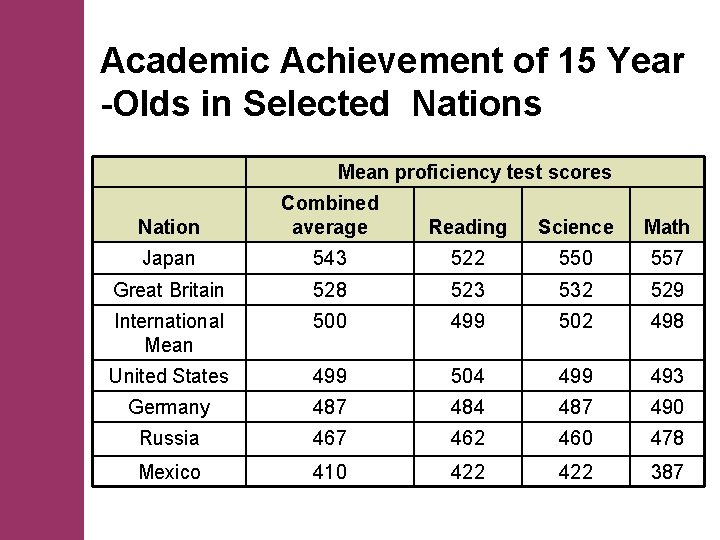
Academic Achievement of 15 Year -Olds in Selected Nations Mean proficiency test scores Nation Combined average Reading Science Math Japan 543 522 550 557 Great Britain 528 523 532 529 International Mean 500 499 502 498 United States 499 504 499 493 Germany 487 484 487 490 Russia 467 462 460 478 Mexico 410 422 387
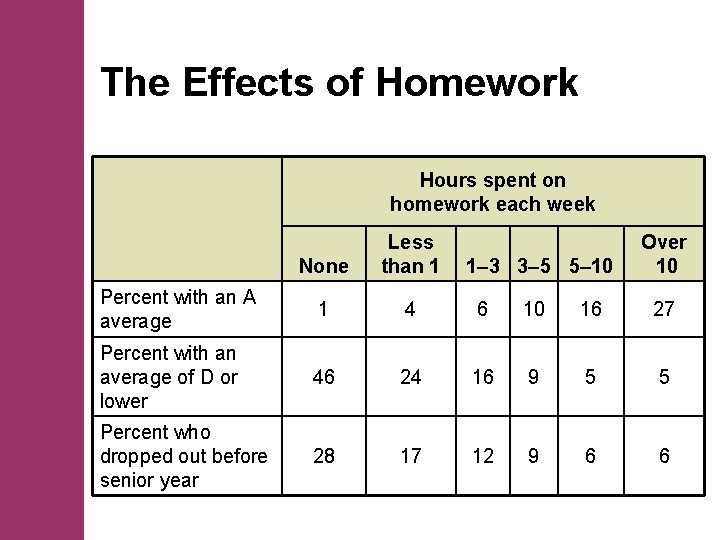
The Effects of Homework Hours spent on homework each week None Less than 1 Percent with an A average 1 4 6 10 16 27 Percent with an average of D or lower 46 24 16 9 5 5 Percent who dropped out before senior year 28 17 12 9 6 6 1– 3 3– 5 5– 10 Over 10
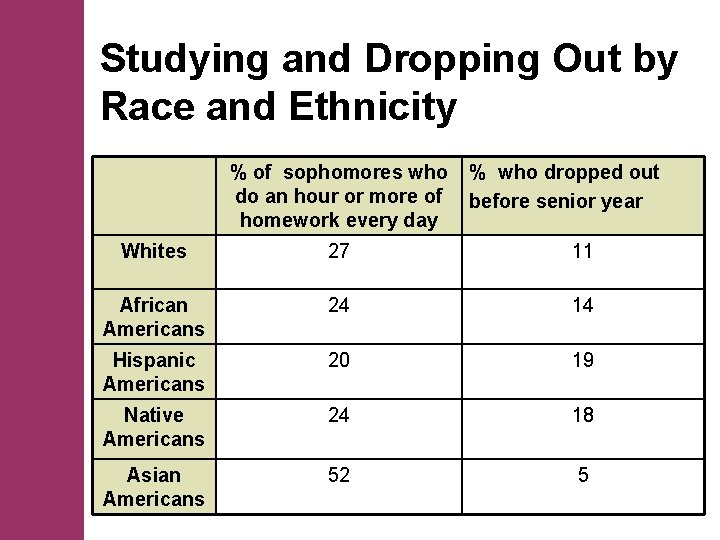
Studying and Dropping Out by Race and Ethnicity % of sophomores who do an hour or more of homework every day % who dropped out before senior year Whites 27 11 African Americans 24 14 Hispanic Americans 20 19 Native Americans 24 18 Asian Americans 52 5
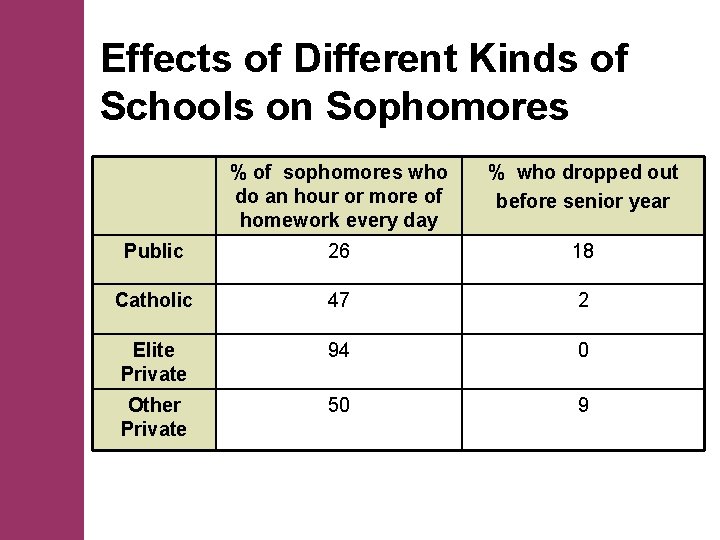
Effects of Different Kinds of Schools on Sophomores % of sophomores who do an hour or more of homework every day % who dropped out before senior year Public 26 18 Catholic 47 2 Elite Private 94 0 Other Private 50 9
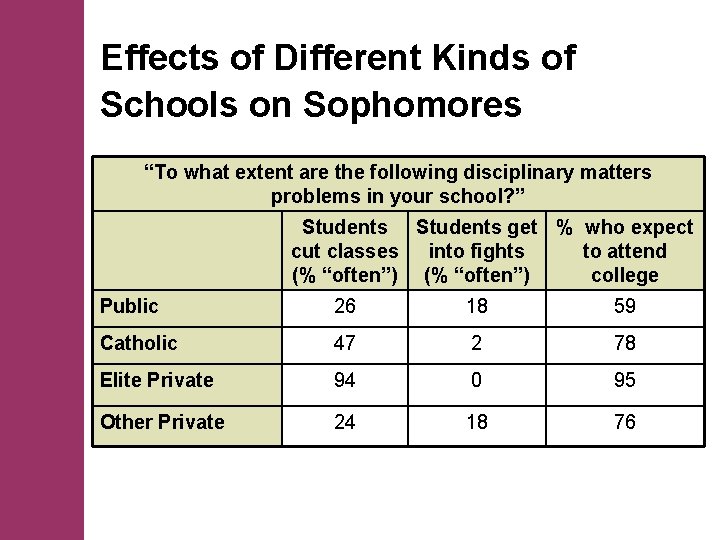
Effects of Different Kinds of Schools on Sophomores “To what extent are the following disciplinary matters problems in your school? ” Students get % who expect cut classes into fights to attend (% “often”) college Public 26 18 59 Catholic 47 2 78 Elite Private 94 0 95 Other Private 24 18 76
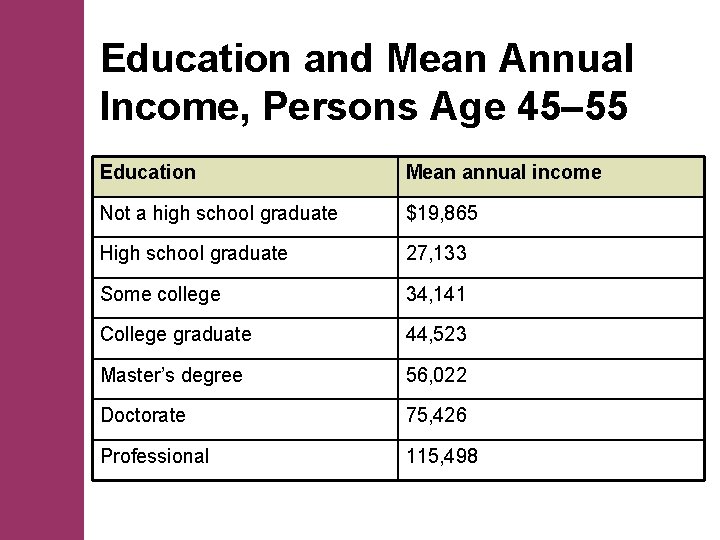
Education and Mean Annual Income, Persons Age 45– 55 Education Mean annual income Not a high school graduate $19, 865 High school graduate 27, 133 Some college 34, 141 College graduate 44, 523 Master’s degree 56, 022 Doctorate 75, 426 Professional 115, 498
- Slides: 25