
Chapter 16 The Fishes Part II Osteichthyes Gnathostome








- Slides: 66
Chapter 16 – The Fishes, Part II Osteichthyes
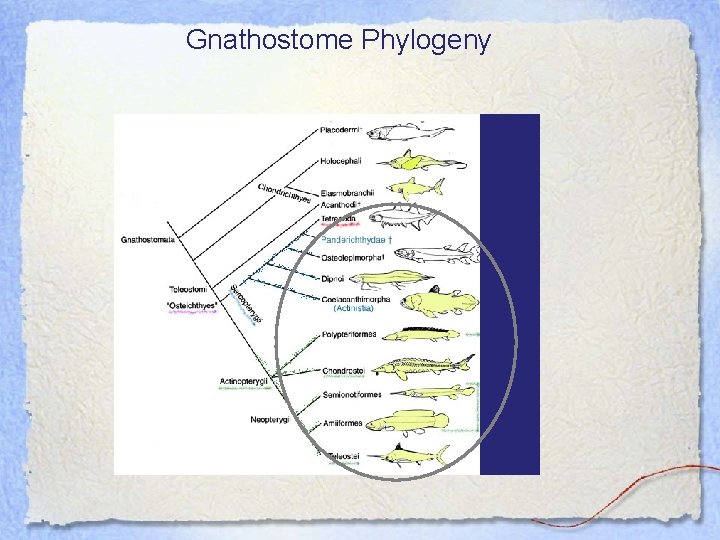
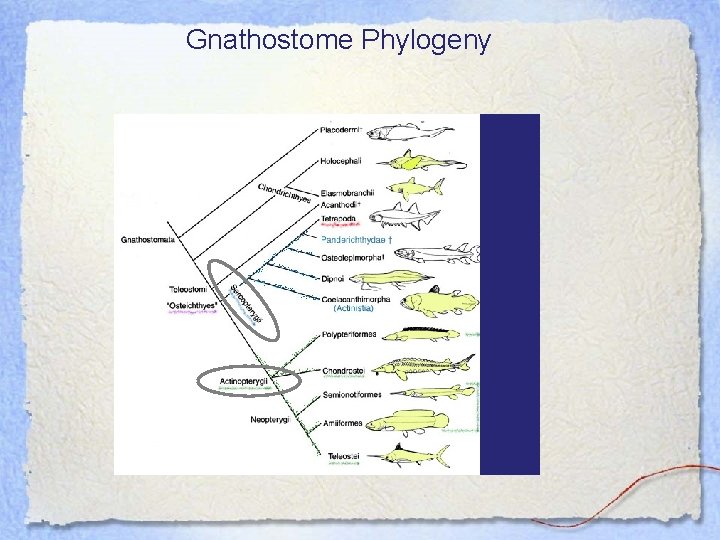
Gnathostome Phylogeny
Osteichthyes: Bony Fishes • Lineage of fishes with bony endoskeletons contains 96% of living fishes and all living tetrapods • 3 features unite bony fishes and tetrapod descendants –Endochondral bone replaces cartilage during development –Lung or swim bladder is present • Evolved as an extension of gut –Have several cranial and dental characters unique to clade
Diversity –Common ancestor of fishes is also an ancestor of land vertebrates –Approximately 24, 600 living species; mostly bony fishes • Include more species than all other vertebrates combined –Adapted to live in medium 800 times denser than air –Can adjust to the salt and water balance of their environment
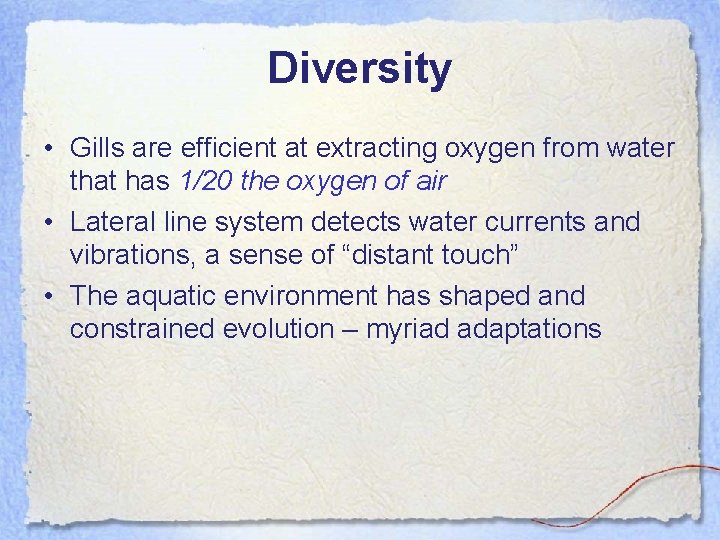
Diversity • Gills are efficient at extracting oxygen from water that has 1/20 the oxygen of air • Lateral line system detects water currents and vibrations, a sense of “distant touch” • The aquatic environment has shaped and constrained evolution – myriad adaptations
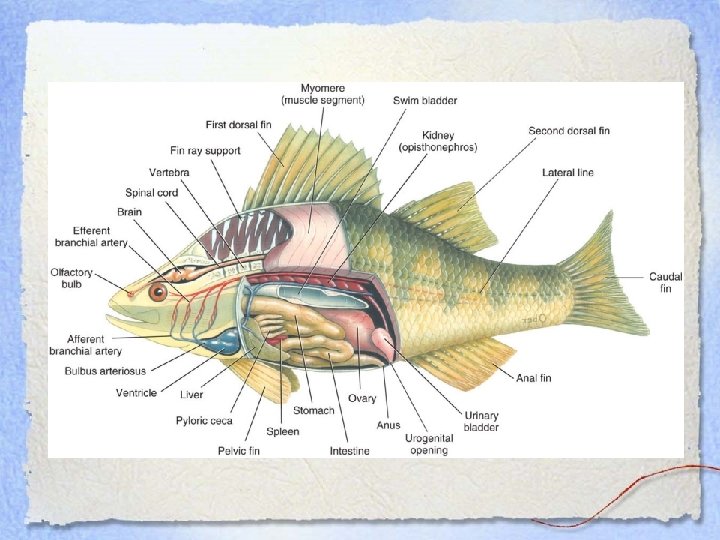
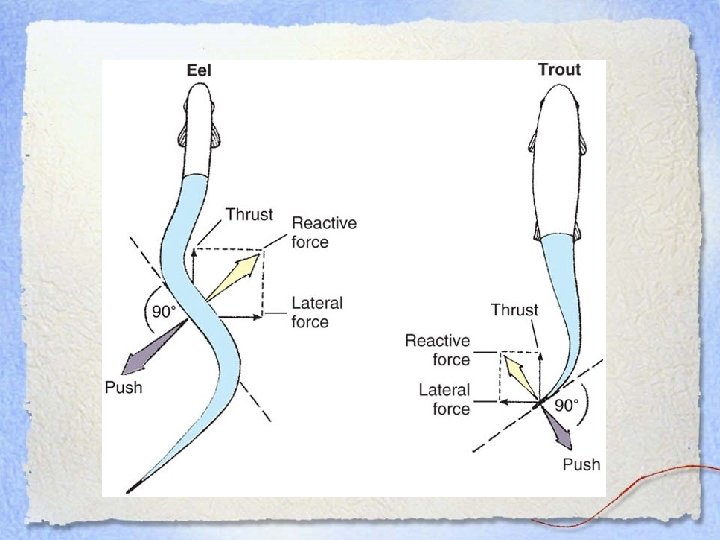
Locomotion in Water • Speed –Most fishes swim maximally at ten body lengths / second • Larger fish therefore swims faster –Short bursts of speed are possible for a few seconds • Mechanism –Trunk and tail musculature propels a fish –Muscles are arranged in zigzag bands called myomeres • Have the shape of a W on the side of fish • Internally the bands are folded and nested • Each myomere pulls on several vertebrae 24 -7
��卓_types of locomotion in fishes
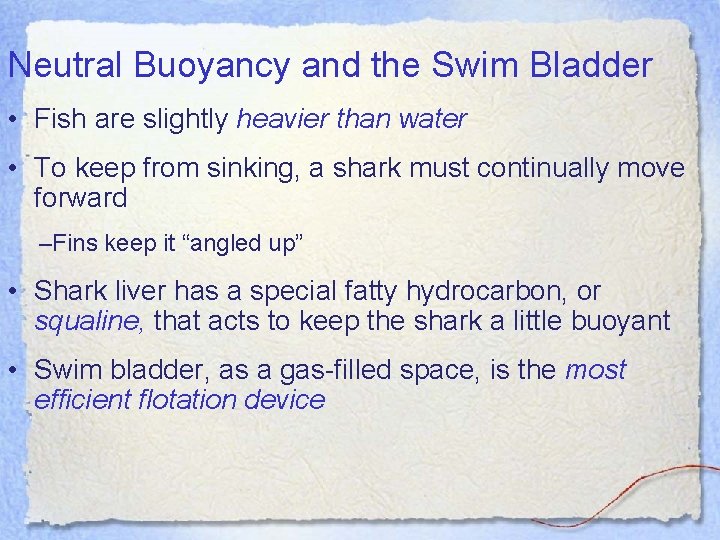
Neutral Buoyancy and the Swim Bladder • Fish are slightly heavier than water • To keep from sinking, a shark must continually move forward –Fins keep it “angled up” • Shark liver has a special fatty hydrocarbon, or squaline, that acts to keep the shark a little buoyant • Swim bladder, as a gas-filled space, is the most efficient flotation device
��涵_How does fish keep their neutral buoyancy?
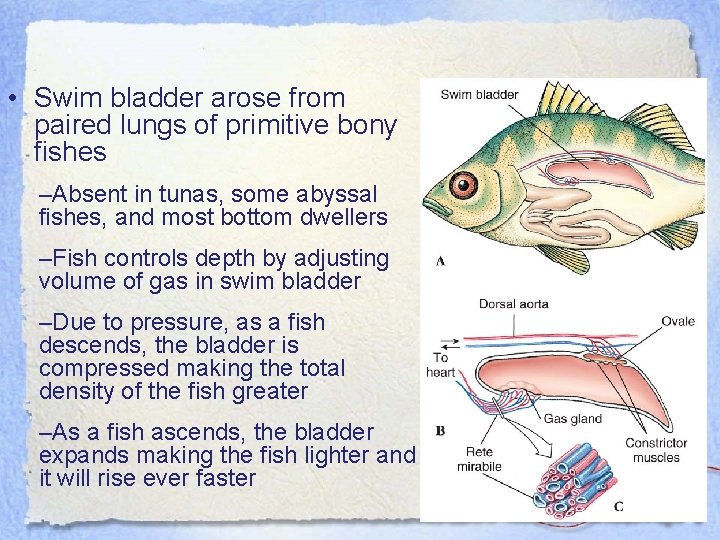
• Swim bladder arose from paired lungs of primitive bony fishes –Absent in tunas, some abyssal fishes, and most bottom dwellers –Fish controls depth by adjusting volume of gas in swim bladder –Due to pressure, as a fish descends, the bladder is compressed making the total density of the fish greater –As a fish ascends, the bladder expands making the fish lighter and it will rise ever faster
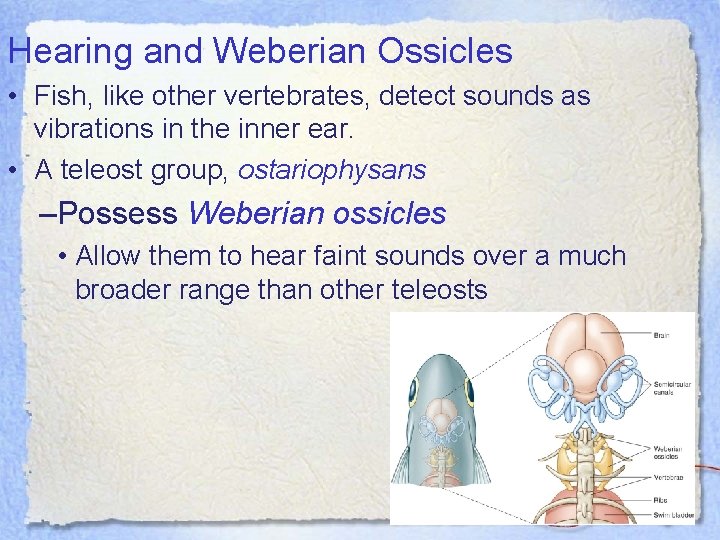
Hearing and Weberian Ossicles • Fish, like other vertebrates, detect sounds as vibrations in the inner ear. • A teleost group, ostariophysans –Possess Weberian ossicles • Allow them to hear faint sounds over a much broader range than other teleosts
�坤�_Weberian occicles
Types of fish respiration
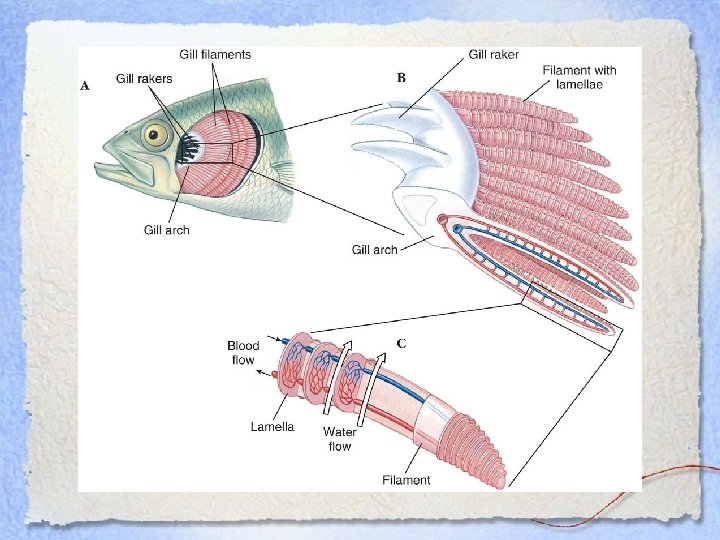
Respiration • Fish gills are filaments with thin membranes folded into plate-like lamellae • Gills are inside the pharyngeal cavity and covered with a movable flap, the operculum • Operculum protects delicate gill filaments and streamlines body • Pumping action by operculum helps move water through gills
Buccal pumping
• Buccal pumping –Carp, eel, tilapia • Some active fishes use ram ventilation –Tuna, lemmon shark –Forward movement is sufficient to force water across gills –Such fishes are asphyxiated in a restrictive aquarium even if the water is saturated with oxygen
�霖青_Countercurrent exchange
• Water flow is opposite to the blood flow –Countercurrent exchange maximizes exchange of gases • Some bony fishes remove 85% of the oxygen from water passing over gills
• Fishes Out of Water –Lungs of lungfishes allow them to respire in air –Eels can wriggle over land during rainy weather • Use skin as major respiratory surface –A bowfin uses gills at cooler temperatures and lunglike swim bladder at higher temperatures –Electric eel has degenerate gills and gulps air through vascular mouth cavity –Indian climbing perch spends most of its time on land, breathing air in special chambers
Feeding Behavior • Fish devote most of their time searching for food to eat and eating • With the evolution of jaws –Fish left a passive filter-feeding life and entered a predatorprey battle • Most fish are carnivores –Feed on zooplankton, insect larvae, and other aquatic animals • Most fish do not chew food –Would block water flow across the gills
• Many plankton feeders swim in large schools and using gill rakers to strain food • Omnivores feed on both plants and animals • Scavengers feed on organic debris • Detritovores consume fine particulate organic matter • Parasitic fishes suck body fluids of other fishes
李欣欣_Carnivorous/herbivorous/… and examples in fishes
• Intestine tends to be shorter in carnivores and long and coiled in herbivores • Stomach primarily stores food • Intestine digests and absorbs nutrients • Teleost fishes have pyloric ceca –Apparently for fat absorption
Fish reproductive migration
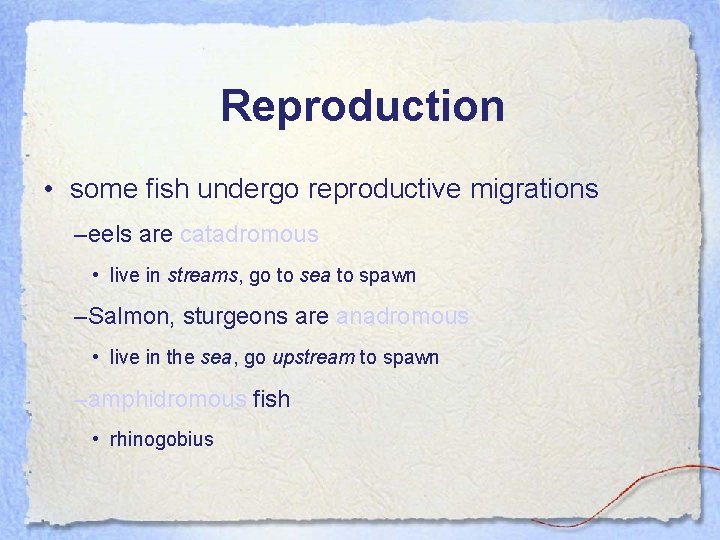
Reproduction • some fish undergo reproductive migrations –eels are catadromous • live in streams, go to sea to spawn –Salmon, sturgeons are anadromous • live in the sea, go upstream to spawn –amphidromous fish • rhinogobius
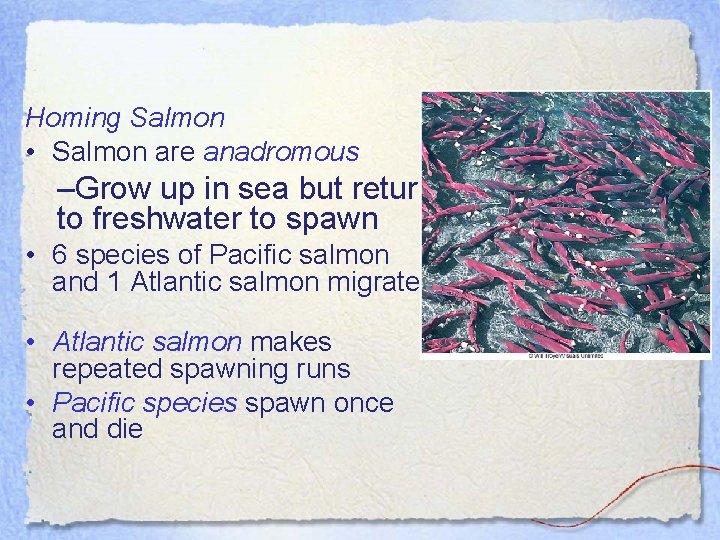
Homing Salmon • Salmon are anadromous –Grow up in sea but return to freshwater to spawn • 6 species of Pacific salmon and 1 Atlantic salmon migrates • Atlantic salmon makes repeated spawning runs • Pacific species spawn once and die
Fish reproduction
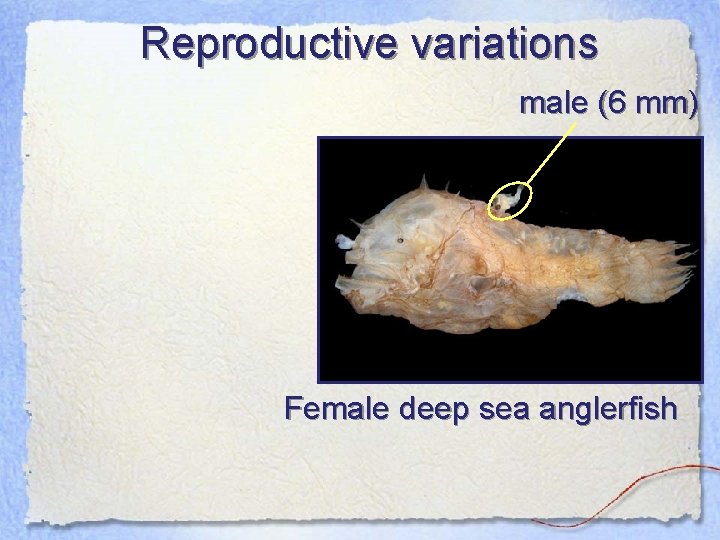
Quick Comments on Reproduction • Most fishes are dioecious with external fertilization and external development, but there is great variation… • Some sharks are viviparous with some kind of placental attachment to nourish young • Most oviparous pelagic fish lay huge numbers of eggs –Female cod may release 4– 6 million eggs • Some are territorial and guard eggs; others release into water column and leave (no parental care) • Some carry broods in their mouth • Many variations in morphology and behavior!
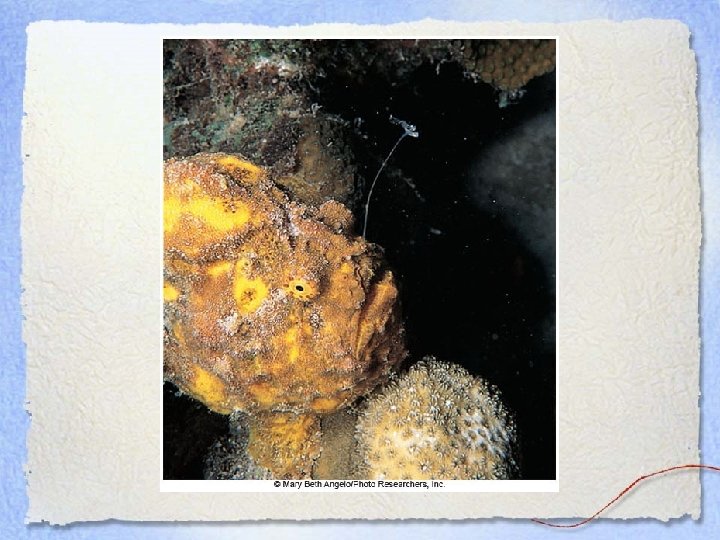
Reproductive variations male (6 mm) Female deep sea anglerfish
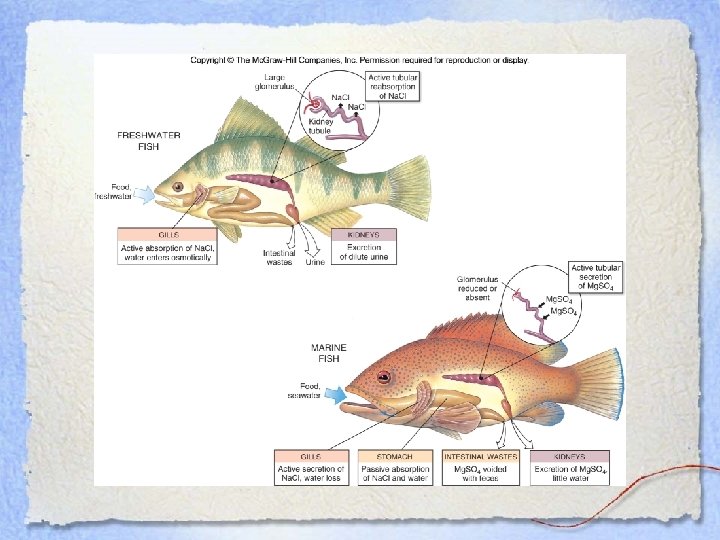
Osmoregulation • Chondrichthyes has high concentration of urea (up to 2. 5%) and trimethylamine N-oxide (TMAO), • allowing them to be in osmotic balance with the seawater.
叶玉林_Osmoregulation in fishes
Osmoregulation • marine bony fish are hypoosmotic (less salty) –to gain water, they absorb water through the stomach –to dump salts, they secrete salts through the gills • freshwater bony fish are hyperosmotic (more salty) –to dump water, they produce dilute urine –to gain salts, they absorb salt from food and across gills
Osteichthyes: Bony Fishes – 2 major lineages • Ray-finned fishes, class Actinopterygii, radiated to form modern bony fishes • Lobe-finned fishes, class Sarcopterygii, include lungfishes and the coelacanth
Gnathostome Phylogeny
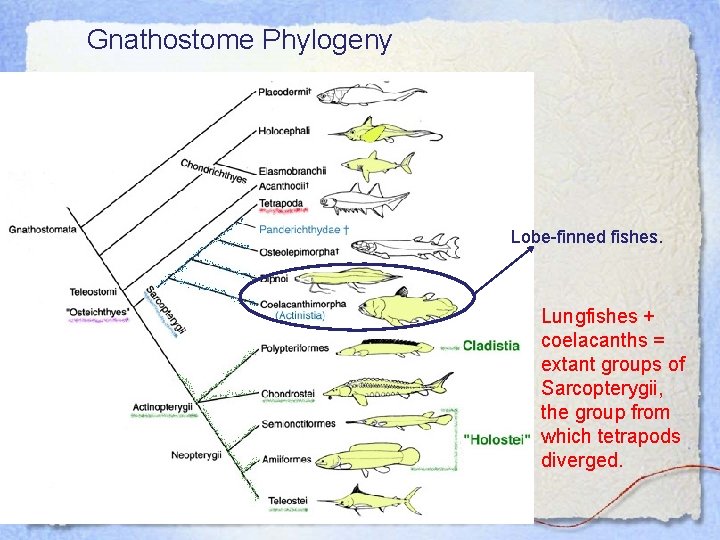
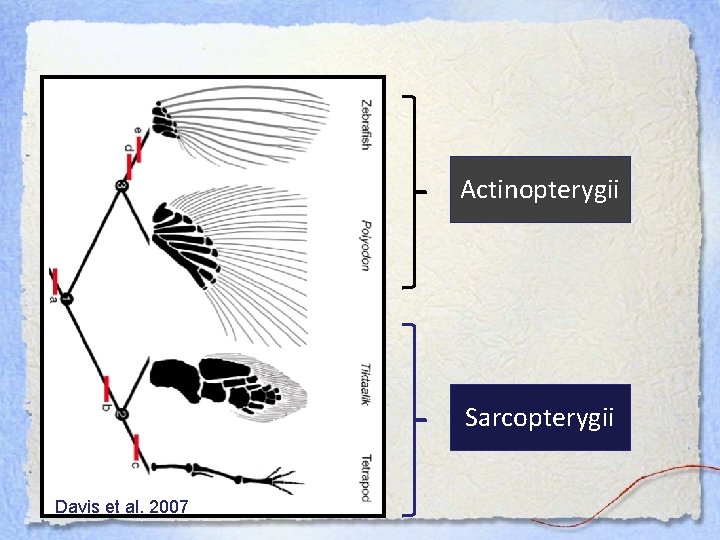
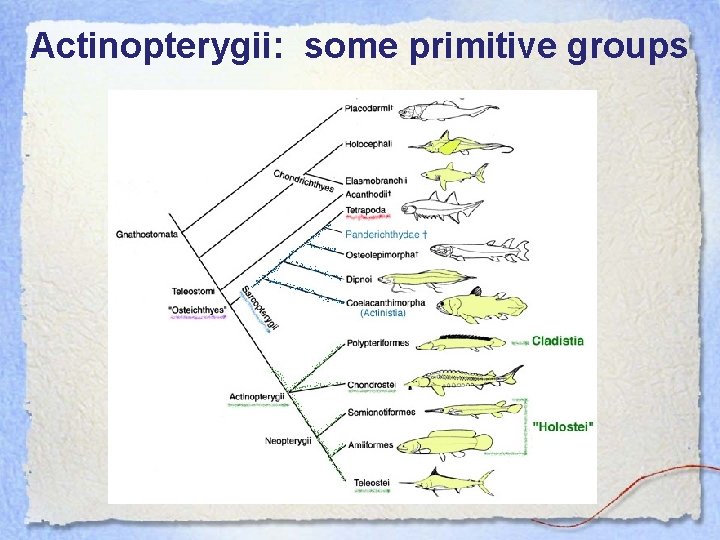
Gnathostome Phylogeny Lobe-finned fishes. Lungfishes + coelacanths = extant groups of Sarcopterygii, the group from which tetrapods diverged.
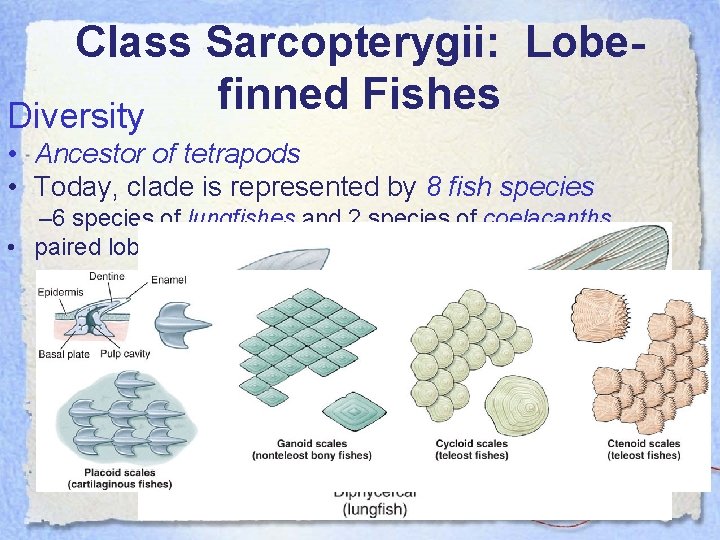
Class Sarcopterygii: Lobefinned Fishes Diversity • Ancestor of tetrapods • Today, clade is represented by 8 fish species – 6 species of lungfishes and 2 species of coelacanths • paired lobed fins
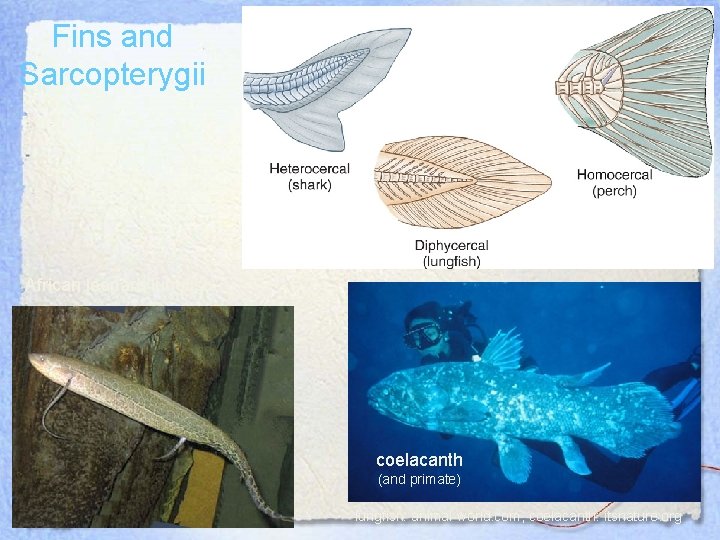
“Sarcopterygii” • the other main group of “bony fish” • low diversity; only eight living species –two coelacanth species, six lungfish species • coelacanths both deep marine, lungfish freshwater • characteristics of sarcopterygians –have a central appendage in their fins that contains many bones and muscles • fins are flexible and potentially useful for supporting the body –possess a diphycercal tail
Actinopterygii Sarcopterygii Davis et al. 2007
Fins and Sarcopterygii African leopard lungfish coelacanth (and primate) lungfish: animal-world. com, coelacanth: itsnature. org
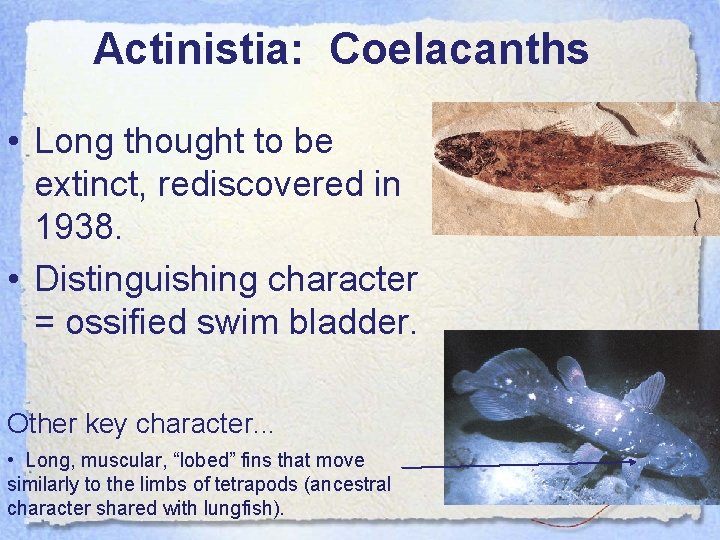
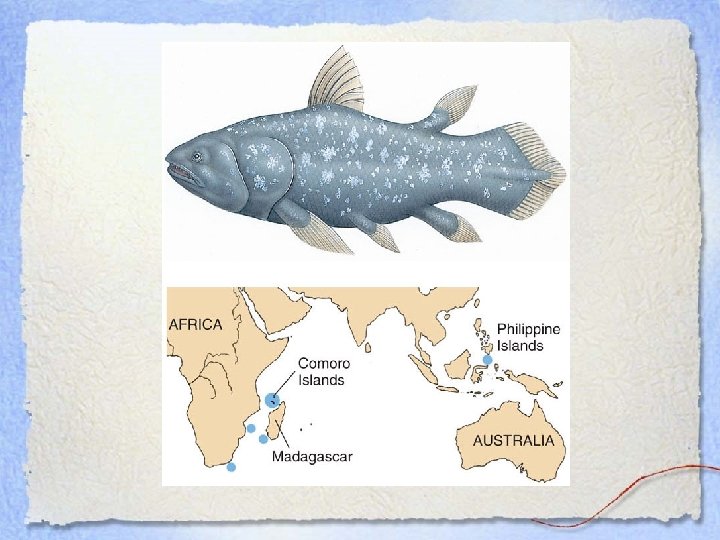
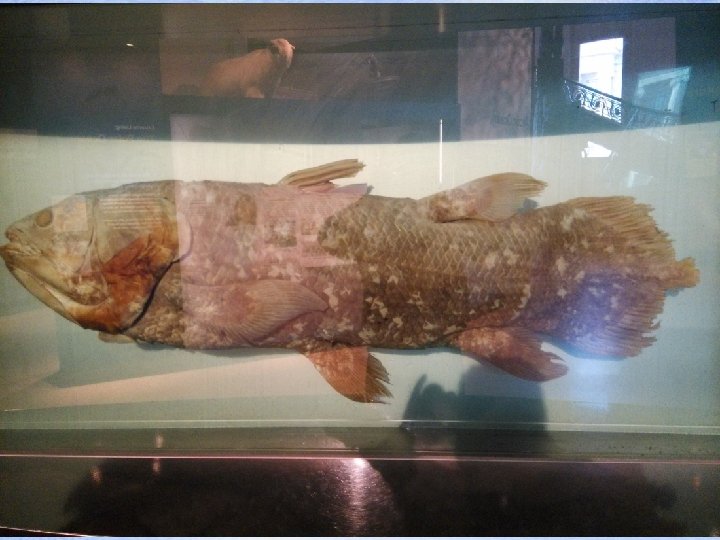
Actinistia: Coelacanths • Long thought to be extinct, rediscovered in 1938. • Distinguishing character = ossified swim bladder. Other key character. . . • Long, muscular, “lobed” fins that move similarly to the limbs of tetrapods (ancestral character shared with lungfish).
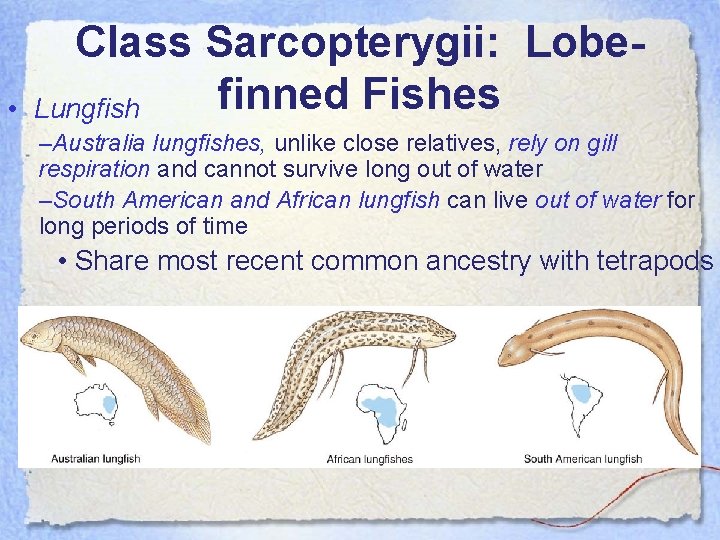
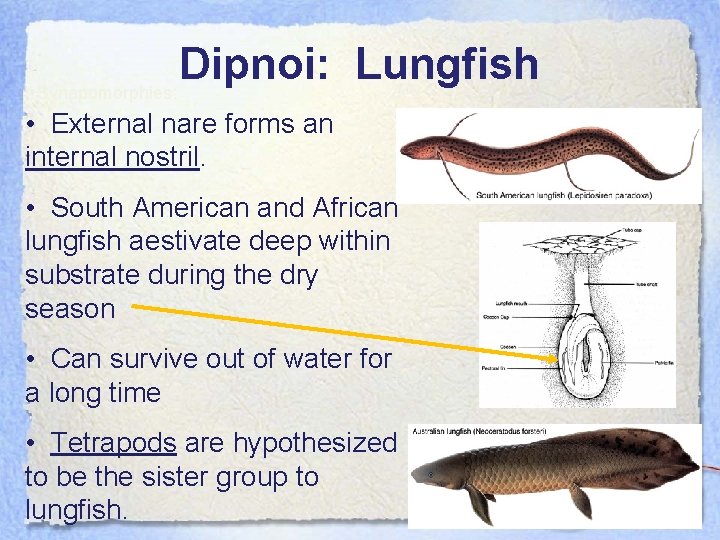
• Class Sarcopterygii: Lobefinned Fishes Lungfish –Australia lungfishes, unlike close relatives, rely on gill respiration and cannot survive long out of water –South American and African lungfish can live out of water for long periods of time • Share most recent common ancestry with tetrapods
Dipnoi: Lungfish Synapomorphies: • External nare forms an internal nostril. • South American and African lungfish aestivate deep within Other characters: substrate during the dry season • Can survive out of water for a long time • Tetrapods are hypothesized to be the sister group to lungfish.
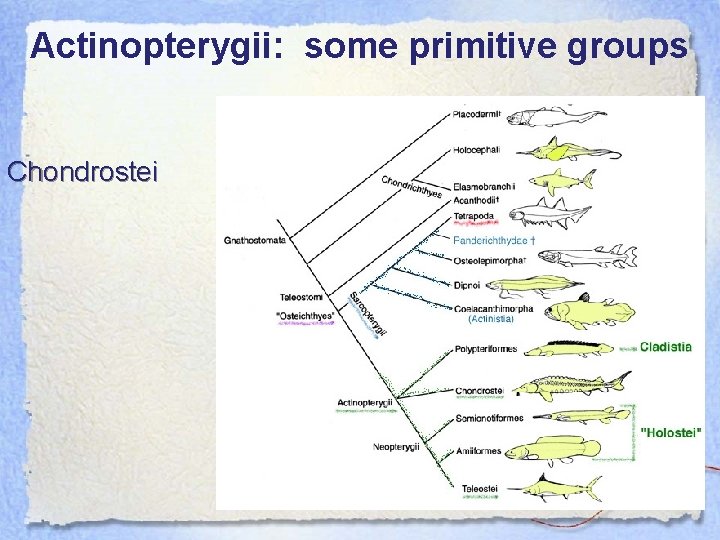
Actinopterygii: some primitive groups
Actinopterygii Diversity • possess lepidotrichia (fin rays) –bony or horny spines that support the fins
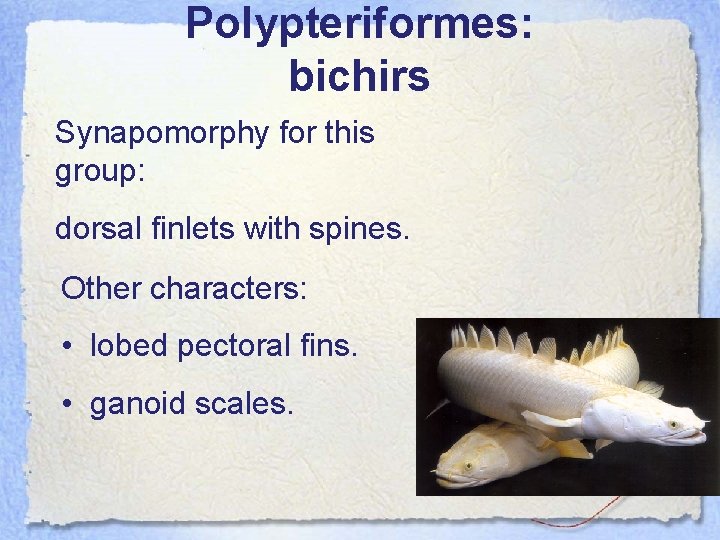
Polypteriformes: bichirs Synapomorphy for this group: dorsal finlets with spines. Other characters: • lobed pectoral fins. • ganoid scales.
Actinopterygii: some primitive groups Chondrostei
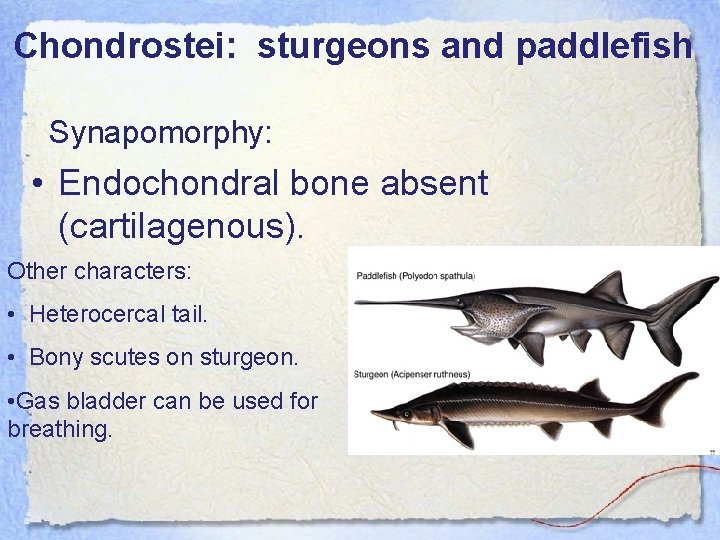
Chondrostei: sturgeons and paddlefish Synapomorphy: • Endochondral bone absent (cartilagenous). Other characters: • Heterocercal tail. • Bony scutes on sturgeon. • Gas bladder can be used for breathing.
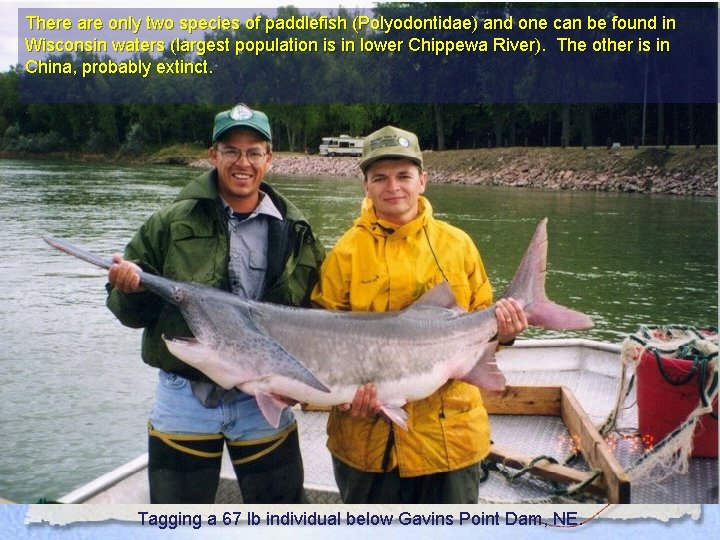
There are only two species of paddlefish (Polyodontidae) and one can be found in Wisconsin waters (largest population is in lower Chippewa River). The other is in China, probably extinct. Tagging a 67 lb individual below Gavins Point Dam, NE.
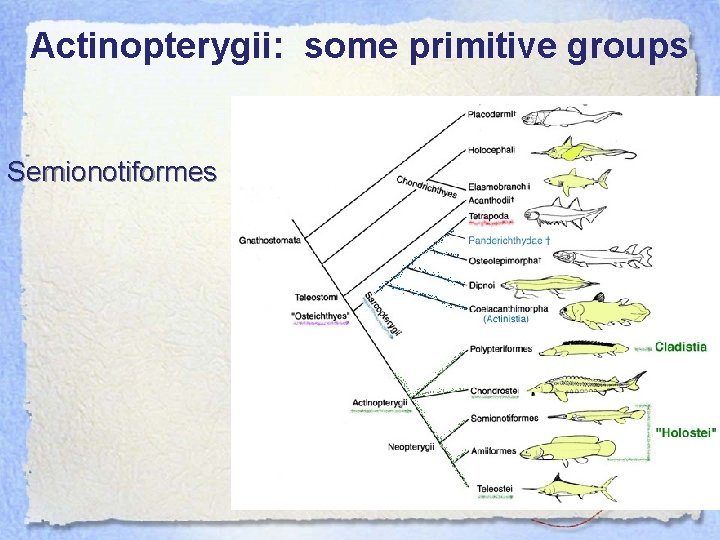
Actinopterygii: some primitive groups Semionotiformes
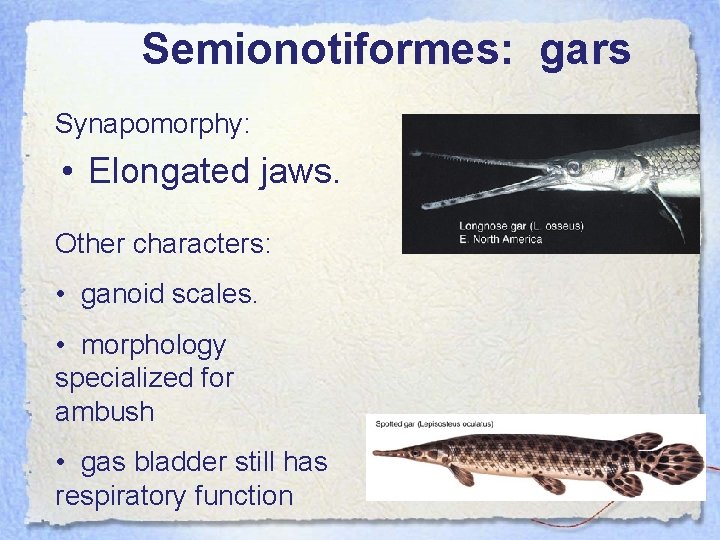
Semionotiformes: gars Synapomorphy: • Elongated jaws. Other characters: • ganoid scales. • morphology specialized for ambush • gas bladder still has respiratory function
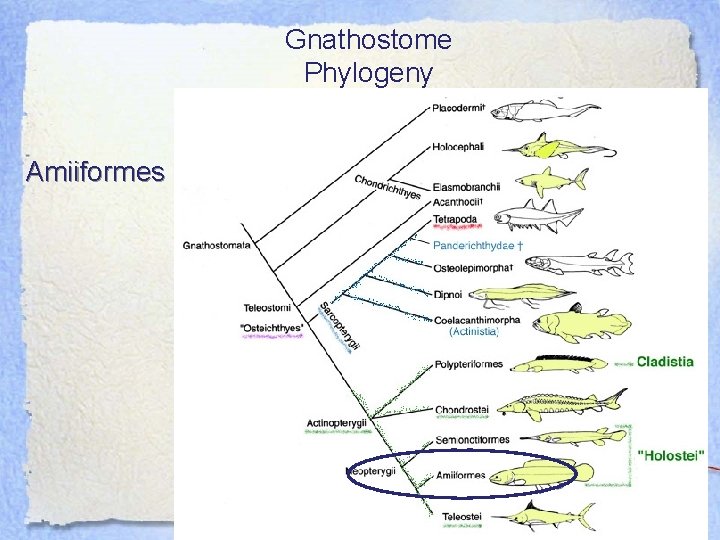
Gnathostome Phylogeny Amiiformes
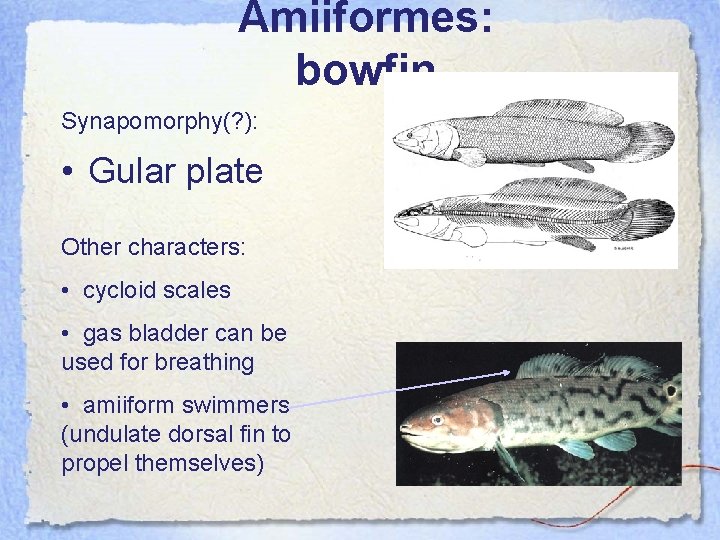
Amiiformes: bowfin Synapomorphy(? ): • Gular plate Other characters: • cycloid scales • gas bladder can be used for breathing • amiiform swimmers (undulate dorsal fin to propel themselves)
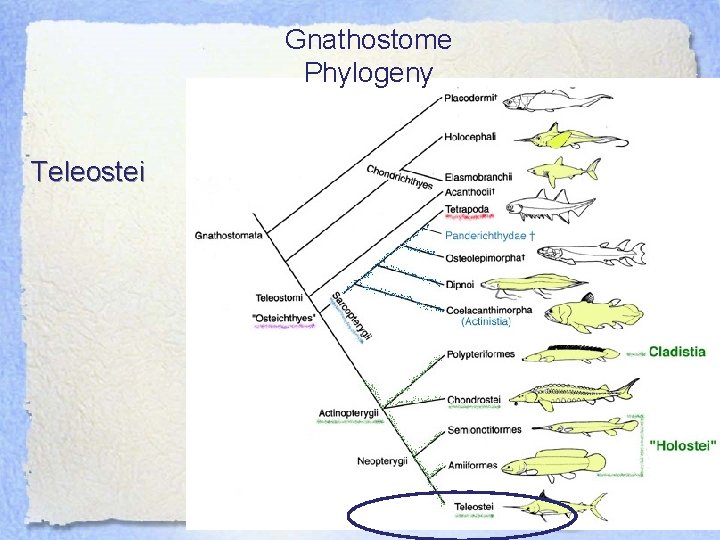
Gnathostome Phylogeny Teleostei
Class Actinopterygii: Rayfinned Fishes • Teleosts –Constitute 96% of all living fishes and half of all vertebrates –Range from 10 millimeters to 17 meters long, and up to 900 kilograms in weight –Survive from 5, 200 meters altitude in Tibet to 8, 000 meters below the ocean surface –Some can live in hot springs at 44 o C while others survive under Antarctic ice at - 2 o C –Some live in salt concentrations three times seawater –Others found swamps devoid of oxygen
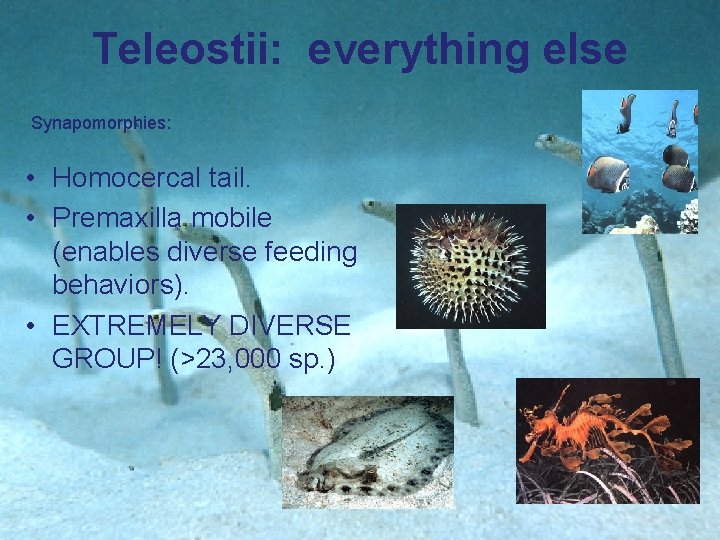
Teleostii: everything else Synapomorphies: • Homocercal tail. • Premaxilla mobile (enables diverse feeding behaviors). • EXTREMELY DIVERSE GROUP! (>23, 000 sp. )