
Chapter 16 Testing Object Oriented Software Objectives Problems
Chapter 16 Testing Object Oriented Software Objectives • • • Problems faced in Object-Oriented Testing Issues in Object-Oriented Testing Strategy for testing Object-Oriented Software: Verification of UML model and Validation Issues in testing a class Feature based testing of class State based testing of class Issues in testing Inheritance Incremental testing method for Inheritance Integration Testing of Object-Oriented Software Thread based Integration Testing Implicit Control Flow based Integration Testing UML based testing and system testing based on use-cases 1 © Oxford University Press 2011. All rights reserved.
Differences between Conventional Testing and Object-Oriented Software Testing Evolution of Software Testing • Nature of classes and objects. • Integration testing (for conventional software) then is truly the unit testing of object-oriented software. • Since the object-oriented paradigm lowers complexity and hence lessens the need for basis path testing. 2 © Oxford University Press 2011. All rights reserved.
Object-Oriented Testing and Maintenance Problems Evolution of Software Testing • Understanding Problem • Dependency Problem State Behavior Problem 3 © Oxford University Press 2011. All rights reserved.
Issues in OO Testing • Basic unit for testing • Implications of inheritance • Polymorphism • White-box testing • Black-box testing • Integration strategies 4 © Oxford University Press 2011. All rights reserved.
Strategy and Tactics of Testing OOS Method-level testing Class Level testing Cluster level testing System level testing 5 © Oxford University Press 2011. All rights reserved.
Verification of OOS Verification of OOA & OOD models • Assess the class-responsibility-collaborator (CRC) model and object-relationship diagram. • Review system design • Test object model against the object relationship network to ensure that all design objects contain necessary attributes and operations needed to implement the collaborations defined for each CRC card. • Review detailed specifications of algorithms used to implement operations using conventional inspection techniques. 6 © Oxford University Press 2011. All rights reserved.
Unit / Class Testing Issues in testing a Class • A class cannot be tested directly. • The methods should also be tested with reference to a class or class hierarchy in the direction of complete testing of a class. • Testing of inheritance. • There may be operations in a class that change the state of the object on their execution. Thus, these operations should be tested with reference to state change of object. • Polymorphism 7 © Oxford University Press 2011. All rights reserved.
Feature based Testing of Classes Software Testing Myths The features of a class can be categorized into six main groups: • Create • Destroy • Modifiers • Predicates • Selectors • Iterators 8 © Oxford University Press 2011. All rights reserved.
![Feature based Testing of Classes Turner and Robson [71] have provided the following guidelines](http://slidetodoc.com/presentation_image_h2/93b5256208cd49641d99eebedde44d7f/image-9.jpg "Feature based Testing of Classes Turner and Robson [71] have provided the following guidelines")
Feature based Testing of Classes Turner and Robson [71] have provided the following guidelines for the preferred features to be tested: • The create features of a class must be verified first as these features are always the first called for every object created. • The Selector features To test them, alter the state of the object, either by using the appropriate constructor (if available), or by directly altering the state of the object. • The Predicate features of a class test for specific states of the object, and therefore while constructing the test cases, care must be taken to place the object in the specific state for the required test result. 9 © Oxford University Press 2011. All rights reserved.
Feature based Testing of Classes • The Modifier features of a class are used to alter the state of the object from one valid state to another valid state. • The destructor feature of a class performs any 'housekeeping', for example, returning any allocated memory to the heap. To test them, features which alter the state of the object and allocate memory are used to create the scenarios for the test cases, then the destructor is called. 10 © Oxford University Press 2011. All rights reserved.
Role of Invariants in Class Testing Class Stack with following data members: Item. Count, empty, full, push, pop, max_size Here, in this class invariants can be defined as given below: • Item. Count cannot have a negative value. • There is an upper bound check on Item. Count, i. e. Item. Count <= max-size • Empty stack, i. e. Item. Count = 0 • Full Stack, i. e. Item. Count = max_size • • invariants allow the validity of the current state of the object to be tested easily. useful for ensuring that the data representation is in a valid state, This can help maintain the integrity of the class. 11 © Oxford University Press 2011. All rights reserved.
State Based Testing Defines the states. Define the transitions between states. Define test scenarios. Define test values for each state. 12 © Oxford University Press 2011. All rights reserved.
Inheritance Testing Superclass modifications Inherited Methods Reusing of Test suite of Superclass Addition of subclass method Change to an abstract superclass interface Interaction among Methods 13 © Oxford University Press 2011. All rights reserved.
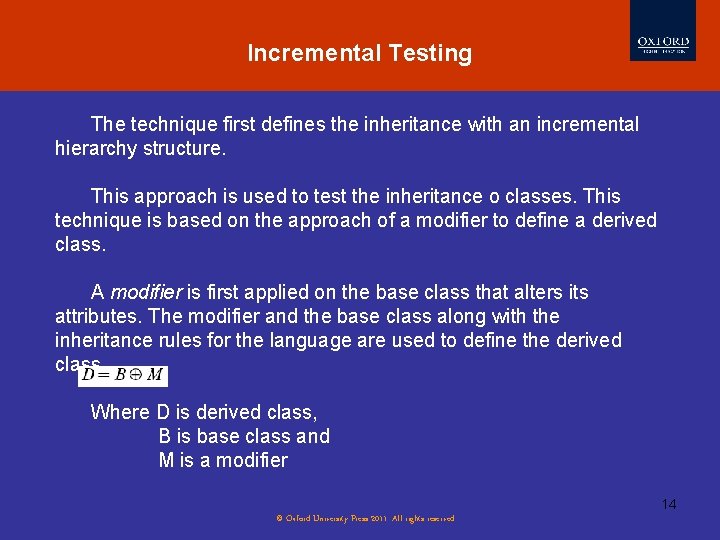
Incremental Testing The technique first defines the inheritance with an incremental hierarchy structure. This approach is used to test the inheritance o classes. This technique is based on the approach of a modifier to define a derived class. A modifier is first applied on the base class that alters its attributes. The modifier and the base class along with the inheritance rules for the language are used to define the derived class. Where D is derived class, B is base class and M is a modifier 14 © Oxford University Press 2011. All rights reserved.
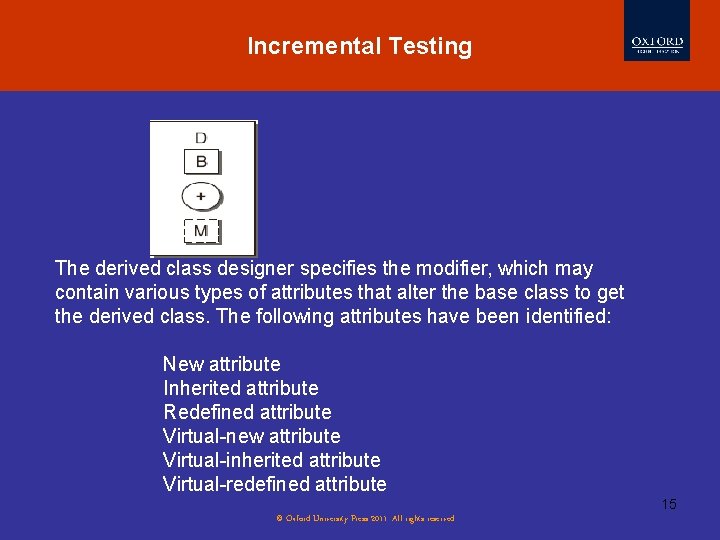
Incremental Testing The derived class designer specifies the modifier, which may contain various types of attributes that alter the base class to get the derived class. The following attributes have been identified: New attribute Inherited attribute Redefined attribute Virtual-new attribute Virtual-inherited attribute Virtual-redefined attribute 15 © Oxford University Press 2011. All rights reserved.
Integration Testing • Inter-class testing • Cluster testing • Inter-cluster testing 16 © Oxford University Press 2011. All rights reserved.
Thread based Integration Testing A thread can be seen as a scenario of normal usage of an objectoriented system. Testing a thread implies testing interactions between classes according to a specific sequence of method invocations. Message quiescence Event quiescence 17 © Oxford University Press 2011. All rights reserved.
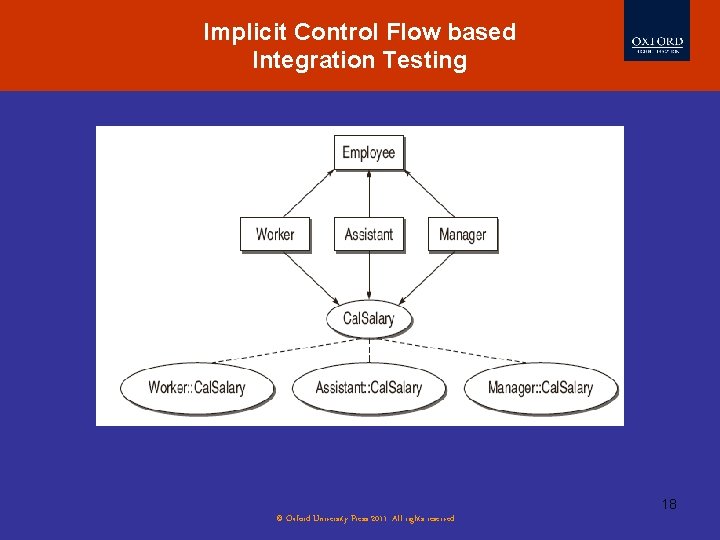
Implicit Control Flow based Integration Testing 18 © Oxford University Press 2011. All rights reserved.
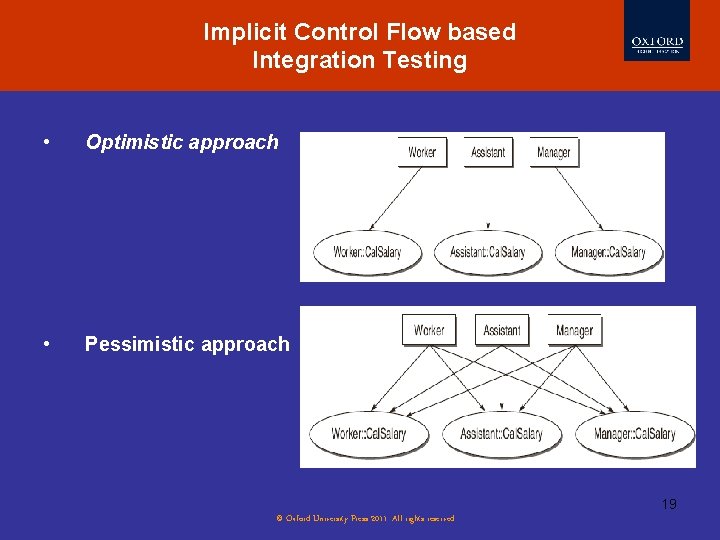
Implicit Control Flow based Integration Testing • Optimistic approach • Pessimistic approach 19 © Oxford University Press 2011. All rights reserved.
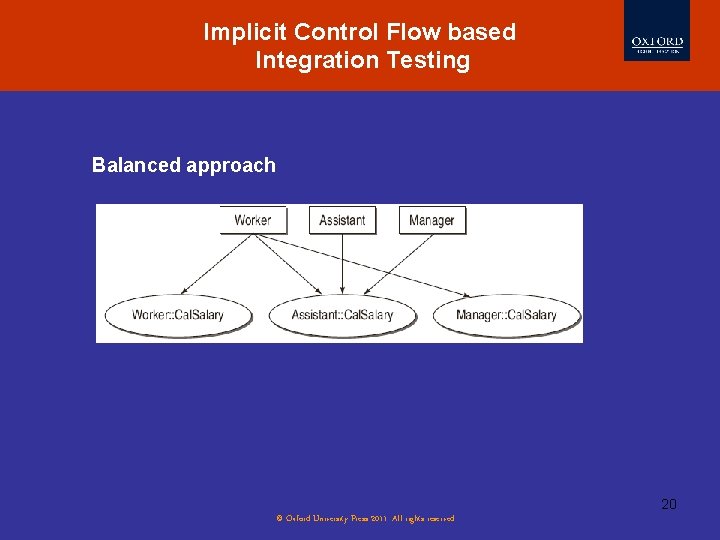
Implicit Control Flow based Integration Testing Balanced approach 20 © Oxford University Press 2011. All rights reserved.
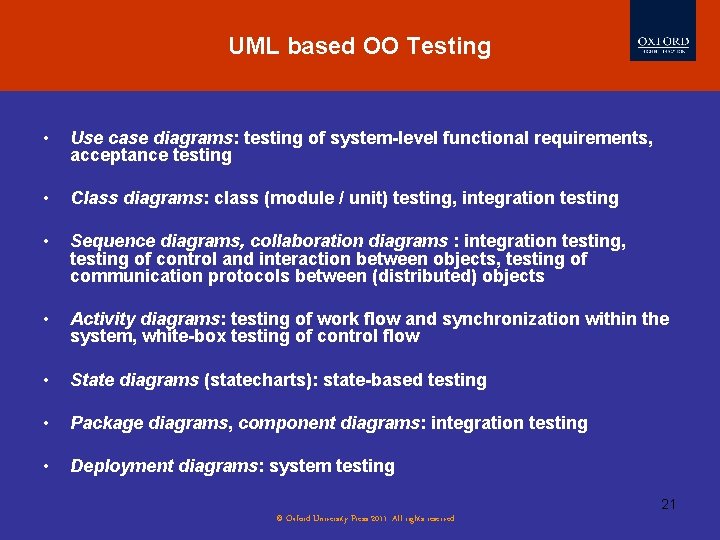
UML based OO Testing • Use case diagrams: testing of system-level functional requirements, acceptance testing • Class diagrams: class (module / unit) testing, integration testing • Sequence diagrams, collaboration diagrams : integration testing, testing of control and interaction between objects, testing of communication protocols between (distributed) objects • Activity diagrams: testing of work flow and synchronization within the system, white-box testing of control flow • State diagrams (statecharts): state-based testing • Package diagrams, component diagrams: integration testing • Deployment diagrams: system testing 21 © Oxford University Press 2011. All rights reserved.
- Slides: 21