
Chapter 16 Sound and Hearing Power Point Lectures
- Slides: 25
Chapter 16 Sound and Hearing Power. Point® Lectures for University Physics, Thirteenth Edition – Hugh D. Young and Roger A. Freedman Lectures by Wayne Anderson Copyright © 2012 Pearson Education Inc.
Goals for Chapter 16 • To describe sound waves in terms of particle displacements or pressure variations • To calculate the speed of sound in different materials • To calculate sound intensity • To find what determines the frequencies of sound from a pipe • To study resonance in musical instruments • To see what happens when sound waves overlap • To investigate the interference of sound waves of slightly different frequencies • To learn why motion affects pitch Copyright © 2012 Pearson Education Inc.
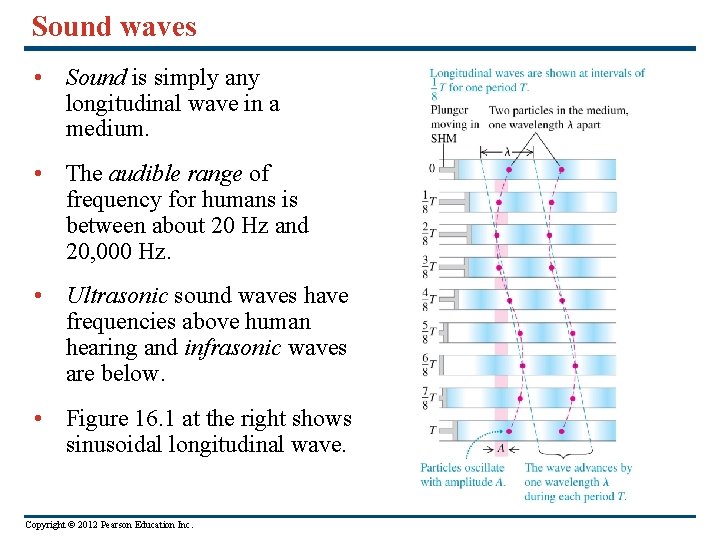
Sound waves • Sound is simply any longitudinal wave in a medium. • The audible range of frequency for humans is between about 20 Hz and 20, 000 Hz. • Ultrasonic sound waves have frequencies above human hearing and infrasonic waves are below. • Figure 16. 1 at the right shows sinusoidal longitudinal wave. Copyright © 2012 Pearson Education Inc.
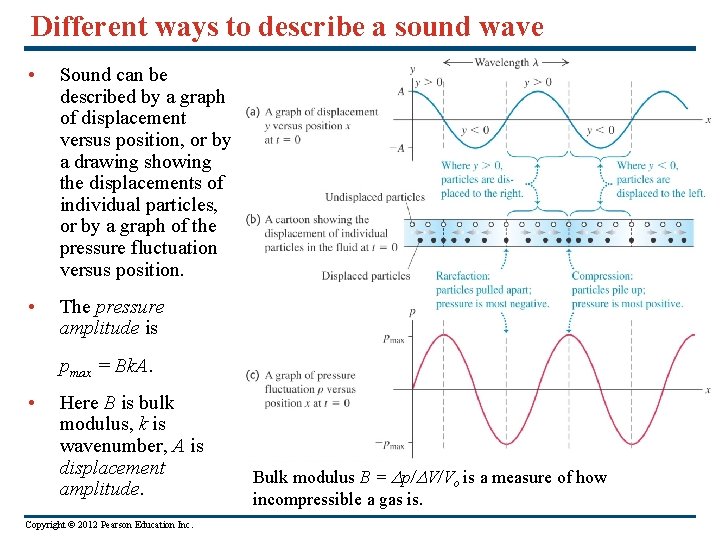
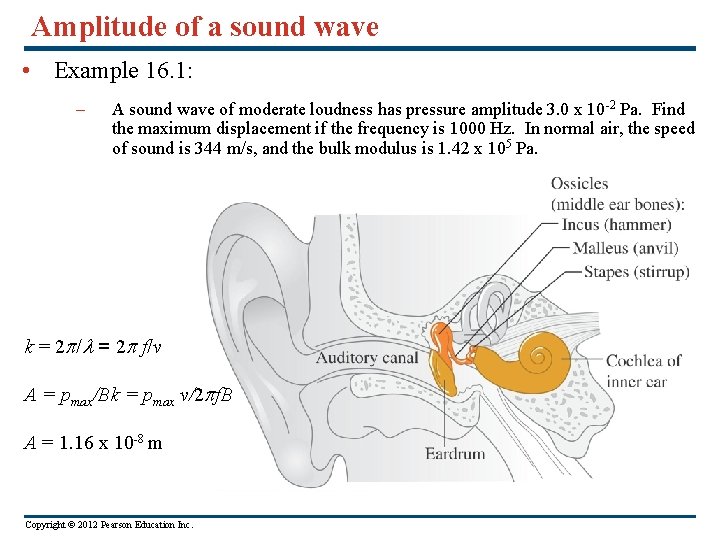
Different ways to describe a sound wave • Sound can be described by a graph of displacement versus position, or by a drawing showing the displacements of individual particles, or by a graph of the pressure fluctuation versus position. • The pressure amplitude is pmax = Bk. A. • Here B is bulk modulus, k is wavenumber, A is displacement amplitude. Copyright © 2012 Pearson Education Inc. Bulk modulus B = Dp/DV/Vo is a measure of how incompressible a gas is.
Amplitude of a sound wave • Example 16. 1: – A sound wave of moderate loudness has pressure amplitude 3. 0 x 10 -2 Pa. Find the maximum displacement if the frequency is 1000 Hz. In normal air, the speed of sound is 344 m/s, and the bulk modulus is 1. 42 x 105 Pa. k = 2 p/ = 2 p f/v A = pmax/Bk = pmax v/2 pf. B A = 1. 16 x 10 -8 m Copyright © 2012 Pearson Education Inc.
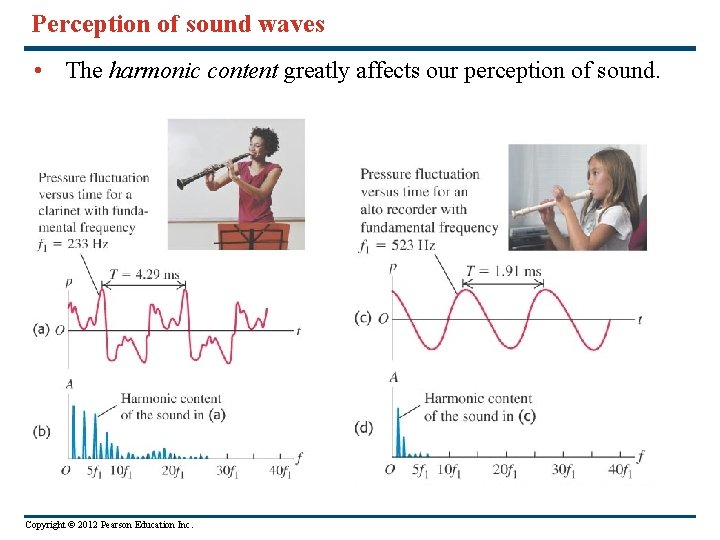
Perception of sound waves • The harmonic content greatly affects our perception of sound. Copyright © 2012 Pearson Education Inc.
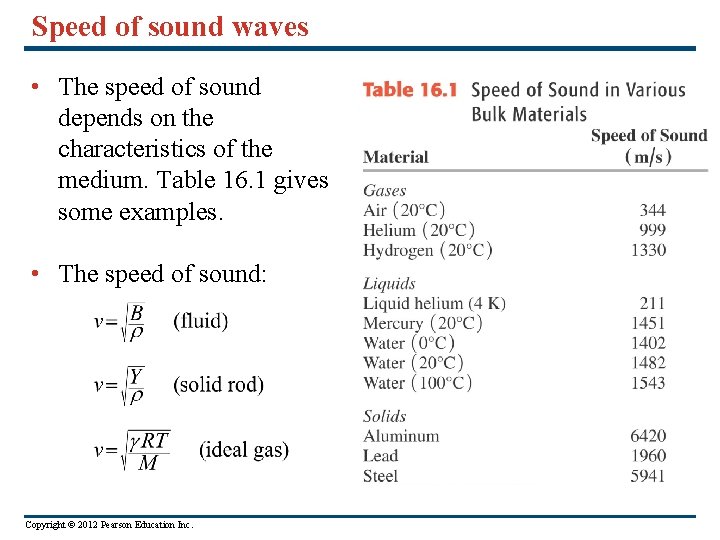
Speed of sound waves • The speed of sound depends on the characteristics of the medium. Table 16. 1 gives some examples. • The speed of sound: Copyright © 2012 Pearson Education Inc.
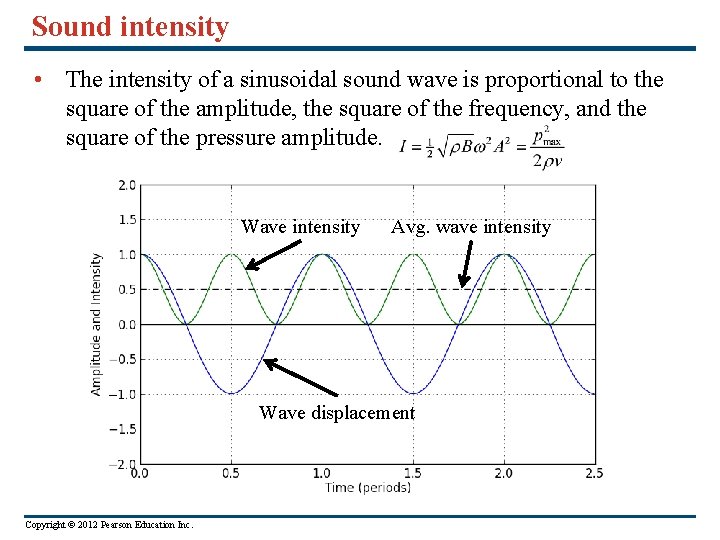
Sound intensity • The intensity of a sinusoidal sound wave is proportional to the square of the amplitude, the square of the frequency, and the square of the pressure amplitude. Wave intensity Avg. wave intensity Wave displacement Copyright © 2012 Pearson Education Inc.
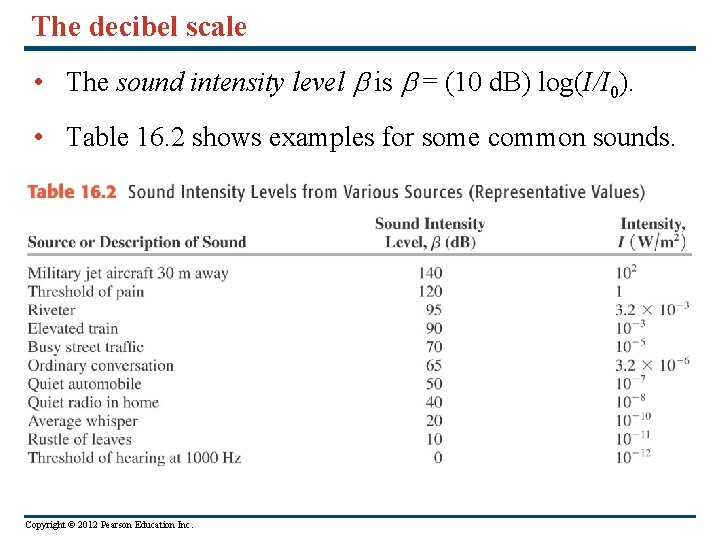
The decibel scale • The sound intensity level is = (10 d. B) log(I/I 0). • Table 16. 2 shows examples for some common sounds. Copyright © 2012 Pearson Education Inc.
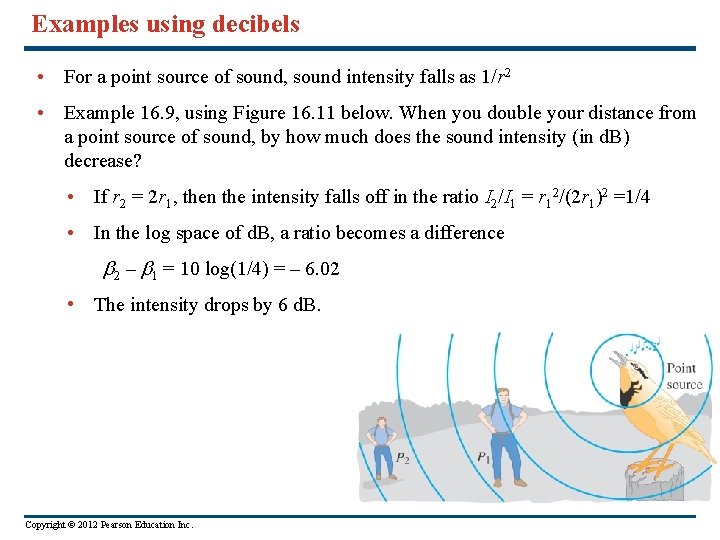
Examples using decibels • For a point source of sound, sound intensity falls as 1/r 2 • Example 16. 9, using Figure 16. 11 below. When you double your distance from a point source of sound, by how much does the sound intensity (in d. B) decrease? • If r 2 = 2 r 1, then the intensity falls off in the ratio I 2/I 1 = r 12/(2 r 1)2 =1/4 • In the log space of d. B, a ratio becomes a difference 2 – 1 = 10 log(1/4) = – 6. 02 • The intensity drops by 6 d. B. Copyright © 2012 Pearson Education Inc.
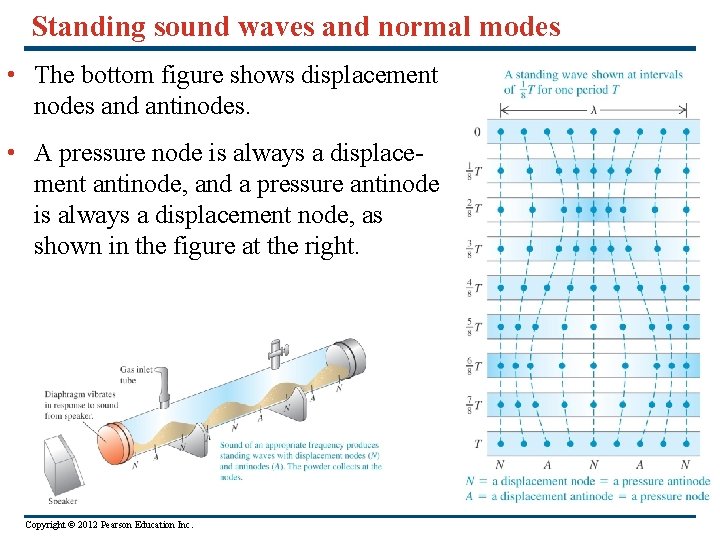
Standing sound waves and normal modes • The bottom figure shows displacement nodes and antinodes. • A pressure node is always a displacement antinode, and a pressure antinode is always a displacement node, as shown in the figure at the right. Copyright © 2012 Pearson Education Inc.
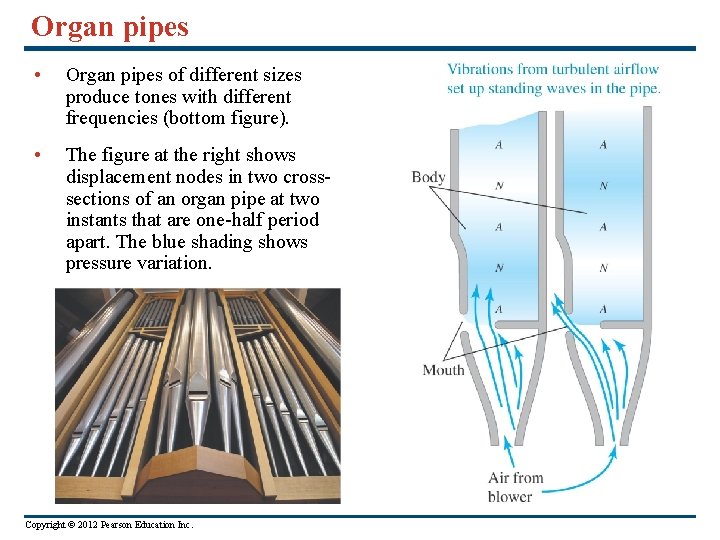
Organ pipes • Organ pipes of different sizes produce tones with different frequencies (bottom figure). • The figure at the right shows displacement nodes in two crosssections of an organ pipe at two instants that are one-half period apart. The blue shading shows pressure variation. Copyright © 2012 Pearson Education Inc.
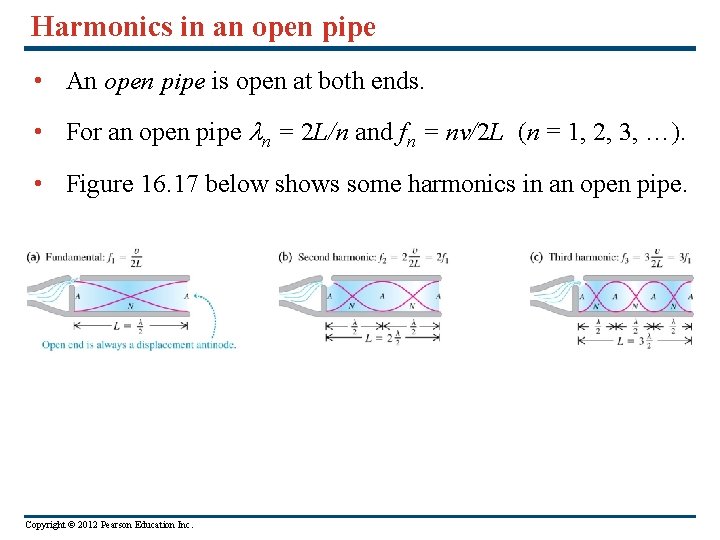
Harmonics in an open pipe • An open pipe is open at both ends. • For an open pipe n = 2 L/n and fn = nv/2 L (n = 1, 2, 3, …). • Figure 16. 17 below shows some harmonics in an open pipe. Copyright © 2012 Pearson Education Inc.
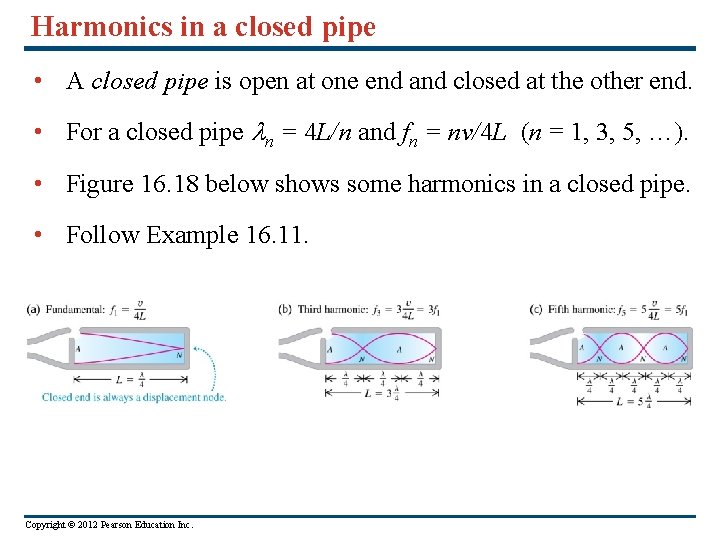
Harmonics in a closed pipe • A closed pipe is open at one end and closed at the other end. • For a closed pipe n = 4 L/n and fn = nv/4 L (n = 1, 3, 5, …). • Figure 16. 18 below shows some harmonics in a closed pipe. • Follow Example 16. 11. Copyright © 2012 Pearson Education Inc.
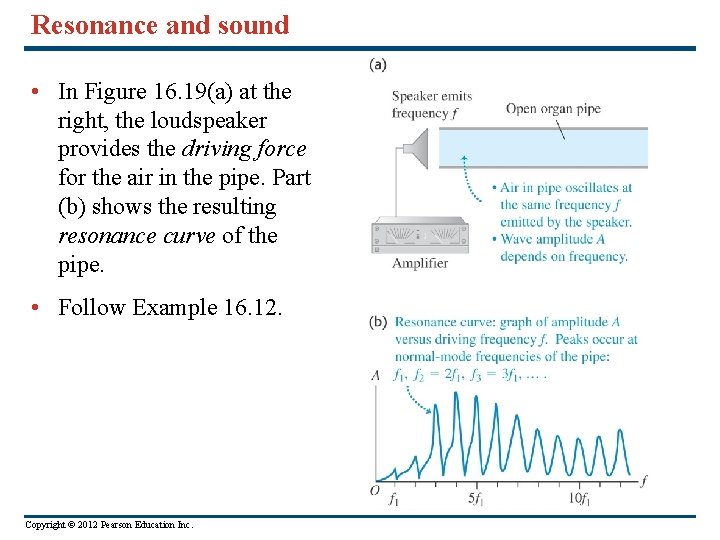
Resonance and sound • In Figure 16. 19(a) at the right, the loudspeaker provides the driving force for the air in the pipe. Part (b) shows the resulting resonance curve of the pipe. • Follow Example 16. 12. Copyright © 2012 Pearson Education Inc.
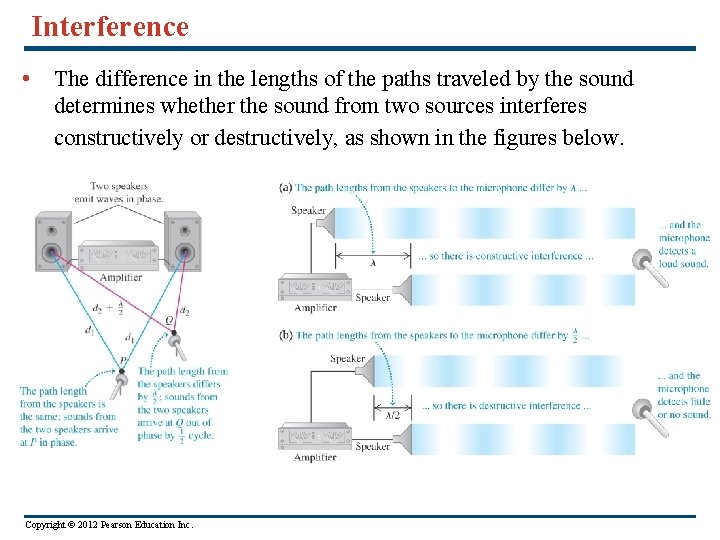
Interference • The difference in the lengths of the paths traveled by the sound determines whether the sound from two sources interferes constructively or destructively, as shown in the figures below. Copyright © 2012 Pearson Education Inc.
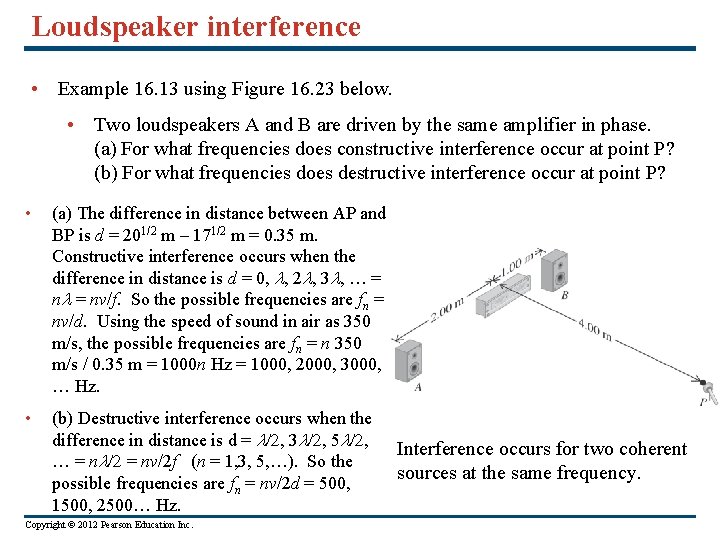
Loudspeaker interference • Example 16. 13 using Figure 16. 23 below. • Two loudspeakers A and B are driven by the same amplifier in phase. (a) For what frequencies does constructive interference occur at point P? (b) For what frequencies does destructive interference occur at point P? • (a) The difference in distance between AP and BP is d = 201/2 m – 171/2 m = 0. 35 m. Constructive interference occurs when the difference in distance is d = 0, , 2 , 3 , … = nv/f. So the possible frequencies are fn = nv/d. Using the speed of sound in air as 350 m/s, the possible frequencies are fn = n 350 m/s / 0. 35 m = 1000 n Hz = 1000, 2000, 3000, … Hz. • (b) Destructive interference occurs when the difference in distance is d = /2, 3 /2, 5 /2, … = n /2 = nv/2 f (n = 1, 3, 5, …). So the possible frequencies are fn = nv/2 d = 500, 1500, 2500… Hz. Copyright © 2012 Pearson Education Inc. Interference occurs for two coherent sources at the same frequency.
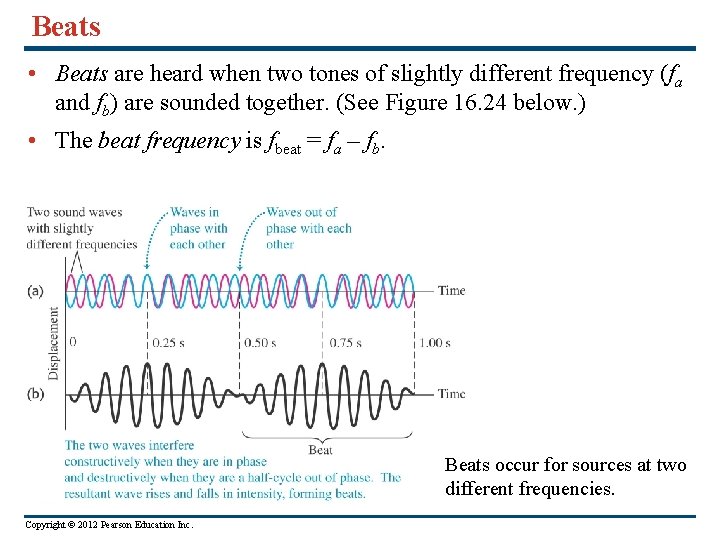
Beats • Beats are heard when two tones of slightly different frequency (fa and fb) are sounded together. (See Figure 16. 24 below. ) • The beat frequency is fbeat = fa – fb. Beats occur for sources at two different frequencies. Copyright © 2012 Pearson Education Inc.
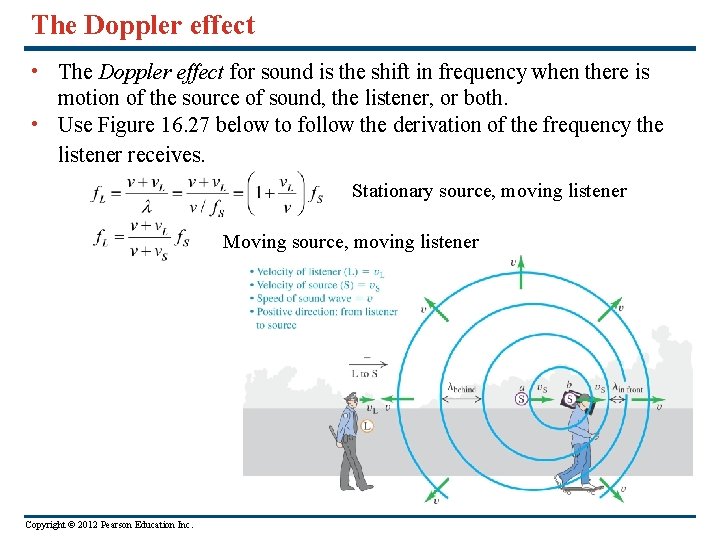
The Doppler effect • The Doppler effect for sound is the shift in frequency when there is motion of the source of sound, the listener, or both. • Use Figure 16. 27 below to follow the derivation of the frequency the listener receives. Stationary source, moving listener Moving source, moving listener Copyright © 2012 Pearson Education Inc.
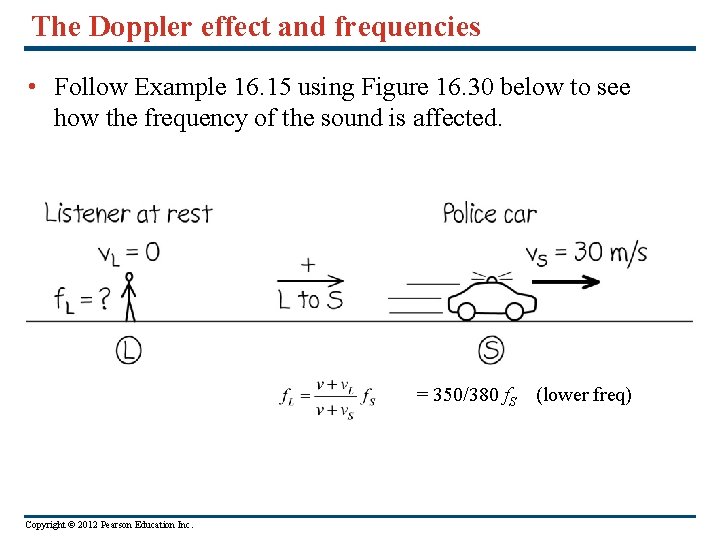
The Doppler effect and frequencies • Follow Example 16. 15 using Figure 16. 30 below to see how the frequency of the sound is affected. = 350/380 f. S Copyright © 2012 Pearson Education Inc. (lower freq)
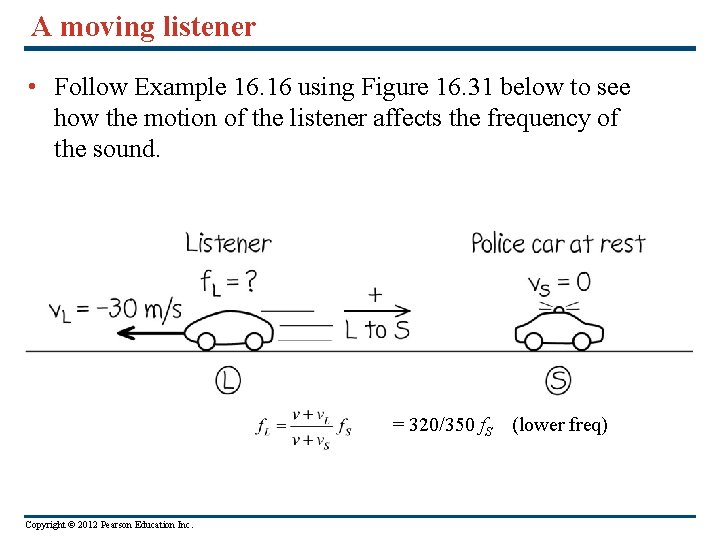
A moving listener • Follow Example 16. 16 using Figure 16. 31 below to see how the motion of the listener affects the frequency of the sound. = 320/350 f. S Copyright © 2012 Pearson Education Inc. (lower freq)
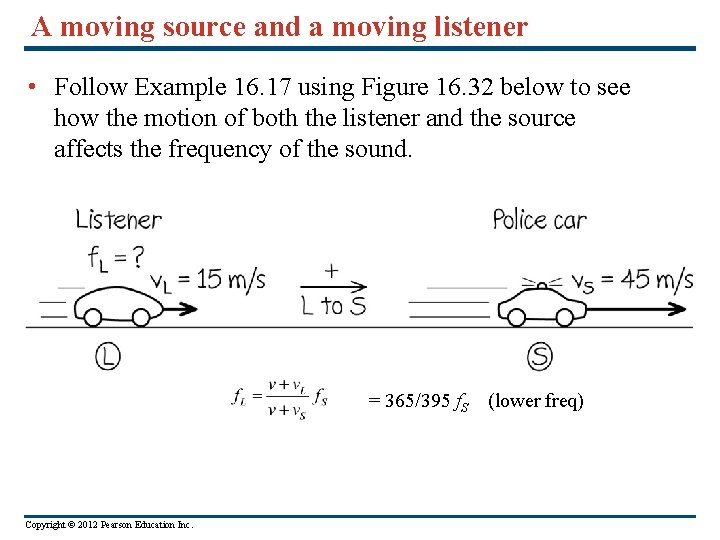
A moving source and a moving listener • Follow Example 16. 17 using Figure 16. 32 below to see how the motion of both the listener and the source affects the frequency of the sound. = 365/395 f. S Copyright © 2012 Pearson Education Inc. (lower freq)
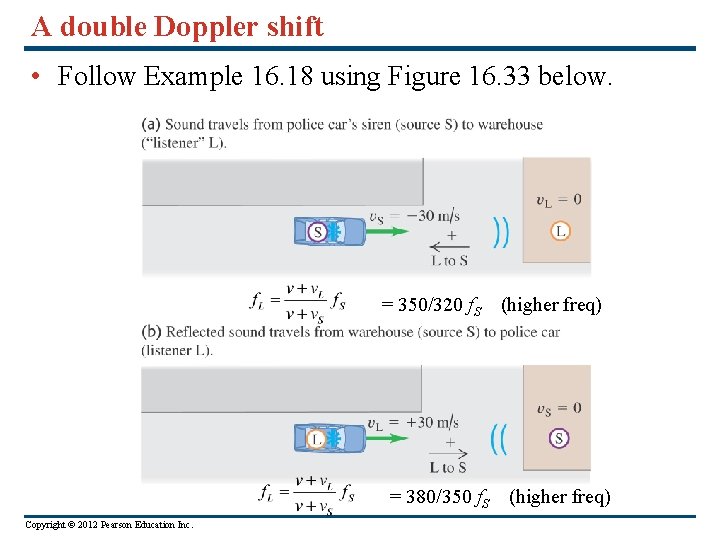
A double Doppler shift • Follow Example 16. 18 using Figure 16. 33 below. = 350/320 f. S = 380/350 f. S Copyright © 2012 Pearson Education Inc. (higher freq)
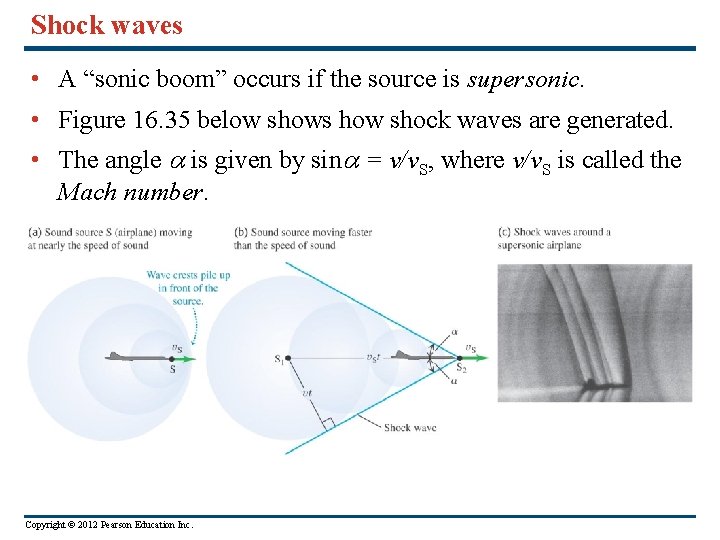
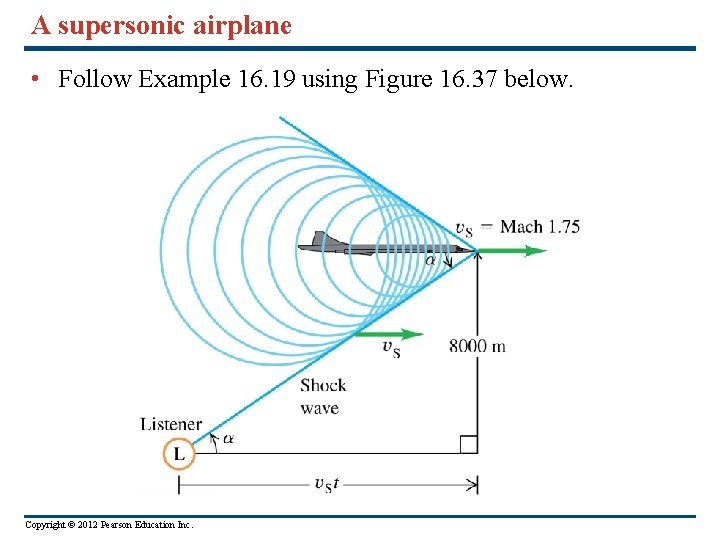
Shock waves • A “sonic boom” occurs if the source is supersonic. • Figure 16. 35 below shows how shock waves are generated. • The angle is given by sin = v/v. S, where v/v. S is called the Mach number. Copyright © 2012 Pearson Education Inc.
A supersonic airplane • Follow Example 16. 19 using Figure 16. 37 below. Copyright © 2012 Pearson Education Inc.