
Chapter 16 Socioemotional Development in late Adulthood 1

- Slides: 14
Chapter 16 Socioemotional Development in late Adulthood 1
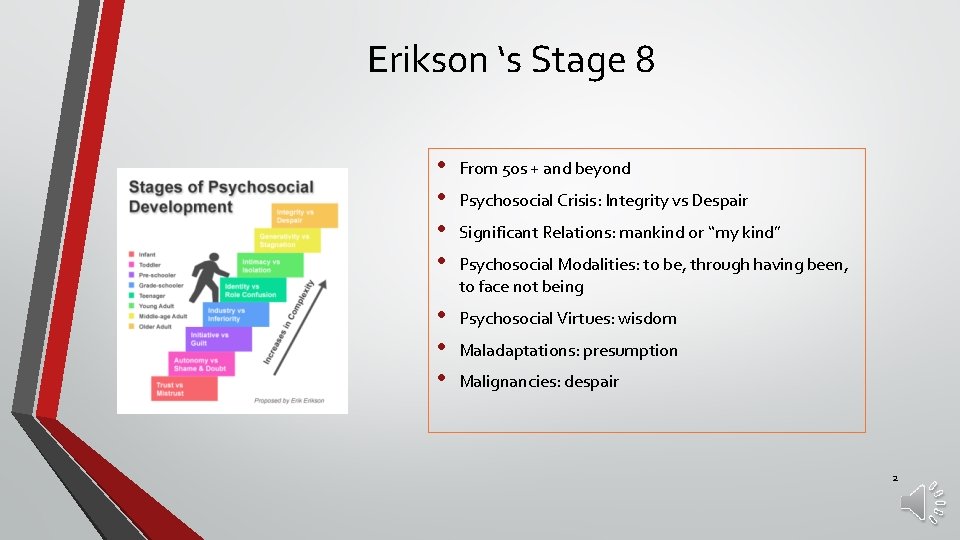
Erikson ‘s Stage 8 • • From 50 s + and beyond • • • Psychosocial Virtues: wisdom Psychosocial Crisis: Integrity vs Despair Significant Relations: mankind or “my kind” Psychosocial Modalities: to be, through having been, to face not being Maladaptations: presumption Malignancies: despair 2
Activity theory • • • Activity theory -- the more active and involved that older adults are, the more likely they are to be satisfied with their lives Successful aging is associated with being active, energetic, and productive Good experience with aging relates to continuing early adult roles or finding substitutes that keep them active and involved Active-productive lives and mental stimulation are associated with successful aging, physical well-being, longevity, and positive emotional states. Activity can occur in areas of productivity, social relationships, or personal interests. 3
Socioemotional Selectivity Theory • Socioemotional selectivity theory -- older adults become more selective about their social networks • Suggests that older adults spend more time with familiar individuals with whom they have rewarding relationships • Challenges the stereotype that older adults are in emotional despair and isolation • Energy is focused on those interactions that are found most enjoyable, increasing positive experiences and limiting emotional risks • Older adults have a better control of their emotional and have less negative emotion than younger adults. 4
Selective optimization with compensation theory -- Suggests that older adults select and allocate resources to successfully master the processes include selection, optimization, and compensation • • selection -- older adults have a reduced capacity and loss of functioning • compensation-- it is to achieve through the use of strategies to maximize success. Effective when people pursue successful outcomes optimization -- it is possible to maintain performance in some areas through practice and use of new technologies. • • • Select among goals Discard less important goals Focus on primary, meaningful goals Persevere; be patient Develop alternatives of achievement when old strategies do not work Work with other people 5
PERSONALITY • Jackson and Other (2009) research examined the changes in the personality factor called conscientiousness, it found that as we age several facets of this factor increase: impulse control, reliability, and conventionality. • Martin, Friedman, and Schwartz (2007)- a five-year longitudinal study indicated the personality traits in the Big Five factors of personality are associated with mortality (an earlier death) • high conscientiousness, openness, and extraversion • Chida & Steptoe (2008)– Older adults characterized by negative affect do not live as long as who display more positive affect 6
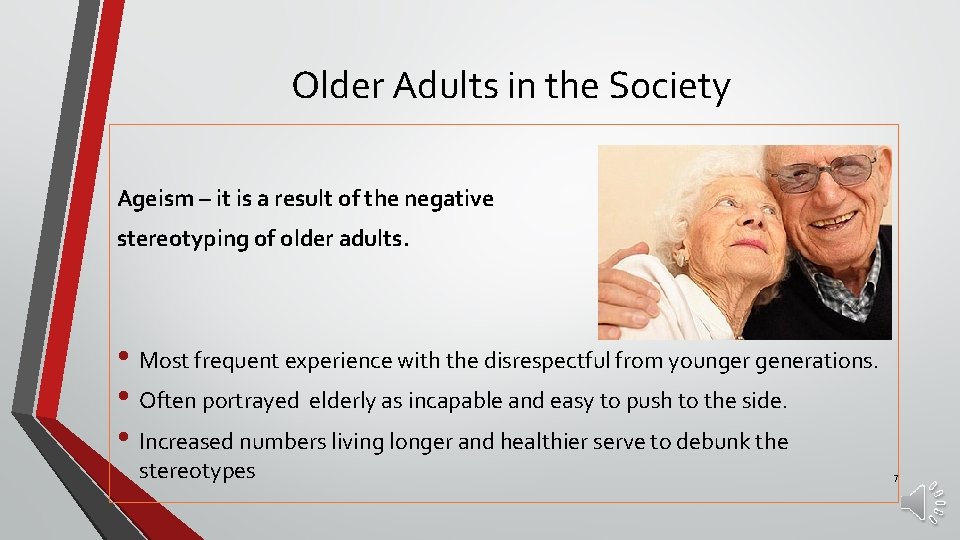
Older Adults in the Society Ageism – it is a result of the negative stereotyping of older adults. • Most frequent experience with the disrespectful from younger generations. • Often portrayed elderly as incapable and easy to push to the side. • Increased numbers living longer and healthier serve to debunk the stereotypes 7
Older Adults in the Society Policy Issues -- health care costs, caring for patients with chronic disease, eldercare, economy and income • helping elderly patients with chronic health conditions, medical services should emphasize care rather than cure • • 12% of 65 years +, 1/3 of the health care bills 65+ elderly are on Medicare Status of the Economy and Income • • 25 % elderly women who live alone live in poverty 10% older people living in poverty Elder Care--it refers to both physical and emotional caretaking of older members of the family, whether that care is day-to-day physical assistance or responsibility for arranging and overseeing such care. Technology—Fastest Growing Segment of Internet Users • • Spend ~ 8 hours/week on Internet Eager to Learn and Use Internet as the channels of communication/health care resource 8
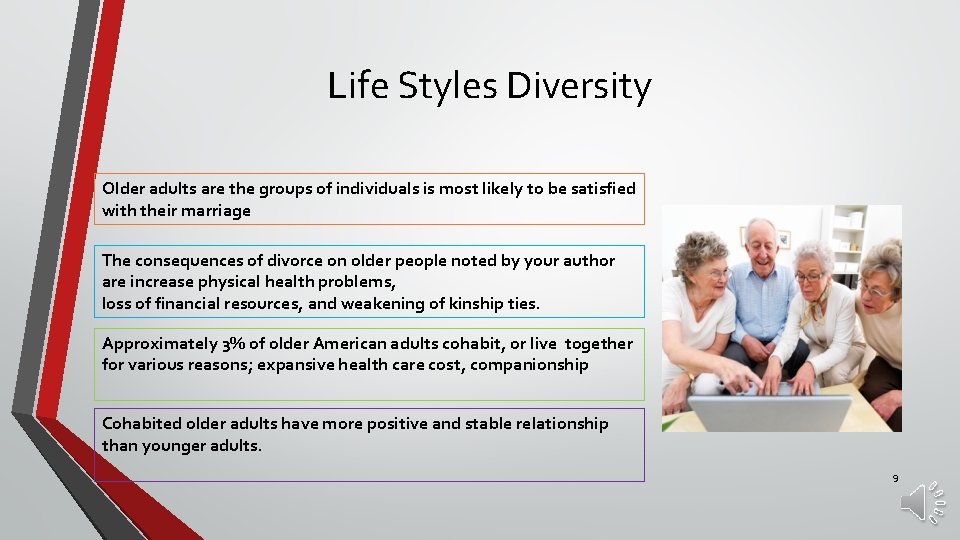
Life Styles Diversity Older adults are the groups of individuals is most likely to be satisfied with their marriage The consequences of divorce on older people noted by your author are increase physical health problems, loss of financial resources, and weakening of kinship ties. Approximately 3% of older American adults cohabit, or live together for various reasons; expansive health care cost, companionship Cohabited older adults have more positive and stable relationship than younger adults. 9
Older Adult Parents and Their Adult Children • • • 80% of Older Adults are having living children (middle Aged) Gender plays important role in relationships involving-caring for older parents Adult daughters are three times more likely than adult sons to provide older adults with assistance with assisting activities of daily living Friendship • According to Antonucci, Lansford, and Akiyama (2001), friendships in late adulthood are associated with lower levels of depression for women • Rasulo, Christensen, and Tomassini (2005) reported that when persons over the age of 75 had close ties with friends, they were less likely to die over seven years. Social Support • • • Social support is negatively correlated with happiness In the social convoy model of social relations, individuals go through life embedded in a personal network of individuals to whom they give, and from whom they receive, social support. Social Integration is associated to poorer health and earlier death in older adults 10
Altruism and Volunteerism • Volunteering refers to the activity in which time is given freely to benefit others or groups. • Research has found that older adults are the group most likely to volunteer their time, giving an average of 100 hours in volunteer services per year. • Volunteering as an older adult is associated with a number of positive outcomes • • higher satisfaction less depression and anxiety 11
Ethnicity and Gender • Minority elderly are over-represented among the poor • Double jeopardy -- they face both ageism and racism • History of less education, underemployment, poor housing conditions, shorter life expectancy than Whites • Strong coping mechanisms (e. g. , church membership, family support for elders) • Elders -- more pronounced in males than females -- become more androgynous • Double jeopardy for older women who face ageism and sexism • • Poverty increased for elderly females Minority females face triple jeopardy -- ageism, sexism, and racism 12
Culture and Successful Aging CULTURE • These factors predict status of older adults in a culture • • Have valuable knowledge • • Participation in extended family Control key family/community resources Permitted to engage in useful functions Role changes involve more responsibility and authority Respect for older adults may be greater SUCCESSFIUL AGING • Even with disease, improvements in medicine mean older adults can still lead active constructive lives • • Being active is especially important Success involves perceived control of the environment (self-efficacy) 13
SEE YOU IN CHAPTER 17 14