
Chapter 16 Random Variables n Random Variable n
Chapter 16 Random Variables n Random Variable n Variable that assumes any of several different values as a result of some random event. Denoted by X n n n Discrete (finite number of outcomes) Continuous Probability Model or Probability Distribution n Collection of all the possible values and their corresponding probabilities
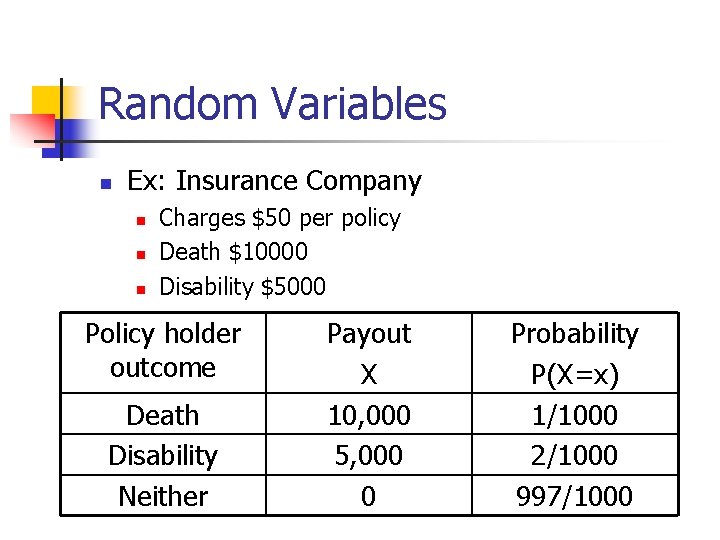
Random Variables n Ex: Insurance Company n n n Charges $50 per policy Death $10000 Disability $5000 Policy holder outcome Death Disability Neither Payout X 10, 000 5, 000 0 Probability P(X=x) 1/1000 2/1000 997/1000
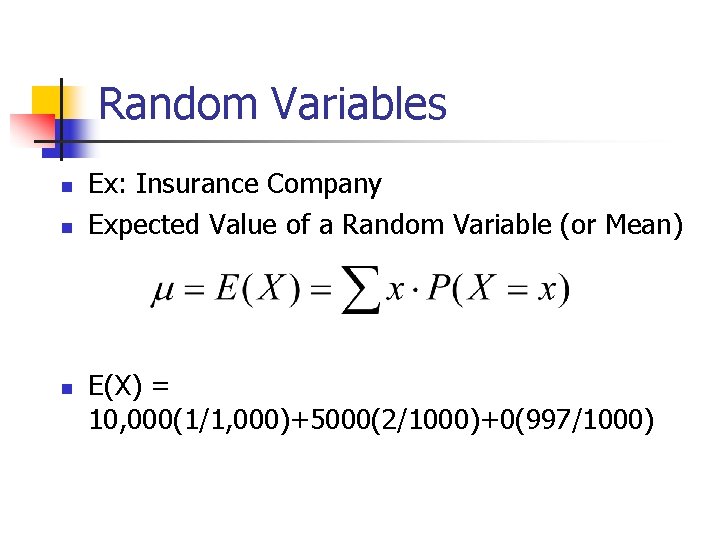
Random Variables n n n Ex: Insurance Company Expected Value of a Random Variable (or Mean) E(X) = 10, 000(1/1, 000)+5000(2/1000)+0(997/1000)
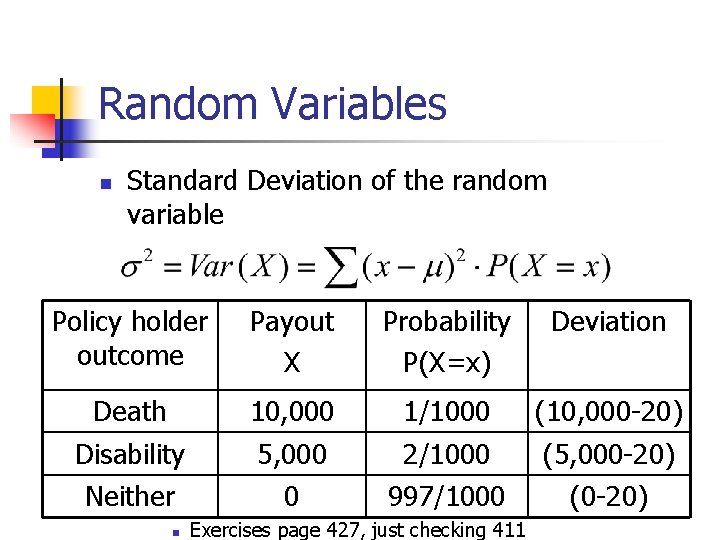
Random Variables n Standard Deviation of the random variable Policy holder outcome Payout X Probability P(X=x) Deviation Death 10, 000 1/1000 (10, 000 -20) Disability 5, 000 2/1000 (5, 000 -20) Neither 0 997/1000 (0 -20) n Exercises page 427, just checking 411
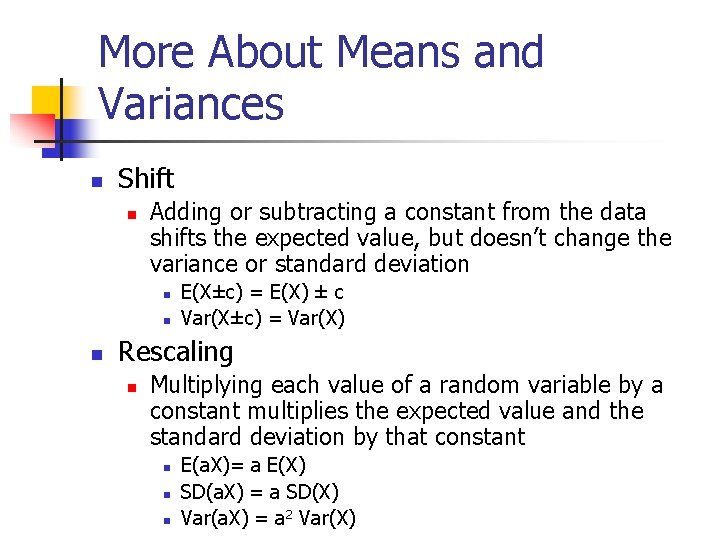
More About Means and Variances n Shift n Adding or subtracting a constant from the data shifts the expected value, but doesn’t change the variance or standard deviation n E(X±c) = E(X) ± c Var(X±c) = Var(X) Rescaling n Multiplying each value of a random variable by a constant multiplies the expected value and the standard deviation by that constant n n n E(a. X)= a E(X) SD(a. X) = a SD(X) Var(a. X) = a 2 Var(X)
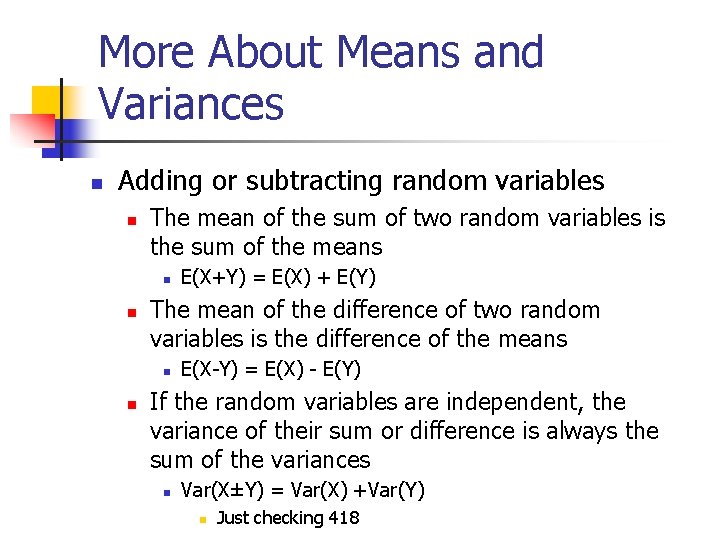
More About Means and Variances n Adding or subtracting random variables n The mean of the sum of two random variables is the sum of the means n n The mean of the difference of two random variables is the difference of the means n n E(X+Y) = E(X) + E(Y) E(X-Y) = E(X) - E(Y) If the random variables are independent, the variance of their sum or difference is always the sum of the variances n Var(X±Y) = Var(X) +Var(Y) n Just checking 418
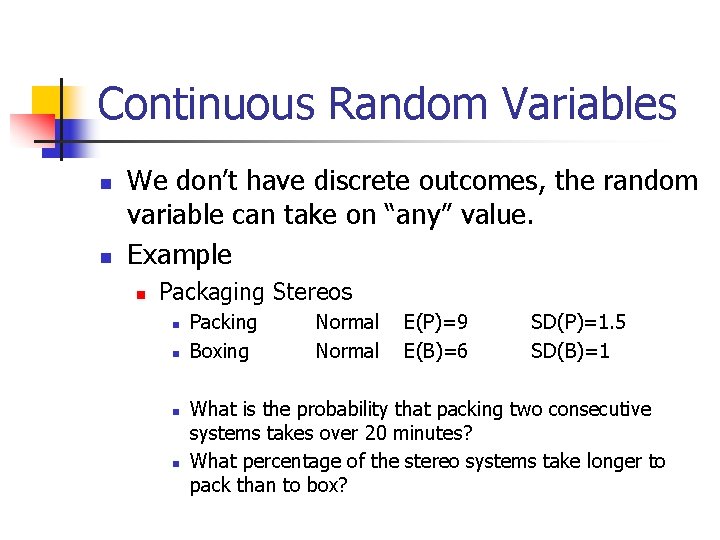
Continuous Random Variables n n We don’t have discrete outcomes, the random variable can take on “any” value. Example n Packaging Stereos n n Packing Boxing Normal E(P)=9 E(B)=6 SD(P)=1. 5 SD(B)=1 What is the probability that packing two consecutive systems takes over 20 minutes? What percentage of the stereo systems take longer to pack than to box?
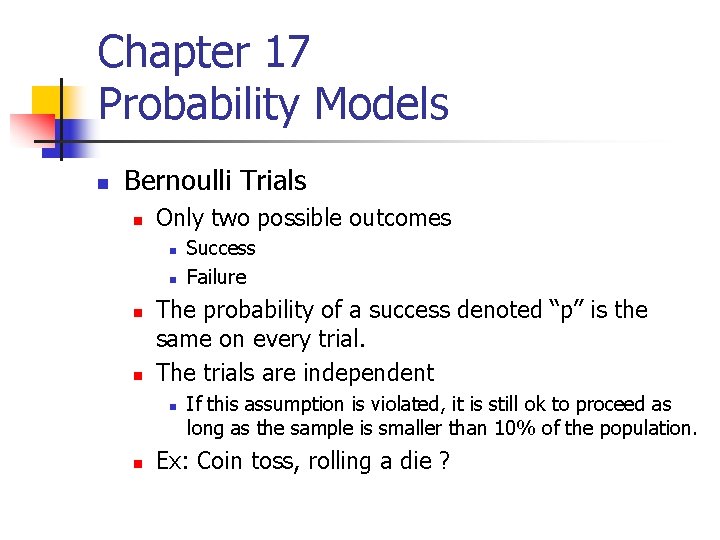
Chapter 17 Probability Models n Bernoulli Trials n Only two possible outcomes n n The probability of a success denoted “p” is the same on every trial. The trials are independent n n Success Failure If this assumption is violated, it is still ok to proceed as long as the sample is smaller than 10% of the population. Ex: Coin toss, rolling a die ?
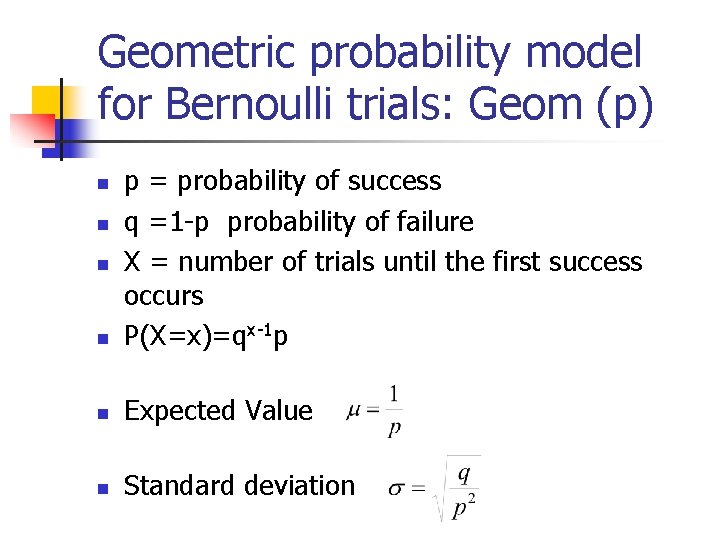
Geometric probability model for Bernoulli trials: Geom (p) n p = probability of success q =1 -p probability of failure X = number of trials until the first success occurs P(X=x)=qx-1 p n Expected Value n Standard deviation n
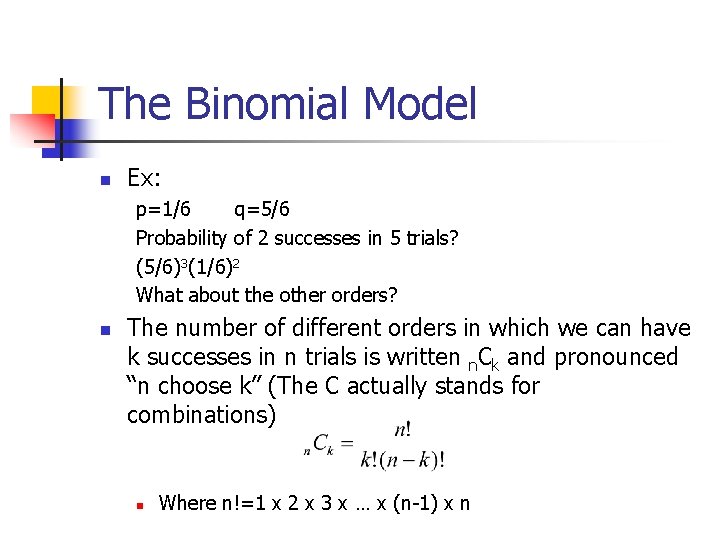
The Binomial Model n Ex: p=1/6 q=5/6 Probability of 2 successes in 5 trials? (5/6)3(1/6)2 What about the other orders? n The number of different orders in which we can have k successes in n trials is written n. Ck and pronounced “n choose k” (The C actually stands for combinations) n Where n!=1 x 2 x 3 x … x (n-1) x n
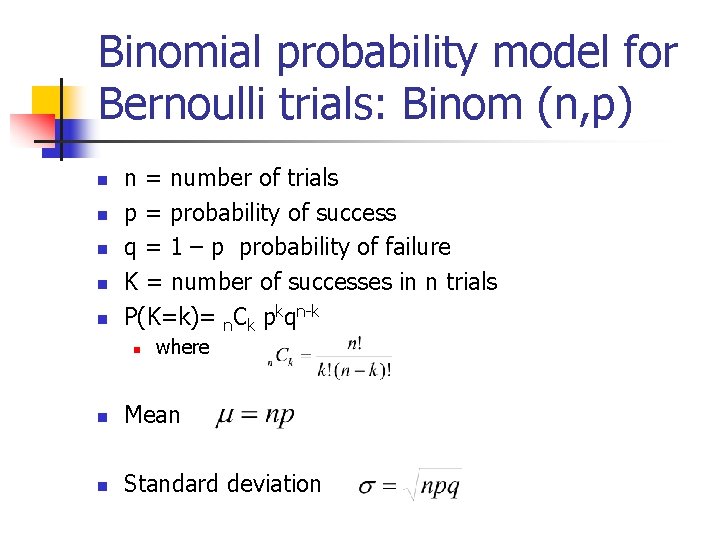
Binomial probability model for Bernoulli trials: Binom (n, p) n n n = number of trials p = probability of success q = 1 – p probability of failure K = number of successes in n trials P(K=k)= n. Ck pkqn-k n where n Mean n Standard deviation
Exercises n Step-by-step page 435 and 438
- Slides: 12