
Chapter 16 Quantitative Data Analysis Nursing Research in
- Slides: 52
Chapter 16 Quantitative Data Analysis Nursing Research in Canada-4 th edition Lo. Biondo-Wood et al. Copyright © 2018 Elsevier Canada, a division of Reed Elsevier Canada, Ltd.
Topics Descriptive statistics Correlations Analysis of variance Copyright © 2018 Elsevier Canada, a division of Reed Elsevier Canada, Ltd. 2
What Is Descriptive Statistics? Description and/or summarization of sample data Allow researchers to arrange data visually to display meaning and to help in understanding the sample characteristics and variables under study. In some studies, descriptive statistics may be the only results sought from statistical analysis. Types of descriptive statistics Copyright © 2018 Elsevier Canada, a division of Reed Elsevier Canada, Ltd. 3
Purposes of Descriptive Statistics Reduce data to manageable proportions by summarizing them Copyright © 2018 Elsevier Canada, a division of Reed Elsevier Canada, Ltd. 4
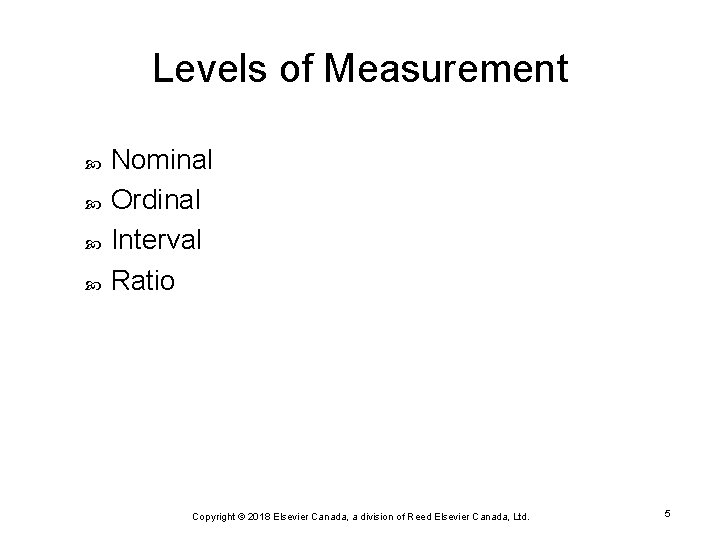
Levels of Measurement Nominal Ordinal Interval Ratio Copyright © 2018 Elsevier Canada, a division of Reed Elsevier Canada, Ltd. 5
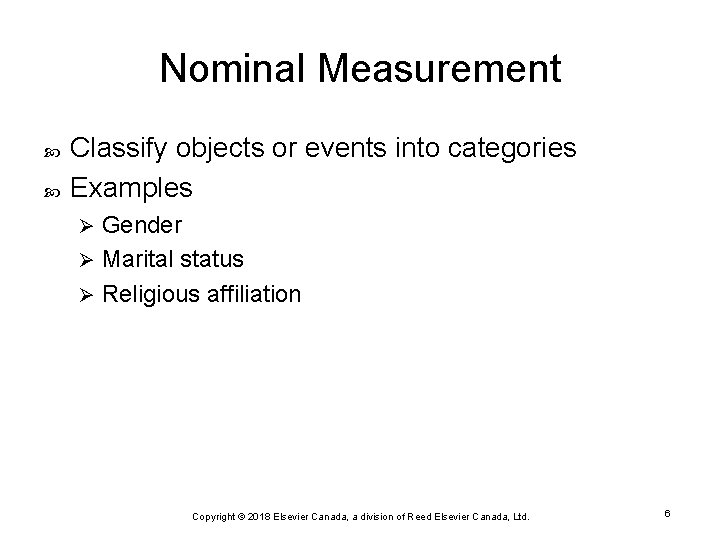
Nominal Measurement Classify objects or events into categories Examples Gender Ø Marital status Ø Religious affiliation Ø Copyright © 2018 Elsevier Canada, a division of Reed Elsevier Canada, Ltd. 6
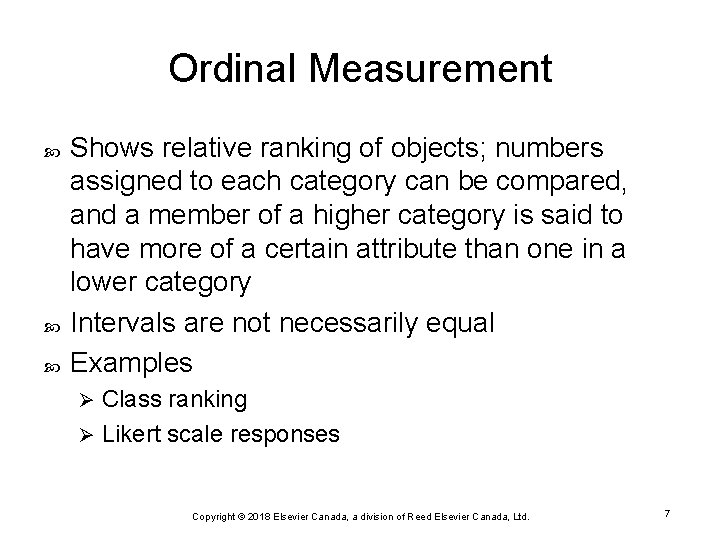
Ordinal Measurement Shows relative ranking of objects; numbers assigned to each category can be compared, and a member of a higher category is said to have more of a certain attribute than one in a lower category Intervals are not necessarily equal Examples Class ranking Ø Likert scale responses Ø Copyright © 2018 Elsevier Canada, a division of Reed Elsevier Canada, Ltd. 7
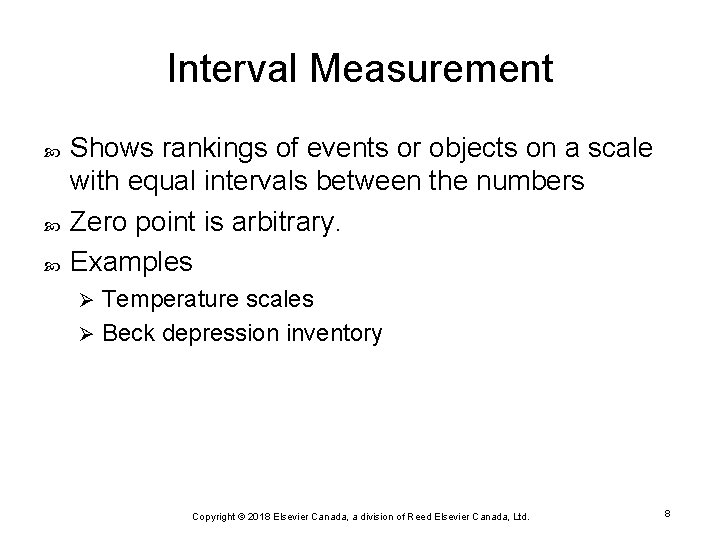
Interval Measurement Shows rankings of events or objects on a scale with equal intervals between the numbers Zero point is arbitrary. Examples Temperature scales Ø Beck depression inventory Ø Copyright © 2018 Elsevier Canada, a division of Reed Elsevier Canada, Ltd. 8
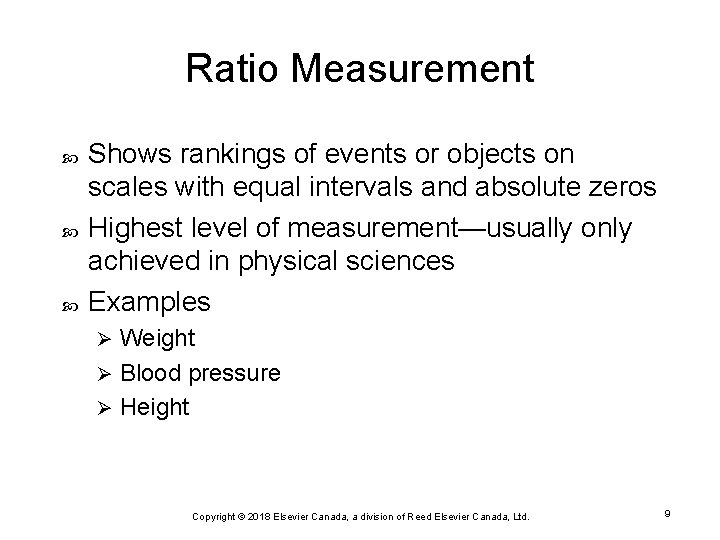
Ratio Measurement Shows rankings of events or objects on scales with equal intervals and absolute zeros Highest level of measurement—usually only achieved in physical sciences Examples Weight Ø Blood pressure Ø Height Ø Copyright © 2018 Elsevier Canada, a division of Reed Elsevier Canada, Ltd. 9
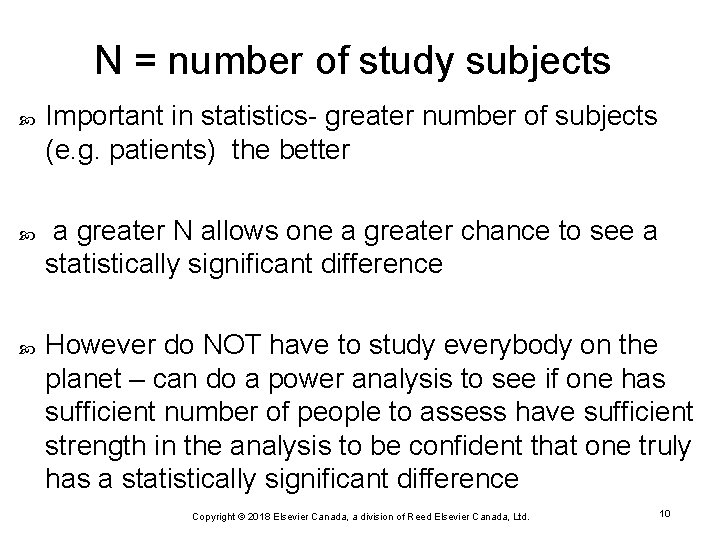
N = number of study subjects Important in statistics- greater number of subjects (e. g. patients) the better a greater N allows one a greater chance to see a statistically significant difference However do NOT have to study everybody on the planet – can do a power analysis to see if one has sufficient number of people to assess have sufficient strength in the analysis to be confident that one truly has a statistically significant difference Copyright © 2018 Elsevier Canada, a division of Reed Elsevier Canada, Ltd. 10
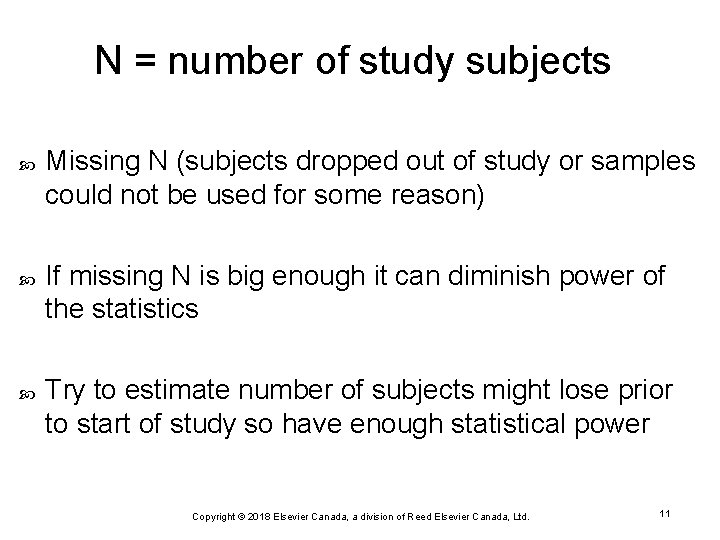
N = number of study subjects Missing N (subjects dropped out of study or samples could not be used for some reason) If missing N is big enough it can diminish power of the statistics Try to estimate number of subjects might lose prior to start of study so have enough statistical power Copyright © 2018 Elsevier Canada, a division of Reed Elsevier Canada, Ltd. 11
Sum and count Sum is the total of all the observations Count is the number of observations Copyright © 2018 Elsevier Canada, a division of Reed Elsevier Canada, Ltd. 12
Percent Value / 100 = 60/100 = 60 % Caution – a 100 % increase is going from 2 to 4 but going from 100 to 102 is only a 2 % increase so one must be careful not to mislead with percentages Copyright © 2018 Elsevier Canada, a division of Reed Elsevier Canada, Ltd. 13
Frequency Distribution Common basic way to organize data Summarizes the occurrences of events under study; tallies the frequency of events Cohort groups are sometimes created to investigate the frequencies of certain data. Copyright © 2018 Elsevier Canada, a division of Reed Elsevier Canada, Ltd. 14
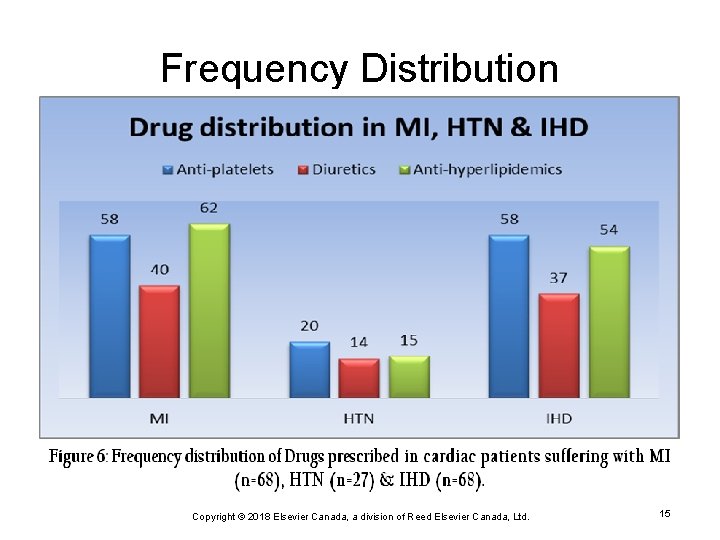
Frequency Distribution Copyright © 2018 Elsevier Canada, a division of Reed Elsevier Canada, Ltd. 15
Central Tendency Summarizes the middle of the group Each measure has specific uses and is most appropriate to select types of distribution and measurement. An “average” Mode: most frequent score Ø Median: middle score Ø Mean: average score Ø Copyright © 2018 Elsevier Canada, a division of Reed Elsevier Canada, Ltd. 16
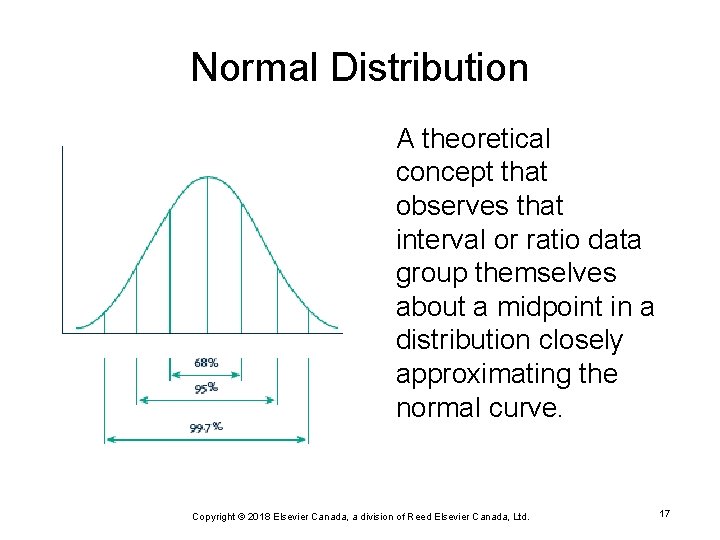
Normal Distribution A theoretical concept that observes that interval or ratio data group themselves about a midpoint in a distribution closely approximating the normal curve. Copyright © 2018 Elsevier Canada, a division of Reed Elsevier Canada, Ltd. 17
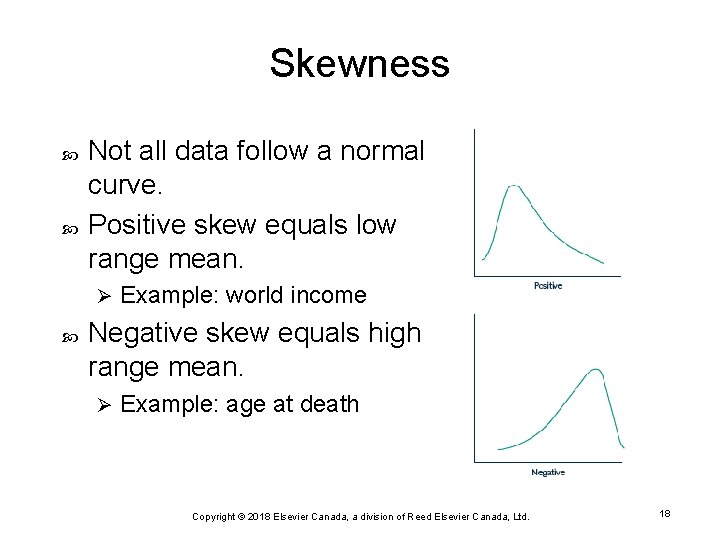
Skewness Not all data follow a normal curve. Positive skew equals low range mean. Ø Example: world income Negative skew equals high range mean. Ø Example: age at death Copyright © 2018 Elsevier Canada, a division of Reed Elsevier Canada, Ltd. 18
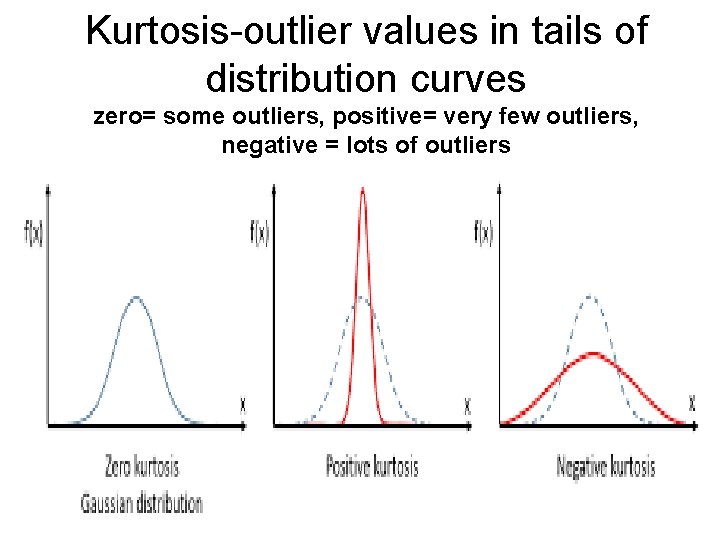
Kurtosis-outlier values in tails of distribution curves zero= some outliers, positive= very few outliers, negative = lots of outliers 19
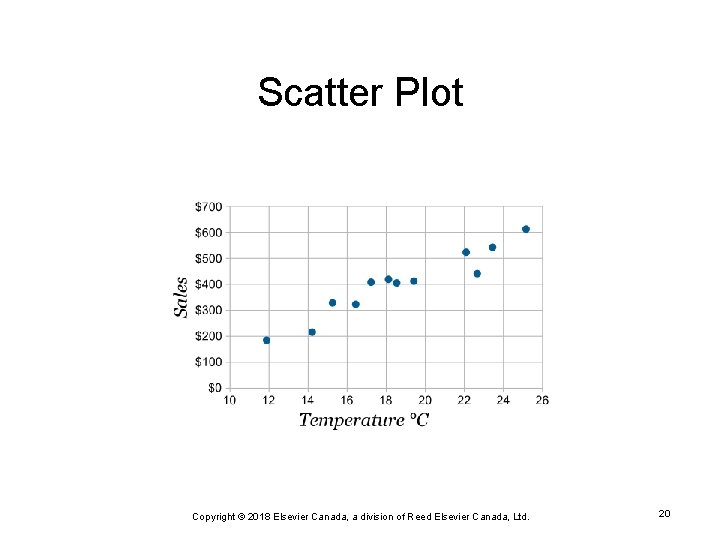
Scatter Plot Copyright © 2018 Elsevier Canada, a division of Reed Elsevier Canada, Ltd. 20
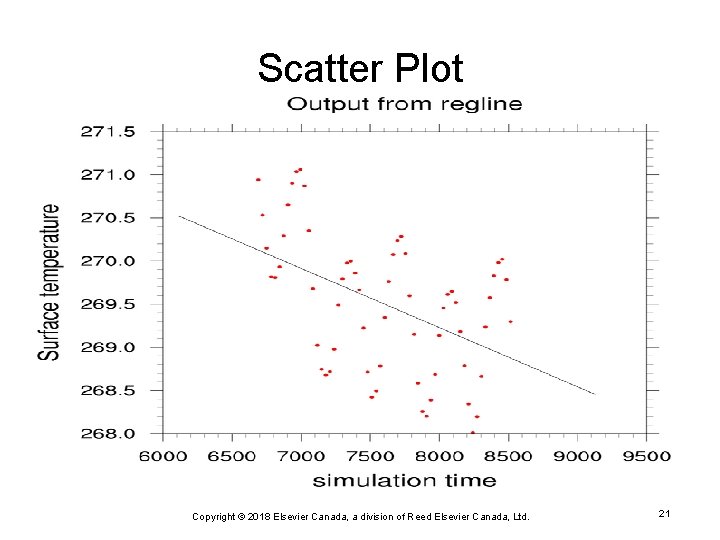
Scatter Plot Copyright © 2018 Elsevier Canada, a division of Reed Elsevier Canada, Ltd. 21
Variability or Dispersion Relates to spread of data Enables you to evaluate homogeneity or heterogeneity Standard deviation Standard error of the mean Copyright © 2018 Elsevier Canada, a division of Reed Elsevier Canada, Ltd. 22
Standard Deviation Most frequently used measure of variability Average deviation of scores from mean Copyright © 2018 Elsevier Canada, a division of Reed Elsevier Canada, Ltd. 23
Standard Error of the Mean standard error of the mean (SEM) measures how far (i. e. precision) the sample mean (average) of the data is likely to be from the true population mean Copyright © 2018 Elsevier Canada, a division of Reed Elsevier Canada, Ltd. 24
Standard Error of the Mean Unlike SD, SEM is not a descriptive statistic and should not be used as such. many authors incorrectly use the SEM to summarize the variability in their data because it is less than the SD, implying incorrectly that their measurements are more precise. 25
Range Minimum value to maximum value is the range (e. g. age) Simplest but most unstable measure of variability To what extent are the variables relatedgreater the range the greater the dispersion and the less the tightness of the relationship Difference between the highest and lowest scores Always reported with other measures of variability Copyright © 2018 Elsevier Canada, a division of Reed Elsevier Canada, Ltd. 26
Percentile The percentage of cases a given score exceeds Median is the 50 th percentile Ø A score in the 90 th percentile is exceeded by only 10% of scores Ø Copyright © 2018 Elsevier Canada, a division of Reed Elsevier Canada, Ltd. 27
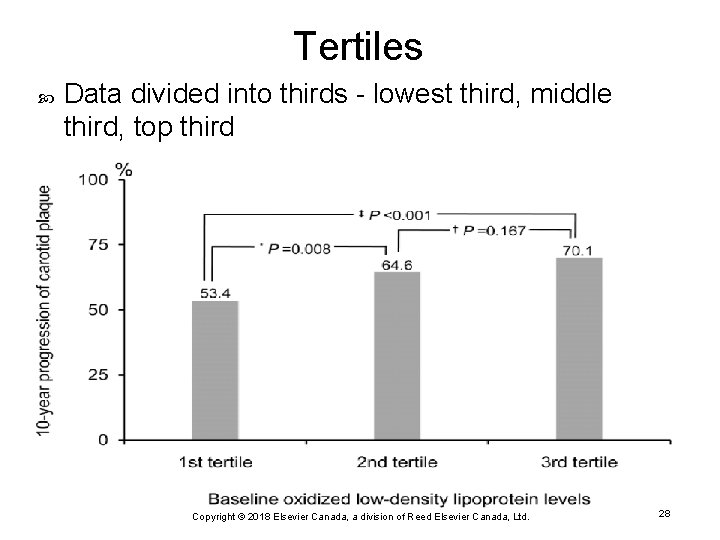
Tertiles Data divided into thirds - lowest third, middle third, top third Copyright © 2018 Elsevier Canada, a division of Reed Elsevier Canada, Ltd. 28
Quartiles Data divided into quarters Copyright © 2018 Elsevier Canada, a division of Reed Elsevier Canada, Ltd. 29
Quintiles Data divided into fifths Copyright © 2018 Elsevier Canada, a division of Reed Elsevier Canada, Ltd. 30
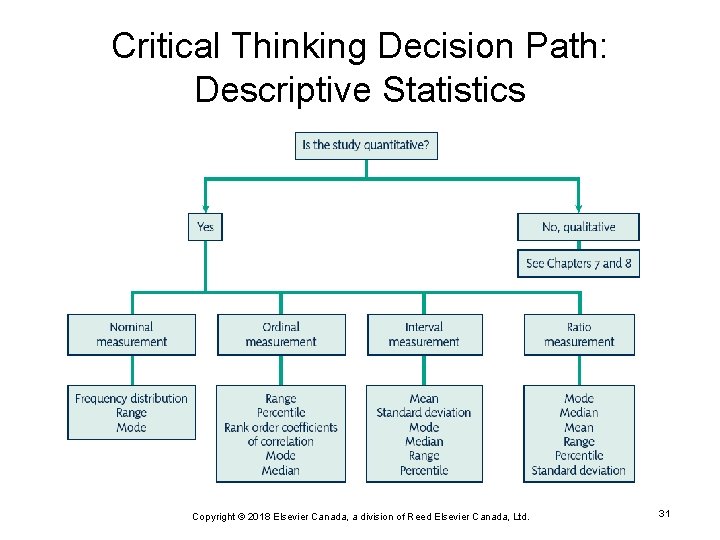
Critical Thinking Decision Path: Descriptive Statistics Copyright © 2018 Elsevier Canada, a division of Reed Elsevier Canada, Ltd. 31
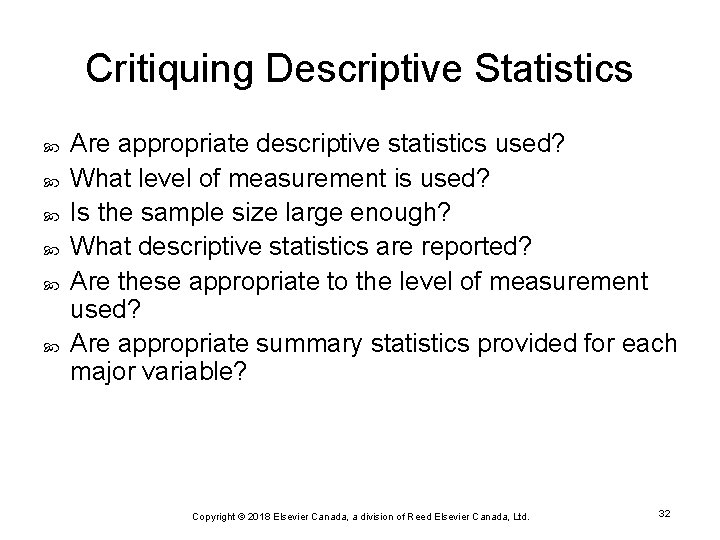
Critiquing Descriptive Statistics Are appropriate descriptive statistics used? What level of measurement is used? Is the sample size large enough? What descriptive statistics are reported? Are these appropriate to the level of measurement used? Are appropriate summary statistics provided for each major variable? Copyright © 2018 Elsevier Canada, a division of Reed Elsevier Canada, Ltd. 32
Correlations Mathematical relationship between two variables Does NOT prove cause and effect though it may turn out upon further investigation that there is a cause and effect relationship between the two variables Copyright © 2018 Elsevier Canada, a division of Reed Elsevier Canada, Ltd. 33
Tests of Relationship Exploring the relationship between two or more variables reflecting interval data Determining the correlation, the degree of association (ranges from − 1. 0 to +1. 0) Most common (three names for same test) Pearson product moment correlation coefficient Ø Pearson r Ø Pearson correlation coefficient Ø Copyright © 2018 Elsevier Canada, a division of Reed Elsevier Canada, Ltd. 34
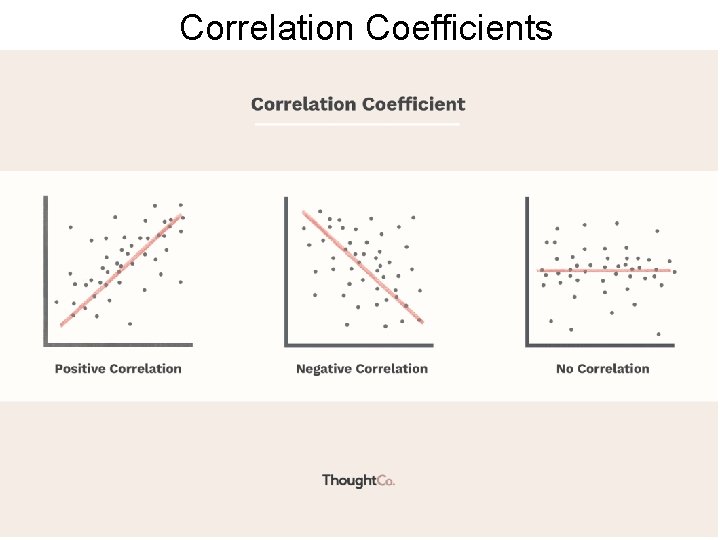
Correlation Coefficients Range from − 1. 0 to +1. 0 Negative correlation r = − 0. 38 Positive correlation r = 0. 65 Perfect correlation r = +1. 0 (positive) or – 1. 0 (negative) Correlations must be statistically significant (p < 0. 05) for there to be a relationship between the two variables that does not occur due to chance Copyright © 2018 Elsevier Canada, a division of Reed Elsevier Canada, Ltd. 35
Correlation Coefficients Correlation coefficient is labelled r (degree of linear relationship between two variables e. g. for relationship between dose and response in a population e. g. r = - 0. 9 coefficient of determination is r 2 = 0. 92 = 0. 81 81 % of the variability in the response is due to the dose Copyright © 2018 Elsevier Canada, a division of Reed Elsevier Canada, Ltd. 36
Correlation Coefficients Copyright © 2018 Elsevier Canada, a division of Reed Elsevier Canada, Ltd. 37
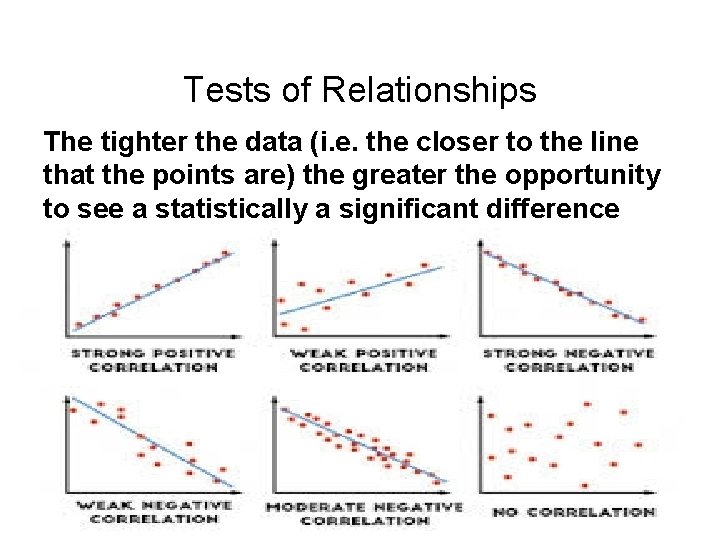
Tests of Relationships The tighter the data (i. e. the closer to the line that the points are) the greater the opportunity to see a statistically a significant difference Copyright © 2018 Elsevier Canada, a division of Reed Elsevier Canada, Ltd. 38
Nominal and Ordinal Data Tests of Relationships Phi coefficient (dichotomous variables (e. g. M/F, yes/no)) Point-biserial correlation (relationship between nominal variable and interval variable) Spearman’s rho- correlation between two sets of ranks Kendall’s tau-correlation between two sets of ranks Copyright © 2018 Elsevier Canada, a division of Reed Elsevier Canada, Ltd. 39
Hypothesis Testing Answers questions such as How much of this effect is a result of chance? Ø How strongly are these two variables associated with each other? Ø Copyright © 2018 Elsevier Canada, a division of Reed Elsevier Canada, Ltd. 40
Hypothesis Testing (Cont. ) Scientific or alternative hypothesis (H 1): Is what the researcher believes the outcome will be, that the variables will interact in some way Null hypothesis (H 0): Is the hypothesis that can actually be tested by statistical methods; states that no difference exists between the groups under study Copyright © 2018 Elsevier Canada, a division of Reed Elsevier Canada, Ltd. 41
Probability Support for the scientific hypothesis by rejecting the null hypothesis This is done by applying probability theory. Definition: An event’s long-run relative frequency in repeated trials under similar conditions Copyright © 2018 Elsevier Canada, a division of Reed Elsevier Canada, Ltd. 42
Type I and Type II Errors Type I: Rejection of the null hypothesis when it is actually true Type II: Accepting the null hypothesis when it is false Copyright © 2018 Elsevier Canada, a division of Reed Elsevier Canada, Ltd. 43
Level of Significance (Alpha Level) Probability of making type I error = 0. 05 The researcher is willing to accept the fact that if the study was done 100 times, the decision to reject the null hypothesis would be wrong 5 times out of those 100 trials. Copyright © 2018 Elsevier Canada, a division of Reed Elsevier Canada, Ltd. 44
Level of Significance (Alpha Level) (Cont. ) Can set probability at 0. 01 if one wants a smaller risk of reflecting a true null hypothesis (the decision to reject the null hypothesis would be wrong 1 time out of 100 trials) Selected alpha level depends on how important it is not to make an error. Copyright © 2018 Elsevier Canada, a division of Reed Elsevier Canada, Ltd. 45
Practical versus Statistical Significance A statistically significant hypothesis = finding unlikely to have occurred by chance Magnitude of significance is important to the outcome of data analysis. Copyright © 2018 Elsevier Canada, a division of Reed Elsevier Canada, Ltd. 46
Tests of Difference For example, if one wanted to conduct an experiment to see how drinking an energy drink increases heart rate, one could do it two ways. The "paired" way would be to measure the heart rate of 10 people before they drink the energy drink and then measure the heart rate of the same 10 people after drinking the energy drink. These two samples consist of the same test subjects, so you would perform a paired t-test on the means of both samples. The "unpaired" way would be to measure the heart rate of 10 people before drinking an energy drink and then measure the heart rate of some other group of people who have drank energy drinks. These two samples consist of different test subjects, so you would perform an unpaired t-test on the means of both samples. 47
Tests of Difference Chi-square: Uses nominal data to determine whether frequencies in each group are different from what would be expected by chance The t statistic: Tests whether the means of two groups are different paired (one group (same people) measured twice e. g. same people used for treatment and control group) and unpaired or independent (two unrelated groups are compared for treatment vs control) 48
Tests of Difference https: //www. youtube. com/watch? v=P 83 D-5 F 21 DA 49
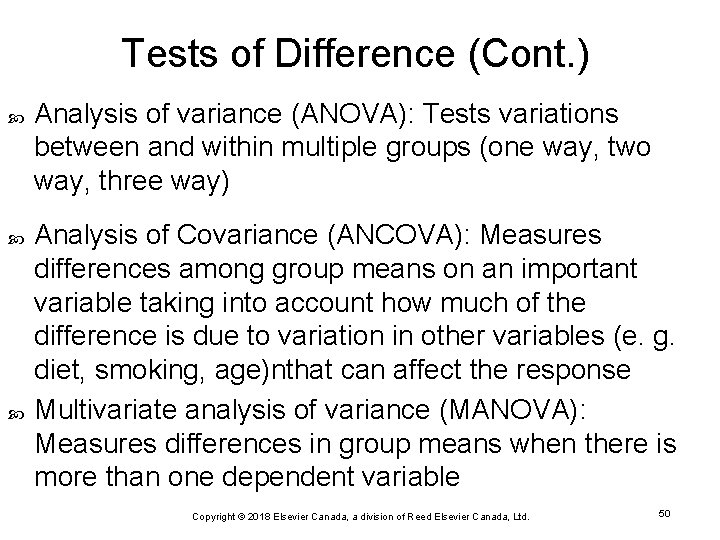
Tests of Difference (Cont. ) Analysis of variance (ANOVA): Tests variations between and within multiple groups (one way, two way, three way) Analysis of Covariance (ANCOVA): Measures differences among group means on an important variable taking into account how much of the difference is due to variation in other variables (e. g. diet, smoking, age)nthat can affect the response Multivariate analysis of variance (MANOVA): Measures differences in group means when there is more than one dependent variable Copyright © 2018 Elsevier Canada, a division of Reed Elsevier Canada, Ltd. 50
Tests of Difference (Cont. ) https: //www. statisticshowto. com/probability-andstatistics/hypothesis-testing/anova/ https: //www. youtube. com/watch? v=p 7 f. U 02 WRQ 7 Y https: //www. youtube. com/watch? v=mp 5 l. RMiqp. OU Copyright © 2018 Elsevier Canada, a division of Reed Elsevier Canada, Ltd. 51
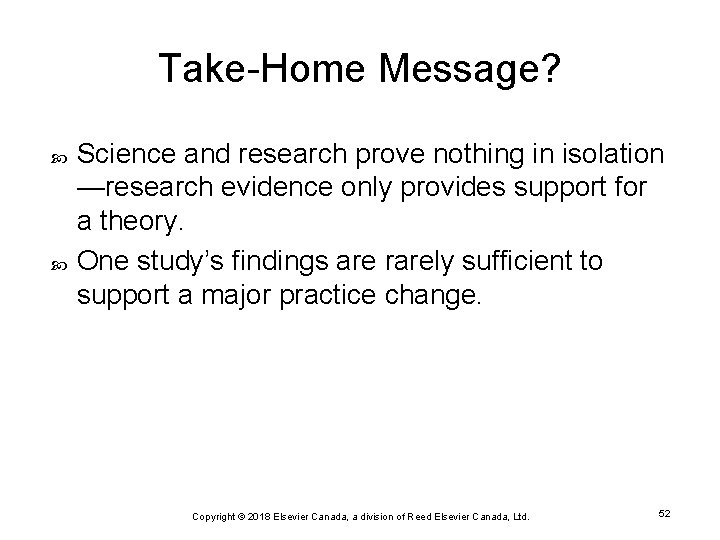
Take-Home Message? Science and research prove nothing in isolation —research evidence only provides support for a theory. One study’s findings are rarely sufficient to support a major practice change. Copyright © 2018 Elsevier Canada, a division of Reed Elsevier Canada, Ltd. 52