
Chapter 16 PERT CPM and Critical Chain Operations
- Slides: 42
Chapter 16 – PERT, CPM and Critical Chain Operations Management by R. Dan Reid & Nada R. Sanders 4 th Edition © Wiley 2010
Learning Objectives n n n Describe project management objectives Describe the project life cycle Diagram networks of project activities Estimate the completion time of a project Compute the probability of completing a project by a specific time © Wiley 2010
Learning Objectives – con’t n n Determine how to reduce the length of a project effectively Describe the critical chain approach to project management © Wiley 2010
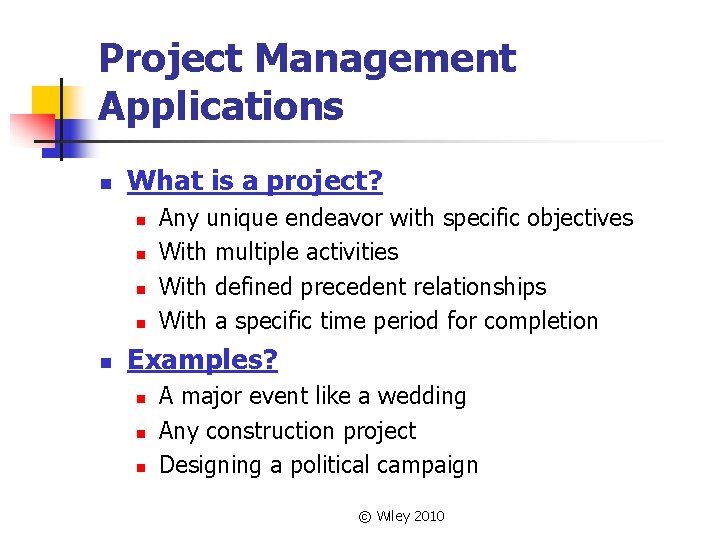
Project Management Applications n What is a project? n n n Any unique endeavor with specific objectives With multiple activities With defined precedent relationships With a specific time period for completion Examples? n n n A major event like a wedding Any construction project Designing a political campaign © Wiley 2010
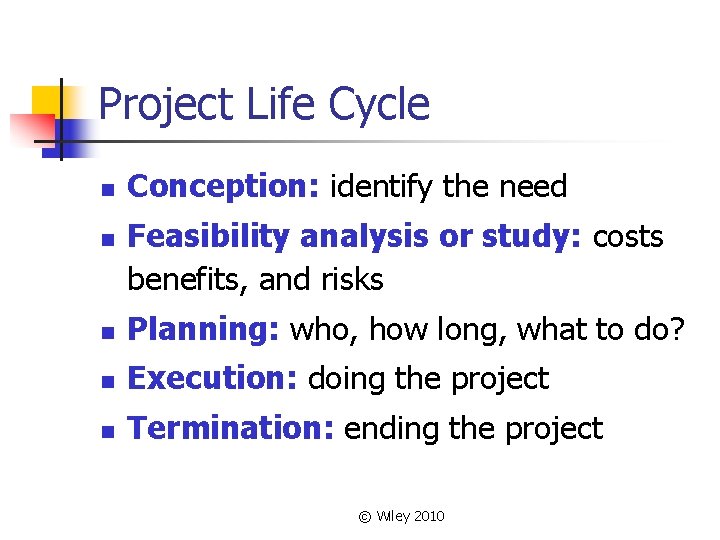
Project Life Cycle n n Conception: identify the need Feasibility analysis or study: costs benefits, and risks n Planning: who, how long, what to do? n Execution: doing the project n Termination: ending the project © Wiley 2010
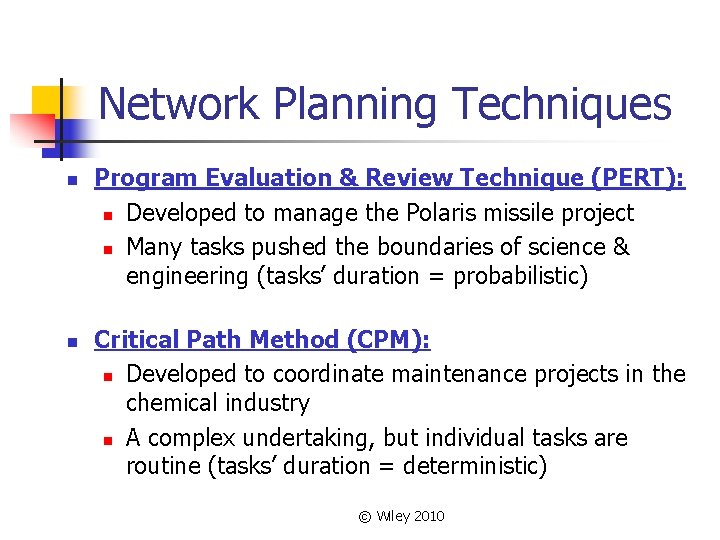
Network Planning Techniques n n Program Evaluation & Review Technique (PERT): n Developed to manage the Polaris missile project n Many tasks pushed the boundaries of science & engineering (tasks’ duration = probabilistic) Critical Path Method (CPM): n Developed to coordinate maintenance projects in the chemical industry n A complex undertaking, but individual tasks are routine (tasks’ duration = deterministic) © Wiley 2010
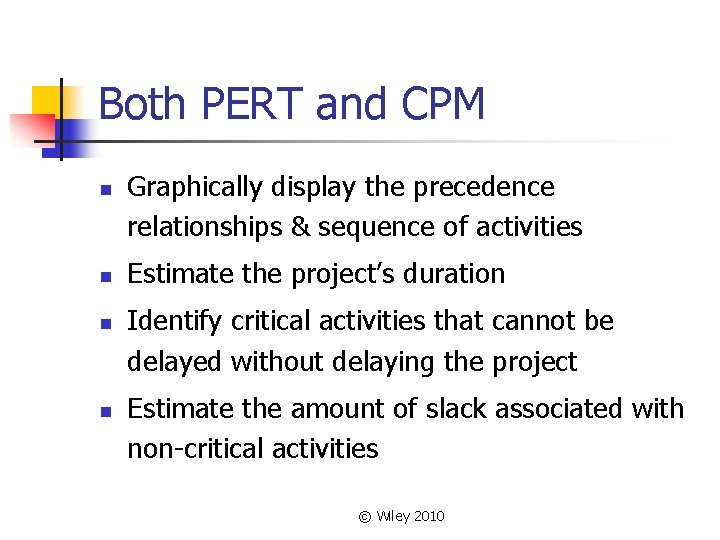
Both PERT and CPM n n Graphically display the precedence relationships & sequence of activities Estimate the project’s duration Identify critical activities that cannot be delayed without delaying the project Estimate the amount of slack associated with non-critical activities © Wiley 2010
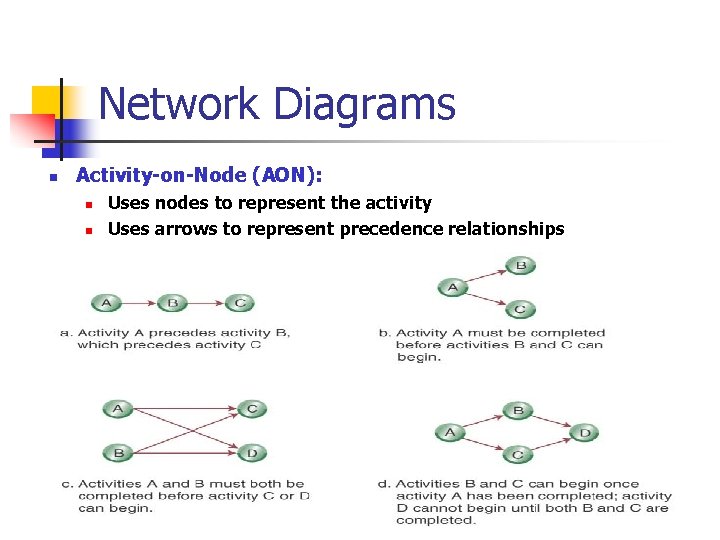
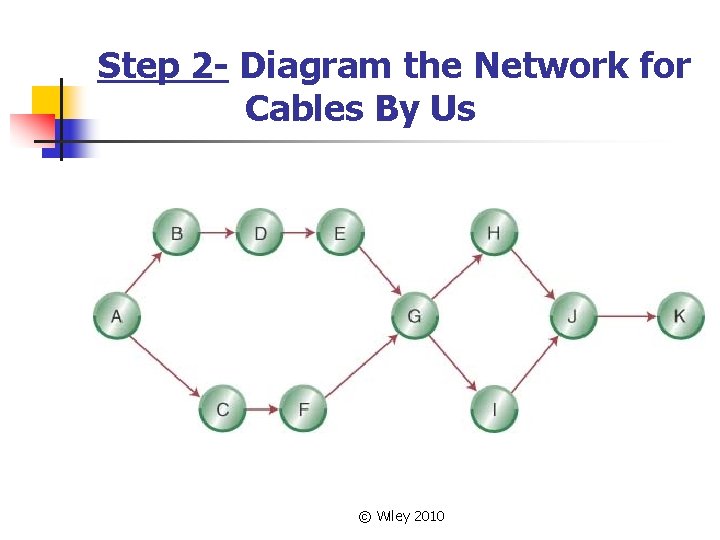
Network Diagrams n Activity-on-Node (AON): n n Uses nodes to represent the activity Uses arrows to represent precedence relationships © Wiley 2007
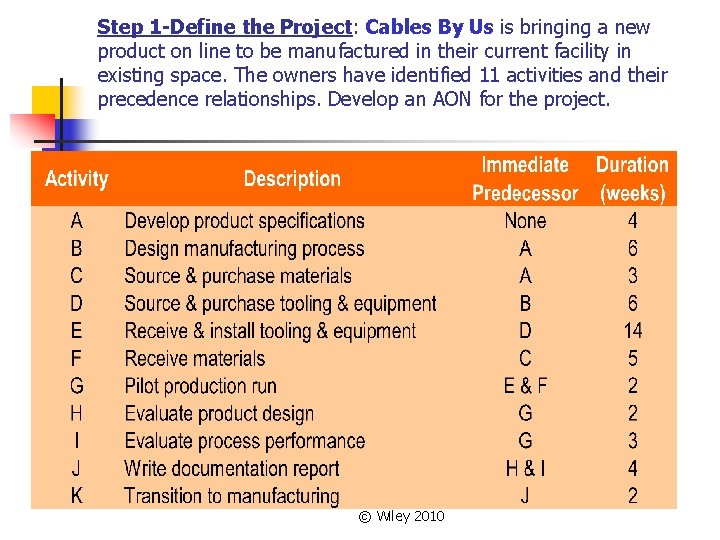
Step 1 -Define the Project: Cables By Us is bringing a new product on line to be manufactured in their current facility in existing space. The owners have identified 11 activities and their precedence relationships. Develop an AON for the project. © Wiley 2010
Step 2 - Diagram the Network for Cables By Us © Wiley 2010
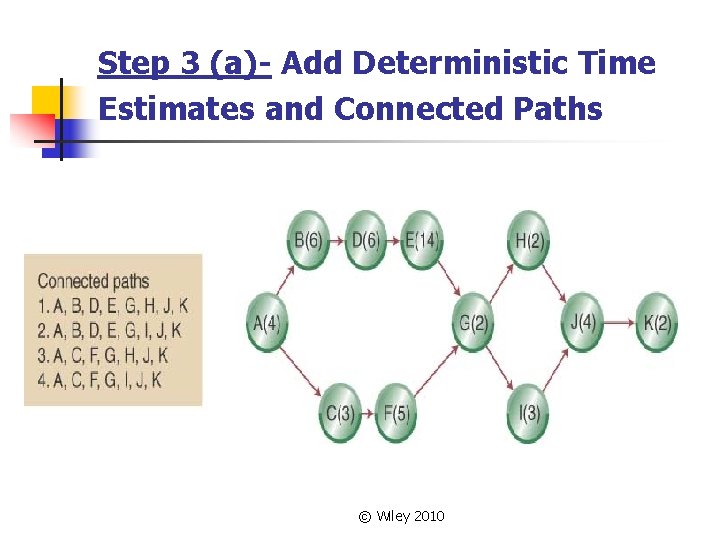
Step 3 (a)- Add Deterministic Time Estimates and Connected Paths © Wiley 2010
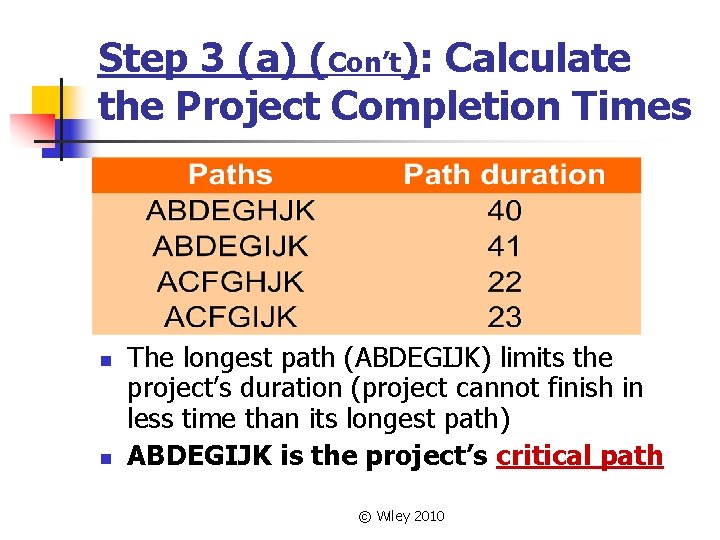
Step 3 (a) (Con’t): Calculate the Project Completion Times n n The longest path (ABDEGIJK) limits the project’s duration (project cannot finish in less time than its longest path) ABDEGIJK is the project’s critical path © Wiley 2010
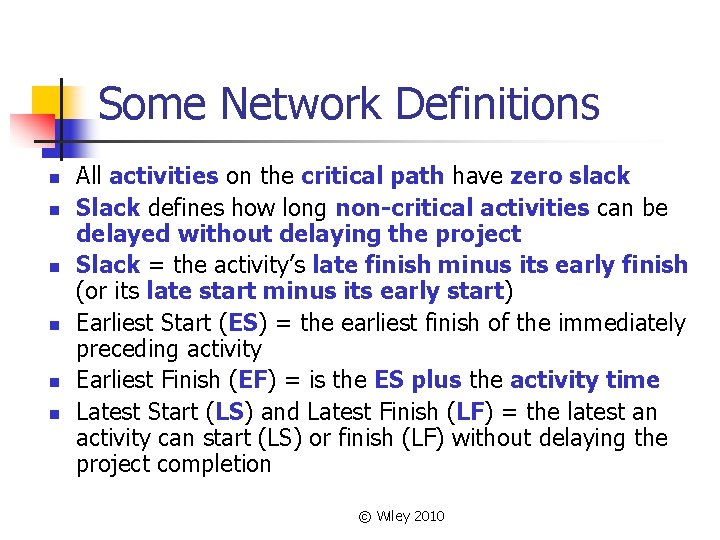
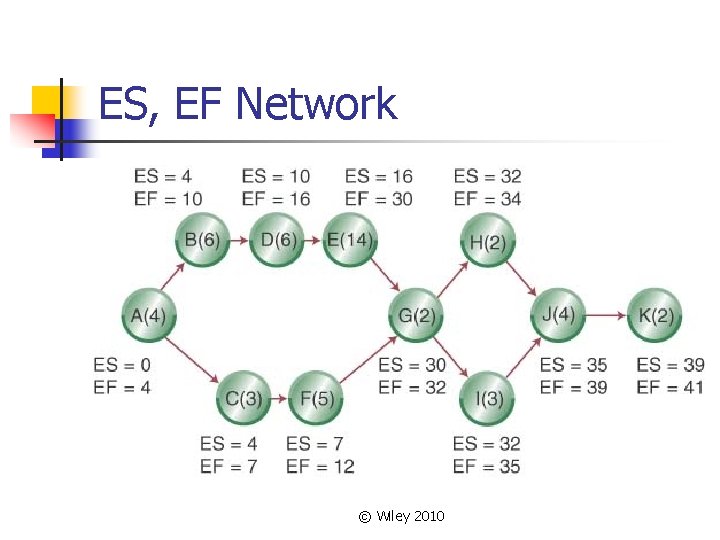
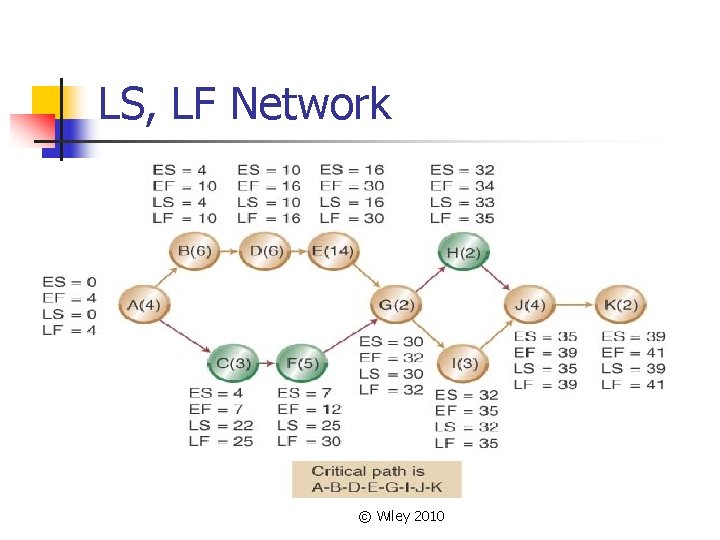
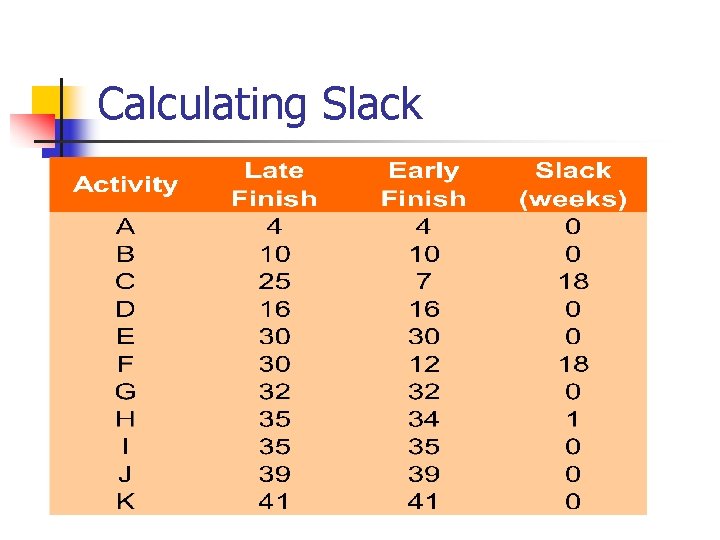
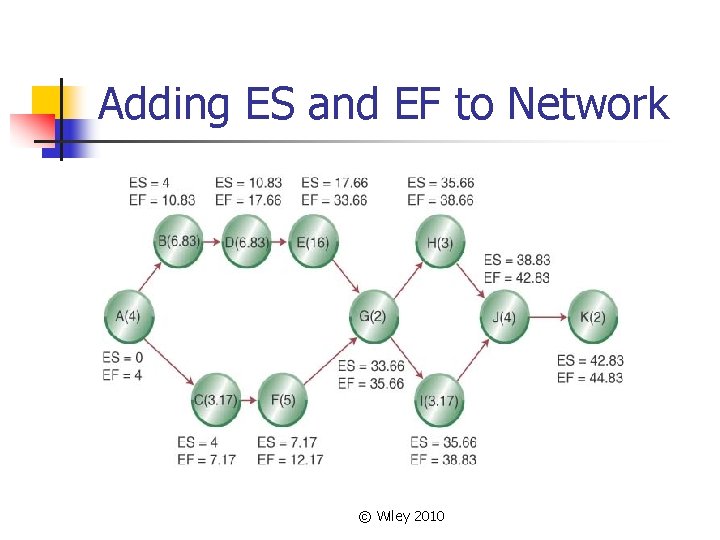
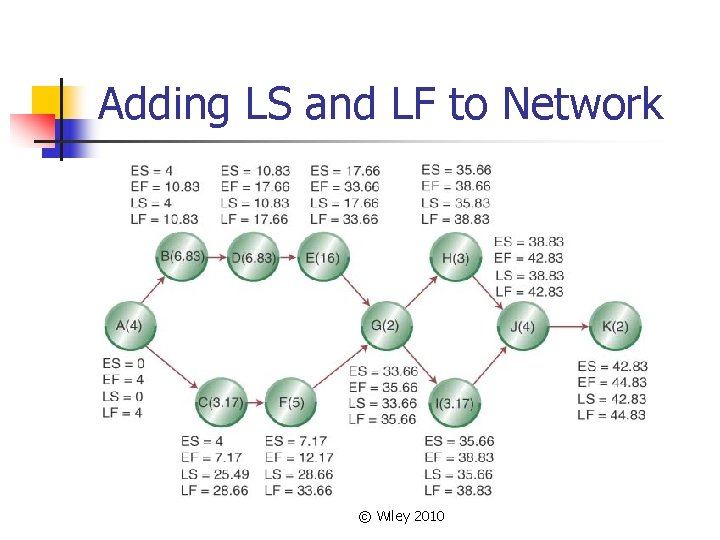
Some Network Definitions n n n All activities on the critical path have zero slack Slack defines how long non-critical activities can be delayed without delaying the project Slack = the activity’s late finish minus its early finish (or its late start minus its early start) Earliest Start (ES) = the earliest finish of the immediately preceding activity Earliest Finish (EF) = is the ES plus the activity time Latest Start (LS) and Latest Finish (LF) = the latest an activity can start (LS) or finish (LF) without delaying the project completion © Wiley 2010
ES, EF Network © Wiley 2010
LS, LF Network © Wiley 2010
Calculating Slack
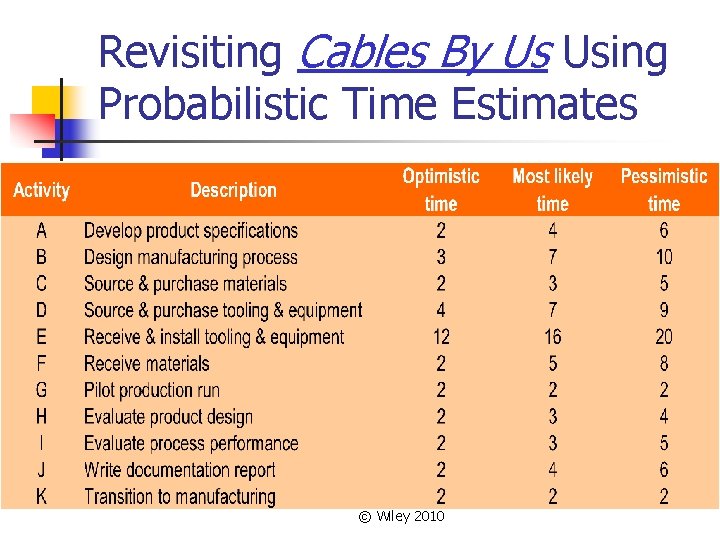
Revisiting Cables By Us Using Probabilistic Time Estimates © Wiley 2010
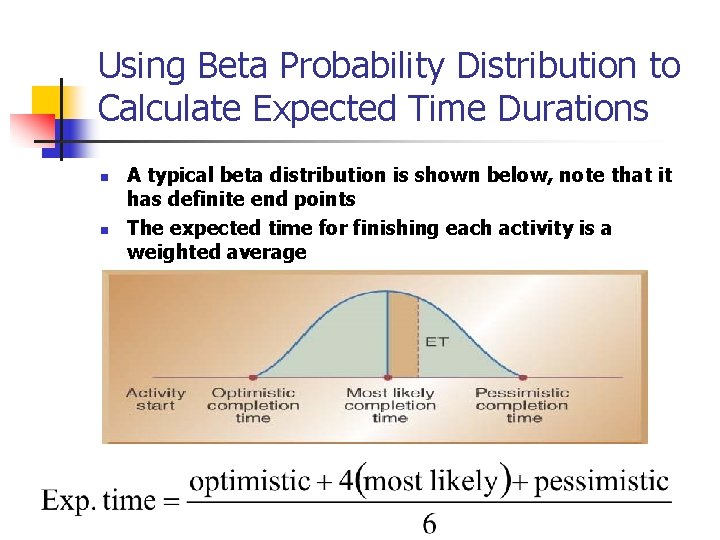
Using Beta Probability Distribution to Calculate Expected Time Durations n n A typical beta distribution is shown below, note that it has definite end points The expected time for finishing each activity is a weighted average
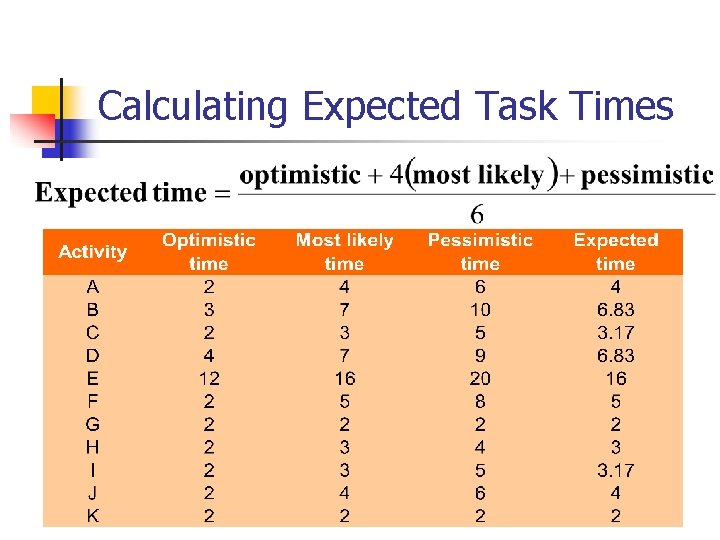
Calculating Expected Task Times © Wiley 2007
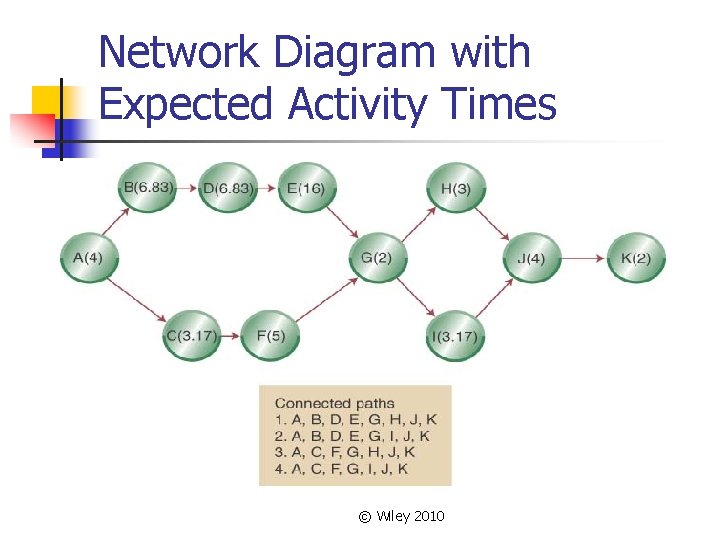
Network Diagram with Expected Activity Times © Wiley 2010
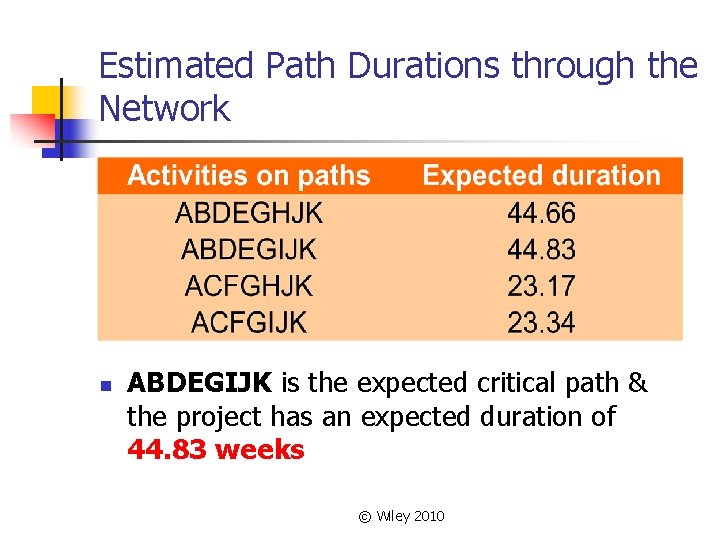
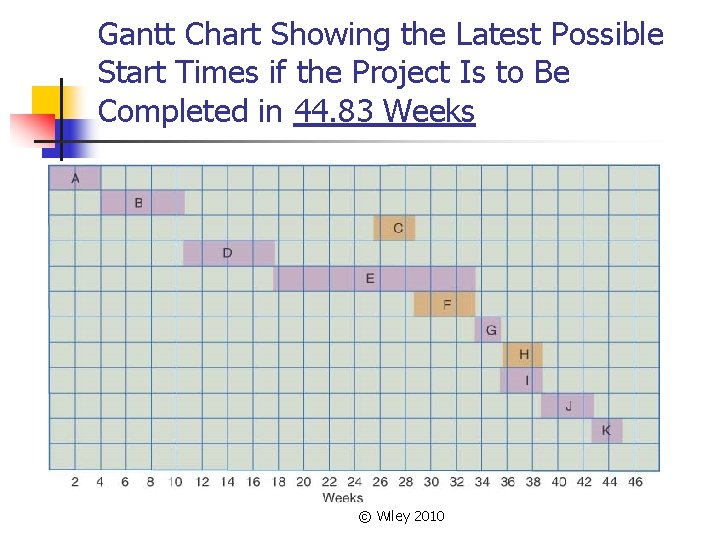
Estimated Path Durations through the Network n ABDEGIJK is the expected critical path & the project has an expected duration of 44. 83 weeks © Wiley 2010
Adding ES and EF to Network © Wiley 2010
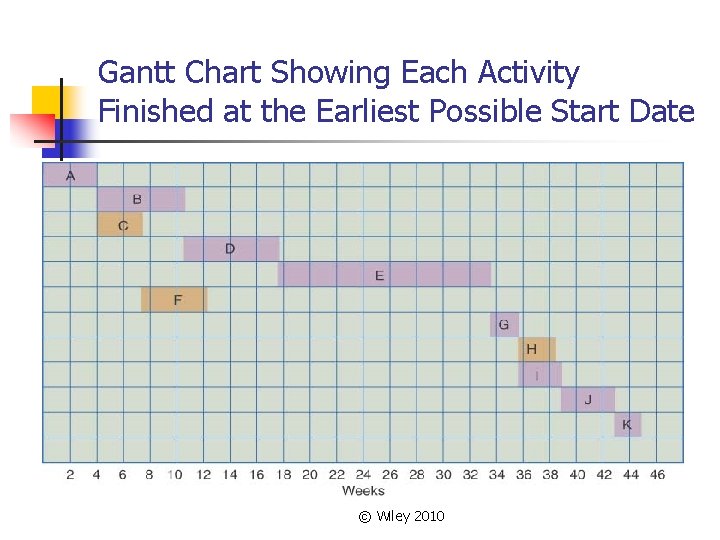
Gantt Chart Showing Each Activity Finished at the Earliest Possible Start Date © Wiley 2010
Adding LS and LF to Network © Wiley 2010
Gantt Chart Showing the Latest Possible Start Times if the Project Is to Be Completed in 44. 83 Weeks © Wiley 2010
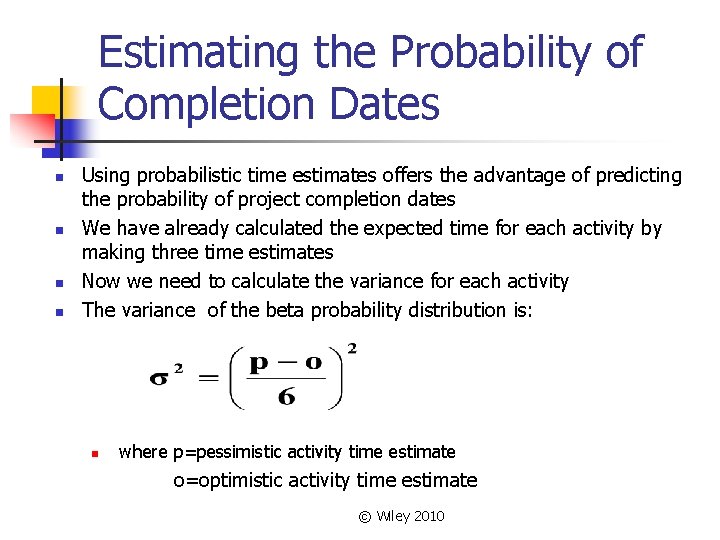
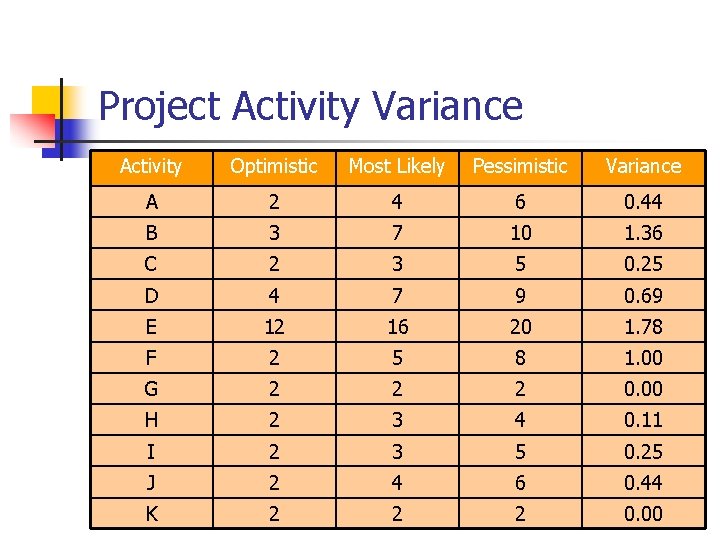
Estimating the Probability of Completion Dates n n Using probabilistic time estimates offers the advantage of predicting the probability of project completion dates We have already calculated the expected time for each activity by making three time estimates Now we need to calculate the variance for each activity The variance of the beta probability distribution is: n where p=pessimistic activity time estimate o=optimistic activity time estimate © Wiley 2010
Project Activity Variance Activity Optimistic Most Likely Pessimistic Variance A 2 4 6 0. 44 B 3 7 10 1. 36 C 2 3 5 0. 25 D 4 7 9 0. 69 E 12 16 20 1. 78 F 2 5 8 1. 00 G 2 2 2 0. 00 H 2 3 4 0. 11 I 2 3 5 0. 25 J 2 4 6 0. 44 K 2 2 2007 © Wiley 2 0. 00
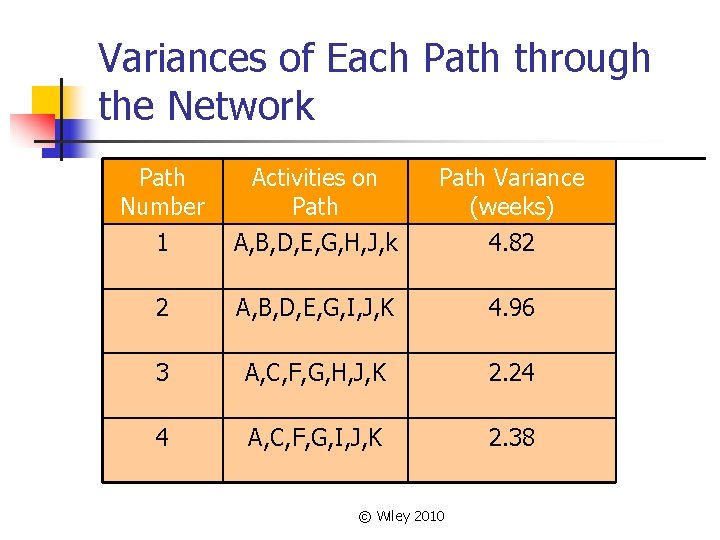
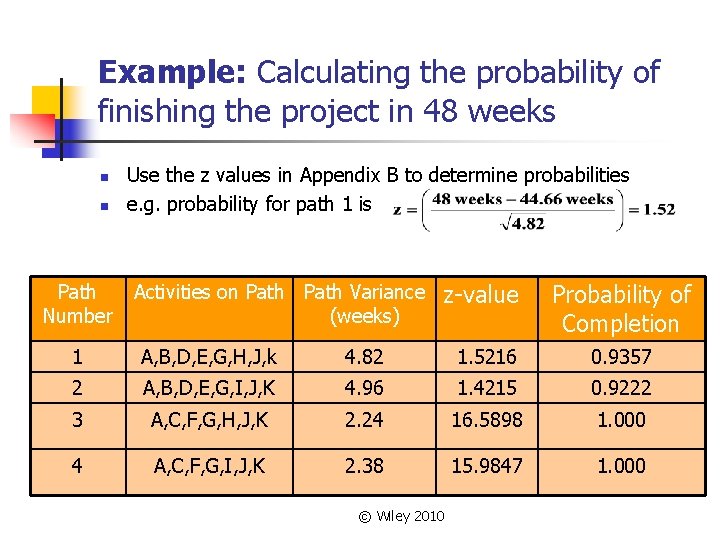
Variances of Each Path through the Network Path Number Activities on Path Variance (weeks) 1 A, B, D, E, G, H, J, k 4. 82 2 A, B, D, E, G, I, J, K 4. 96 3 A, C, F, G, H, J, K 2. 24 4 A, C, F, G, I, J, K 2. 38 © Wiley 2010
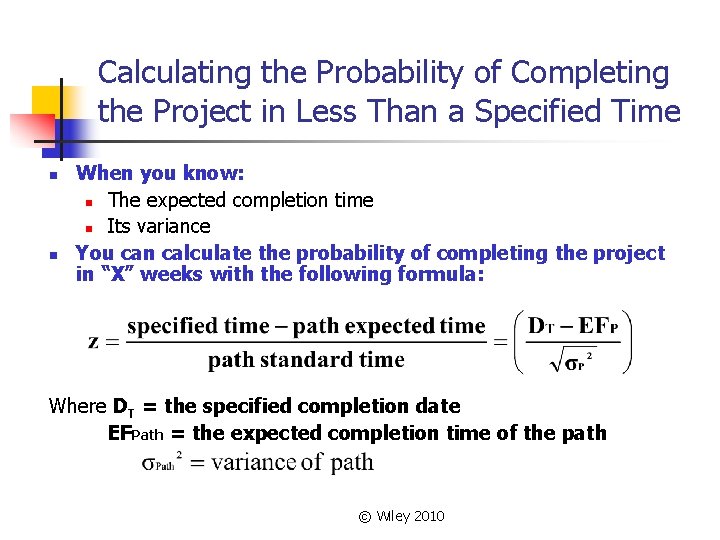
Calculating the Probability of Completing the Project in Less Than a Specified Time n n When you know: n The expected completion time n Its variance You can calculate the probability of completing the project in “X” weeks with the following formula: Where DT = the specified completion date EFPath = the expected completion time of the path © Wiley 2010
Example: Calculating the probability of finishing the project in 48 weeks n n Path Number Use the z values in Appendix B to determine probabilities e. g. probability for path 1 is Activities on Path Variance (weeks) z-value Probability of Completion 1 A, B, D, E, G, H, J, k 4. 82 1. 5216 0. 9357 2 A, B, D, E, G, I, J, K 4. 96 1. 4215 0. 9222 3 A, C, F, G, H, J, K 2. 24 16. 5898 1. 000 4 A, C, F, G, I, J, K 2. 38 15. 9847 1. 000 © Wiley 2010
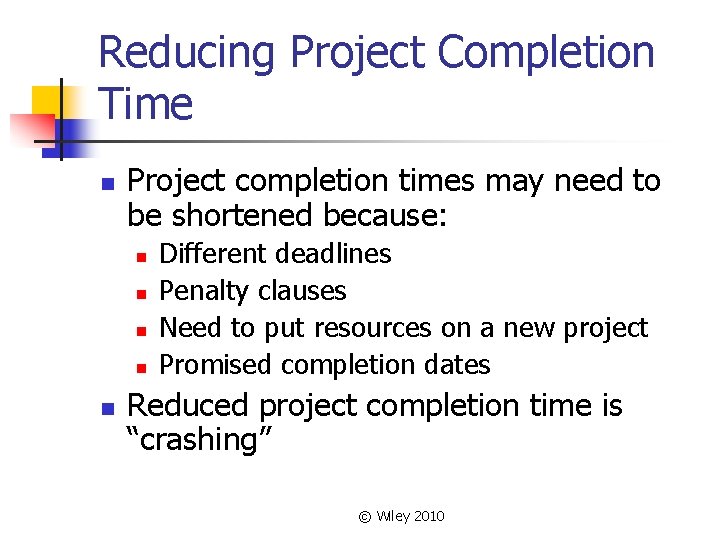
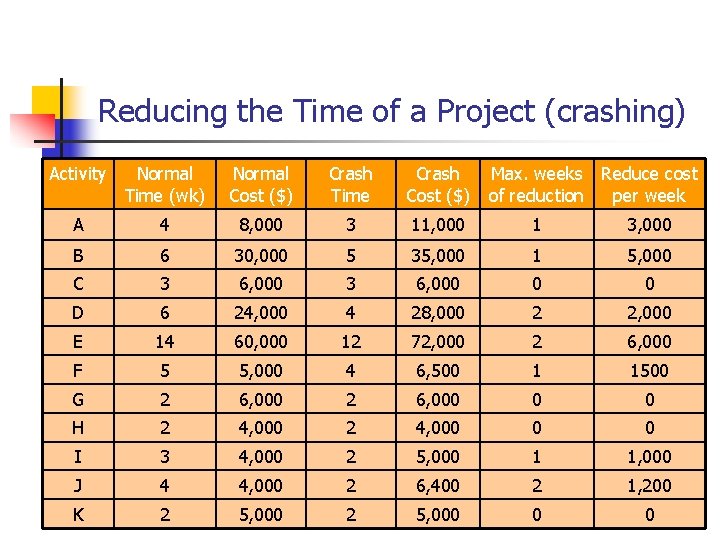
Reducing Project Completion Time n Project completion times may need to be shortened because: n n n Different deadlines Penalty clauses Need to put resources on a new project Promised completion dates Reduced project completion time is “crashing” © Wiley 2010
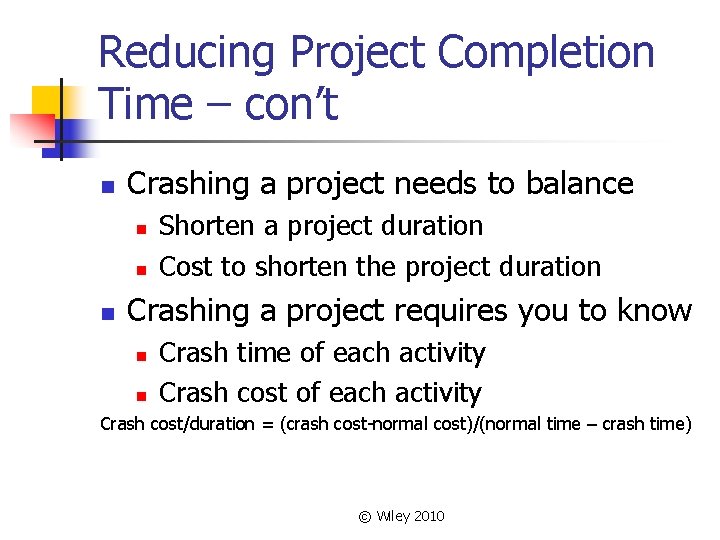
Reducing Project Completion Time – con’t n Crashing a project needs to balance n n n Shorten a project duration Cost to shorten the project duration Crashing a project requires you to know n n Crash time of each activity Crash cost/duration = (crash cost-normal cost)/(normal time – crash time) © Wiley 2010
Reducing the Time of a Project (crashing) Activity Normal Time (wk) Normal Cost ($) Crash Time Crash Cost ($) Max. weeks Reduce cost of reduction per week A 4 8, 000 3 11, 000 1 3, 000 B 6 30, 000 5 35, 000 1 5, 000 C 3 6, 000 0 0 D 6 24, 000 4 28, 000 2 2, 000 E 14 60, 000 12 72, 000 2 6, 000 F 5 5, 000 4 6, 500 1 1500 G 2 6, 000 0 0 H 2 4, 000 0 0 I 3 4, 000 2 5, 000 1 1, 000 J 4 4, 000 2 6, 400 2 1, 200 K 2 5, 000 2 © Wiley 2007 5, 000 0 0
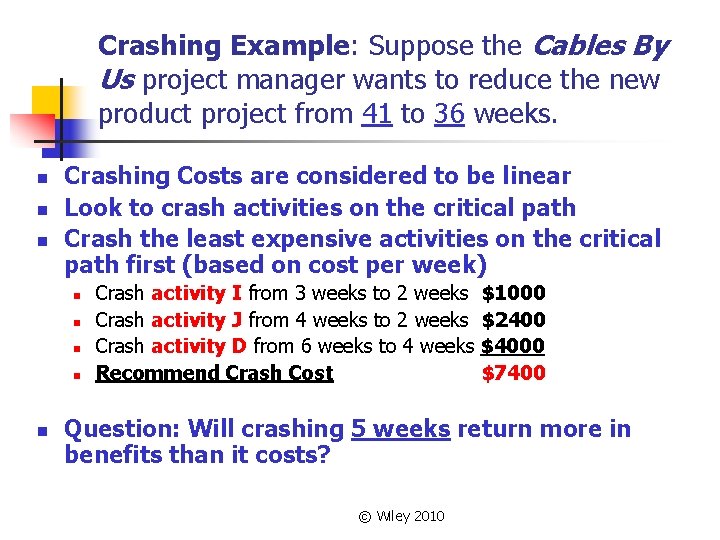
Crashing Example: Suppose the Cables By Us project manager wants to reduce the new product project from 41 to 36 weeks. n n n Crashing Costs are considered to be linear Look to crash activities on the critical path Crash the least expensive activities on the critical path first (based on cost per week) n n n Crash activity I from 3 weeks to 2 weeks Crash activity J from 4 weeks to 2 weeks Crash activity D from 6 weeks to 4 weeks Recommend Crash Cost $1000 $2400 $4000 $7400 Question: Will crashing 5 weeks return more in benefits than it costs? © Wiley 2010
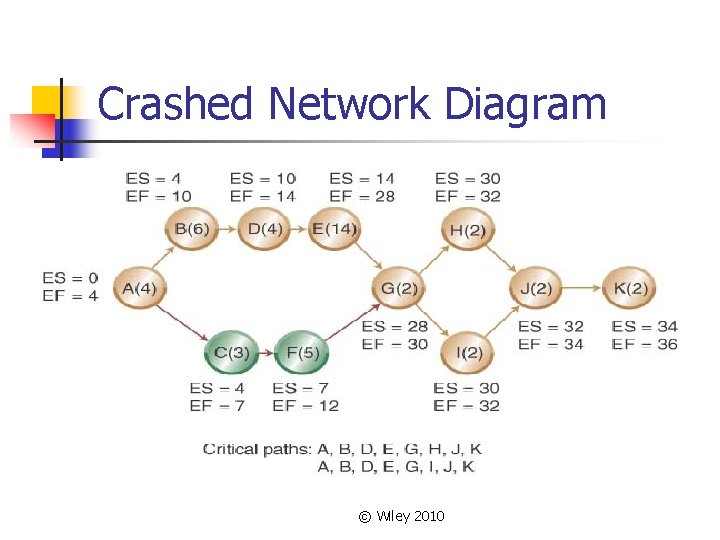
Crashed Network Diagram © Wiley 2010
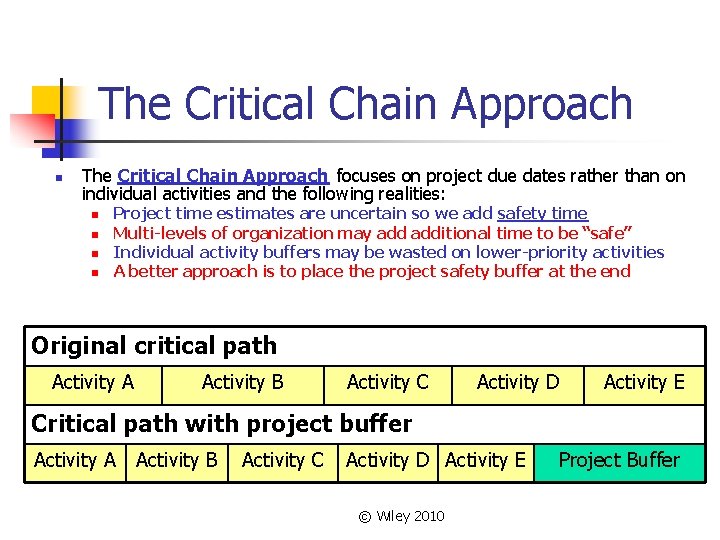
The Critical Chain Approach n The Critical Chain Approach focuses on project due dates rather than on individual activities and the following realities: n n Project time estimates are uncertain so we add safety time Multi-levels of organization may additional time to be “safe” Individual activity buffers may be wasted on lower-priority activities A better approach is to place the project safety buffer at the end Original critical path Activity A Activity B Activity C Activity D Activity E Critical path with project buffer Activity A Activity B Activity C Activity D Activity E © Wiley 2010 Project Buffer
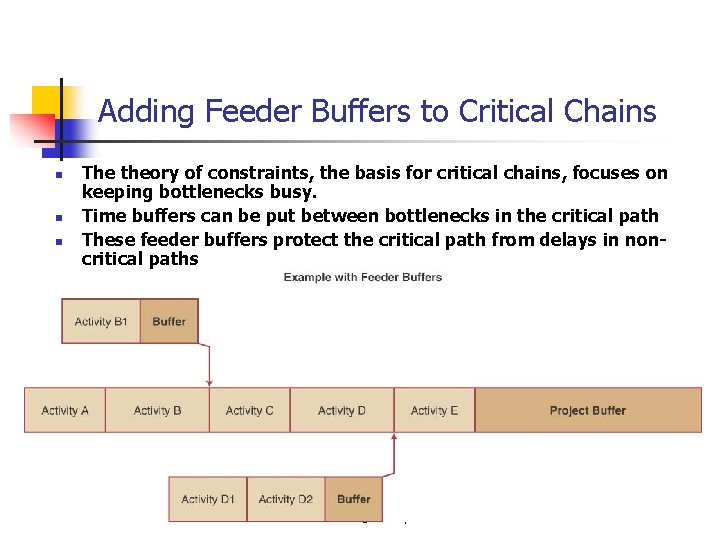
Adding Feeder Buffers to Critical Chains n n n The theory of constraints, the basis for critical chains, focuses on keeping bottlenecks busy. Time buffers can be put between bottlenecks in the critical path These feeder buffers protect the critical path from delays in noncritical paths © Wiley 2007
Project Management within OM: How it all fits together n n Project management techniques provide a structure for the project manager to track the progress of different activities required to complete the project. Particular concern is given to critical path (the longest connected path through the project network) activities. Any delay to a critical path activity affects the project completion time. These techniques indicate the expected completion time and cost of a project. The project manager reviews this information to ensure that adequate resources exist and that the expected completion time is reasonable. © Wiley 2010
Project Management OM Across the Organization n n Accounting uses project management (PM) information to provide a time line for major expenditures Marketing use PM information to monitor the progress to provide updates to the customer Information systems develop and maintain software that supports projects Operations use PM to information to monitor activity progress both on and off critical path to manage resource requirements © Wiley 2010
Chapter 16 Highlights n n A project is a unique, one time event of some duration that consumes resources and is designed to achieve an objective in a given time period. Each project goes through a five-phase life cycle: concept, feasibility study, planning, execution, and termination. Two network planning techniques are PERT and CPM. Pert uses probabilistic time estimates. CPM uses deterministic time estimates. Pert and CPM determine the critical path of the project and the estimated completion time. On large projects, software programs are available to identify the critical path. © Wiley 2010
Chapter 16 Highlights con’t n n n Pert uses probabilistic time estimates to determine the probability that a project will be done by a specific time. To reduce the length of the project (crashing), we need to know the critical path of the project and the cost of reducing individual activity times. Crashing activities that are not on the critical path typically do not reduce project completion time. The critical chain approach removes excess safety time from individual activities and creates a project buffer at the end of the critical path. © Wiley 2010
The End Copyright © 2010 John Wiley & Sons, Inc. All rights reserved. Reproduction or translation of this work beyond that permitted in Section 117 of the 1976 United State Copyright Act without the express written permission of the copyright owner is unlawful. Request for further information should be addressed to the Permissions Department, John Wiley & Sons, Inc. The purchaser may make back-up copies for his/her own use only and not for distribution or resale. The Publisher assumes no responsibility for errors, omissions, or damages, caused by the use of these programs or from the use of the information contained herein. © Wiley 2010