
Chapter 16 Introduction to Managerial Accounting Learning Objectives
Chapter 16 Introduction to Managerial Accounting
Learning Objectives 1. Define managerial accounting and understand how it is used 2. Describe the differences between service, merchandising, and manufacturing companies 3. Classify costs for service, merchandising, and manufacturing companies 16 -2
Learning Objectives 4. Prepare an income statement and schedule of cost of goods manufactured for a manufacturing company and calculate cost per item 5. Calculate cost per service for a service company and cost per item for a merchandising company 16 -3
Learning Objective 1 Define managerial accounting and understand how it is used 16 -4
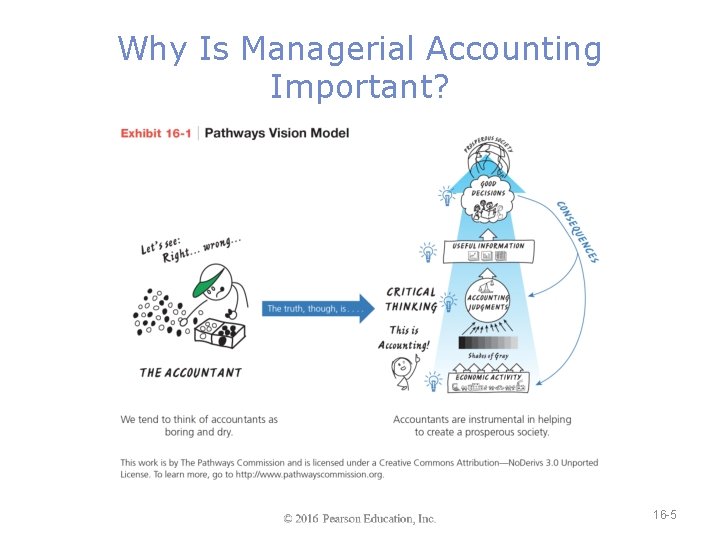
Why Is Managerial Accounting Important? 16 -5

Financial Versus Managerial Accounting • Financial accounting: – Financial statements are used by investors, creditors, and government authorities. • Managerial accounting: – Reports are generated for planning. • One planning tool is the budget. – Controlling involves evaluating the plan and comparing the actual results to the budget. – Weighing the costs against the benefits is called cost/benefit analysis. 16 -6
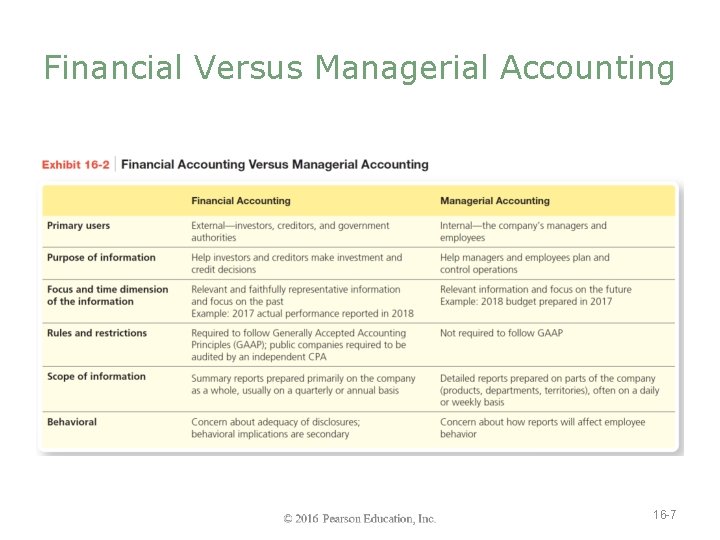
Financial Versus Managerial Accounting 16 -7

Management Accountability • Management accountability is the manager’s responsibility to the various stakeholders to wisely manage the organization’s resources. • Stakeholders have an interest in the business and include the following: – – Customers Creditors Suppliers Investors 16 -8
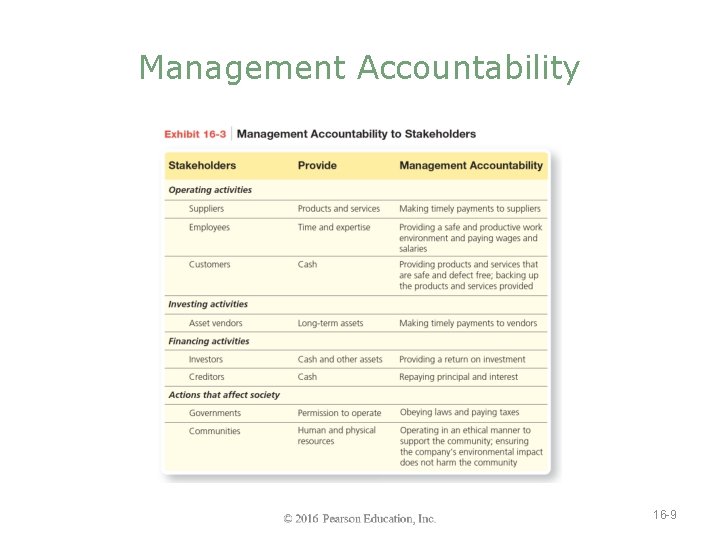
Management Accountability 16 -9
Today’s Business Environment • Shift toward a service economy • Global competition • Time-based competition: – Enterprise Resource Planning (ERP) systems integrate companies data. – E-commerce allows companies to sell products to customers around the world. – Just-in-Time (JIT) Management is an inventory management tool. 16 -10
Today’s Business Environment • Total Quality Management (TQM) is a philosophy of continuous improvement in products and processes. – Creates a culture of cooperation. – Each step adds value to the end product, and this is referred to as the value chain. • The economic, social, and environmental impact of doing business is referred to as the triple bottom line, which includes: – Profits – People – Planet 16 -11
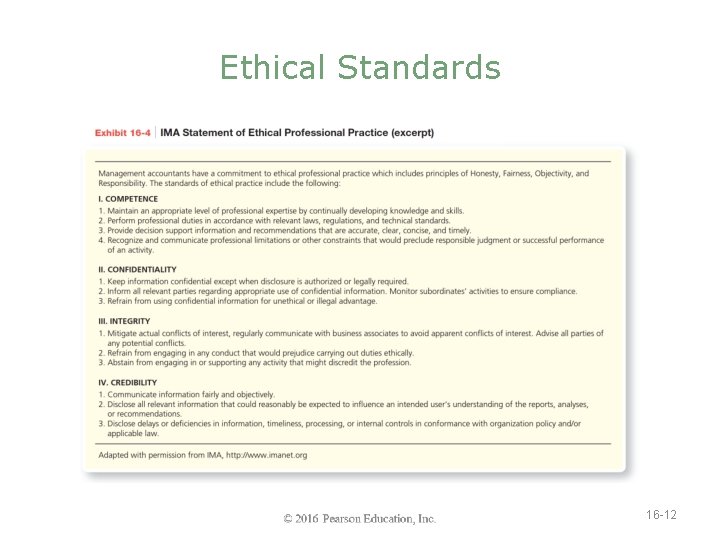
Ethical Standards 16 -12
Learning Objective 2 Describe the differences between service, merchandising, and manufacturing companies 16 -13
How Do Service, Merchandising, and Manufacturing Companies Differ? • Service companies sell their time, skill, and knowledge. – All of their costs are period costs and are expensed in the period incurred. • Merchandising companies resell products they previously bought from suppliers. – Cost of goods sold is an inventoriable product cost, also called a product cost. • Manufacturing companies create products customers want. 16 -14
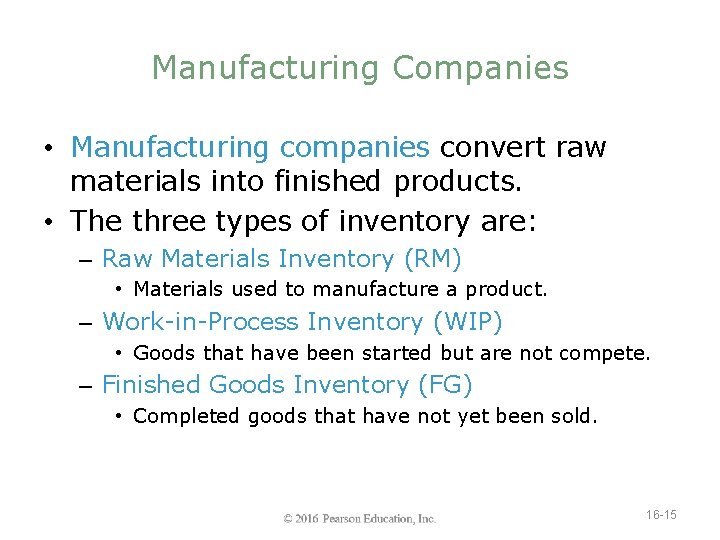
Manufacturing Companies • Manufacturing companies convert raw materials into finished products. • The three types of inventory are: – Raw Materials Inventory (RM) • Materials used to manufacture a product. – Work-in-Process Inventory (WIP) • Goods that have been started but are not compete. – Finished Goods Inventory (FG) • Completed goods that have not yet been sold. 16 -15
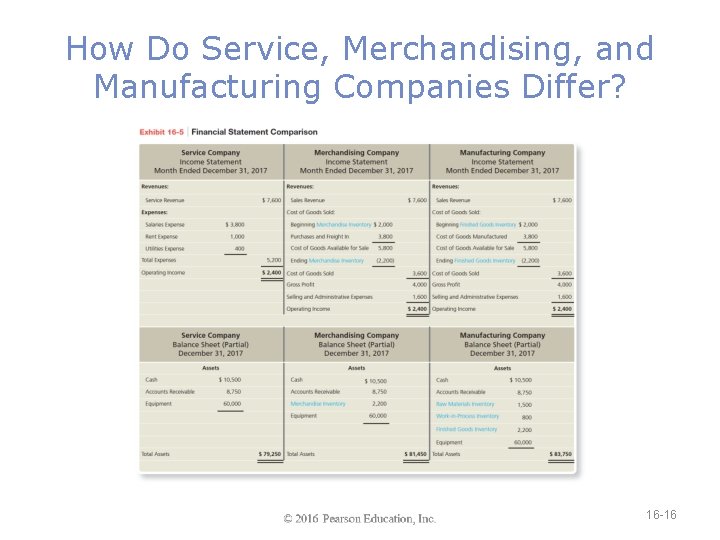
How Do Service, Merchandising, and Manufacturing Companies Differ? 16 -16
Learning Objective 3 Classify costs for service, merchandising, and manufacturing companies 16 -17
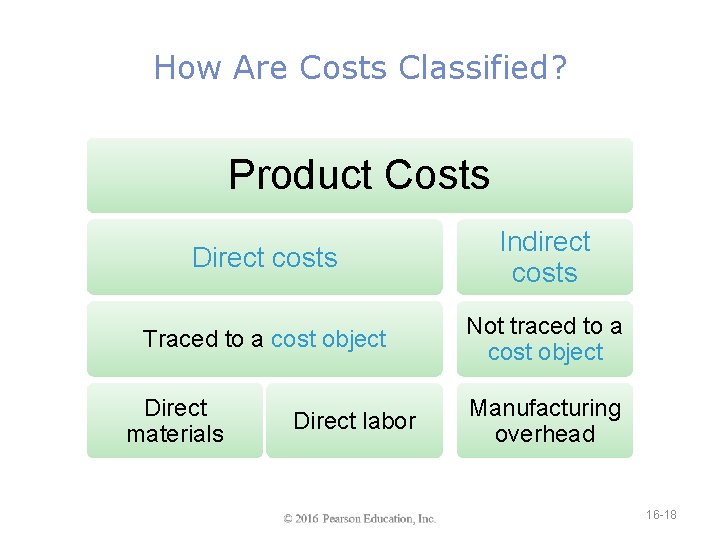
How Are Costs Classified? Product Costs Direct costs Indirect costs Traced to a cost object Not traced to a cost object Direct materials Direct labor Manufacturing overhead 16 -18
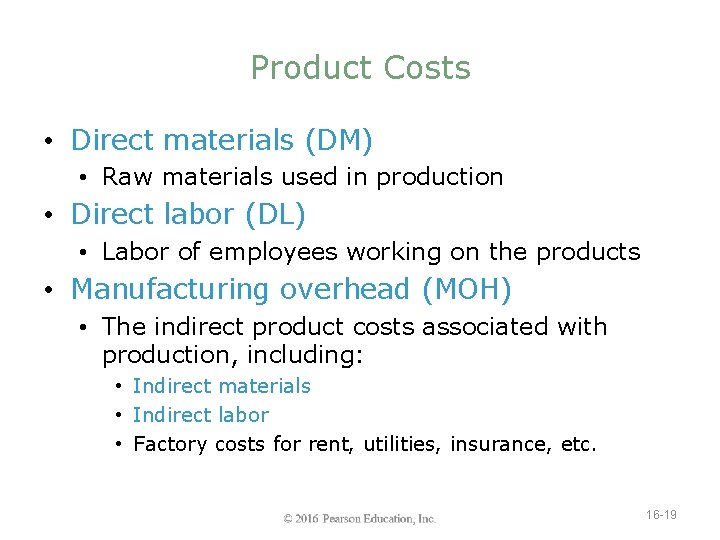
Product Costs • Direct materials (DM) • Raw materials used in production • Direct labor (DL) • Labor of employees working on the products • Manufacturing overhead (MOH) • The indirect product costs associated with production, including: • Indirect materials • Indirect labor • Factory costs for rent, utilities, insurance, etc. 16 -19
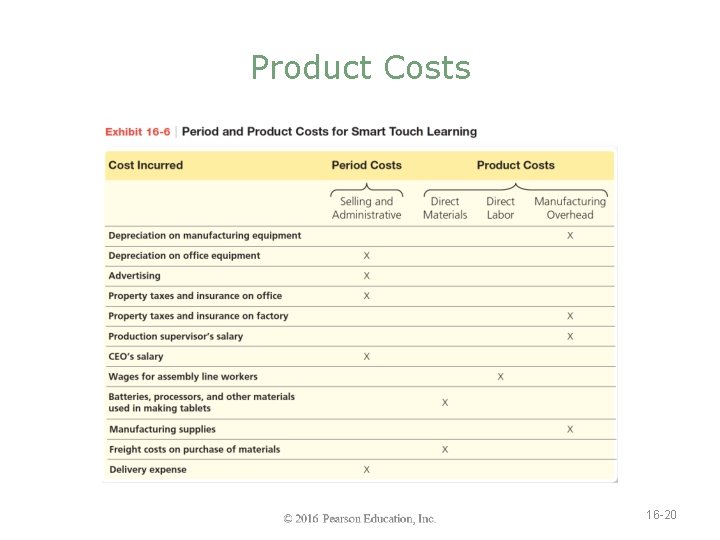
Product Costs 16 -20
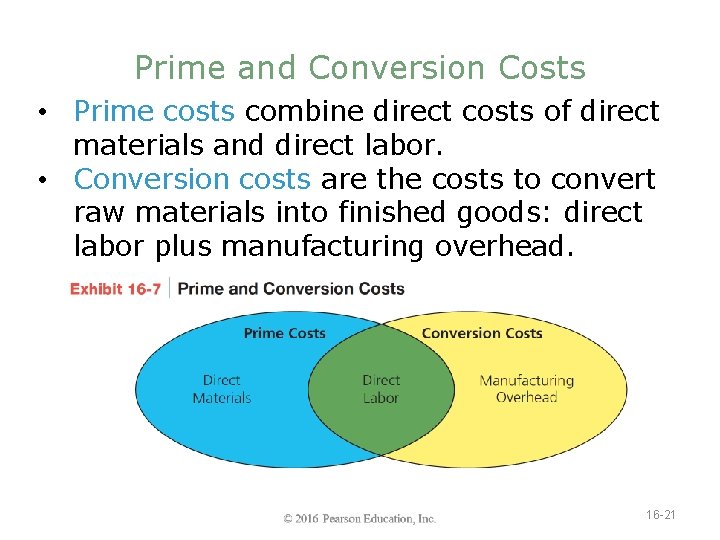
Prime and Conversion Costs • Prime costs combine direct costs of direct materials and direct labor. • Conversion costs are the costs to convert raw materials into finished goods: direct labor plus manufacturing overhead. 16 -21
Learning Objective 4 Prepare an income statement and schedule of cost of goods manufactured for a manufacturing company and calculate cost per item 16 -22
How Do Manufacturing Companies Determine the Cost of Manufactured Products? • Income statement – Calculating cost of goods sold • The Finished Goods Inventory account provides information for the cost of goods sold section of the income statement – Gross profit • Gross profit = Net Sales Revenue – Cost of Goods Sold – Operating income • Operating income = Gross profit – sales and administrative expenses 16 -23
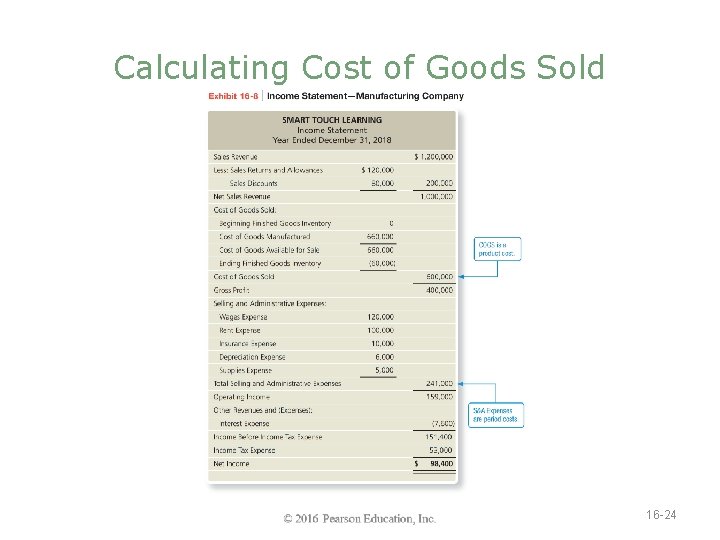
Calculating Cost of Goods Sold 16 -24
Calculating Cost of Goods Manufactured • Cost of goods manufactured is the manufacturing costs of the goods that finished the production process in a given accounting period. – Costs are determined from activities that took place in the past. 16 -25
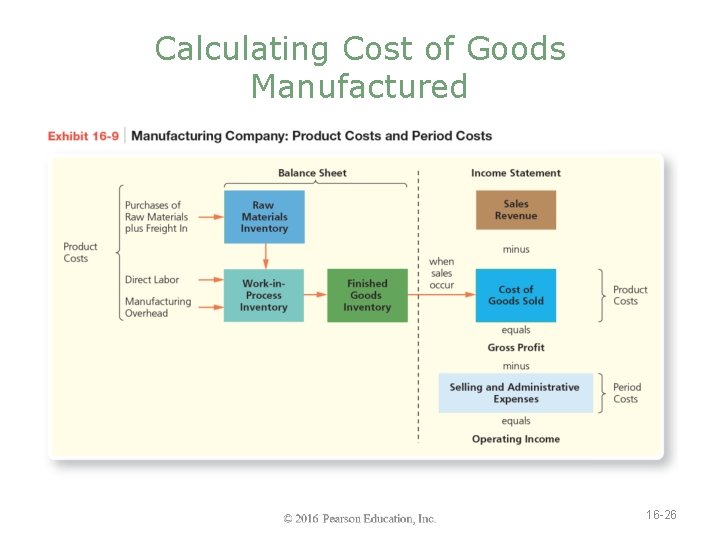
Calculating Cost of Goods Manufactured 16 -26
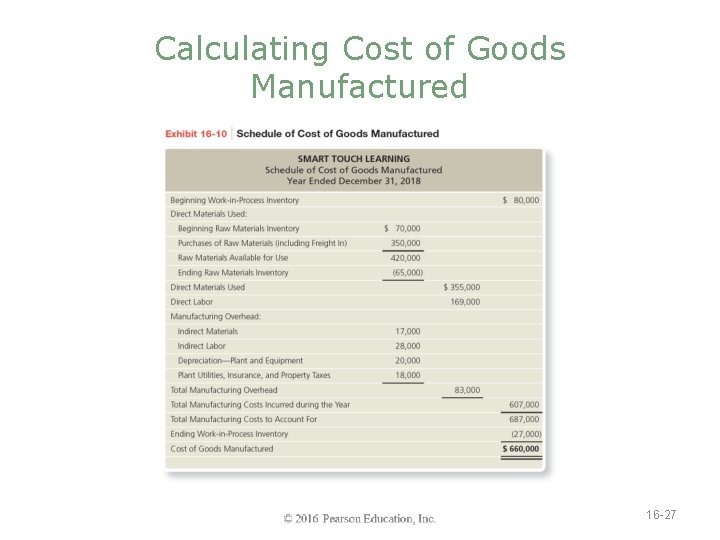
Calculating Cost of Goods Manufactured 16 -27
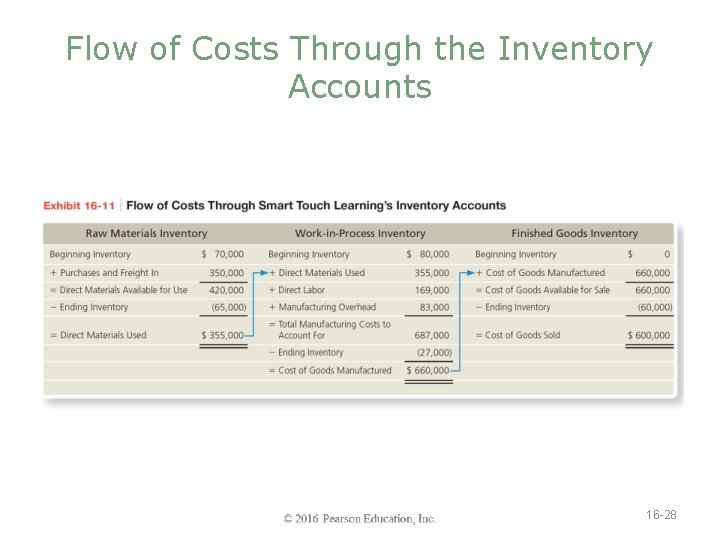
Flow of Costs Through the Inventory Accounts 16 -28
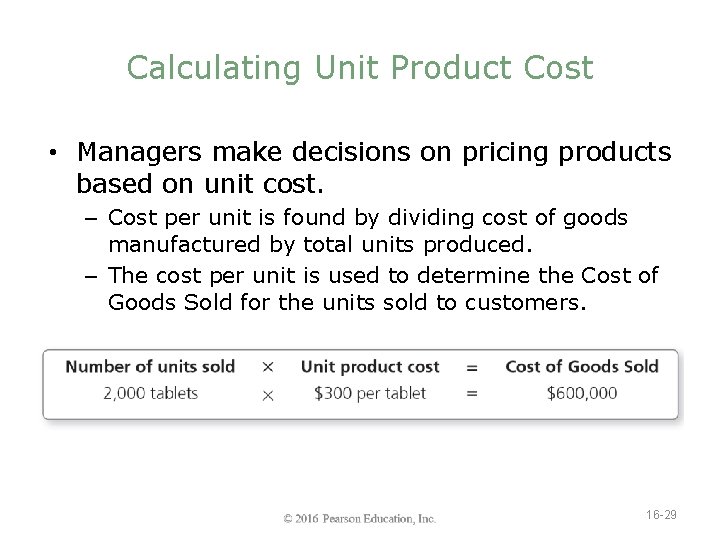
Calculating Unit Product Cost • Managers make decisions on pricing products based on unit cost. – Cost per unit is found by dividing cost of goods manufactured by total units produced. – The cost per unit is used to determine the Cost of Goods Sold for the units sold to customers. 16 -29
Learning Objective 5 Calculate cost per service for a service company and cost per item for a merchandising company 16 -30
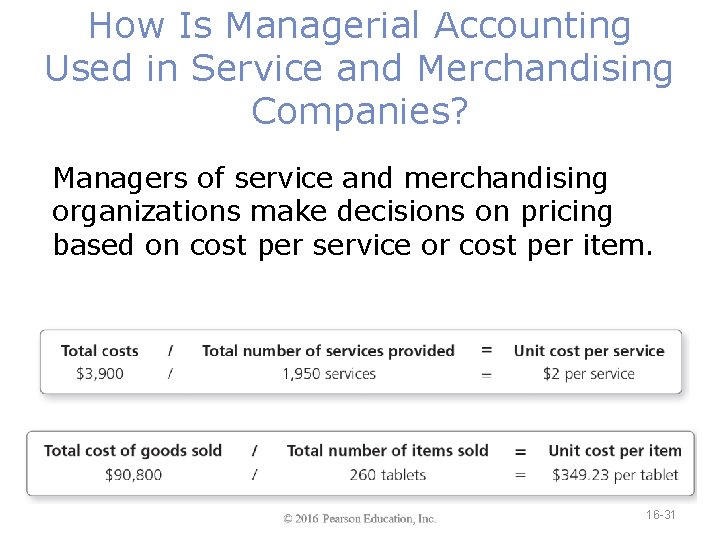
How Is Managerial Accounting Used in Service and Merchandising Companies? Managers of service and merchandising organizations make decisions on pricing based on cost per service or cost per item. 16 -31
16 -32
- Slides: 32