
Chapter 16 Internetwork Operation Routing Protocols Integrated Services
- Slides: 37
Chapter 16. Internetwork Operation • Routing Protocols • Integrated Services Architecture • Resource Reservation: RSVP • Differentiated Services 1
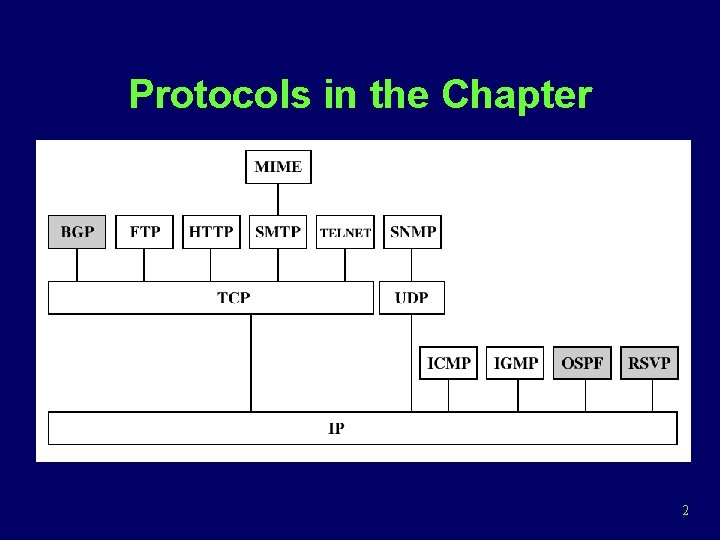
Protocols in the Chapter 2
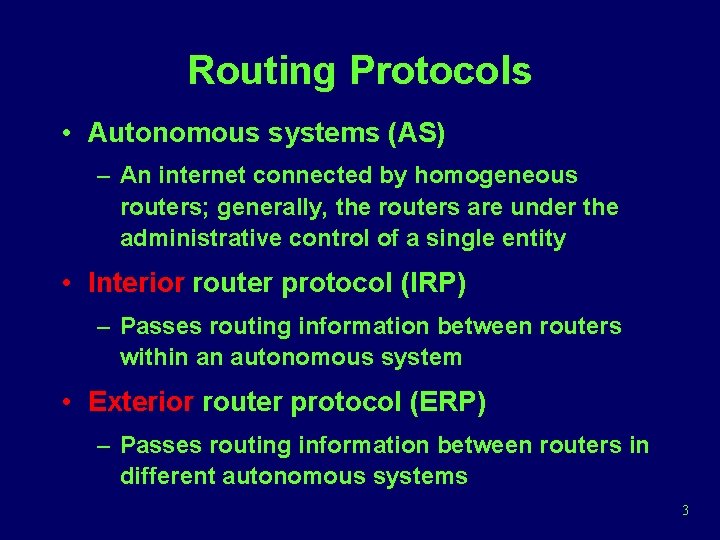
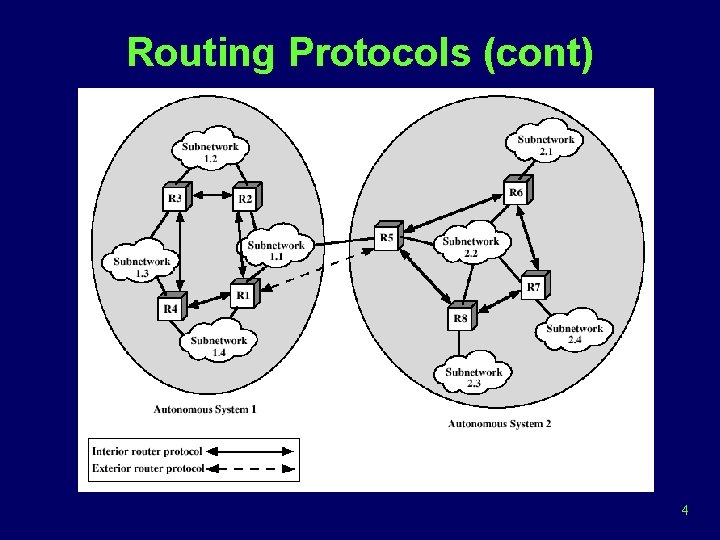
Routing Protocols • Autonomous systems (AS) – An internet connected by homogeneous routers; generally, the routers are under the administrative control of a single entity • Interior router protocol (IRP) – Passes routing information between routers within an autonomous system • Exterior router protocol (ERP) – Passes routing information between routers in different autonomous systems 3
Routing Protocols (cont) 4
Hierarchical Routing • Hosts – Maintain sufficient routing information to forward datagrams to other hosts or an interior gateway(s) that is (are) attached to the same network. (ARP) • Interior Gateways – Maintain sufficient routing information to forward datagrams to hosts or other interior gateways within the same autonomous system • Exterior Gateways – Maintain sufficient routing information to forward datagrams either to an interior gateway, if the datagram is for the same autonomous system, or to another exterior gateway, if it is not. 5
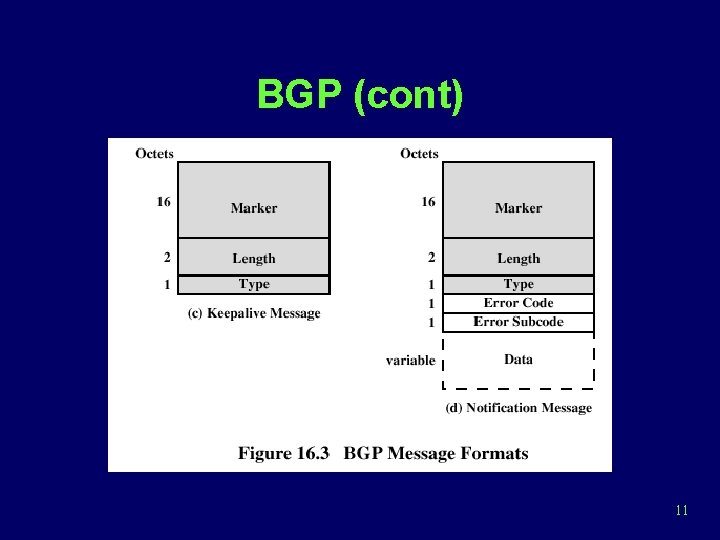
Border Gateway Protocol • Standardized exterior router protocol for the Internet (BGP-4, RFC 1771) – Allows routers (gateways) in different autonomous systems to cooperate in the exchange of routing information. – Operates in terms of messages, which are sent over TCP connections. – Message: Open, Update, Keepalive, Notification • 3 functional procedures – Neighbor acquisition, Neighbor reachability – Network reachability (Routing update) 6
BGP (cont) • Neighbor acquisition – Neighbor acquisition occurs when two neighboring routers in different autonomous systems agree to regularly exchange routing information – 1. One router sends an Open msg to another – 2. If the target router accepts the request, it returns a Keepalive msg in response 7
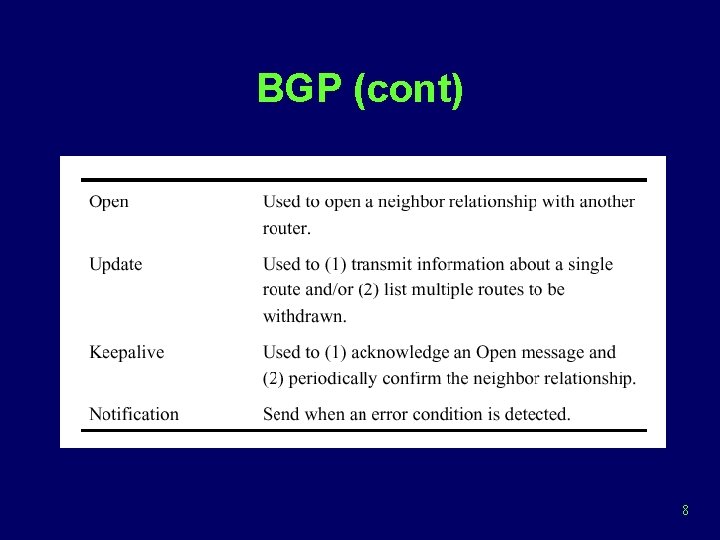
BGP (cont) 8
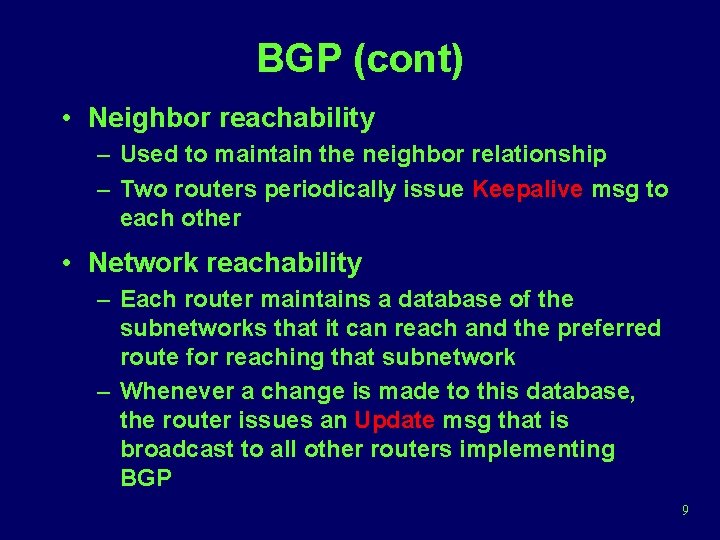
BGP (cont) • Neighbor reachability – Used to maintain the neighbor relationship – Two routers periodically issue Keepalive msg to each other • Network reachability – Each router maintains a database of the subnetworks that it can reach and the preferred route for reaching that subnetwork – Whenever a change is made to this database, the router issues an Update msg that is broadcast to all other routers implementing BGP 9
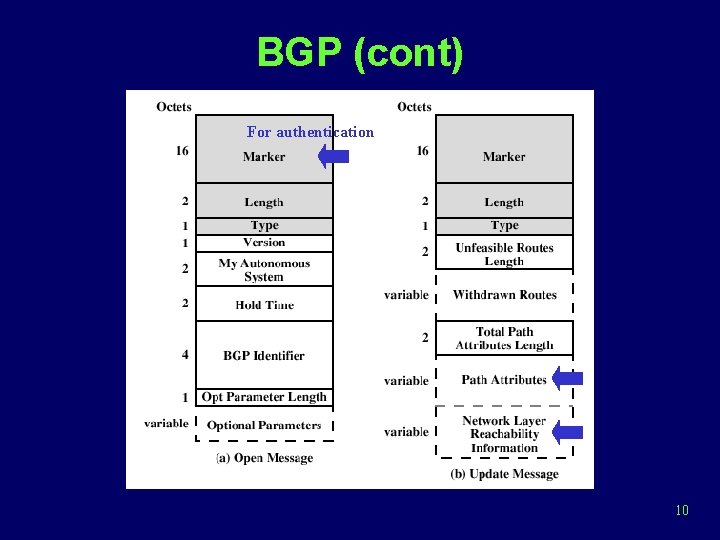
BGP (cont) For authentication 10
BGP (cont) 11
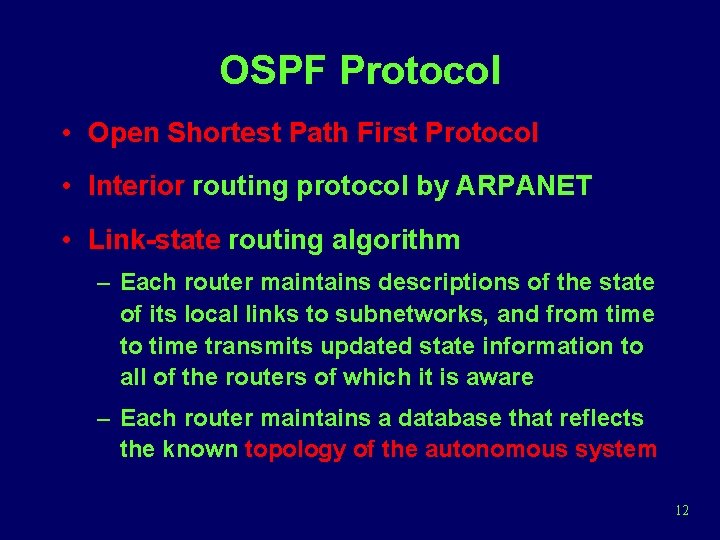
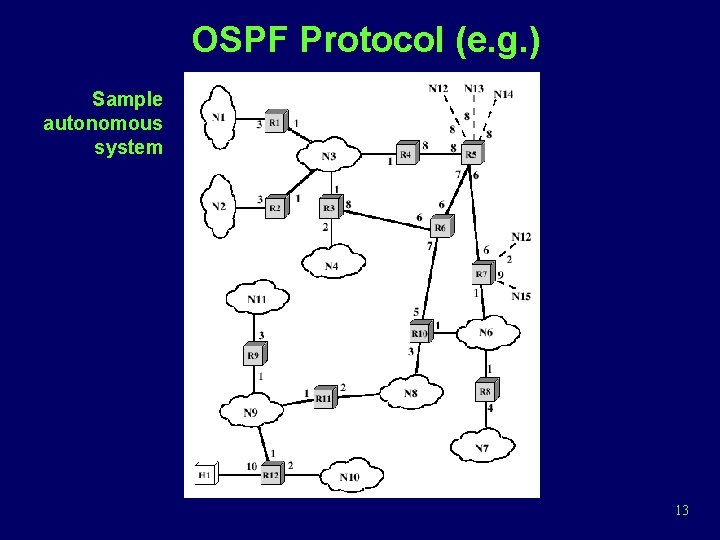
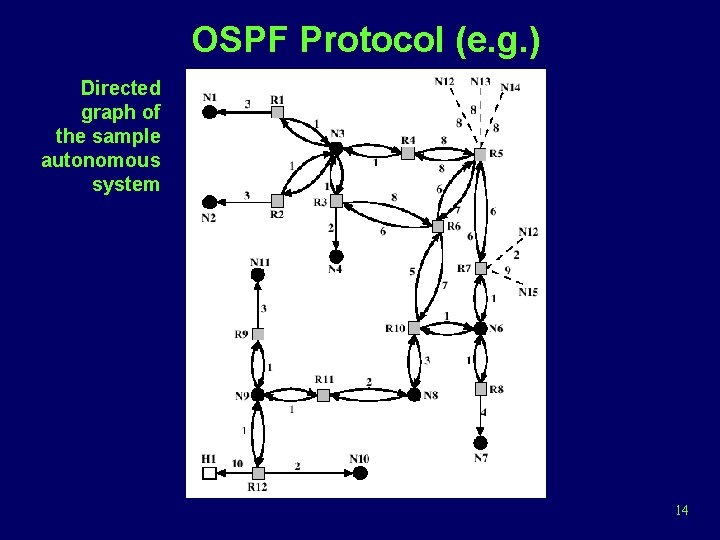
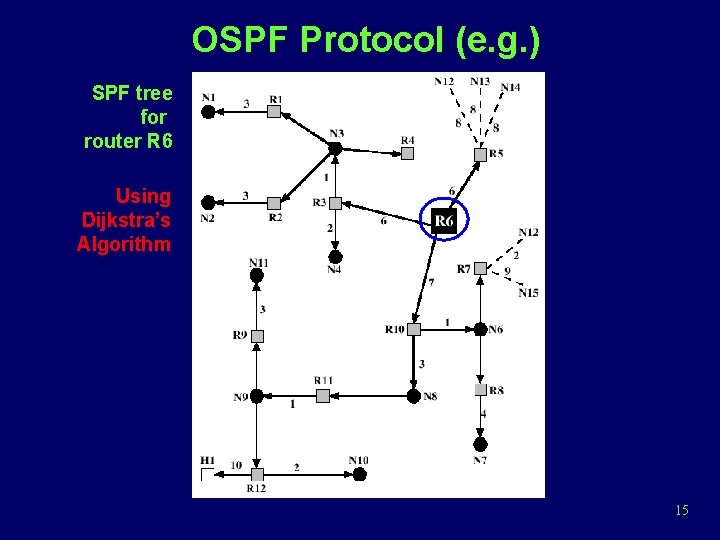
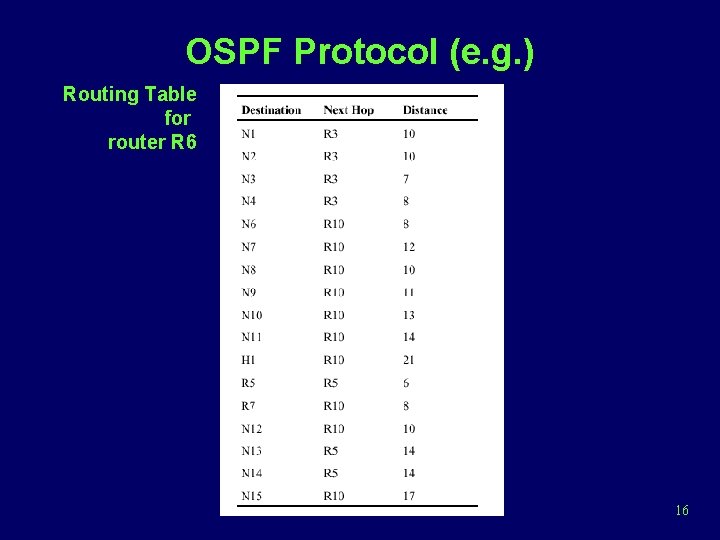
OSPF Protocol • Open Shortest Path First Protocol • Interior routing protocol by ARPANET • Link-state routing algorithm – Each router maintains descriptions of the state of its local links to subnetworks, and from time to time transmits updated state information to all of the routers of which it is aware – Each router maintains a database that reflects the known topology of the autonomous system 12
OSPF Protocol (e. g. ) Sample autonomous system 13
OSPF Protocol (e. g. ) Directed graph of the sample autonomous system 14
OSPF Protocol (e. g. ) SPF tree for router R 6 Using Dijkstra’s Algorithm 15
OSPF Protocol (e. g. ) Routing Table for router R 6 16
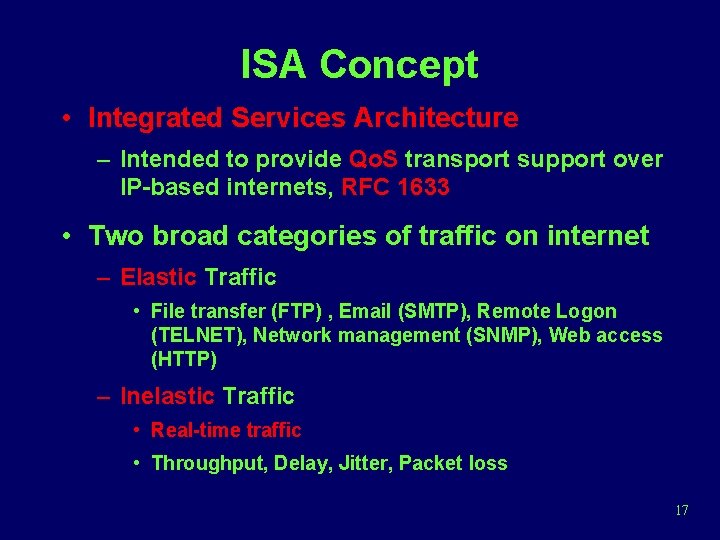
ISA Concept • Integrated Services Architecture – Intended to provide Qo. S transport support over IP-based internets, RFC 1633 • Two broad categories of traffic on internet – Elastic Traffic • File transfer (FTP) , Email (SMTP), Remote Logon (TELNET), Network management (SNMP), Web access (HTTP) – Inelastic Traffic • Real-time traffic • Throughput, Delay, Jitter, Packet loss 17
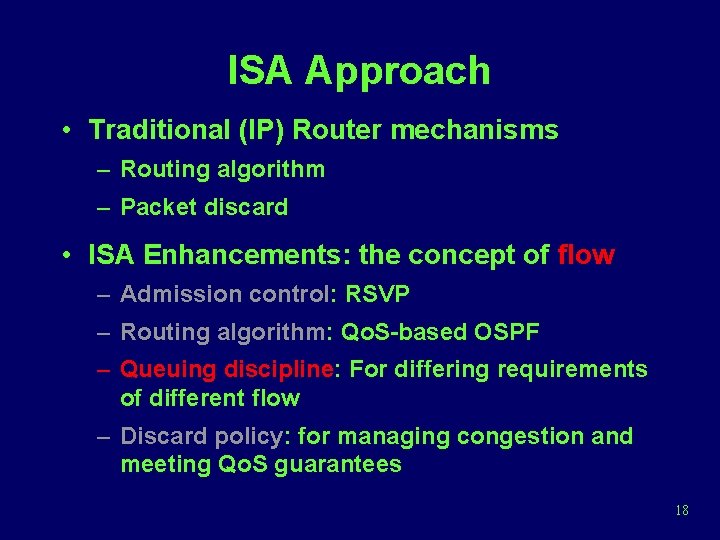
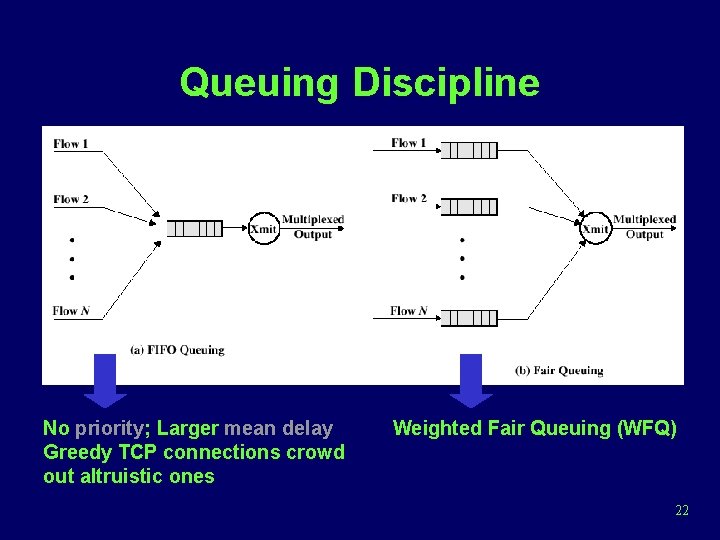
ISA Approach • Traditional (IP) Router mechanisms – Routing algorithm – Packet discard • ISA Enhancements: the concept of flow – Admission control: RSVP – Routing algorithm: Qo. S-based OSPF – Queuing discipline: For differing requirements of different flow – Discard policy: for managing congestion and meeting Qo. S guarantees 18
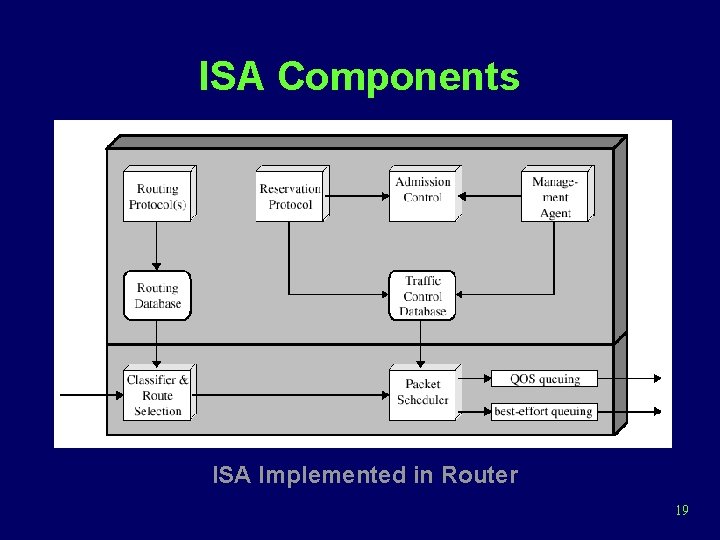
ISA Components ISA Implemented in Router 19
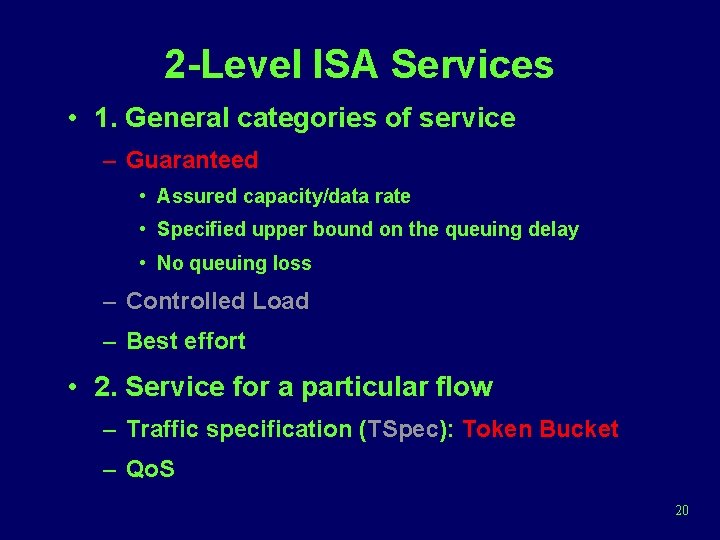
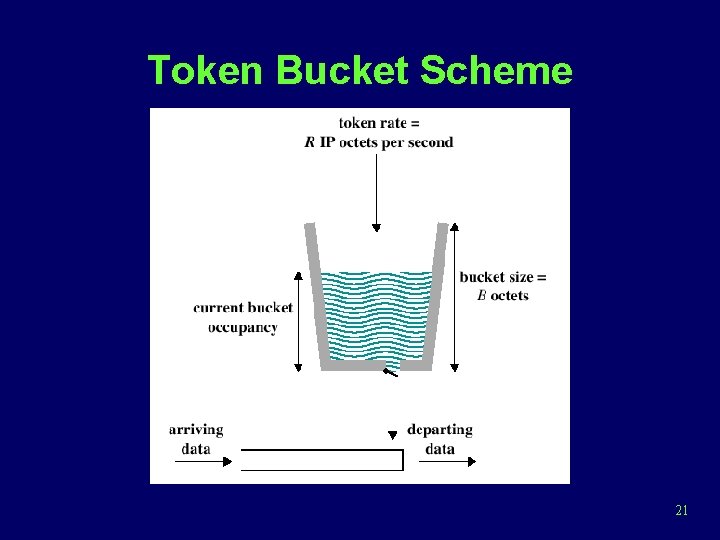
2 -Level ISA Services • 1. General categories of service – Guaranteed • Assured capacity/data rate • Specified upper bound on the queuing delay • No queuing loss – Controlled Load – Best effort • 2. Service for a particular flow – Traffic specification (TSpec): Token Bucket – Qo. S 20
Token Bucket Scheme 21
Queuing Discipline No priority; Larger mean delay Greedy TCP connections crowd out altruistic ones Weighted Fair Queuing (WFQ) 22
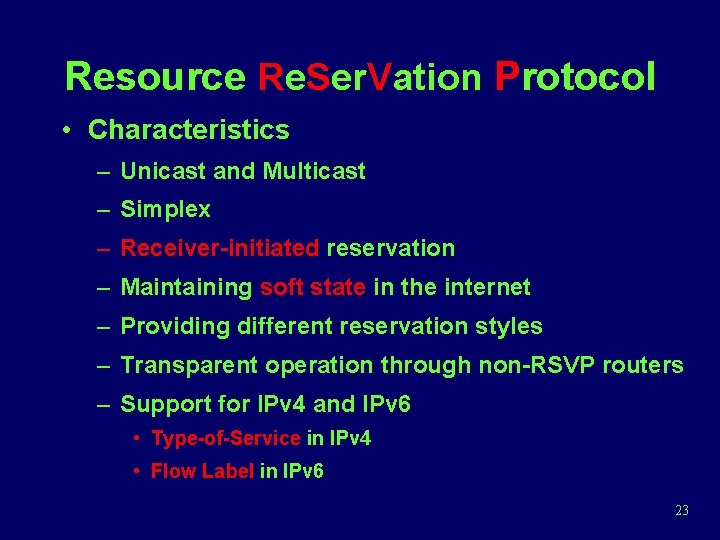
Resource Re. Ser. Vation Protocol • Characteristics – Unicast and Multicast – Simplex – Receiver-initiated reservation – Maintaining soft state in the internet – Providing different reservation styles – Transparent operation through non-RSVP routers – Support for IPv 4 and IPv 6 • Type-of-Service in IPv 4 • Flow Label in IPv 6 23
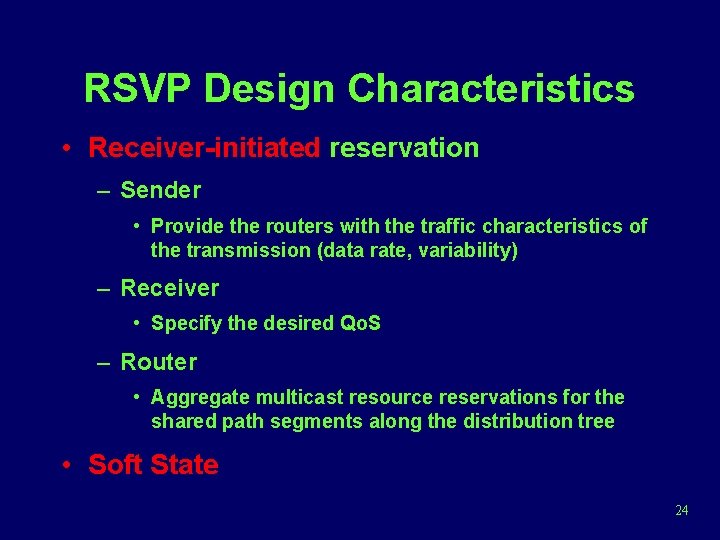
RSVP Design Characteristics • Receiver-initiated reservation – Sender • Provide the routers with the traffic characteristics of the transmission (data rate, variability) – Receiver • Specify the desired Qo. S – Router • Aggregate multicast resource reservations for the shared path segments along the distribution tree • Soft State 24
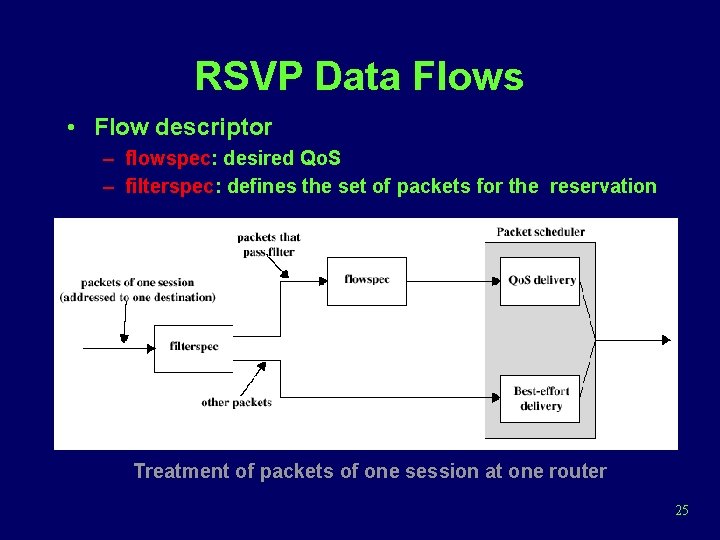
RSVP Data Flows • Flow descriptor – flowspec: desired Qo. S – filterspec: defines the set of packets for the reservation Treatment of packets of one session at one router 25
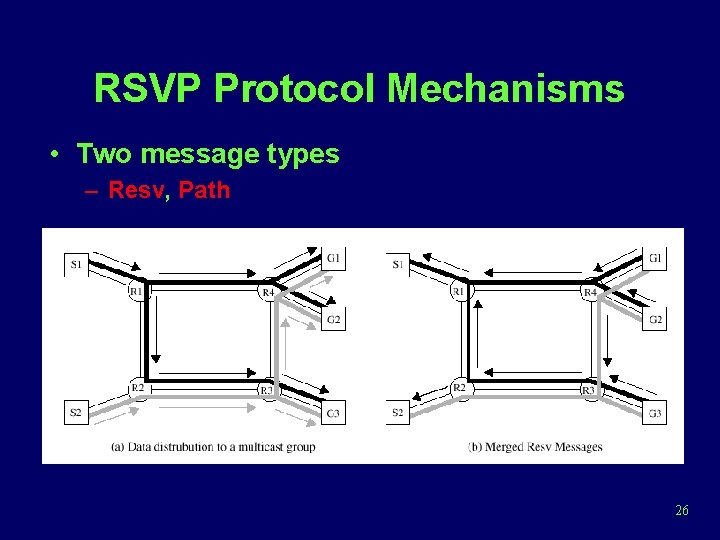
RSVP Protocol Mechanisms • Two message types – Resv, Path 26
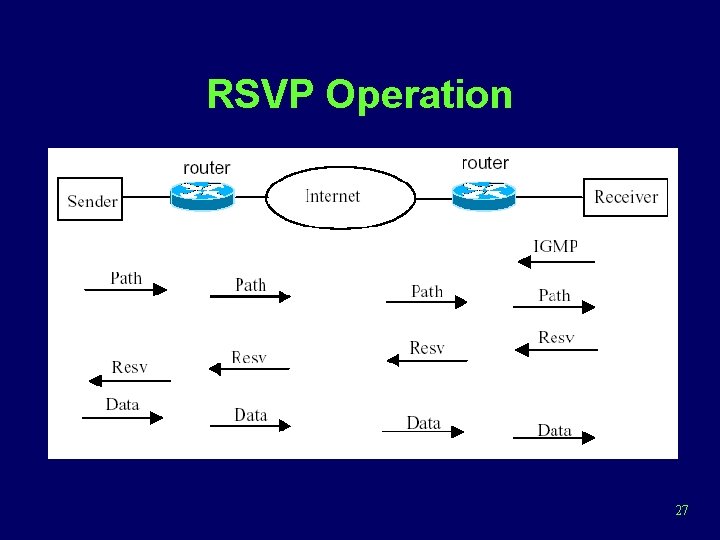
RSVP Operation 27
Differentiated Services (DS) • Goal (RFC 2475) – Provide a simple, easy-to-implement, lowoverhead tool to support a range of network services (comparing with ISA) • Key characteristics – IP packets are labeled for differing Qo. S treatment using the existing IPv 4 Type-of. Service octet or IPv 6 Traffic Class octet. Thus, no change is required to IP 28
Differentiated Service (cont) – A service level agreement (SLA) is established between the service provider (internet domain) and the customer prior to the use of DS – All traffic with the same DS octet is treated the same by the network service – Routers deal with each packet individually and do not have to save state information on packet flows 29
DS Octet • Packets are labeled for service handling by means of the DS octet • Placed in the Type of Service field of an IPv 4 header, or the Traffic Class field of the IPv 6 header • RFC 2474: The leftmost 6 bits form a DS codepoint • The DS codepoint is the DS label used to classify packets for differentiated services 30
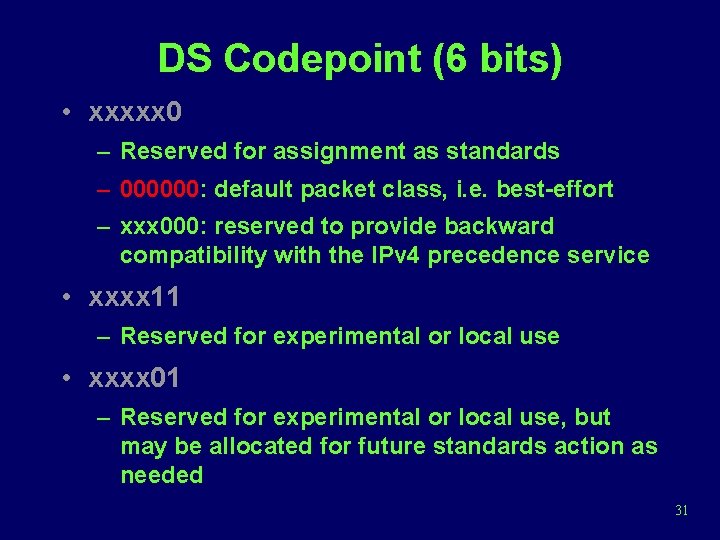
DS Codepoint (6 bits) • xxxxx 0 – Reserved for assignment as standards – 000000: default packet class, i. e. best-effort – xxx 000: reserved to provide backward compatibility with the IPv 4 precedence service • xxxx 11 – Reserved for experimental or local use • xxxx 01 – Reserved for experimental or local use, but may be allocated for future standards action as needed 31
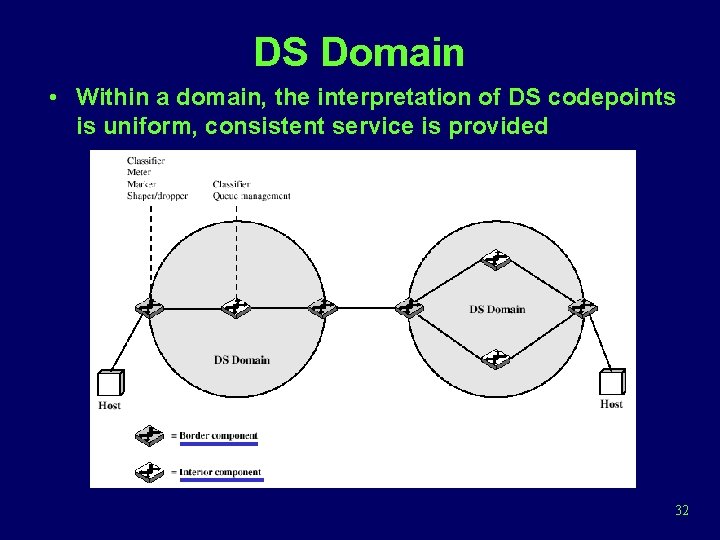
DS Domain • Within a domain, the interpretation of DS codepoints is uniform, consistent service is provided 32
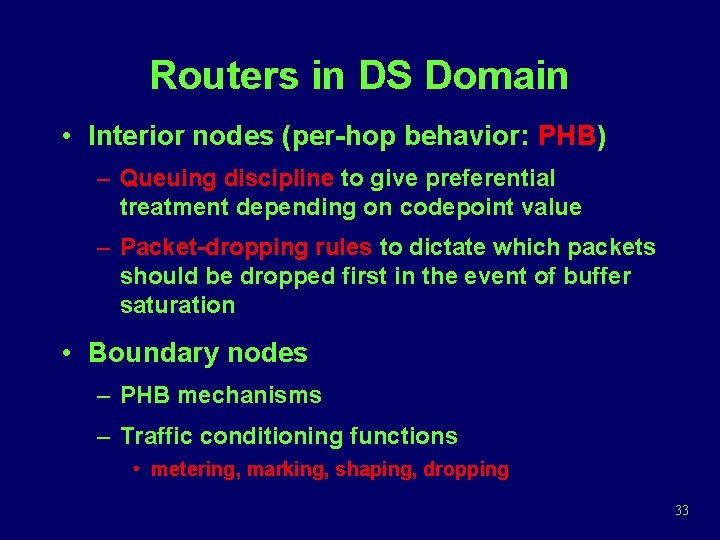
Routers in DS Domain • Interior nodes (per-hop behavior: PHB) – Queuing discipline to give preferential treatment depending on codepoint value – Packet-dropping rules to dictate which packets should be dropped first in the event of buffer saturation • Boundary nodes – PHB mechanisms – Traffic conditioning functions • metering, marking, shaping, dropping 33
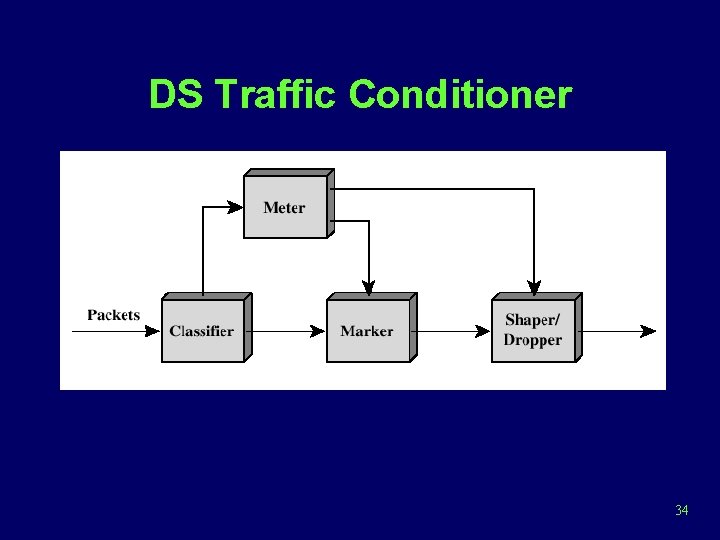
DS Traffic Conditioner 34
DS Traffic Conditioner (cont) • Classifier – Separates submitted packets into different classes – Based on the DS codepoint or on multiple fields within the packet header • Meter – Measures submitted traffic for conformance to a profile – Determines whether a given packet stream class is within or exceeds the service level guaranteed for that class 35
DS Traffic Conditioner (cont) • Marker – Polices traffic by re-marking packets with a different codepoint as needed • Shaper – Polices traffic by delaying packets as necessary so that the packet stream in a given class does not exceed the traffic rate specified in the profile for that class • Dropper – Drops packets when the rate of packets of a given class exceeds that specified in the profile for that class 36
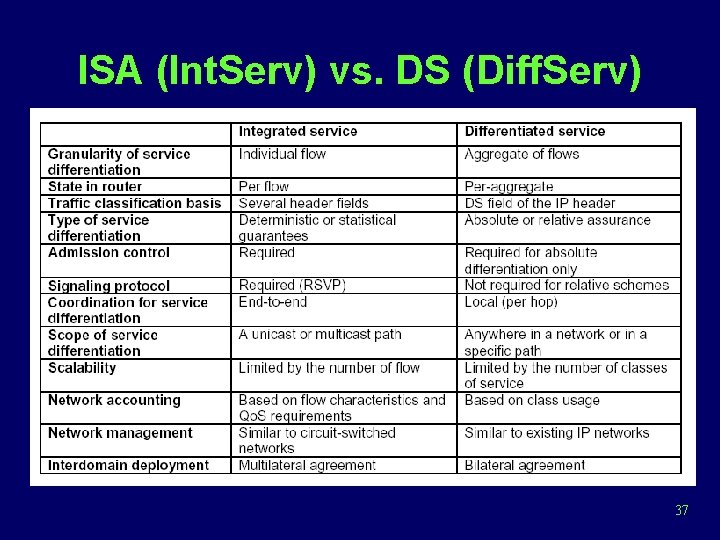
ISA (Int. Serv) vs. DS (Diff. Serv) 37