
Chapter 16 Global Strategy an Organizing Framework by

Chapter 16 “Global Strategy: an Organizing Framework by Ysanne Carlisle
Introduction • S. Ghoshal states that "organizations are not born international, they become international through specific strategic. That is, the interactions between different national markets developing economies of scale/scope. • He claims three main strategic objectives for firms operating in international markets: 1. Achieving efficiency 2. Managing risks and improving their ability to innovate 3. Learn and adopt • These three objectives are against three sources of competitive advantages: 1. national differences 2. scale economies 3. and scope economies
Introduction • Levitt (1983) “the core of a global strategy lies in developing a standardized product to be produced and sold the same way throughout the world”. • Hout et al (1982), “Exploiting economies of scale through global volume, taking pre-emptive positions through quick and large investments, and managing inter dependently to achieve synergies across different activities • Hamel and Prahalad (1985) they recommend a broad product portfolio with many product varieties, so that investments on technologies and distribution channels can be shared
The main points in the module • The module introduces an organizing framework for global strategy (to help MNC managers in reviewing and analyzing their strategies) he notes that: • The interactions between different national markets arise from actions aimed at developing attributes such as synergies and economics of scale/scope, not from natural characteristics of those markets. • Firms are different from each other not only on account of the particular markets in which they operate but also, and especially, because of their firm-specific capabilities and strategies.

Sources of competitive advantage Strategic objectives National differences Scale economies Scope economies achieving efficiency in current Benefiting from differences in factor costs-wages and cost of capital (Fiat)(Nike) Expanding and exploiting potential scale economies in each activity (Toyota) Sharing of investment and costs across products, markets and business. (Volkswagen) operations Managing risks Innovation, learning and adaptation Managing different kinds Balancing scale with Portfolio of risks arising from strategic and diversification of market or policy-induced operational flexibility. risk and creation changes in comparative of options and sideadvantages of different bets. countries Learning from societal differences in organizational and managerial processes and systems. Benefiting from experience-cost reduction and innovation Shared learning across organizational components in different products, markets or business.
• There is no right or wrong box in the matrix for a firm to operate in. different firms in a given industry might find themselves in a different box. For example, consider how different firms in the car industry differ in their ways of achieving efficiency in current operations: a firm like Toyota, which exploits the advantages of global integration through centralized production, would be placed in the first box under ‘scale economies’. Another firm, like Fiat, which takes advantages of national differentiation, would be in the first box under ‘national differences’. Some companies will find themselves in more than one box. • Note that the strategic task of managing globally is to use all three sources of competitive advantages to optimize efficiency, risk and learning simultaneously. In a world-wide business. The key to a successful global strategy is to manage the interactions between these different goals and means.
Advantages of The framework: 1. It can help managers in generating a comprehensive checklist of factors and issues that must be considered in reviewing different strategic alternatives. 2. It can highlight the contradictions between the different goals and between different means, and thereby make salient the strategic dilemmas that may otherwise get resolved through omission.
The Goals: strategic objectives Achieving efficiency • Firms competing in imperfect markets earn different 'efficiency rents' from the use of their resources (Caves, 1980). The objective of strategy, given this perspective, is to enhance such efficiency rents. Viewing a firm broadly as an input-output, the overall efficiency of the firm can be defined as the ratio of the value of its outputs to the costs of all its inputs. The field of strategic management is currently dominated by this efficiency perspective. • In the field of global strategy this efficiency perspective has been reflected in the widespread use of the integrationresponsiveness framework. The framework is a conceptual lens for visualizing the cost advantages of global integration of certain tasks in relation to the differentiation benefits of responding to national differences in tastes, industry structures, distribution systems, and government regulations.
The Goals: strategic objectives Managing risks MNC may face four different types of risk: 1. Macroeconomic risks: non-diversifiable, such as wars and natural climates (completely outside the firm’s control). 2. Political (policy) risks: risks that arise from policy actions of national government (at least partially controllable). 3. Competitive risks: arising from the uncertainties of competitors’ responses to its strategies, such as technological risk. 4. Resource risks: the risk that the adopted strategy will require resources that the firm does not have, cannot acquire. • The strategic task is to consider these different kinds of risks jointly in the context of particular strategic decision. However, it is only those risks which cannot be diversified that are of concern at the strategic level.
The Goals: strategic objectives Innovation, learning and adoption • A key asset of the MNC is the diversity of environments in which it operates. This diversity allows it to develop diverse capabilities, and provides it with a broader learning opportunity than is available to a purely domestic firm. • However, the simple existence of diversity does not enhance learning. It only creates the potential for learning. To exploit this potential, the organization must consider learning as explicit objective, and must create mechanisms and systems for such learning to take place.
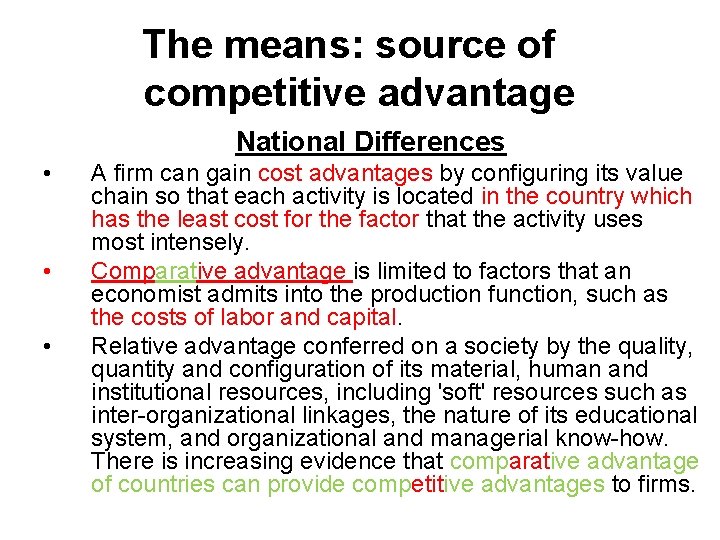
The means: source of competitive advantage National Differences • • • A firm can gain cost advantages by configuring its value chain so that each activity is located in the country which has the least cost for the factor that the activity uses most intensely. Comparative advantage is limited to factors that an economist admits into the production function, such as the costs of labor and capital. Relative advantage conferred on a society by the quality, quantity and configuration of its material, human and institutional resources, including 'soft' resources such as inter-organizational linkages, the nature of its educational system, and organizational and managerial know-how. There is increasing evidence that comparative advantage of countries can provide competitive advantages to firms.
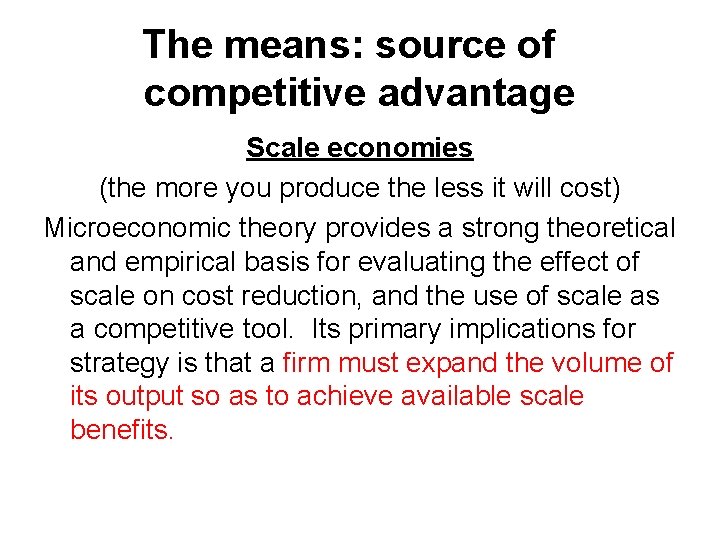
The means: source of competitive advantage Scale economies (the more you produce the less it will cost) Microeconomic theory provides a strong theoretical and empirical basis for evaluating the effect of scale on cost reduction, and the use of scale as a competitive tool. Its primary implications for strategy is that a firm must expand the volume of its output so as to achieve available scale benefits.
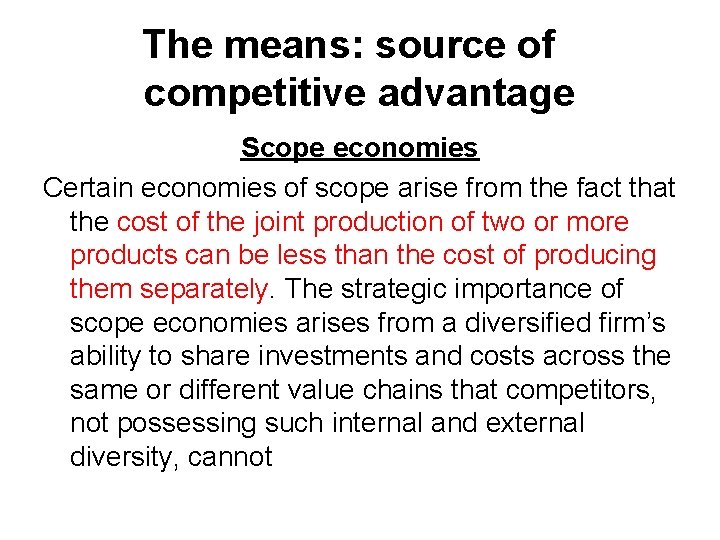
The means: source of competitive advantage Scope economies Certain economies of scope arise from the fact that the cost of the joint production of two or more products can be less than the cost of producing them separately. The strategic importance of scope economies arises from a diversified firm’s ability to share investments and costs across the same or different value chains that competitors, not possessing such internal and external diversity, cannot
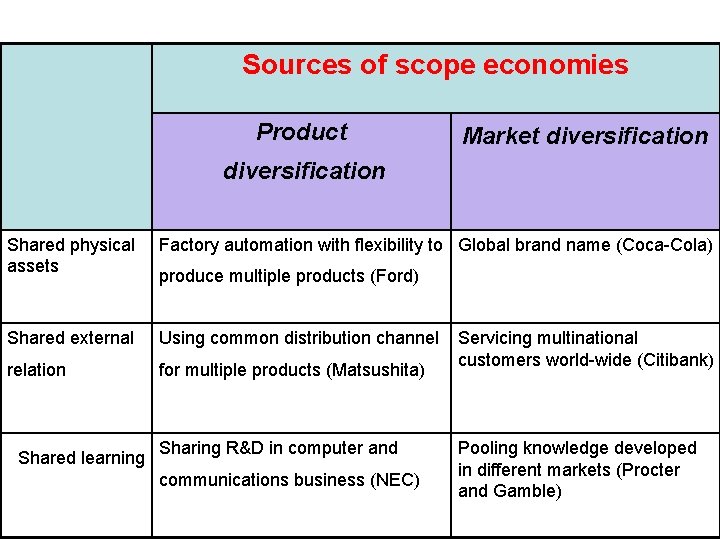
Sources of scope economies Product Market diversification Shared physical assets Factory automation with flexibility to Global brand name (Coca-Cola) Shared external Using common distribution channel relation for multiple products (Matsushita) Shared learning produce multiple products (Ford) Sharing R&D in computer and communications business (NEC) Servicing multinational customers world-wide (Citibank) Pooling knowledge developed in different markets (Procter and Gamble)
Chapter 18 “Global Strategy in the Twenty. First Century” by George S. Yip
Introduction • G. Yib talks about when a home country competency become less important, while global is the most relevant in the 'information age' where internet-based 'new economy' is the ideal model • This chapter looks at different ways in which a company can become global in which networks and alliances between firms are very important. • The main point in this chapter is that globalization occurs via the link between strategy and organization.
Overall global strategy and organizational forms • Today, multinational companies can take one of the three main forms : 1. Internationalist 2. Federalist 3. Or global maximizer
The internationalist • • • It is a home business that have spread internationally such as Chrysler. Home market activities dominate and foreign activities are often opportunistic, without too much investment and adaptation. Some companies are stuck in this from because they compete in regulated industries that allow only limited internationalization such as defense
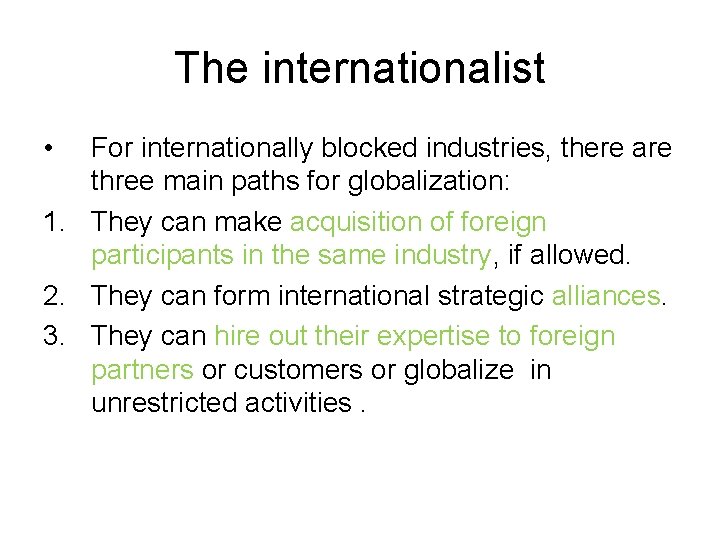
The internationalist • For internationally blocked industries, there are three main paths for globalization: 1. They can make acquisition of foreign participants in the same industry, if allowed. 2. They can form international strategic alliances. 3. They can hire out their expertise to foreign partners or customers or globalize in unrestricted activities.
The Federalist • This is the classical MNCs form. In this model each international subsidiary operates most, if not all, of the value chain, and has considerable autonomy. The home market becomes just another country and the head office primarily a holding company
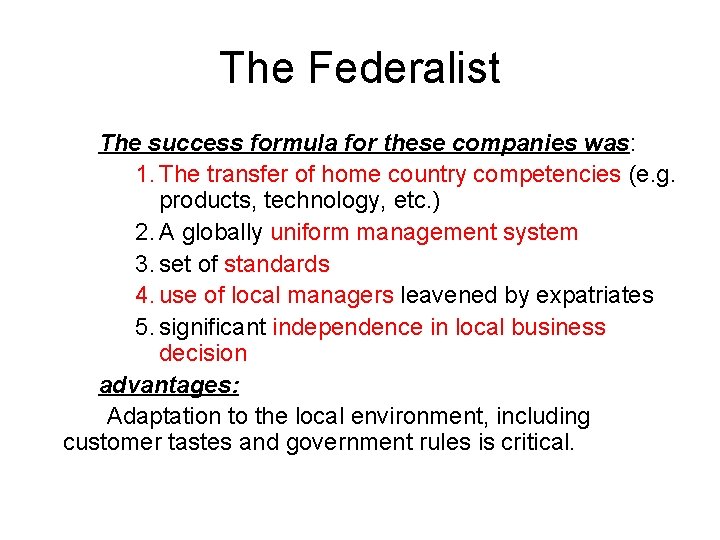
The Federalist The success formula for these companies was: 1. The transfer of home country competencies (e. g. products, technology, etc. ) 2. A globally uniform management system 3. set of standards 4. use of local managers leavened by expatriates 5. significant independence in local business decision advantages: Adaptation to the local environment, including customer tastes and government rules is critical.
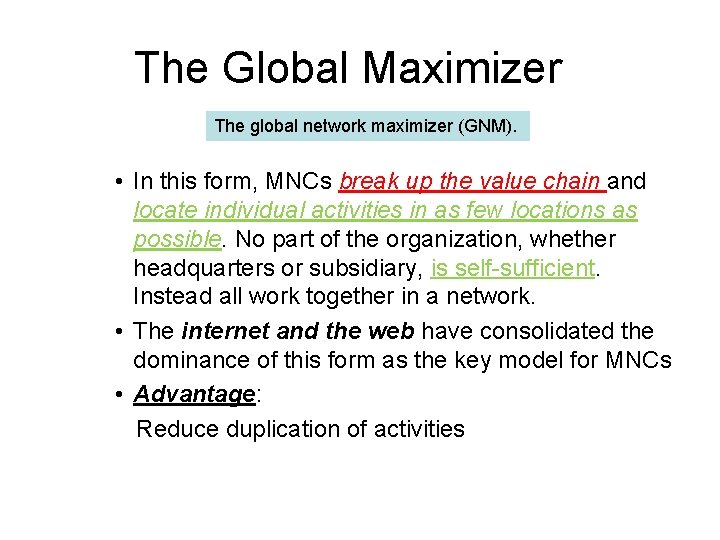
The Global Maximizer The global network maximizer (GNM). • In this form, MNCs break up the value chain and locate individual activities in as few locations as possible. No part of the organization, whether headquarters or subsidiary, is self-sufficient. Instead all work together in a network. • The internet and the web have consolidated the dominance of this form as the key model for MNCs • Advantage: Reduce duplication of activities
Globalization of individual activities • Global R&D: means being able to access new knowledge and capabilities anywhere in the world and develop globally appealing products that can be produced on a globally competitive basis • Global products and services: the output of global R&D should be global products, but these are rarely totally standardized worldwide. Instead, such products are designed with global markets in mind, and they have as large a common core as possible • Global logistics: the challenge for global companies to deliver their intermediate and final products anywhere in the world in a cost-effective and timely manner. (Such as Fed. Ex, DHL )
Globalization of individual activities • Global marketing and selling: the appropriate balance of global uniformity and local adaptation in all elements of the marketing mix, but with a probable bias in a favor of uniformity, unless a good case can be made for local exceptions. (Mc Donald) • Global customer service: customers require service anytime, anywhere (retail bank, Citibank, ATMs, HP ) • Global capital & financial management: MNCs seek to diversify their shareholders bases geographically by listing on multiple exchanges and doing other things to encourage foreign shareholders. Adv. (increase demand for the company’s shares).
Globalization of individual activities • 1. 2. 3. • • Global HRM: In the internationalist model companies tend to rely on expatriates. In the federalist model they aim to have as many as local managers as possible. The GNM model requires a balance of global, regional, and national managers. Global governance and leadership: means getting the best top executive and board members from anywhere in the world Global sourcing and production: It have to reconcile several conflicting objectives: cost, productivity, quality, reliability, protection of expertise, and trade barriers
Globalization of individual activities Global companies need to invest in building a portfolio of the necessary capabilities, not just in technical or business terms, but in terms of languages and cultural capabilities and types of international experience.
The global challenge • MNCs need to be globally excellent in nearly every activity, and find the right balance of global, regional, and national solutions. Beiersdorf said that “As global as possible, As local as necessary”. That is the global company does not have to be every where, but it has the capability to go anywhere, deploy any assets, and access any resources, and it maximizes profits on a global basis
The global challenge Network enterprise specific from of enterprise whose system of means is constituted by the intersection of segments of autonomous systems of goals. Thus, the components of the network are both autonomous and dependent vis-à-vis the network, and may be a part of other networks, and therefore of other systems of means aimed at other goals.
The global challenge Network enterprise • The performance of a given network will then depend on two fundamental attributes of the network: – Its connectedness: its structural ability to facilitate noise-free communication between its components. – Its consistency: the extent to which there is sharing of interests between the network’s goals and the goals of its components.
- Slides: 29