
CHAPTER 16 Externalities Public Goods and Social Choice
CHAPTER 16 Externalities, Public Goods, and Social Choice Power. Point Lectures for Principles of Economics, 9 e ; ; By Karl E. Case, Ray C. Fair & Sharon M. Oster © 2009 Pearson Education, Inc. Publishing as Prentice Hall Principles of Economics 9 e by Case, Fair and Oster 1 of 49

CHAPTER 16 Externalities, Public Goods, and Social Choice © 2009 Pearson Education, Inc. Publishing as Prentice Hall Principles of Economics 9 e by Case, Fair and Oster 2 of 49
PART III MARKET IMPERFECTIONS AND THE ROLE OF GOVERNMENT 16 Externalities, Public Goods, and Social Choice Prepared by: Fernando & Yvonn Quijano © 2009 Pearson Education, Inc. Publishing as Prentice Hall Principles of Economics 9 e by Case, Fair and Oster

PART III MARKET IMPERFECTIONS AND CHAPTER 16 Externalities, Public Goods, and Social Choice THE ROLE OF GOVERNMENT Externalities, Public Goods, and Social Choice 16 CHAPTER OUTLINE Externalities and Environmental Economics Marginal Social Cost and Marginal-Cost Pricing Private Choices and External Effects Internalizing Externalities Public (Social) Goods The Characteristics of Public Goods Income Distribution as a Public Good? Public Provision of Public Goods Optimal Provision of Public Goods Local Provision of Public Goods: Tiebout Hypothesis Mixed Goods Social Choice The Voting Paradox Government Inefficiency: Theory of Public Choice Rent-Seeking Revisited Government and the Market © 2009 Pearson Education, Inc. Publishing as Prentice Hall Principles of Economics 9 e by Case, Fair and Oster 4 of 49

Externalities, Public Goods, and Social Choice CHAPTER 16 Externalities, Public Goods, and Social Choice market failure Occurs when resources are misallocated or allocated inefficiently. Externalities and Environmental Economics externality A cost or benefit imposed or bestowed on an individual or a group that is outside, or external to, the transaction. © 2009 Pearson Education, Inc. Publishing as Prentice Hall Principles of Economics 9 e by Case, Fair and Oster 5 of 49
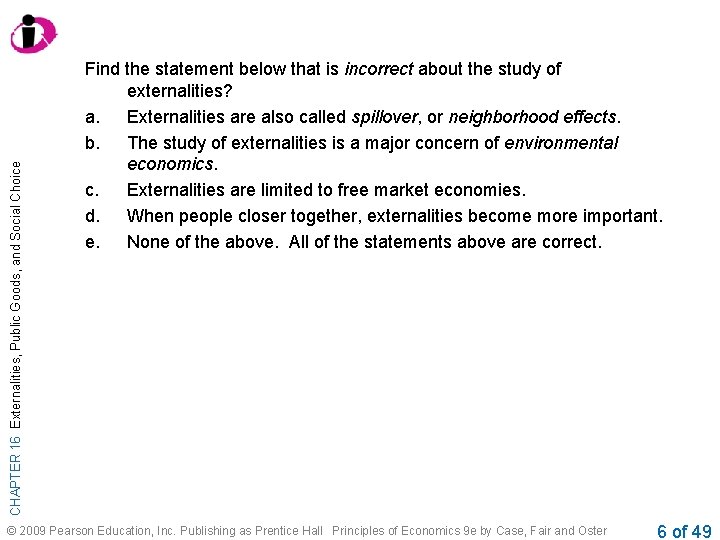
CHAPTER 16 Externalities, Public Goods, and Social Choice Find the statement below that is incorrect about the study of externalities? a. Externalities are also called spillover, or neighborhood effects. b. The study of externalities is a major concern of environmental economics. c. Externalities are limited to free market economies. d. When people closer together, externalities become more important. e. None of the above. All of the statements above are correct. © 2009 Pearson Education, Inc. Publishing as Prentice Hall Principles of Economics 9 e by Case, Fair and Oster 6 of 49
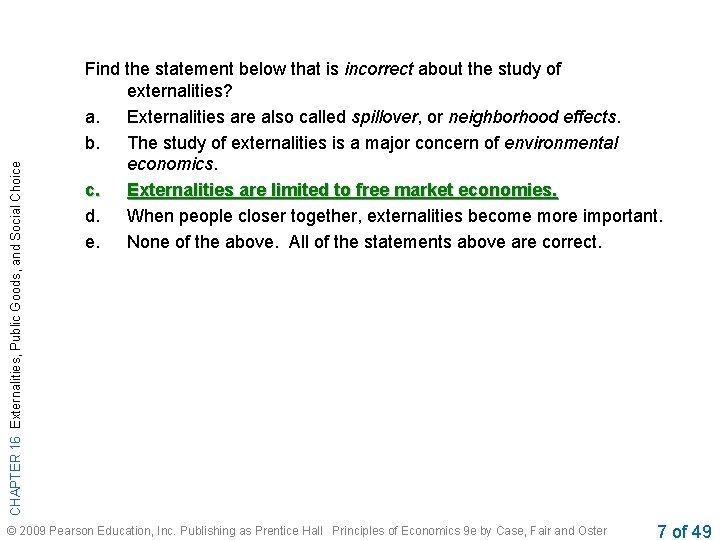
CHAPTER 16 Externalities, Public Goods, and Social Choice Find the statement below that is incorrect about the study of externalities? a. Externalities are also called spillover, or neighborhood effects. b. The study of externalities is a major concern of environmental economics. c. Externalities are limited to free market economies. d. When people closer together, externalities become more important. e. None of the above. All of the statements above are correct. © 2009 Pearson Education, Inc. Publishing as Prentice Hall Principles of Economics 9 e by Case, Fair and Oster 7 of 49
Externalities and Environmental Economics CHAPTER 16 Externalities, Public Goods, and Social Choice Marginal Social Cost and Marginal-Cost Pricing marginal social cost (MSC) The total cost to society of producing an additional unit of a good or service. MSC is equal to the sum of the marginal costs of producing the product and the correctly measured damage costs involved in the process of production. © 2009 Pearson Education, Inc. Publishing as Prentice Hall Principles of Economics 9 e by Case, Fair and Oster 8 of 49
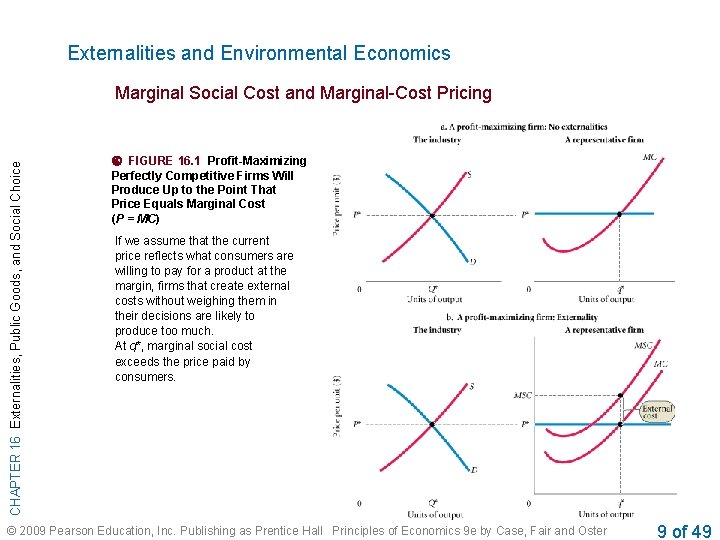
Externalities and Environmental Economics CHAPTER 16 Externalities, Public Goods, and Social Choice Marginal Social Cost and Marginal-Cost Pricing FIGURE 16. 1 Profit-Maximizing Perfectly Competitive Firms Will Produce Up to the Point That Price Equals Marginal Cost (P = MC) If we assume that the current price reflects what consumers are willing to pay for a product at the margin, firms that create external costs without weighing them in their decisions are likely to produce too much. At q*, marginal social cost exceeds the price paid by consumers. © 2009 Pearson Education, Inc. Publishing as Prentice Hall Principles of Economics 9 e by Case, Fair and Oster 9 of 49

CHAPTER 16 Externalities, Public Goods, and Social Choice For every unit produced beyond the level at which P = MC: a. Society uses up resources that have a value (or cost) in excess of the benefits that consumers place on that unit. b. Society uses up resources that have a value (or cost) that is less than the benefits that consumers place on that unit. c. Society begins to enjoy the benefits of additional production. d. Society stops enjoying the benefits of additional production. © 2009 Pearson Education, Inc. Publishing as Prentice Hall Principles of Economics 9 e by Case, Fair and Oster 10 of
CHAPTER 16 Externalities, Public Goods, and Social Choice For every unit produced beyond the level at which P = MC: a. Society uses up resources that have a value (or cost) in excess of the benefits that consumers place on that unit. b. Society uses up resources that have a value (or cost) that is less than the benefits that consumers place on that unit. c. Society begins to enjoy the benefits of additional production. d. Society stops enjoying the benefits of additional production. © 2009 Pearson Education, Inc. Publishing as Prentice Hall Principles of Economics 9 e by Case, Fair and Oster 11 of
Externalities and Environmental Economics Marginal Social Cost and Marginal-Cost Pricing CHAPTER 16 Externalities, Public Goods, and Social Choice Acid Rain and the Clean Air Act Acid rain is an excellent example of an externality and of the issues and conflicts involved in dealing with externalities. The case of acid rain highlights the fact that efficiency analysis ignores the distribution of gains and losses. That is, to establish efficiency, we need only demonstrate that the total value of the gains exceeds the total value of the losses. © 2009 Pearson Education, Inc. Publishing as Prentice Hall Principles of Economics 9 e by Case, Fair and Oster 12 of
Externalities and Environmental Economics Marginal Social Cost and Marginal-Cost Pricing CHAPTER 16 Externalities, Public Goods, and Social Choice Other Externalities Other examples of external effects are all around us. When people drive their cars into the center of the city at rush hour, they contribute to the congestion and impose costs (in the form of lost time and auto emissions) on others. Clearly, the most significant and hotly debated issue of externalities is global warming. © 2009 Pearson Education, Inc. Publishing as Prentice Hall Principles of Economics 9 e by Case, Fair and Oster 13 of
Externalities and Environmental Economics Marginal Social Cost and Marginal-Cost Pricing CHAPTER 16 Externalities, Public Goods, and Social Choice Some Examples of Positive Externalities Thus far we have described a series of negative externalities. But externalities can also be positive. In some cases, when other people or firms engage in an activity, there are side benefits from that activity. From an economics perspective, there are problems with positive externalities as well. The problem with positive externalities is that the individuals in charge have too little incentive to engage in the activity. © 2009 Pearson Education, Inc. Publishing as Prentice Hall Principles of Economics 9 e by Case, Fair and Oster 14 of

Externalities and Environmental Economics CHAPTER 16 Externalities, Public Goods, and Social Choice Private Choices and External Effects FIGURE 16. 2 Externalities in a College Dormitory The marginal benefits to Harry exceed the marginal costs he must bear to play his stereo system for a period of up to 8 hours. When the stereo is playing, a cost is being imposed on Jake. When we add the costs borne by Harry to the damage costs imposed on Jake, we get the full cost of the stereo to the twoperson society made up of Harry and Jake. Playing the stereo more than 5 hours is inefficient because the benefits to Harry are less than the social cost for every hour above 5. If Harry considers only his private costs, he will play the stereo for too long a time from society’s point of view. © 2009 Pearson Education, Inc. Publishing as Prentice Hall Principles of Economics 9 e by Case, Fair and Oster 15 of
Externalities and Environmental Economics CHAPTER 16 Externalities, Public Goods, and Social Choice Private Choices and External Effects marginal private cost (MPC) The amount that a consumer pays to consume an additional unit of a particular good. marginal damage cost (MDC) The additional harm done by increasing the level of an externality -producing activity by 1 unit. If producing product X pollutes the water in a river, MDC is the additional cost imposed by the added pollution that results from increasing output by 1 unit of X period. © 2009 Pearson Education, Inc. Publishing as Prentice Hall Principles of Economics 9 e by Case, Fair and Oster 16 of
CHAPTER 16 Externalities, Public Goods, and Social Choice In the case of a negative externality, the socially efficient level of output is set where marginal benefit equals: a. Marginal social cost. b. Marginal private cost. c. Marginal damage cost. d. Marginal cost. © 2009 Pearson Education, Inc. Publishing as Prentice Hall Principles of Economics 9 e by Case, Fair and Oster 17 of
CHAPTER 16 Externalities, Public Goods, and Social Choice In the case of a negative externality, the socially efficient level of output is set where marginal benefit equals: a. Marginal social cost. b. Marginal private cost. c. Marginal damage cost. d. Marginal cost. © 2009 Pearson Education, Inc. Publishing as Prentice Hall Principles of Economics 9 e by Case, Fair and Oster 18 of
Externalities and Environmental Economics CHAPTER 16 Externalities, Public Goods, and Social Choice Internalizing Externalities Five approaches have been taken to solving the problem of externalities: (1) (2) (3) (4) government imposed taxes and subsidies, private bargaining and negotiation, legal rules and procedures, sale or auctioning of rights to impose externalities, and (5) direct government regulation. While each is best suited for a different set of circumstances, all five provide decision makers with an incentive to weigh the external effects of their decisions. © 2009 Pearson Education, Inc. Publishing as Prentice Hall Principles of Economics 9 e by Case, Fair and Oster 19 of
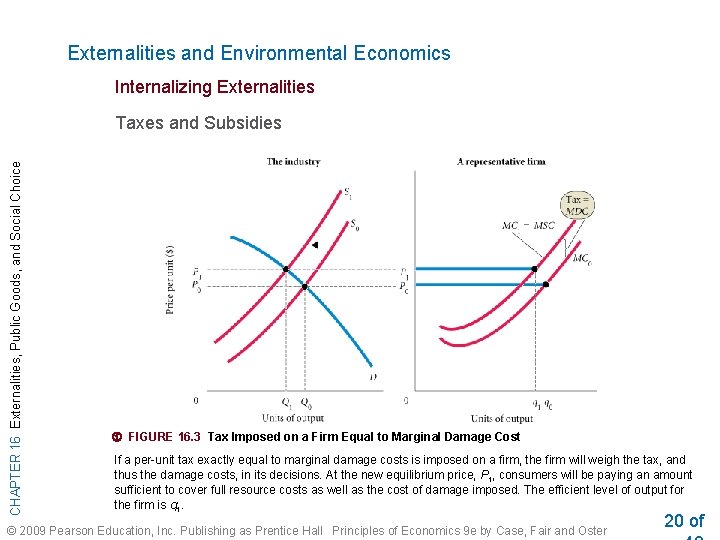
Externalities and Environmental Economics Internalizing Externalities CHAPTER 16 Externalities, Public Goods, and Social Choice Taxes and Subsidies FIGURE 16. 3 Tax Imposed on a Firm Equal to Marginal Damage Cost If a per-unit tax exactly equal to marginal damage costs is imposed on a firm, the firm will weigh the tax, and thus the damage costs, in its decisions. At the new equilibrium price, P 1, consumers will be paying an amount sufficient to cover full resource costs as well as the cost of damage imposed. The efficient level of output for the firm is q 1. © 2009 Pearson Education, Inc. Publishing as Prentice Hall Principles of Economics 9 e by Case, Fair and Oster 20 of
CHAPTER 16 Externalities, Public Goods, and Social Choice When a tax is used to internalize an externality, the tax should be set equal to: a. Marginal social cost. b. Marginal private cost. c. Marginal damage cost. d. Marginal cost. © 2009 Pearson Education, Inc. Publishing as Prentice Hall Principles of Economics 9 e by Case, Fair and Oster 21 of
CHAPTER 16 Externalities, Public Goods, and Social Choice When a tax is used to internalize an externality, the tax should be set equal to: a. Marginal social cost. b. Marginal private cost. c. Marginal damage cost. d. Marginal cost. © 2009 Pearson Education, Inc. Publishing as Prentice Hall Principles of Economics 9 e by Case, Fair and Oster 22 of

Externalities and Environmental Economics Internalizing Externalities CHAPTER 16 Externalities, Public Goods, and Social Choice Taxes and Subsidies Measuring Damages The biggest problem with using taxes and subsidies is that damages must be estimated in financial terms. © 2009 Pearson Education, Inc. Publishing as Prentice Hall Principles of Economics 9 e by Case, Fair and Oster 23 of

Externalities and Environmental Economics Internalizing Externalities CHAPTER 16 Externalities, Public Goods, and Social Choice Taxes and Subsidies Reducing Damages to an Efficient Level Taxes also provide firms with an incentive to use the most efficient technology for dealing with damage. The Incentive to Take Care and to Avoid Harm You should understand that all externalities involve at least two parties and that it is not always clear which party is “causing” the damage. © 2009 Pearson Education, Inc. Publishing as Prentice Hall Principles of Economics 9 e by Case, Fair and Oster 24 of

Externalities and Environmental Economics Internalizing Externalities CHAPTER 16 Externalities, Public Goods, and Social Choice Taxes and Subsidies Subsidizing External Benefits Sometimes activities or decisions generate external benefits instead of costs. Externalities Are All Around Us Abominable Snowmen: The War on Lawn Decorations Wall Street Journal © 2009 Pearson Education, Inc. Publishing as Prentice Hall Principles of Economics 9 e by Case, Fair and Oster 25 of

Externalities and Environmental Economics Internalizing Externalities CHAPTER 16 Externalities, Public Goods, and Social Choice Bargaining and Negotiation Coase theorem Under certain conditions, when externalities are present, private parties can arrive at the efficient solution without government involvement. Legal Rules and Procedures injunction A court order forbidding the continuation of behavior that leads to damages. liability rules Laws that require A to compensate B for damages imposed. © 2009 Pearson Education, Inc. Publishing as Prentice Hall Principles of Economics 9 e by Case, Fair and Oster 26 of
CHAPTER 16 Externalities, Public Goods, and Social Choice According to the Coase theorem, in order to arrive at an efficient solution to an externality problem associated with a given activity: a. No party should be given the right to that activity prior to negotiation; otherwise, that party would have no incentive to bargain. b. The right to an activity must be decided during the negotiation process. c. It doesn’t matter which party is initially assigned the right to that activity. d. Both parties must feel that they have equal rights to the activity prior to negotiation. © 2009 Pearson Education, Inc. Publishing as Prentice Hall Principles of Economics 9 e by Case, Fair and Oster 27 of
CHAPTER 16 Externalities, Public Goods, and Social Choice According to the Coase theorem, in order to arrive at an efficient solution to an externality problem associated with a given activity: a. No party should be given the right to that activity prior to negotiation; otherwise, that party would have no incentive to bargain. b. The right to an activity must be decided during the negotiation process. c. It doesn’t matter which party is initially assigned the right to that activity. d. Both parties must feel that they have equal rights to the activity prior to negotiation. © 2009 Pearson Education, Inc. Publishing as Prentice Hall Principles of Economics 9 e by Case, Fair and Oster 28 of

Externalities and Environmental Economics Internalizing Externalities CHAPTER 16 Externalities, Public Goods, and Social Choice Selling or Auctioning Pollution Rights TABLE 16. 1 Permit Trading Firm A Reduction of MC of reducing TC of reducing pollution by Firm A pollution for (in units of pollution) Firm A Firm B Reduction of MC of reducing TC of reducing pollution by Firm B pollution for Firm pollution for (in units of pollution) B Firm B 1 $ 5 1 $ 8 2 7 12 2 14 22 3 9 21 3 23 45 4 12 33 4 35 80 5 17 50 5 50 130 © 2009 Pearson Education, Inc. Publishing as Prentice Hall Principles of Economics 9 e by Case, Fair and Oster $ 8 29 of
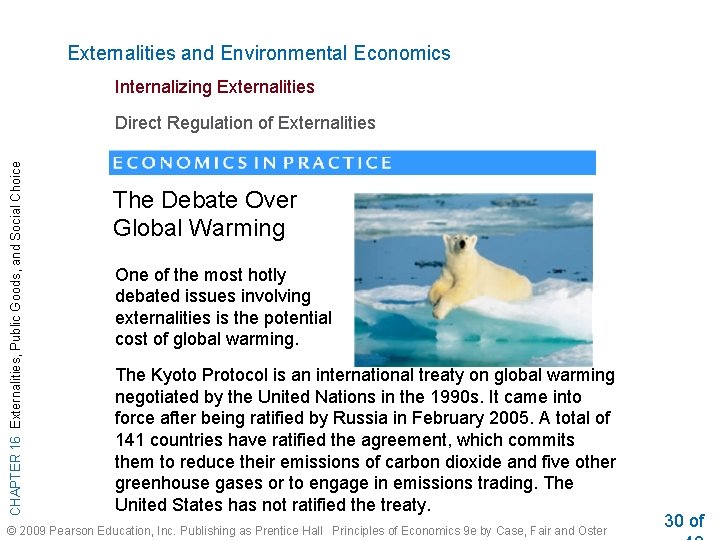
Externalities and Environmental Economics Internalizing Externalities CHAPTER 16 Externalities, Public Goods, and Social Choice Direct Regulation of Externalities The Debate Over Global Warming One of the most hotly debated issues involving externalities is the potential cost of global warming. The Kyoto Protocol is an international treaty on global warming negotiated by the United Nations in the 1990 s. It came into force after being ratified by Russia in February 2005. A total of 141 countries have ratified the agreement, which commits them to reduce their emissions of carbon dioxide and five other greenhouse gases or to engage in emissions trading. The United States has not ratified the treaty. © 2009 Pearson Education, Inc. Publishing as Prentice Hall Principles of Economics 9 e by Case, Fair and Oster 30 of
Public (Social) Goods CHAPTER 16 Externalities, Public Goods, and Social Choice public goods (social or collective goods) Goods that are nonrival in consumption and/or their benefits are nonexcludable. The Characteristics of Public Goods nonrival in consumption A characteristic of public goods: One person’s enjoyment of the benefits of a public good does not interfere with another’s consumption of it. nonexcludable A characteristic of most public goods: Once a good is produced, no one can be excluded from enjoying its benefits. © 2009 Pearson Education, Inc. Publishing as Prentice Hall Principles of Economics 9 e by Case, Fair and Oster 31 of
Public (Social) Goods CHAPTER 16 Externalities, Public Goods, and Social Choice The Characteristics of Public Goods free-rider problem A problem intrinsic to public goods: Because people can enjoy the benefits of public goods whether or not they pay for them, they are usually unwilling to pay for them. drop-in-the-bucket problem A problem intrinsic to public goods: The good or service is usually so costly that its provision generally does not depend on whether any single person pays. © 2009 Pearson Education, Inc. Publishing as Prentice Hall Principles of Economics 9 e by Case, Fair and Oster 32 of
Public (Social) Goods CHAPTER 16 Externalities, Public Goods, and Social Choice Income Distribution as a Public Good? Note that some economists have argued for redistribution of income on grounds that it generates public benefits. If we accept the idea that redistributing income generates a public good, private endeavors may fail to do what we want them to do, and government involvement may be called for. © 2009 Pearson Education, Inc. Publishing as Prentice Hall Principles of Economics 9 e by Case, Fair and Oster 33 of
Public (Social) Goods CHAPTER 16 Externalities, Public Goods, and Social Choice Public Provision of Public Goods All societies, past and present, have had to face the problem of providing public goods. When members of society get together to form a government, they do so to provide themselves with goods and services that will not be provided if they act separately. © 2009 Pearson Education, Inc. Publishing as Prentice Hall Principles of Economics 9 e by Case, Fair and Oster 34 of
CHAPTER 16 Externalities, Public Goods, and Social Choice Which of the following is the best example of a mixed good? a. A Big Mac. b. The Golden Gate bridge. c. The Statue of Liberty. d. Elementary education. e. All of the above are good examples of mixed goods. © 2009 Pearson Education, Inc. Publishing as Prentice Hall Principles of Economics 9 e by Case, Fair and Oster 35 of
CHAPTER 16 Externalities, Public Goods, and Social Choice Which of the following is the best example of a mixed good? a. A Big Mac. b. The Golden Gate bridge. c. The Statue of Liberty. d. Elementary education. e. All of the above are good examples of mixed goods. © 2009 Pearson Education, Inc. Publishing as Prentice Hall Principles of Economics 9 e by Case, Fair and Oster 36 of
Public (Social) Goods CHAPTER 16 Externalities, Public Goods, and Social Choice Optimal Provision of Public Goods Economist Paul Samuelson demonstrated that there exists an optimal, or a most efficient, level of output for every public good. Samuelson’s Theory An efficient economy produces what people want. Private producers, whether perfect competitors or monopolists, are constrained by the market demand for their products. If they cannot sell their products for more than it costs to produce them, they will be out of business. Because private goods permit exclusion, firms can withhold their products until households pay. Buying a product at a posted price reveals that it is “worth” at least that amount to you and to everyone who buys it. © 2009 Pearson Education, Inc. Publishing as Prentice Hall Principles of Economics 9 e by Case, Fair and Oster 37 of
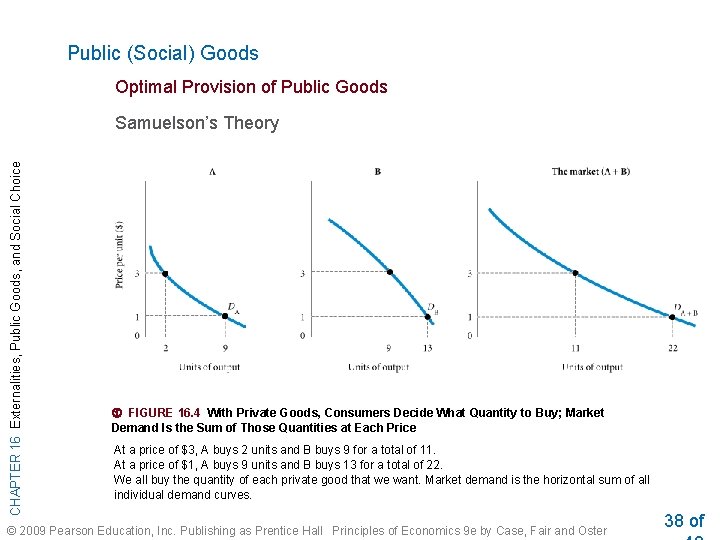
Public (Social) Goods Optimal Provision of Public Goods CHAPTER 16 Externalities, Public Goods, and Social Choice Samuelson’s Theory FIGURE 16. 4 With Private Goods, Consumers Decide What Quantity to Buy; Market Demand Is the Sum of Those Quantities at Each Price At a price of $3, A buys 2 units and B buys 9 for a total of 11. At a price of $1, A buys 9 units and B buys 13 for a total of 22. We all buy the quantity of each private good that we want. Market demand is the horizontal sum of all individual demand curves. © 2009 Pearson Education, Inc. Publishing as Prentice Hall Principles of Economics 9 e by Case, Fair and Oster 38 of
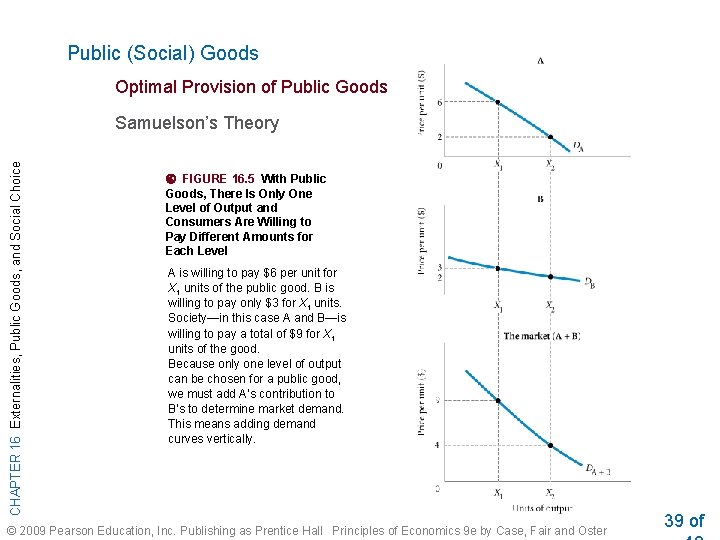
Public (Social) Goods Optimal Provision of Public Goods CHAPTER 16 Externalities, Public Goods, and Social Choice Samuelson’s Theory FIGURE 16. 5 With Public Goods, There Is Only One Level of Output and Consumers Are Willing to Pay Different Amounts for Each Level A is willing to pay $6 per unit for X 1 units of the public good. B is willing to pay only $3 for X 1 units. Society—in this case A and B—is willing to pay a total of $9 for X 1 units of the good. Because only one level of output can be chosen for a public good, we must add A’s contribution to B’s to determine market demand. This means adding demand curves vertically. © 2009 Pearson Education, Inc. Publishing as Prentice Hall Principles of Economics 9 e by Case, Fair and Oster 39 of
CHAPTER 16 Externalities, Public Goods, and Social Choice Which of the following is/are true? a. Only one level of output can be chosen for a public good. b. The demand for a public good is the horizontal summation of individual demand curves for that good. c. Government must decide how much of a public good to produce. d. The satisfaction we derive from the quantity consumed of public goods is just as great as the satisfaction derived from consumption of private goods. e. All of the above. © 2009 Pearson Education, Inc. Publishing as Prentice Hall Principles of Economics 9 e by Case, Fair and Oster 40 of
CHAPTER 16 Externalities, Public Goods, and Social Choice Which of the following is/are true? a. Only one level of output can be chosen for a public good. b. The demand for a public good is the horizontal summation of individual demand curves for that good. c. Government must decide how much of a public good to produce. d. The satisfaction we derive from the quantity consumed of public goods is just as great as the satisfaction derived from consumption of private goods. e. All of the above. © 2009 Pearson Education, Inc. Publishing as Prentice Hall Principles of Economics 9 e by Case, Fair and Oster 41 of
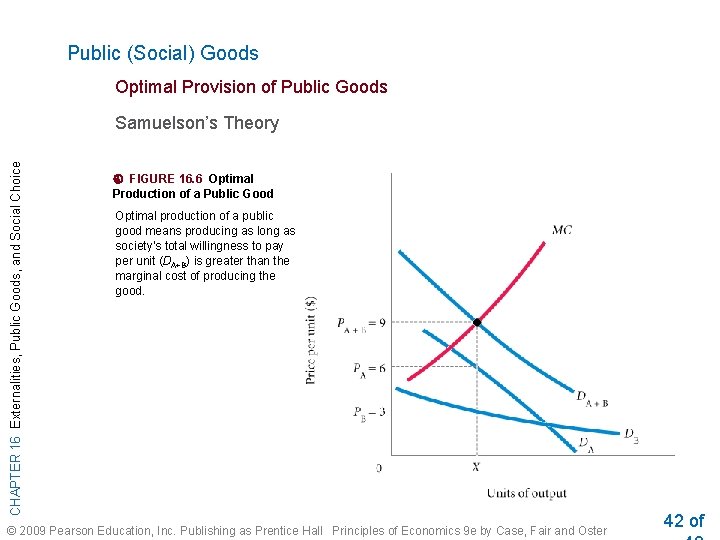
Public (Social) Goods Optimal Provision of Public Goods CHAPTER 16 Externalities, Public Goods, and Social Choice Samuelson’s Theory FIGURE 16. 6 Optimal Production of a Public Good Optimal production of a public good means producing as long as society’s total willingness to pay per unit (DA+B) is greater than the marginal cost of producing the good. © 2009 Pearson Education, Inc. Publishing as Prentice Hall Principles of Economics 9 e by Case, Fair and Oster 42 of
Public (Social) Goods Optimal Provision of Public Goods CHAPTER 16 Externalities, Public Goods, and Social Choice Samuelson’s Theory optimal level of provision for public goods The level at which society’s total willingness to pay per unit is equal to the marginal cost of producing the good. The Problems of Optimal Provision One major problem exists. To produce the optimal amount of each public good, the government must know something that it cannot possibly know— everyone’s preferences. © 2009 Pearson Education, Inc. Publishing as Prentice Hall Principles of Economics 9 e by Case, Fair and Oster 43 of
Public (Social) Goods CHAPTER 16 Externalities, Public Goods, and Social Choice Local Provision of Public Goods: Tiebout Hypothesis Tiebout hypothesis An efficient mix of public goods is produced when local land/housing prices and taxes come to reflect consumer preferences just as they do in the market for private goods. Mixed Goods mixed goods Goods that are part public goods and part private goods. Education is a key example. © 2009 Pearson Education, Inc. Publishing as Prentice Hall Principles of Economics 9 e by Case, Fair and Oster 44 of
CHAPTER 16 Externalities, Public Goods, and Social Choice social choice The problem of deciding what society wants. The process of adding up individual preferences to make a choice for society as a whole. The Voting Paradox Impossibility theorem A proposition demonstrated by Kenneth Arrow showing that no system of aggregating individual preferences into social decisions will always yield consistent, nonarbitrary results. © 2009 Pearson Education, Inc. Publishing as Prentice Hall Principles of Economics 9 e by Case, Fair and Oster 45 of
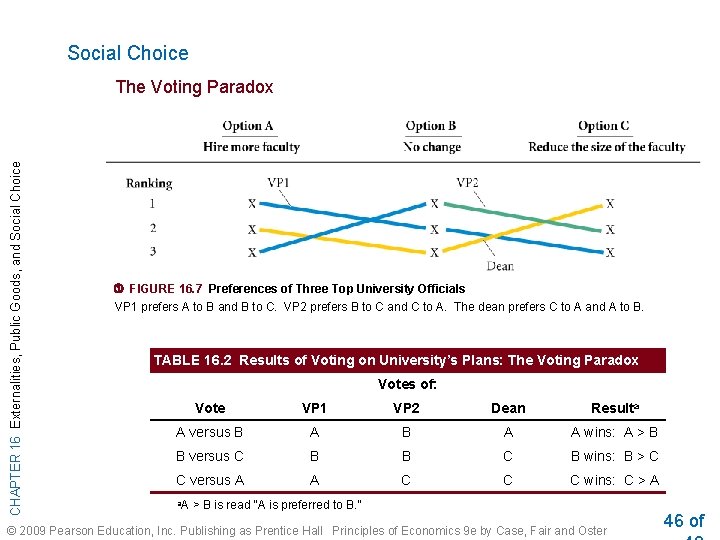
Social Choice CHAPTER 16 Externalities, Public Goods, and Social Choice The Voting Paradox FIGURE 16. 7 Preferences of Three Top University Officials VP 1 prefers A to B and B to C. VP 2 prefers B to C and C to A. The dean prefers C to A and A to B. TABLE 16. 2 Results of Voting on University’s Plans: The Voting Paradox Votes of: Vote VP 1 VP 2 Dean Resulta A versus B A A wins: A > B B versus C B B C B wins: B > C C versus A A C C C wins: C > A a. A > B is read “A is preferred to B. ” © 2009 Pearson Education, Inc. Publishing as Prentice Hall Principles of Economics 9 e by Case, Fair and Oster 46 of
Social Choice CHAPTER 16 Externalities, Public Goods, and Social Choice The Voting Paradox voting paradox A simple demonstration of how majority-rule voting can lead to seemingly contradictory and inconsistent results. A commonly cited illustration of the kind of inconsistency described in the impossibility theorem. logrolling Occurs when congressional representatives trade votes, agreeing to help each other get certain pieces of legislation passed. © 2009 Pearson Education, Inc. Publishing as Prentice Hall Principles of Economics 9 e by Case, Fair and Oster 47 of
Social Choice CHAPTER 16 Externalities, Public Goods, and Social Choice Government Inefficiency: Theory of Public Choice Looking at the public sector from the standpoint of the behavior of public officials and the potential for inefficient choices and bureaucratic waste rather than in terms of its potential for improving the allocation of resources has become quite popular. This is the viewpoint of what is called the public choice field in economics that builds heavily on the work of Nobel laureate James Buchanan. © 2009 Pearson Education, Inc. Publishing as Prentice Hall Principles of Economics 9 e by Case, Fair and Oster 48 of
Social Choice CHAPTER 16 Externalities, Public Goods, and Social Choice Rent-Seeking Revisited A monopolist would be willing to pay to prevent competition from eroding its economic profits. Many —if not all—industries lobby for favorable treatment, softer regulation, or antitrust exemption. This, as you recall, is rent-seeking. Theory may suggest that unregulated markets fail to produce an efficient allocation of resources. This should not lead you to the conclusion that government involvement necessarily leads to efficiency. There are reasons to believe that government attempts to produce the right goods and services in the right quantities efficiently may fail. © 2009 Pearson Education, Inc. Publishing as Prentice Hall Principles of Economics 9 e by Case, Fair and Oster 49 of
CHAPTER 16 Externalities, Public Goods, and Social Choice Government and the Market There is no question that government must be involved in both the provision of public goods and the control of externalities. The question is not whether we need government involvement. The question is how much and what kind of government involvement we should have. © 2009 Pearson Education, Inc. Publishing as Prentice Hall Principles of Economics 9 e by Case, Fair and Oster 50 of
CHAPTER 16 Externalities, Public Goods, and Social Choice REVIEW TERMS AND CONCEPTS Coase theorem market failure drop-in-the-bucket problem mixed goods externality nonexcludable free-rider problem nonrival in consumption impossibility theorem optimal level of provision for public goods injunction liability rules logrolling marginal damage cost (MDC) marginal private cost (MPC) public goods (social or collective goods) social choice Tiebout hypothesis voting paradox marginal social cost (MSC) © 2009 Pearson Education, Inc. Publishing as Prentice Hall Principles of Economics 9 e by Case, Fair and Oster 51 of
- Slides: 51