
Chapter 16 Evolution of Populations 16 1 Genes
- Slides: 45
Chapter 16 Evolution of Populations
16. 1 Genes and Variation A. Populations and Gene Pools a. population: individuals of the same species in a given area. b. gene pool is the combined genetic material of all the alleles in the population c. allele frequency = % of an allele in the pool * 20 bugs =the gene pool has 40 alleles (some B, b) 30 B alleles =. 75 10 b alleles =. 25
n Genes are responsible for the phenotypes in organisms n if the frequency of allele changes, then the population will start to look different as nature selects for these alleles. – breeding bunnies for example n In genetic terms = evolution is any change in the relative frequency of alleles in a population.
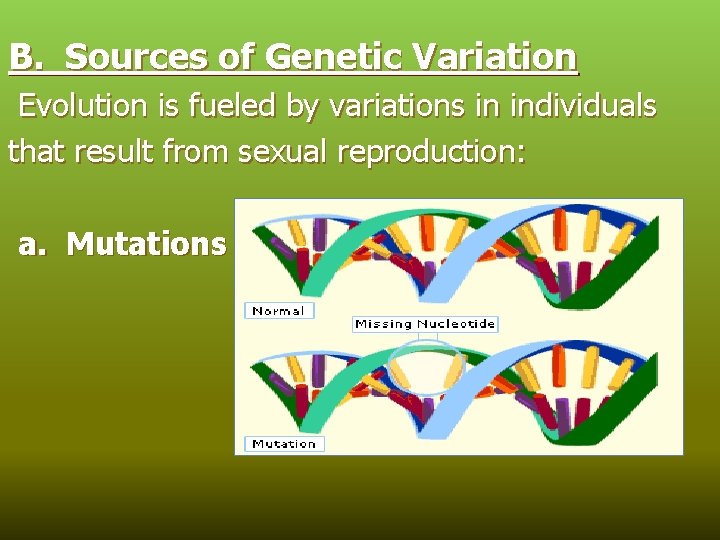
B. Sources of Genetic Variation Evolution is fueled by variations in individuals that result from sexual reproduction: a. Mutations
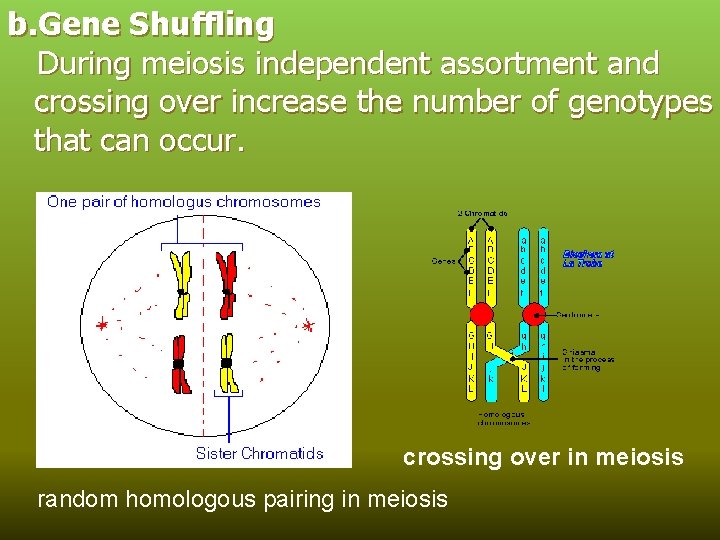
b. Gene Shuffling During meiosis independent assortment and crossing over increase the number of genotypes that can occur. crossing over in meiosis random homologous pairing in meiosis
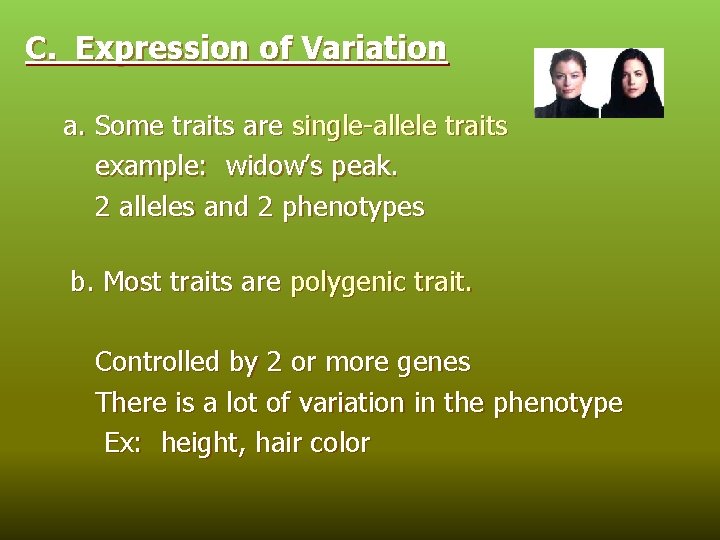
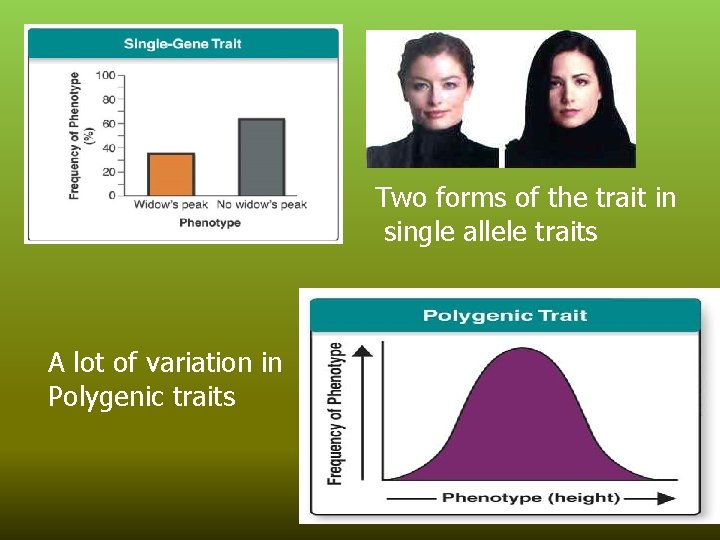
C. Expression of Variation a. Some traits are single-allele traits example: widow’s peak. 2 alleles and 2 phenotypes b. Most traits are polygenic trait. Controlled by 2 or more genes There is a lot of variation in the phenotype Ex: height, hair color
Two forms of the trait in single allele traits A lot of variation in Polygenic traits
16. 2 Evolution as Genetic Change A. What causes allele frequencies in a gene pool to change? 1. Natural Selection on Single Allele Traits If an organism survives and produces many offspring, its alleles stay in the gene pool and may increase in frequency. The adaptations that helped it to survive will be magnified. Example: Breeding Bunnies fur or no fur
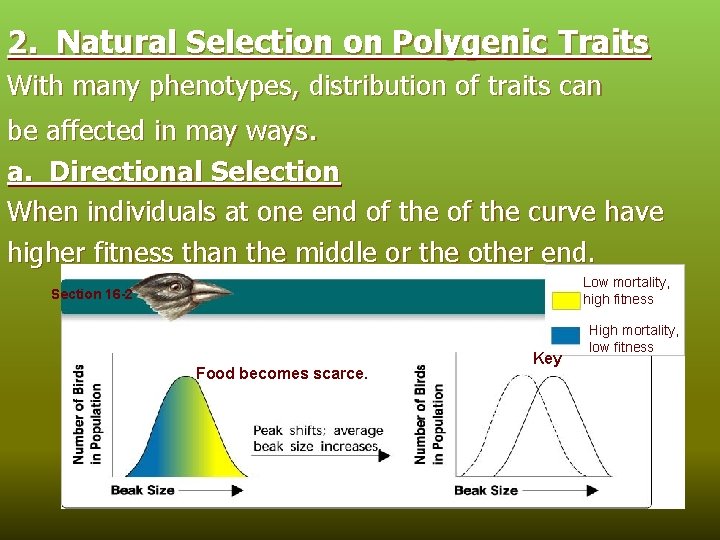
2. Natural Selection on Polygenic Traits With many phenotypes, distribution of traits can be affected in may ways. a. Directional Selection When individuals at one end of the curve have higher fitness than the middle or the other end. Low mortality, high fitness Section 16 -2 Food becomes scarce. Key High mortality, low fitness
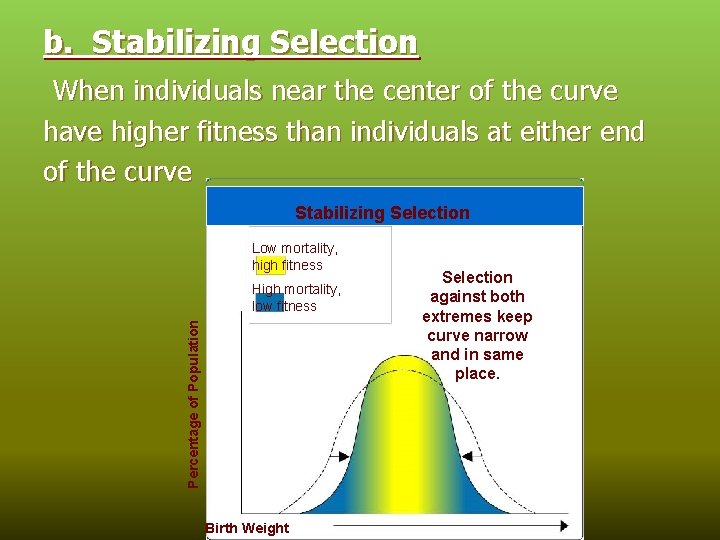
b. Stabilizing Selection When individuals near the center of the curve have higher fitness than individuals at either end of the curve Stabilizing Selection Key Low mortality, high fitness Percentage of Population High mortality, low fitness Birth Weight Selection against both extremes keep curve narrow and in same place.
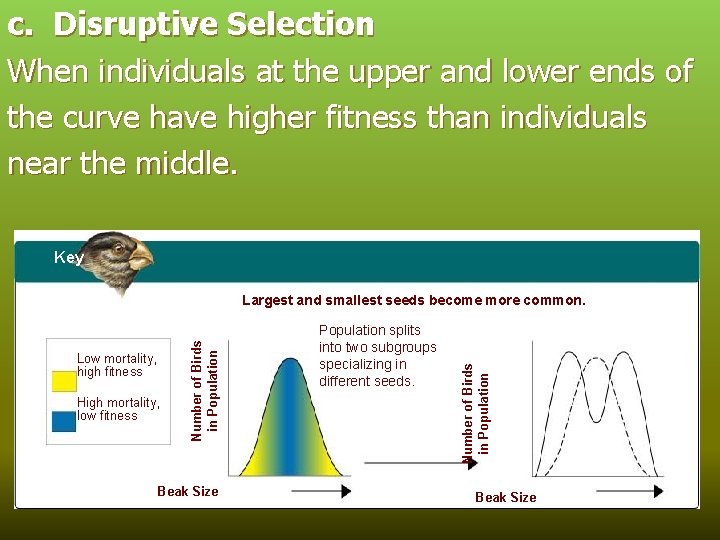
c. Disruptive Selection When individuals at the upper and lower ends of the curve have higher fitness than individuals near the middle. Key High mortality, low fitness Beak Size Population splits into two subgroups specializing in different seeds. Number of Birds in Population Low mortality, high fitness Number of Birds in Population Largest and smallest seeds become more common. Beak Size
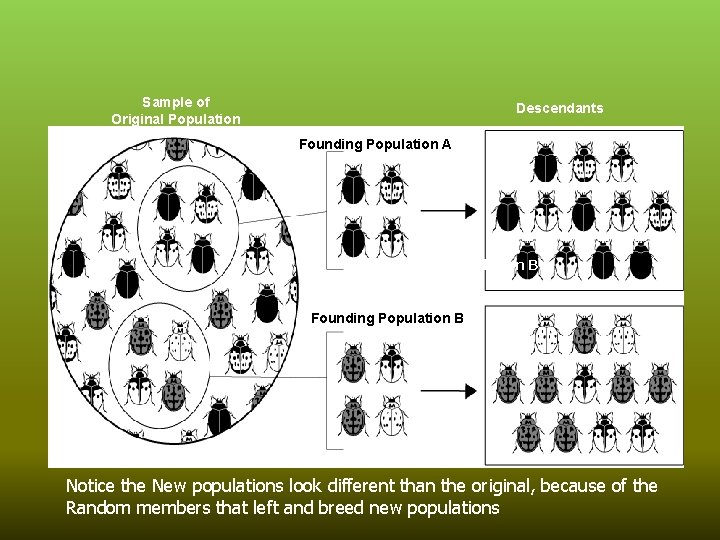
3. Genetic Drift – Random change in the frequency of a gene. (not natural selection) Occurs more in small population. a. Can happen by natural disasters – certain phenotypes in a population die and it then changes the gene pool b. Founders effect – a group leaves a population and settles in new location after generations, new looks different than original population. Chance – not natural selection.
Sample of Original Population Descendants Founding Population A Founding Population B Notice the New populations look different than the original, because of the Random members that left and breed new populations
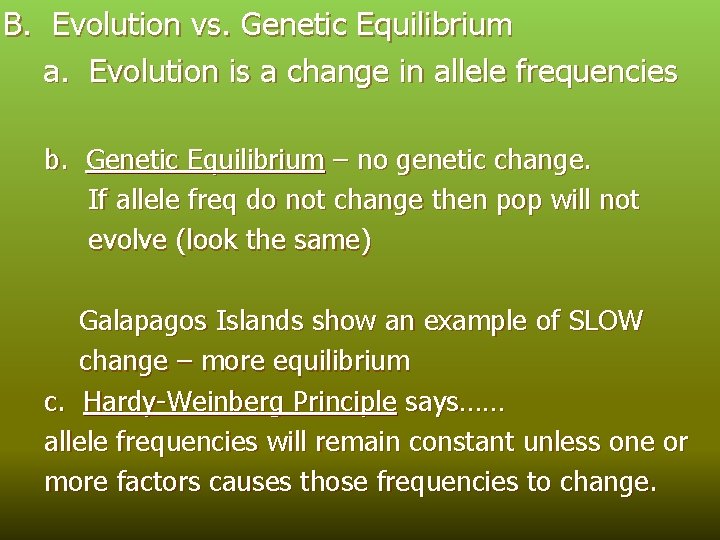
B. Evolution vs. Genetic Equilibrium a. Evolution is a change in allele frequencies b. Genetic Equilibrium – no genetic change. If allele freq do not change then pop will not evolve (look the same) Galapagos Islands show an example of SLOW change – more equilibrium c. Hardy-Weinberg Principle says…… allele frequencies will remain constant unless one or more factors causes those frequencies to change.
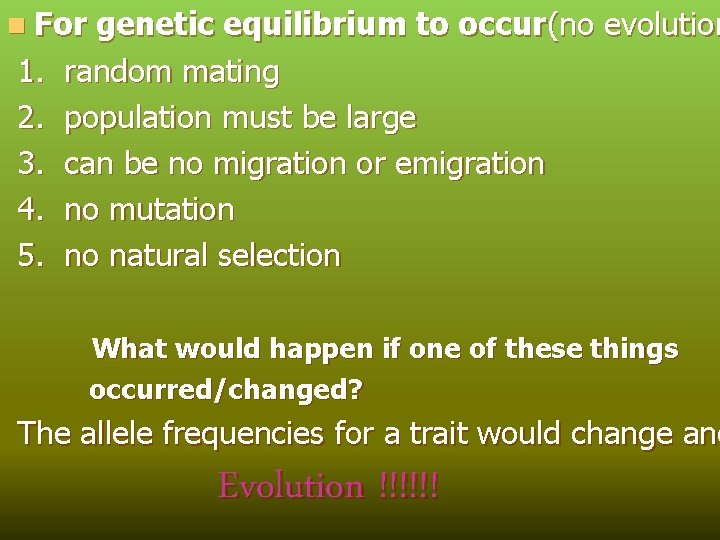
n For 1. 2. 3. 4. 5. genetic equilibrium to occur(no evolution random mating population must be large can be no migration or emigration no mutation no natural selection What would happen if one of these things occurred/changed? The allele frequencies for a trait would change and Evolution !!!!!!
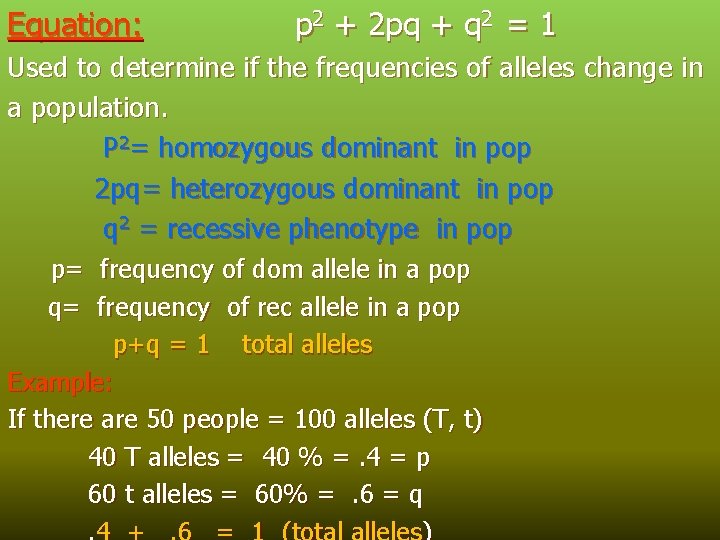
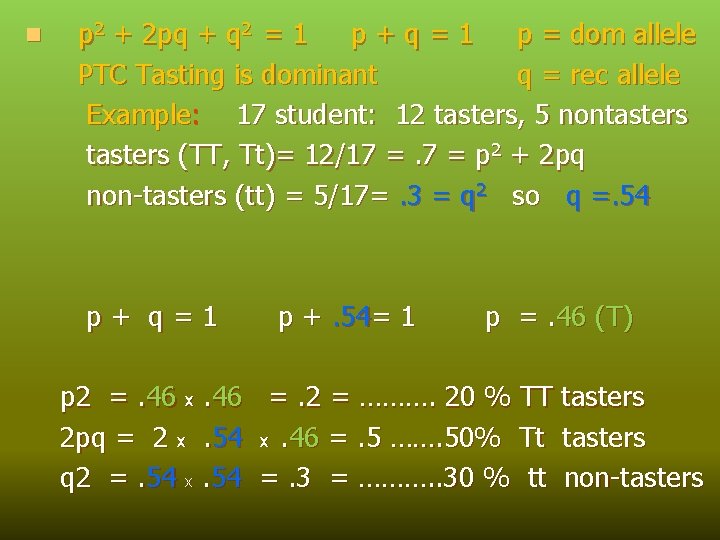
Equation: p 2 + 2 pq + q 2 = 1 Used to determine if the frequencies of alleles change in a population. P 2= homozygous dominant in pop 2 pq= heterozygous dominant in pop q 2 = recessive phenotype in pop p= frequency of dom allele in a pop q= frequency of rec allele in a pop p+q = 1 total alleles Example: If there are 50 people = 100 alleles (T, t) 40 T alleles = 40 % =. 4 = p 60 t alleles = 60% =. 6 = q
n p 2 + 2 pq + q 2 = 1 p+q=1 p = dom allele PTC Tasting is dominant q = rec allele Example: 17 student: 12 tasters, 5 nontasters (TT, Tt)= 12/17 =. 7 = p 2 + 2 pq non-tasters (tt) = 5/17=. 3 = q 2 so q =. 54 p+ q=1 p +. 54= 1 p =. 46 (T) p 2 =. 46 x. 46 =. 2 = ………. 20 % TT tasters 2 pq = 2 x. 54 x. 46 =. 5 ……. 50% Tt tasters q 2 =. 54 x. 54 =. 3 = ………. . 30 % tt non-tasters
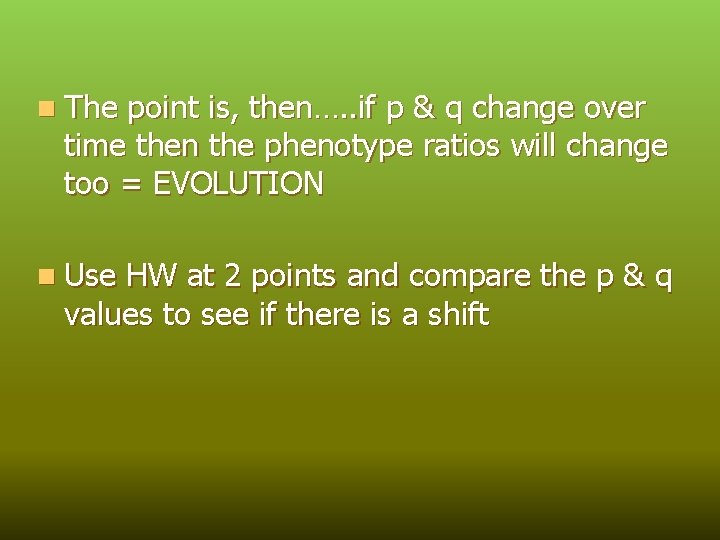
n The point is, then…. . if p & q change over time then the phenotype ratios will change too = EVOLUTION n Use HW at 2 points and compare the p & q values to see if there is a shift
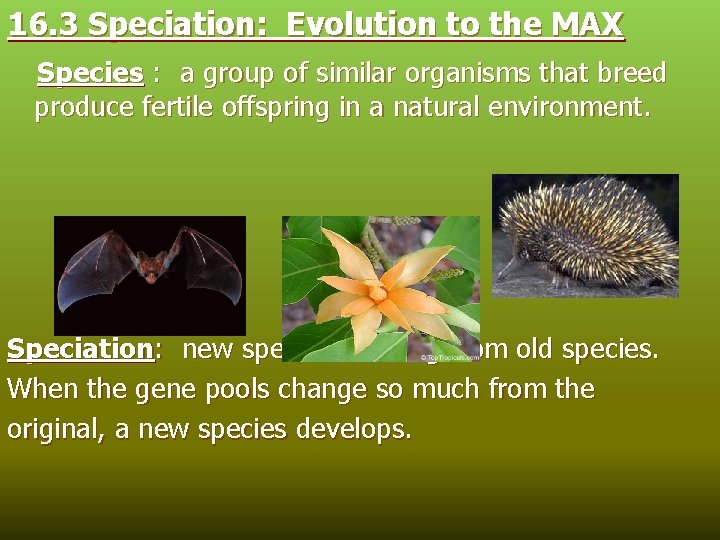
16. 3 Speciation: Evolution to the MAX Species : a group of similar organisms that breed produce fertile offspring in a natural environment. Speciation: new species evolving from old species. When the gene pools change so much from the original, a new species develops.
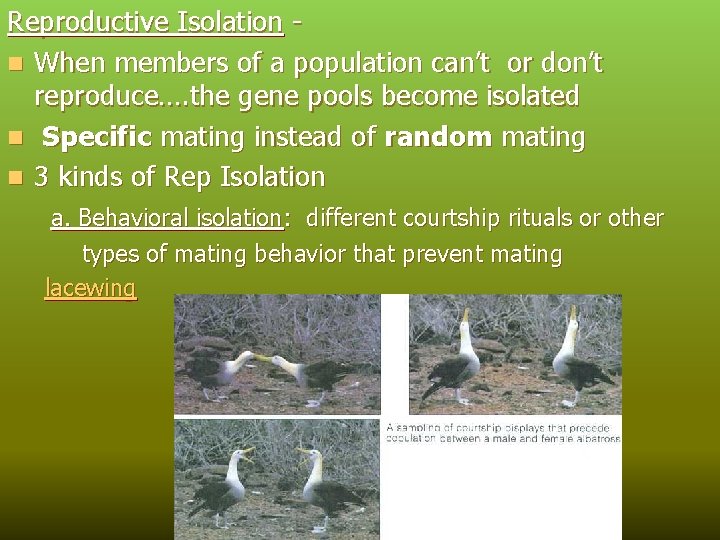
Reproductive Isolation n When members of a population can’t or don’t reproduce…. the gene pools become isolated n Specific mating instead of random mating n 3 kinds of Rep Isolation a. Behavioral isolation: different courtship rituals or other types of mating behavior that prevent mating lacewing
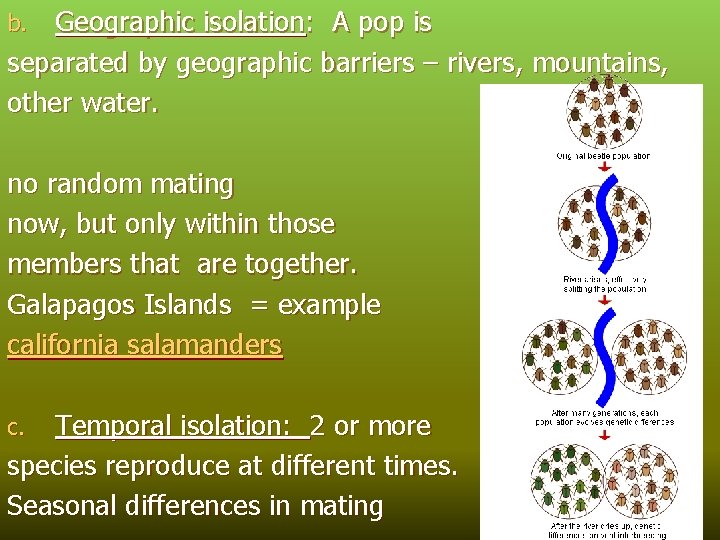
Geographic isolation: A pop is separated by geographic barriers – rivers, mountains, other water. b. no random mating now, but only within those members that are together. Galapagos Islands = example california salamanders Temporal isolation: 2 or more species reproduce at different times. Seasonal differences in mating c.
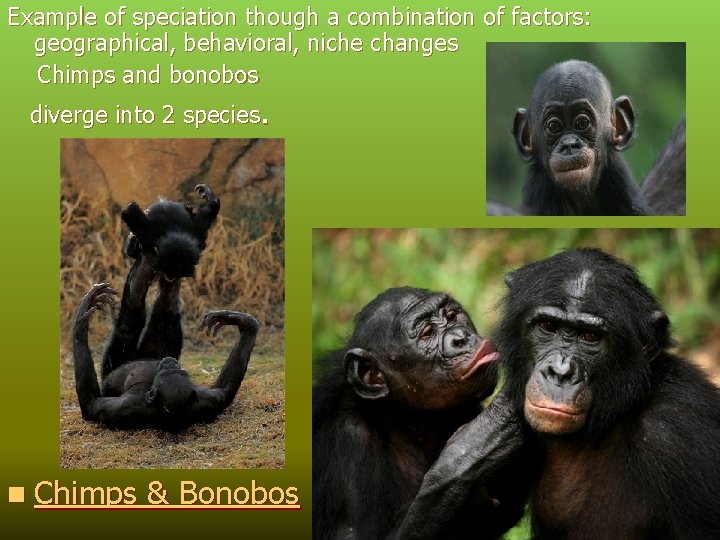
Example of speciation though a combination of factors: geographical, behavioral, niche changes Chimps and bonobos diverge into 2 species. n Chimps & Bonobos
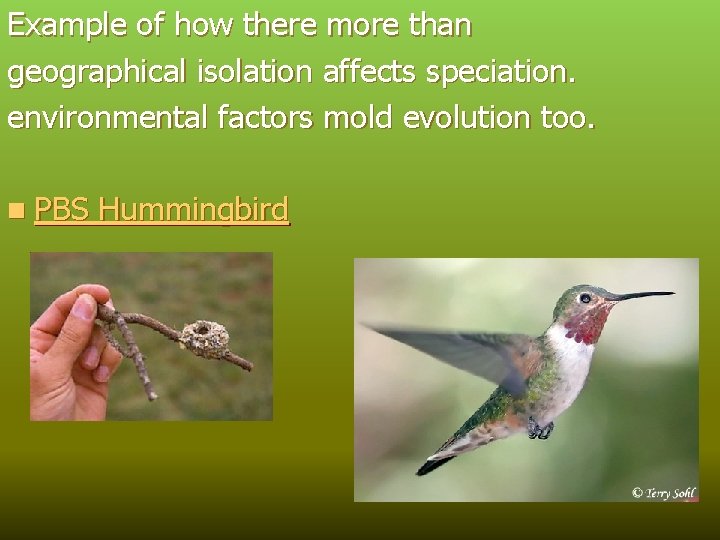
Example of how there more than geographical isolation affects speciation. environmental factors mold evolution too. n PBS Hummingbird
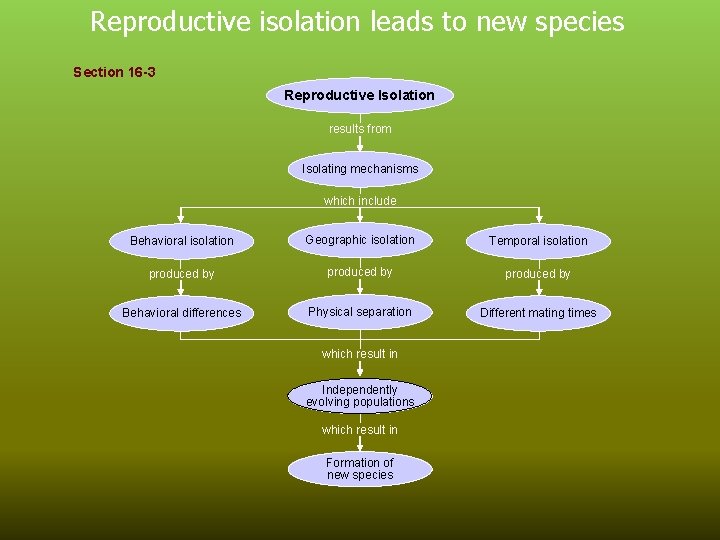
Reproductive isolation leads to new species Section 16 -3 Reproductive Isolation results from Isolating mechanisms which include Behavioral isolation Geographic isolation Temporal isolation produced by Behavioral differences Physical separation Different mating times which result in Independently evolving populations which result in Formation of new species
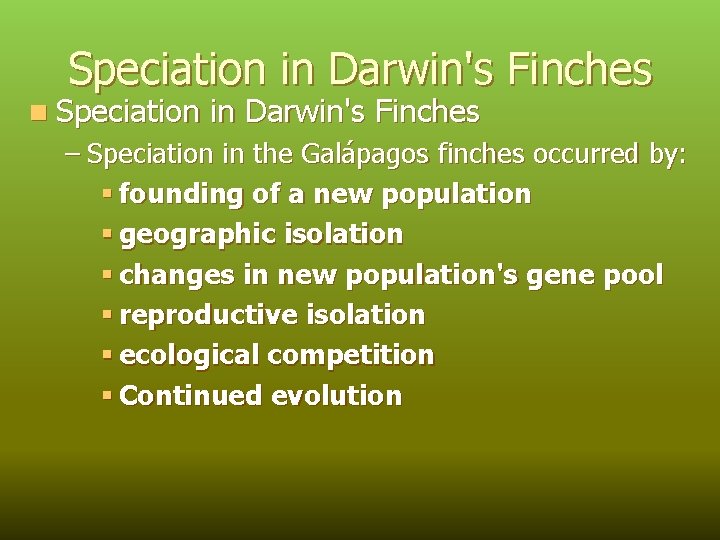
Speciation in Darwin's Finches n Speciation in Darwin's Finches – Speciation in the Galápagos finches occurred by: § founding of a new population § geographic isolation § changes in new population's gene pool § reproductive isolation § ecological competition § Continued evolution
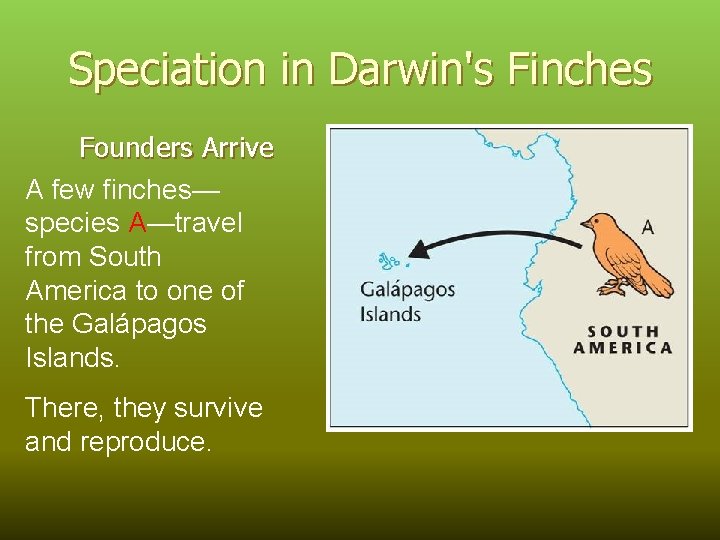
Speciation in Darwin's Finches Founders Arrive A few finches— species A—travel from South America to one of the Galápagos Islands. There, they survive and reproduce.
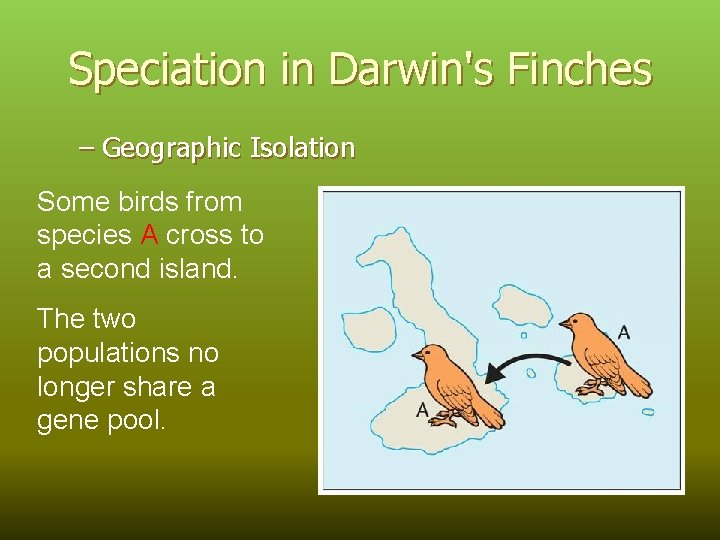
Speciation in Darwin's Finches – Geographic Isolation Some birds from species A cross to a second island. The two populations no longer share a gene pool.
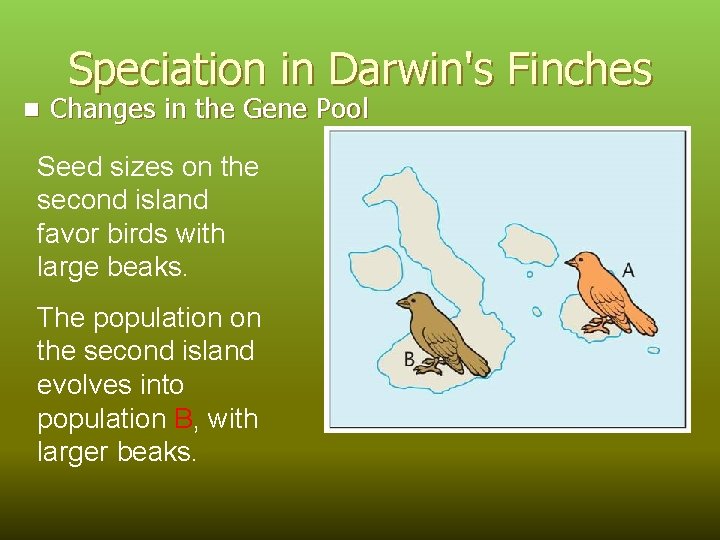
Speciation in Darwin's Finches n Changes in the Gene Pool Seed sizes on the second island favor birds with large beaks. The population on the second island evolves into population B, with larger beaks.
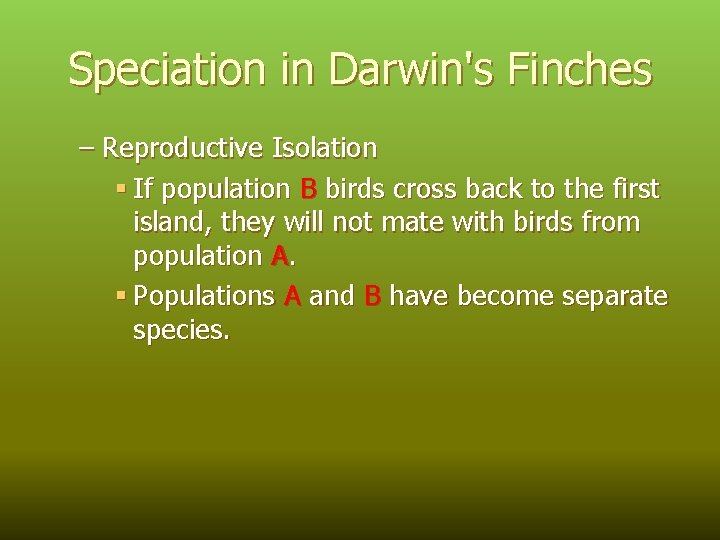
Speciation in Darwin's Finches – Reproductive Isolation § If population B birds cross back to the first island, they will not mate with birds from population A. § Populations A and B have become separate species.
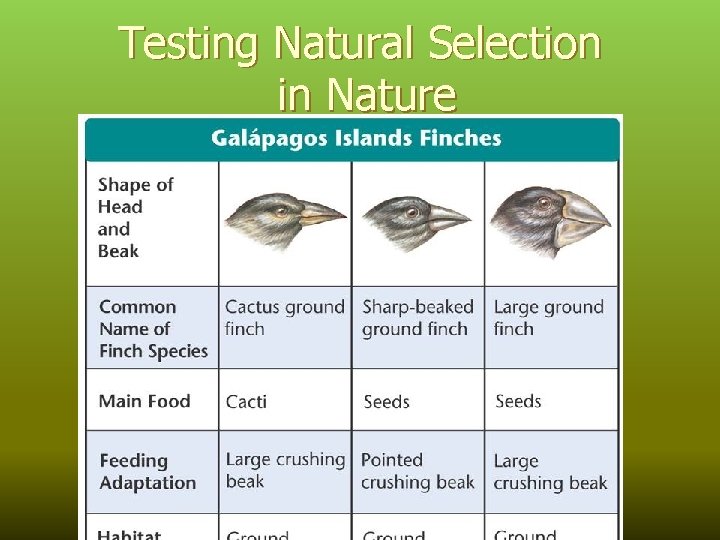
Testing Natural Selection in Nature
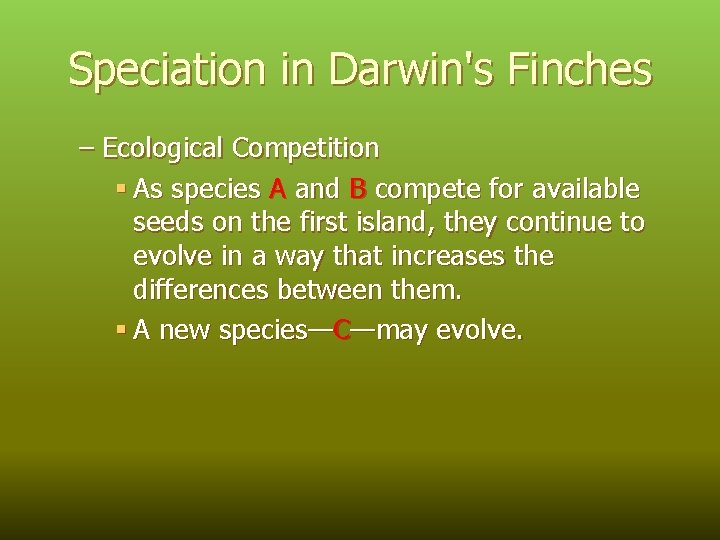
Speciation in Darwin's Finches – Ecological Competition § As species A and B compete for available seeds on the first island, they continue to evolve in a way that increases the differences between them. § A new species—C—may evolve.
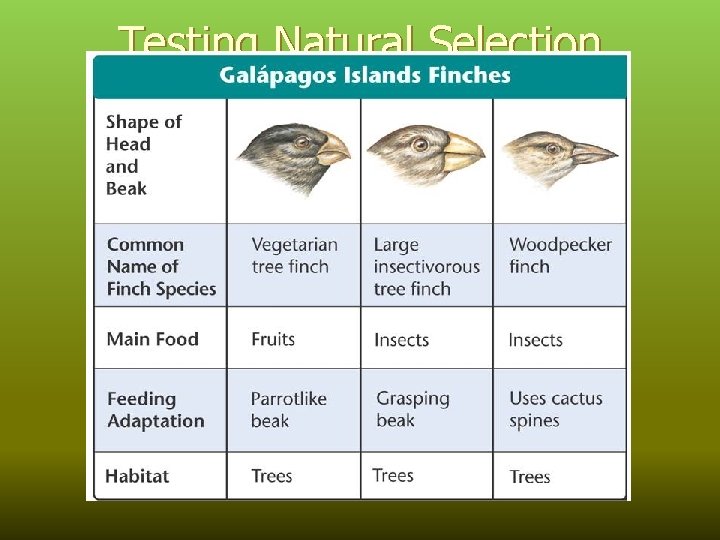
Testing Natural Selection in Nature
Speciation in Darwin's Finches – Continued Evolution § This process of isolation, genetic change, and reproductive isolation probably repeated itself often across the entire Galápagos island chain.
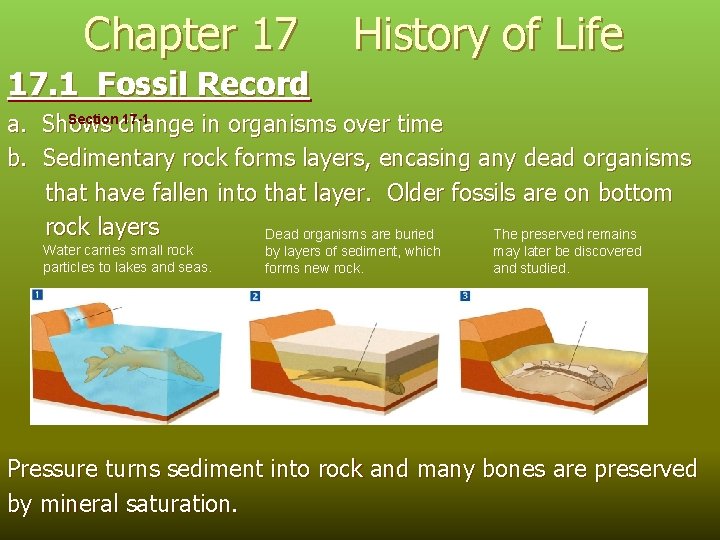
Chapter 17 History of Life 17. 1 Fossil Record Section 17 -1 a. Shows change in organisms over time b. Sedimentary rock forms layers, encasing any dead organisms that have fallen into that layer. Older fossils are on bottom rock layers Dead organisms are buried The preserved remains Water carries small rock particles to lakes and seas. by layers of sediment, which forms new rock. may later be discovered and studied. Pressure turns sediment into rock and many bones are preserved by mineral saturation.
n Fossilization n PBS Fossilization Show fossils are used to piece together the ancestry of whales from that of land mammals to aquatic mammals. n Lucy fossilization Show fossils are formed
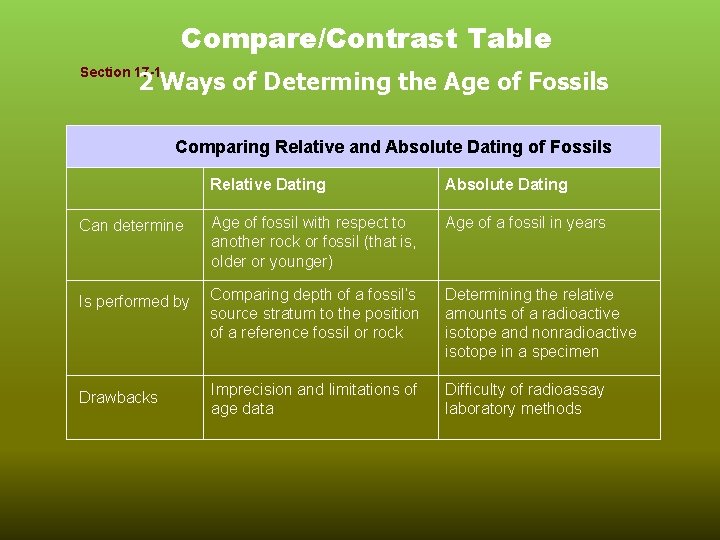
Compare/Contrast Table Section 17 -1 2 Ways of Determing the Age of Fossils Comparing Relative and Absolute Dating of Fossils Relative Dating Absolute Dating Can determine Age of fossil with respect to another rock or fossil (that is, older or younger) Age of a fossil in years Is performed by Comparing depth of a fossil’s source stratum to the position of a reference fossil or rock Determining the relative amounts of a radioactive isotope and nonradioactive isotope in a specimen Imprecision and limitations of age data Difficulty of radioassay laboratory methods Drawbacks
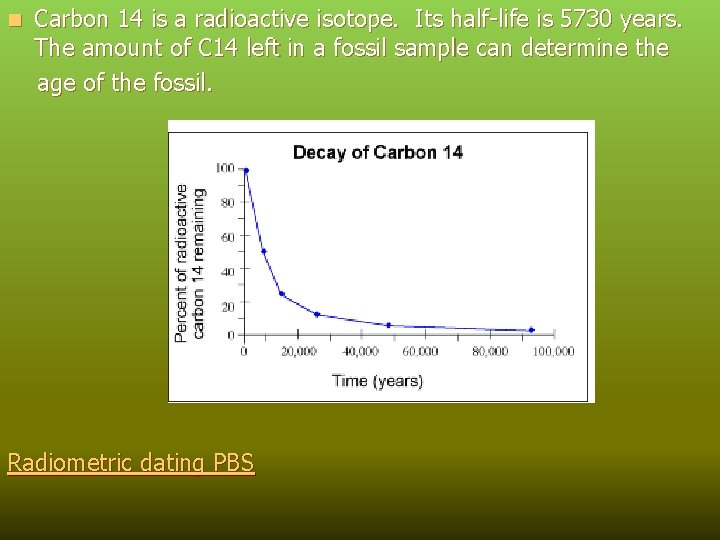
n Carbon 14 is a radioactive isotope. Its half-life is 5730 years. The amount of C 14 left in a fossil sample can determine the age of the fossil. Radiometric dating PBS
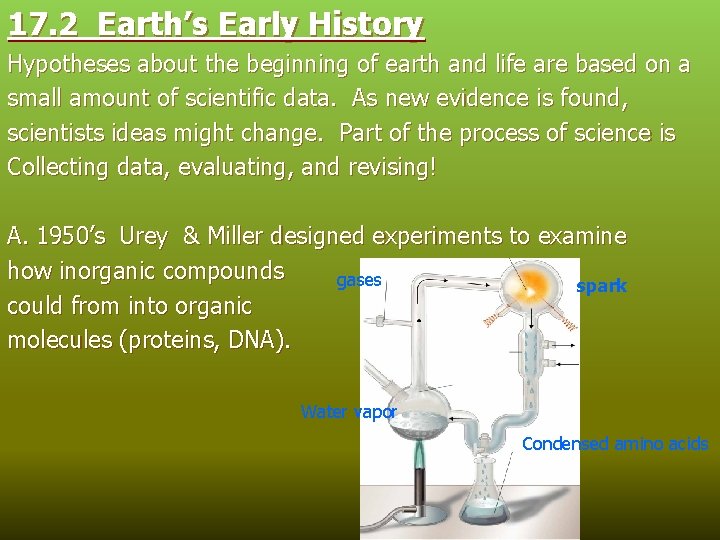
17. 2 Earth’s Early History Hypotheses about the beginning of earth and life are based on a small amount of scientific data. As new evidence is found, scientists ideas might change. Part of the process of science is Collecting data, evaluating, and revising! A. 1950’s Urey & Miller designed experiments to examine how inorganic compounds gases spark could from into organic molecules (proteins, DNA). Water vapor Condensed amino acids
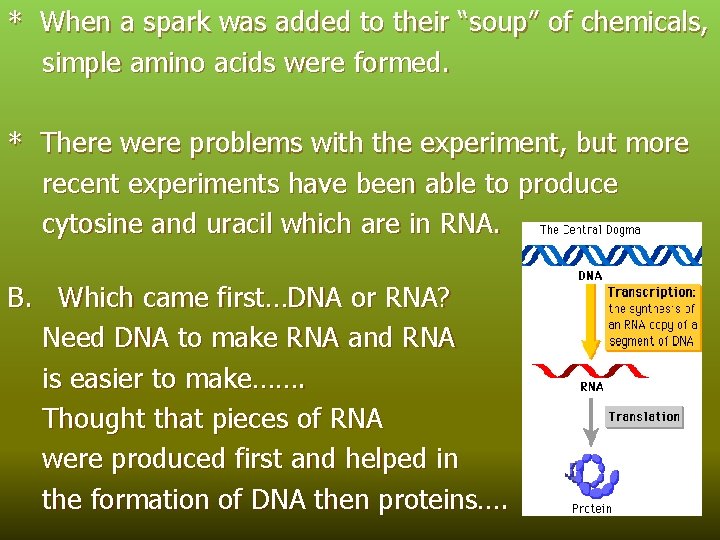
* When a spark was added to their “soup” of chemicals, simple amino acids were formed. * There were problems with the experiment, but more recent experiments have been able to produce cytosine and uracil which are in RNA. B. Which came first…DNA or RNA? Need DNA to make RNA and RNA is easier to make……. Thought that pieces of RNA were produced first and helped in the formation of DNA then proteins….
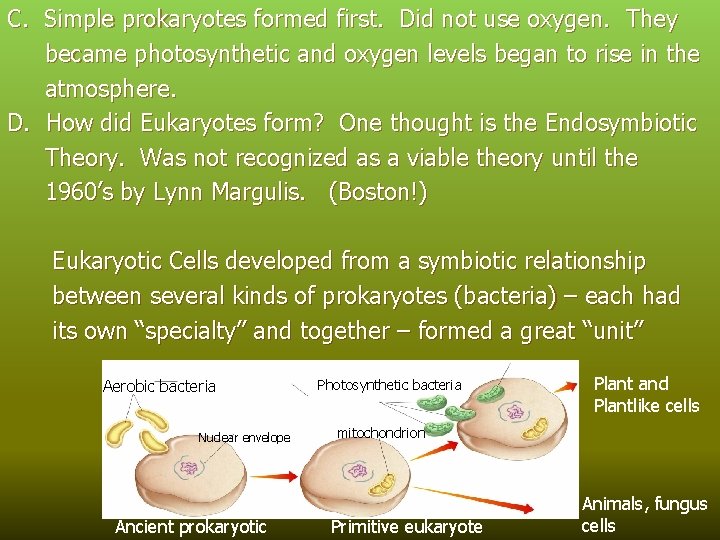
C. Simple prokaryotes formed first. Did not use oxygen. They became photosynthetic and oxygen levels began to rise in the atmosphere. D. How did Eukaryotes form? One thought is the Endosymbiotic Theory. Was not recognized as a viable theory until the 1960’s by Lynn Margulis. (Boston!) Eukaryotic Cells developed from a symbiotic relationship between several kinds of prokaryotes (bacteria) – each had its own “specialty” and together – formed a great “unit” Aerobic bacteria Nuclear envelope Ancient prokaryotic Photosynthetic bacteria Plant and Plantlike cells mitochondrion Primitive eukaryote Animals, fungus cells
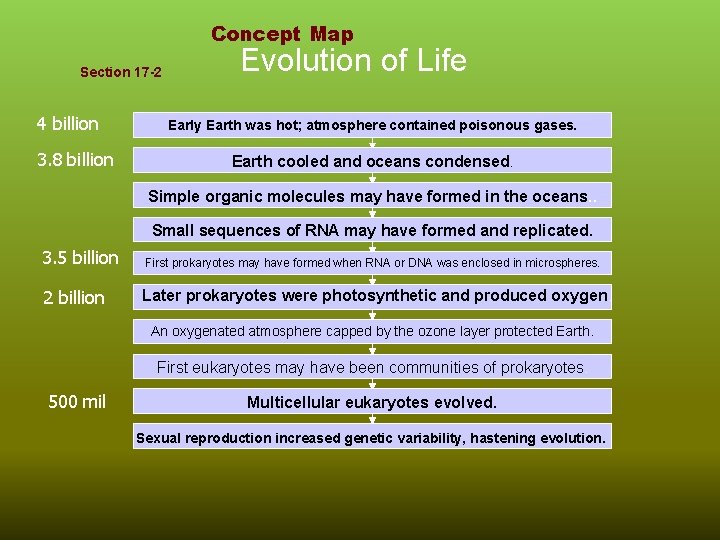
Concept Map Section 17 -2 4 billion 3. 8 billion Evolution of Life Early Earth was hot; atmosphere contained poisonous gases. Earth cooled and oceans condensed. Simple organic molecules may have formed in the oceans. . Small sequences of RNA may have formed and replicated. 3. 5 billion First prokaryotes may have formed when RNA or DNA was enclosed in microspheres. 2 billion Later prokaryotes were photosynthetic and produced oxygen. An oxygenated atmosphere capped by the ozone layer protected Earth. First eukaryotes may have been communities of prokaryotes. 500 mil Multicellular eukaryotes evolved. Sexual reproduction increased genetic variability, hastening evolution.
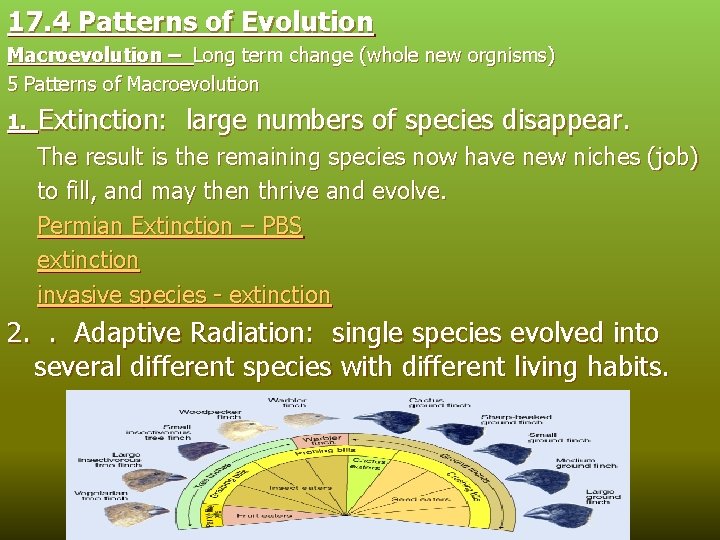
17. 4 Patterns of Evolution Macroevolution – Long term change (whole new orgnisms) 5 Patterns of Macroevolution 1. Extinction: large numbers of species disappear. The result is the remaining species now have new niches (job) to fill, and may then thrive and evolve. Permian Extinction – PBS extinction invasive species - extinction 2. . Adaptive Radiation: single species evolved into several different species with different living habits.
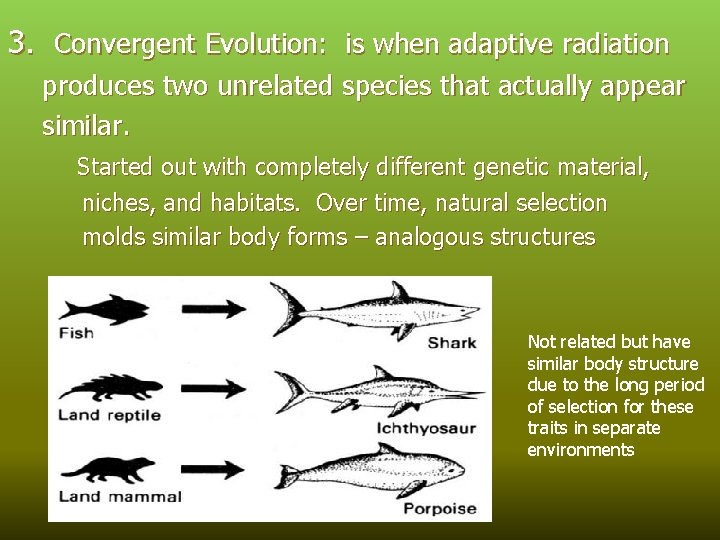
3. Convergent Evolution: is when adaptive radiation produces two unrelated species that actually appear similar. Started out with completely different genetic material, niches, and habitats. Over time, natural selection molds similar body forms – analogous structures Not related but have similar body structure due to the long period of selection for these traits in separate environments
n Convergent Evolution n PBS Anteater 4. Coevolution The evolution of two organisms together. The two organisms benefit each other and therefore they change together Toxic Newt Leafcutter red queen allergies and asthma
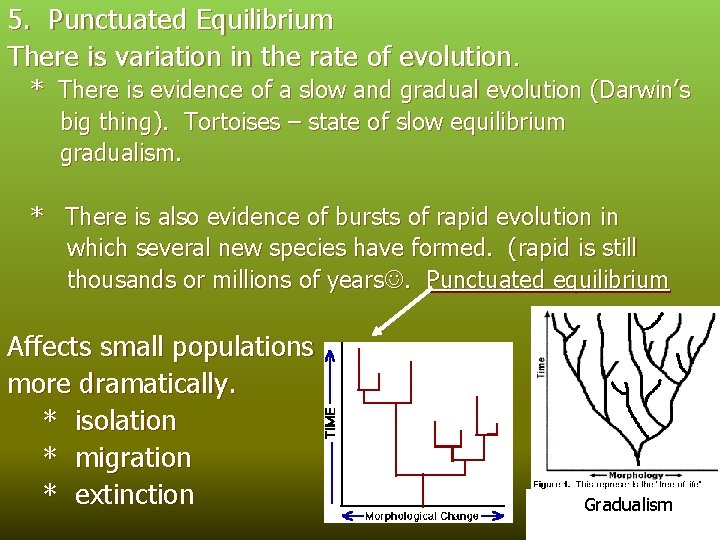
5. Punctuated Equilibrium There is variation in the rate of evolution. * There is evidence of a slow and gradual evolution (Darwin’s big thing). Tortoises – state of slow equilibrium gradualism. * There is also evidence of bursts of rapid evolution in which several new species have formed. (rapid is still thousands or millions of years. Punctuated equilibrium Affects small populations more dramatically. * isolation * migration * extinction Gradualism