
Chapter 16 DNA The Genetic Material Replication AP

- Slides: 48
Chapter 16. DNA The Genetic Material Replication AP Biology 2005 -2006
Scientific History § The march to understanding that DNA is the genetic material T. H. Morgan (1908) u Frederick Griffith (1928) u Avery, Mc. Carty & Mac. Leod (1944) u Hershey & Chase (1952) u Watson & Crick (1953) u Meselson & Stahl (1958) u AP Biology 2005 -2006
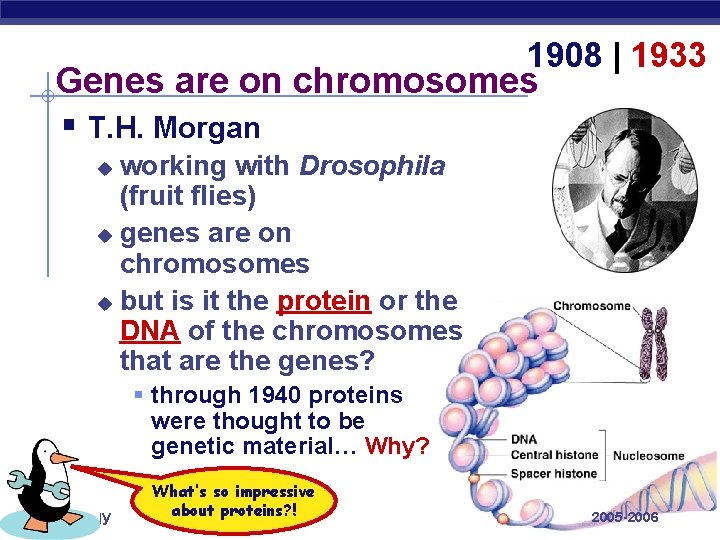
1908 | 1933 Genes are on chromosomes § T. H. Morgan working with Drosophila (fruit flies) u genes are on chromosomes u but is it the protein or the DNA of the chromosomes that are the genes? u § through 1940 proteins were thought to be genetic material… Why? AP Biology What’s so impressive about proteins? ! 2005 -2006
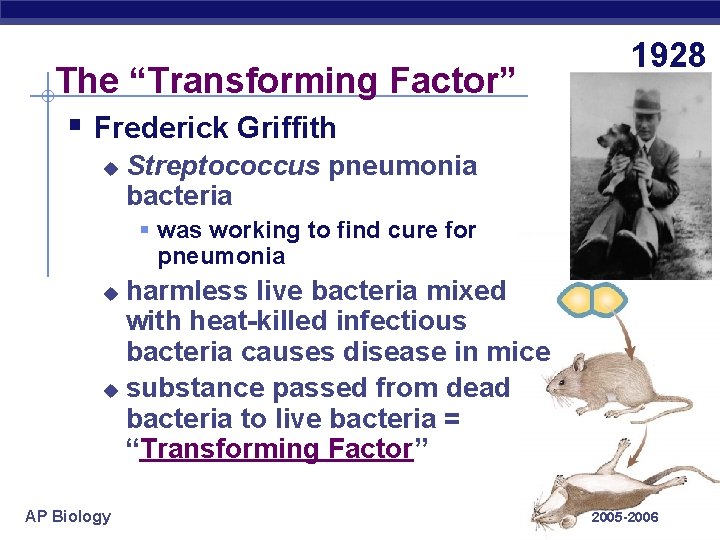
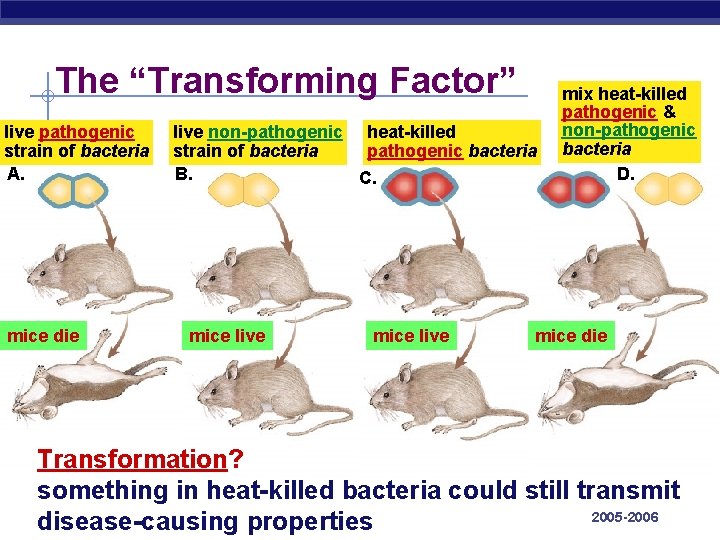
The “Transforming Factor” § Frederick Griffith u 1928 Streptococcus pneumonia bacteria § was working to find cure for pneumonia harmless live bacteria mixed with heat-killed infectious bacteria causes disease in mice u substance passed from dead bacteria to live bacteria = “Transforming Factor” u AP Biology 2005 -2006
The “Transforming Factor” live pathogenic strain of bacteria A. mice die live non-pathogenic heat-killed strain of bacteria pathogenic bacteria B. C. mice live mix heat-killed pathogenic & non-pathogenic bacteria D. mice die Transformation? something in heat-killed bacteria could still transmit AP Biology 2005 -2006 disease-causing properties
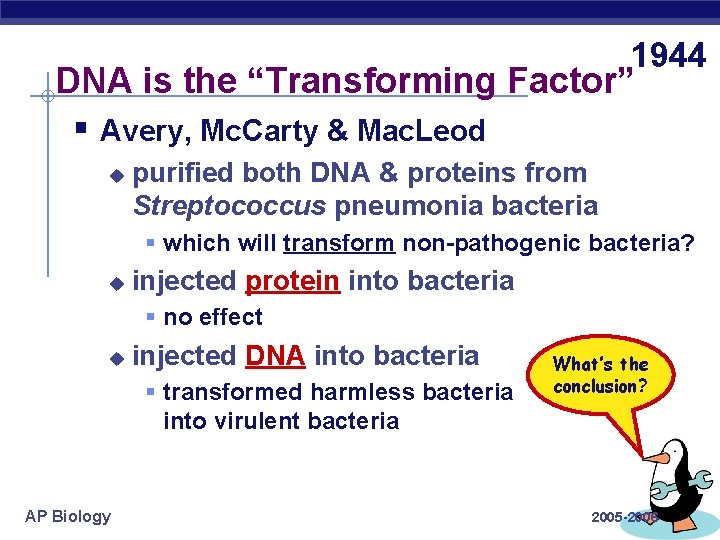
1944 DNA is the “Transforming Factor” § Avery, Mc. Carty & Mac. Leod u purified both DNA & proteins from Streptococcus pneumonia bacteria § which will transform non-pathogenic bacteria? u injected protein into bacteria § no effect u injected DNA into bacteria § transformed harmless bacteria into virulent bacteria AP Biology What’s the conclusion? 2005 -2006
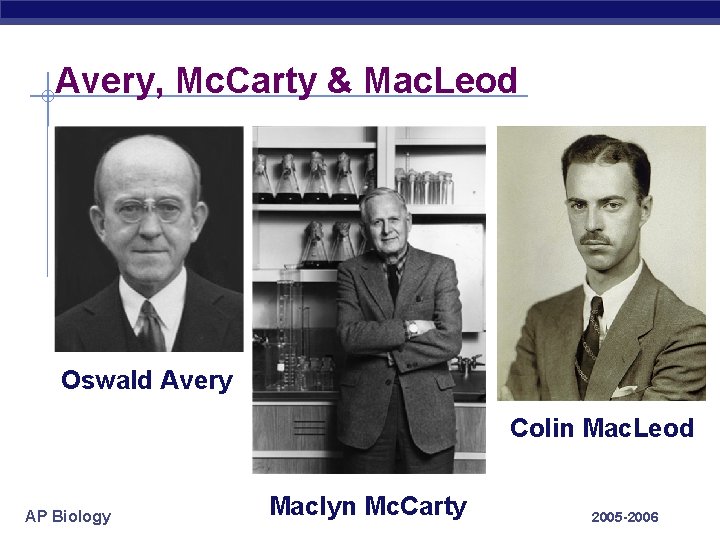
Avery, Mc. Carty & Mac. Leod Oswald Avery Colin Mac. Leod AP Biology Maclyn Mc. Carty 2005 -2006
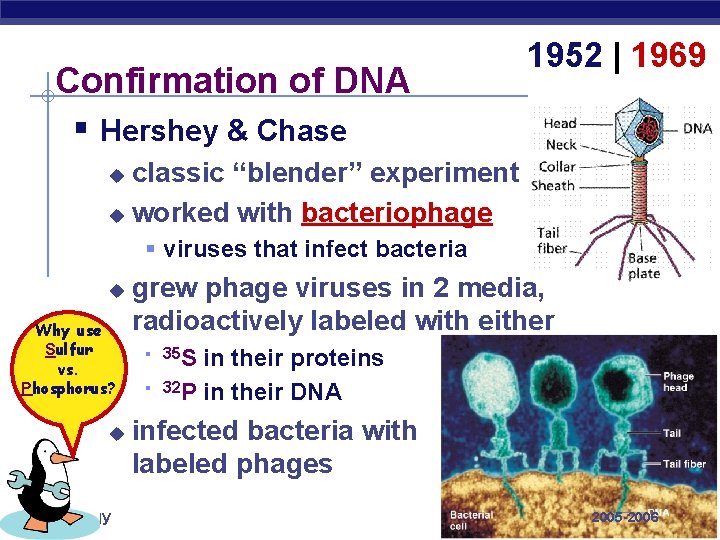
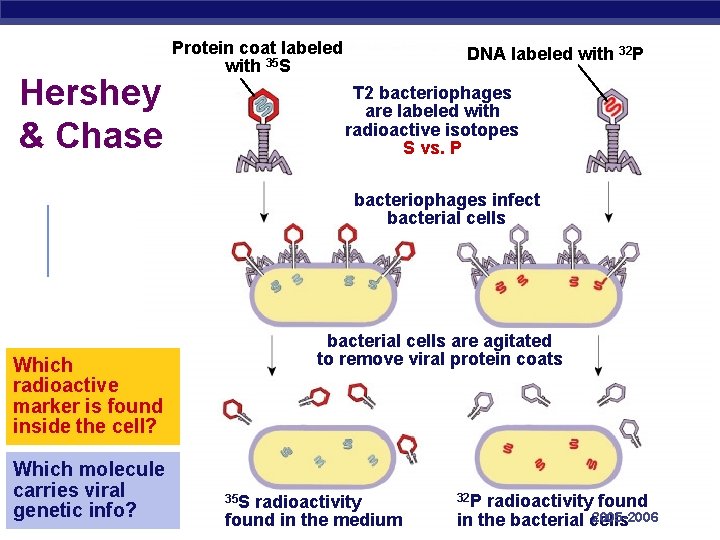
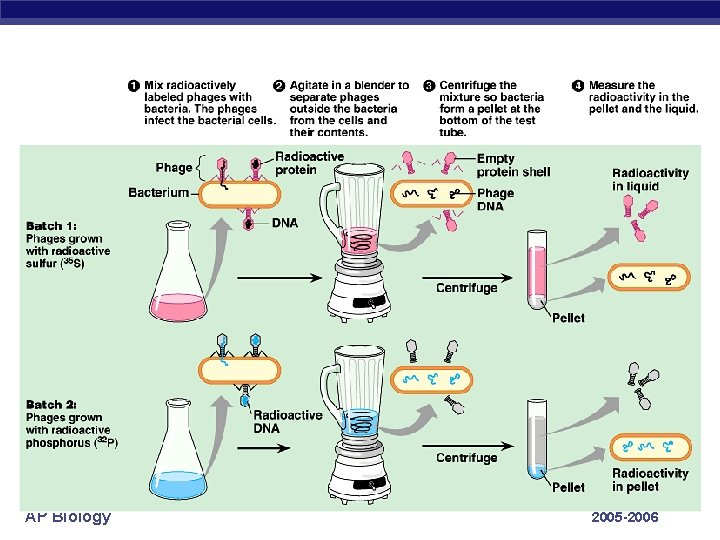
Confirmation of DNA § Hershey & Chase 1952 | 1969 classic “blender” experiment u worked with bacteriophage u § viruses that infect bacteria u Why use Sulfur vs. Phosphorus? u AP Biology grew phage viruses in 2 media, radioactively labeled with either § 35 S § in their proteins 32 P in their DNA infected bacteria with labeled phages 2005 -2006
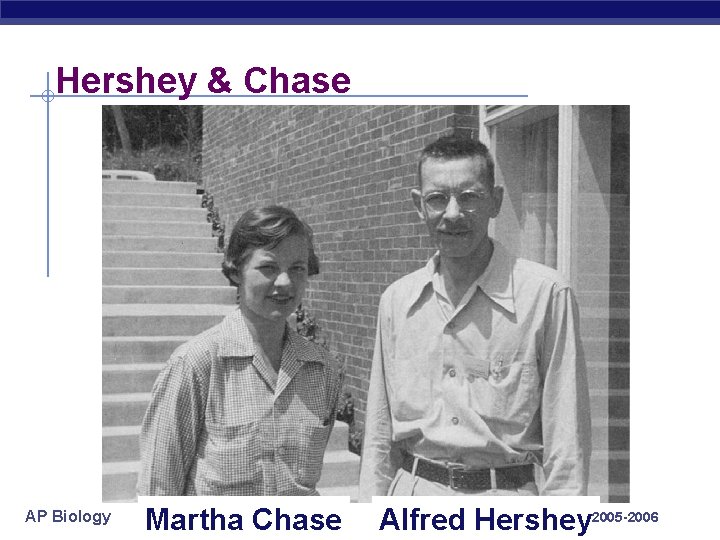
Hershey & Chase AP Biology Martha Chase Alfred Hershey 2005 -2006
Hershey & Chase Protein coat labeled with 35 S DNA labeled with 32 P T 2 bacteriophages are labeled with radioactive isotopes S vs. P bacteriophages infect bacterial cells are agitated to remove viral protein coats Which radioactive marker is found inside the cell? Which molecule carries viral genetic info? AP Biology 35 S radioactivity found in the medium 32 P radioactivity found 2005 -2006 in the bacterial cells
AP Biology 2005 -2006
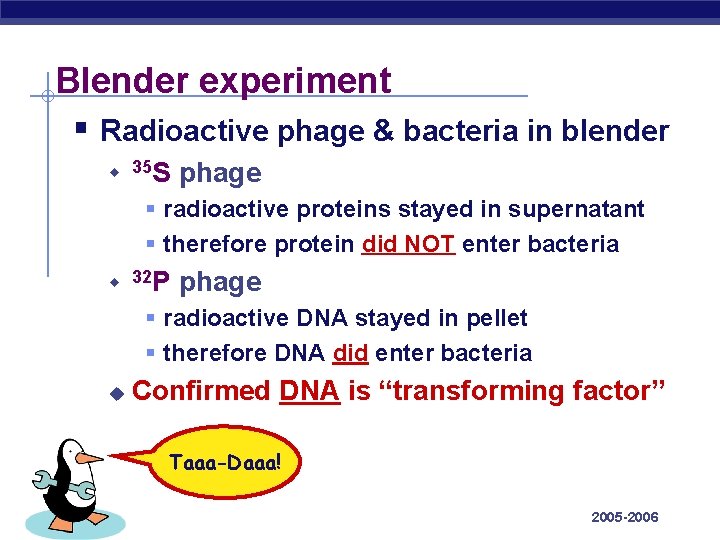
Blender experiment § Radioactive phage & bacteria in blender u 35 S phage § radioactive proteins stayed in supernatant § therefore protein did NOT enter bacteria u 32 P phage § radioactive DNA stayed in pellet § therefore DNA did enter bacteria u Confirmed DNA is “transforming factor” Taaa-Daaa! AP Biology 2005 -2006
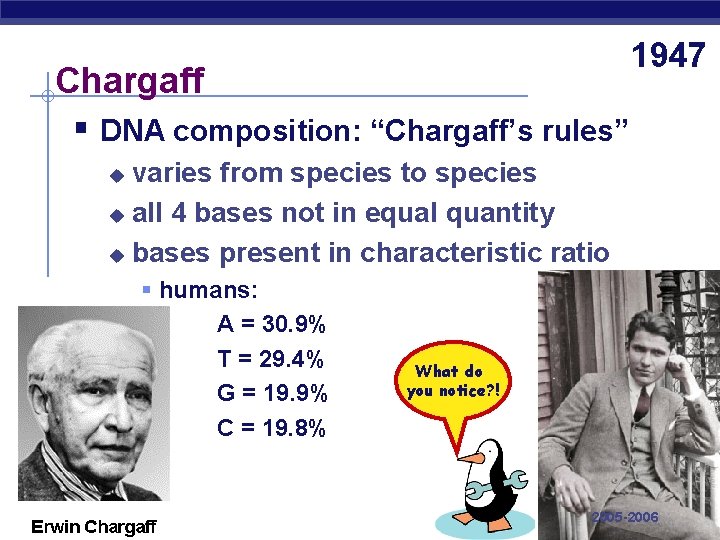
Chargaff § DNA composition: “Chargaff’s rules” 1947 varies from species to species u all 4 bases not in equal quantity u bases present in characteristic ratio u § humans: A = 30. 9% T = 29. 4% G = 19. 9% C = 19. 8% AP Biology What do you notice? ! 2005 -2006
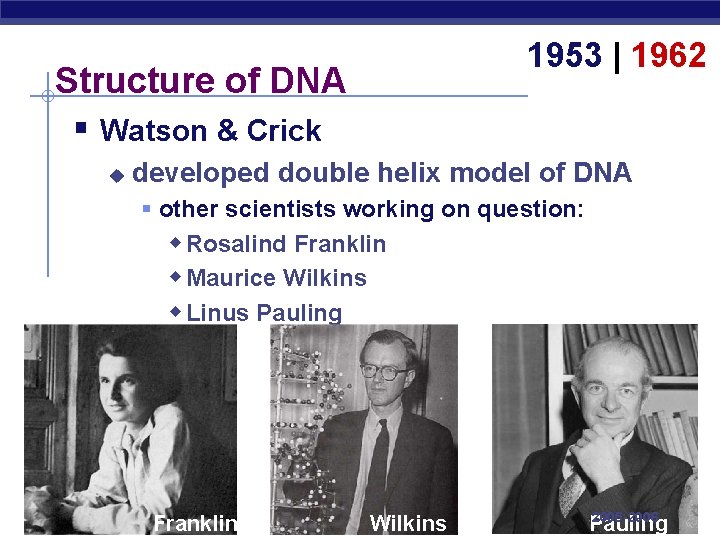
1953 | 1962 Structure of DNA § Watson & Crick u developed double helix model of DNA § other scientists working on question: w Rosalind Franklin w Maurice Wilkins w Linus Pauling AP Biology Franklin Wilkins 2005 -2006 Pauling
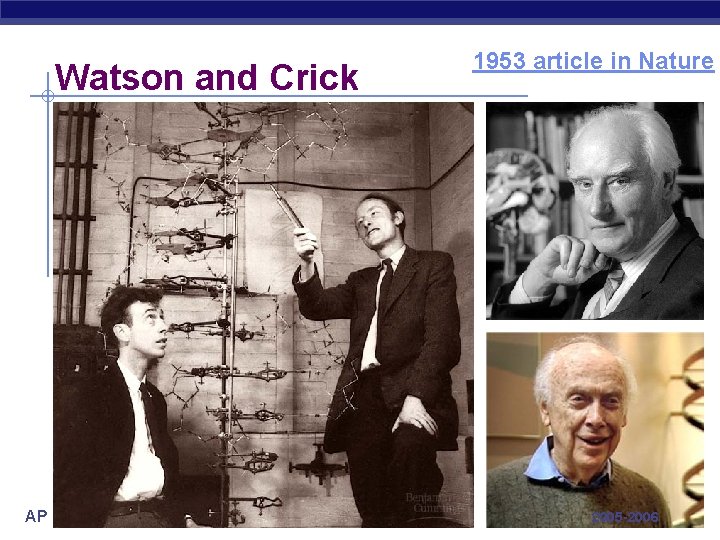
Watson and Crick AP Biology 1953 article in Nature 2005 -2006
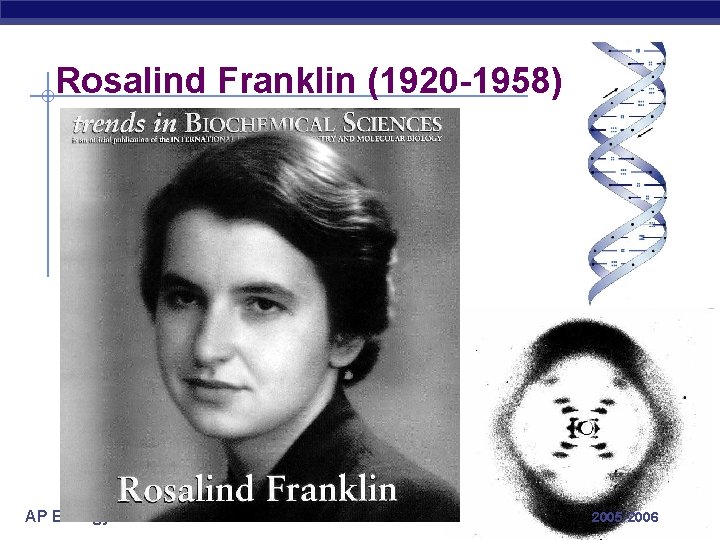
Rosalind Franklin (1920 -1958) AP Biology 2005 -2006
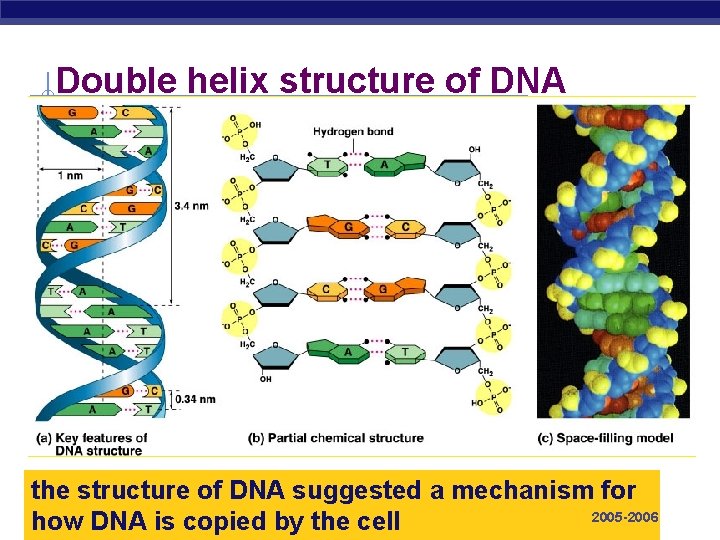
Double helix structure of DNA the structure of DNA suggested a mechanism for AP Biology 2005 -2006 how DNA is copied by the cell
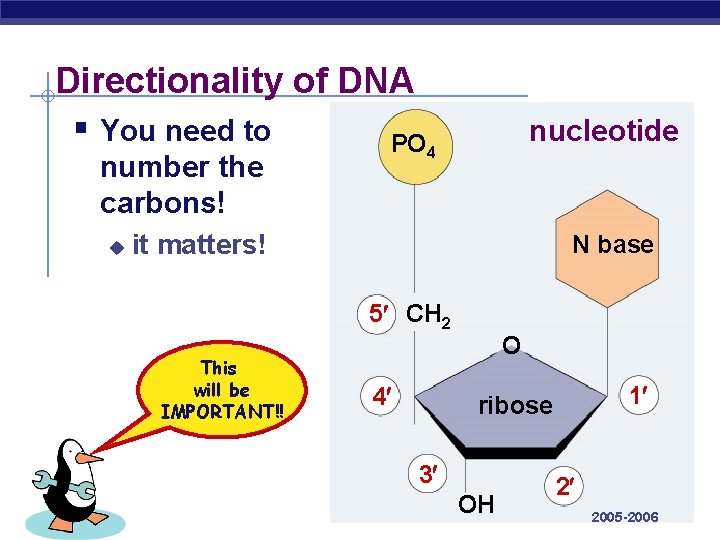
Directionality of DNA § You need to PO 4 nucleotide number the carbons! u it matters! N base 5 CH 2 This will be IMPORTANT!! 4 O 3 AP Biology 1 ribose OH 2 2005 -2006
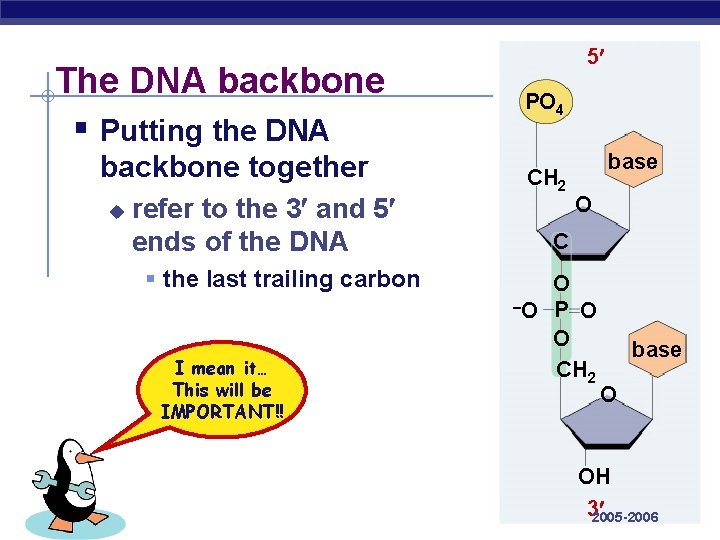
The DNA backbone § Putting the DNA backbone together u refer to the 3 and 5 ends of the DNA § the last trailing carbon I mean it… This will be IMPORTANT!! AP Biology 5 PO 4 CH 2 base O C O –O P O O CH 2 base O OH 3 2005 -2006
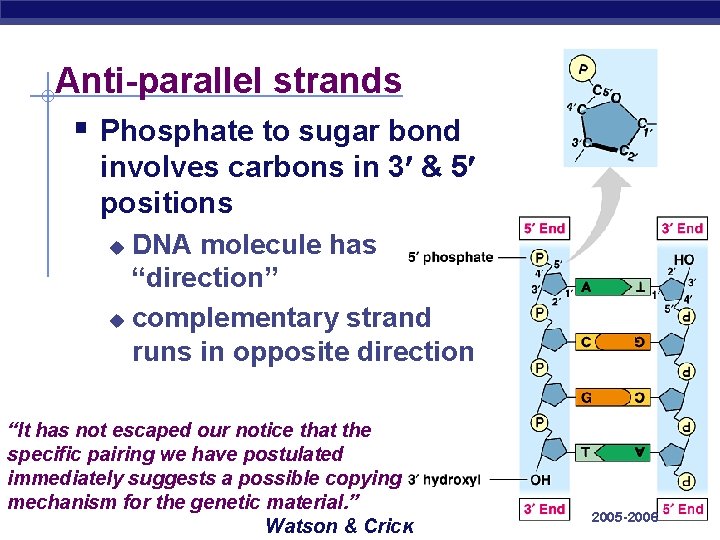
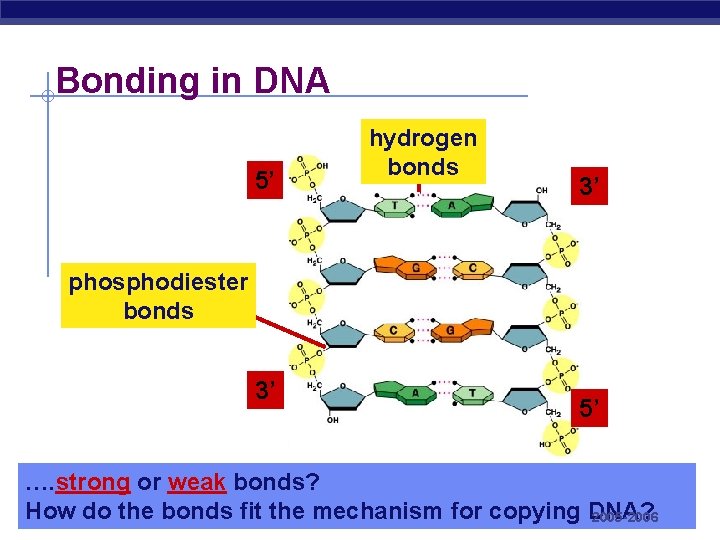
Anti-parallel strands § Phosphate to sugar bond involves carbons in 3 & 5 positions DNA molecule has “direction” u complementary strand runs in opposite direction u “It has not escaped our notice that the specific pairing we have postulated immediately suggests a possible copying mechanism for the genetic material. ” AP Biology Watson & Crick 2005 -2006
Bonding in DNA 5’ hydrogen bonds 3’ phosphodiester bonds 3’ 5’ …. strong or weak bonds? How do the bonds fit the mechanism for copying DNA? AP Biology 2005 -2006
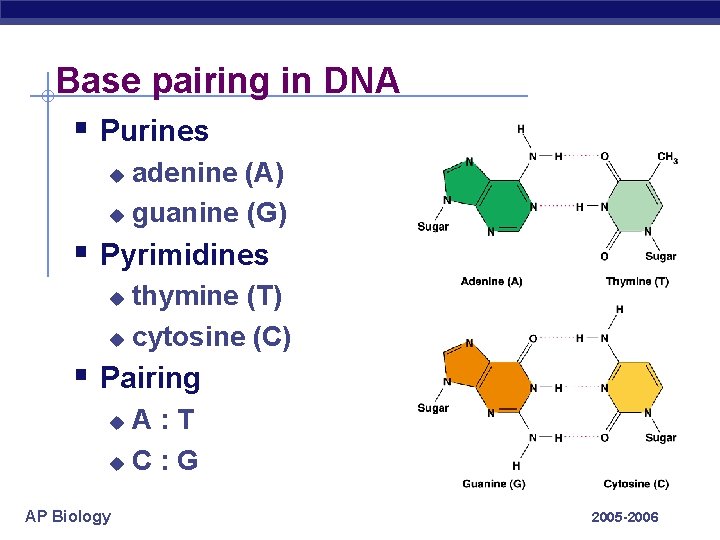
Base pairing in DNA § Purines adenine (A) u guanine (G) u § Pyrimidines thymine (T) u cytosine (C) u § Pairing A: T u. C : G u AP Biology 2005 -2006
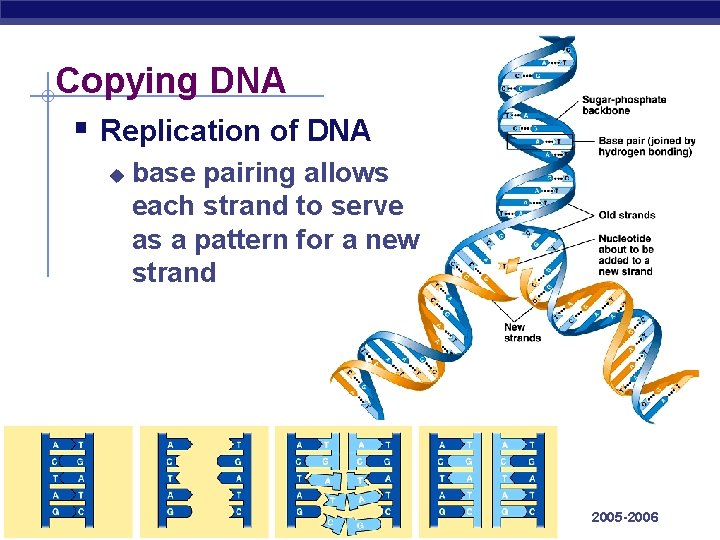
Copying DNA § Replication of DNA u AP Biology base pairing allows each strand to serve as a pattern for a new strand 2005 -2006
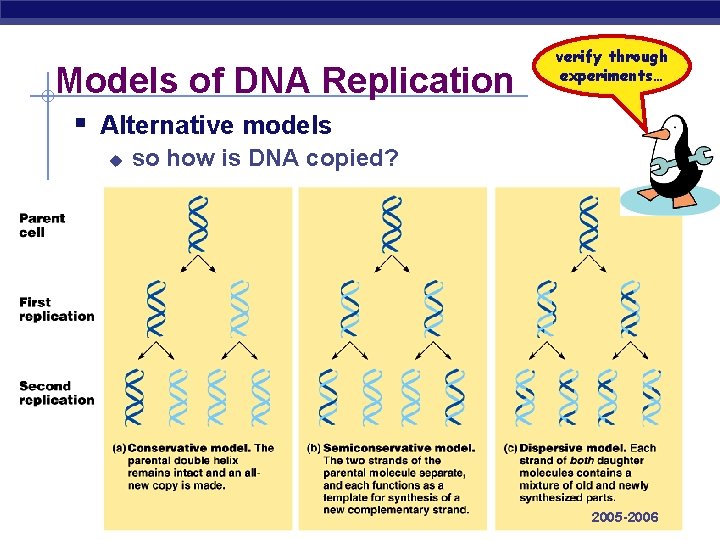
Models of DNA Replication verify through experiments… § Alternative models u AP Biology so how is DNA copied? 2005 -2006
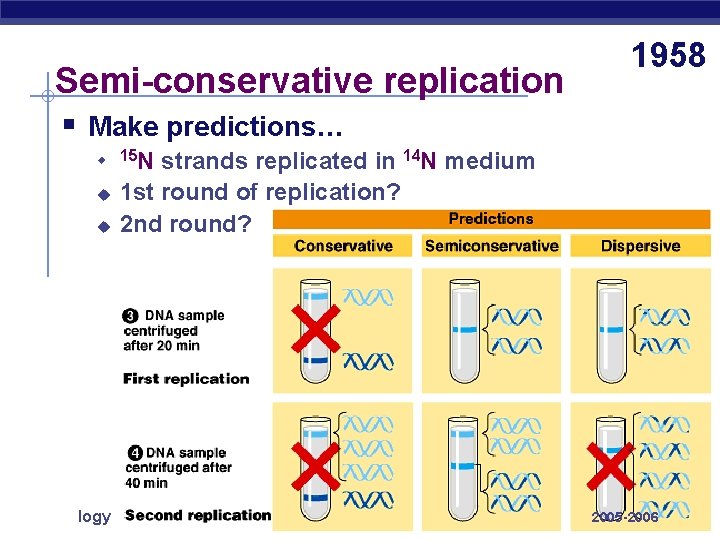
Semi-conservative replication 1958 § Meselson & Stahl u u label nucleotides of “parent” DNA strands with heavy nitrogen = 15 N label new nucleotides with lighter isotope = 14 N “The Most Beautiful Experiment in Biology” parent replication make predictions… AP Biology 2005 -2006
Semi-conservative replication 1958 § Make predictions… u u u AP Biology 15 N strands replicated in 14 N medium 1 st round of replication? 2 nd round? 2005 -2006
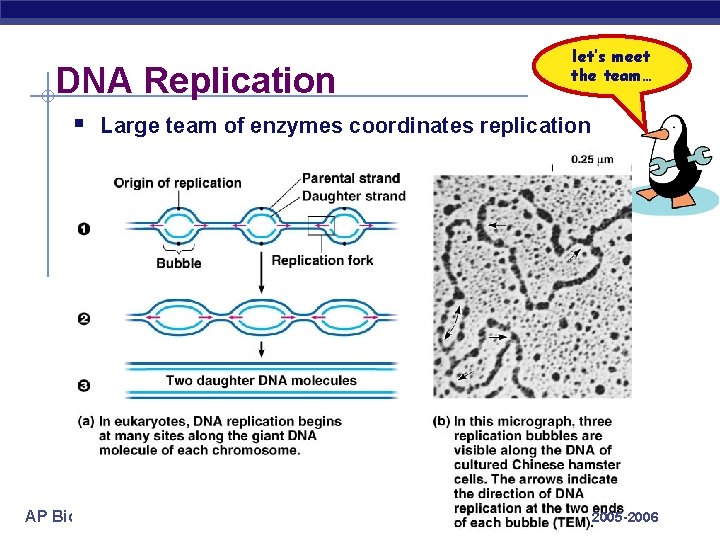
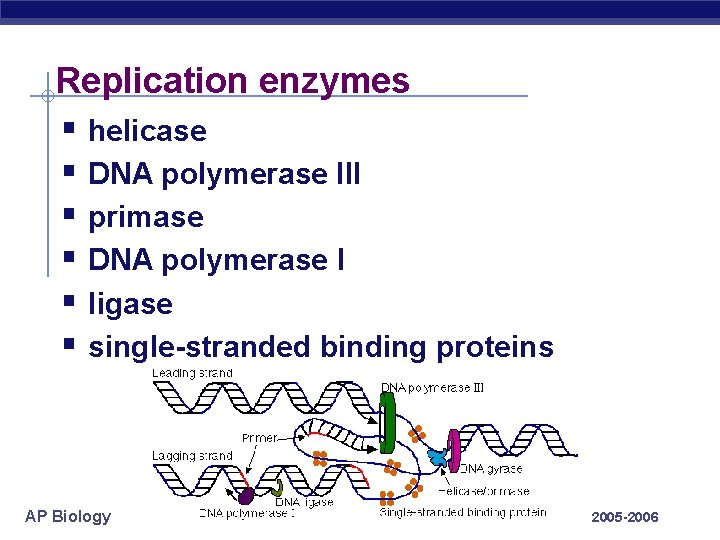
DNA Replication let’s meet the team… § Large team of enzymes coordinates replication AP Biology 2005 -2006
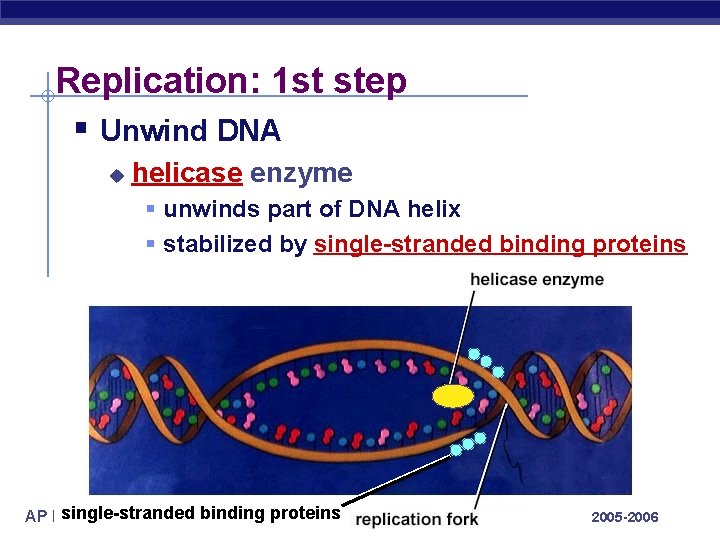
Replication: 1 st step § Unwind DNA u helicase enzyme § unwinds part of DNA helix § stabilized by single-stranded binding proteins AP Biology 2005 -2006
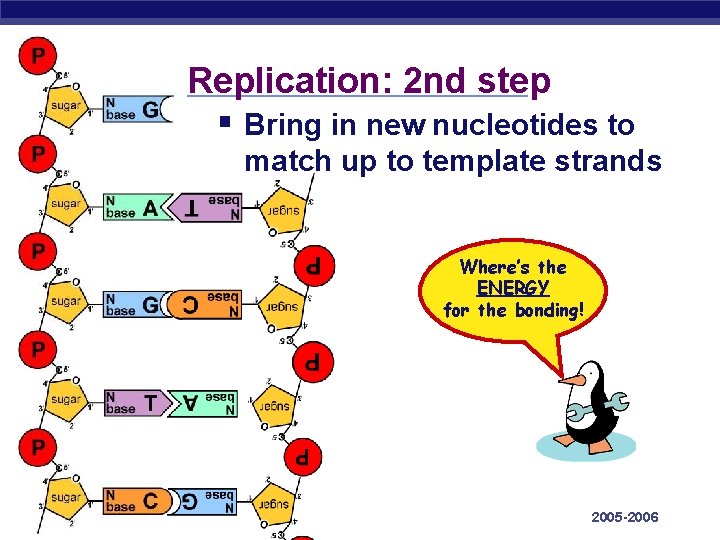
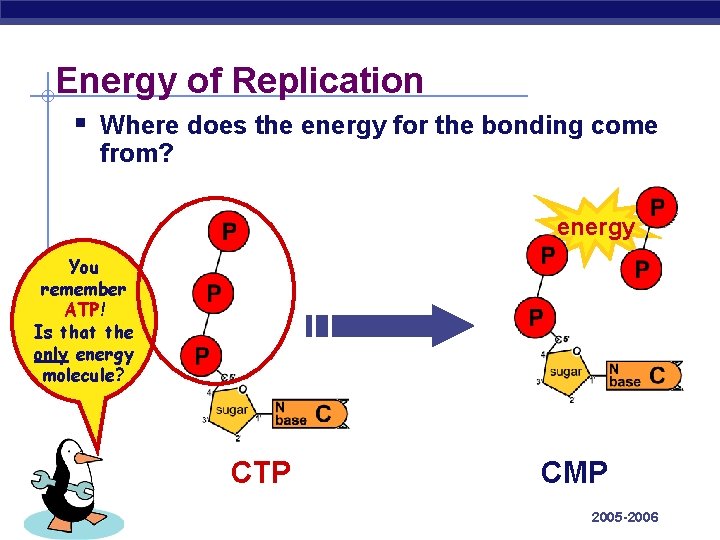
Replication: 2 nd step § Bring in new nucleotides to match up to template strands But… the Where’s We’re missing ENERGY forsomething! the bonding! What? AP Biology 2005 -2006
Energy of Replication § Where does the energy for the bonding come from? energy You remember ATP! Is that the only energy molecule? GTP TTP ATP CTP AP Biology AMP CMP ADP GMP TMP 2005 -2006
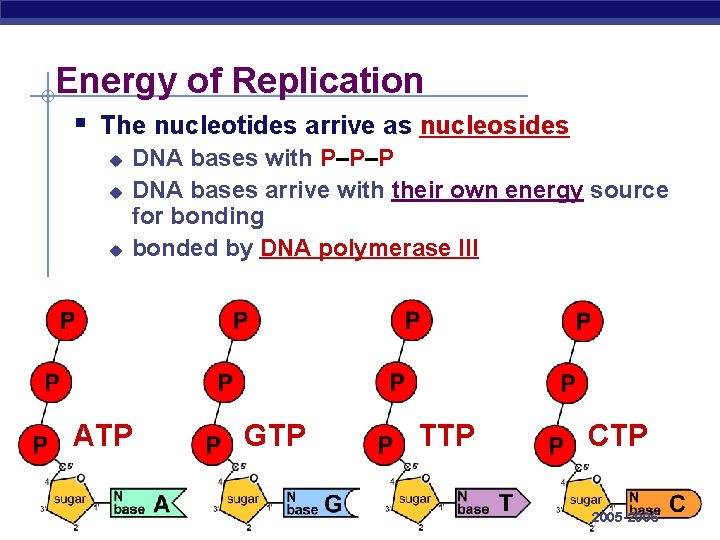
Energy of Replication § The nucleotides arrive as nucleosides u u u DNA bases with P–P–P DNA bases arrive with their own energy source for bonding bonded by DNA polymerase III ATP AP Biology GTP TTP CTP 2005 -2006
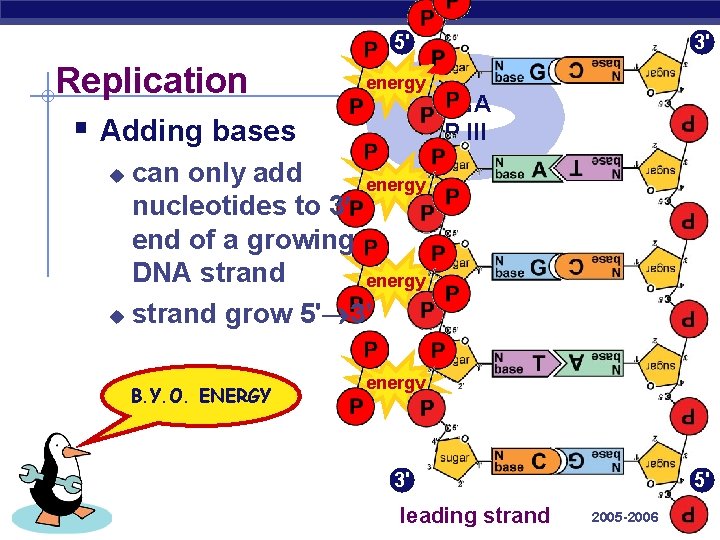
5' Replication § Adding bases energy 3' DNA P III can only add energy nucleotides to 3 end of a growing DNA strand energy u strand grow 5' 3’ u B. Y. O. ENERGY energy 3' AP Biology leading strand 5' 2005 -2006
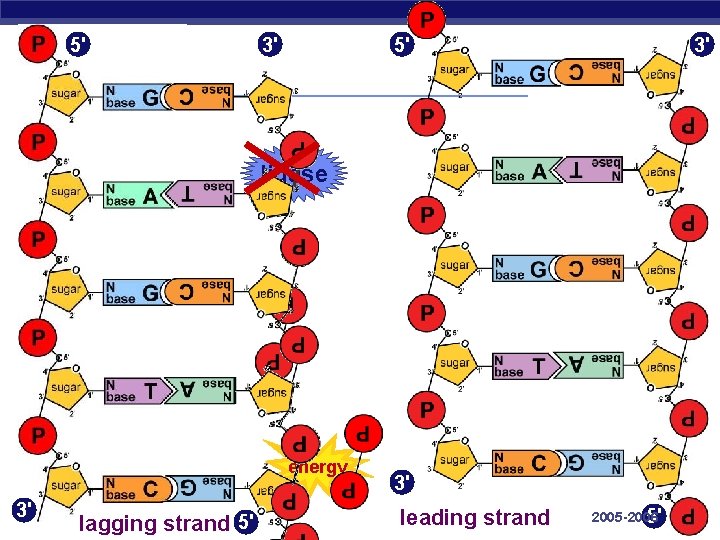
5' 3' ligase energy 3'AP Biology lagging strand 5' 3' leading strand 2005 -2006 5'
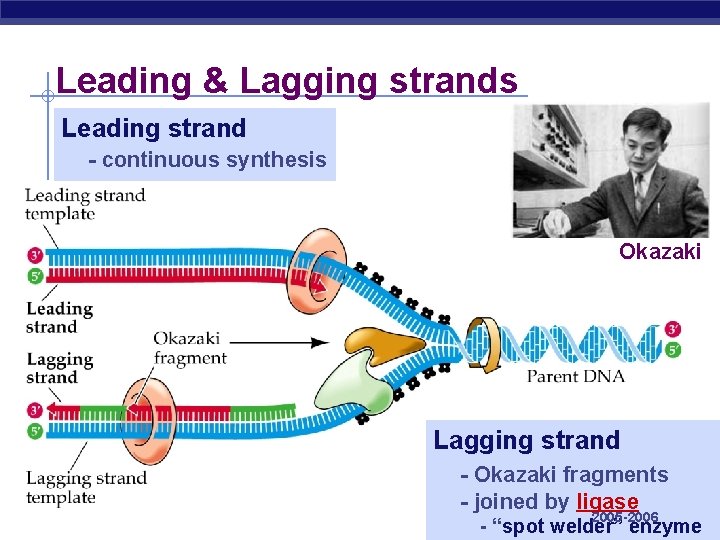
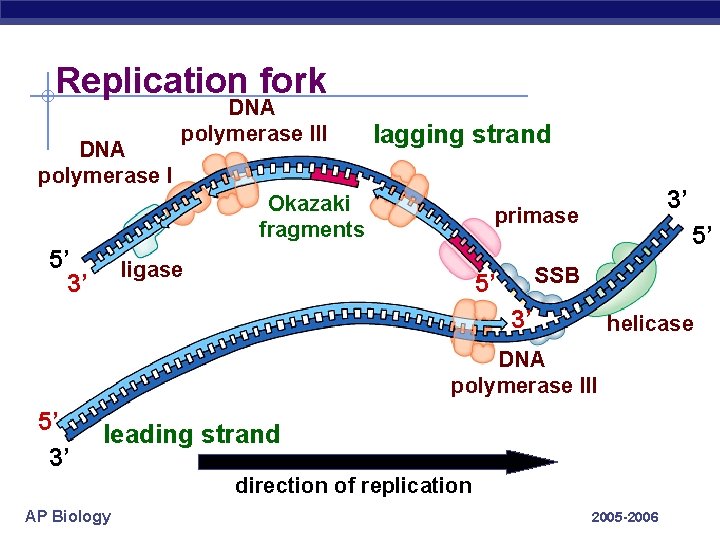
Leading & Lagging strands Leading strand - continuous synthesis Okazaki Lagging strand AP Biology - Okazaki fragments - joined by ligase 2005 -2006 - “spot welder” enzyme
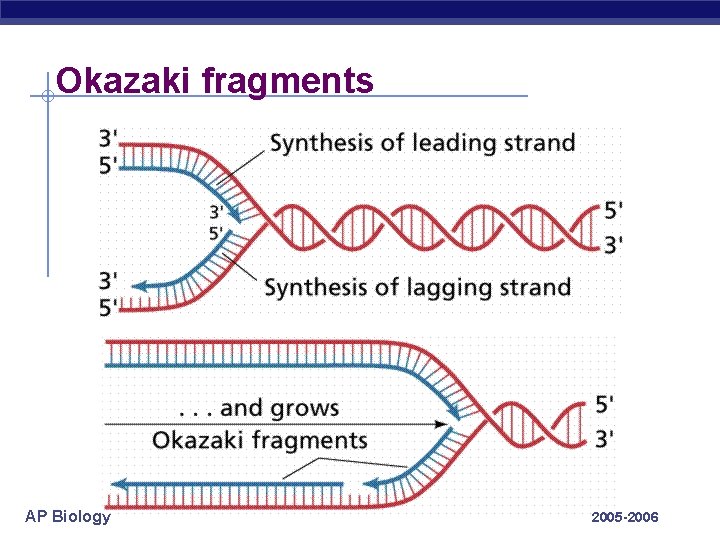
Okazaki fragments AP Biology 2005 -2006
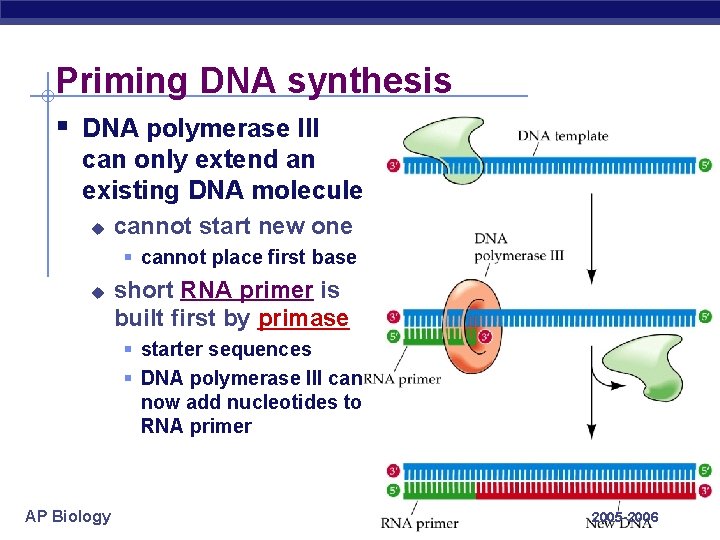
Priming DNA synthesis § DNA polymerase III can only extend an existing DNA molecule u cannot start new one § cannot place first base u short RNA primer is built first by primase § starter sequences § DNA polymerase III can now add nucleotides to RNA primer AP Biology 2005 -2006
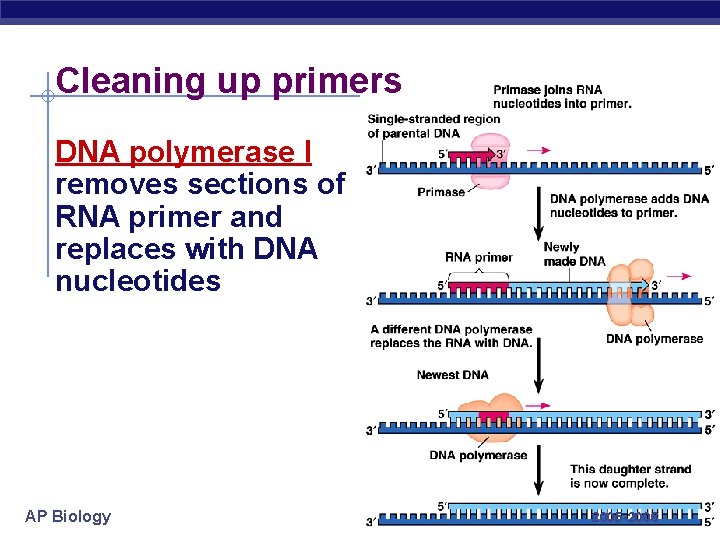
Cleaning up primers DNA polymerase I removes sections of RNA primer and replaces with DNA nucleotides AP Biology 2005 -2006
Replication fork DNA polymerase III lagging strand Okazaki fragments 5’ 3’ 3’ primase ligase 5’ SSB 5’ 3’ helicase DNA polymerase III 5’ 3’ leading strand direction of replication AP Biology 2005 -2006
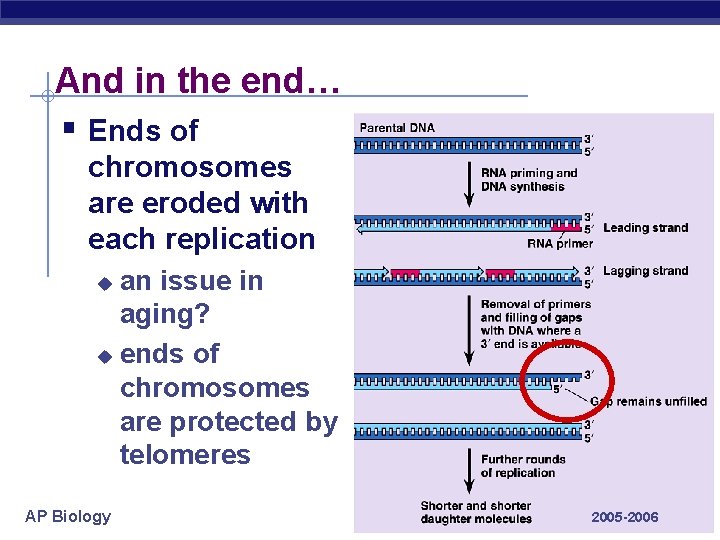
And in the end… § Ends of chromosomes are eroded with each replication an issue in aging? u ends of chromosomes are protected by telomeres u AP Biology 2005 -2006
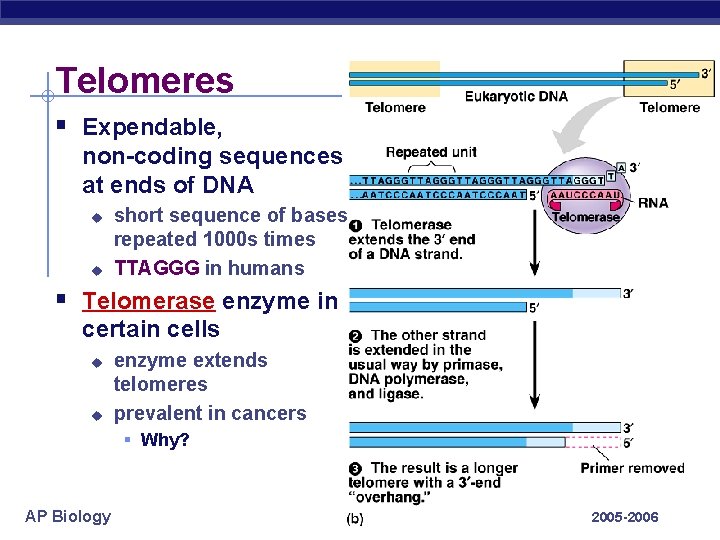
Telomeres § Expendable, non-coding sequences at ends of DNA u u short sequence of bases repeated 1000 s times TTAGGG in humans § Telomerase enzyme in certain cells u u enzyme extends telomeres prevalent in cancers § Why? AP Biology 2005 -2006
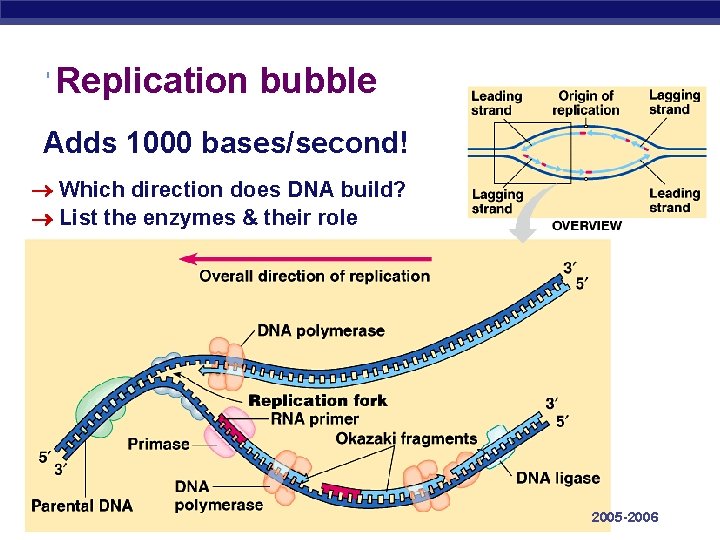
Replication bubble Adds 1000 bases/second! Which direction does DNA build? List the enzymes & their role AP Biology 2005 -2006
Replication enzymes § helicase § DNA polymerase III § primase § DNA polymerase I § ligase § single-stranded binding proteins AP Biology 2005 -2006
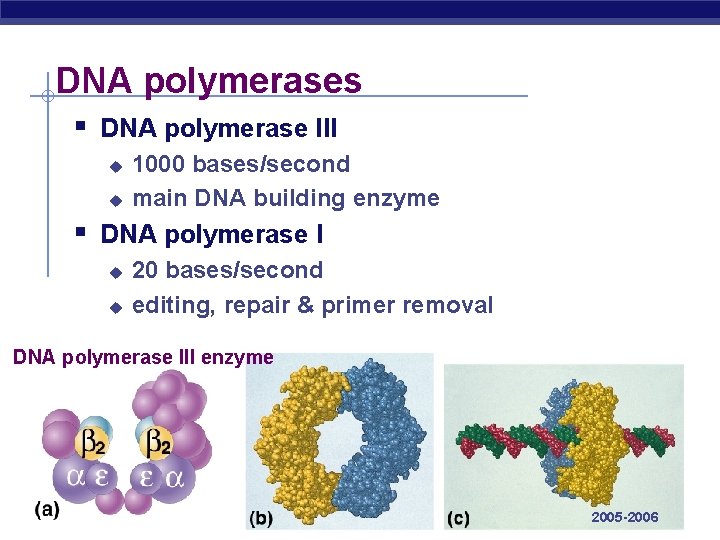
DNA polymerases § DNA polymerase III u u 1000 bases/second main DNA building enzyme § DNA polymerase I u u 20 bases/second editing, repair & primer removal DNA polymerase III enzyme AP Biology 2005 -2006
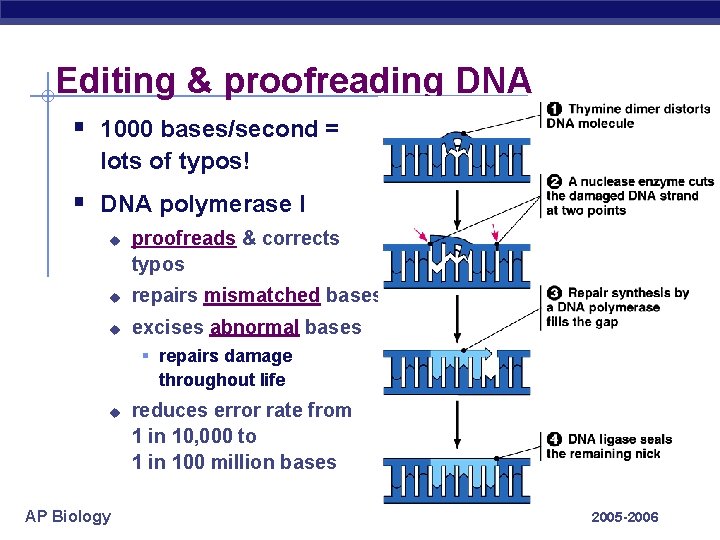
Editing & proofreading DNA § 1000 bases/second = lots of typos! § DNA polymerase I u proofreads & corrects typos u repairs mismatched bases u excises abnormal bases § repairs damage throughout life u AP Biology reduces error rate from 1 in 10, 000 to 1 in 100 million bases 2005 -2006
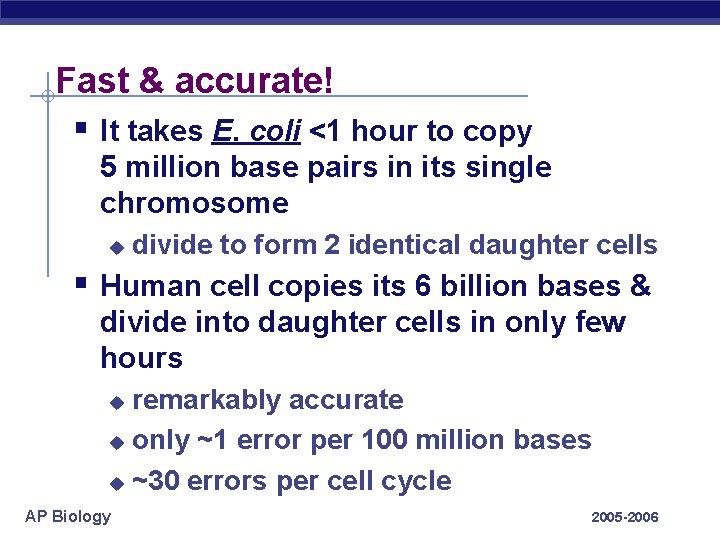
Fast & accurate! § It takes E. coli <1 hour to copy 5 million base pairs in its single chromosome u divide to form 2 identical daughter cells § Human cell copies its 6 billion bases & divide into daughter cells in only few hours remarkably accurate u only ~1 error per 100 million bases u ~30 errors per cell cycle u AP Biology 2005 -2006
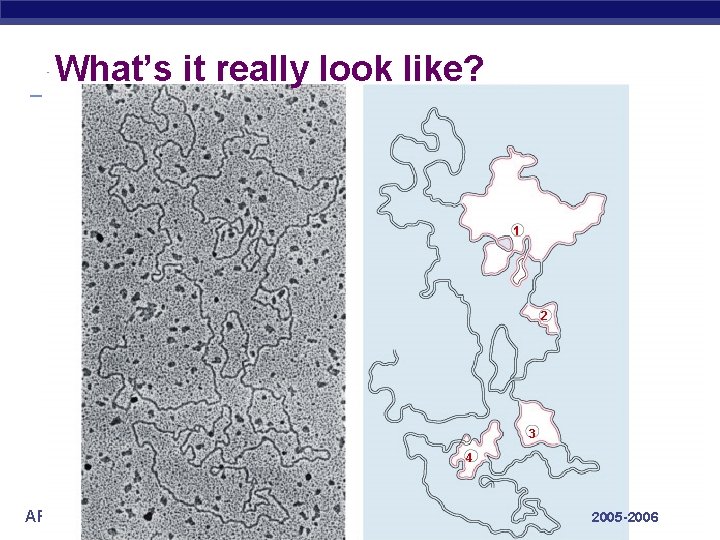
What’s it really look like? 1 2 3 4 AP Biology 2005 -2006
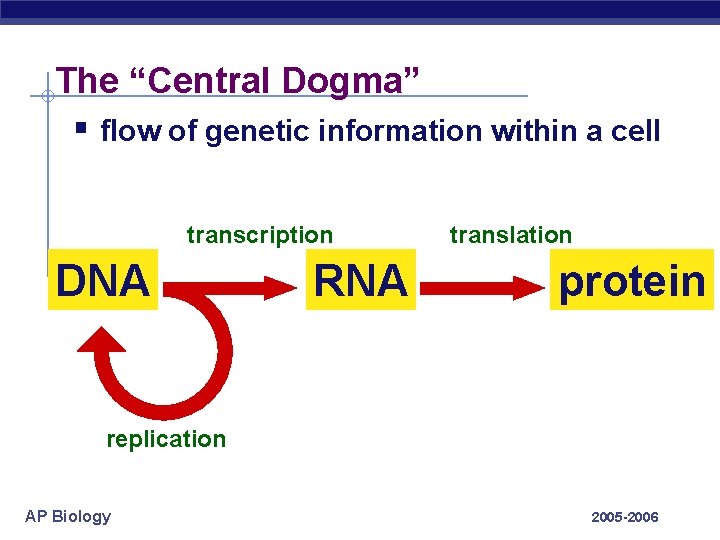
The “Central Dogma” § flow of genetic information within a cell transcription DNA RNA translation protein replication AP Biology 2005 -2006
Any Questions? ? AP Biology 2005 -2006