
Chapter 16 Decision Analysis 2015 Mc GrawHill Education
- Slides: 36
Chapter 16 Decision Analysis © 2015 Mc. Graw-Hill Education. All rights reserved.
Introduction • The focus of previous chapters: – Decision-making when consequences of alternative decisions are known with a reasonable degree of certainty • Testing (experimentation) can reduce level of uncertainty • Decision analysis – Addresses decision-making in the face of great uncertainty – Provides framework and methodology © 2015 Mc. Graw-Hill Education. All rights reserved. 2
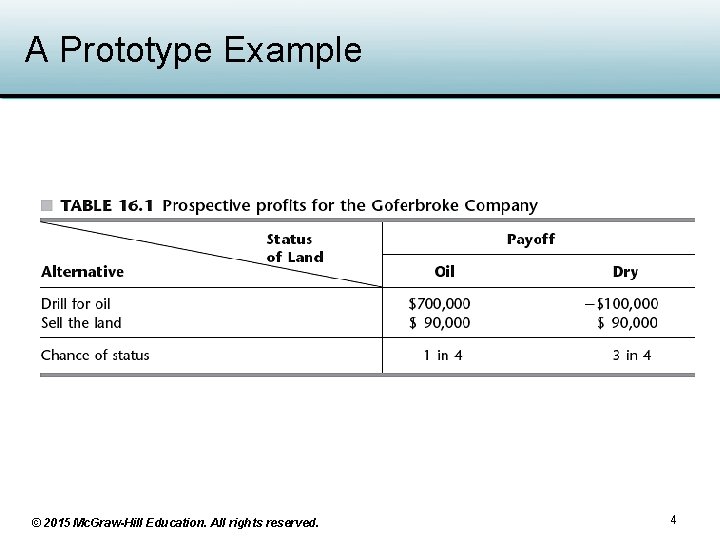
16. 1 A Prototype Example • Goferbroke Company owns land that may contain oil – Geologist reports 25% chance of oil – Another company offers to purchase land for $90 k – Goferbroke option: drill for oil at cost of $100 k • Potential gross profit $800 k (net $700 k) • Potential net loss of $100 k if land is dry – Need to decide whether to drill or sell © 2015 Mc. Graw-Hill Education. All rights reserved. 3
A Prototype Example © 2015 Mc. Graw-Hill Education. All rights reserved. 4
16. 2 Decision Making Without Experimentation • Decision maker must choose an alternative – From a set of feasible alternatives • State of nature – Factors in place at the time of the decision that affect the outcome • Payoff table shows payoff for each combination of decision alternative and state of nature © 2015 Mc. Graw-Hill Education. All rights reserved. 5
Decision Making Without Experimentation • Analogy with game theory – Decision maker is player 1 • Chooses one of the decision alternatives – Nature is player 2 • Chooses one of the possible states of nature – Each combination of decision and state of nature results in a payoff – Payoff table should be used to find an optimal alternative for the decision maker • According to an appropriate criterion © 2015 Mc. Graw-Hill Education. All rights reserved. 6
Decision Making Without Experimentation • Differences from game theory – Nature is not rational or self-promoting – Decision maker likely has information about relative likelihood of possible states of nature • Probability distribution: prior distribution • Probabilities: prior probabilities © 2015 Mc. Graw-Hill Education. All rights reserved. 7
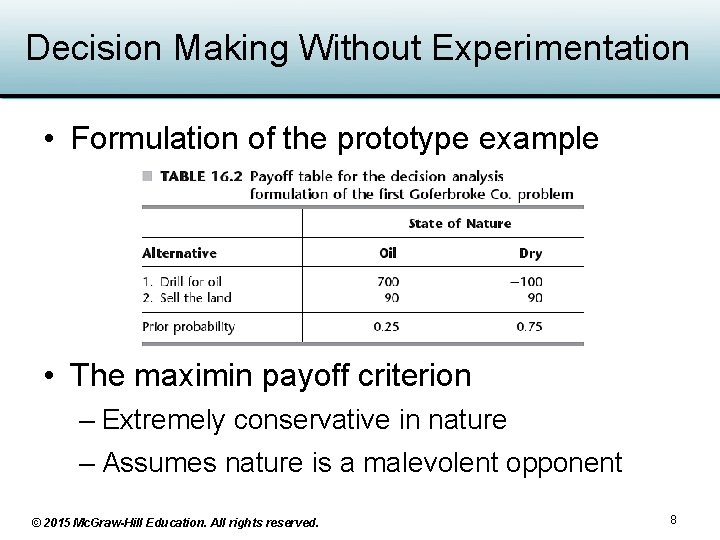
Decision Making Without Experimentation • Formulation of the prototype example • The maximin payoff criterion – Extremely conservative in nature – Assumes nature is a malevolent opponent © 2015 Mc. Graw-Hill Education. All rights reserved. 8
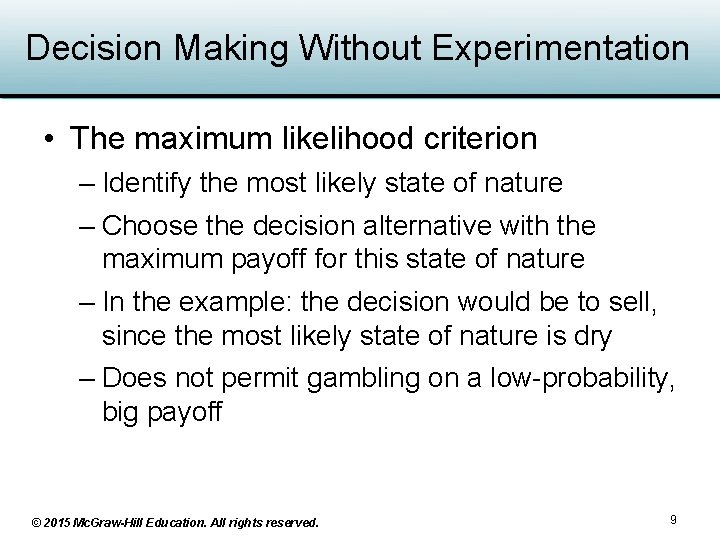
Decision Making Without Experimentation • The maximum likelihood criterion – Identify the most likely state of nature – Choose the decision alternative with the maximum payoff for this state of nature – In the example: the decision would be to sell, since the most likely state of nature is dry – Does not permit gambling on a low-probability, big payoff © 2015 Mc. Graw-Hill Education. All rights reserved. 9
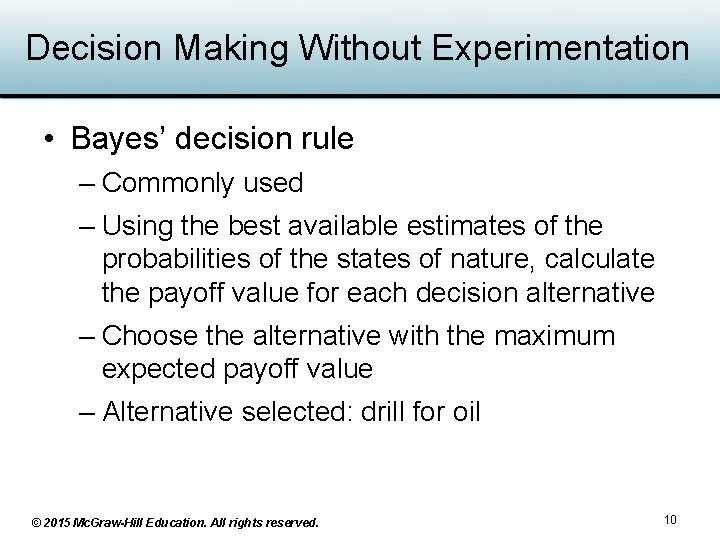
Decision Making Without Experimentation • Bayes’ decision rule – Commonly used – Using the best available estimates of the probabilities of the states of nature, calculate the payoff value for each decision alternative – Choose the alternative with the maximum expected payoff value – Alternative selected: drill for oil © 2015 Mc. Graw-Hill Education. All rights reserved. 10
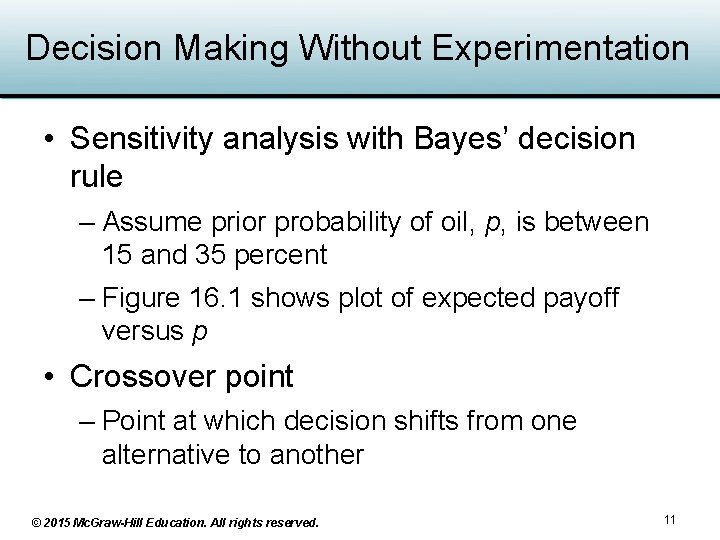
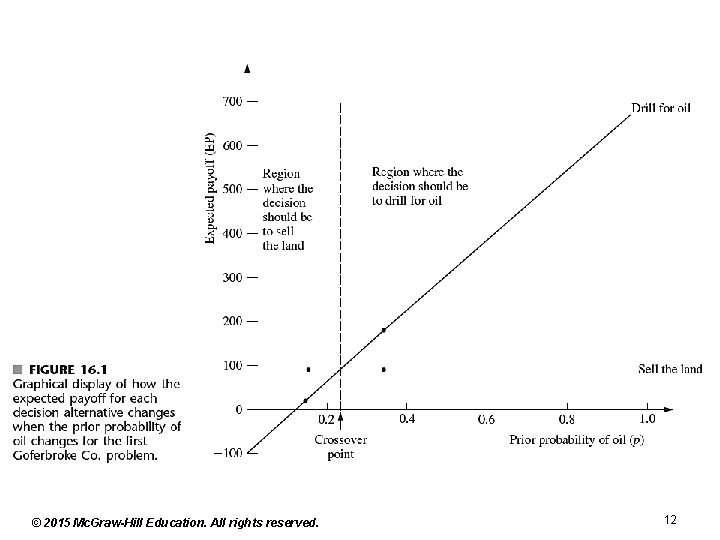
Decision Making Without Experimentation • Sensitivity analysis with Bayes’ decision rule – Assume prior probability of oil, p, is between 15 and 35 percent – Figure 16. 1 shows plot of expected payoff versus p • Crossover point – Point at which decision shifts from one alternative to another © 2015 Mc. Graw-Hill Education. All rights reserved. 11
© 2015 Mc. Graw-Hill Education. All rights reserved. 12
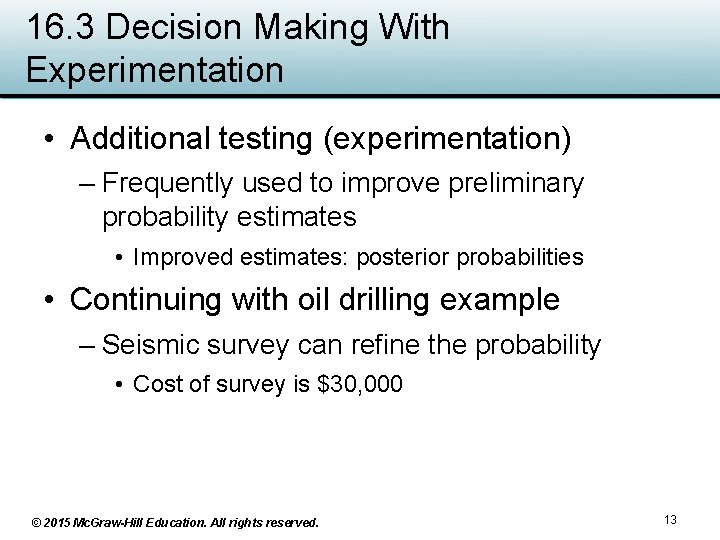
16. 3 Decision Making With Experimentation • Additional testing (experimentation) – Frequently used to improve preliminary probability estimates • Improved estimates: posterior probabilities • Continuing with oil drilling example – Seismic survey can refine the probability • Cost of survey is $30, 000 © 2015 Mc. Graw-Hill Education. All rights reserved. 13
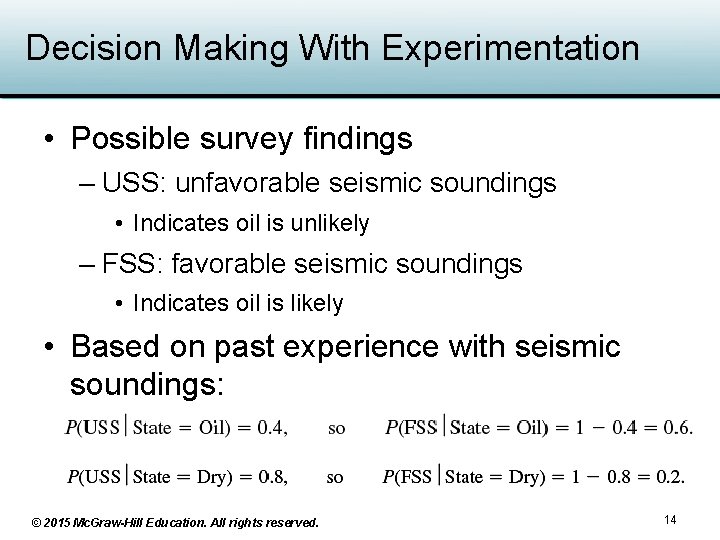
Decision Making With Experimentation • Possible survey findings – USS: unfavorable seismic soundings • Indicates oil is unlikely – FSS: favorable seismic soundings • Indicates oil is likely • Based on past experience with seismic soundings: © 2015 Mc. Graw-Hill Education. All rights reserved. 14
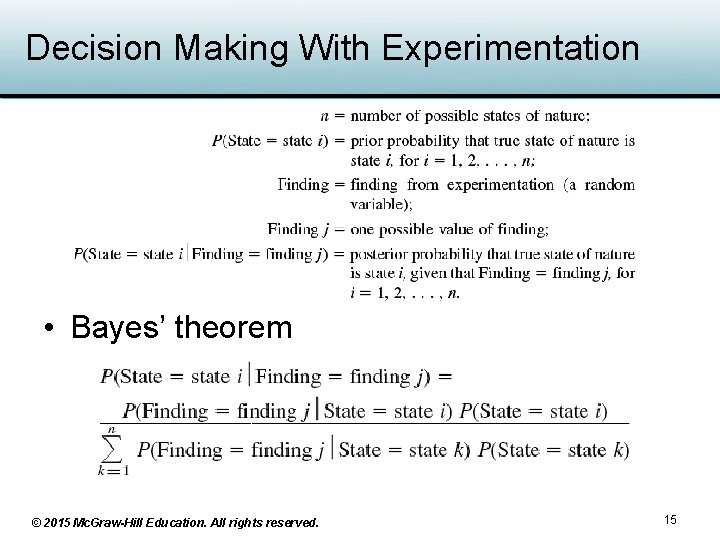
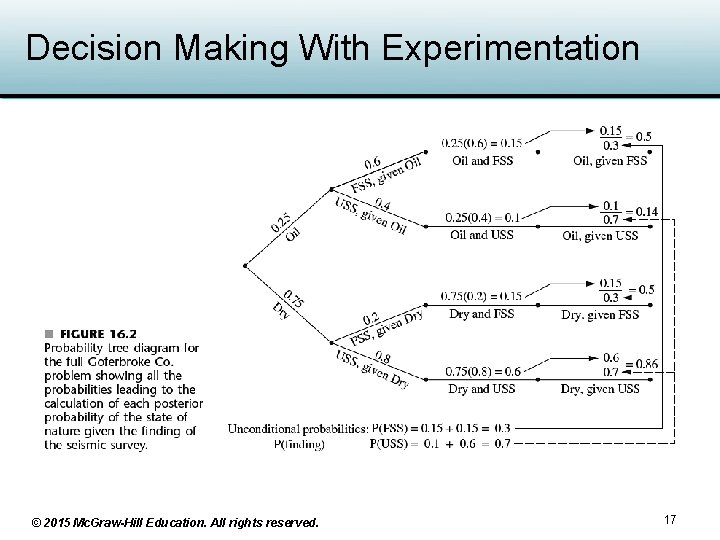
Decision Making With Experimentation • Bayes’ theorem © 2015 Mc. Graw-Hill Education. All rights reserved. 15
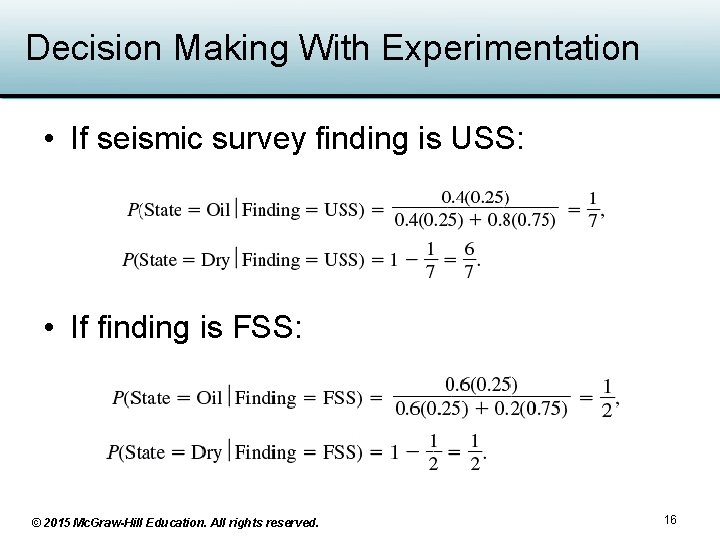
Decision Making With Experimentation • If seismic survey finding is USS: • If finding is FSS: © 2015 Mc. Graw-Hill Education. All rights reserved. 16
Decision Making With Experimentation © 2015 Mc. Graw-Hill Education. All rights reserved. 17
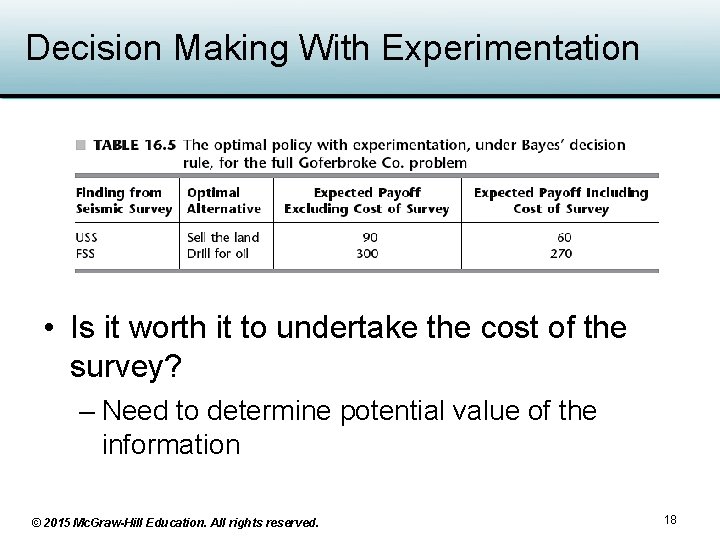
Decision Making With Experimentation • Is it worth it to undertake the cost of the survey? – Need to determine potential value of the information © 2015 Mc. Graw-Hill Education. All rights reserved. 18
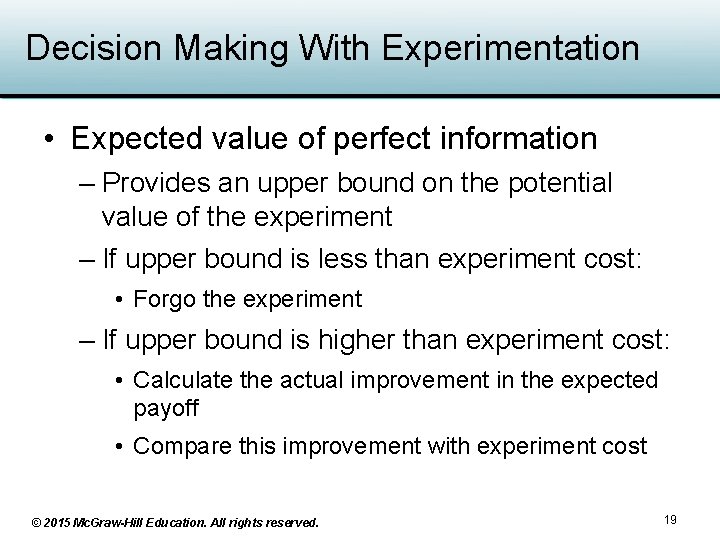
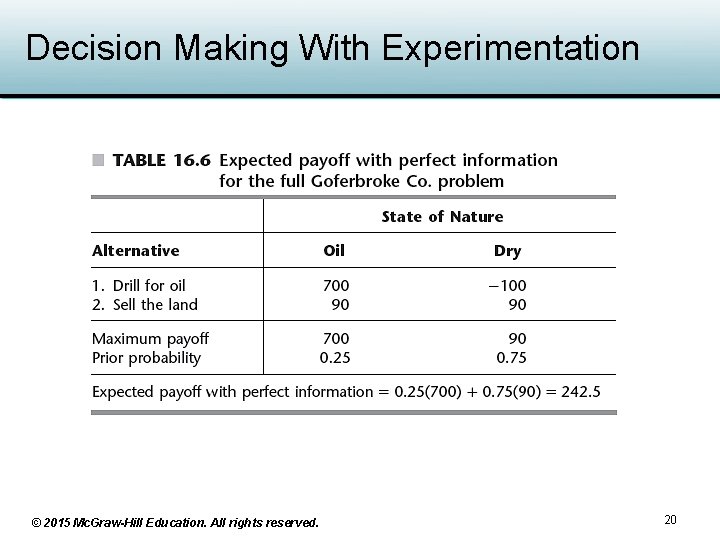
Decision Making With Experimentation • Expected value of perfect information – Provides an upper bound on the potential value of the experiment – If upper bound is less than experiment cost: • Forgo the experiment – If upper bound is higher than experiment cost: • Calculate the actual improvement in the expected payoff • Compare this improvement with experiment cost © 2015 Mc. Graw-Hill Education. All rights reserved. 19
Decision Making With Experimentation © 2015 Mc. Graw-Hill Education. All rights reserved. 20
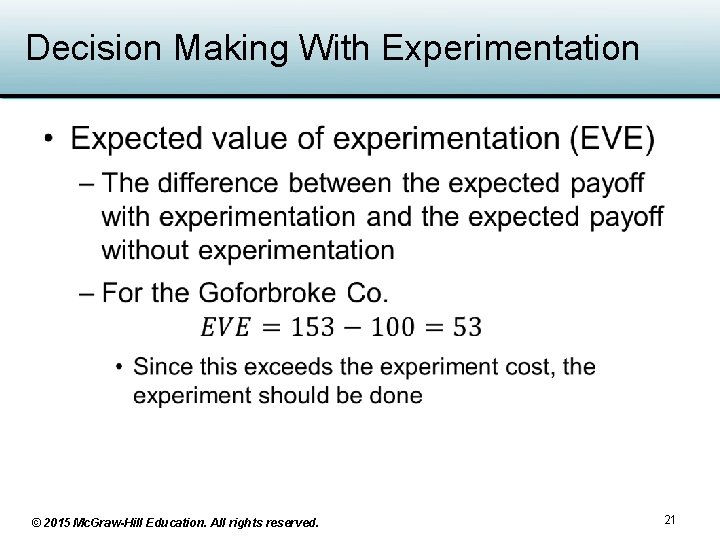
Decision Making With Experimentation • © 2015 Mc. Graw-Hill Education. All rights reserved. 21
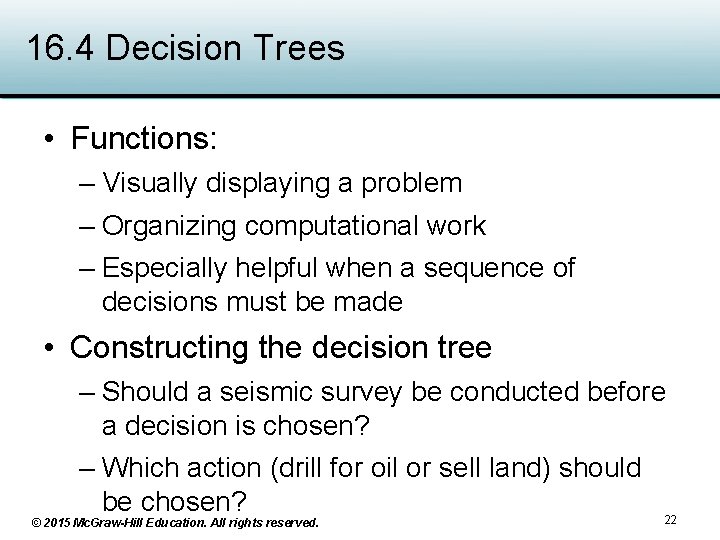
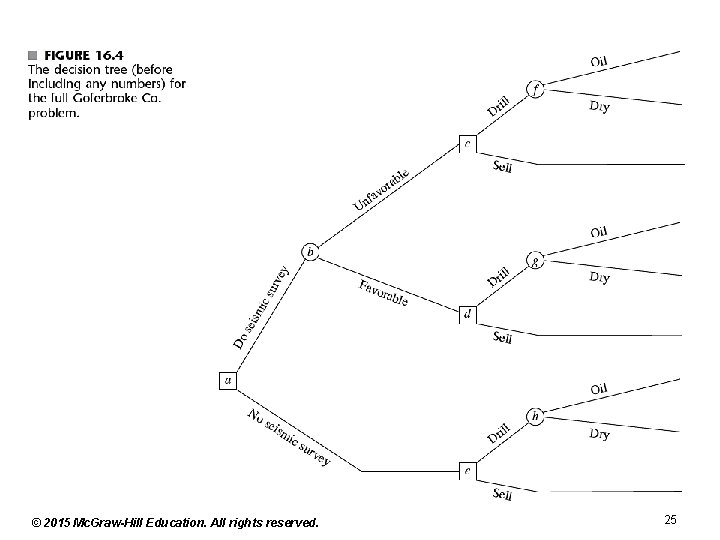
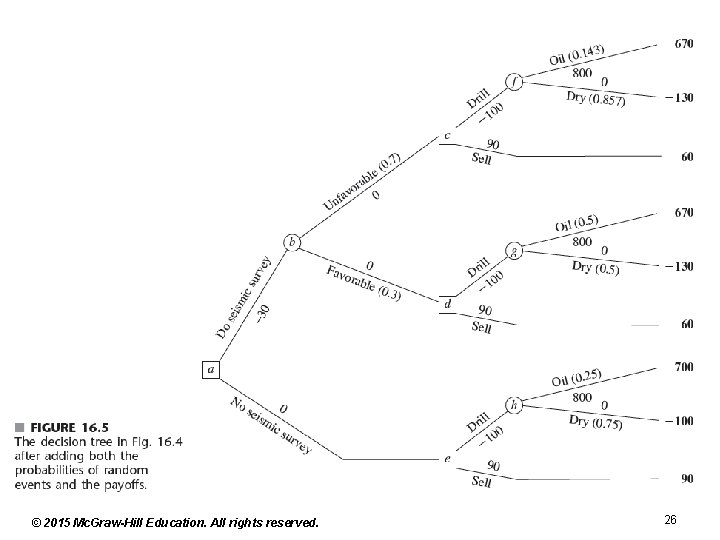
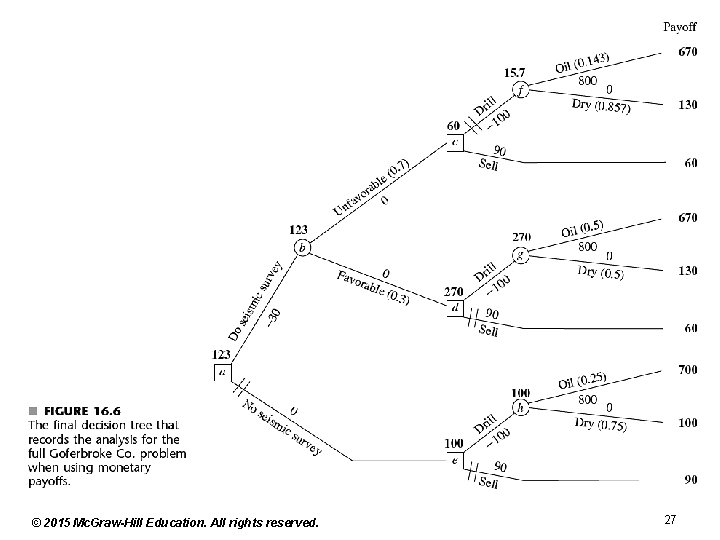
16. 4 Decision Trees • Functions: – Visually displaying a problem – Organizing computational work – Especially helpful when a sequence of decisions must be made • Constructing the decision tree – Should a seismic survey be conducted before a decision is chosen? – Which action (drill for oil or sell land) should be chosen? 22 © 2015 Mc. Graw-Hill Education. All rights reserved.
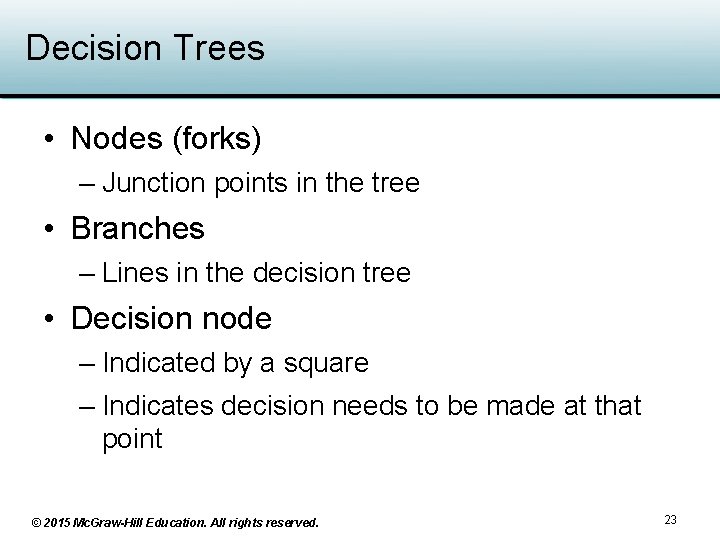
Decision Trees • Nodes (forks) – Junction points in the tree • Branches – Lines in the decision tree • Decision node – Indicated by a square – Indicates decision needs to be made at that point © 2015 Mc. Graw-Hill Education. All rights reserved. 23
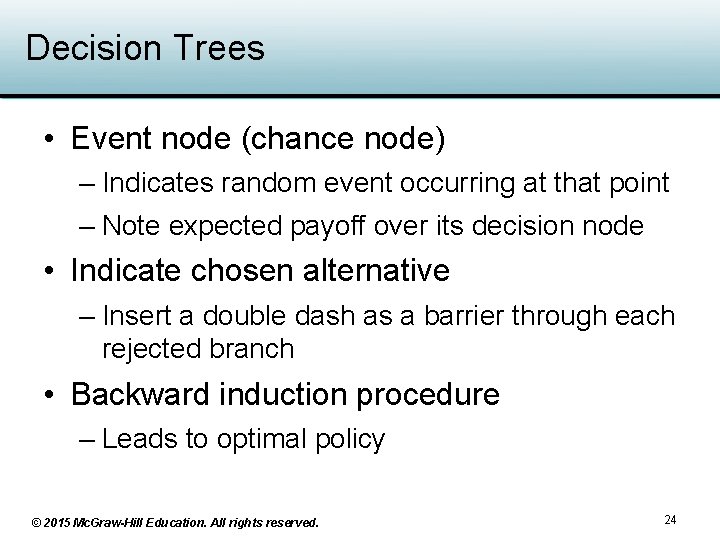
Decision Trees • Event node (chance node) – Indicates random event occurring at that point – Note expected payoff over its decision node • Indicate chosen alternative – Insert a double dash as a barrier through each rejected branch • Backward induction procedure – Leads to optimal policy © 2015 Mc. Graw-Hill Education. All rights reserved. 24
© 2015 Mc. Graw-Hill Education. All rights reserved. 25
© 2015 Mc. Graw-Hill Education. All rights reserved. 26
© 2015 Mc. Graw-Hill Education. All rights reserved. 27
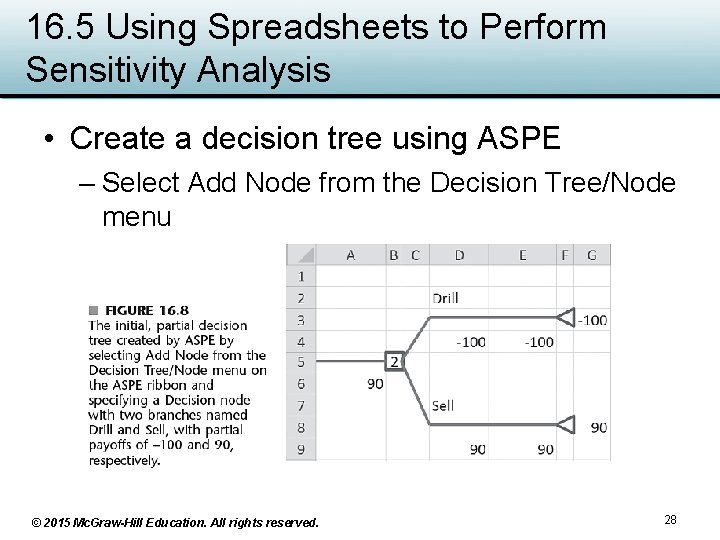
16. 5 Using Spreadsheets to Perform Sensitivity Analysis • Create a decision tree using ASPE – Select Add Node from the Decision Tree/Node menu © 2015 Mc. Graw-Hill Education. All rights reserved. 28
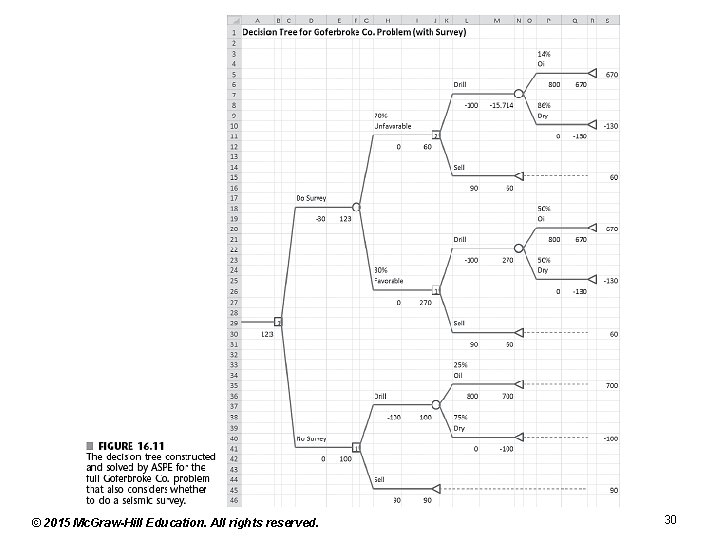
Using Spreadsheets to Perform Sensitivity Analysis • Full decision tree shown in Figure 16. 11 • Expand the spreadsheet for performing sensitivity analysis – Consolidate the data and result on the right hand side • Advantage: need to only change data in one place • Approaches – Select new trial values – Consider a range of values © 2015 Mc. Graw-Hill Education. All rights reserved. 29
© 2015 Mc. Graw-Hill Education. All rights reserved. 30
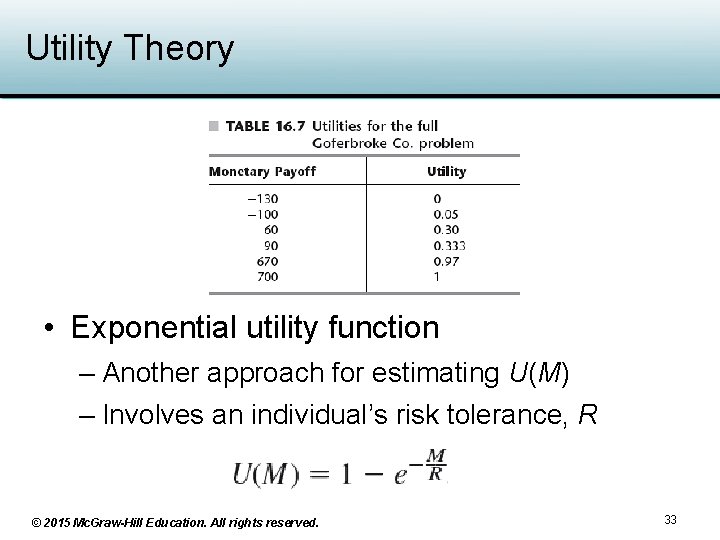
16. 6 Utility Theory • Monetary values may not always correctly represent consequences of taking an action • Utility functions for money U(M) – People may have an increasing or decreasing marginal utility for money • Decision maker is indifferent between two courses of action if they have the same utility © 2015 Mc. Graw-Hill Education. All rights reserved. 31
Utility Theory • Equivalent lottery method for determining utilities – See Page 710 in the text • Applying utility theory to the full Goforbroke Co. problem – Identify the utilities for all the possible monetary payoffs • Shown in Table 16. 7 on next slide © 2015 Mc. Graw-Hill Education. All rights reserved. 32
Utility Theory • Exponential utility function – Another approach for estimating U(M) – Involves an individual’s risk tolerance, R © 2015 Mc. Graw-Hill Education. All rights reserved. 33
16. 7 The Practical Application of Decision Analysis • Real applications involve many more decisions and states of nature: – Than were considered in the prototype example • Decision trees would become large and unwieldy • Several software packages are available • Algebraic techniques being developed and incorporated into computer solvers © 2015 Mc. Graw-Hill Education. All rights reserved. 34
The Practical Application of Decision Analysis • Other graphical techniques – Tornado charts – Influence diagrams • Decision conferencing – Technique for group decision making – Group of people work with a facilitator – Analyst builds and solves models on the spot • Consulting firm may be used if company does not have analyst trained in OR techniques © 2015 Mc. Graw-Hill Education. All rights reserved. 35
16. 8 Conclusions • Decision analysis is an important technique when facing decisions with considerable uncertainty • Decision analysis involves: – Enumerating potential alternatives – Identifying payoffs for all possible outcomes – Quantifying probabilities for random events • Decision trees and utility theory are tools for decision analysis © 2015 Mc. Graw-Hill Education. All rights reserved. 36