
Chapter 16 Corporations Learning Objectives Determine the types
Chapter 16 Corporations
Learning Objectives • Determine the types of entities that can be classified as a corporation for federal income tax purposes • Calculate the corporate income tax liability and explain specific tax rules • Apply the non-recognition of gain or loss rules for corporate formations
Learning Objectives • Understand the significance of earnings and profits • Determine the consequences of non money distributions and stock redemptions • Understand the consequences of a corporate liquidation to shareholders and the liquidating corporation
How A Business May Be Organized • • • Sole Proprietorship C (regular) Corporation S Corporation Partnership Limited Liability Partnership - LLP • Limited Liability Company - LLC
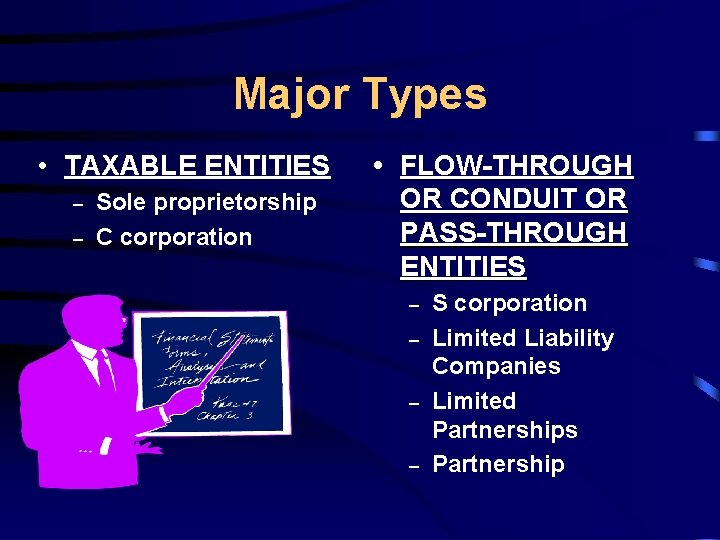
Major Types • TAXABLE ENTITIES – – Sole proprietorship C corporation • FLOW-THROUGH OR CONDUIT OR PASS-THROUGH ENTITIES – – S corporation Limited Liability Companies Limited Partnerships Partnership
Taxation Of Businesses • Income from sole proprietorships and flow -through entities – is taxed once at the individual owner level while corporate income is taxed twice, – once at the corporate level – and again at the shareholder level upon dividend distributions or stock sales
Define A Corporation • A business entity with two or more owners is classified as either a corporation or a partnership • A business entity with one owner is classified as a corporation or a sole proprietorship
Define A Corporation • A business entity is a corporation if it is organized under a federal or state statue that refers to the entity as incorporated or as a corporation • If a business entity incorporates, it is a corporation
Define A Corporation • If a business forms itself as a Partnership, Limited Liability Company(LLC) Or Limited Liability Partnership(LLP), the entity can elect to be taxed as either a partnership or corporation
Similarities Of Individuals And Corporations • Similar computation of taxable income • Allowed to deduct ordinary and necessary business expenses • Can deduct interest and depreciation
Differences Between Corporations And Individuals • Personal, consumption-type expenditures and exemptions apply solely to individuals • Computation of AGI applies only to individuals • Corporation is not permitted to use standard deduction or deduct personal and dependency exemptions • Corporations receive a dividends-received deduction • Corporate charitable deductions limited to 10% taxable income • Compensation deduction limitation for Publicly Held Corporations • Corporations are not permitted any preferential treatment of net long term capital gains
Specific Rules Applicable To Corporations • • • Capital gains & losses Dividends received deduction Net operating losses Charitable contributions Compensation deduction limitation for publicly held corporations
Computation Of Taxable Income • Reflects a stair-step progression (see table on page 16 - 9) • Corporation income tax is essentially a flat tax for large corporations • Special rules for certain Personal Service Corporations
Computation Of Corporate Alternative Minimum Tax • Designed to ensure that no corporation with substantial economic income can use exclusions, deductions, and credits to avoid significant tax liability • 20% of alternative minimum taxable income (AMTI) less an exemption amount
Exception To AMT For Small Corporations • For tax years after 1997 AMT does not apply to small corporations • $5 million gross receipts test in its first tax year after 1996
Penalty Taxes • Two penalty taxes – – Accumulated earnings tax Personal holding company tax
Computation of Tax for Controlled Groups • • • Definition of controlled group To prevent manipulation Brother – Sister Parent – Subsidiary Combine Controlled
Consolidated Returns • Corporations that are members of a parent – subsidiary affiliated group are eligible to file a consolidated tax return.
Transfers Of Property To Controlled Corporations • Section 351 nonrecognition requirements • Basis considerations • Treatment of liabilities
Capitalization Of The Corporation • Debt has two main tax advantages: – – Interest payments are deductible Principal repayments are a tax-free return of capital • Safe harbor rule
Earnings And Profits • Calculation of earnings and profits • Current versus Accumulated E&P
Non Money Distributions • Tax consequences to the shareholders – – – Amount distributed= FMV of property (reduced by liabilities) Treated as taxable dividend if corporation has sufficient E&P Basis of distributed property=FMV (without reduction for liabilities)
Non Money Distributions • Tax consequences to the distributing corporation – – General rule, the corporation recognizes no gain or loss upon a distribution to its shareholders If corporation distributes appreciated property to its shareholders, the corporation is treated as if it sold the property to the shareholder for its FMV immediately before the distribution, and the corporation recognizes any realized gain
Stock Redemption • Redemption treated as a taxable dividend (E&P) • Redemption treated as an exchange, resulting in capital gain or loss by shareholder
Determining Whether A Redemption Is A Dividend Or Capital Gain • Subject to capital gain or loss if any of following met: Redemption. . . – – Is not essentially equivalent to a dividend Is substantially disproportionate with respect to shareholders’ interest Results in a complete termination of shareholders’ interest Is made in partial liquidation of corporation
Corporate Distributions In Complete Liquidation • Tax consequences to the liquidating corporation • Tax consequences to the shareholders • Section 332: Liquidation of a subsidiary corporation
Typical Misconception • It is sometimes assumed that the liquidation of a corporation always is associated with the discontinuance of business activities. Sometimes the business is operated as a partnership or sole proprietorship after the liquidation
Compliance & Procedural Considerations • Filing requirements – – Corporation must file Form 1120 Not based on gross income Due date is one month earlier than individual returns Due date for estimated tax installment also one month earlier
Tax Planning Considerations • Capital structure and Section 1244 • Dividend policy • Use of losses • Charitable contributions • Dividends-received deductions
Compliance & Procedural Considerations • Schedule M-1 and M-2 reconciliation – – M-1 used to reconcile financial accounting net income with taxable income (before NOL & dividendsreceived deductions) M-2 reconciles the beginning year balance in retained earnings with yearend balance • Maintenance of records/E&P
- Slides: 30