
Chapter 16 Classes and Data Abstraction Outline 16
Chapter 16: Classes and Data Abstraction Outline 16. 1 16. 2 16. 3 16. 4 16. 5 16. 6 16. 7 16. 8 16. 9 16. 10 16. 11 16. 12 16. 13 16. 14 Introduction Implementing a Time Abstract Data Type with a Class Scope and Accessing Class Members Separating Interface from Implementation Controlling Access to Members Access Functions and Utility Functions Initializing Class Objects: Constructors Using Default Arguments with Constructors Using Destructors When Constructors and Destructors Are Called Using Data Members and Member Functions A Subtle Trap: Returning a Reference to a private Data Member Assignment by Default Memberwise Copy Software Reusability 2000 Prentice Hall, Inc. All rights reserved.
16. 1 Introduction • Object-oriented programming (OOP) – Encapsulates data (attributes) and functions (behavior) into packages called classes – Data and functions closely related • Information hiding – Implementation details are hidden within the classes themselves • Unit of C++ programming: the class – – A class is like a blueprint – reusable Objects are instantiated (created) from the class For example, a house is an instance of a “blueprint class” C programmers concentrate on functions 2000 Prentice Hall, Inc. All rights reserved.
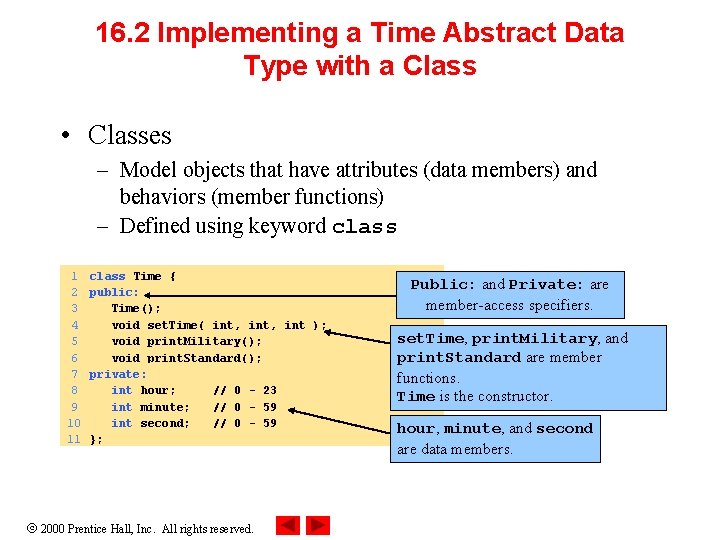
16. 2 Implementing a Time Abstract Data Type with a Class • Classes – Model objects that have attributes (data members) and behaviors (member functions) – Defined using keyword class 1 2 3 4 5 6 7 8 9 10 11 class Time { public: Time(); void set. Time( int, int ); void print. Military(); void print. Standard(); private: int hour; // 0 - 23 int minute; // 0 - 59 int second; // 0 - 59 }; 2000 Prentice Hall, Inc. All rights reserved. Public: and Private: are member-access specifiers. set. Time, print. Military, and print. Standard are member functions. Time is the constructor. hour, minute, and second are data members.
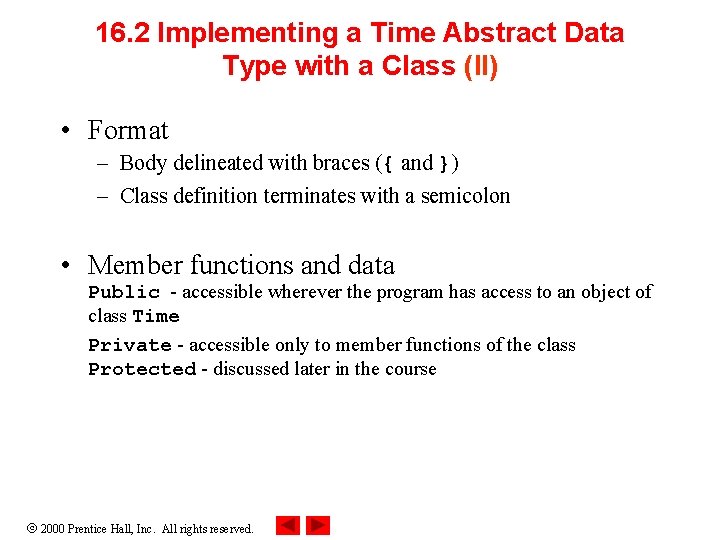
16. 2 Implementing a Time Abstract Data Type with a Class (II) • Format – Body delineated with braces ({ and }) – Class definition terminates with a semicolon • Member functions and data Public - accessible wherever the program has access to an object of class Time Private - accessible only to member functions of the class Protected - discussed later in the course 2000 Prentice Hall, Inc. All rights reserved.
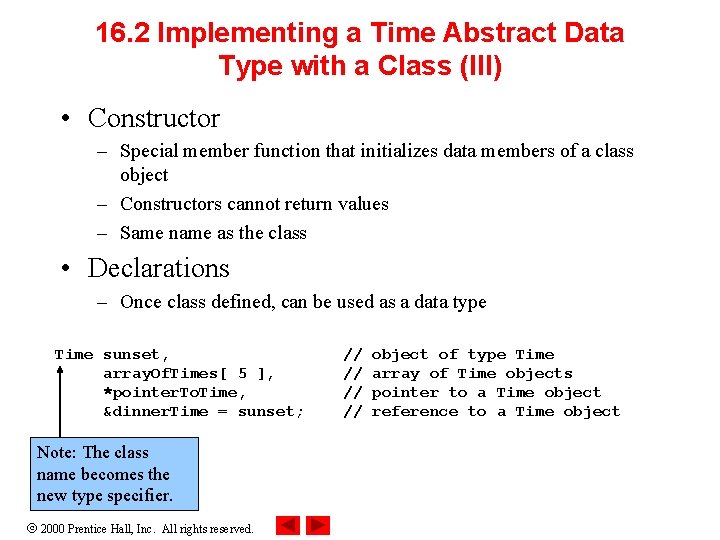
16. 2 Implementing a Time Abstract Data Type with a Class (III) • Constructor – Special member function that initializes data members of a class object – Constructors cannot return values – Same name as the class • Declarations – Once class defined, can be used as a data type Time sunset, // object of type Time array. Of. Times[ 5 ], // array of Time objects *pointer. To. Time, // pointer to a Time object &dinner. Time = sunset; // reference to a Time object Note: The class name becomes the new type specifier. 2000 Prentice Hall, Inc. All rights reserved.
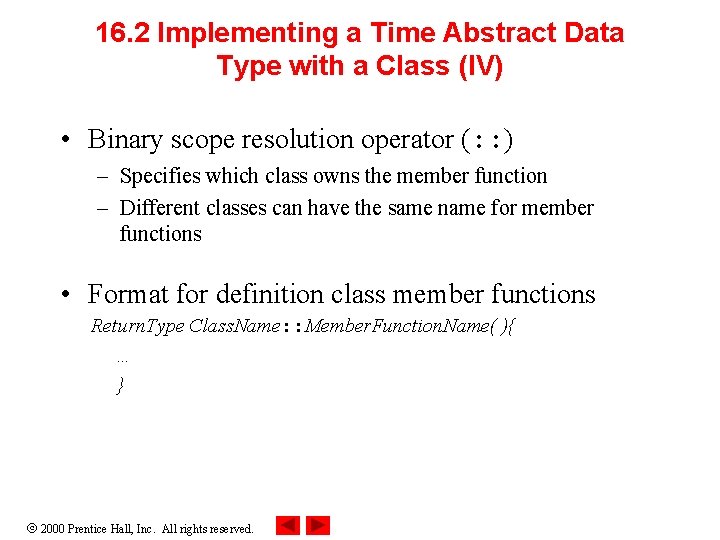
16. 2 Implementing a Time Abstract Data Type with a Class (IV) • Binary scope resolution operator (: : ) – Specifies which class owns the member function – Different classes can have the same name for member functions • Format for definition class member functions Return. Type Class. Name: : Member. Function. Name( ){ … } 2000 Prentice Hall, Inc. All rights reserved.
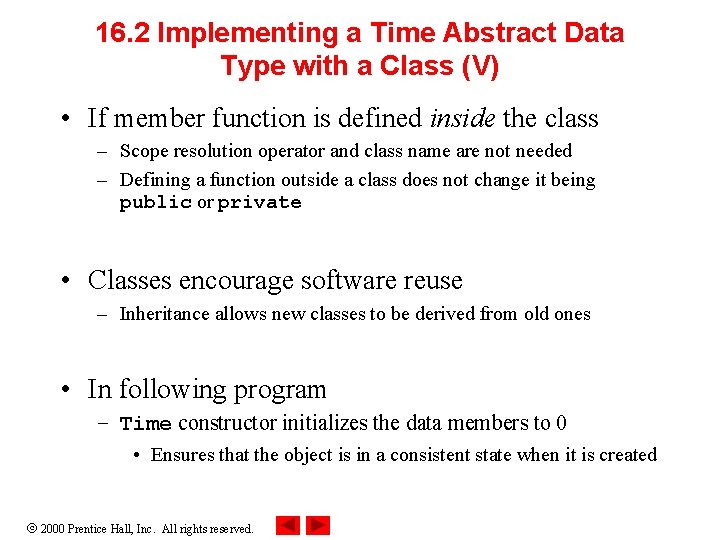
16. 2 Implementing a Time Abstract Data Type with a Class (V) • If member function is defined inside the class – Scope resolution operator and class name are not needed – Defining a function outside a class does not change it being public or private • Classes encourage software reuse – Inheritance allows new classes to be derived from old ones • In following program – Time constructor initializes the data members to 0 • Ensures that the object is in a consistent state when it is created 2000 Prentice Hall, Inc. All rights reserved.
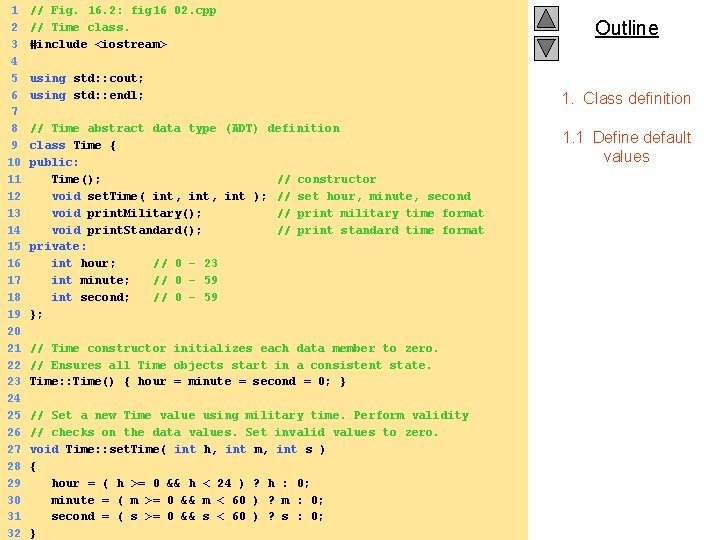
1 2 3 4 5 6 7 8 9 10 11 12 13 14 15 16 17 18 19 20 21 22 23 24 25 26 27 28 29 30 31 32 // Fig. 16. 2: fig 16_02. cpp // Time class. #include <iostream> using std: : cout; using std: : endl; // Time abstract data type (ADT) definition class Time { public: Time(); // constructor void set. Time( int, int ); // set hour, minute, second void print. Military(); // print military time format void print. Standard(); // print standard time format private: int hour; // 0 – 23 int minute; // 0 – 59 int second; // 0 – 59 }; // Time constructor initializes each data member to zero. // Ensures all Time objects start in a consistent state. Time: : Time() { hour = minute = second = 0; } // Set a new Time value using military time. Perform validity // checks on the data values. Set invalid values to zero. void Time: : set. Time( int h, int m, int s ) { hour = ( h >= 0 && h < 24 ) ? h : 0; minute = ( m >= 0 && m < 60 ) ? m : 0; second = ( s >= 0 && s < 60 ) ? s : 0; } 2000 Prentice Hall, Inc. All rights reserved. Outline 1. Class definition 1. 1 Define default values
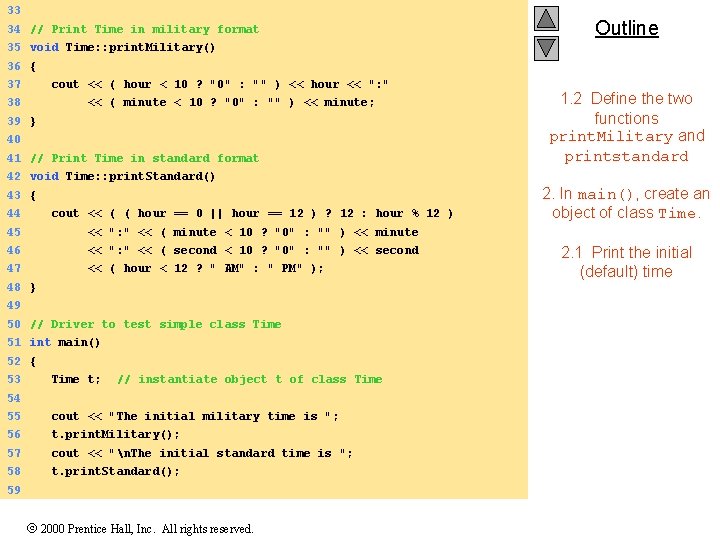
33 34 // Print Time in military format Outline 35 void Time: : print. Military() 36 { 37 cout << ( hour < 10 ? "0" : "" ) << hour << ": " 38 << ( minute < 10 ? "0" : "" ) << minute; 39 } 40 41 // Print Time in standard format 1. 2 Define the two functions print. Military and printstandard 42 void Time: : print. Standard() 43 { 44 cout << ( ( hour == 0 || hour == 12 ) ? 12 : hour % 12 ) 2. In main(), create an object of class Time. 45 << ": " << ( minute < 10 ? "0" : "" ) << minute 46 << ": " << ( second < 10 ? "0" : "" ) << second 47 << ( hour < 12 ? " AM" : " PM" ); 48 } 49 50 // Driver to test simple class Time 51 int main() 52 { 53 Time t; // instantiate object t of class Time 54 55 cout << "The initial military time is "; 56 t. print. Military(); 57 cout << "n. The initial standard time is "; 58 t. print. Standard(); 59 2000 Prentice Hall, Inc. All rights reserved. 2. 1 Print the initial (default) time
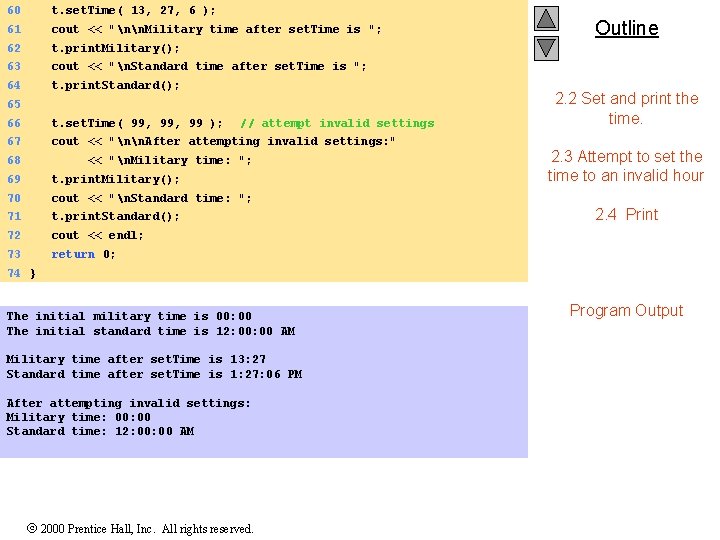
60 t. set. Time( 13, 27, 6 ); 61 cout << "nn. Military time after set. Time is "; Outline 62 t. print. Military(); 63 cout << "n. Standard time after set. Time is "; 64 t. print. Standard(); 65 66 t. set. Time( 99, 99 ); // attempt invalid settings 67 cout << "nn. After attempting invalid settings: " 68 << "n. Military time: "; 69 t. print. Military(); 70 cout << "n. Standard time: "; 71 t. print. Standard(); 2. 2 Set and print the time. 2. 3 Attempt to set the time to an invalid hour 2. 4 Print 72 cout << endl; 73 return 0; 74 } The initial military time is 00: 00 The initial standard time is 12: 00 AM Military time after set. Time is 13: 27 Standard time after set. Time is 1: 27: 06 PM After attempting invalid settings: Military time: 00 Standard time: 12: 00 AM 2000 Prentice Hall, Inc. All rights reserved. Program Output
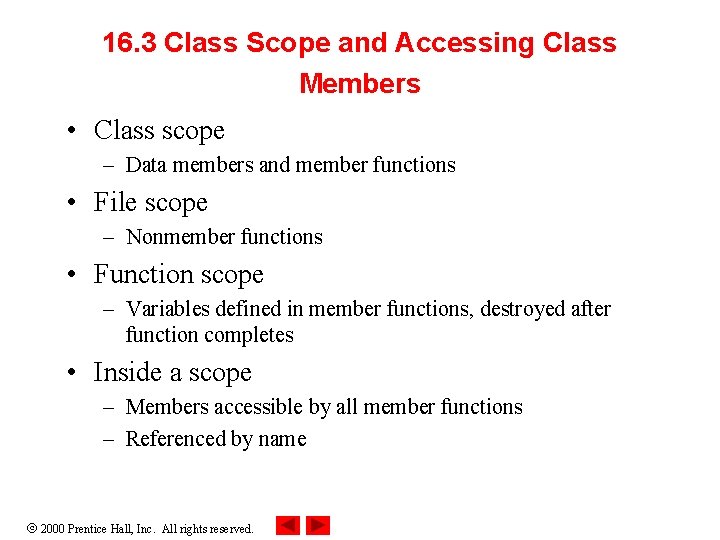
16. 3 Class Scope and Accessing Class Members • Class scope – Data members and member functions • File scope – Nonmember functions • Function scope – Variables defined in member functions, destroyed after function completes • Inside a scope – Members accessible by all member functions – Referenced by name 2000 Prentice Hall, Inc. All rights reserved.
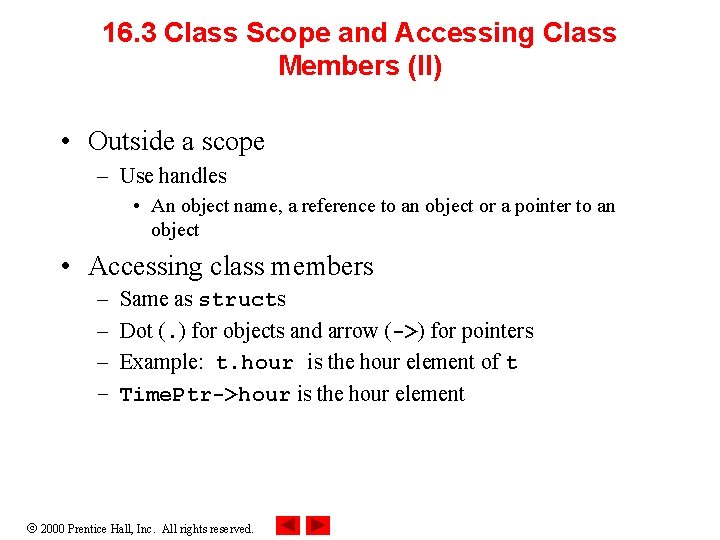
16. 3 Class Scope and Accessing Class Members (II) • Outside a scope – Use handles • An object name, a reference to an object or a pointer to an object • Accessing class members – – Same as structs Dot (. ) for objects and arrow (->) for pointers Example: t. hour is the hour element of t Time. Ptr->hour is the hour element 2000 Prentice Hall, Inc. All rights reserved.
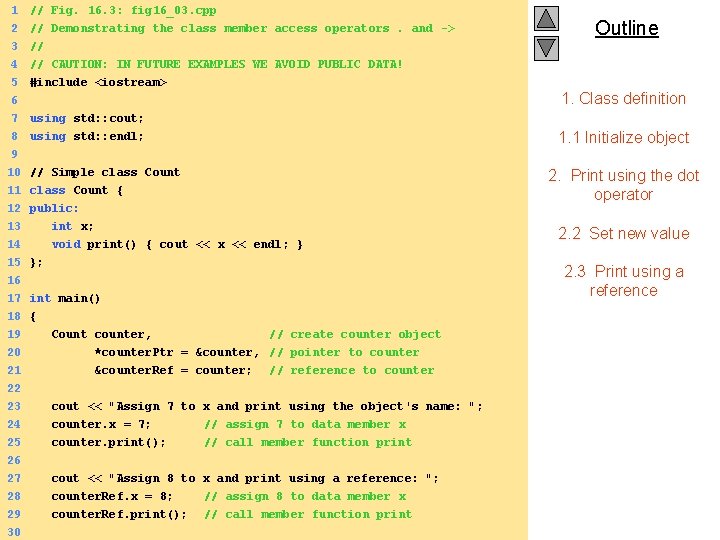
1 // Fig. 16. 3: fig 16_03. cpp 2 3 4 5 6 // Demonstrating the class member access operators. and -> // // CAUTION: IN FUTURE EXAMPLES WE AVOID PUBLIC DATA! #include <iostream> 7 using std: : cout; 8 9 using std: : endl; Outline 1. Class definition 10 // Simple class Count 11 class Count { 12 public: 13 int x; 14 void print() { cout << x << endl; } 15 }; 16 17 int main() 18 { 19 Count counter, // create counter object 20 *counter. Ptr = &counter, // pointer to counter 21 22 23 24 25 26 &counter. Ref = counter; // reference to counter 27 28 29 30 cout << "Assign 8 to x and print using a reference: "; counter. Ref. x = 8; // assign 8 to data member x counter. Ref. print(); // call member function print 2000 Prentice Hall, Inc. All rights reserved. cout << "Assign 7 to x and print using the object's name: "; counter. x = 7; // assign 7 to data member x counter. print(); // call member function print 1. 1 Initialize object 2. Print using the dot operator 2. 2 Set new value 2. 3 Print using a reference
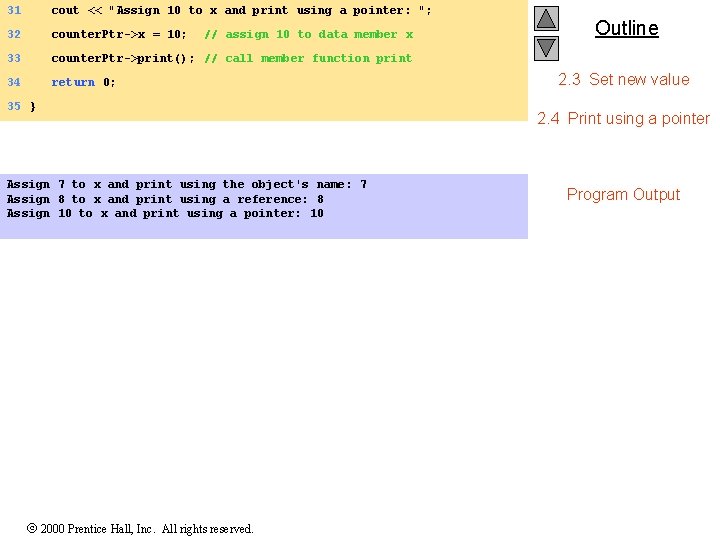
31 cout << "Assign 10 to x and print using a pointer: "; 32 counter. Ptr->x = 10; // assign 10 to data member x Outline 33 counter. Ptr->print(); // call member function print 34 return 0; 35 } Assign 7 to x and print using the object's name: 7 Assign 8 to x and print using a reference: 8 Assign 10 to x and print using a pointer: 10 2000 Prentice Hall, Inc. All rights reserved. 2. 3 Set new value 2. 4 Print using a pointer Program Output
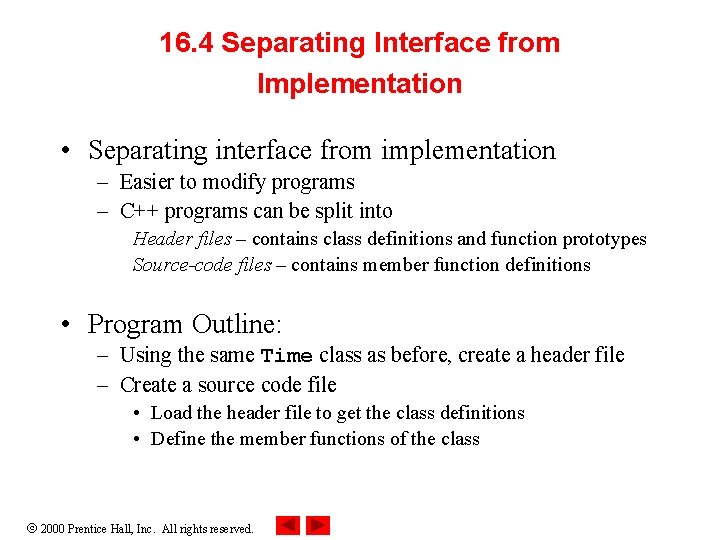
16. 4 Separating Interface from Implementation • Separating interface from implementation – Easier to modify programs – C++ programs can be split into Header files – contains class definitions and function prototypes Source-code files – contains member function definitions • Program Outline: – Using the same Time class as before, create a header file – Create a source code file • Load the header file to get the class definitions • Define the member functions of the class 2000 Prentice Hall, Inc. All rights reserved.
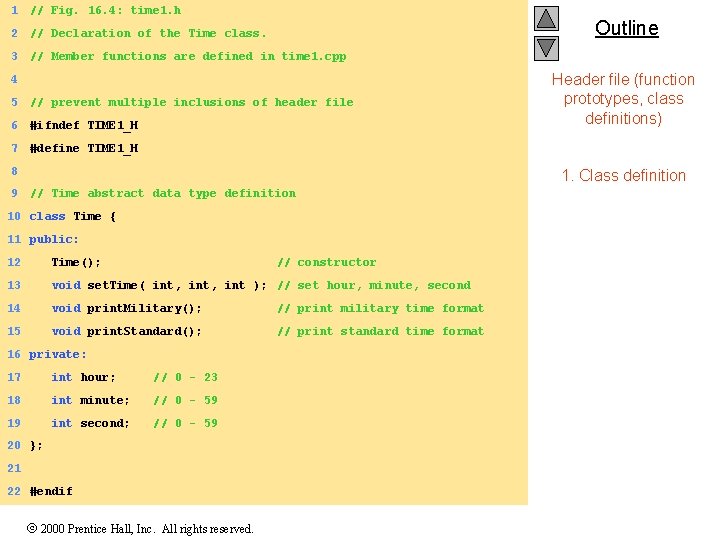
1 // Fig. 16. 4: time 1. h 2 // Declaration of the Time class. 3 // Member functions are defined in time 1. cpp 4 5 // prevent multiple inclusions of header file 6 #ifndef TIME 1_H 7 #define TIME 1_H 8 9 Outline Header file (function prototypes, class definitions) 1. Class definition // Time abstract data type definition 10 class Time { 11 public: 12 Time(); // constructor 13 void set. Time( int, int ); // set hour, minute, second 14 void print. Military(); // print military time format 15 void print. Standard(); // print standard time format 16 private: 17 int hour; // 0 - 23 18 int minute; // 0 - 59 19 int second; // 0 - 59 20 }; 21 22 #endif 2000 Prentice Hall, Inc. All rights reserved.
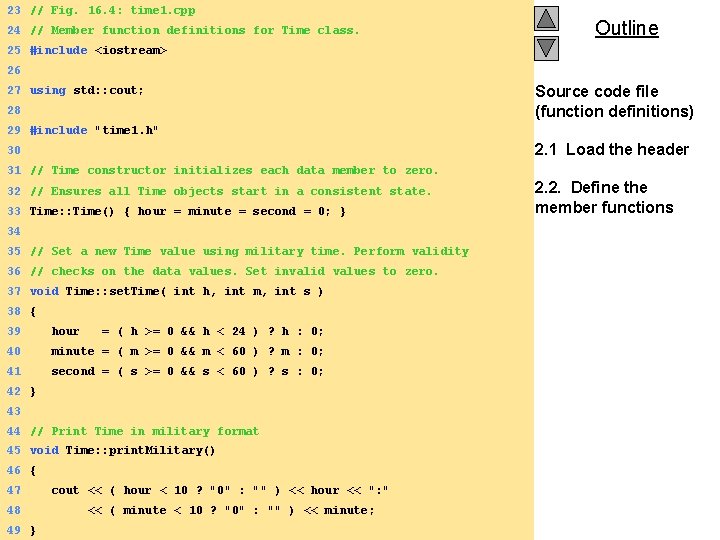
23 // Fig. 16. 4: time 1. cpp 24 // Member function definitions for Time class. Outline 25 #include <iostream> 26 27 using std: : cout; 28 Source code file (function definitions) 29 #include "time 1. h" 30 2. 1 Load the header 31 // Time constructor initializes each data member to zero. 32 // Ensures all Time objects start in a consistent state. 33 Time: : Time() { hour = minute = second = 0; } 34 35 // Set a new Time value using military time. Perform validity 36 // checks on the data values. Set invalid values to zero. 37 void Time: : set. Time( int h, int m, int s ) 38 { 39 hour = ( h >= 0 && h < 24 ) ? h : 0; 40 minute = ( m >= 0 && m < 60 ) ? m : 0; 41 second = ( s >= 0 && s < 60 ) ? s : 0; 42 } 43 44 // Print Time in military format 45 void Time: : print. Military() 46 { 47 cout << ( hour < 10 ? "0" : "" ) << hour << ": " 48 << ( minute < 10 ? "0" : "" ) << minute; 49 } 2000 Prentice Hall, Inc. All rights reserved. 2. 2. Define the member functions
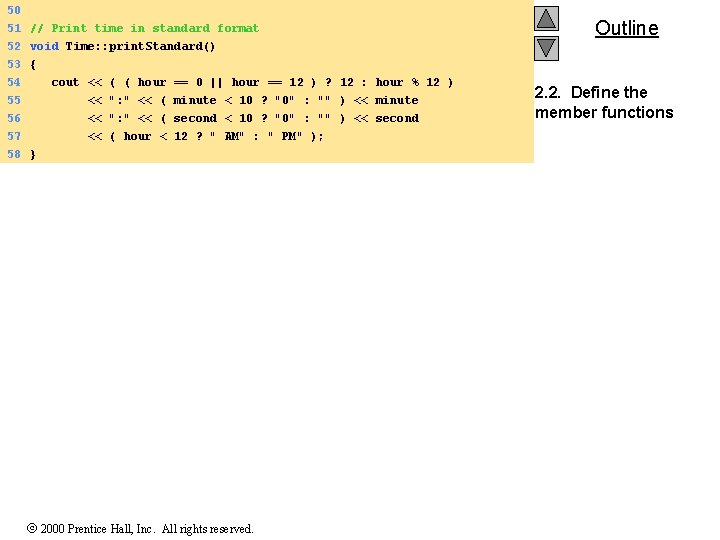
50 51 52 53 54 55 // Print time in standard format void Time: : print. Standard() { cout << ( ( hour == 0 || hour == 12 ) ? 12 : hour % 12 ) << ": " << ( minute < 10 ? "0" : "" ) << minute 56 << ": " << ( second < 10 ? "0" : "" ) << second 57 << ( hour < 12 ? " AM" : " PM" ); 58 } 2000 Prentice Hall, Inc. All rights reserved. Outline 2. 2. Define the member functions
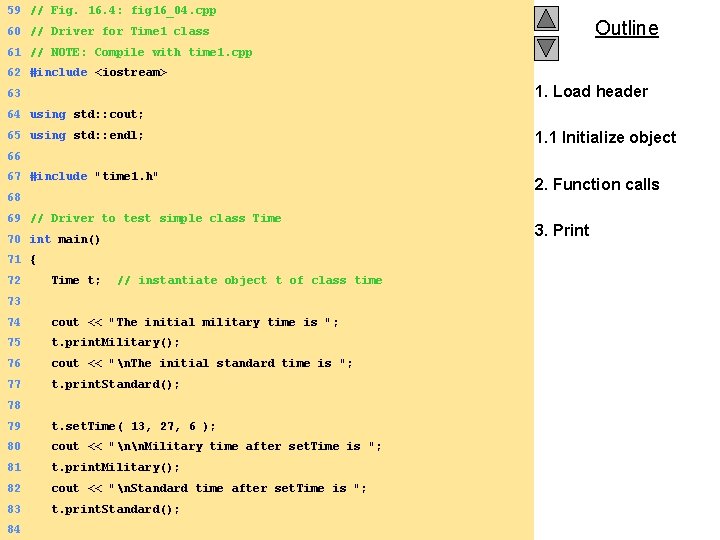
59 // Fig. 16. 4: fig 16_04. cpp Outline 60 // Driver for Time 1 class 61 // NOTE: Compile with time 1. cpp 62 #include <iostream> 63 1. Load header 64 using std: : cout; 65 using std: : endl; 1. 1 Initialize object 66 67 #include "time 1. h" 68 69 // Driver to test simple class Time 70 int main() 71 { 72 Time t; // instantiate object t of class time 73 74 cout << "The initial military time is "; 75 t. print. Military(); 76 cout << "n. The initial standard time is "; 77 t. print. Standard(); 78 79 t. set. Time( 13, 27, 6 ); 80 cout << "nn. Military time after set. Time is "; 81 t. print. Military(); 82 cout << "n. Standard time after set. Time is "; 83 t. print. Standard(); 84 2000 Prentice Hall, Inc. All rights reserved. 2. Function calls 3. Print
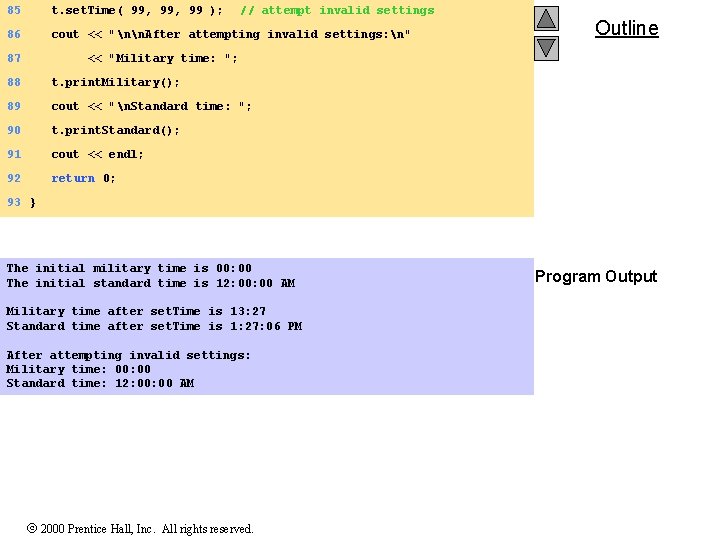
85 t. set. Time( 99, 99 ); // attempt invalid settings 86 cout << "nn. After attempting invalid settings: n" Outline 87 << "Military time: "; 88 t. print. Military(); 89 cout << "n. Standard time: "; 90 t. print. Standard(); 91 cout << endl; 92 return 0; 93 } The initial military time is 00: 00 The initial standard time is 12: 00 AM Military time after set. Time is 13: 27 Standard time after set. Time is 1: 27: 06 PM After attempting invalid settings: Military time: 00 Standard time: 12: 00 AM 2000 Prentice Hall, Inc. All rights reserved. Program Output
16. 5 Controlling Access to Members • Purpose of public – Give clients a view of the services the class provides (interface) • Purpose of private – Default setting – Hide details of how the class accomplishes its tasks (implementation) – Private members only accessible through the public interface using public member functions 2000 Prentice Hall, Inc. All rights reserved.
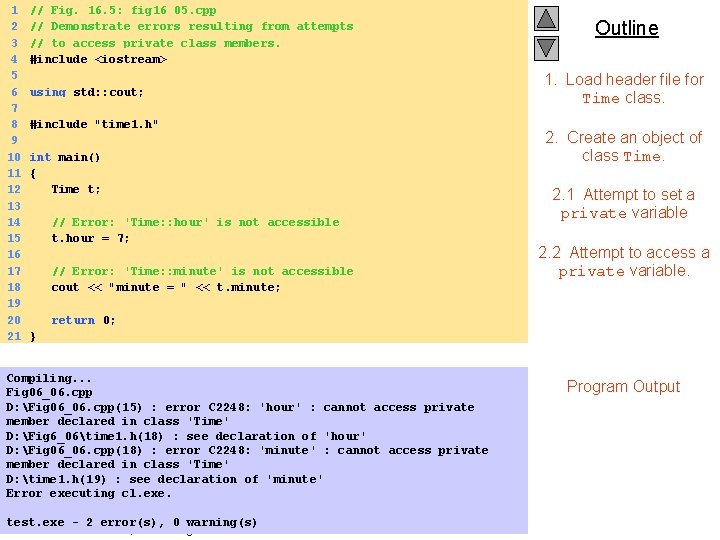
1 2 3 4 5 6 7 8 9 10 11 12 13 14 15 16 17 18 19 20 21 // Fig. 16. 5: fig 16_05. cpp // Demonstrate errors resulting from attempts // to access private class members. #include <iostream> using std: : cout; #include "time 1. h" int main() { Time t; // Error: 'Time: : hour' is not accessible t. hour = 7; // Error: 'Time: : minute' is not accessible cout << "minute = " << t. minute; Outline 1. Load header file for Time class. 2. Create an object of class Time. 2. 1 Attempt to set a private variable 2. 2 Attempt to access a private variable. return 0; } Compiling. . . Fig 06_06. cpp D: Fig 06_06. cpp(15) : error C 2248: 'hour' : cannot access private member declared in class 'Time' D: Fig 6_06time 1. h(18) : see declaration of 'hour' D: Fig 06_06. cpp(18) : error C 2248: 'minute' : cannot access private member declared in class 'Time' D: time 1. h(19) : see declaration of 'minute' Error executing cl. exe. test. exe - 2 error(s), 0 warning(s) 2000 Prentice Hall, Inc. All rights reserved. Program Output
16. 6 Access Functions and Utility Functions • Utility functions – private functions that support the operation of public functions – Not intended to be used directly by clients • Access functions – public functions that read/display data or check conditions – For a container, it could call the is. Empty function • Next – Program to take in monthly sales and output the total – Implementation not shown, only access functions 2000 Prentice Hall, Inc. All rights reserved.
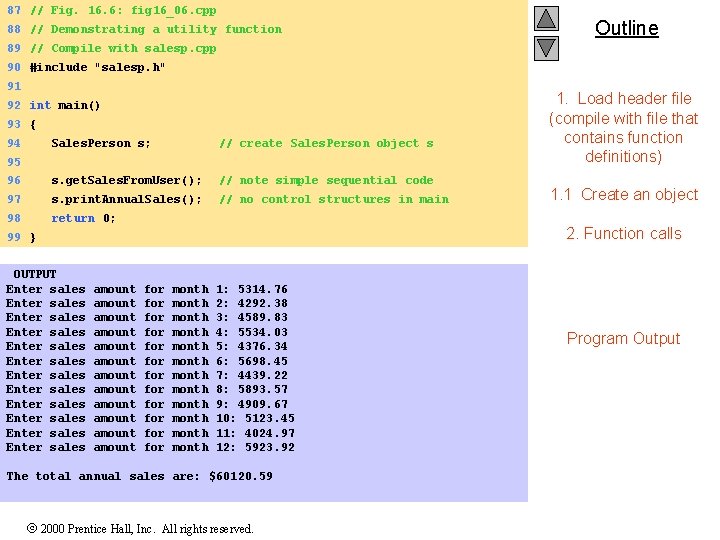
87 // Fig. 16. 6: fig 16_06. cpp 88 // Demonstrating a utility function Outline 89 // Compile with salesp. cpp 90 #include "salesp. h" 91 92 int main() 93 { 94 Sales. Person s; // create Sales. Person object s 95 96 s. get. Sales. From. User(); // note simple sequential code 97 s. print. Annual. Sales(); // no control structures in main 98 return 0; 99 } OUTPUT Enter sales amount for month 1: 5314. 76 Enter sales amount for month 2: 4292. 38 Enter sales amount for month 3: 4589. 83 Enter sales amount for month 4: 5534. 03 Enter sales amount for month 5: 4376. 34 Enter sales amount for month 6: 5698. 45 Enter sales amount for month 7: 4439. 22 Enter sales amount for month 8: 5893. 57 Enter sales amount for month 9: 4909. 67 Enter sales amount for month 10: 5123. 45 Enter sales amount for month 11: 4024. 97 Enter sales amount for month 12: 5923. 92 The total annual sales are: $60120. 59 2000 Prentice Hall, Inc. All rights reserved. 1. Load header file (compile with file that contains function definitions) 1. 1 Create an object 2. Function calls Program Output
16. 7 Initializing Class Objects: Constructors • Constructor function – Can initialize class members – Same name as the class, no return type – Member variables can be initialized by the constructor or set afterwards • Declaring objects – Initializers can be provided – Initializers passed as arguments to the class’ constructor 2000 Prentice Hall, Inc. All rights reserved.
16. 7 Initializing Class Objects: Constructors (II) • Format Type Object. Name( value 1, value 2, …); – Constructor assigns value 1, value 2, etc. to its member variables – If not enough values specified, rightmost parameters set to their default (specified by programmer) my. Class my. Object( 3, 4. 0 ); 2000 Prentice Hall, Inc. All rights reserved.
16. 8 Using Default Arguments with Constructors • Default constructor – One per class – Can be invoked without arguments – Has default arguments • Default arguments – Set in default constructor function prototype (in class definition) • Do not set defaults in the function definition, outside of a class – Example: Sample. Class( int = 0, float = 0); • Constructor has same name as class 2000 Prentice Hall, Inc. All rights reserved.
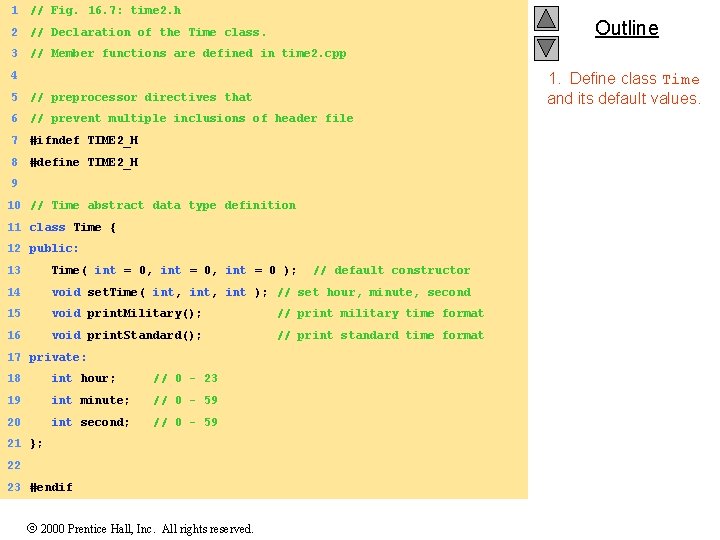
1 // Fig. 16. 7: time 2. h 2 // Declaration of the Time class. 3 // Member functions are defined in time 2. cpp 4 5 // preprocessor directives that 6 // prevent multiple inclusions of header file 7 #ifndef TIME 2_H 8 #define TIME 2_H 9 10 // Time abstract data type definition 11 class Time { 12 public: 13 Time( int = 0, int = 0 ); // default constructor 14 void set. Time( int, int ); // set hour, minute, second 15 void print. Military(); // print military time format 16 void print. Standard(); // print standard time format 17 private: 18 int hour; // 0 - 23 19 int minute; // 0 - 59 20 int second; // 0 - 59 21 }; 22 23 #endif 2000 Prentice Hall, Inc. All rights reserved. Outline 1. Define class Time and its default values.
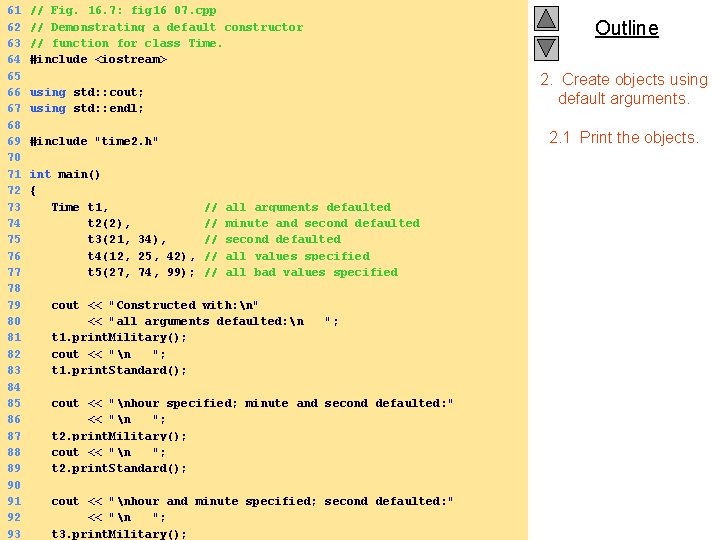
61 62 63 64 65 66 67 68 69 70 71 72 73 74 75 76 77 78 79 80 81 82 83 84 85 86 87 88 89 90 91 92 93 // Fig. 16. 7: fig 16_07. cpp // Demonstrating a default constructor // function for class Time. #include <iostream> using std: : cout; using std: : endl; #include "time 2. h" int main() { Time t 1, // all arguments defaulted t 2(2), // minute and second defaulted t 3(21, 34), // second defaulted t 4(12, 25, 42), // all values specified t 5(27, 74, 99); // all bad values specified cout << "Constructed with: n" << "all arguments defaulted: n "; t 1. print. Military(); cout << "n "; t 1. print. Standard(); cout << "nhour specified; minute and second defaulted: " << "n "; t 2. print. Military(); cout << "n "; t 2. print. Standard(); cout << "nhour and minute specified; second defaulted: " << "n "; 2000 Prentice Hall, Inc. All rights reserved. t 3. print. Military(); Outline 2. Create objects using default arguments. 2. 1 Print the objects.
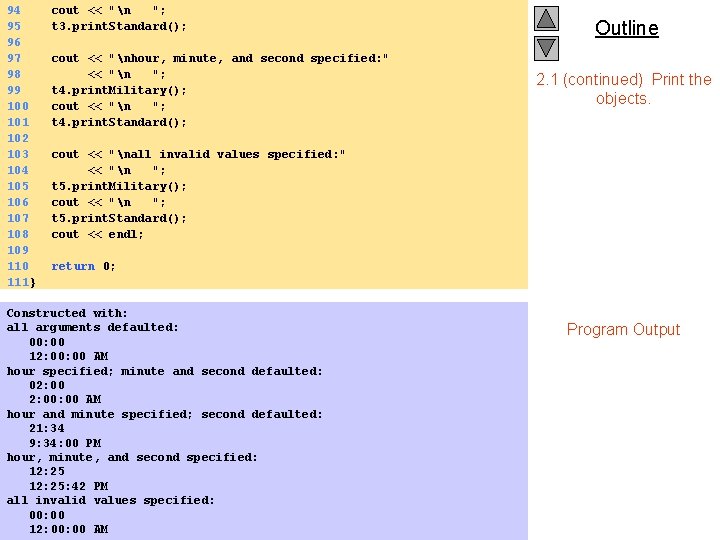
94 cout << "n "; 95 t 3. print. Standard(); 96 97 cout << "nhour, minute, and second specified: " 98 << "n "; 99 t 4. print. Military(); 100 cout << "n "; 101 t 4. print. Standard(); 102 103 cout << "nall invalid values specified: " 104 << "n "; 105 t 5. print. Military(); 106 cout << "n "; 107 t 5. print. Standard(); 108 cout << endl; 109 110 return 0; 111 } Constructed with: all arguments defaulted: 00 12: 00 AM hour specified; minute and second defaulted: 02: 00 AM hour and minute specified; second defaulted: 21: 34 9: 34: 00 PM hour, minute, and second specified: 12: 25: 42 PM all invalid values specified: 00 12: 00 AM 2000 Prentice Hall, Inc. All rights reserved. Outline 2. 1 (continued) Print the objects. Program Output
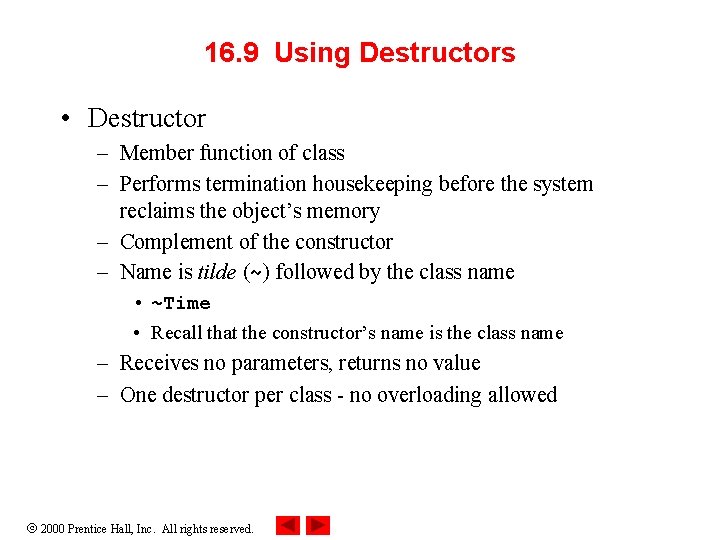
16. 9 Using Destructors • Destructor – Member function of class – Performs termination housekeeping before the system reclaims the object’s memory – Complement of the constructor – Name is tilde (~) followed by the class name • ~Time • Recall that the constructor’s name is the class name – Receives no parameters, returns no value – One destructor per class - no overloading allowed 2000 Prentice Hall, Inc. All rights reserved.
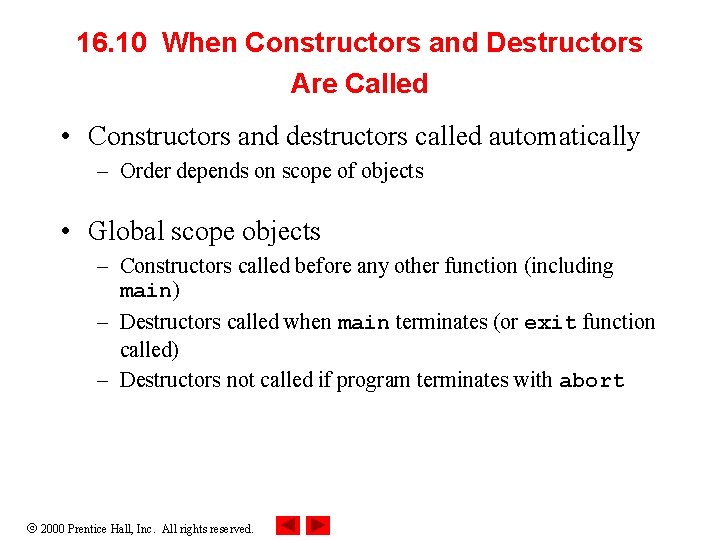
16. 10 When Constructors and Destructors Are Called • Constructors and destructors called automatically – Order depends on scope of objects • Global scope objects – Constructors called before any other function (including main) – Destructors called when main terminates (or exit function called) – Destructors not called if program terminates with abort 2000 Prentice Hall, Inc. All rights reserved.
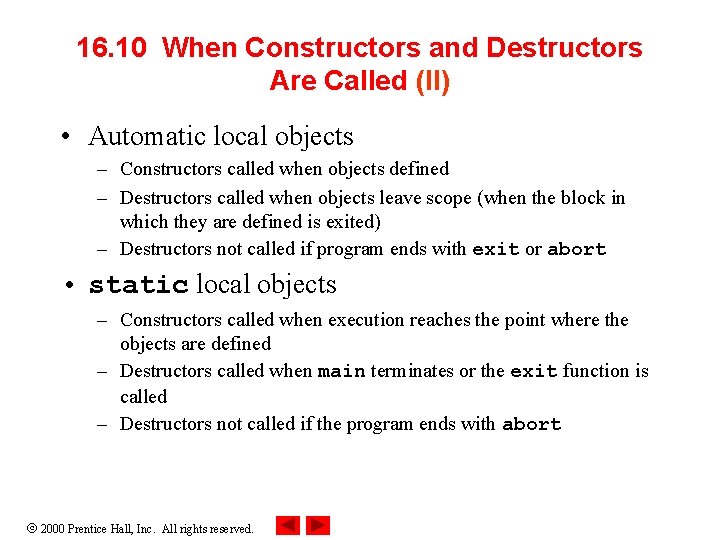
16. 10 When Constructors and Destructors Are Called (II) • Automatic local objects – Constructors called when objects defined – Destructors called when objects leave scope (when the block in which they are defined is exited) – Destructors not called if program ends with exit or abort • static local objects – Constructors called when execution reaches the point where the objects are defined – Destructors called when main terminates or the exit function is called – Destructors not called if the program ends with abort 2000 Prentice Hall, Inc. All rights reserved.
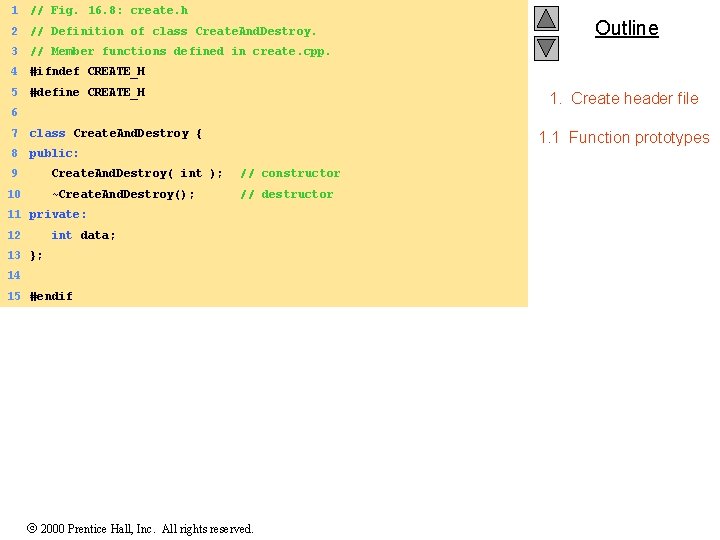
1 // Fig. 16. 8: create. h 2 // Definition of class Create. And. Destroy. 3 // Member functions defined in create. cpp. 4 #ifndef CREATE_H 5 #define CREATE_H 6 7 class Create. And. Destroy { 8 public: 9 Create. And. Destroy( int ); // constructor 10 ~Create. And. Destroy(); // destructor 11 private: 12 int data; 13 }; 14 15 #endif 2000 Prentice Hall, Inc. All rights reserved. Outline 1. Create header file 1. 1 Function prototypes
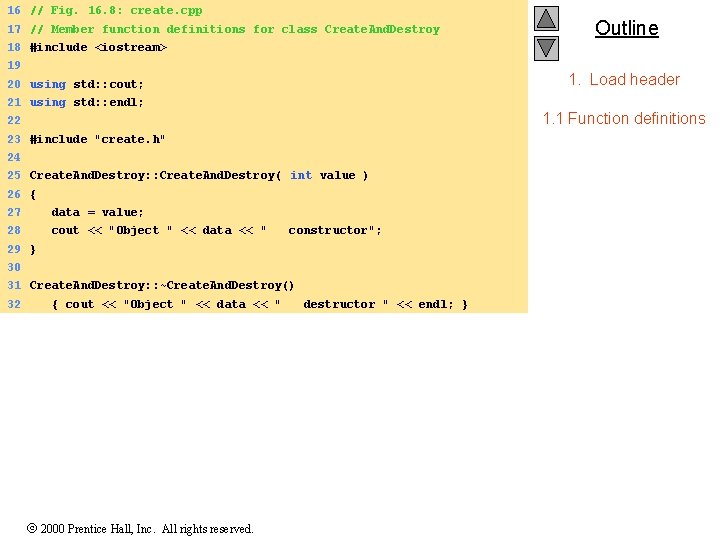
16 // Fig. 16. 8: create. cpp 17 // Member function definitions for class Create. And. Destroy Outline 18 #include <iostream> 19 20 using std: : cout; 21 using std: : endl; 22 23 #include "create. h" 24 25 Create. And. Destroy: : Create. And. Destroy( int value ) 26 { 27 data = value; 28 cout << "Object " << data << " constructor"; 29 } 30 31 Create. And. Destroy: : ~Create. And. Destroy() 32 { cout << "Object " << data << " destructor " << endl; } 2000 Prentice Hall, Inc. All rights reserved. 1. Load header 1. 1 Function definitions
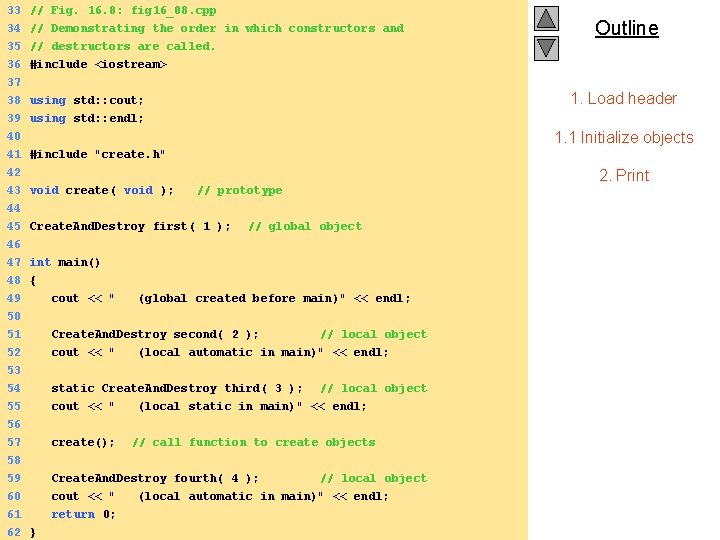
33 // Fig. 16. 8: fig 16_08. cpp 34 35 36 37 38 // Demonstrating the order in which constructors and // destructors are called. #include <iostream> using std: : cout; Outline 1. Load header 39 using std: : endl; 40 41 #include "create. h" 42 43 void create( void ); // prototype 44 45 Create. And. Destroy first( 1 ); // global object 46 47 int main() 48 { 49 cout << " (global created before main)" << endl; 50 51 Create. And. Destroy second( 2 ); // local object 52 cout << " (local automatic in main)" << endl; 53 54 static Create. And. Destroy third( 3 ); // local object 55 cout << " (local static in main)" << endl; 56 57 create(); // call function to create objects 58 59 60 61 62 Create. And. Destroy fourth( 4 ); // local object cout << " (local automatic in main)" << endl; return 0; } 2000 Prentice Hall, Inc. All rights reserved. 1. 1 Initialize objects 2. Print
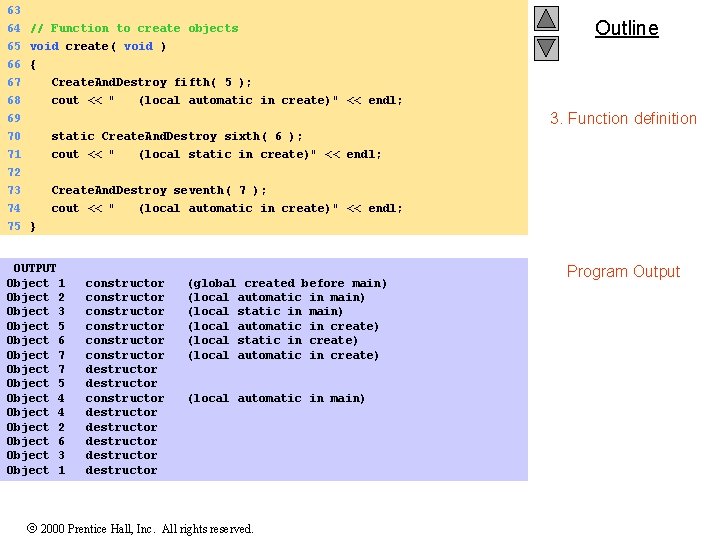
63 64 65 66 67 68 // Function to create objects void create( void ) { Create. And. Destroy fifth( 5 ); cout << " (local automatic in create)" << endl; Outline 3. Function definition 69 70 static Create. And. Destroy sixth( 6 ); 71 cout << " (local static in create)" << endl; 72 73 Create. And. Destroy seventh( 7 ); 74 cout << " (local automatic in create)" << endl; 75 } OUTPUT Object 1 constructor (global created before main) Object 2 constructor (local automatic in main) Object 3 constructor (local static in main) Object 5 constructor (local automatic in create) Object 6 constructor (local static in create) Object 7 constructor (local automatic in create) Object 7 destructor Object 5 destructor Object 4 constructor (local automatic in main) Object 4 destructor Object 2 destructor Object 6 destructor Object 3 destructor Object 1 destructor 2000 Prentice Hall, Inc. All rights reserved. Program Output
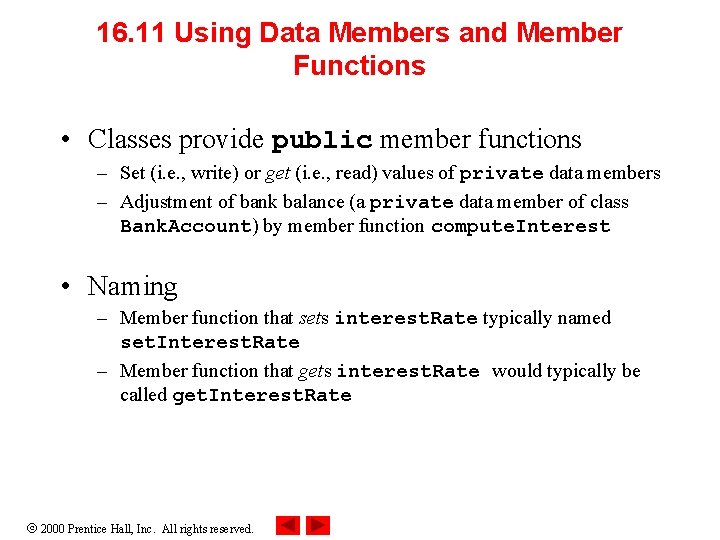
16. 11 Using Data Members and Member Functions • Classes provide public member functions – Set (i. e. , write) or get (i. e. , read) values of private data members – Adjustment of bank balance (a private data member of class Bank. Account) by member function compute. Interest • Naming – Member function that sets interest. Rate typically named set. Interest. Rate – Member function that gets interest. Rate would typically be called get. Interest. Rate 2000 Prentice Hall, Inc. All rights reserved.
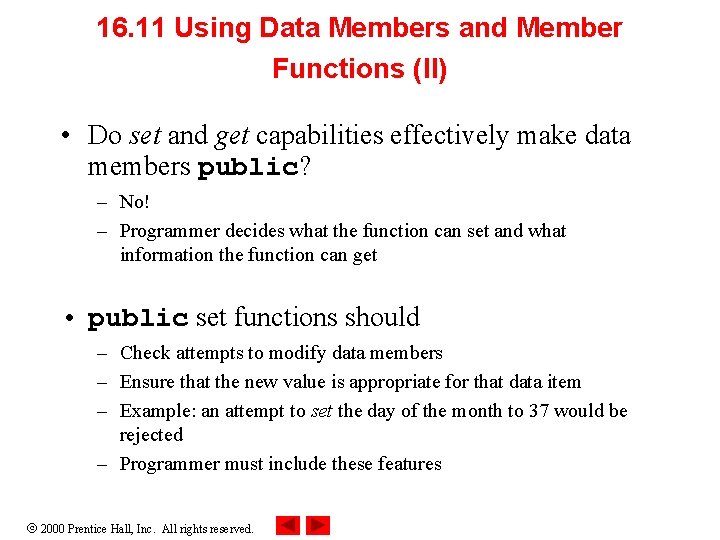
16. 11 Using Data Members and Member Functions (II) • Do set and get capabilities effectively make data members public? – No! – Programmer decides what the function can set and what information the function can get • public set functions should – Check attempts to modify data members – Ensure that the new value is appropriate for that data item – Example: an attempt to set the day of the month to 37 would be rejected – Programmer must include these features 2000 Prentice Hall, Inc. All rights reserved.
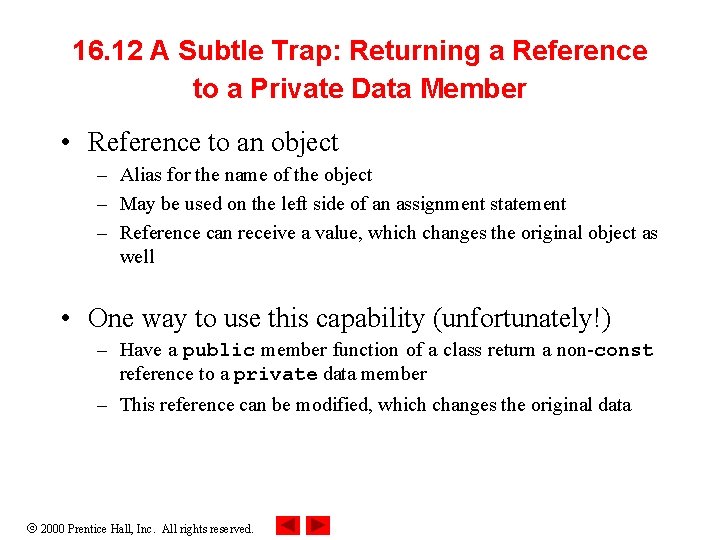
16. 12 A Subtle Trap: Returning a Reference to a Private Data Member • Reference to an object – Alias for the name of the object – May be used on the left side of an assignment statement – Reference can receive a value, which changes the original object as well • One way to use this capability (unfortunately!) – Have a public member function of a class return a non-const reference to a private data member – This reference can be modified, which changes the original data 2000 Prentice Hall, Inc. All rights reserved.
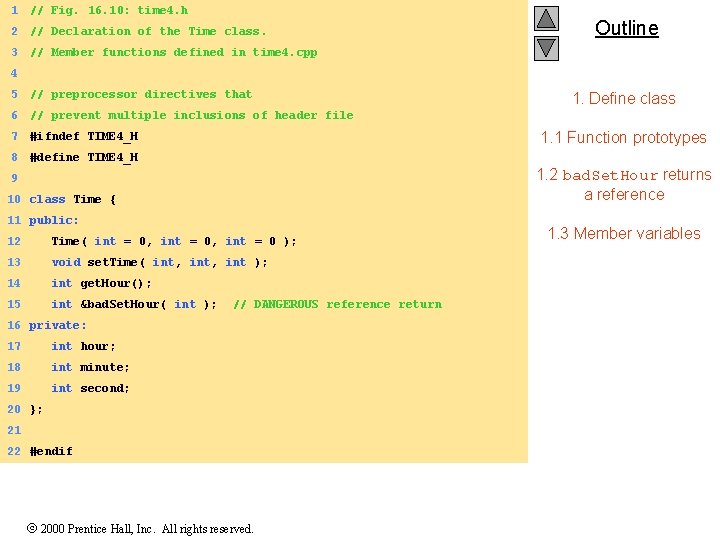
1 // Fig. 16. 10: time 4. h 2 // Declaration of the Time class. 3 // Member functions defined in time 4. cpp Outline 4 5 // preprocessor directives that 6 // prevent multiple inclusions of header file 7 #ifndef TIME 4_H 8 #define TIME 4_H 9 10 class Time { 11 public: 12 Time( int = 0, int = 0 ); 13 void set. Time( int, int ); 14 int get. Hour(); 15 int &bad. Set. Hour( int ); // DANGEROUS reference return 16 private: 17 int hour; 18 int minute; 19 int second; 20 }; 21 22 #endif 2000 Prentice Hall, Inc. All rights reserved. 1. Define class 1. 1 Function prototypes 1. 2 bad. Set. Hour returns a reference 1. 3 Member variables
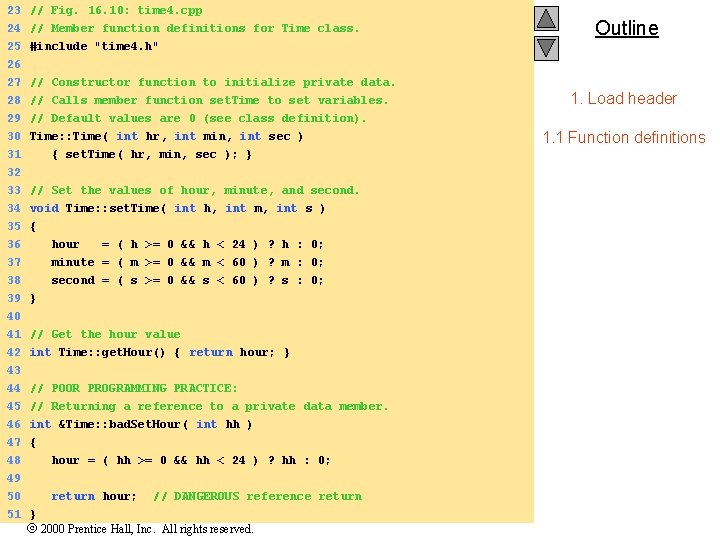
23 // Fig. 16. 10: time 4. cpp 24 25 26 27 28 // Member function definitions for Time class. #include "time 4. h" // Constructor function to initialize private data. // Calls member function set. Time to set variables. Outline 1. Load header 29 // Default values are 0 (see class definition). 30 Time: : Time( int hr, int min, int sec ) 31 { set. Time( hr, min, sec ); } 32 33 // Set the values of hour, minute, and second. 34 void Time: : set. Time( int h, int m, int s ) 35 { 36 hour = ( h >= 0 && h < 24 ) ? h : 0; 37 minute = ( m >= 0 && m < 60 ) ? m : 0; 38 second = ( s >= 0 && s < 60 ) ? s : 0; 39 } 40 41 // Get the hour value 42 int Time: : get. Hour() { return hour; } 43 44 45 46 47 48 // POOR PROGRAMMING PRACTICE: // Returning a reference to a private data member. int &Time: : bad. Set. Hour( int hh ) { hour = ( hh >= 0 && hh < 24 ) ? hh : 0; 49 50 return hour; // DANGEROUS reference return 51 } 2000 Prentice Hall, Inc. All rights reserved. 1. 1 Function definitions
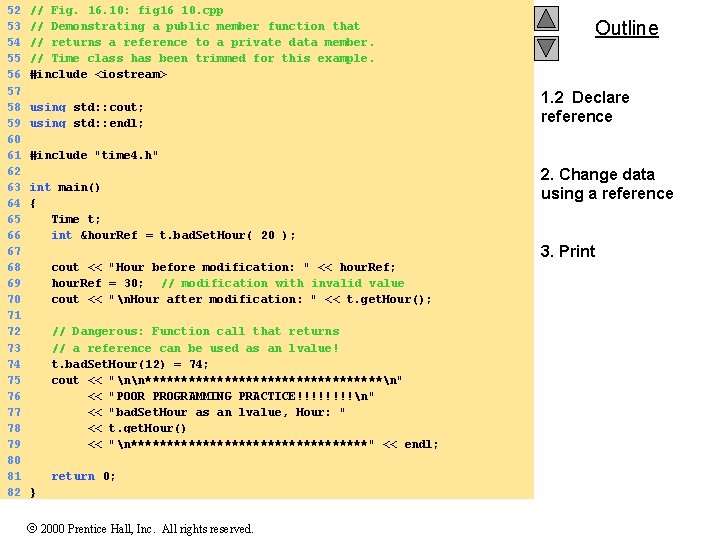
52 53 54 55 56 57 58 59 60 61 62 63 64 65 66 67 68 69 70 71 72 73 74 75 76 77 78 79 80 81 82 // Fig. 16. 10: fig 16_10. cpp // Demonstrating a public member function that // returns a reference to a private data member. // Time class has been trimmed for this example. #include <iostream> using std: : cout; using std: : endl; Outline 1. 2 Declare reference #include "time 4. h" int main() { Time t; int &hour. Ref = t. bad. Set. Hour( 20 ); cout << "Hour before modification: " << hour. Ref; hour. Ref = 30; // modification with invalid value cout << "n. Hour after modification: " << t. get. Hour(); // Dangerous: Function call that returns // a reference can be used as an lvalue! t. bad. Set. Hour(12) = 74; cout << "nn*****************n" << "POOR PROGRAMMING PRACTICE!!!!n" << "bad. Set. Hour as an lvalue, Hour: " << t. get. Hour() << "n*****************" << endl; return 0; } 2000 Prentice Hall, Inc. All rights reserved. 2. Change data using a reference 3. Print
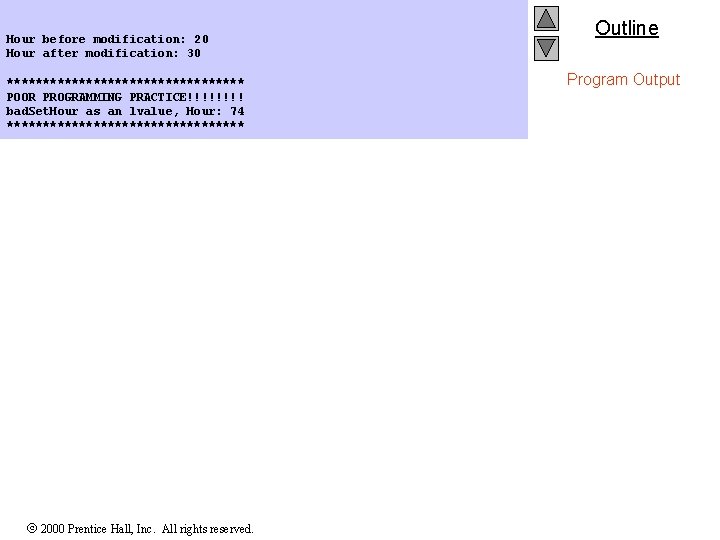
Hour before modification: 20 Hour after modification: 30 ***************** POOR PROGRAMMING PRACTICE!!!! bad. Set. Hour as an lvalue, Hour: 74 ***************** 2000 Prentice Hall, Inc. All rights reserved. Outline Program Output
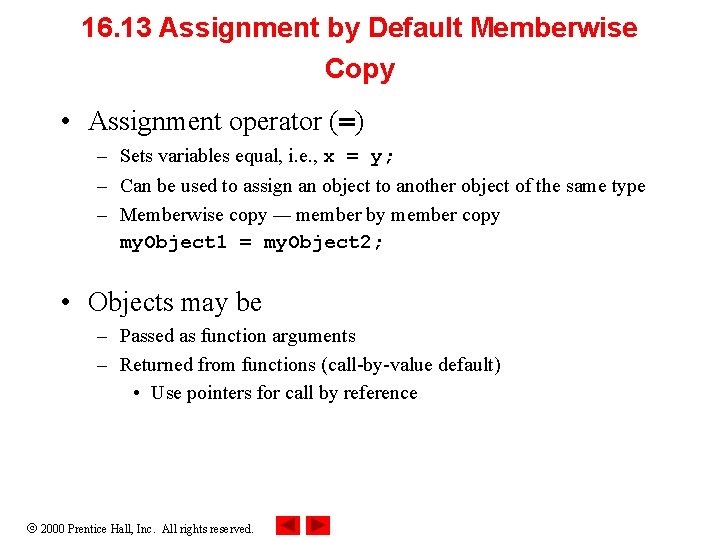
16. 13 Assignment by Default Memberwise Copy • Assignment operator (=) – Sets variables equal, i. e. , x = y; – Can be used to assign an object to another object of the same type – Memberwise copy — member by member copy my. Object 1 = my. Object 2; • Objects may be – Passed as function arguments – Returned from functions (call-by-value default) • Use pointers for call by reference 2000 Prentice Hall, Inc. All rights reserved.
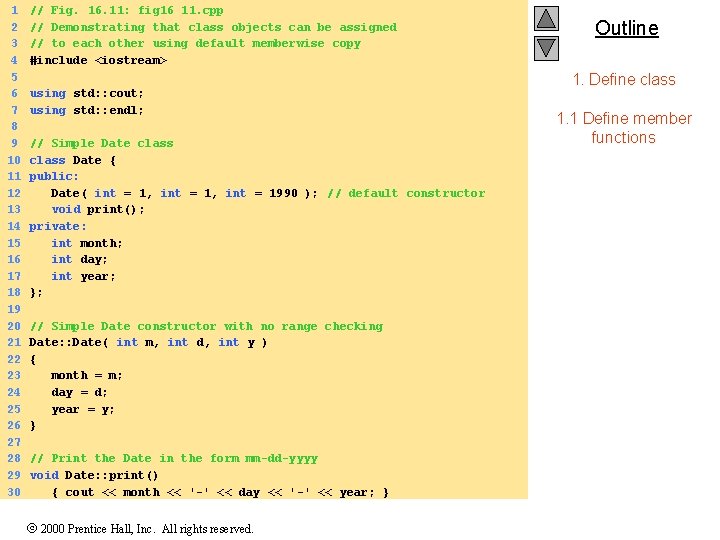
1 2 3 4 5 6 7 8 9 10 11 12 13 14 15 16 17 18 19 20 21 22 23 24 25 26 27 28 29 30 // Fig. 16. 11: fig 16_11. cpp // Demonstrating that class objects can be assigned // to each other using default memberwise copy #include <iostream> using std: : cout; using std: : endl; // Simple Date class Date { public: Date( int = 1, int = 1990 ); // default constructor void print(); private: int month; int day; int year; }; // Simple Date constructor with no range checking Date: : Date( int m, int d, int y ) { month = m; day = d; year = y; } // Print the Date in the form mm-dd-yyyy void Date: : print() { cout << month << '-' << day << '-' << year; } 2000 Prentice Hall, Inc. All rights reserved. Outline 1. Define class 1. 1 Define member functions
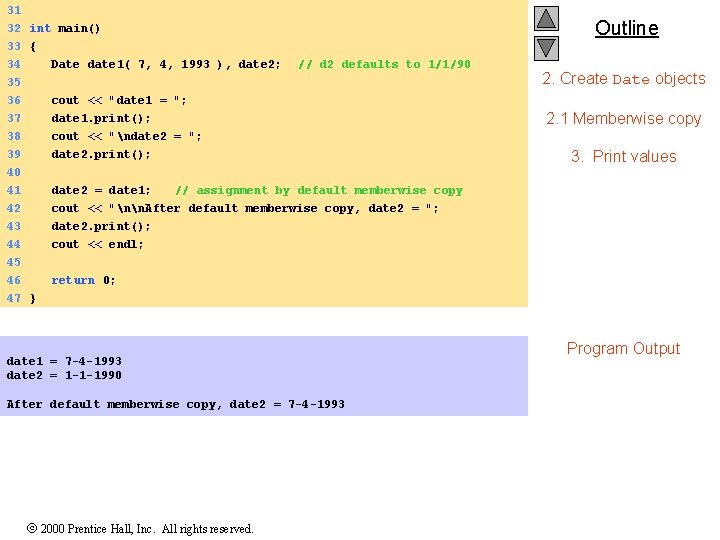
31 32 33 34 35 36 int main() { Date date 1( 7, 4, 1993 ), date 2; // d 2 defaults to 1/1/90 Outline 2. Create Date objects cout << "date 1 = "; 37 date 1. print(); 38 cout << "ndate 2 = "; 39 date 2. print(); 2. 1 Memberwise copy 3. Print values 40 41 date 2 = date 1; // assignment by default memberwise copy 42 cout << "nn. After default memberwise copy, date 2 = "; 43 date 2. print(); 44 cout << endl; 45 46 return 0; 47 } date 1 = 7 -4 -1993 date 2 = 1 -1 -1990 After default memberwise copy, date 2 = 7 -4 -1993 2000 Prentice Hall, Inc. All rights reserved. Program Output
16. 14 Software Reusability • Object-oriented programmers – Concentrate on implementing useful classes • Tremendous opportunity to capture and catalog classes – Accessed by large segments of the programming community – Class libraries exist for this purpose • Software – Constructed from existing, well-defined, carefully tested, portable, widely available components – Speeds development of powerful, high-quality software 2000 Prentice Hall, Inc. All rights reserved.
- Slides: 48