
Chapter 16 Chemical Equilibrium Keeping fish in an
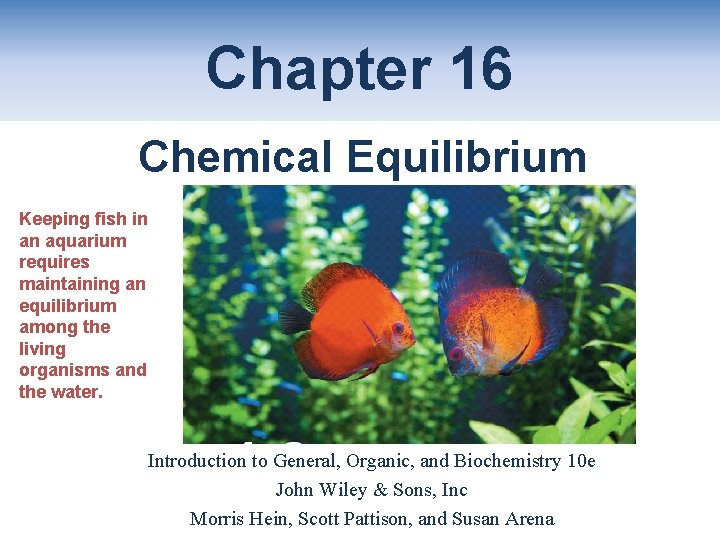
Chapter 16 Chemical Equilibrium Keeping fish in an aquarium requires maintaining an equilibrium among the living organisms and the water. Introduction to General, Organic, and Biochemistry 10 e John Wiley & Sons, Inc Morris Hein, Scott Pattison, and Susan Arena
Reversible Reactions Most chemical reactions are reversible. They consist of a forward reaction (reactants are converted into products) and a reverse reaction (the products are converted back into reactants. ) A + B C + D (forward reaction) C + D A + B (reverse reaction) Eventually, the rate of the forward reaction is equal to the rate of the reverse reaction. This is the point when equilibrium is attained. A+B → C+D → Copyright 2012 John Wiley & Sons, Inc
Reversible Reactions We measure the equilibrium vapor pressures at different temperatures to generate the vapor pressure curve. liquid + heat → vapor Forward reaction: liquid + heat vapor (evaporation) Reverse reaction: vapor liquid + heat (condensation) At equilibrium, the rate of evaporation = rate of condensation and the vapor pressure of the liquid is no longer changing with time. → Copyright 2012 John Wiley & Sons, Inc
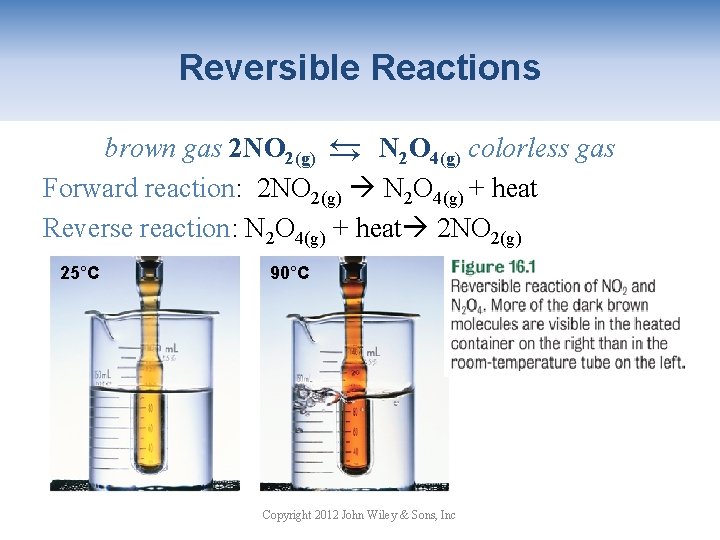
Reversible Reactions → brown gas 2 NO 2(g) → N 2 O 4(g) colorless gas Forward reaction: 2 NO 2(g) N 2 O 4(g) + heat Reverse reaction: N 2 O 4(g) + heat 2 NO 2(g) 25°C 90°C Copyright 2012 John Wiley & Sons, Inc
Rates of Reactions The study of reaction rates and reaction mechanisms is known as chemical kinetics. What factors affect the rate reaction? Frequency of collisions between reactants (concentration effects) Energy of the collisions needed for effective collisions between reactants (temperature and catalytic effects) Copyright 2012 John Wiley & Sons, Inc
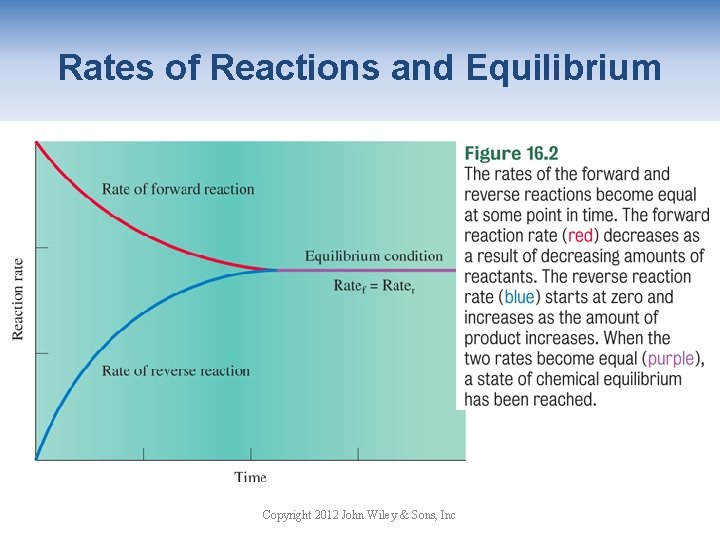
Rates of Reactions and Equilibrium Copyright 2012 John Wiley & Sons, Inc
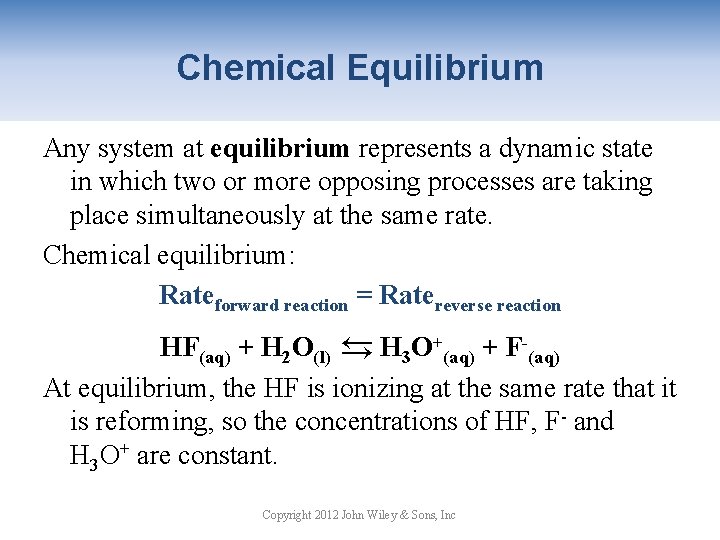
Chemical Equilibrium Any system at equilibrium represents a dynamic state in which two or more opposing processes are taking place simultaneously at the same rate. Chemical equilibrium: Rateforward reaction = Ratereverse reaction → HF(aq) + H 2 O(l) → H 3 O+(aq) + F-(aq) At equilibrium, the HF is ionizing at the same rate that it is reforming, so the concentrations of HF, F- and H 3 O+ are constant. Copyright 2012 John Wiley & Sons, Inc
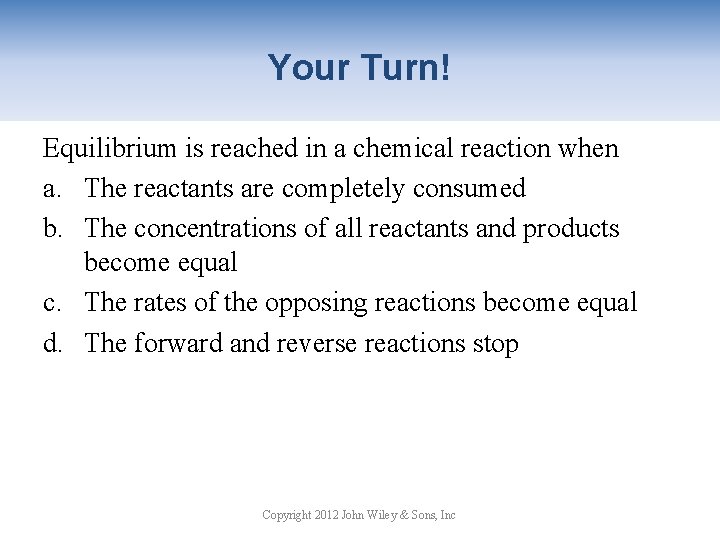
Your Turn! Equilibrium is reached in a chemical reaction when a. The reactants are completely consumed b. The concentrations of all reactants and products become equal c. The rates of the opposing reactions become equal d. The forward and reverse reactions stop Copyright 2012 John Wiley & Sons, Inc
Le Châtelier’s Principle If a stress is applied to a system in equilibrium, the system will respond in such a way as to relieve that stress and restore equilibrium under a new set of conditions. What kinds of things stress chemical equilibria? Changes in concentration, temperature and volumes of gases. Copyright 2012 John Wiley & Sons, Inc
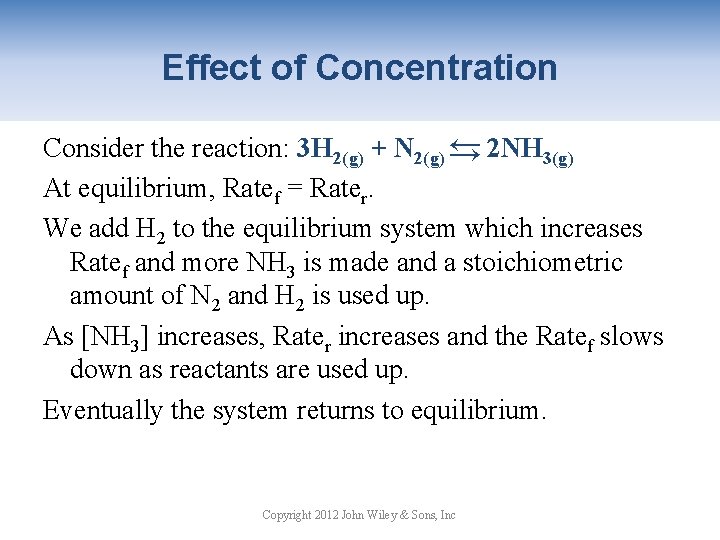
Effect of Concentration → Consider the reaction: 3 H 2(g) + N 2(g) → 2 NH 3(g) At equilibrium, Ratef = Rater. We add H 2 to the equilibrium system which increases Ratef and more NH 3 is made and a stoichiometric amount of N 2 and H 2 is used up. As [NH 3] increases, Rater increases and the Ratef slows down as reactants are used up. Eventually the system returns to equilibrium. Copyright 2012 John Wiley & Sons, Inc
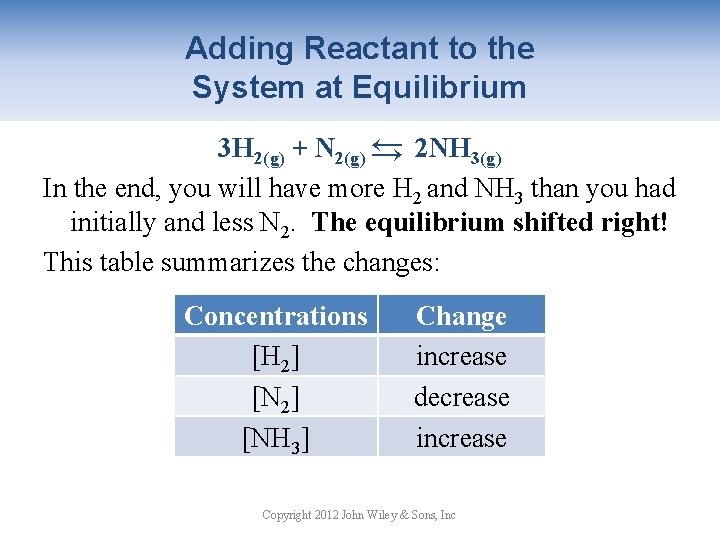
Adding Reactant to the System at Equilibrium → 3 H 2(g) + N 2(g) → 2 NH 3(g) In the end, you will have more H 2 and NH 3 than you had initially and less N 2. The equilibrium shifted right! This table summarizes the changes: Concentrations [H 2] [NH 3] Change increase decrease increase Copyright 2012 John Wiley & Sons, Inc
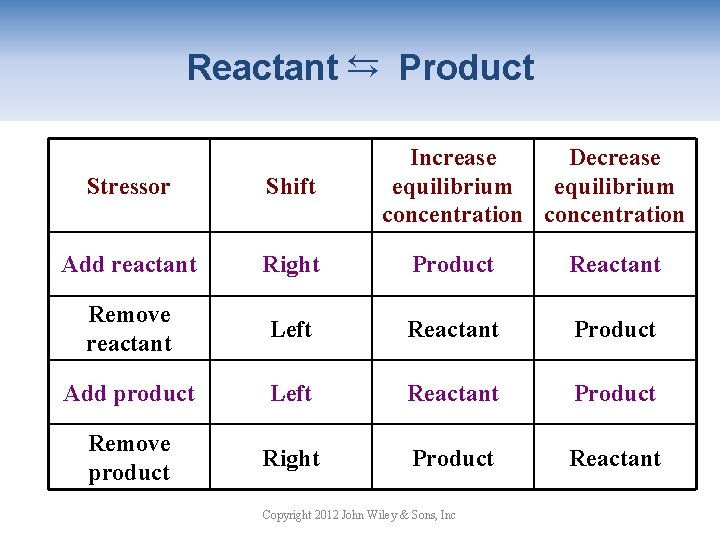
→ Reactant → Product Increase Decrease equilibrium concentration Stressor Shift Add reactant Right Product Reactant Remove reactant Left Reactant Product Add product Left Reactant Product Remove product Right Product Reactant Copyright 2012 John Wiley & Sons, Inc
 pale](http://slidetodoc.com/presentation_image_h2/12537ac29d95a9584d6c40425cad6d78/image-13.jpg "Effect of Concentration → Cu 2+(aq) + 4 NH 3(aq) → [Cu(NH 3)42+](aq) pale")
Effect of Concentration → Cu 2+(aq) + 4 NH 3(aq) → [Cu(NH 3)42+](aq) pale blue royal blue What color will you see if aqueous ammonia is added to a medium blue solution containing the above equilibrium? Adding ammonia will Concentrations Change cause a shift right, [Cu 2+] decrease [NH 3] increase resulting in an increase 2+] [Cu(NH ) increase 3 4 in the royal blue ion! Copyright 2012 John Wiley & Sons, Inc
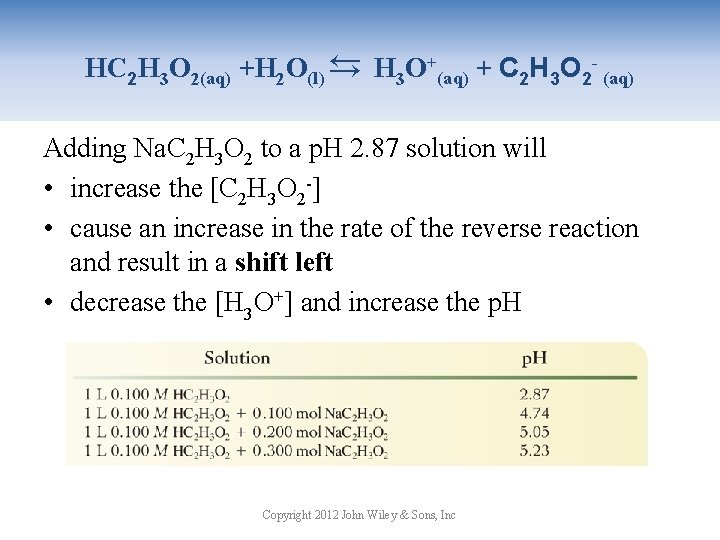
→ HC 2 H 3 O 2(aq) +H 2 O(l) → H 3 O+(aq) + C 2 H 3 O 2 - (aq) Adding Na. C 2 H 3 O 2 to a p. H 2. 87 solution will • increase the [C 2 H 3 O 2 -] • cause an increase in the rate of the reverse reaction and result in a shift left • decrease the [H 3 O+] and increase the p. H Copyright 2012 John Wiley & Sons, Inc
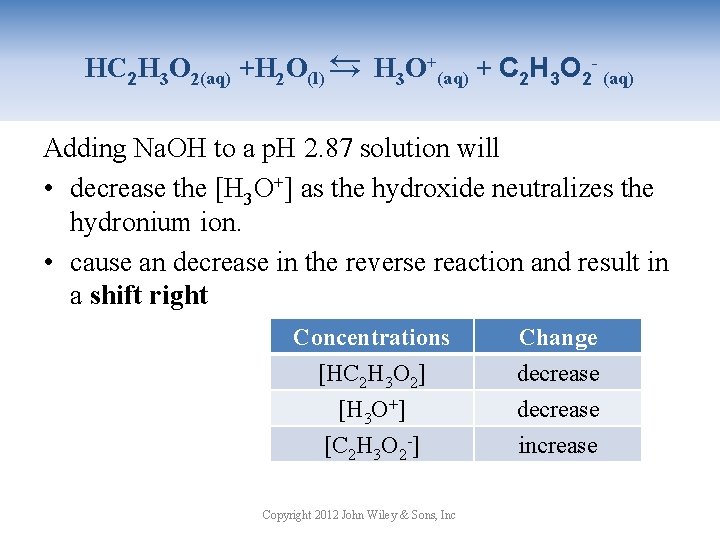
→ HC 2 H 3 O 2(aq) +H 2 O(l) → H 3 O+(aq) + C 2 H 3 O 2 - (aq) Adding Na. OH to a p. H 2. 87 solution will • decrease the [H 3 O+] as the hydroxide neutralizes the hydronium ion. • cause an decrease in the reverse reaction and result in a shift right Concentrations [HC 2 H 3 O 2] [H 3 O+] [C 2 H 3 O 2 -] Copyright 2012 John Wiley & Sons, Inc Change decrease increase
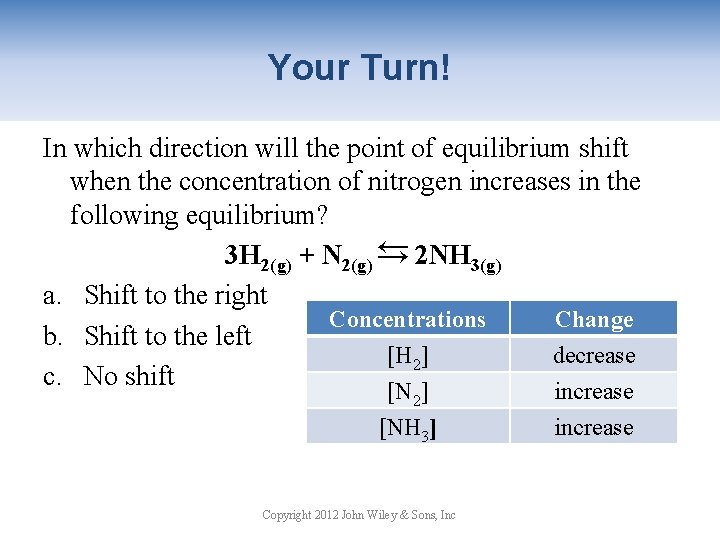
Your Turn! In which direction will the point of equilibrium shift when the concentration of nitrogen increases in the following equilibrium? 3 H 2(g) + N 2(g) → 2 NH 3(g) a. Shift to the right Concentrations Change b. Shift to the left [H 2] decrease c. No shift [N ] increase → 2 [NH 3] Copyright 2012 John Wiley & Sons, Inc increase
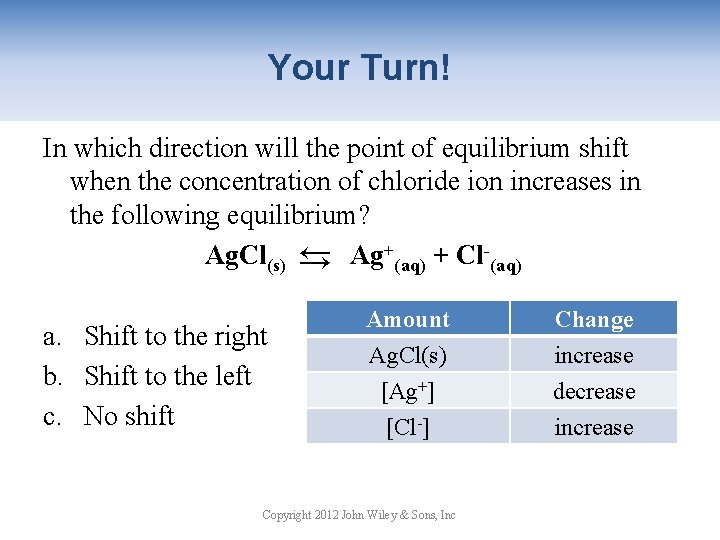
Your Turn! In which direction will the point of equilibrium shift when the concentration of chloride ion increases in the following equilibrium? Ag. Cl(s) → Ag+(aq) + Cl-(aq) → a. Shift to the right b. Shift to the left c. No shift Amount Ag. Cl(s) [Ag+] [Cl-] Copyright 2012 John Wiley & Sons, Inc Change increase decrease increase
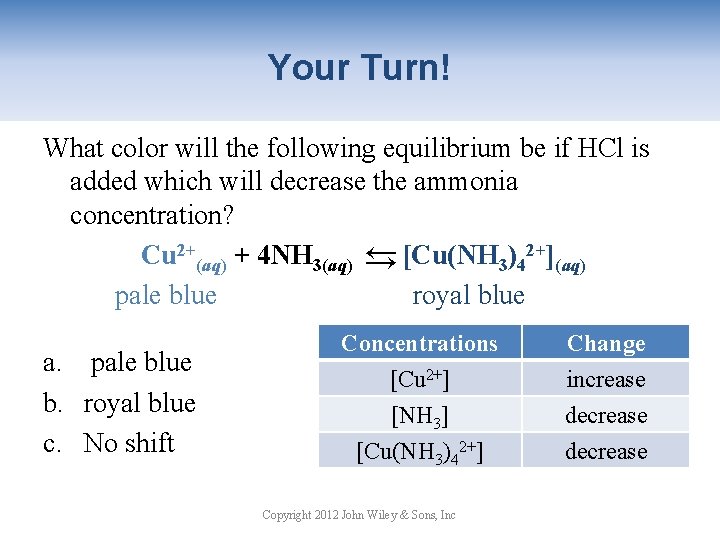
Your Turn! What color will the following equilibrium be if HCl is added which will decrease the ammonia concentration? Cu 2+(aq) + 4 NH 3(aq) → [Cu(NH 3)42+](aq) pale blue royal blue → a. pale blue b. royal blue c. No shift Concentrations [Cu 2+] [NH 3] [Cu(NH 3)42+] Copyright 2012 John Wiley & Sons, Inc Change increase decrease
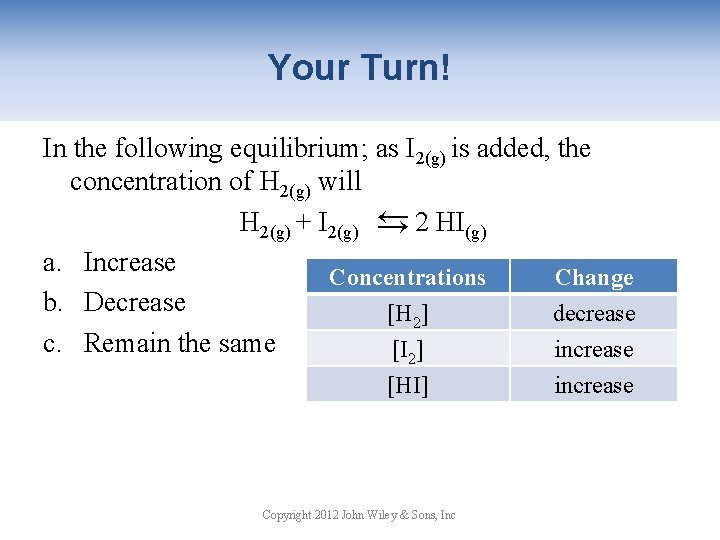
Your Turn! In the following equilibrium; as I 2(g) is added, the concentration of H 2(g) will H 2(g) + I 2(g) → 2 HI(g) a. Increase Concentrations Change b. Decrease [H 2] decrease c. Remain the same [I 2] increase → [HI] Copyright 2012 John Wiley & Sons, Inc increase
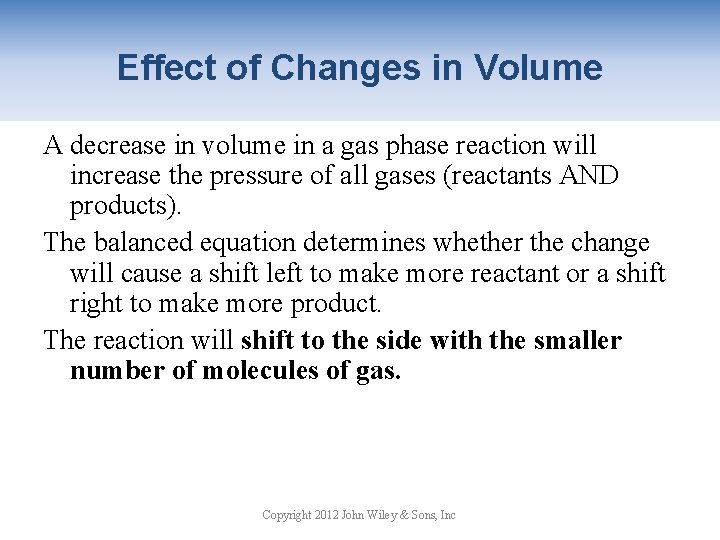
Effect of Changes in Volume A decrease in volume in a gas phase reaction will increase the pressure of all gases (reactants AND products). The balanced equation determines whether the change will cause a shift left to make more reactant or a shift right to make more product. The reaction will shift to the side with the smaller number of molecules of gas. Copyright 2012 John Wiley & Sons, Inc
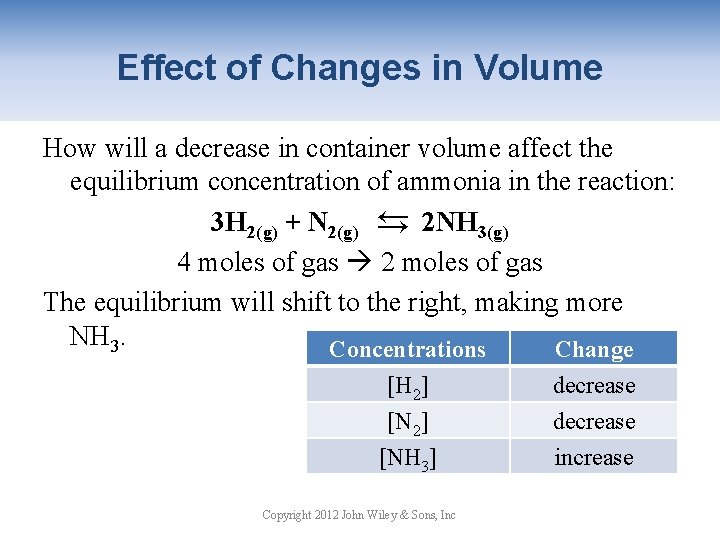
Effect of Changes in Volume How will a decrease in container volume affect the equilibrium concentration of ammonia in the reaction: 3 H 2(g) + N 2(g) → 2 NH 3(g) 4 moles of gas 2 moles of gas The equilibrium will shift to the right, making more NH 3. Concentrations Change → [H 2] [NH 3] Copyright 2012 John Wiley & Sons, Inc decrease increase
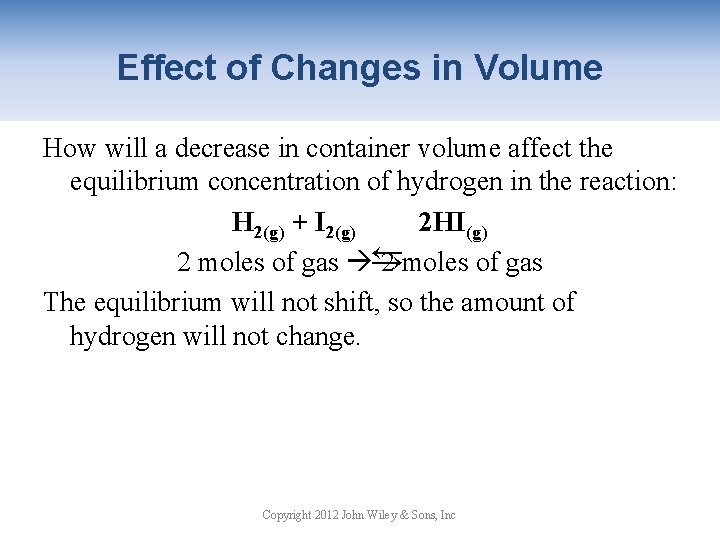
Effect of Changes in Volume How will a decrease in container volume affect the equilibrium concentration of hydrogen in the reaction: H 2(g) + I 2(g) 2 HI(g) 2 moles of gas → 2 moles of gas The equilibrium will not shift, so the amount of hydrogen will not change. → Copyright 2012 John Wiley & Sons, Inc
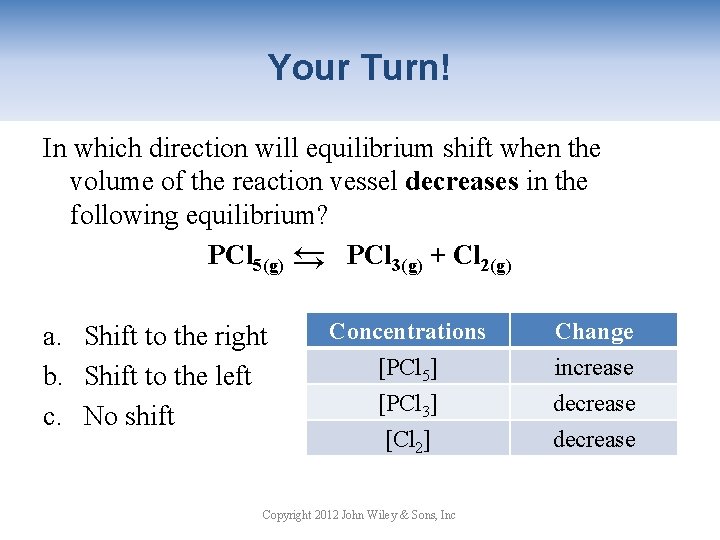
Your Turn! In which direction will equilibrium shift when the volume of the reaction vessel decreases in the following equilibrium? PCl 5(g) → PCl 3(g) + Cl 2(g) → a. Shift to the right b. Shift to the left c. No shift Concentrations [PCl 5] [PCl 3] [Cl 2] Copyright 2012 John Wiley & Sons, Inc Change increase decrease
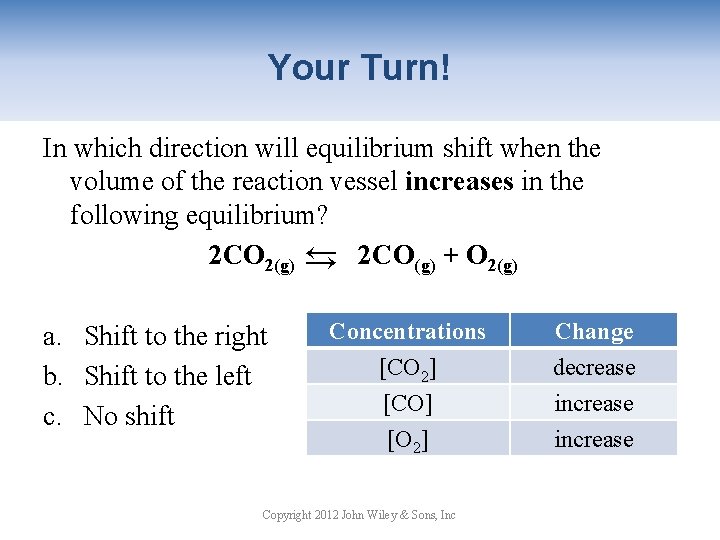
Your Turn! In which direction will equilibrium shift when the volume of the reaction vessel increases in the following equilibrium? 2 CO 2(g) → 2 CO(g) + O 2(g) → a. Shift to the right b. Shift to the left c. No shift Concentrations [CO 2] [CO] [O 2] Copyright 2012 John Wiley & Sons, Inc Change decrease increase
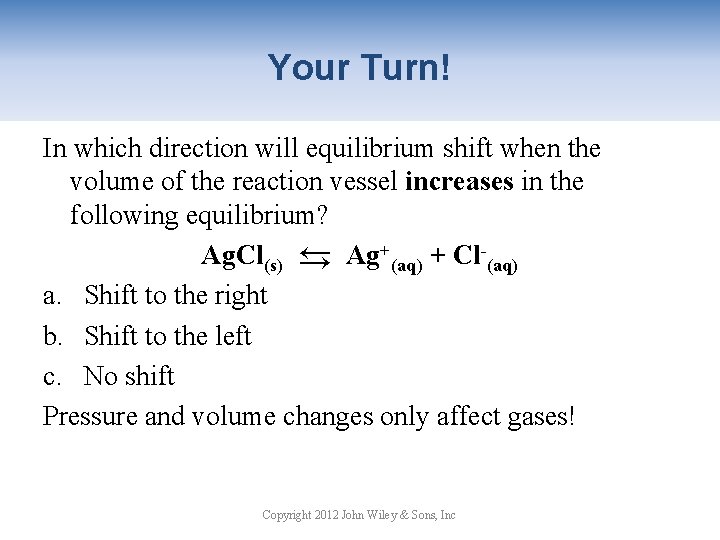
Your Turn! In which direction will equilibrium shift when the volume of the reaction vessel increases in the following equilibrium? Ag. Cl(s) → Ag+(aq) + Cl-(aq) a. Shift to the right b. Shift to the left c. No shift Pressure and volume changes only affect gases! → Copyright 2012 John Wiley & Sons, Inc
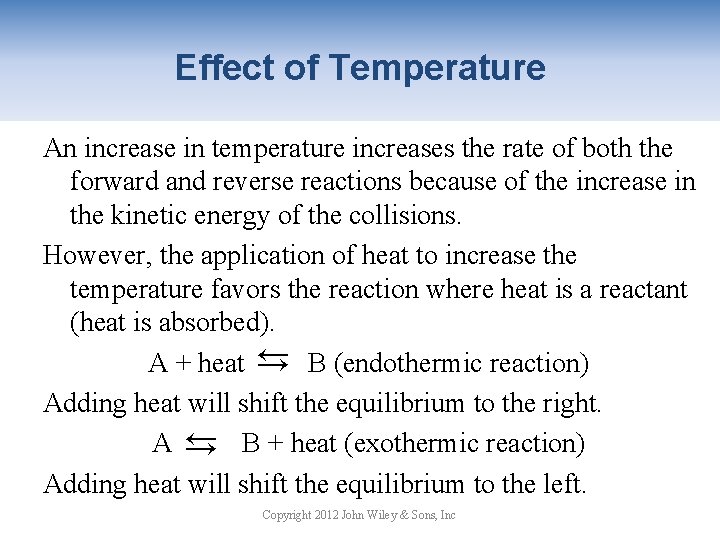
Effect of Temperature An increase in temperature increases the rate of both the forward and reverse reactions because of the increase in the kinetic energy of the collisions. However, the application of heat to increase the temperature favors the reaction where heat is a reactant (heat is absorbed). A + heat → B (endothermic reaction) Adding heat will shift the equilibrium to the right. A → B + heat (exothermic reaction) Adding heat will shift the equilibrium to the left. → → Copyright 2012 John Wiley & Sons, Inc
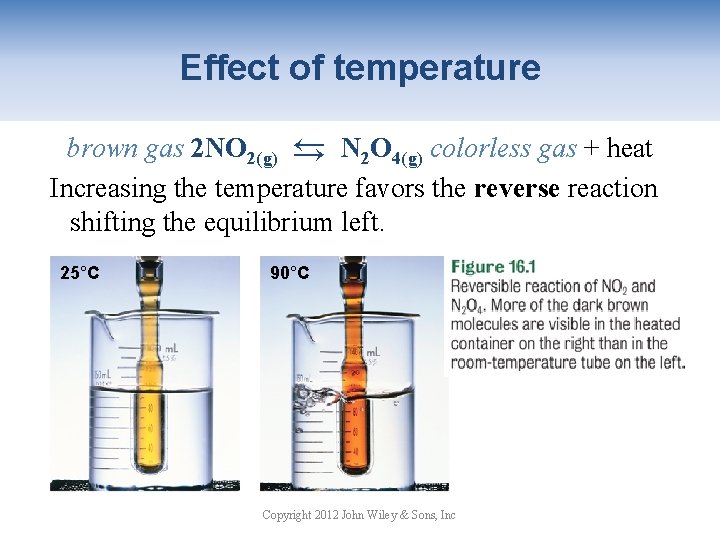
Effect of temperature → brown gas 2 NO 2(g) → N 2 O 4(g) colorless gas + heat Increasing the temperature favors the reverse reaction shifting the equilibrium left. 25°C 90°C Copyright 2012 John Wiley & Sons, Inc
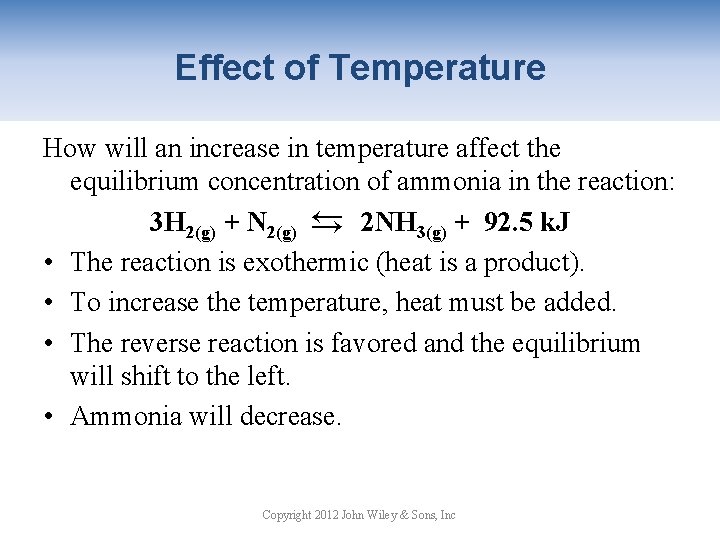
Effect of Temperature How will an increase in temperature affect the equilibrium concentration of ammonia in the reaction: 3 H 2(g) + N 2(g) → 2 NH 3(g) + 92. 5 k. J • The reaction is exothermic (heat is a product). • To increase the temperature, heat must be added. • The reverse reaction is favored and the equilibrium will shift to the left. • Ammonia will decrease. → Copyright 2012 John Wiley & Sons, Inc
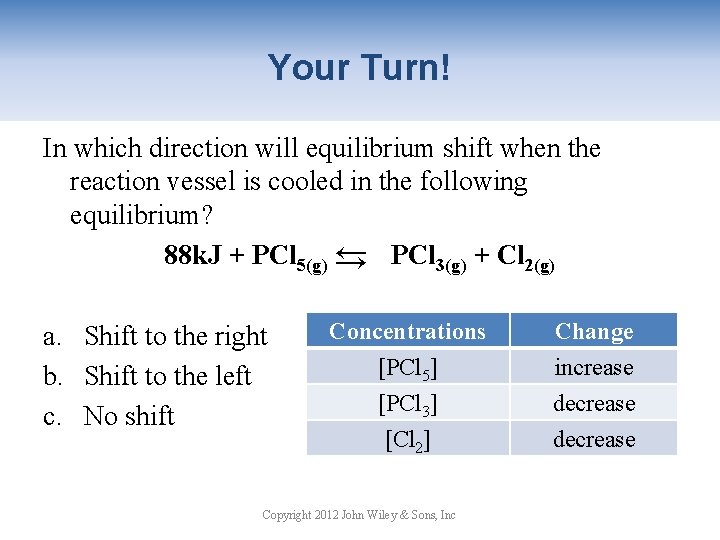
Your Turn! In which direction will equilibrium shift when the reaction vessel is cooled in the following equilibrium? 88 k. J + PCl 5(g) → PCl 3(g) + Cl 2(g) → a. Shift to the right b. Shift to the left c. No shift Concentrations [PCl 5] [PCl 3] [Cl 2] Copyright 2012 John Wiley & Sons, Inc Change increase decrease
Effect of Catalysts A catalyst is a substance that influences the rate of a reaction but can be fully recovered at the end of the reaction. A catalyst does not shift the equilibrium or change the yield of either reactants or products. A catalyst lowers the energy of activation of the reaction and thus affects the rate of the reaction. The activation energy is the minimum energy required for the reaction to occur. Copyright 2012 John Wiley & Sons, Inc
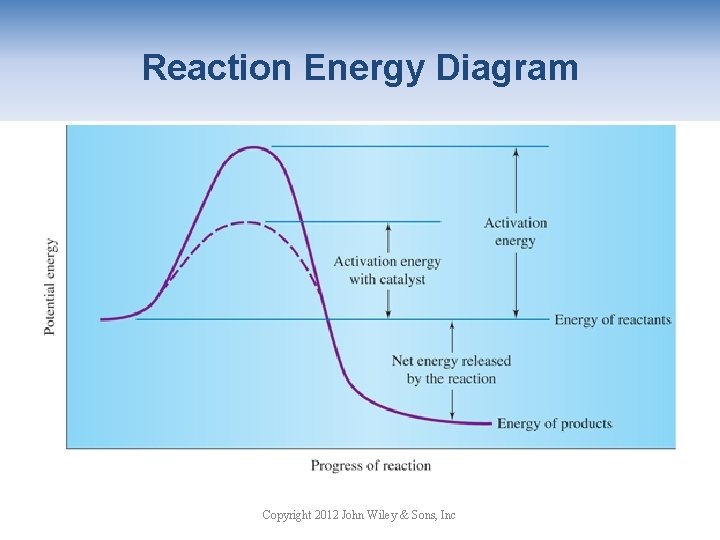
Reaction Energy Diagram Copyright 2012 John Wiley & Sons, Inc
Your Turn! In which direction will the point of equilibrium shift when a catalyst is added to the following equilibrium system? 3 H 2(g) + N 2(g) → 2 NH 3(g) + 92. 5 k. J a. Shift to the right b. Shift to the left c. No shift → Copyright 2012 John Wiley & Sons, Inc
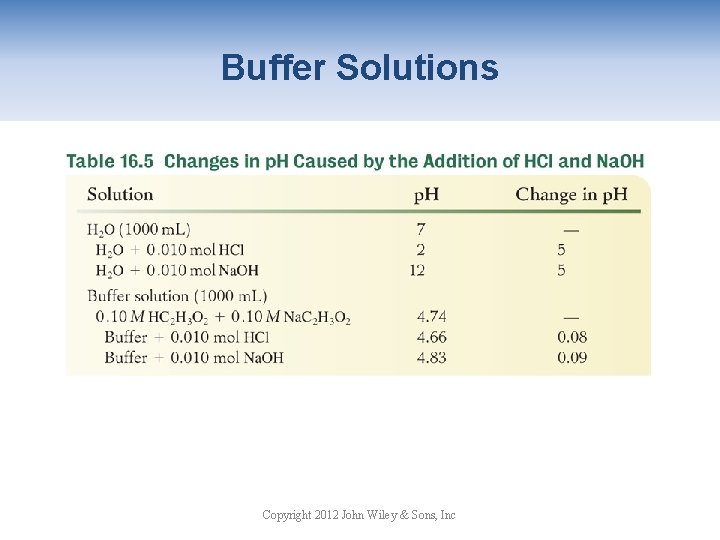
Buffer Solutions A buffer solution resists changes in p. H when diluted or when small amounts of acid or base are added. Buffer solutions can be made by mixing together (usually in equimolar amounts) either • a weak acid with a salt containing its conjugate base • a weak base with a salt containing its conjugate acid The buffer capacity of the solution is the extent to which the buffer can absorb added acid or base and still maintain the p. H. Copyright 2012 John Wiley & Sons, Inc
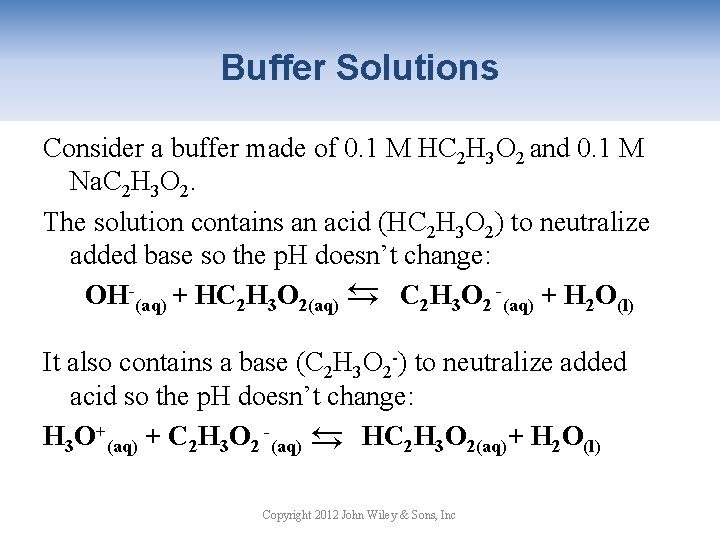
Buffer Solutions Consider a buffer made of 0. 1 M HC 2 H 3 O 2 and 0. 1 M Na. C 2 H 3 O 2. The solution contains an acid (HC 2 H 3 O 2) to neutralize added base so the p. H doesn’t change: OH-(aq) + HC 2 H 3 O 2(aq) → C 2 H 3 O 2 -(aq) + H 2 O(l) → It also contains a base (C 2 H 3 O 2 -) to neutralize added acid so the p. H doesn’t change: H 3 O+(aq) + C 2 H 3 O 2 -(aq) → HC 2 H 3 O 2(aq)+ H 2 O(l) → Copyright 2012 John Wiley & Sons, Inc
Buffer Solutions Copyright 2012 John Wiley & Sons, Inc
- Slides: 35